Eighty of the nation’s largest 100 cities had rents increase in May, according to the report. But on a year-over-year basis, rent growth is positive for only 43 of these cities.
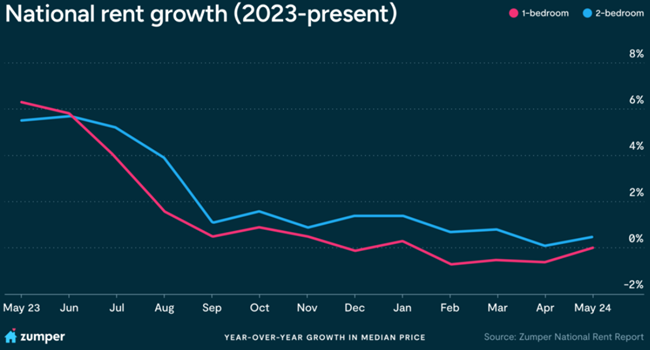
While there have been steady small monthly increases, overall rent growth remains sluggish so far in 2024.
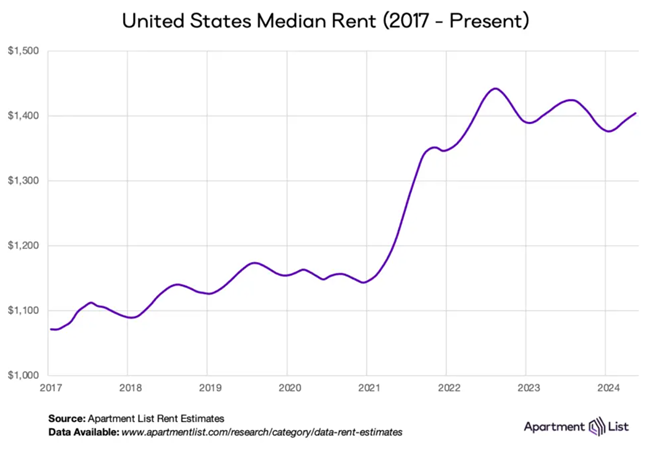
“The national median rent increased by 0.5% in May and now stands at $1,404, but the pace of growth slowed slightly this month. This is typically the time of year when rent growth is accelerating amid the busy moving season, so sluggish growth this month indicates that the market is headed for another slow summer,” Apartment List economists write in the report.
Seasonal increases have been mild while seasonal declines have been steeper than usual.
“As a result, apartments are on average slightly cheaper today than they were one year ago. Year-over-year rent growth nationally currently stands at -0.8 percent and has now been in negative territory since last summer. But despite this cooldown, the national median rent is still more than $200 per month higher than it was just a few years ago,” the report says.
Vacancy index continues trending up
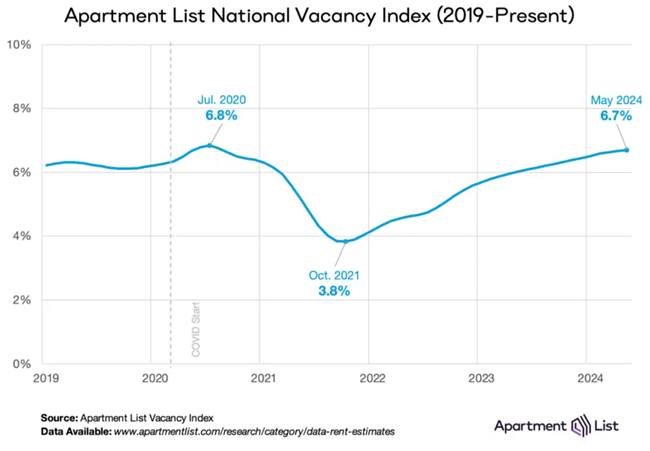
With the supply of new apartments coming on line, multifamily occupancy has been slowly but consistently easing for more than two years.
“As of May, our vacancy index sits at 6.7 percent, the highest reading since August 2020. And there’s good reason to expect that it could rise even further during the remainder of the year.
“Despite a recent slowdown in new permits being issued and new construction projects breaking ground, the number of multifamily units under construction remains near record levels. (The year) 2023 saw the most new apartments complete construction in more than 30 years, and an even greater number of new units are expected to come on the market this year. This means that renters should have more available options than they have in some time, especially in the Sun Belt markets, where construction activity has been strongest,” the report says.
Conclusion
Rent prices in May show that rent growth is stalling out at a time of the year when it is normally increasing.
“Rent increases are currently being moderated by a robust construction pipeline expected to deliver a decades-high number of new apartment units in 2024. Improving consumer sentiment about broader macroeconomic conditions may be driving a modest rebound in rental demand, but that bounce-back has so far been outweighed by the impact of incoming supply,” Apartment List economists say.
Digital infrastructure and Wi-Fi at most apartment communities aren’t built to withstand the connectivity and cyber security needs necessary to support the influx of new technologies that are now the core of modern multifamily operations.
By Andrew Ruhland
The multifamily industry is becoming increasingly digitized, and operators have no choice but to get on board. The resident experience depends on it. We’ve seen the emergence of tech-centric features such as centralized leasing, smart access controls, self-guided tours and the internet of things (IoT), all of which have completely modernized the apartment leasing and living experience.
However, a number of operators are still missing one critical element – a reliable foundation.
Simply put, many apartment communities can’t modernize the living and leasing experience because they don’t have a connectivity foundation to do so. This means that IT infrastructures at most apartment communities aren’t built to withstand the connectivity and cyber security needs necessary to support the influx of new technologies that are now the core of modern operations.
Residents and associates alike are inconvenienced when their Wi-Fi connection drops. In addition to the normal annoyances of losing a signal – dropped calls or paused streaming – it causes the inability to use crucial smart-home features that keep apartment life humming.
Even operational tools like mobile maintenance and virtual leasing count on a strong foundation. When vital amenities or software lose connection due to inadequate Wi-Fi access, satisfaction tanks for everybody living and working at a property. In an era of instant communication and the need to be connected, operators are having to reimagine their IT infrastructure from the ground up.
In order to help operators better understand the connectivity foundation and how it resolves connectivity issues, it’s best to go back to the basics.
Laying the groundwork
Akin to constructing a home and ensuring the right foundation to build upon is in place, apartment communities must lay the proper groundwork to support seamless, community-wide Wi-Fi connectivity.
If the foundation is shaky, it’ll only be a matter of time before Wi-Fi issues disrupt operations and affect both resident and associate satisfaction.
Opposed to traditional internet service connections, a connectivity foundation seamlessly integrates into an infrastructure and offers connectivity support that reaches the entire community. Fiber-based mesh networking technology, like DPSK, delivers a secure Wi-Fi connection via dedicated fiber connectivity that spans every inch of a property.
In order for any Wi-Fi-dependent components of a community to properly function, the digital framework is the most integral piece of the puzzle. From proptech tools supporting operational tasks to the countless smart-home features appearing at communities across the country, uninterrupted connectivity depends on a sturdy foundation.
“Across our portfolio, nearly every aspect of a community’s daily functions, smart building and home management, prospect and customer experience, as well as community amenities rely on having a stable/reliable Wi-Fi connection,” said Amy Chien, director of strategic innovations at BH Management.
“Prospective residents are looking for cellular strength and internet reliability among their top features needed in their home. Residents were regularly complaining about poor cell-phone connectivity and dropped Wi-Fi signals before we brought on a managed Wi-Fi provider. Our onsite teams were experiencing difficulty executing things like work orders and effective communication. After trying various ways to remedy the problem, we realized it wasn’t a technology or user-error issue, we needed a stronger foundation to achieve end-to-end connectivity.”
Wi-Fi isn’t enough
Although Wi-Fi services do offer connectivity benefits for many properties, a foundation is a physical hard-wired component of the Wi-Fi experience that truly enhances a community’s tech stack.
Due to its forward-thinking mechanics and ability to evolve with new technology and adapt to each community’s individual needs, a strong digital infrastructure adds tremendous value to a property.
“Offering property-wide Wi-Fi enhances the prospect and resident experience, and fast, reliable internet connection through a managed IP is a fundamental need due to the use and demand of the residents we serve,” Chien said. “It ensures that all our proptech, from mobile maintenance to automation, functions efficiently and effectively. Just like the innovations and tools it keeps running, community-wide connectivity adds immense value to our communities.”
Asset Value
From the perspective of the resident, a strong connectivity foundation is of great value. They gain the ability to be on their network no matter where they’re located in the community – in the hallways, parking garages, the gym and all of the common spaces on a property.
Looking at it from an investor and operator perspective, renters want to live in communities that can guarantee a reliable Wi-Fi connection; by delivering a foundation that supports that, residents are more likely to renew their lease agreement when the time comes.
“A strong foundation for connectivity is the basis for all operations,” said Jeffrey Kok, CEO of Aerwave. “It is the enabling technology that lets you do all of the initiatives that drive value for communities. It supports modern amenities and countless operational tools. Once you have it in place, the improvement is immediate and evident in both resident-associate satisfaction and NOI.”
As an extension of smart amenities modern communities encompass in day-to-day operations, a connectivity foundation streamlines the Wi-Fi experience for both owners and residents. Technology is getting increasingly sophisticated and it is more important than ever for operators to ensure community networks are operating optimally.
“Modern residents and onsite teams crave connectivity that they can depend on, and we aim to deliver that,” Chien said. “To build a great community, you need solid infrastructure, which begins with your connectivity foundation. It supports the modern community and will future-proof our investments in technology. This service is not only a vital part of our operations but provides the necessary support to fully thrive and keep all features in our ecosystem up and running.”
About the author:
Andrew Ruhland is an account executive and content writer for LinnellTaylor Marketing, which focuses exclusively on the rental housing industry, its trends and technology innovations.
A landlord’s tenants want a kiddie pool in the backyard of the landlord’s rental so that is the question for Ask Landlord Hank. Remember Hank is not an attorney and is not offering legal advice.
Dear Landlord Hank:
My tenants want to have a “seasonal” kiddie pool in my backyard rental. What is my liability? Do I need to have a legal rider to my lease stating terms?
– Denise
Dear Landlady Denise,
Swimming pools are a wonderful luxury for a rental, even a kiddie pool. But you do have liability, as the owner. A couple of questions:
Is your yard fenced in?
Is the pool going to be emptied after use, or kept full of water?
You definitely need to have an addendum to your lease, as a pool heightens the risk of personal injury or property damage, especially to children. The tenant would have to agree to take all necessary and reasonable precautions to ensure the safety of anyone that comes to the property.
You also need to call your homeowners’ insurance company and see if a pool is allowed or if your insurance could be canceled if a pool were known to be there.
Sincerely,
Hank Rossi
Landlord Hank says, “You definitely need to have an addendum to your lease, as a pool heightens the risk of personal injury or property damage, especially to children.”
Ask Landlord Hank Your Question
Ask veteran landlord and property manager Hank Rossi your questions from tenant screening to leases to pets and more! He provides answers each week to landlords.
Here are 5 easy upgrades for your rentals this summer as the weather is getting nicer, the sun is shining brighter, and the days are longer, so time for upgrades to attract tenants during the moving season.
For many rental property owners, this means it’s time to get started on summer projects, which can range from very small updates to the interior to major renovation projects, such as remodeling a bathroom or replacing siding all to help attract tenants.
Here are 5 easy upgrades for your rentals this summer
You can still make a huge impact by making minor changes that are simple and don’t cost a ton of money
No. 1 – Replace Your Windows
One of the most popular trends—especially in preparation for the summer—is replacing old, out-of-date, or damaged windows with new ones. Most people don’t realize this, but we lose 25 to 30 percent of the heated and cooled air our HVAC systems produce through our windows and doors.
In other words, that’s 30 percent of the energy we pay for that ends up completely wasted. You can prevent this from happening by installing windows that provide better insulation, helping keep cool air in during the warm summer months, preventing heat loss during the winter, and reducing the frequency at which your A/C unit runs. The less you have to depend on your HVAC system, the less you’ll have to pay in energy costs.
When shopping for new windows, look for high-quality, durable materials that are insulating and will help reduce heat transfer, such as vinyl and fiberglass. When selecting glass for your new windows, choose dual-pane Low-E (low-emissivity) glass with gas fills between the panes. The more glass panes, the better—two or more will provide greater energy efficiency, improved impact-resistance and sound insulation. Low-E coatings on the glass reflect infrared light, which keeps heat out and helps protect your home’s interior furnishings from damage from UV light.
No. 2 – Add New Shades or Blinds
When it comes to shopping for new blinds or shades, there are a variety of styles available on the market.
This is one of the 5 easy upgrades for your rentals that will really make a difference. With summer comes lots of sunshine and rising temperatures that can make your home feel uncomfortable – while increasing your energy costs. Not only that, but sunlight streaming through your windows can be annoying. And with more evening hours for neighbors and curious eyes to peer in, tenants will want to find a way to cover windows.
Whether you need to add window treatments to your home or replace your existing window coverings, installing new blinds or shades is a great way to help keep your home cool during the summer, improve your privacy, and update your home’s style.
When it comes to shopping for new blinds or shades, there are a variety of styles available on the market. Gone are the days when homeowners had only a few options to choose from. These days, homeowners can select from a range of styles, such as room-darkening shades, wood or faux wood blinds, and Roman shades, as well as bamboo blinds and woven shades for those who are looking for more unique and environmentally friendly coverings.
There are also a range of colors and control mechanisms to choose from, including cordless operation, which is recommended for apartments and rental homes with small children and pets.
No. 3 – Install New Ceiling Fans
Ceiling fans have a reputation for being noisy, outdated, and terrible for design—and perhaps this may have been true at one point in time. However, much like window treatments, ceiling fans now come in more modern options that are quiet, sleek, and elegant. There are many benefits to incorporating ceiling fans into your rental unit that go beyond simply moving air and keeping rooms cool.
For example, ceiling fans can help dramatically lower energy costs by up to 40 percent by making rooms feel cooler, allowing you to raise the thermostat and be just as comfortable. Ceiling fans are also extremely versatile and come in a variety of styles, sizes, and finishes to complement your home’s style. Many come with lights for greater illumination.
To get the biggest energy savings out of your ceiling fans, make sure you have them set to rotate in the correct direction. In the summertime, ceiling fans should rotate counter-clockwise, allowing the blades to push cooler air down; in the winter, reverse the direction so that the blades rotate clockwise, pulling cool air up toward the ceiling.
No. 4 – Add Covers to Furniture
Another simple upgrade you can make is to provide tenants with slipcovers for their furniture or your furniture in a furnished unit, to protect them from becoming damaged in the sun. You can prevent sunlight from shining in by keeping your blinds or shades closed, but for added protection—and for beautiful days when tenants want to keep the windows open—consider adding slipcovers to furnishings.
No. 5 – Update Bedding and Pillows
Choose breathable fabrics, such as cottons and linens.
One easy upgrade that makes a huge impact is swapping out your bedding. Our needs for our homes can change greatly depending on the time of year it is. In the winter, we need thick blankets with cozy layers and plushness to combat the cold; in the summer, we need bedding that’s airier and light.
Choose breathable fabrics, such as cottons and linens that won’t suffocate you in the heat and humidity, and store your down comforter until the temperatures start to cool down again. Another simple and quick update you can make to your space is to place a few new pillows around the house to give your rooms a crisp, summery feel.
After hibernating in your home during the cold winter months, the summertime allows us the opportunity to open our windows and invite sunshine and warm weather in. Whether you have the budget to take on larger updates or you simply want to make a few small changes, these five simple updates will improve your home and invite you to enjoy it this summer in style.
These 5 easy upgrades for your rental homes will impress your tenants and keep them happy.
About the author:
Kenneth Gordon is Assistant Vice President of Factory Direct Blinds.
Here is a look at 4 kinds of front doors you can choose for your rental property when you are making repairs or replacing and the pros and cons of each.
The look, feel and features of a rental property’s front door are more important to tenants than landlords and property managers might think.
So taking a look at front door material and the look of the door is the maintenance checkup from Keepe.
The front door is one of those subtle elements that can actually make a big difference to the overall feel of a property. Experts point out that a property’s front door can actually be responsible for significant fluctuations in the value of the property.
Potential tenants will likely take notice of a damaged, flimsy or older-looking entryways. They could interpret this as a sign of lack of upkeep for the property or concern for the well-being of tenants.
Additionally, a damaged front door can make it easy for burglars to identify a certain property as one that they could successfully break into.
Pros and cons of front door material for your rental property
Purchasing a brand new front door is not be a routine expense. So if you are thinking of replacing old doors or upgrading doors on your property, here are some front door materials to consider:
Pros and cons of wooden front doors
1. Ultra-customizable – wooden doors can be tailored to match countless designs, shapes and color schemes, while also being able to house additional decorative elements, such as glass mosaics and panels
2. Flexible price points – the unique natural look of wood can be accessible for most budgets as different varieties of woods are available at a variety of price points
3. Unique look – Many property owners and designers find wood to be worth the investment as it presents a naturally variegated and “high-end” refined look that other man-made materials cannot replicate
Cons:
1. Weather-sensitive – wood is a material that is prone to be affected by its exposure to the weather and other environmental elements. Direct sunlight can fade the natural coloring of the wood, and high-moisture levels in the air (or from precipitation alone) can lead to warping and even rotting of the wood
2. High-maintenance – to ensure that the wood ages well and without being damaged by the natural elements discussed above, it’s essential to regularly treat the wood. Tinctures and sealants should be regularly applied by a reliable maintenance professional, which will be an added maintenance cost to consider.
3. High-price for top-quality – some wood varieties are naturally more resistant and sophisticated-looking, which contributes to their one-of-a-kind appeal and/or ability to last through the years without needing major attention. Premium varieties, such as mahogany or cedar, will be considerably pricier.
Steel stands out as being far more affordable, while still offering the safety element that it shares with fiberglass and being more low-maintenance.
Pros and cons of steel front doors
1. Super safe – when it comes to property intrusions, reinforced steel doors are known to be safest against breaches, allowing for increased confidence in a property’s overall defenses against unwanted visitors.
2. Affordable but effective – when considering its wood and fiberglass counterparts, steel stands out as being far more affordable, while still offering the safety element that it shares with fiberglass and being much more low-maintenance than wood and its issues with exposure and aging.
Cons:
1. Insulation is not its forte – steel is a known conductor of heat and electricity, which makes it problematic when it comes to wanting to keep a property’s interior temperature at a set level. Steel will contribute to heating up the space when heated by outside temperatures and/or sunlight and will struggle to keep the cold out during the winter months. Insulating layers and treatments can improve this downside, but they will come at an added cost.
2. Denting – steel can easily become dented or chipped following impact, and this often results in unappealing marks that are difficult to completely erase. To effectively get right of the unappealing look of those visible surface damages, an entirely new door might need to be purchased.
3. Rusting – while steel is not as sensitive to moisture as wood, it can easily rust over time as it is exposed to moisture and precipitation. Our experts encourage consulting the manufacturer to understand whether and how professional treatments can help with rust-proofing.
Pros and cons of glass front doors
Glass doors made for the purpose of being a property’s front door are generally reinforced to make it difficult for intruders to gain access.
1. Unique look – solid glass doors can be made to match a great variety of preferred styles, with varying cuts, shapes and opacity available to be reproduced as desired.
2. Luminosity – glass allows natural light to enter the home like no other material can, which some property owners find to be a valuable addition to the look and feel of their property.
Cons:
1. Fragility – experts agree that glass is naturally delicate even when it is reinforced, making it essential to be mindful of potential scratches, cracks and chipping that could easily occur.
2. Privacy – while some might be excited about the way glass allows for natural light to illuminate the home, some can be put off by the way glass makes it easy for passerby’s to peek inside a property
3. Questionable safety factor – glass door made for the purpose of being utilized as a property’s front door are generally reinforced to make it difficult for intruders to gain access by easily shattering the glass surface. This being said, glass remains rather fragile and much more easy to break than wood, steel, and fiberglass combined.
Pros and cons of fiberglass front doors for your rental
Many property owners choose fiberglass front doors as opposed to wood because they are not vulnerable to discoloration and damage from exposure, while still closely resembling the look of wood.
1. Versatile – fiberglass paneling is man-made, which allows for creating a variety of unique textures and styles. Fiberglass doors can be made to resemble a natural wood grain, or also present smooth and glossy or matte and satin surfaces for distinguished coloring that can match a variety of architectural elements.
2. Resistant – many property owners choose fiberglass front doors as opposed to wood because they are not vulnerable to discoloration and damage from exposure, while still closely resembling the look of wood. They are also more resistant to wear and tear than their steel counterpart.
3. Low-maintenance – these door should be maintained occasionally as they age, but they do not require sealants to be regularly applied, which does help with saving considerable amounts when it comes to maintenance expenses.
4. Secure – our experts confirm that fiberglass doors are just as secure as their steel counterpart, which allows them to stand strong and dent-free following forced impact
5. Efficient – while all door types can be treated to add insulating properties, fiberglass vastly surpasses wooden and steel door when it comes to insulation. While steel will always struggle with efficiently insulating and wood is vulnerable to temperature and humidity changes, fiberglass is not affected by any of these issues. Having optimal insulation can help ensure lower energy use and expenses as it allows for a property to easily remain hot or cool temperatures as desired.
6. Affordable – while aesthetic additions – such as integrated wood or glass decors – will rise costs, basic fiberglass door models are generally rather affordable.
Cons:
Pricey add-ons – fiberglass doors are fairly affordable. But can get expensive as they are further customized with the addition of decorative elements or coats.
About Keepe:
Keepe is an on-demand maintenance solution for property managers and independent landlords. The company makes a network of hundreds of independent contractors and handymen available for maintenance projects at rental properties. Learn more about Keepe at https://www.keepe.com
A tenant poured grease down the kitchen sink so who is responsible for the plumbing repair is the question this week for Ask Landlord Hank. Remember Hank is not an attorney and he is not offering legal advice. If you have a question for him please fill out the form below.
Dear Hank:
Turns out in checking on a stopped up sink drain in the kitchen it looks like the tenants poured grease down there. Anything we can do about this?
Is this the landlord’s problem or the city’s sewer problem?
-Sam
Dear Landlord Sam,
If the tenant causes damage to your property, then they are responsible.
If the plumbing was working fine and draining properly when they moved in, and per most leases, it is the tenant’s responsibility to “keep all plumbing fixtures in good repair.”
Check your lease-but if tenants caused drain blockage then they are responsible for the repair. Good luck!
Each week I answer questions from landlords and property managers across the country in my “Dear Landlord Hank” blog in the digital magazine Rental Housing Journal. https://rentalhousingjournal.com/asklandlordhank/
Landlord Hank says, “If the tenant causes damage to your property, then they are responsible.”
Ask Landlord Hank Your Question
Ask veteran landlord and property manager Hank Rossi your questions from tenant screening to leases to pets and more! He provides answers each week to landlords.
National monthly rent growth rates topped 1% in May, with the exception of large California cities that saw declines, Zumper says in its monthly report.
“May marks the first time we’ve seen national monthly growth rates of over 1% since October 2022,” said Zumper CEO Anthemos Georgiades in a release. “This notable rise in rent coupled with the current persisting inflation suggests that there will be even more pressure put on the CPI (Consumer Price Index) in the coming months, and rate cuts by the Fed may be pushed back further than previously anticipated.”
Highlights of the report:
The national rent index saw both one- and two-bedroom apartments increase 1.2% this May to medians of $1,504 and $1,865, respectively.
The monthly uptick in the national rent index – coupled with the current persisting inflation – suggests that there will be even more pressure put on the CPI in the near future and rate cuts may be pushed back even further.
Demand has shrunk in some of the biggest California cities as the majority of this state’s markets in this report experienced declining annual rent rates.
Syracuse and Columbus rents were the fastest growing nationwide, both climbing over 20% since this time last year.
Rent declines in major California cities
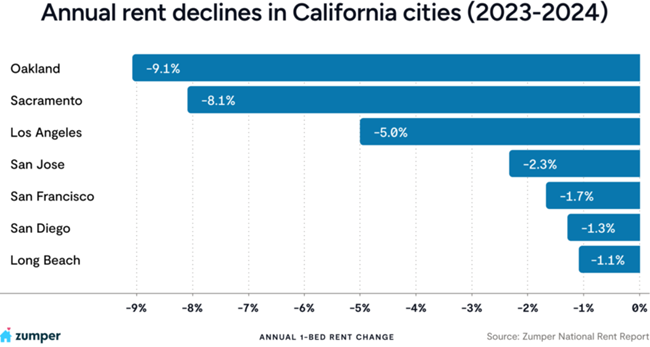
The report says seven of the 11 larger California cities had negative annual rent rates for one-bedroom units, and of those seven declining markets, nearly all are located in the top 20th percentile in terms of price and population. Oakland and Sacramento led the pack with rents down between 8% and 9% since this time last year. Los Angeles, San Jose, San Francisco, San Diego, and Long Beach followed suit.
“It seems that it is less of a supply factor that is driving rents down in California right now, which is what’s happening in many other U.S. markets and especially in the Sun Belt area, but more of a demand one,” Zumper said in the report.
Of the top 50 largest markets, the Bay Area and the Los Angeles metro area have seen some of the largest population losses in the last few years. These two areas have also not recovered from pandemic-related job losses, as Los Angeles had the most severe decline in nationwide employment, currently sitting at nearly 60,000 jobs below its pre-pandemic rate, while San Francisco had about 45,000 fewer jobs.
California actually posted the highest unemployment rate of all states in April, sitting at 5.3%. Meanwhile, San Diego experienced net move-outs in nearly every submarket and experienced the worst demand performance of the nation’s 150 largest cities, and Sacramento’s occupancy rate has continued to decline every quarter from 2021 through 2023.
The ins and outs of section 8 and other housing choice voucher programs. Landlords are encouraged to seek legal counsel and set appropriate policies for handling housing-choice voucher applicants.
By Denise Holliday
The Housing Choice Voucher Program is the federal government’s major program for assisting low-income tenants, the disabled and the elderly to afford safe and sanitary housing in the private market.
This program allows the participants to find their own housing, which may include single-family homes, townhomes, or apartment communities, but does not currently include other forms of housing options such as mobile home parks or RV parks.
Participants are free to choose any housing that meets the requirements of the program, are not limited to units located in subsidized housing projects, and may even include the residence where they currently live. The housing provider must agree to participate in this program, abide by certain terms and conditions that are part of the HAP contract, accept the voucher that will verify the total amount of rent to be paid, and the housing must meet minimum health and safety standards by passing an inspection.
That being said, the cities of Tucson, Phoenix and Tempe have passed ordinances under which a landlord is NOT allowed to refuse an applicant solely because the applicant has a voucher. Each city has provided some guidance on its interpretation of a landlord’s policy that an applicant must have verifiable income of at least a certain amount (typically two to three times the monthly rent). That guidance is that the landlord should limit that requirement solely to the amount of the tenant’s portion of the monthly amount. Some landlords require applicants to verify legal income of at least a minimum amount, and there is no current guidance on that issue.
Assuming that the applicant meets the screening requirements, the parties then notify the PHA of their joint interest in renting a dwelling, and Section 8 then schedules an inspection of the dwelling unit to ensure that it complies with Section 8’s housing quality standards (“HQS”).
The inspection department is also responsible for determining “rent reasonableness” for the unit. What rent is reasonable for a particular unit may depend upon the ZIP code in which the unit is located, the age of the property, the number of bedrooms and the unit location. It will also hinge on the amount of rent that the property charges non-Section 8 residents for the same apartment type and style. Before Section 8 will approve a unit, properties must submit to Section 8 three actual leases that they have entered into with non-Section 8 tenants over the last twelve months and the rent for those units must average the same or higher rent than what is being sought for the specific unit being offered to the voucher holder. The property is NOT required to lower its rent in order to allow a voucher holder to live there. There is currently no clear guidance as to whether the landlord may redact the tenant identities on the copy of leases provided to that agency.
Section 8 must approve, in advance, the lease between the voucher holder/applicant and the property. That lease must have the same start and ending dates as the HAP i.e. Section 8 contract that the property and Section 8 will enter into at the same time. It is illegal for a landlord to require any special criteria or increased rent that applies only to voucher recipients.
The lease must not contain certain provisions that are prohibited by state or federal law. Those provisions are identified on the voucher and on the Section 8 administrative plan for each Section 8 agency. The lease must include all charges, including any administrative fees, pet fees, storage/garage/parking fees, deposits, etc unless the HAP provider specifically authorizes in writing that the parties may enter into a separate addendum for special charges (note that current Quadel Phoenix appears to be permitting this type of addendum). A landlord is prohibited from entering into any other arrangements with the voucher recipient that has not been fully disclosed and approved by the agency. This means that all side deals, even if offered by the tenant, are illegal and not enforceable.
Landlords are encouraged to seek legal counsel and set appropriate policies for handling housing-choice voucher applicants as well as ensuring that their leases are compliant with both state and federal law. Additionally, all three of the cities that require mandatory participation in the voucher programs provide free educational information on their websites.
About the author:
Denise Holliday is the managing partner of Hull, Holliday & Holliday, PLC and has been engaged in landlord/tenant law practice since 1996. She is a certified instructor for the Arizona Department of Real Estate, Arizona Association of Realtors, Property Management Institute, and National Association of Real Property Managers.
Situations of resident harassment and resident bullying will occur on any property. And they’re tough incidents to deal with.
Conflict is inevitable, but the key turning point is when resident bullying and resident harassment turns into a the Fair Housing Act issue and cannot be tolerated.
By The Fair Housing Institute
It’s simply a part of managing any property; your residents aren’t always going to agree. This makes conflict inevitable, but the key turning point is when it turns into bullying and harassment. To be clear, the Fair Housing Act states that resident bullying and harassment cannot be tolerated. Are you sure that your property, as a whole, has the best practices in place when it comes to resident bullying and harassment? Let’s go over four key points that occur during this situation and highlight best practices for each.
1. Best Practice: Proper Training for Staff
Your staff members typically have the most contact with your residents. They’re the listening ear and first point of contact for many issues, including incidents of harassment and bullying. So what should happen if your staff member witnesses a case of resident bullying?
First and foremost, any member of your staff who is not involved with management should not get involved in the situation in any way. This is because not all staff members will have the training to discern a personality conflict from a conflict based on a protected category/class.
The training you should invest in for all staff members is twofold: incident reaction and documentation. Training all staff members to stay a witness to an incident involving resident bullying and harassment is your first step. The next steps are to ensure that everyone understands how to document the witnessed occurrence properly. Any little detail missed can affect management’s investigation of the incident.
2. Best Practice: Incident Documentation
So, a staff member has witnessed and documented a conflict between two residents that they perceived to be bullying and/or harassment. What are management’s next steps? Along the same lines as staff-member training, ensure that every step you take is well-documented when following up on the reported incident.
Your first important step is to establish that there is bullying and/or harassment taking place between the residents. If there is enough evidence found to support this claim, you cannot hesitate to launch an investigation. Why is this?
3. Best Practice: No Investigation Hesitation
The most important answer to the above question is quite simple: Investigation hesitation can lead to a violation of the Fair Housing Act. It is illegal for harassment to persist with no action on behalf of the housing provider.
As a follow-up answer, the housing provider will almost always be the focus of the legal case if a court investigation is launched. This is based on the fact that the housing provider is operating as an asset of a property management company, therefore, they have more money to pay in a settlement, as opposed to an individual who was the cause of the bullying. In summary, if you want to avoid a pricey settlement on top of a violation fine, it’s best that you launch an investigation as soon as it has been proven harassment is taking place.
4. Best Practice: Zero-Tolerance Policy
Once you have your documentation in place, from the incident report to the investigation, it is up to management to issue consequential action. Bullying and harassment are not only against the Fair Housing Act, they also are violations of the resident’s lease.
Depending on the severity of the situation, a lease violation or termination can be issued. A zero-tolerance for bullying and harassment policy can also be installed as part of your property for further proof of a decision made by management.
Conclusion
Situations of resident harassment and resident bullying will occur on any property. And they’re tough incidents to deal with. In any case, remember the discussed best practices: ensure your staff is properly trained, incident documentation must be as thorough as possible, don’t give in to investigation hesitation, and consider a zero-tolerance policy.
Above all else, remember the Fair Housing Act is against bullying and harassment of any kind. So ensure you’re following through on your responsibility to uphold and abide by its laws.
About the author:
In 2005, The Fair Housing Institute was founded as a company with one goal: to provide educational and entertaining fair-housing compliance training at an affordable price at the click of a button.
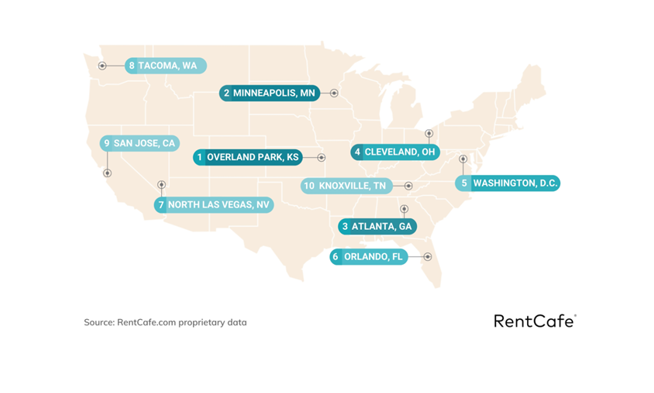
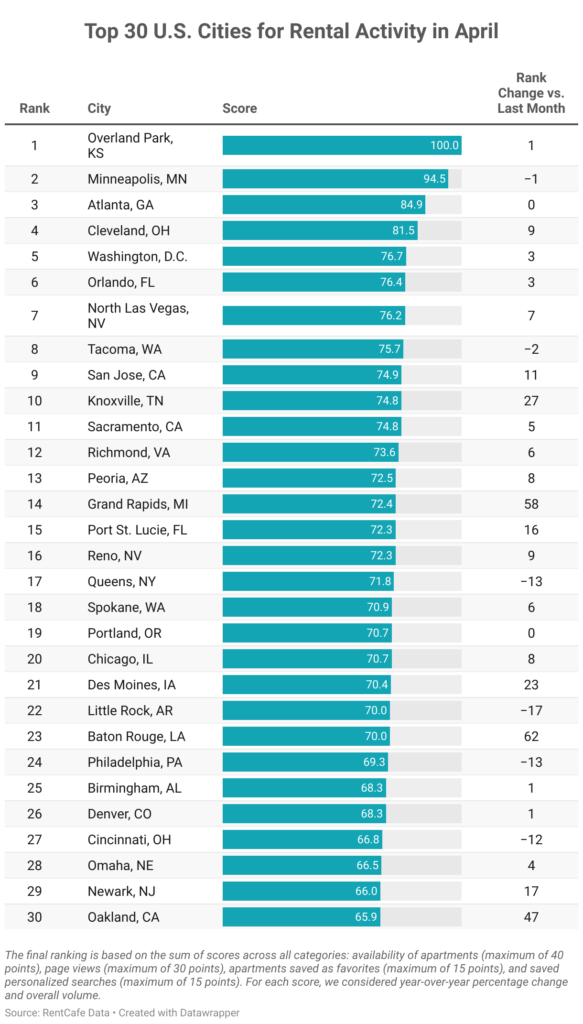
Where in the country were the top five cities for rental activity in April? As the rental season picks up and apartment hunters remain actively engaged in their search for suitable living spaces, RentCafe reports on exactly that question.
While the month’s data shows the South and West as still very popular with renters, the top spots in April go to the Midwest, RentCafe says, based on what the company sees on their platform.
“The Midwest is reclaiming its hold on the top five, with Overland Park, Kan., in the lead, followed by Minneapolis in second place and Cleveland securing the fourth spot.
“However, this resurgence of the Midwest does nothing to push out the South’s presence in the ranking, with Atlanta holding steady in third place and Washington, D.C. coming in fifth
Top 5 cities for rental activity in April
Overland Park, Kan.
Securing the top position after a steady climb since the beginning of the year, Overland Park, Kan., is propelled by a 256% surge in page views and a 138% increase in favorited listings compared to the previous year. Notably, this surge in rental activity coincides with a strong 67% increase year-over-year in saved searches on RentCafe.com. Even with a 3% increase in available apartment listings, it’s evident that the demand for rental properties in this Kansas City suburb continues to be high.
Minneapolis
Although Minneapolis has slipped to second place since last month, it continues to be a frontrunner for April. Here, renters’ interest in the City of Lakes was solidified by a 133% increase in page views and a 47% increase in saved searches compared to April 2023. Moreover, despite a 23% decrease in favorited listings, the city’s allure remains strong, as evidenced by a 19% year-over-year drop in available apartment listings on RentCafe.com, which indicates high demand and a competitive rental market.
Atlanta
Atlanta retained its third spot in April, repeating its placement from the previous month. That said, the city has seen a slight 1% increase in the number of listings availability, but the interest among renters — particularly those hailing from New York, Miami and Chicago — remains robust. April also marks Atlanta’s seventh appearance in the top three most sought-after cities, highlighting this Southern gem’s enduring charm.
Cleveland
Cleveland has made a significant leap to the fourth spot in April, climbing nine positions since last month. Clearly, apartments in Cleveland are captivating renters’ attention, as demonstrated by a 118% surge in page views and a 26% drop in available listings. Plus, despite experiencing a 10% decrease in saved searches and only an 8% rise in favorited listings, it’s clear that this Ohio haven still maintains its status as a sought-after market in rental activity.
Washington, D.C.
Washington, D.C. claims the fifth spot in April rankings, due to a 35% increase in page views and a 9% decrease in apartment availability compared to the previous year. This highlight sustained interest from renters in spite of a slight drop in favorited listings (down 16%) and a 36% decrease in saved searches, which could be attributed to lack of immediate intent to rent given that the rental season has just started. Nevertheless, the capital continues to attract attention, particularly from renters hailing from Baltimore, New York and Atlanta.