Home Blog Page 194

California Landlords Settle Over ‘No Criminal Record’ And Discrimination

California landlords have reached a settlement and agreed to pay $8,000 after a complaint alleging they used a policy of “no criminal or police record of any kind,” and in addition discriminated on the basis of race and national origin.

The U.S. Department of Housing and Urban Development (HUD) charged in the conciliation agreement that the landlords discriminated on the basis of race, national origin and prior criminal history, according to a release. The agreement names the Grand Oaks Apartments and Sierra Vista Apartments in Atwood, California, and MacBeth Apartment Systems in Carlsbad, California.

“Denying someone an apartment because of how they look or where they come from not only deprives them of a home, it is against the law,” Anna María Farías, HUD Assistant Secretary for Fair Housing and Equal Opportunity, said in the release. The “agreement reaffirms HUD’s commitment to ensuring that every person, no matter their race or national origin, has access to the housing of their choice.”

The agreement is the result of two complaints the Fair Housing Council of Riverside County (FHCRC) filed with HUD after it conducted fair housing tests.  The complaints alleged that the owners and managers of Sierra Vista and Grand Oaks Apartments discriminated against applicants because of their race and national origin. According to the complaints, tests conducted by FHCRC allegedly showed that property managers at the two complexes refused to rent, cited different terms and conditions, and misrepresented the availability of units to testers based on their race and national origin.

California landlords to pay $8,000 in settlement

Under the terms of the agreement, the owners and property managers will pay FHCRC $8,000, require that their employees take fair housing training, amend their rental qualification criteria to remove the requirement that applicants have “No Criminal or Police Record of Any Kind,” and develop and implement a nondiscriminatory criminal record policy.

The agreement also says MacBeth Apartment Systems must delete from their qualifying criteria “no criminal or police record of any kind” and provide HUD a copy of the revisions. Also “develop a criminal records policy that complies with the Fair Housing Act to be used in evaluating potential applicants at all properties,” according to the settlement. It also requires the company to distribute the new policy to all company executives and staff responsible for screening applicants and tenants.

Resources:

Application Of Fair Housing Standards To the Use Of Criminal Records

U.S. Department of Housing and Urban Development Conciliation Agreement

HUD APPROVES AGREEMENT RESOLVING ALLEGATIONS OF HOUSING DISCRIMINATION INVOLVING TWO CALIFORNIA APARTMENT COMPLEXES


Why Is It So Hard To Build Affordable Housing In Portland?

A leader in the Portland affordable housing industry talks about why it took four years to get 40 units of affordable housing done from concept to opening and why it is so hard to build affordable housing in Portland.

By John Triplett

Rental Housing Journal

Tom Brenneke has a passion for building affordable housing in Portland, the community where he lives, and is proud to talk about his latest 40-unit project when recently opened – a triumph of affordable housing.

“I have a particular passion for affordable housing,” said Brenneke, who is president of Guardian Real Estate Services LLC. “I enjoy the complexities,” he said in an interview with Rental Housing Journal.

“We are a housing organization that runs the range from very low income to market rate. We have the highest priced housing in town that we operate and the lowest priced housing in town. In terms of affordable housing, I enjoy the complexities, I enjoy the mission. It is a very high barrier to entry business. So it is what has distinguished us in the marketplace as a developer and operator. We love the concept of intergenerational housing. I think that’s a winner,” he said.

Brenneke was discussing his most recent affordable housing project, the NAYA (Native American Youth and Family Center) Generations, in Portland’s Lents neighborhood.

“At a time when affordable housing is a particularly controversial subject in Portland, we’re especially proud to launch NAYA Generations. This is more than housing, it is a true community that promotes stability, collaboration and caring relationships,” he said.

How did this all get started?

There is a prject in Portland called Bridge Meadows, 36 units of intergenerational and foster family housing and “we developed that for the Bridge Meadows organization,” he said. “This is how it kind of all started. They had an idea and we brought all the development expertise, we created the green project for them and it worked out great. That was in 2010.

“After completion of that project, the NAYA group (Native American Youth and Family Center) approached us, took a look at Bridge Meadows, and said, ‘We want one of these for us’ – and I said, “Sure.”

“So that is what we do. We take those kinds of wishes, wants and challenges” and turn them into a project like this.

“We started looking for a site and connected with a city commissioner, Dan Saltzman, who helped us locate and acquire an old public school site in a neighborhood called Lents in Portland.”  It is one of the poorer neighborhoods in Portland.

Frustrations of getting the deal done


Why is it so hard to build affordable housing in Portland Oregon?


NAYA Generations apartments exteior photos © Cathy Cheney

Getting the deal done between the Portland Public School district, the city, which are separate entities completely was frustrating.

“It was piece of work. We ended up with a complicated master lease of the land, indirectly, from Portland Public Schools. The lease passes through the city and it goes to us.”

Many of us do not know the foster system – it’s tragic

“When you couple of the intergenerational concept with both Bridge Meadows and now NAYA Generations, it especially helps the foster families. We all love seniors. But many of us do not know or understand the foster system.  And it’s tragic. And it’s not just Portland, Oregon, but everywhere.

“So if you look at projects like Bridge Meadows and NAYA Generations, Bridge Meadows focused on the adoption process so if you were living in Bridge Meadows as a foster family you got a break on your rent, but you had to agree to adopt up to three children in five years. We don’t have that at NAYA Generations. But we have a disproportionately high number of Native Americans in the foster system. So there is a preference there.

“I have a passion for the children. The foster system. And affordable housing at the end of the day,” Brenneke said.

Naya Generations was developed as an intergenerational, cooperative community that supports families of foster children. Residents can contribute to this collaborative community in a variety of ways, including teaching cultural values and history, indigenous storytelling, being a mentor and more.

“NAYA services Portland’s urban Indian population in many vital ways, from our precious youth to our respected elders, “Paul Lumley, NAYA executive director, said in a release. “We are blessed to have this culturally specific inter-generational housing that was made possible through this unique partnership.”

The units range from one bedroom to four bedrooms depending on family size. The mission was to address the over-representation of Native American youth in the foster care system.

Why is it so hard to build affordable housing in Portland Oregon?

Kitchen in Naya Generations apartments photos © Cathy Cheney

Gentrification is the buzz word

The Lents district historically is the lowest priced housing in Portland. “Guess what’s happening.  In East Portland suddenly you get people going out and buying $250,000 starter-type homes, putting $50,000 in them, and flipping them for $400,000.” Brenneke said, “That is what is going on in that area. But gentrification is a concern. It makes the demands for affordability even higher.

“These developers and these landlords. I am one of them who is acquiring buildings – substandard buildings – and putting them in good condition. And charging market rates. I do not have a problem with that.  We see people living in squalor. Is that fair? Reasonable? No.

“It certainly makes the demand for affordability even higher. We are seeing just huge demand for affordability here.”

Why is it so hard to build affordable housing in Portland, Oregon like this apartment at NAYA Generations?

I would not blame the landlords- but some are doing “dumb stuff”

“I blame some landlords because some landlords are doing dumb stuff. When you go into the middle of a school year in a building full of low-income households full of kids and you double the rent – that’s dumb stuff.  You can do it. It’s just insensitive. It’s just dumb. You just don’t do that.  A good landlord would not do that.

“He might put them on a path to essentially improving their units and gradually increasing their rent over time or giving them lots of notice,” he said. “And, voluntarily paying relocation fees. We’ve done that before.

“The other dumb thing these landlords do, is they go in and clear the whole building out with no-cause notice evictions. That’s hard. I have mixed feelings about that. Once again – would you do that in the middle of a school year? No. But if you give them six-months notice – six months from now I am going to ask you to vacate your unit. I am going to give you the opportunity to transfer to a new unit. We are going to put your unit in market-standard condition and charge a market price for it. And I’m ok with that. It puts more burden on our city to figure out affordability.  It offers opportunity for groups like ours to create affordable housing but it’s the market and the way the market works.”

Government getting in the way or our business

“Unfortunately, our city and our government is kind of getting in the way of our business now.

“Things like rent control. Those kind of things being floated. Inclusionary zoning. Those kinds of things are going to put a damper on the market and hurt us and at the end of the day hurt affordability,” he said.

Four years to produce 40 units of affordable housing, really?

Brenneke discussed the difficulty, the barriers and the time it takes to produce affordable housing as a reason more is not getting built.

“It takes nine months to get a permit here. On the NAYA Generations project I bet we were four plus years from the conversation I had with the executive director to opening the front door on this thing. I was an honest four years.

The construction process is the easy part. That’s a year. We know that. But if you back it up from there, it’s four years.

He said in the case of NAYA Generations they were working on affordable housing in an area that is not even in what is called a design review district. “Those districts can be found in some of the nicer areas of Portland – closer in areas, Pearl district, in those areas you are going to see a design review process where we go through a commission of six or eight volunteer types – architects – that are going to critique your project. And I bet that process can easily take a year or two on its own. You have to sit there and hear commissioners give you conflicting signals on your own project. That is slowing the whole system down here. And God help you if you are in an historic district.”

Challenges of affordable housing in Portland

“I do these grand openings,” Brenneke said in summary.

“I stand on the podium and thank all the people.  This is 40 units. Why is this such a difficult thing?

“This is something we ought to be producing every day or every month – not a once every four years event. Why is it so damn difficult?”

And that is another story at some point.

Tom Brenneke of Guardian Real Estate Services asks why is it so hard to build affordable housing in Portland Oregon?

Tom Brenneke at Naya Generations apartments dedication photo © Cathy Cheney

About Guardian Real Estate Services

Locally owned and operated out of Portland, Oregon, for more than 40 years, Guardian Real Estate Services has evolved into a leading management, development and investment firm in the Pacific Northwest. Defined by a deep commitment to the communities in which it invests, Guardian continues to advocate for housing across the entire spectrum.

About NAYA

Founded by the community, for the community, NAYA is a family of numerous tribes and voices who are rooted in sustaining tradition and building cultural wealth. The organization provides culturally-specific programs and services that guide people in the direction of personal success and balance through cultural empowerment. Find out more here.

Resources:

NAYA Generations affordable housing

Guardian Real Estate Services

Bridge Meadows affordable housing

Lents Neighborhood Association

Five myths about gentrification

Portland’s Pearl District

NAYA Family Center

Affordable Housing Community in Downtown Seattle Purchased by Security Properties

Sign Up For Our Newsletter And Get Apartment News And Helpful, Useful Content Each Week.

* indicates required


Landlords Sue Seattle Over Criminal Background Check Restrictions

Three small landlords have banded together with two organizations to sue the City of Seattle over a criminal background checks ordinance that keeps landlords from considering certain criminal histories of tenants during the tenant screening process.

Sean Martin of the RHAWA, left, Ethan Blevins and William Shadbolt

By John Triplett

The Pacific Legal Foundation and the Rental Housing Association of Washington (RHAWA) have filed suit against the City of Seattle over the ordinance which bans landlords from most criminal background checks when screening an applicant. The suit argues the ordinance violates due process and free speech.

Seattle’s Fair Chance Housing Ordinance, passed by city council in 2017, forbids landlords from considering applicants’ criminal histories when selecting tenants. In other words, landlords cannot base a rental decision on concerns over their own safety or the safety of other tenants and neighbors. Violators face fines and penalties of up to $55,000.

The Rental Housing Association of Washington said in a release, “The ordinance is based on the flawed reasoning that inequities of our criminal justice system can be solved by limiting the rights of property owners from making informed decisions about the person(s) with whom they enter into rental agreements.

“Rental property owners recognize the struggle for applicants with criminal convictions history and the industry supports measures like Certificates of Restoration of Opportunities and simple “ban the box” legislation to ensure that an individual’s full list of qualifications are considered. However, the ostensibly blanket restrictions imposed by the City put rental property owners at too high of a risk of exposure to the safety of other tenants and their property,” RHAWA Interim Executive Director, Sean Martin, said in the release.

Landlords Sue Seattle Over Criminal Background Check Restrictions

Sean Martin, Interim Executive Director, RHAWA

“RHAWA supports second-chance housing and educates its members on HUD guidelines and state law which restrict how criminal records history may be considered, including an individualized assessment which consider factors such as the nature and severity of a criminal conviction,” Martin said in the release.

The RHAWA and the Pacific Legal Foundation held a joint press conference where they set out the reasons for the lawsuit and took questions from the media.

“Pacific Legal Foundation filed a complaint to King County Superior Court challenging Fair Chance Housing Ordinance on behalf of the Rental Housing Association of Washington and three small time landlords: Chong and MariLyn Yim, Kelly Lyles, and Scott Davis,” attorney Ethan W. Blevins with the Pacific Legal Foundation said at the press conference.

“The Fair Chance Housing Ordinance forbids landlords and organizations like RHA from asking about criminal background of housing applicants or denying someone tenancy on the basis of their criminal history. The law’s intent is to help former convicts reintegrate. It’s effect, however, is to deny landlords and screening organizations of their basic constitutional rights,” Blevins said.

Blevins also explained the due process and free speech aspects of the complaint.

“The due process claim argues that the Fair Chance Housing Ordinance pursues its objective in an unreasonable and unduly oppressive manner. The free speech argument says that the First Amendment embodies a right to receive information, and landlords rely upon that right when selecting their tenants. The city can and should help those emerging from criminal confinement, but it cannot do so at the cost of others’ constitutional rights,” Blevins said.

Average RHAWA member landlord owns two rental properties

William Shadbolt, President of the RHAWA Board of Directors, said at the press conference, “I’m a small time landlord. The Rental Housing Association represents the interests of independent rental owners. We’re the small mom-and-pop landlords.

“Our members live, work, and own rentals in the local community. Our average member has roughly two rental properties, and are very much part-time landlords. They teach our children, they design our planes, and they drive our buses. Many who were born and raised in this area purchase property in Seattle to help put their kids through school and provide for themselves in their old age.

“Our members provide the only organically affordable housing left in the city,” Shadbolt said.

Landlords sue city of seattle

William Shadbolt President of the RHAWA Board of Directors

City has dropped the ball on housing affordability

“Over the last few years, we’re seen a barrage of legislative attacks on our industry by the City of Seattle,” Shadbolt said.

“Rather than crafting policies to combat real housing issues, such as affordability and homelessness, the City of Seattle Council is more inclined to pass legislation that forces small mom-and-pop landlords to struggle to deal with larger societal ills that they’re just simply not able to cope with.

“If the city of Seattle is serious about reforming the criminal justice system, it should focus on reforming the criminal justice system. Continually adding regulations and cost to our local landlords does nothing to resolve the root causes of the injustices we all seek to remedy.

“Prior to the passage of this legislation, the Rental Housing Association reached out to the city of Seattle and suggested a variation on a local Certificate of Restoration of Opportunity. This was something that RHA supported on a state level, and it was passed on the state level. So a person with a criminal record could apply to an impartial panel and get a certificate. They could then take that certificate to a small landlord. Unfortunately RHA found no willing partners on this solution,” Shadbolt told the press conference.

“Our members are long time citizens of this city. Most of whom are concerned about reforms of the criminal justice system, and finding better opportunities to provide safe and affordable housing to everybody. We believe the best was to increase a housing opportunity is through partnership and the exchange of honest information, not through the concealment of public records,” he said.

Small landlords forced to sell their rental properties

“The impact of this and other short-sighted ordinances passed by the city council is that thousands of mom-and-pop landlords can no longer afford to operate their units,” Shadbolt said.

“They’re being forced to sell their rental properties in the thousands. Fatigued by over regulation and demonization, they’ve thrown up their hands and voted with their feet.

“It’s important to recognize that these tens of thousands of units have gobbled up by developers in large corporations, and turned into fancy condos and boxy town homes. The city council needs to understand they’re causing a reduction in the number of housing units by these actions.

“These laws are destroying the affordability in our city. Making criminals a protected class, and other ordinances like it, that makes the city council directly responsible for increasing people’s rent,” Shadbolt said.

Questions and answers at the press conference

Q: And what’s our timeline? How long do these things take? What are our next steps? What can we expect going forward?

A: Blevins said, “Well, this is a fairly straight-forward legal issue, so we don’t, hopefully, have to go through the long process of discovery that you might typically have to go through. It’s going to depend somewhat on the city’s willingness to move forward at pace, so it may depend on the particular Deputy City Attorney that we have, but if it moves at the pace, for example, that the First-in-Time litigation went, then I would anticipate we probably have a summary judgment hearing in about six months or so.”

Q: In the media all the time you hear constantly about the issues that special populations not being able to find housing. If this isn’t the policy to help folks with criminal records get more housing, what are the solutions?

A: Shadbolt said, “You know, we have an affordability issue because there just simply is not enough housing. There is just not enough supply to meet the demand that we have in the city. So that’s kind of the affordability issue side of it. But if the city is serious about people with criminal records, they need to look at the criminal justice system. Rather than going and putting the burdens on small landlords, they need to be asking questions, and on the federal level, of why this country imprisons more people per capita than any other developed nation. It’s just wrong. But putting the burdens on small landlords to deal with that symptom, rather than dealing with the cause, is not the way to do it.

Q: The ordinance … makes no differentiation, in terms of criminal convictions, for, say, a pot conviction of a 21-year-old or a repeat assault conviction or domestic violence, somebody who’s got multiple offenses, for example, who would have a serious impact on the way that you’d be able to operate your apartment building. There’s no differentiation there?

A: Blevins said, “That’s correct. There’s no consideration of the gravity of the offense. The only, very limited, exception is if someone’s on the sex offender registry, and they committed the related crime as an adult, then if you can prove to the CR office for civil rights you have a legitimate business reason for denying them tenancy, then you can deny them tenancy because of that criminal background.”

Q: But only for sexual offenders?

A: Blevins said, “That’s correct. Only if they’re on the sex offender registry, and only if they committed that crime as an adult, and only if you can prove to the Civil Rights Office you have a good reason. In that context gravity of the offense is one of the factors the civil rights office will consider, but it’s in this very, very narrow context.”

Martin added, “I think one thing that people need to understand is that this is not the Wild West out there in the screening world, where landlords can just deny someone and have a blanket policy to say, criminal records I’m not going to even look at anything. We have the Federal HUD Guidelines that make it very prescriptive, and already you have to make the business case justification outside of Seattle, where this law is not in place, as well as state limitations on how far someone can look back. So really if someone’s saying they were convicted of an offense 20 years ago, that’s really not even in the discussion for being denied tenancy at this point. It’s too old of a conviction. So there are a lot of restrictions and regulations in place already for how people are using criminal records.”

Q: How does this law affect the roommate situation?

A: Shadbolt said, “We actually had a member who had a senior citizen, she was in her 70s, her rent had gone up, mainly because of the property tax increases, and she asked her landlord if she could have a roommate. The landlord said, ‘Yep, that’s fine.’ And the tenant turned around and said, ‘You do a background screening if I find somebody?’ And because of this law, she couldn’t do a background screening on criminal records, so they turned around and said, ‘What happens if we do a formal sublet. Can you do a screening on that?’ And the answer to that was ‘No’ because the only exception is owner occupied. So if you have a roommate situation where it’s a rental property, you cannot screen. So literally the people that you’re sharing very close space with, you can’t do it. The upshot of what happened with that person, she moved out of the city. She loved living in West Seattle. She could walk to her doctors, she had all the facilities here, but she ended up moving to Maple Valley to a small accessory dwelling unit because of this law.”

Q: Is the city considering any protections for landlords with regard to potential civil action from a tenant who is harmed by a former criminal who has a violent past?

A: Blevins said, “I certainly haven’t heard of any. One of the great ironies behind this is the studies that the city relies upon, one of the things that is suggested by those studies, is that before this kind of burden can be placed on landlords, tort reform has to occur, because landlords can be criminally or civilly liable for crimes committed by tenants against other tenants. And so, a lot of these studies have said, ‘If we’re going to do something about this, and force landlords to take individual criminal backgrounds, or not allow them to look at that, then we need to at least reform tort law, so that they’re not going to be liable for crimes committed by those tenants.’ “

Martin added, “I would add to that ‘No’ there are no considerations for landlords coming from the city, and that’s not something that’s been discussed. And I wouldn’t anticipate the city going that direction, at least not in the current setting that we’re in.”

Q: What can we, as citizens and landlords, do to express our discomfort and concern with this law?

A: Shadbolt said, “Ultimately, a lot of our members have simply just sold their properties in the City of Seattle. So they just left the city. So that is a reduction of housing. And the impact of that is quite dramatic. The people that have single-family homes, they’re invariably becoming owner-occupied as post rental properties. So they’re gone. The small two, three, four-unit buildings are getting scraped and townhouses going up. You can go along California and Fauntleroy Way and see tons of them have been built. And even the small apartment buildings, what typically happened was that they were artificially low rents.

“There’s a former board member that had two small apartment buildings in Queen Anne, and her rents were significantly below market. In reality, she was subsidizing her tenants’ rents for a period of time. And she and her family that had owned them for 40 or 50 years, just turned around and said, ‘We just can’t continue.’ It’s not just the regulations that have already been passed, which are onerous, it’s what’s going to be next? So she sold those properties, and prior to the sale she actually took three of her tenants to find new places. That was their relationship. What happened after the sale, is that the rents went up because the new owner suddenly had a very large mortgage payment to make. Whereas prior, they didn’t. So those affordable units have just disappeared out of there.

“For the people that want to keep their rental units, I think they just need to contact their city council members. Put it in writing that they’re upset with these issues. We’re open to any discussion of solutions that work for both sides, but what it seems with the city council is ‘Let’s put the burden on the mom-and-pop landlords and let them deal with it.’ And the reality is, we supported the Housing Levy strongly. We think that the whole of society should take responsibility for the issues that we have in the city, not just this one segment,” Shadbolt said.

Q: Did the city council come to RHA and try to get input and sort of work together on this Fair Chance Housing issue, or did they just act alone in their offices?

A: Martin said, “The ordinance was kind of born out of the process originally, and so a sub-committee was formed. We’re at the table for that, but we’re one of many voices, and when you have dozens of advocates and one landlord organization at the table, you’re not going to see equitable legislation. And, in fact, what happened with this ordinance in particular, was that council took the draft proposal, which would have allowed a two-year look back to still consider recent convictions, they took that and just said ‘We’re going to wipe everything out altogether.’ So it actually was maybe even worse after hearing what our concerns were.”

Shadbolt added, ”So there was actually a panel public hearing last year that I was the only landlord on that panel, and there was, I think there was about six or seven activists. I was quite horrified that when a particular council member started to speak, her reaction was, ‘Isn’t there anybody else other than the Rental Housing Association that could be here?’ She simply just did not want to listen to the small landlord’s point of view.”

Q: The criminals as a protected class in the ordinance, and combined with the series of other things that have been passed in recent years, do you see that affecting the standard that small landlords are using, for the criteria that they’re using in selecting tenants? For example, is the landlord making it more difficult for maybe a middle of the road tenant to access housing?

A: Shadbolt said, “Absolutely. I’m a small landlord, and my rental criteria before First-in-Time came into effect was half a page and it was pretty liberal. I’ve housed former offenders, I’ve housed people in Section 8, people with the Landlord Liaison Project. When First-in-Time came into effect our half page of rental criteria went to five pages long. And I legally could not rent to somebody if they didn’t meet that threshold of those criteria. So even though the city has lost the First-in-Time lawsuit, but the house appealed it, I’m looking at those and I’m actually probably going to keep most of those additional rental criteria. I have to protect my property, and I have to protect the residents that are in my duplexes and the other units.”

Q: So this is limiting access for maybe the middle- of- the-road tenants? Not just the criminals?

A: Shadbolt said, “Yes very much so.” Martin added, “I hear that every day from our members. ‘If I can’t run a criminal background check, and that was one of the criteria I relied upon, what can I look at instead?’  And things like credit score, that requirement goes up, employment references, income, things like that. So now not only is it probably still difficult for an ex-offender to qualify, you don’t get to have the conversation with the person because the criteria are so much higher that they’re not going to apply in the first place. And now you’re disadvantaging other people who aren’t even in the category that this law is intended to protect. Lower income individuals who effectively are being priced out, or kind of regulated out by the unintended consequences that we have.”

Q: Why are the constitutional challenges important here?

A: Blevins said, “The Constitution is a particularly good format for this kind of a law, because we have what I think are ultimately good intentions, where a city is so committed to its particular end that it’s willing to go through an extraordinary means to get there.

landlords sue city of seattle

Ethan Blevins, Pacific Legal Foundation

“And that’s what the Constitution’s built to prevent. So the Constitution limits the means the government can use to achieve certain ends. So there’s no question that the government has a legitimate interest in preventing recidivism, helping people reintegrate into society who have been in criminal confinement for a long time, but to do so while imposing this extreme burden on a particular segment of society is directly contrary to what the Constitution built, which is a situation in which everyone’s rights are due equal respect by the government.

“Here, with this particular challenge, we’re raising two constitutional issues: the speech issue and the due process issue. Due process just says you can’t deprive someone of a property interest, like the right to lease their property to an individual that they choose with an informed decision making process. You can’t take that property interest away from them without due process of law, which means you can’t do so in an arbitrary or unreasonable or unduly oppressive way, which is what occurs here, because there’s no question that this is vital information that landlords want, and they have a right to access it.

“And that’s very similar to the speech claim, which is just that First Amendment has consistently been interpreted to mean you have a right to receive information, you have a right especially to receive information from public records, and that’s consistently been held to be part of the First Amendment. And landlords rely upon that information to make really important long term decisions. And so they have a First Amendment right to seek that information, and screening companies have a First Amendment right to share that information, which they can’t do under this ordinance,” Blevins said.

Q: Are there any other cities or counties who’ve attempted this type of overreaching law?

A: Shadbolt said, “Nope. First in the nation.” Martin added, “An outright ban of the use of criminal records, this is the first in the country. And we’re seeing council push the envelope. First-in-Time, first in the country. This is first in the country as well. That’s just kind of the environment that we’re in right now,” Martin said.

Resources:

Hear press conference announcing the lawsuit here

New lawsuit in Seattle: Housing ordinance is unfair and unconstitutional


Landlords Sue Seattle to Overturn Ban on Criminal Records When Screening Applicants


Fair Chance Housing Law


About the Rental Housing Association of Washington

Rental Housing Association of Washington with 5,300 members, is a state-wide trade association representing landlords and property managers. RHAWA has existed in some form or another since 1935, starting out as a Seattle based association that grew into a regional resource throughout the Puget Sound area. In an effort to serve all those in the rental housing industry regardless of geographic location in Washington, RHAWA expanded to become a statewide association in 2012.

 

5 Ways To Protect Applicants, Residents And Employees With Sexual Harassment Training

Do you know best practices when it comes to avoiding sexual harassment complaints? The Grace Hill training tip of the week focuses on 5 ways to protect your applicants, residents and employees from sexual harassment.

By Ellen Clark

Recent high-profile sexual harassment allegations have highlighted the need for increased sexual harassment training, education, and awareness.

The Fair Housing Act (FHA) protects individuals against discrimination because of sex. In 2016, the U.S. Department of Housing and Urban Development (HUD) published a final rule, formalizing legal standards under the FHA for sexual harassment and other forms of harassment in housing.

HUD commentary on this rule noted that sexual harassment may violate a variety of provisions of the Fair Housing Act.

How to protect your applicants, residents, and employees from sexual harassment

Courts have consistently recognized sexual harassment as a form of discrimination that violates the FHA.

No. 1 – Have strong written policies

The FHA, Title VII, and most state and local laws require that you have a written sexual harassment policy.

The precise contents of the policy vary greatly depending upon your jurisdiction.

However, most require that you at least prohibit sexual harassment, adopt a comprehensive complaint process that allows for multiple channels of reporting, prohibit retaliation against those who file complaints, provide precise investigation procedures, and provide confidentiality (to the extent possible).

No. 2 – Provide meaningful training sexual harassment training

Demonstrating that your employees and managers have been trained is one of the best ways to show compliance with sexual harassment laws.

The frequency and detail of the training will depend greatly upon your particular jurisdiction

No. 3 – Conduct thorough investigations

If a sexual harassment allegation is lodged against someone within your organization, the law requires that the company conduct a thorough, good-faith investigation.

This typically would include interviewing and getting statements from all parties involved, including talking with other residents or employees to see if they have ever witnessed similar behavior.

No. 4 – Discipline offenders

The company that overlooks sexual harassment and continues to employ a harasser risks great liability in the future.

If a harassment victim can prove that the company knew of previous allegations and failed to take steps to address the issue and stop the behavior, then the company could find itself subject to legal penalties.

In the current environment, HUD, the U.S. Department of Justice, and juries will likely not have sympathy for organizations that overlook harassing behavior.

No. 5 – Consult an attorney early

It is never too early in the process to consult an attorney or consultant to help guide you through the process.

 Summary:

Many have argued that companies are not doing enough to proactively address the harassing issue, and the potential cost for property managers is high. Having a strong anti-harassment is important, but the implementation is important too. It is best to demonstrate good-faith compliance with the sexual harassment laws through a comprehensive policy of written guidance, thorough training, and effective response.

Read Ellen’s full blog post here.

Recent training tips you may have missed:

Do You Have A Smoke-Free Policy That Adequately Protects Residents?

How To Handle Suspicious Documentation For Assistance Animals

How A No Pet Policy Can Be Discriminatory

Property Management Cyberattack Risks Overlooked, Underestimated

Have You Reviewed Your Criminal Background Checks Policy Lately?

Multifamily Managers And Marijuana: Caught In A Pot Crossfire

Fair Housing Discrimination Against Someone You’ve Never Talked To?

About the author:

Ellen Clark is the Director of Assessment at Grace Hill.  Her work has spanned the entire learner lifecycle, from elementary school through professional education. She spent over 10 years working with K12 Inc.’s network of online charter schools – measuring learning, developing learning improvement plans using evidence-based strategies, and conducting learning studies. Later, at Kaplan Inc., she worked in the vocational education and job training divisions, improving online, blended and face-to-face training programs, and working directly with business leadership and trainers to improve learner outcomes and job performance. Ellen lives and works in Maryland, where she was born and raised.

About Grace Hill

For nearly two decades, Grace Hill has been developing best-in-class online training courseware and administration solely for the Property Management Industry, designed to help people, teams and companies improve performance and reduce risk.

5 Ways To Protect Applicants, Residents And Employees From Sexual Harassment

Photo credit microgen via istockphoto.com


7 Common Maintenance Emergencies And What To Do

Top 5 Apartment Maintenance Emergencies vs. Maintenance Requests

Maintenance emergencies are a nightmare for property managers and tenants so this week the maintenance checkup from Keepe will discuss how to handle 7 common maintenance emergencies.

Most of the scenarios we will discuss present the possibility of causing serious damage to the property, and in some case even harm tenants.

7 common maintenance emergencies and how to resolve them

The goal is to solve the emergency as quickly and safely as possible. And with a result that both property managers and tenants will feel satisfied with the way their discomfort was addressed and resolved.

No. 1 – Flooded basement or ground floor

Generally caused by piping failures or harsh weather, indoor floods are just as dangerous as they are inconvenient.

Flood water cause major health complications. These range from being exposed to sewage, inviting mosquitoes and parasites, and kickstarting toxic mold growth. Also, once flood water reaches outlets and hot wires, it becomes immensely dangerous. It can conduct electricity and turn the space into a shock-zone.

The “golden rule” to keep in mind is that letting water sit around is the worst mistake that can be made.

Get started with clean-up and repair efforts as quickly as possible, especially to salvage materials and avoid thousands of dollars worth of damage.

If the cause of the flood can be easily identified as a burst pipe, the water supply must be immediately turned off. If the flood has reached exposed outlets, plugs, and wires, it’s then important to turn off power and contact a professional for the assessment of whether the area presents a serious electrical hazard.

Once the area has been cleared, all furniture should be removed and put in a dry space to optimize the likelihood they can be salvaged.

Pumps, wet-dry vacuums and eventually fans and dehumidifiers can be helpful with drying out the space once the majority of the water has been drained.

A professional handyman should be contacted to help with removing and repairing damaged walls – especially drywall, paneling and wallpapers – insulation, and ventilating wall cavities to minimize the risk of toxic mold growth.

If the flooding is unrelated to burst piping, it’s adequate to contact a professional for the assessment of whether the flood water is dangerous/toxic, and proceed with water removal and repair. Consult a second expert contractor regarding how floods can be prevented in your particular case (adding insulation, creating barriers, reconfiguring basements, etc.)

No. 2 – Bursting pipes

A frozen pipe that bursts means water can find its way inside a property.

In case of a burst pipe, immediately turn off the water supply. If the space is flooded, it’s appropriate to proceed as described above, with initial safety checks followed by water and furniture removal.

It’s then fundamental to contact a professional plumber for the repair of the burst section, but also for a consultation regarding how it would be best for your case to prevent burst pipes in the future.

No. 3 – Water heater bursts

A burst water heater will try to continue re-filling, causing water to continue on spilling and flooding the space.

First, if the heater is electric shut off the breaker to power it down. Gas heaters need to be shut off by utilizing the proper valve.

Water supply should be turned off next. Then proceed with steps for damage control outlined in scenario No. 1 above.

It’s best to then call the manufacturer of the appliance and your insurance company to best resolve how to repair or replace the heater, and whether any items are protected under your insurance package.

No. 4 – Pilot light shutting off

A tenant waking up in a house or apartment without hot water is a particularly uncomfortable experience.

A water heater or furnace without an active pilot light is likely what is causing the problem.

Fortunately, some appliances feature ignition buttons for easily relighting the pilot light. But, this must be done safely. The gas supply needs to be cut off and the area around the appliance needs to be allowed to be properly ventilated.

If you smell the characteristic “rotten egg” scent of natural gas lingering in the space and the smell persists for longer than an hour, leave the property and call the utility company.

You need a professional to check whether there is a gas leak or any gas-related hazard, investigate the issue, and determine whether other parts of the system should be addressed and replaced.

Once the space has been cleared, it is safe to proceed with attempting to light the pilot light by following the appliance instruction. We always recommend the help of a professional if you are at all unsure how to proceed.

No. 5 – Junction box and electrical fires


7 Common Maintenance Emergencies And What To Do

Old or incorrectly set-up wiring can be responsible for sparking dangerous electrical fires.

While junction boxes are supposed to help with containing sparks, they are no help if a fire actually catches on.

If smoke or visible flames are spotted, the electricity must be immediately shut off, and the fire department should be alerted.

If flames are burning, it would be adequate to have a Class C or multipurpose fire extinguisher at hand to try and put out the fire as long as it is safe to do so. Following the incident, contact an electrician to check on your property’s wiring to determine what caused the issue.

No. 6 – Backed-up septic tank


7 Common Maintenance Emergencies And What To Do

House image created by Katemangostar – Freepik.com

A backed-up septic tank will overflow and allow spilled toxic waste to flow near or even into a property.

This is not just disgusting and smelly, but also dangerous and damaging.

Septic waste carries bacteria and disease, and can impregnate and linger into most surfaces it touches upon contact.

The best way to address this issue is to be proactive with clean-up, removing waste as it surfaces and removing – ideally disposing of – any contaminated furniture and objects. Spaces should be disinfected with a bleach solution, and a septic tank specialist should be called immediately to investigate the source of the problem.

No. 7 – Roots growing in sewer line

Tree roots are naturally attracted to the nutrients and moisture that are found within sewer lines.

Roots can easily sense and access pipes that are cracked or damaged by wear and time.

As roots infiltrate the system and grow longer and larger, the line can be completely burst or become backed-up, which becomes visible by above-ground or in-home resurfacing of sewage.

If waste floods a space, proceed as outlined in the “backed-up septic tank” scenario.

To address the issue of roots, some products that are available for purchase claim to burn off and kill roots upon contact after being easily and directly poured into drains. Our experts find these to be a “bad-aid” type of solution. These products do not resolve this issue long term and make it is likely to resurface.

In these situation, it is best to contact a professional to arrange the removal of the tree completely, and it is fundamental to try and avoid planting trees within 10 feet of a sewage line, or implement an underground barrier system to protect pipes.

7 common maintenance emergencies summary:

Investing in and prioritizing preventative maintenance strategies can lower risk of plumbing and utility emergencies.

However it is important to invest just as much time and energy into being prepared to handle them safely and promptly in case they were to actually happen

Other recent rental property maintenance Keepe posts you may have missed:

4 Outdoor Flooring Options For Your Rentals

20 Easy, Affordable Maintenance Projects To Update Your Rentals

5 Maintenance Tips For Long-Lasting Rental Carpet Flooring

About Keepe:

Keepe is an on-demand maintenance solution for property managers and independent landlords. The company makes hundreds of independent contractors and handymen available for maintenance projects at rental properties. Keepe is available in the Greater Seattle area, Phoenix, San Francisco Bay and San Diego areas.


HUD Settles With Landlords Over Sexual Harassment In Housing

Sexual harassment in housing complaints by tenants continue to be a HUD focus as HUD and the U.S. Department of Justice have combined to fight sexual harassment in housing which has led to fines totaling more than $120,000 against landlords in three states recently.

“It’s against the law to harass residents of housing because of sex, disability or any another protected characteristic. The settlements we are announcing today reflect HUD’s commitment to rooting out sexual harassment and all housing discrimination as we know it,” Anna Maria Farias, HUD Assistant Secretary for Fair Housing and Equal Opportunity, said in a release.

Sexual harassment in housing fight

When the HUD joined the Justice Department to fight sexual harassment in housing, Attorney General Jeff Sessions said in a release, “Sexual harassment in housing is illegal, immoral, and unacceptable. It is all too common today, as too many landlords, managers, and their employees attempt to prey on vulnerable women. We will not hesitate to pursue these predators and enforce the law.

“Landlords are required to comply with the Fair Housing Act, the federal law that has banned housing discrimination for the last 50 years,” she said.

In the California  case HUD said:

    • A California landlord made repeated unwanted sexual advances towards a male tenant with a mental disability and ultimately evicted him for refusing the advances. The landlord agreed to pay the tenant $12,000 and attend fair housing training.

In the Florida case HUD said:

    • A Jacksonville, Florida housing authority employee on multiple occasions sexually harassed a female resident. The alleged harassment included unwelcome sexual comments, requests for sex or sexual favors, and threats of eviction if the tenant did not submit to such requests. The housing authority agreed to pay the resident $75,000, adopt a new sexual harassment policy, and require staff to attend fair housing training.

In the Virginia case HUD said:

    • An independent senior living facility failed to take reasonable steps to prevent sexual harassment of a female tenant by another tenant. The female tenant alleged that a male tenant harassed her with unwelcome and unsolicited advances, made suggestive comments, whistled at her, and followed her around the apartment complex. The facility agreed to pay complainants $37,500 and adopt a sexual harassment policy

News reports said in September 2015, a female resident of The Park at Ridgedale Independent Living said a neighbor sexually harassed her and other female residents. She alleged the neighbor made numerous advances against her, making sexually suggestive comments, catcalling her, and making physical approaches towards her in the common areas.

She reported the incidents to the complex management, TRG Management Company, LLP, and the Chesterfield County Police Department. She also contacted the fair housing non-profit HOME (Housing Opportunities Made Equal of Virginia, Inc.).


Landlord Attorney Warns Cities May Have To Follow Portland Tenant Relocation Payments Ordinance

A Portland landlord attorney has written to other city attorneys in Oregon warning them that they could soon see a push in their city for an ordinance similar to Portland’s requiring tenant relocation payments be made by landlords.

Portland attorney John DiLorenzo, who represents landlords in a lawsuit on appeal challenging the Portland tenant relocation ordinance, said he wrote the letter because “all kinds of city attorneys are interested in our case.

“We have heard there are tenant advocacy groups approaching smaller cities in Oregon,” he said and he wanted the other city attorneys to have the background on the case and the filings.

DiLorenzo letter to Oregon city attorneys on tenant relocation payments ordinance

“You are no doubt aware of the efforts by the City of Portland to require landlords to pay “relocation payments” to tenants when their tenancies are terminated by use of “no-cause stated” notices, when landlords refuse to renew leases, or when landlords raise rents 10 percent or more over any one-year period. On March 7, 2018, the Portland City Council made this ordinance permanent and extended its application to landlords who own as few as one rental unit.

“A copy of the ordinance is available at Ordinance 188849 . (“The Ordinance”). Last year, my clients initiated an action challenging the ordinance on several grounds. The Multnomah County Circuit Court dismissed those claims, but the judgment is currently on appeal. My clients have recently filed our opening briefs with the Court of Appeals. An amicus brief has already been filed on our behalf. The following is a summary of our more significant points:

“The legislature has determined that rent control is a matter of statewide concern and proclaimed that no local government may enact any ordinance that either “controls the rent that may be charged for the rental of any dwelling unit,” ORS 91.225(2), or that is inconsistent with that prohibition, ORS 91.225(7). Notwithstanding the legislature’s unambiguously expressed intent to preempt local rent control legislation, the City enacted the Ordinance, which requires landlords to pay thousands of dollars to tenants upon the tenants’ demand when a landlord gives notice of a rent increase of 10 percent or more in a 12-month period—meaning the Ordinance penalizes rent increases that cumulatively total 10 percent or more in any rolling 12-month period.

Tenants not required to use the money for relocation

“The Ordinance calls the payments “relocation assistance,” but tenants are not required to use the money for that or any other designated purpose. Further, the requirement to make the payments is triggered solely by the size of the rent increase and is intended to limit those rent increases. By penalizing rent increases greater than a certain size, the Ordinance is designed to control the rent that may be charged. Accordingly, the Ordinance runs afoul of ORS 91.225(2) and ORS 91.225(7) which forbid the rent control aspects of the Ordinance.

“In a separate provision, the Ordinance also imposes payment requirements when a landlord issues a “no-cause stated” termination; that is, the landlord exercises her state-granted right to terminate a periodic tenancy by giving notice without having to state a reason for the termination. See ORS 90.427. Under the Ordinance, a landlord cannot give notice and regain possession of the property at the end of the notice period, as the legislature has chosen to allow.

“Instead, the Ordinance requires a landlord to give more notice than state law requires and also to pay thousands of dollars to the tenant before the landlord may regain possession. Given those requirements, the Ordinance is incompatible and with and contrary to ORS 90.427 and is preempted for that reason.

“The Ordinance has yet a third provision that state law preempts. Where a landlord and tenant have a fixed-term lease, the Ordinance requires the landlord “to renew or replace an expiring fixed-term lease on substantially the same terms except for the amount of Rent or Associated Housing Costs” or pay relocation assistance to the tenant. That requirement destroys the very essence of a fixed-term lease, which by definition terminates without further notice or obligations. The Ordinance’s fixed-term provision is incompatible and cannot operate concurrently with state law authorizing fixed-term leases.

“Finally, the Ordinance, in violation of the Oregon Constitution, impairs existing contracts because it applies retrospectively to contracts entered into before the Ordinance was adopted.

“Before the Ordinance, landlords could raise rent or issue a no-cause stated termination without penalty. Tenants also had an obligation to vacate the premises upon expiration of a fixed-term lease. The Ordinance dramatically changes the landlords’ rights and tenants’ obligations by imposing significant penalties if landlords exercise their preexisting contractual rights, unconstitutionally impairing the parties’ contracts.

“Needless to say, we feel we have a good chance of prevailing in the Court of Appeals. We anticipate that your City Council members might be approached by tenant advocacy groups urging they emulate Portland’s current regime. We therefore thought you would have an interest in following the progress of our appeal since the outcome will, no doubt, impact whatever proposed ordinance your city might consider. Below are links to our opening brief and to the amicus brief which has recently been filed.

Appellates’ Opening Brief

Brief of Amicus Curiae

“I hope this material is helpful to you and welcome any comments or questions you may have regarding the issues raised in our case,” DiLorenzo said in the letter.

Resources:

Portland Relocation Assistance Ordinance

BRIEF  OFAMICUS  CURIAEOREGON  ASSOCIATION  OF  REALTORS

PHILLIP  E.  OWEN,  an  individual;  OWEN  PROPERTIES,  LLC,  an  Oregon  limited  liability  company;  and  MICHAEL  L.  FEVES,  an  individual,  Plaintiffs-Appellants,  v.  CITY  OF  PORTLAND,  an  Oregon Municipal Corporation

About John DiLorenzo:

John DiLorenzo’s practice emphasizes change. Even if the law does not support a client’s position, there may be good policy reasons to support change. John’s practice designs and implements strategies to change the law by lobbying legislative and executive branch officials, initiating administrative rulemaking, or litigating to clarify what the law means. John has authored and been a primary advocate for major legislation in the areas of state and local taxation, tort reform, natural resources, and economic development. John also assists clients in campaign finance, government ethics, initiatives and referendums, insurance recovery actions, environmental claim responses, appellate cases, and a variety of government-related litigation matter


Apartment Jobs In Maintenance Continue In High Demand

Apartment jobs in maintenance continue to be in high demand as leasing and property management jobs have leveled off, according to quarterly jobs report from The National Apartment Association Education Institute.

The new jobs report focuses on jobs that are being advertised in the apartment industry as being available, according to Paula Munger, Director, Industry Research and Analysis, for the National Apartment Association’s Education Institute.

While the total number of apartment jobs were down compared to first quarter last year, “I don’t see it as an alarming sign that jobs are down. Even though we are comparing the same quarter of the year, I think there is still seasonality factors in here,” Munger said.

Many new apartments came online last year plus, “We all heard about the ‘Trump bump.’ I hesitate to say euphoria but one of the things that companies do when they are feeling super optimistic is ramp up their hiring plan,” Munger said. She added that deliveries of new apartments are slower now and “the market is decelerating a bit.”

Background on the apartment jobs report

“Our education institute is a credentialing body for the apartment industry. They hear often that one of the biggest problems keeping our industry leaders up at night is the difficulty in finding talent, attracting talent and retaining talent,” Munger said.  “Labor-market issues are happening in a lot of industries, certainly with the tight labor market we have.”

So NAA decided to partner with Burning Glass Technologies. “They have a labor-job posting database that is proprietary,” she said, and they can “layer on data from the Bureau of Labor Statistics (BLS). We looked at that and thought we could do something that is really going to help the industry and help benchmark job titles and trends as we go forward.”

Total Rental Housing Industry Job Postings

Apartment Jobs In Maintenance Continue In High Demand

“The number of available apartment jobs during the first quarter 2018 decreased from the same period last year, but came in above the 5-year average. Unsurprisingly, job postings are strongly tied to new apartment deliveries, which were at their lowest quarterly level in Q4 2017 in nearly four years according to CoStar Group. Also, the effects of the “Trump Bump” at the end of 2016, when business optimism increased dramatically as reported by the National Federation of Independent Business, could certainly be reflected in employers’ robust hiring plans for Q1 2017,” the report states.

Apartment jobs postings by major category

Apartment jobs by major category in apartment jobs

Apartment  jobs for maintenance and writing skills in demand

Maintenance jobs continue to be one of the hardest areas to fill.

“That really fits in with everything our members tell us,” Munger said. “It is just one of the hardest positions to fill. There tends to be a lot of turnover. I think there is a lot of churn. There’s maintenance workers going from one company to another.”

Apartment maintenance jobs are not entry level “but it’s a position that doesn’t require an advanced degree either,” she said. “Just the simple fact that there are a lot more apartment residents out there, with a lot more maintenance needs. I did find that interesting too, that some postings were down but maintenance was up. It’s clearly in high demand,” she said.

The report also looks at the top baseline skills most important in 2018 and the impact of technology shows up in the requirements now for the baseline skills.

    • Preventative maintenance
    • Troubleshooting
    • Communication skills
    • Detail oriented
    • Writing


“There are multiple ways you could put in a maintenance request, obviously,” Munger said. “But now you are seeing a lot of companies use apps. The other interesting thing that’s happening is the maintenance tech is interacting more and more with the residents without having the property manager as a go between or middle person. There are different types communications required across all these generations.  I think you are seeing that playing out in these job postings,” she said.

“Even though there are communications skills in all these top five, it’s not good enough to just broadly talk about communication skills. I think that these job postings are getting more specific now.  I think that’s where you are seeing that writing comes into the top five. Because you better be able to communicate back with your resident who is looking for a fix,” she said.

Writing key to responding to resident text messages and email

Writing is important “because the property manager isn’t necessarily involved in those interactions. In a lot of places that’s where the industry is trending,” she said.

Also the use of apps means writing is needed and “I’ve seen some of these apps, or at least demos of them. It’s pretty click, click, click. To provide the customer service, and make the resident feel like you did everything you could, and ‘here’s the update on your maintenance request.’ I think that requires a little more detail and some of that will be written in detail,” Munger said.

Role of the property manager is evolving

Just as the maintenance role is changing, so is the property manager job. While that issue was not part of the jobs report, there is a trend there.

“I don’t want to call them concierges, because that’s a different job. But I also think there are some property managers that are needing to be more mindful of events,” Munger said.

“Getting residents together, planning events, maybe dealing with outside vendors more than they have,” she said. And not in terms of vendors like a landscaper “they’ve been doing that forever,” she said. But more like a celebrity chef or “someone who comes into the building to do a quickie demo. That kind of stuff. I think in general they are having to think a little bit more about, I won’t say event planning, but something along those lines,” Munger said.

The role is becoming more than just a property manager. Munger said then “the hiring manager gets to a point where they say, ‘I need more than one whole person to do this job.’ So we are seeing more and more event coordinators in apartment communities,” she said.

apartment jobs

apartment jobs


apartment jobs


apartment jobs


apartment jobs


Northern California challenge in filling apartment jobs

“I think it’s particularly interesting that you see Northern California show up here twice as one of those with the longest time to fill. You are so used to hearing about tech positions. I think they are having to deal with a limited labor pool because it’s such a tech oriented place.

“That’s just a theory, but I think that is kind of interesting that they are having a problem filling both those positions. And you can see that clearly the maintenance position is the lowest, lowest paid. Although, they do have a problem hiring leasing consultants too. “

The turnover rate challenge

Ellis Management Solutions has statistics showing the national turnover rate for jobs is 19 percent but in the multifamily industry it is 39 percent.

“I think, I’ll state the obvious, with the high turnover, you are going to have to go out to the market more often to keep your positions filled,” Munger said. “I actually have another report from CEL and Associates a company out of LA, and theirs is more like 32 percent turnover rate for the multifamily industry. But the maintenance job, the on-site maintenance job, is almost consistently the highest turnover year after year.

“Like any other industry, with a lot of turnover, there is that time that has to be taken out to bring the person on board, to do other hiring activities like background checks. So it’s costly and that certainly does not help the bottom line.

Apartment jobs summary:

Munger talked about the seasonality factors and seeing “a little bit of deceleration.”

“One thing I didn’t mention that I’m going to be curious about going forward is, we are hearing that because of the moderating rent growth – it’s still growing but not as fast as it was – that a lot of owners and operators are looking towards, either additional revenue sources or increasing their operational efficiencies.

“And I am wondering if this isn’t seasonal? If this is playing out here like, ‘Okay let’s take a step back and do we really need this position here?  Can we get by with maybe not filling that other position?’

“So that’s something I hesitate to say after one quarter. I’ll be looking out for that going forward,” Munger said.

Resources:

National Apartment Association Education Institute

Burning Glass technologies

National Apartment Association

Ellis Partners in management solutions

CEL & Associates – Enterprise strategies and solutions for the real estate industry

About the National Apartment Association Education Institute:

NAAEI’s mission is to provide broad-based education, training and recruitment programs that attract, nurture and retain high-quality professionals and develop tomorrow’s apartment industry leaders.


Leaking Toilets Key To Saving Money And Water In Apartments

How to save money and water in apartments is the passion of entrepreneur Richard Lamondin Jr., who has founded a company to take on the challenge of both saving water and helping apartment owners, landlords and property managers make their apartment communities more green and eco-friendly.

By John Triplett

Recently Earth Day helped remind us of  to save money and water in apartments..

In an interview with Rental Housing Journal, one entrepreneur, who is in the middle of a large 10-property project in Dallas to help the Dallas-Fort Worth area with water conservation, talked about his passion and his company. The project is expected to save multifamily properties there an estimated 108 million gallons of water this year alone. The company is expecting to save two billion gallons of water over time.

How leaking toilets are key to saving money and water in apartments

“My brother and I grew up with a father who is a real estate developer, so we basically grew up on construction sites,” said Richard Lamondin Jr., CEO of Ecosystems. “But we are also environmentalists. We began researching the water situation here in the U.S. and found that 20 percent of all toilets in the U.S. right now are leaking as much as 200 gallons of water a day.

“I can go on with the numbers, but homes waste one trillion gallons of water every year. So while we’re trying to find solutions on the grand scale, a lot of times what’s being overlooked is the basic building block of water usage in apartment communities, which is the bathroom,” he said.

Seattle and Atlanta two of highest cost cities

Atlanta, Georgia and Seattle, Washington have some of the highest water rates in the country at $325.52 and $309.72 per month for a family of four, respectively, according to a Michigan State University study. “These rates are based on 100 gallons (378.54 liters) of water per person per day including water, sewer and storm water for 5/8 inch (15.875 mm) meters. It is likely these rates will rise as the cost of providing water increases.”

The Michigan State University study, called “Affordable Water In the U.S. – A Burgeoning Crisis,” says “If water rates continue rising at projected amounts, the number of U.S. households unable to afford water could triple in five years, to nearly 36 percent.”

So Lamondin said it’s actually a growing problem not just for apartment owners but “pretty much anyone paying their water bill right now because of our aging infrastructure and certain stresses on the water supply.”

“I think part of the reason why we’ve actually seen a lot more interest in water conservation over the last few years is the fact that it’s hitting people’s pockets in a meaningful way,” he said.

Apartment bathrooms are the initial focus

“We audit a property’s water usage,” Lamondin said. The audit is based upon the building structure plus any potential local incentives and other contributing factors. Then they create a program based upon that property.

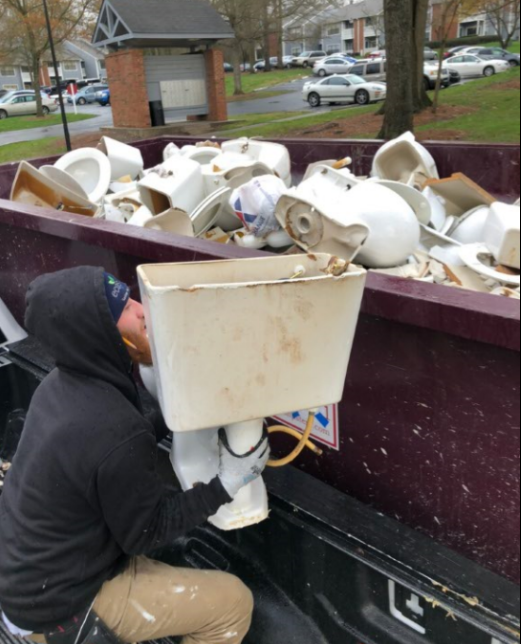
“Most of the time what that includes is full replacements of all water-using fixtures in the bathrooms and kitchens. So we’ll change out toilets, shower heads, sinks, or even just the sink aerators ,” Lamondin said.

They also inspect the apartment community looking for:

    • Any sinks, tubs, valves and supply lines that may have an existing leak
    • Any ground leaks throughout the property

”It’s very common to come across toilets that use three-and-a-half gallons per flush. Now those toilets were manufactured usually in the 70’s and 80’s and haven’t been changed since.”

And when the company is done, “We’re really saving anywhere from about 30 percent to as much as 68 percent off of water bills,” Lamondin said.

Installing new toilets without disrupting tenants 

“These days, you’re getting toilets that are flushing 0.8 to one gallon per flush with more power than those big guzzling fixtures. It is basically a simple math problem.

“If you take a three-and-a-half gallon per flush toilet and cut 75% off its water use, it’s going to save you money. The same thing in the shower heads. A typical shower head uses two-and-a-half gallons per minute. We typically put in one-and-a-half gallon per minute shower heads, and that saves 40 percent off their shower usage right there.

“We try to make conservation unavoidable. We do not seek to disrupt any person’s daily routine, that’s really embedded in our philosophy,” Lamondin said.

“Sometimes we find some fun things when we lift up the toilets. And, that is another added value of the program.

“For instance, we may lift up the fixture and find there’s a rotted floor under there. Or, there’s some cracked item or a leaky valve that may in the future cause a catastrophic leak. So we go in and harden those properties against those leaks in a multi-floor building.

“We’re in and out usually within half an hour or 45 minutes, very quickly. We try to disrupt residents as little as possible. I would say that a lot of times the management, especially property managers on site, really appreciate the efforts we go through to handle that. We have their maintenance teams opening doors for us. We have a member of the staff with us at all times so residents see a friendly face. We really make an effort to make this a positive project,” Lamondin said.

Big projects around the country to save money and water in apartments

How To Save Money And Water In Apartments

The Ecosystems team in Houston where they did 1,300 bathrooms. Lamondin is back left top.

Lamondin said his company works with another company called BH Management Services, LLC which has expanded to a nation-wide project.

“We’re doing more than 14,000 bathrooms with them over the next year nationwide. In Arizona, we did 4,400 bathrooms in the fourth quarter of last year. We’re still working on getting the savings numbers off of that, but they’re going to be saving hundreds of millions of gallons of fresh water. I have no doubt about that,” he said.

Denver project provided return on investment in nine months

“Last year we did a project in Denver for one property.” Lamondin said. “It used to be called the Breakers and now it’s called Tava Waters,” and is managed by BH Management Services.

“It was about 2,500 bathrooms in one shot. We did it in three months. Denver Water didn’t think we could do it in five months. They gave our clients the largest rebate in Colorado history. it was about $376,000 on that project. Their return on investment (ROI) was about nine months.

“This was the largest toilet rebate we’ve ever done,” Jeff Tejral, Denver Water conservation manager, said in the great toilet payback on the Denver Water site. “It was an impressive project, and they’re saving a lot of water by using some of the most efficient toilets available.” Denver Water estimates that Tava Waters will save around 33 million gallons of water each year by making the changes. Before the changes, Tava Waters residents were using about 51 gallons per person, per day; after the renovations, each person is using around 33 gallons per day.

The practical side of working with a single vendor

Mike Watkins, Director of Construction, West, for BH Management Services, said, “In the very beginning of an acquisition or refinance, we’re working with an engineer on a green study report to  identify the different items and areas where there could be efficiencies,  electrical or water. A lot of our projects to date  have been focused around  water savings.

“EcoSystems really stood out to me,” Watkins said. “I was involved in the Denver project where we had a short time frame of less than 90 days to do about 2,500 bathrooms. When I got involved with the program, and looked at how to roll this out nationally, we asked ‘Does it make sense to have multiple different vendors throughout the country doing it, or does it make sense to work with one vendor who has it down?’

“Based on their response and how they performed on the project in Denver, it was a no-brainer to work with them on the  project nationwide  That way, we have similar crews going on site and into tenant’s units, rather than having multiple different vendors. This has allowed EcoSystems to become more efficient working with our projects and our managers to continue to deliver a high level of customer service to our residents. ,” Watkins said.

Freddie Mac Green Up Program for borrowers

“BH Management has the Denver property but also 269 properties and just over 80,000 units under ownership and management,” said Kate Miller, Senior Asset Manager for BH Management Services.

“We started participating in the Freddie Mac Green Up program when it was initiated in early 2017. The benefit here is Freddie Mac recognized that in most multifamily apartment communities, the tenants paid their own utilities such as electric, gas, water, etc.. Previously, multi-family investors didn’t have a strong motivation to focus on  green improvements.

However, Miller said, “We are always cognizant of our footprint. We want to save resources, both utility-wise and financially, and we’re always trying to do the right thing. We’ve taken full advantage of the Freddie Mac loans since they were introduced, which provide for funds to be rolled into the loan at favorable loan rates to implement green initiatives within the individual units.

“It’s a program that we’re really excited about,” she said. Of their 269 properties “we’ve got 55 properties to date that are participating in the Green Up initiative. It’s really something that we’re proud of. It takes a lot of work. It takes a lot of logistics. But it’s fun to see these projects wrap up. EcoSystems been very helpful to us in tracking, so going forward we’ll be able to see the benefits of the investments being made in these properties,” Miller said.

City rebates make a difference

“Municipalities often offer rebates to encourage owners to participate in energy saving practices ,” Watkins said. “Denver had a phenomenal rebate. It basically paid for more than half of the project, which was fantastic.”

“In Phoenix, we’ve  taken advantage of smaller rebates; every market and county has their own standard for what is offered. But as far as all the cities, between Phoenix and Tempe, everything was fine. I can’t think of anything that stood out to me, where it didn’t go smoothly,” Watkins said.

Return on investment for apartment owners

Apartment owners can finance much of the cost for the water saving initiatives.

“Right now, there’s a fantastic financing opportunity through Fannie Mae and Freddie Mac for any owners purchasing or refinancing,” Lamondin said.

The programs go by different names, but “they all boil down to basically green loan programs.”

“And for owners, that can save 25 percent on their utility costs. They’re able to receive significant reductions of up to 30 basis points on the loan in basis points, basis point discount, sa well as receive back much of the cost of the project that they implement through rebates.” Whose quote is this?

“So, for example, that project in Denver was one of the early ones for that program, and they received, I don’t know officially how much, but I think about 30 basis points off of their loan in addition to the water savings. We’ve seen a lot of growth and a lot of large owners taking advantage of this program lately,” Lamondin said.

“I’d say about 18 months is our average ROI. We’ve had as quickly as three. When we do our due diligence, we ask the owner what their tolerance is in terms of an ROI. And if it goes above that – it’s the least favorite part of my job – but we recommend not performing projects if something doesn’t meet roughly about a 24- to 36-month ROI.

“We really understand the importance from a business perspective in doing this work. But I would say right now anything built before 2000 has significant potential from a conservation standpoint. And there’s about 20 million or so bathrooms in the U.S. that meet that criteria just in the multifamily industry,” he said.

Owners saving 35 percent to 68 percent

“It really all depends in terms of consumption, the amount of gallons saved, but we’re pretty steady on that savings number,” Lamondin said. “A lot of times the way bills are structured – and this is something that we teach our partners – is a large determining factor in how much savings in dollars are achieved.

“For example, you have things on your bill like a storm water charge that no one can affect. However, you also have consumption charges based on the number of gallons. That’s where we really hone in. And a lot of times people don’t understand how much of the bill they can actually affect. And so we do a lot of educating on understanding both opportunity and liability from a utility standpoint,” he said.

Millennials like apartments to focus on green initiatives

So for example, for BH Management, “We did a projection that they’re going to save about 400 million gallons of fresh water annually and just from the projects we’re going to do for them within a calendar year,” Lamondin said. “Those are significant numbers that continue to build on each other.

“I’m 30. A lot of times people in my generation do care that the place they live is doing their part to keep and stay green,” Lamondin said, and the key is to save money and water in apartments.

Resources:

Michigan State Study Affordable Water In The U.S. – A Burgeoning Crisis

A Nationwide Assessment of the Geography of Water Affordability in the United States

The great Denver toilet payback

Ecosystems

BH Management Services

Freddie Mac Multifamily Green Advantage

Four ways Miami startups are trying to save the planet


Tacoma Votes To Make Landlords Give 90-Day Notice Before Evictions

The Tacoma City Council has adopted a temporary ordinance that requires property owners to give 90 days notice to tenants who are being evicted due to building demolition, renovation or change of use.

That ordinance will expire at the end of September, but the city council said it’s working on something more permanent.

The new temporary ordinance came after council members  voted to look into tenants’ rights issues and landlord-tenant laws after a hearing involving residents at the Tiki Apartments who had been facing evictions after a 20-day notice, according to reports.

The temporary ordinance is intended to provide interim enhanced protections as the city develops further recommendations to address housing and tenant protections for City Council consideration.

“Having experienced homelessness in my life I understand the hardship caused by the affordable housing crisis and the need for enhanced tenant protections,” Councilmember Keith Blocker said in a release.“To address the immediate needs of the residents at the Tiki Apartments, we have been in contact with the new property owner, who has agreed to provide additional time for tenants to relocate and extended the notice of eviction to June 30, 2018. The city is committed to continued coordination of service delivery with our community partners to ease residents’ transition as we begin to work toward long-term solutions for our community.”

The ordinance will not address the emergent need of residents who have already received notification of termination of tenancy, yet city leaders recognize the urgency for assistance according to the release.

“The rising cost of housing in Tacoma impacts us all, but being displaced in this climate creates a particular hardship for our most vulnerable neighbors,”  Mayor Victoria Woodards said in the release.

“While the landlord in this case offered to go beyond the minimum requirements of the law, we as leaders need to ensure that other tenants in the city have sufficient time to relocate and to access the services they need to keep a roof over their heads,” she said.

Evicted residents given until end of June

With the passing of the temporary ordinance, the residents now have until the end of June to relocate.

Initially, the council voted unanimously to direct City Manager Elizabeth Pauli “to look into options for expanding tenant rights, while working with tenant and landlord groups to build a consensus, and to bring possible recommendations to be discussed at an upcoming Community Vitality and Safety Committee meeting,” according to the Tacoma News Tribune.

On April 5, the Tiki Apartments on South Highland Avenue were purchased by CWD Investments, a Seattle-based company, according to KIRO-TV. Residents in all 58 units received a notice from Allied Residential, the third-party company that now manages the property. The notices indicated that residents in half of the units have until April 30 to vacate. Residents in the other half have until the end of May.

The tenants have been renting month-to-month and Washington law only requires a 20-day notice to move, according to reports.

The notice said that the property will be “going through a major renovation in the next few months” and offered “a one-time relocation benefit of $900 … exchanged for your apartment keys on the prearranged move out date,” according to the newspaper.

Chad Duncan is the lone registered member of CWD Investments LLC, according to the newspaper, and he said in a statement, ““We intend to work with those in hardship that communicate such. We are not heartless.”

Ordinance deals with evictions

Mayor Woodards  initially called the emergency public meeting which resulted in the temporary ordinance and an extension of time to the end of June for the Tiki Apartments residents, many of whom have nowhere to go and don’t have the means to pay first and last month’s rent as well as a deposit for a new place on such short notice.

Woodards also directed Pauli to look into any possible violations of landlord-tenant law that may have occurred at the Tiki Apartments and other Allied Residential properties as alleged by some speakers at a recent council meeting.

Roger Valdez with Seattle for Growth told the television station that what happened at the Tiki Apartments may become more common in places like Tacoma. Tenants say the building has been run down for years. Housing experts think that leaves developers with few options.

“You see people who are benefiting from years and years of deferred maintenance in lower rent and then it all catches up,” he told KIRO-TV. “It’s an unfortunate situation but we’ve seen it a lot in Seattle.”

Resources:

Tacoma examining rental laws after evictions

Emergency Tacoma council meeting planned to discuss evicted Tiki Apartment residents

New Tacoma landlord to desperate tenants he’s evicting: ‘Moving will be an improvement’

Families told to leave Tacoma apartments: ‘It’s so scary it brings tears to my eyes’