Home Blog Page 189

Multifamily Investors Face Shortage Of Quality Assets

Multifamily Investors Face Shortage Of Quality Assets

Multifamily investors are finding a shortage of quality assets, particularly in the value-add category, according to a new report.

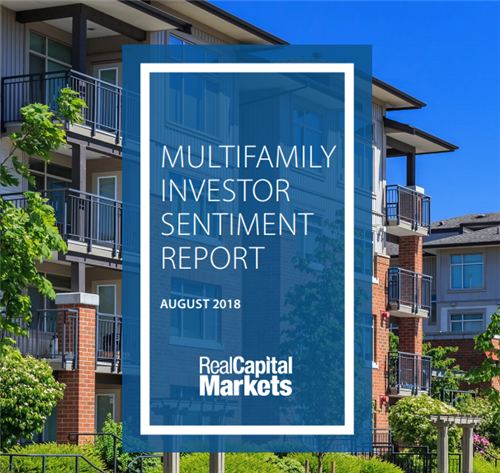
Strong market fundamentals, an abundance of capital, and an influx of investors continue to propel the U.S. multifamily investment market, according to Real Capital Markets’ 2018 Multifamily Investor Sentiment Report.

Experts interviewed by Real Capital Markets in July 2018 noted that underlying fundamentals shaping rental demand continue to draw a wide range of investors into the multifamily sector, despite upward movement in interest rates, according to a release.

“Overall, the commercial real estate market—and particularly the multifamily sector—remains strong, with significant capital, both domestic and foreign, looking to be placed,” Tina Lichens, COO, Real Capital Markets, said in the release.

“The challenge for many investors is finding quality assets at reasonable prices,” she said.

Statistics on rents per square foot, cap rates, sales prices and unit completions, aggregated by the National Multifamily Housing Council demonstrate the continued strength of the multifamily sector. Moreover, mid-year sales statistics reported by Real Capital Analytics showing $69.8 billion in mid-year multifamily sales underscore the findings of the RCM Report.

RCM surveyed its U.S. database of multifamily investors and conducted follow up interviews to gauge investor sentiment on various topics.

Multifamily investors sentiment report

Highlights of the Multifamily Investor Sentiment Report include:

;

    • Market Thrives with Capital Chasing Deals—According to experts interviewed for the report, there is at least $250 billion in capital already committed to commercial real estate, with much of it likely focused on the multifamily sector. This capital is coming from a range of investors including institutions, private equity, REITS, as well as private and public funds. The product types they are chasing most include garden and suburban style apartments, followed by urban style apartments.
    • Interest Rates are a Looming Threat—Most industry experts interviewed, and 69.7 percent of survey participants, ranked interest rates as a looming concern, as the market has already absorbed 12 to 18 months of increases and spreads are very thin. The consensus is that further rate hikes will be difficult for lenders to absorb. This increased cost may cause investors to modify strategies.


    • Value-Add Remains Hot, but Elusive—Approximately 58 percent of Investors are looking for 1970s and 80s rental properties that need upgrades but are finding fierce competition and an upward tick in pricing.
    • Job Growth is Driving Multifamily Activity—In many core and secondary markets across the country, strong employment, often from the tech sector, is fueling growth in the multifamily sector.
    • Fundamentals Look Strong—With national and individual market vacancy rates fluctuating as new supply is brought online, more than half the survey participants believe that further increases in vacancy rates are likely, but the level of increase will be only marginal. Nearly 65 percent believe that rents will increase at least marginally. Given these factors, while almost one third of investors see a slight slowing of the market, approximately 66 percent of investors believe the market will maintain at current levels and remain strong.

“Housing is one of the most fundamental needs, regardless of income level or socio-economic status,” Steve Shanahan, Executive Managing Director, Real Capital Markets, said in the release.

“Investors will continue to leverage those intrinsic needs, as well as strong market fundamentals, to create and take advantage of a steady stream of investment opportunities.”

Multifamily investor fundamentals remain strong

The report says the fundamentals of the market remain strong because fewer people  want or are able to afford home ownership. Thus the demand for apartments remains high and as such, competition to invest in the market is equally strong.

;

    • Rents per square foot: Rents have increased for the seventh consecutive year to $1.44 per square foot nationally. This represents more than a 16 percent increase since 2014 when the rate was $1.24 per square foot.


      • Cap Rates: For the last four years the multifamily market has continued to see cap rate compression. While the rate of compression has slowed—year over year it declined by 10 basis points to 5.6 percent in 2017— the overall compression since 2014 is 70 basis points.

</ul

        • Sale prices: In each of the last eight years, the average sale price per square foot has increased, reaching a peak of $196 per square foot at year end 2017. During the eight consecutive increases, prices have jumped 56.8 percent, from $125 per square foot in 2009.
        • New product completions: Year-end completions in 2017 totaled 347,000 units, the sixth consecutive year that annual completions increased. During that run, a total of approximately 1.6 million units were completed.
        • Vacancy rate: The only metric that is not altogether positive for the sector was the national vacancy rate. At year end of 2017 the national vacancy was 8.6 percent, a sizable increase from 2015’s rate of 7.4 percent, but still lower than the 2013 rate of 9.1 percent. The increase in vacancy can be attributed to the significant level of new construction that has taken place

To download a copy of the Real Capital Markets’ 2018 Multifamily Investor Sentiment Report, click here.

About Real Capital Markets:

Founded in 1999, Real Capital Markets (RCM) is the global marketplace for buying and selling CRE. RCM increases the speed, exposure, and security of CRE sales through its streamlined online platform. Solutions include integrated property marketing, transaction management, and business intelligence tools to unify broker-level and firm-level data and work flows. RCM has executed over 62,000 assignments with total consideration in excess of $2.1 trillion. Approximately 50% of all U.S. commercial assets sold, over $10 million, are brought to market using RCM’s online marketplace annually.


Only 41 Percent Of Renters Carry Renters Insurance

Only 41 percent of renters carry renters insurance, a substantial difference from 95 percent of homeowners who carry homeowner’s insurance policies, according to a new poll from the Insurance Information Institute.

The number of renters has reached a near all-time high of 43 million according to the current population survey/housing vacancy survey at the U.S. Census Bureau.

“Many renters underestimate both the value and affordability of renters insurance,”  Mendi Riddle, vice president of product and pricing for Nationwide’s personal lines, said in a release.

“Not only does renters insurance provide coverage for belongings inside the residence should those items be stolen, destroyed or damaged, but the coverage may also extend to personal items renters keep inside their vehicle. Additionally, renters insurance helps pay for covered damage or bodily injury to others caused by an accident that may occur at their residence,” she said in the release.

3 myths about renters insurance

    • Myth: A landlord’s insurance policy will cover a renter’s personal belongings in the event of fire or theft.Truth: While a landlord’s insurance policy will likely cover the dwelling and infrastructure of that dwelling, that coverage typically does not extend to the possessions owned by the renter.
    • Myth: Renters insurance is expensive.Truth: On average, renters insurance costs less than $20 per month.
    • Myth: Renters insurance coverage is limited.Truth: A renters insurance policy typically provides coverage for the loss or destruction of personal belongings in the event of a covered peril.

What a renters insurance policy typically covers

    • Theft
    • Fire
    • Lightning
    • Windstorm
    • Hail
    • Frozen plumbing system
    • Vandalism

Renters insurance may also provide coverage if:

    • A renter is forced to temporarily move out of their home due to a covered loss.
    • A person is injured in the renter’s apartment or home and requires medical attention.
    • Items a renter keeps inside their vehicle are damaged or lost.

Based on Nationwide claims data, the following were the most common renters insurance claims submitted by its members in 2017:

    • Theft (from dwelling or vehicle)
    • Water damage (non-weather related)
    • Fire and smoke damage
    • Liability
    • Wind related

“Having to replace possessions such as clothing, furniture and electronics can be very expensive should they be suddenly lost due to a fire or other tragic event,” Riddle said in the relase.

“Renters insurance provides peace of mind allowing renters to keep their lives on track should a major setback occur.”

Expenditures homeowners and renters insurance

The average homeowners insurance premium rose by 3.6 percent in 2015, following a 3.3 percent increase in 2014, according to a January 2018 study by the National Association of Insurance Commissioners. The average renters insurance premium fell by 1.1 percent in 2015 after rising 1.1 percent in 2014, according to the Insurance Information Institute which provided the comparison.

About Nationwide

Nationwide, a Fortune 100 company based in Columbus, Ohio, is one of the largest and strongest diversified insurance and financial services organizations in the U.S. and is rated A+ by both A.M. Best and Standard & Poor’s. The company provides a full range of insurance and financial services, including auto, commercial, homeowners, farm and life insurance; public and private sector retirement plans, annuities and mutual funds; banking and mortgages; excess & surplus, specialty and surety; pet, motorcycle and boat insurance. For more information, visit www.nationwide.com.


How to Protect Your Rental Property’s Fence From Wind Damage

3 tips to protect your rental property fence

Rental property fence maintenance and repair can be an issue when big Summer storms hit so the maintenance checkup this week from Keepe focuses on rental property fences.

If you own a rental in an area with high winds, you’ve probably experienced a few damaged fences and the dilemma that follows after – repair or replace?

To prevent your fence from being destroyed, take some preventative steps and ensure that you’ve got the right fence for your climate. Plus, learn the best fence types to withstand the wear and tear of the peak wind season.

3 tips to protect your rental property fence

    1. Trim the trees near the fence line: a large portion of wind-damaged fences are a result of trees or tree debris falling and colliding with fencing. Before the wind season returns, take some time to confirm that your landscape is free of yard debris and other vegetation. Furthermore, maintain the trees surrounding your property, a simple trimming or removal can prevent a costly fence repair.
    2. Remove yard objects: similar to tree debris, maintaining a clean, object-free landscape is key to avoiding damage from wind-blown objects. Many times, fencing damage doesn’t result from the wind itself, but from collisions with things such as outdoor chairs, garden tools, patio umbrellas, trash cans or sheets of wood.
    3. Regular inspection: property owners should regularly review the health of their property fences for signs of damage. Looking for visible signs of wear and tear can lead to cost-effective repairs.
  1. 3 tips to protect your rental property fence

If your fence is damaged should you repair or replace?

Depending on the size of the damage and what your long-term costs are for fencing, it might be best to fully replace your fence rather than conducting a repair.

Problems such as holes in the wood and staining on the wood are usually alerting to a deeper issue that involves issues involving microorganism activity as well as general rotting and molding from extreme weather. Un-repairable damage is important to address quickly and effectively to avoid further complications. Ensure your property manager is aware of the severity of any issues involving your fencing.

Damage such as broken or missing boards, leaning fences, and small splintering of wood are signs of a structural weakness. In these cases, the weak parts of the fence can be replaced or  repaired. Since these accidents can lead to further damage, it is ideal to address these issues immediately. Reinforce loose posts and partially replace broken, splintering and missing boards. If the damage is larger than one section or the issue is recurring, investing in a complete fence replacement solution will likely be more cost-effective for your property manager.

Finding the best fence type for your property and environment is crucial when addressing fence replacement and repair. The best wind-withstanding fences include those made from materials such as aluminum, iron and vinyl. If your in an area where it’s windy and rainy, a durable steel or iron fence would be ideal. For those in extreme climates, make sure your metal fencing has a thick, multi-layered finish or sealant to help avoid weather related damage. If privacy is a priority, a vinyl fence might be more fitting.

Wooden fences and gates are also other choices that prioritize style and design. To avoid durability issues with wooden fencing, be sure to use metal posts to regain further durability. Furthermore, to preserve the wood and avoid early decay, make sure your property manager to stains and re-stains your fence every 3-5 years to maintain its strength and beauty.

Evaluating the condition of your fence should be a part of you and your property managers’ regular maintenance routine. To accurately determine if it’s time to repair or replace your fence, be sure to contact a professional contractor.

Other recent rental property maintenance Keepe posts you may have missed:

4 Outdoor Flooring Options For Your Rentals

20 Easy, Affordable Maintenance Projects To Update Your Rentals

About Keepe:

Keepe is an on-demand maintenance solution for property managers and independent landlords. The company makes hundreds of independent contractors and handymen available for maintenance projects at rental properties. Keepe is available in the Greater Seattle area, Portland, Phoenix, San Francisco Bay and San Diego areas.


Portland Rental Property Owners Plan To Fight City Hall And State

Portland rental property owners, managers, builders and building suppliers feel they are under attack from Portland City Hall and the Oregon Legislature and have mounted a campaign against proposed regulations.

The group has launched a website called More Housing Now! in support of more housing for all income levels and to “provide a voice of reason” on the issues.

Multifamily NW, Rental Housing Alliance Oregon (RHAO) and the Oregon Rental Housing Association (ORHA) formed More Housing Now!  to “mobilize and provide the first unified voice for landlords and property managers throughout the state,” the group says on the website. They say their work consists of lobbying, media relations and social media. The group says they plan to raise $2 million to “defeat inequitable initiatives pushed by activists and ill-informed politicians.”

Active voice to make people aware of the issues

“We are long-term stakeholders in the Oregon apartment market,” said Tom Brenneke, board president of the non-profit lobbying organization, More Housing Now!. “We have a great interest in a range of issues. Our hot buttons at the moment are rent control. And those kinds of issues that involve government intervention in our market, which has been a real problem.

“What we are trying to do is be an active voice and put pressure on politicians and constituents to make them aware of issues people just miss in the day’s news. They are important issues, though. They impact businesses. We cannot hire people because they have to travel too far or they don’t have housing. Those are big issues.

“We are very focused at the moment on things like rent control. That is an easy one to understand,” Brenneke said.

Oregon’s housing market is one of the hottest in the country, with more than 100 people moving to Portland alone each day. While overall this is a net-positive, more people are moving there than there are places for them to live, the group says on the website.

Highlights of Portland rental property owners issues and what they say

    • Portland rental property owners, managers, builders and building suppliers are under attack.
    • City government has made it prohibitively complicated to build more rental housing in the midst of an affordable housing crisis.
    • Activists have manipulated Portland City Hall and the Oregon State Legislature to create threats to property owners and managers, developers and their vendors.

Portland rental property owners face barriers to construction

“To compound matters, our local government hasn’t modernized with the changing times, and instead continues to create layers of bureaucracy that slow down the development of more housing for citizens in all income brackets,” the group says.

A recent study of the private and public sector by the National Apartment Association showed barriers to affordable apartment housing mean developers cannot get new units off the ground in many cities often due to high construction costs, land availability and costs, development fees, impact fees and community opposition.

The NAA study also referred to Nimbyism (not in my backyard) groups showing up in 70 percent of the responses from public officials as being one of the top 3 problems. “Plenty of folks in city planning and city government know that the approval process is complex,” the NAA said in the report.

Some smart people at city hall, but pressure from aggressive tenant groups

“There are some smart people in the city,” Brenneke said. “Our mayor, look at the mayor and his credentials, Harvard, Stanford, Columbia.  He’s a smart guy. I know him well.

“But you’ve got a very aggressive, vocal group of tenant advocates in this town and state who don’t care about economics,” Brenneke said.

“I know darn well what the mayor and the smart people at the city really think. Deep down they understand rent control is not a solution. But they are buckling to these very, very loud, aggressive tenant advocates,” Brenneke said.

Six years to build new apartments makes it hard

“Fundamentally it’s a supply-and-demand issue. We have more people coming than we have housing for,” Brenneke said.

“Today’s luxury housing is tomorrow’s affordable housing. Half of my business is affordable housing. This is what I do. So I understand the mechanics, the regulations and the finance on affordable housing. It is incredibly expensive to build housing targeted toward a 50 percent AMI (area medium income) household. And you add on all the government bells and whistles they have to have – green this, green that, you know it’s expensive.”

He said the city can get its own way. And, much power has been handed over to neighborhood groups.

Brenneke said he is “the poster child” for the issue; one of his deals has been in the works for six years.

“I have been through two plans, multiple appeals, now at the court of appeals, etc. I should have had this deal delivered four years ago.

“I will be six years delivering apartments,” Brenneke said.

“Meantime, costs are going up and rents are actually coming down in the market. So my deal is getting tighter and tighter as we wait,” he said.

Resources:

The voice of reason providing More Housing Now! to Oregon

Oregon needs more housing now

Landlords pep for new fights with Portland City Hall, Oregon Legislature


No Fire Sprinklers:13 Dead, Nearly 500 Homeless From 4 Fires In 11 Days

A mother and her five children, ages 2 through 10, were killed in a fire at an extended-stay hotel in Benton Harbor, Michigan, on July 27, 2018

Several others were taken to the hospital with injuries from the fire at the Cosmo Extended Living Hotel, which was reported about 1:45 a.m. The hotel was built as a Howard Johnson in 1962.

    • Five more people died in an off-campus apartment fire in San Marcos, Texas on July 20; four were Texas State University students. At least 200 more residents were affected by the fire, which was reported about 4:30 a.m. at the Iconic Building Apartments. A student who survived is in the hospital with 3rd degree burns over 70 percent of his body. The apartments were built in the 1970s.
    • Two women died in an apartment fire in Westminister, Colo., on July 22. Fourteen more people were injured, some of whom had jumped from two- or three-story windows to escape the fire at the Westbury Apartments, which was reported at 2 a.m.
    • The apartments were built in the 1970s and fire sprinklers were not required.


Fire sprinklers buy time and save lives

Most people don’t realize how quickly fires spread in real life,” Shane Ray, President of the National Fire Sprinkler Association (NFSA), said in a release. “Smoke is so thick that you can’t see, and flames can engulf a room in seconds.  Fires on TV and in movies don’t show the real danger and they create myths about fire sprinklers; they don’t all go off, only the one closest to the fire. Fire sprinklers buy time and time buys life.”

None of the buildings had fire sprinklers, which are required in new construction but not in existing buildings unless they are being extensively renovated. Nor did the River Trails Condominium complex in Prospect Heights, Ill., that left dozens homeless on July 18. Authorities believe that fire would also have caused fatalities if it had occurred at night, like the others did. River Trails was built in the 1970s.

Because of the lack of sprinklers, all the buildings were fully engulfed by the time firefighters arrived.

After a 2017 fire that killed three people in a residential tower in Honolulu, the Associated Press took a look at fire-sprinkler policies in major cities across the United States.

The policies vary widely – New York City requires sprinklers to be installed in older buildings that are 100 feet tall or more; Los Angeles requires sprinklers in residential buildings built before 1943 that are three stories or higher. Some cities require requires sprinklers in high-rise commercial towers, but not in residential buildings; Chicago, Philadelphia and San Francisco are some of these. Dallas does not require sprinklers, though city officials count 89 high-rise residential buildings in the city; 23 have partial sprinkler coverage.

Houston, San Antonio and San Jose are some of the few cities that require retrofitting of all residential buildings. San Diego had such a law but it was later taken out of the municipal code.

As inconsistent as requirements are in major cities, buildings in smaller cities or suburbs are even more unpredictable as to their sprinkler requirements. The safest thing to do, according to the NFSA, is to make sure that any apartment, condominium or hotel room you or your family stays in has a fire sprinkler system.

If you are staying or living in a place without fire sprinklers, the NFSA recommends these precautions:

    • Interconnected smoke alarms in common areas, in all bedrooms and on every level;
    • An escape plan, with two ways out from each bedroom;
    • Portable escape ladders in every bedroom above ground level.

The National Fire Protection Association (NFPA) says that myths about automatic fire sprinklers including thinking that smoke alarms provide enough protection, that they leak or activate accidentally, that when one activates all will activate, ruining items even in rooms that are not burning, or that they aren’t practical in colder climates, where pipes can freeze. None are true.

Resources:

The Associated Press

Detroit Free Press

KXAN, Austin, Texas

9News, Denver

National Fire Protection Association

National Fire Sprinkler Association


Apartment Jobs Account For One Third Of All Real Estate Jobs

A new report from the National Apartment Association says apartment jobs across the country account for one-third of all the real estate jobs in the nation.

In Portland it is even higher.

Apartment jobs in Portland represent 54 percent of all the real estate jobs in the metro area according to the report which ended with the second quarter in June.

Apartments remained a favored asset class for investors and have regularly out-performed other real estate sectors during this cycle.

Continued strong demand for apartment jobs especially property managers

Over 71 percent of apartment industry jobs fell within the property management, leasing and maintenance categories.

Property managers, in particular, were in higher demand this year although all sectors witnessed increases thanks to continued strong demand for apartments.

The jobs report focuses on jobs that are being advertised in the apartment industry as being available, according to Paula Munger, Director, Industry Research and Analysis, for the National Apartment Association’s Education Institute.

“Our education institute is a credentialing body for the apartment industry. They hear often that one of the biggest problems keeping our industry leaders up at night is the difficulty in finding talent, attracting talent and retaining talent,” Munger said.  “Labor-market issues are happening in a lot of industries, certainly with the tight labor market we have.”

So NAA decided to partner with Burning Glass Technologies. “They have a labor-job posting database that is proprietary,” she said, and they can “layer on data from the Bureau of Labor Statistics (BLS). We looked at that and thought we could do something that is really going to help the industry and help benchmark job titles and trends as we go forward.”

Apartment Jobs Account For One Third Of All Real Estate Jobs

Customer services most desired apartment jobs after property management

Other job sectors often compete for candidates with similar skills sets to those apartments need.

Outside of the specialized skill of property management, customer service is the most desired skill in the apartment industry, as it is in retail trade and hospitality.

During the second quarter, mean salaries for apartment job postings surpassed both sectors, by 12.8 and 29.4 percent, respectively.

There was also a smaller concentration of lower-paying apartment jobs (under $35,000) which bodes well for the industry in this extremely competitive labor market.

Apartment Jobs Account For One Third Of All Real Estate Jobs

The turnover rate challenge

Ellis Management Solutions has statistics showing the national turnover rate for jobs is 19 percent but in the multifamily industry it is 39 percent.

“I think, I’ll state the obvious, with the high turnover, you are going to have to go out to the market more often to keep your positions filled,” Munger said. “I actually have another report from CEL and Associates a company out of LA, and theirs is more like 32 percent turnover rate for the multifamily industry. But the maintenance job, the on-site maintenance job, is almost consistently the highest turnover year after year.

“Like any other industry, with a lot of turnover, there is that time that has to be taken out to bring the person on board, to do other hiring activities like background checks. So it’s costly and that certainly does not help the bottom line


NAA Study: Barriers To Affordable Apartment Housing In Many Cities

Barriers to affordable apartment housing  mean developers cannot get new units off the ground in many cities according to a new National Apartment Association study.

By John R. Triplett

Rental Housing Journal

The challenges developers face in trying to build affordable housing apartments is the focus of the study by the National Apartment Association (NAA), using four key cities as pilot projects.

While developers know the roadblocks they hit in trying to build affordable apartment housing, local city planning officials and city government officials are also aware of the problem, said Paula Munger, Director of Industry Research and Analysis for the NAA, in an interview.

The pilot cities study came from research showing a need for 4.6 million new apartments by 2030.

A few highlights from the barriers to affordable apartment housing study:

    • The cost of construction, including land costs and fees, are the most common factor affecting new development.
    • Of the four cities in the pilot – San Diego, New York City, Austin and Miami –  San Diego has the greatest number of restrictions, from land availability to community involvement.
    • New York has high construction costs and land availability issues, plus the highest multifamily property tax in the country.
    • Miami has land availability issues due to being on the water.
    • Austin has rising construction, land, labor and impact fees.

“We commissioned a group called Hoyt Advisory Services to look at future demand for apartments,” Munger said.

Munger was referring to a report that “paints a dire picture of apartment availability between now and 2030.”  According to the report, the U.S. housing market will need 4.6 million new apartment homes at all price points by 2030. GlobeSt.com’s Erika Morphy writes that the “apartment industry is quickly exceeding capacity.” Overall, nearly 39 million people live in apartments.

She said “an offshoot of that study was looking at the correlation between affordability and difficulty building new multifamily apartments. The Hoyt group looked at an old (2007) land use index that the University Of Pennsylvania Wharton School Of Business put out and ranked 50 metro areas according to how difficult it was to build. They did a little bit of updating.

“Then we decided to expand upon that, because the Wharton Index was over 10 years old. These four markets are the beginning of that expansive research.

“This is a 70-question survey. It’s pretty intensive, asks about how long it takes to get things approved, how much costs have changed over time, etc., etc. We wanted to dig into it some more because we know its impact. The more difficult it is to build, you can’t meet the demand for apartments. That’s what causes the affordability issues,” Munger said.

Why were these four markets chosen?

“One, we wanted a good geographical dispersion. We have New York, Miami on the East Coast, we have Austin in the middle, and San Diego on the West Coast, different-sized markets.

“We do have these rankings of the 50 metro areas that are mostly based on this 2007 index with some updates. New York, Miami, and San Diego were showing up as difficult to build in with a lot of barriers. Austin was not. Clearly the markets where it was difficult, we wanted to expand upon. We also wanted to look at one, Austin, where it wasn’t so difficult, relatively speaking of course. We chose Austin for that just so the research team could see how the survey performed with both spectrums,” Munger said.

Seattle in top 10 of cities with barriers to affordable apartment housing

In addition to the four cities used in the pilot study, the NAA has the rankings of the top cities where it is most difficult to build affordable apartment housing.

“Certainly Seattle is in the top 10 most difficult to build from the research that hasn’t yet been updated, and Portland is down around 20,” Munger said.

What action can the NAA take?

“We can try to make recommendations to policy leaders and legislators,” Munger said.

“The one-page reports on those four markets are geared towards that, geared to really bringing the problem to light:

    • These are the barriers.
    • This is why we can’t build.
    • This is why we don’t have enough supply to meet the demand.

“We can make policy recommendations. If you go to our website, weareapartments.org, and we have a document. It’s called Vision 2030. There are some policy recommendations in there.

“We do advocate on behalf of the industry, and affordability is part of that in issues such as  outdated zoning laws; we also advocate for “by-right” development, expedited approval for affordable housing, and density bonuses. Those are just a few issues our Government Affairs team is focused on, as well as the other recommendations in Vision 2030.

Construction costs a problem in all markets

“Construction cost showed up as being a problem in all of the markets, rising construction cost in particular. Land cost, and fees, and labor,” Munger said.

She said NAA will be starting the second phase of the project in the next couple of weeks and “we’ll roll out the survey on a national basis.

“Depending on where we get a statistically significant number of responses, those will be the next few markets to be released. I don’t really have a list of what’s upcoming. They’ll self-select themselves based on responses,” Munger said.

Barriers to affordable apartment housing summary

It was important that this study be balanced between apartment developers in the private sector and those in the public sector, Munger said.

“We ended up getting about two-thirds private and a third public. I think when you dig into the public sector responses, there’s certainly a variance between public and private in terms of their perception of the process.

“But I was also surprised that there’s plenty of folks in city planning and city government that know that the approval process is complex. They know that it can take so long. Nimbyism (not in my back yard) showed up in 70 percent of the public responses as being one of their top three problems.

“I guess just the point being that both sides are recognizing that this is an issue, and that’s a very good thing. Hopefully that means we can make some headway going forward,” Munger said.

Munger and the NAA hope that by exploring problems in apartment construction in various cities, more people will understand why costs rise and rents increase – and what has to be done to help ease the situation.

“I’m hoping that (it) helps when people see that these are barriers. Different cities have differing degrees of these barriers, but they’re all common in that they exist and that they impact the supply.

“The other thing to remember too is that it just varies widely state-to-state, jurisdiction- to-jurisdiction, sometimes even within the same metro area,” Munger said.

Here is some more detail from each of the cities in the report

Austin has environmental restrictions plus rising land and construction costs.

NAA Study: Barriers To Affordable Apartment Housing In Many Cities

This high growth market ranks 6 of 50 metro markets for forecasted growth through 2030.

Given the high demand, the market is facing significantly rising construction, land and labor costs. Larger developments can more easily absorb impact fees, creating concern as to the financial feasibility of smaller-scale apartments.

The market is significantly impacted by protective environmental standards which are frequently stated as a costly and time consuming process issue. Building codes are under review with revisions expected later this year. Respondents particularly rank influence of local councils and local residents, namely citizen opposition to growth as strong influencers on residential building activity, which creates a more complicated structure and entitlement process and often requires a real estate advocate and/or community relations specialist to assist the development team.

As one of the fastest growing renter population bases, this market has a relatively new rental stock with only 21% of apartment units built before 1980 and only 17% of rental housing stock in STAR units, the lowest share of older, readily affordable rentals in 50 national metros previously surveyed.

Miami land availability and environmental restrictions

NAA Study: Barriers To Affordable Apartment Housing In Many Cities

As is typical for coastal markets, land in Miami is constrained by natural barriers.

The metro scores high in the number of conservation bonds passed in the past ten years and survey respondents rate the impact of environmental restrictions and their mitigation as important factors in regulating and impacting new apartment development, particularly near the coast.

Land availability ranks the highest barrier, followed by the environments issues above, land and construction costs. Costs are particularly affected by impact fees and waivers are generally not available in lieu of fees. Community involvement remains a significant barrier. Here, survey respondents note that community meetings and engagement are a requirement before the presentation of any zoning or rezoning application.

Local council is rated the strongest in terms of organizations that influence apartment building activity. Miami political structure was ranked the fifth most significant barrier, a nod to the vagaries of metro politics, followed by infrastructure and density and/or growth issues amid a rising demand for more upscale and affordable rental units. Those rental households paying more than 35% of income on rent is the highest share in 50 national metros previously surveyed.

New York City has land availability issues and costs

Not unexpectedly, construction and land costs as well as general land availability were rated as the top factors influencing the new apartment market in New York City.

NAA Study: Barriers To Affordable Apartment Housing In Many Cities

The city also has the highest multifamily property tax rate in the country with complex rent control laws, and can have lengthy submission and appeal processes for housing developers. Respondents then listed affordable housing requirements and the entitlement process as restrictive, followed by community involvement. Community meetings before zoning requests was a particularly significant influence.

The complexity of the NYC urban market is particularly extreme when compared to other metros in the number of submissions and percent of projects that require property tax or other public subsidies. Also, environmental restrictions have significant impact on new apartments. Interestingly, less significant factors include infra-structure and political structure, particularly involvement of county and state level legislative and approval processes versus City actions.

San Diego land availability and environmental restrictions

NAA Study: Barriers To Affordable Apartment Housing In Many Cities

A highly desirable, land-constrained market, San Diego metro has multiple factors ranked high for their impact on apartment development.

Respondents particularly noted that citizen opposition to growth influences the development process through an array of advocacy groups, public votes to circumvent council or planning commissions, repeated lawsuits, and numerous community meetings required before zoning or rezoning. Construction costs are driven up by the high number of impact fees, lack of waivers or processes to mediate fees, and high and increasing land costs.

In addition to coastal restrictions, environmental restrictions and mitigation, the area ranks high in the number of conservation bonds passed at the local and state level in the past ten years including the California Environmental Quality Act (CEQA).

Metro experts also noted process and political structure issues that create uncertainty and delays in the entitlement process. Complex approval structures requiring multiple submissions to approve developments are frequently cited. More than most metro markets, these top issues present formidable barriers to new apartment supply amid strong demand ahead.

Resources:

National Apartment Association

New Report Highlights the Need for 4.6 Million Apartments By 2030

A New Measure of the Local Regulatory Environment for Housing Markets: The Wharton Residential Land Use Regulatory Index

U.S. Apartment Demand – A Forward Look

The Country Needs 4.6 Million New Apartments By 2030. How Many Are Needed Near You?


Portland, Seattle Apartment Rents Lag As Other Metros Increase For Sixth Straight Month

The national apartment rents index is up 0.1 percent month-over-month in the peak of the rental season, marking the sixth straight month of increasing rents, except in Portland and Seattle where rents have declined slightly, according to Apartment List.com.

Year-over-year growth now stands at 1.2 percent, lagging the rates from the two prior years.

“While rents were increasing at a fairly fast clip over in May and June, things cooled off in July with a modest 0.1 percent month-over-month increase,” according to Chris Salviati, housing economist at Apartment List.


“This slowdown is notable, given that we’re still in the midst of the summer months when rental activity is generally at its busiest. For comparison, month-over-month rent growth for July was 0.4 percent in each of the two prior years. This month’s data serves as further evidence of softness in the market, as rent growth over the past year remains sluggish compared to the previous two years.


“Year-over-year growth currently stands at 1.2 percent at the national level, which is well below the 3.1 percent rate we saw this time last year as well as the 2.8 percent rate from July 2016. Rent growth is also pacing well behind the overall rate of inflation, which stands at 2.9 percent as of the latest data release, and is similarly lagging growth in average hourly earnings which have increased by 2.7 percent over the past twelve months. With the homeownership rate continuing to trend upward and more new supply slated to come online throughout the year in many markets, it’s possible that rent growth will continue to be sluggish, a welcome bit of relief as millions of our nation’s renters continue to struggle with housing affordability.


Portland, Seattle show apartment rents declines


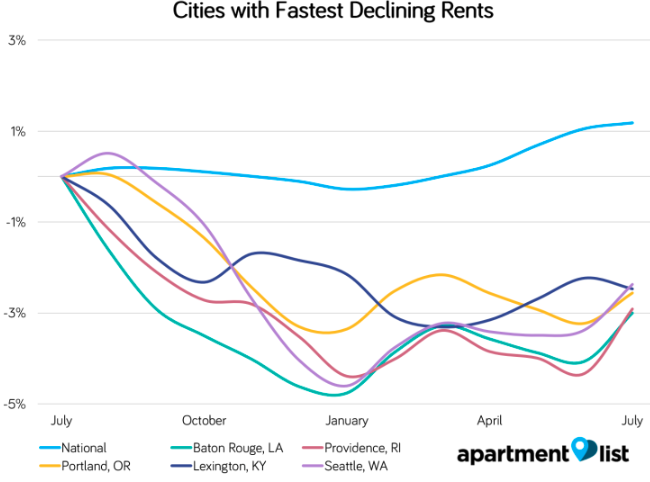
Only 23 of the 100 largest cities have seen rents fall over the past year, though an additional 24 saw modest gains of less than 1.0 percent. The chart below shows trends for the five cities where rents declined most:


Portland apartment rent report


Portland, Seattle Apartment Rents Lag As Other Metros Increase For Sixth Straight Month


Portland rents have increased 0.7% over the past month, but are down significantly by 2.6% in comparison to the same time last year. Currently, median rents in Portland stand at $1,130 for a one-bedroom apartment and $1,330 for a two-bedroom. Portland’s year-over-year rent growth lags the state average of -0.9%, as well as the national average of 1.2%.


While rent decreases have been occurring in the city of Portland over the past year, cities in the rest of the metro are seeing the opposite trend. Rents have risen in 8 of the largest 10 cities in the Portland metro for which we have data. Oregon as a whole logged rent growth of -0.9% over the past year. Here’s a look at how rents compare across some of the largest cities in the metro.


    • Looking throughout the metro, Hillsboro is the most expensive of all Portland metro’s major cities, with a median two-bedroom rent of $2,030; of the 10 largest cities in the metro that we have data for, Hillsboro, where a two-bedroom goes for $2,030, is the only other major city besides Portland to see rents fall year-over-year (-0.3%).


    • Springfield, Vancouver, and Corvallis have all experienced year-over-year growth above the state average (3.1%, 2.9%, and 1.9%, respectively).


Portland rents more affordable than many similar cities nationwide


As rents have fallen significantly in Portland, many comparable cities nationwide have seen prices increase, in some cases substantially. Portland is also more affordable than most other large cities across the country.


    • Portland’s median two-bedroom rent of $1,330 is above the national average of $1,180. Nationwide, rents have grown by 1.2% over the past year compared to the 2.6% decline in Portland.


    • While rents in Portland fell significantly over the past year, many cities nationwide saw increases, including Las Vegas (+4.3%), Phoenix (+2.4%), and Charlotte (+1.5%).


    • Renters will find more reasonable prices in Portland than most comparable cities. For example, San Francisco has a median 2BR rent of $3,090, which is more than twice the price in Portland.


Portland, Seattle Apartment Rents Lag As Other Metros Increase For Sixth Straight Month


Seattle apartment rents report


Seattle rents have remained steady over the past month, but have decreased significantly by 2.0% year-over-year. Currently, median rents in Seattle stand at $1,320 for a one-bedroom apartment and $1,650 for a two-bedroom. Seattle’s year-over-year rent growth lags the state average of 0.9%, as well as the national average of 1.4%.


Rents rising in other cities in the Seattle metro


Portland, Seattle Apartment Rents Lag As Other Metros Increase For Sixth Straight Month


While rent prices have decreased in Seattle over the past year, the rest of the metro is seeing the opposite trend. Rents have risen in 9 of the largest 10 cities in the Seattle metro for which we have data. Here’s a look at how rents compare across some of the largest cities in the metro.


    • Federal Way has seen the fastest rent growth in the metro, with a year-over-year increase of 7.0%. The median two-bedroom there costs $1,730, while one-bedrooms go for $1,390.


    • Over the past year, Seattle proper is the only city in the metro that has seen rents fall, with a decline of 2.0%. Median two-bedrooms there cost $1,650, while one-bedrooms go for $1,320.


    • Bellevue has the most expensive rents of the largest cities in the Seattle metro, with a two-bedroom median of $2,330; rents rose 0.5% over the past month but remained flat year-over-year.


    • Lakewood has the least expensive rents in the Seattle metro, with a two-bedroom median of $1,430; rents increased 0.6% over the past month and 5.1% over the past year.


Portland, Seattle Apartment Rents Lag As Other Metros Increase For Sixth Straight Month


Apartment Rents Report Methodology:


Apartment List is committed to making our rent estimates the best and most accurate available. To do this, they start with fully representative median rent statistics for recent movers taken from the Census Bureau American Community Survey. Then, extrapolate this data forward to the current month using a growth rate calculated from the company’s listing data. Growth rates are calculated using a same-unit analysis similar to Case-Shiller’s approach, comparing only units that are available across both time periods in order to provide an accurate picture of rent growth in cities across the country.


The approach corrects for the sample bias inherent in private sources, producing results that are representative of the entire market. The company’s methodology also allows construction of a picture of rent growth over an extended period of time, with estimates that are updated each month. Read more about the methodology here.


3 Types Of Lighting For Your Rentals To Attract Tenants

Lighting for your rentals can be important in attracting and keeping the best tenants, so the maintenance checklist from Keepe this week is on three types of lighting.

These days, the sheer amount of lighting options and seasonal trends available on the Internet’s home design boards and websites alone are endless.

Lighting layouts and lighting fixtures fall among the categories of interior design that can easily get overwhelming as soon as one starts exploring what is available, or “in” lately.

In most cases, choosing over-the-top statement pieces, trendy or poorly planned layouts can lead to wasting hundreds of dollars on items that will quickly become easily damaged, faulty or simply unpractical for tenants.

This week’s post will overview the important bits about lighting – listing the available types and layouts that it’s actually useful to know about and opt for accordingly for your rental property

No. 1 – Ambient or “general” lighting for your rentals

Ambient lighting is the bread and butter of interior illumination because it is responsible for illuminating rooms as a whole.

It is the most basic and fundamental “layer” of indoor lighting, which is why the layout of light sources intended to be the key source of general light should be carefully planned beforehand: ambient lighting should be balanced – not allowing for either awkwardly dark areas or overly bright, glaring ones to form in a space.

The ultimate goal of this first layer of lighting is to produce a natural and comfortable glow that allows residents to enjoy a well-lit space when it’s dark outside.

Our expert electricians find that many different looks and types of light fixtures can create ambient lighting, but ceiling-mounted – or recessed – fixtures are generally most common in rental units as they produce a 360 degree radius of light, which alone easily illuminates square and oblong rooms.

Ambient lighting: a word of advice

The color of a property’s walls plays a huge role in determining the overall luminosity of a room. A less airy, darker look results when the walls are painted with a color that is too dark and does not complement available light sources – both natural and artificial – to ultimately create a well-lit space.

No. 2 – Task lighting for your rentals

3 Types Of Lighting For Your Rentals To Attract Tenants

Task lighting refers to those light sources that purposefully illuminate a certain space to aid daily activities of a property’s residents.

Nightstand lamps, table lamps, pendant kitchen lights, bathroom vanity and kitchen cabinet lighting are all examples of task lighting because they provide light for practical tasks: reading in bed, working at a desk, cooking and getting ready in the bathroom.

Integrated lighting in the kitchen cabinets and bathroom vanities is a type of lighting upgrade that should not be underestimated: most tenants really appreciate having available task lighting.

Task Lighting: a word of advice

When thinking about a rental property’s indoor lighting, it’s important to do so by visualizing layers. While ambient lighting is the first, core layer, it should not be the only focus when planning how to illuminate a space. Task lighting is immensely important because it makes a space more practical and functional.

Our experts find that added lighting in the kitchen and bathroom is almost always a plus for tenants, who really enjoy thoughtful lighting choices.

No. 3 – Accent lighting

3 Types Of Lighting For Your Rentals To Attract Tenants

Also known as “highlighting”, accent lighting works to draw attention to a specific area in the home, typically for aesthetic purposes.

Accent lighting shines a light – pun intended – on a feature or decorative element that one intends to highlight in the home.

Accent Lighting: a word of advice

Unless they are furnished, luxury units, most rental properties do not have a serious necessity for accent lighting.

It’s generally a better idea to give priority to task lighting for your rentals over accent lighting, which actually serves a helpful purpose that tenants enjoy. It can be easy to waste a lot of energy, time and money on choosing and installing accent lighting and other colorful or elaborate “statement” fixtures in a property: while they might look appealing, they rarely keep their value as they usually become outdated in a short span of time.

Other recent rental property maintenance Keepe posts you may have missed:

4 Outdoor Flooring Options For Your Rentals

20 Easy, Affordable Maintenance Projects To Update Your Rentals

7 Tech Gadgets For A Safer And More Efficient Rental Property

5 Maintenance Tips For Long-Lasting Rental Carpet Flooring

Is The Water Heater At Your Rental Property Ready For The Big One?

7 Types Of Kitchen Countertops For Your Apartments

Which Cooktop Is Best For Your Rental Property?

About Keepe:

Keepe is an on-demand maintenance solution for property managers and independent landlords. The company makes hundreds of independent contractors and handymen available for maintenance projects at rental properties. Keepe is available in the Greater Seattle area, Portland, Phoenix, San Francisco Bay and San Diego areas.


Portland Rental Property Database Requires Landlords List Properties

Portland landlords will be required to register the addresses of all rental properties in the new Portland rental property database beginning with the 2018 tax year, the City Council voted.

“A rental registration system will benefit current and potential tenants by giving the city access to real-time data, which will help direct policies to better address Portland’s housing crisis,” said Mayor Ted Wheeler in a press release. The program, called the Residential Rental Registration Program, also allows for routine health and safety inspections of leased properties.

“Quality data in our rental system is something that tenants and landlords have been asking for,” Wheeler told Oregon Public Broadcasting.

The program is the city’s latest effort to combat its ongoing housing crisis. The council declared an official housing emergency in October 2015 due to the low inventory of affordable housing and a corresponding rise in the homeless rate. That declaration waived parts of the city’s zoning codes, which streamlined the building permit process for more than 2,000 new housing units. A month earlier, Portland’s Community Alliance of Tenants had declared a “Renter State of Emergency” after mass evictions became rampant when lower-priced rentals were being upscaled.

Even so, the city has a way to go to even out housing availability. In a June 2018 CNBC ranking of the most expensive places to live in America, Oregon ranked sixth in the nation – and Portland was the most expensive place in Oregon, with the average for a two-bedroom apartment at about $2,500 a month.  The state’s cost-of-living score received only six out of 50 possible points.

Portland rental property database – landlords must register properties by April 2019

For the new database registration, landlords must register their properties by April 2019, when they file their annual business license tax.

All landlords are affected, even those who only lease one property. The city plans to use property tax records to determine the names of residents who own more than one home and notify them of the new requirement. There is no penalty for noncompliance during the first year, but a fine of $500 will be assessed in future years.

“Most jurisdictions, including Gresham, Eugene, Seattle, and San Francisco have data and registration collection systems,” Wheeler said. “It’s time for Portland to catch up.”

No current program keeps track of the number of landlords in Portland, the exact number of units available, or where those units are located. Wheeler said the program will better help the council monitor and enact housing regulations, help low-income tenants and evaluate rent stabilization.

The inclusion of single-unit property owners in the new rental database is an accomplishment for organizations that represent Portland tenants. Single-unit owners were excluded from a temporary Renter Relocation Ordinance passed by the City Council in February 2017 that requires landlords to pay relocation assistance to tenants evicted without cause or whose rent increased 10 percent or more in a year. A study done by Portland researcher Meg Hanson showed that 24,000 landlords were exempt from that ordinance because they owned only one rental property. This accounted for more than 16 percent of the city’s rentals, the report said.

“There’s been this big piece of data that’s been missing from this very important conversation about policy,” Hanson said in an interview with the alternative weekly The Portland Mercury. “This is a huge gap and something that was really important.”

The new database registration will require an estimated 10,000 or more landlords to begin filing business taxes, something that hadn’t previously been required for those who grossed less than $50,000 a year from their rentals.

Resources:

Residential Rental Registration Program Ordinance text, portlandoregon.gov, July 2018

Press release from Mayor Ted Wheeler, July 2018

Portland to Develop Database of Rental Housing Inventory, KUOW, Oregon Public Broadcasting (OPB), July 2018

City of Portland, City Council/Wheeler Press Release, July 2018

Portland City Council Declares a Housing Emergency, OPB, Oct. 2015

A Summer of Evictions: Portland Renters are in a State of Emergency, Portland Mercury, Sept. 2015

The Most Expensive Places to Live in America, CNBC, June 2018

Portland Rental Housing Analytics Summary, Chariot Wheel Research Consultants, Jan. 2018

A New Report Suggests More than 24,000 Rental Units Aren’t Subject to Portland’s Strongest Tenant Protections, The Portland Mercury, Jan. 2018

Portland Will Require All Landlords to Register their Apartments – by Late 2020, The Oregonian/Oregon Live, July 2018