
Home Blog Page 186

Landlords Fined $2.25 Million For Running Illegal Airbnb Apartment Rentals

Landlords Fined $2.25 Million For Running Illegal Airbnb Apartment Rentals

Two landlords who own 17 buildings have been fined $2.25 million in penalties and investigation costs after unlawfully renting out 14 apartments on Airbnb, according to a release.

San Francisco City Attorney, Dennis Herrera said in a release that the landlord owners, “who, after being caught in 2014, returned to flouting the law and unlawfully rented out 14 other apartments on Airbnb until being caught again in a lengthy investigation that culminated in May 2018.

“This is a win for San Francisco residents,” Herrera said in the release. “Whether you’re a tenant or a landlord who has been following the law, this is a victory. This outcome frees up more homes for long-term tenants and stops unfair competition in the marketplace.”

The $2.25 million settlement will cover the costs of the investigation and fund future consumer protection enforcement, including of the city’s short-term rental law.

“These are not the type of hosts we want on our platform and are glad the City has the tools it needs to enforce the rules,” an Airbnb  spokesperson told TechCrunch. “We are proud home sharing is legal in San Francisco and look forward to continuing to work with the City.”

 Landlords fined for running an illicit hotel chain

“The defendants, landlords Darren and Valerie Lee, had been running an illicit hotel chain during San Francisco’s housing crisis rather than lawfully renting the units to residential tenants,” Herrera said in the release.

As part of the settlement, the Lees are prohibited from renting out any units as short-term rentals in the 17 San Francisco buildings they own or manage. That restriction is in place until at least May 2025, preserving the more than 45 units for use by long-term tenants. The settlement requires the couple to pledge their real estate as collateral to ensure compliance. A modified injunction was filed in San Francisco Superior Court  laying out these exacting requirements.

45 units preserved as apartment homes

“The serious financial penalty is an important deterrent. It sends a clear message to those looking to illegally profit off of San Francisco’s housing crisis: Don’t try it. We will catch you,” Herrera said in the statement.

“Most importantly, we preserved more than 45 housing units to be used as homes, not hotel rooms. We are fighting back against San Francisco’s housing crisis in every way possible. I also want to thank the Office of Short-Term Rentals for their invaluable work that helped us bring this case,” Herrera said in the statement.

“The Lees are some of the most egregious, repeat violators of the City’s short-term rental laws,” Office of Short-Term Rentals Director Kevin Guy said in the statement. “They have taken units off of the market that should be reserved for long-term San Francisco residents. It is extremely gratifying to see them being brought to account for their actions.”

Landlords booked more than $900,000 in short-term rentals

Herrera first sued the Lees in April 2014 after the couple evicted tenants from their property at 3073-3075 Clay St. using the Ellis Act and then unlawfully converted it into short-term rentals. The Lees settled in May 2015, agreeing to pay $276,000 and have a court-authorized injunction prohibiting them from maintaining any of their San Francisco properties as short-term rentals in violation of the law. The injunction covers 17 buildings with more than 45 units, according to the release.

“After a painstaking two-year investigation, the City Attorney’s Office found that in just the first 11 months that the injunction was in place, the Lees violated it more than 5,000 times, booking more than $900,000 in short-term rentals and pocketing more than $700,000 in illicit profits from 14 units.  It was only after this rash of later violations was uncovered that the Lees finally stopped their illegal conduct.” according to the release. “To ensure that the Lees did not get to keep their ill-gotten gains — and to send a message to anyone else considering this scheme” — Herrera filed a motion in court to enforce the injunction in May 2018, prompting the settlement.

San Francisco requires, among other things, that anyone renting a unit less than 30 days register with the City’s Office of Short-Term Rentals and be a permanent resident of that unit. If you own or rent a multi-unit building, you may only rent out one unit for short term rentals, and it must be the unit in which you reside. The rules are designed to prevent residential housing from being turned into de facto hotels.

Elaborate scheme of straw tenants and phony leases and staged apartments

None of the units in question were ever registered with the Office of Short-Term Rentals, making each short-term rental illegal and a violation of the injunction.

“The Lees concocted an elaborate scheme where friends, family and associates — none of whom lived at the properties — posed as straw tenants or Airbnb hosts to illegally advertise and rent 14 residential units for short-term stays. The scheme included drawing up phony leases and even staging the apartments to look like they were being lived in — complete with dirty dishes and damp towels — before City investigators inspected them.

“However, every apartment was staged in the same way. They had the same Costco food items scattered about, the same arrangement of dirty breakfast dishes in every kitchen sink, same personal products in each bathroom, same damp towels artfully draped over doors as though someone had recently showered, the same collection of shoes and clothes in closets, and the same houseplants in each apartment.

“An exhaustive investigation found that all but one of the different Airbnb “host” accounts for the properties were created from the same IP address, showing that the rental accounts were almost entirely created from a single computer, smart phone or similar device,” Herrera said in the release.

Resources:

Herrera secures $2.25 million from scofflaw property owners over illegal Airbnb rentals

SF fines two landlords $2.25 million for illegal Airbnb rentals

Portland Mayor To Take On Short-Term Fake Rental Owners And Airbnb

Landlords Fined $2.25 Million For Running Illegal Airbnb Apartment Rentals
The City Of San Francisco has fined two landlords $2.25 Million for running illegal Airbnb apartment rentals. Photo credit AVNphotolab via istockphoto.com

4 Ways A Landlord Can Improve Communication With Tenants

4 Ways A Landlord Can Improve Communication With Tenants

The maintenance checkup this week provided by Keepe focuses on the challenges of communication with tenants these days and some suggestions on how to improve.

Do you have a hard time reaching your tenants?

Do they complain you are hard to reach?

It might be time to upgrade and modernize your communication strategy with tech-based tools to better serve your customers.

1. Take a mobile-first approach

 Take advantage of the fact that most of your tenants use smartphones and adopt a mobile-friendly website to empower tenants and prospects to easily direct your business.

Optimizing your content for the web is a growing expectation and demand from tenants that will help you stay competitive within the rental market.

2. Be accessible via text message

 Before sending an email, ask yourself if the message you want to send to a tenant can be done via text message.

Texting often yields greater efficiency and effectiveness than other modes of communication. Build a stronger bond with your tenants by utilizing two-way text messaging as a channel for routine discussion.

3. Maintain your online presence

4 Ways A Landlord Can Improve Communication With Tenants
Maintain your online presence to better communicate with tenants.

  In addition to going mobile-friendly and utilizing SMS communications, speed up your productivity by maintaining and optimizing your digital presence.

Providing up-to-date information on your property will benefit your tenants and prospective tenants, and leave you with less repetitive inquires, leaving you more time to focus on other areas of your business.

4. Connect with Your Tenants

  Send a monthly email newsletter to your tenants to share things like property news, changes to rent payments and upcoming events in the community.

Use this channel to connect with your tenants and keep them in the loop for relevant news within your property and extended community.

Benefits of Going Digital

  • Trust: When you make it easy for renters to contact you when they have issues, and then resolve the issue in a timely manner, it helps build trust and loyalty.
  • Satisfaction: Enhancing communication and quickly resolving issues, helps improve renter satisfaction. In the long-term, this flow of communication allows for relationship building and encourages community spirit.
  • Efficiency: Using tech-based platforms allows property managers to quickly connect with tenants and reduces the chance for common manual-based error.
  • Security: Issues with payment are one of the most frequent issues property managers face today. Using an online platform to accept payments from tenants is a safer option for renters and managers.
4 Ways A Landlord Can Improve Communication With Tenants
Upgrade your communication with tenants to match their digital style of communication.

New tools can help you streamline your communication and the way you do business. By applying these tips, you will stay ahead within the digital market and keep your tenants happy

Other recent rental property maintenance Keepe posts you may have missed:

4 Outdoor Flooring Options For Your Rentals

20 Easy, Affordable Maintenance Projects To Update Your Rentals

7 Tech Gadgets For A Safer And More Efficient Rental Property

5 Maintenance Tips For Long-Lasting Rental Carpet Flooring

Is The Water Heater At Your Rental Property Ready For The Big One?

7 Types Of Kitchen Countertops For Your Apartments

Which Cooktop Is Best For Your Rental Property?

A Guide To 4 Types Of Flat Roof Systems

6 Ways To Trash Your Apartment Waste Management Issues

About Keepe:

Keepe is an on-demand maintenance solution for property managers and independent landlords. The company makes a network of hundreds of independent contractors and handymen available for maintenance projects at rental properties. Keepe is available in the Greater Seattle area, Greater Phoenix area, San Francisco Bay area, Portland, San Diego and is coming soon to an area near you. Learn more about Keepe at https://www.keepe.com


Portland Rents Continue Decline But Rents Rising In Some Cities Across The Metro

Portland Rents Continue Decline

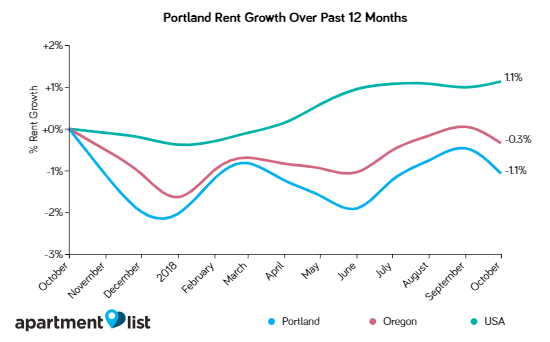
Portland rents have declined 0.6% over the past month, and are down moderately by 1.1% in comparison to the same time last year, according to a new report.

Currently, median rents in Portland stand at $1,130 for a one-bedroom apartment and $1,330 for a two-bedroom. Portland’s year-over-year rent growth lags the state average of -0.3%, as well as the national average of 1.1%, according to ApartmentList.com.

Rents rising across cities in the Portland metro

Portland Rents Continue Decline
Hillsboro and Beaverton rents most expensive in the Portland metro area.

While rent decreases have been occurring in the city of Portland over the past year, cities in the rest of the metro are seeing the opposite trend.

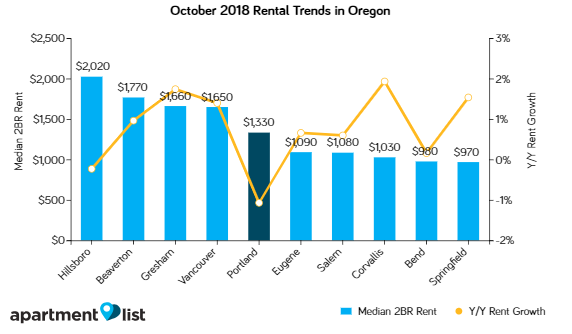
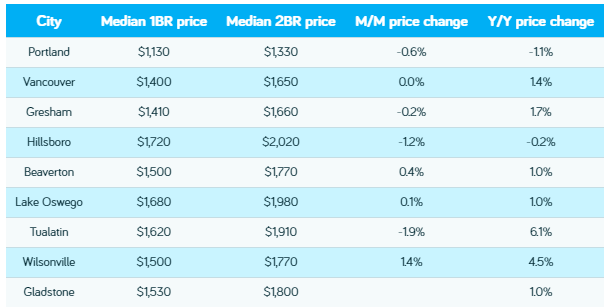
Rents have risen in 8 of the largest 10 cities in the Portland metro for which we have data. Oregon as a whole logged rent growth of -0.3% over the past year. Here’s a look at how rents compare across some of the largest cities in the metro.

  • Looking throughout the metro, Hillsboro is the most expensive of all Portland metro’s major cities, with a median two-bedroom rent of $2,020; of the 10 largest cities in the metro that we have data for, Hillsboro, where a two-bedroom goes for $2,020, is the only other major city besides Portland to see rents fall year-over-year (-0.2%).
  • Corvallis, Gresham, and Springfield have all experienced year-over-year growth above the state average (1.9%, 1.7%, and 1.5%, respectively).
Portland Rents Continue Decline
Rent prices around the metro.

Portland rents more affordable than many similar cities nationwide

Portland Rents Continue Decline
Portland rents compared to national rents.

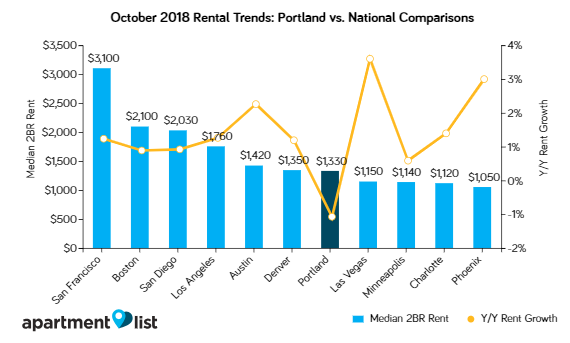
As rents have fallen moderately in Portland, many other large cities nationwide have seen prices increase, in some cases substantially. Portland is also more affordable than most comparable cities across the country.

  • Portland’s median two-bedroom rent of $1,330 is above the national average of $1,180. Nationwide, rents have grown by 1.1% over the past year compared to the 1.1% decline in Portland.
  • While rents in Portland fell moderately over the past year, many cities nationwide saw increases, including Las Vegas (+3.6%), Phoenix (+3.0%), and Austin (+2.3%).
  • Renters will find more reasonable prices in Portland than most similar cities. For example, San Francisco has a median 2BR rent of $3,100, which is more than twice the price in Portland.

Eugene rents decline sharply over the past month

Eugene rents have declined 0.6% over the past month, but are up marginally by 0.7% in comparison to the same time last year. Currently, median rents in Eugene stand at $820 for a one-bedroom apartment and $1,090 for a two-bedroom. Eugene’s year-over-year rent growth leads the state average of -0.3%, but trails the national average of 1.1%.

Salem rents decline sharply over the past month

Salem rents have declined 0.9% over the past month, but are up marginally by 0.6% in comparison to the same time last year.

Currently, median rents in Salem stand at $820 for a one-bedroom apartment and $1,080 for a two-bedroom. Salem’s year-over-year rent growth leads the state average of -0.3%, but trails the national average of 1.1%.

Methodology:

Apartment List is committed to making our rent estimates the best and most accurate available. To do this, we start with reliable median rent statistics from the Census Bureau, then extrapolate them forward to the current month using a growth rate calculated from our listing data. In doing so, we use a same-unit analysis similar to Case-Shiller’s approach, comparing only units that are available across both time periods to provide an accurate picture of rent growth in cities across the country.

Our approach corrects for the sample bias inherent in other private sources, producing results that are much closer to statistics published by the Census Bureau and HUD. Our methodology also allows us to construct a picture of rent growth over an extended period of time, with estimates that are updated each month.

Rents Declined The Most In Portland Year-Over-Year


Apartment Residents Favor Living In A Green Apartment Community

Apartment Residents Favor Living In A Green Apartment Community

Apartments that pursue more environmental friendly practices will gain favor with a majority of apartment residents who believe global warming is a real danger and want to live in a green apartment community, according to a new survey.

The national survey by AMLI Residential shows that apartment residents are more likely to believe in global warning than the U.S. popular in general and it impacts where they choose to live.

Apartment residents would pay more to live in a green apartment community

The survey also found that 83 percent of respondents believe that living in a green community is beneficial to their health and 59 percent of respondents would pay more to live in a green/sustainable community.

The AMLI results are from the company’s second Sustainable Living index,  a survey of more than 4,200 apartment residents in their properties charting how their attitudes on environmentalism impact their choices on where to live.

Apartment Residents Favor Living In A Green Apartment Community
Residents would pay more to live in a green apartment community survey shows.

The 2018 survey indicated that 84 percent of respondents say they believe in global warming and/or climate change. This is significantly higher than the U.S. population at large according to recent data from the Yale Program on Climate Change Communications. According to the Yale research, which was published in July 2017, 70 percent of Americans believe global warming is happening with only 50 percent expressing certainty that global warming is happening.

Although the majority of the AMLI survey respondents were millennials (62 percent), belief in global warming was consistent across generations: roughly 89 percent of Gen Z, 88 percent of millennials, 80 percent of Gen X and 74 percent of baby boomers surveyed believe in global warming and/or climate change.

“This year’s survey shows apartment residents remain concerned about the environment and are committed to making lifestyle choices to reduce their carbon footprint,” Phil Tague, President of AMLI Residential, said in a release.

“The residents surveyed are mindful of how daily activities and where they live might impact their health as well as the environment. AMLI continues to invest in conscious and sustainable practices to make sure we deliver on what’s important to our residents. Our communities use land, water and energy more efficiently through clean-air initiatives and lifestyle amenities that enable residents to live more sustainably every day.”

The survey of AMLI residents was conducted in August 2018 at properties in Atlanta, Austin, Chicago, Dallas, Denver, Houston, Seattle, Southern California and Southeast Florida. AMLI expanded this year’s survey to help it better understand its residents’ interest in sustainable living compared to 2017 survey results. AMLI will utilize the results to further advance its sustainability efforts and improve residents’ wellness and living experiences.

About AMLI:

AMLI is a leader in multifamily sustainability. Thirty-two AMLI properties (almost half of the company’s portfolio) are LEED (Leadership in Energy and Environmental Design) certified and 25 AMLI communities are ENERGY STAR certified. AMLI’s goal is to grow its portfolio to more than 50 percent LEED-certified properties by 2019. Last month, AMLI received a LEED Power Builder Award from the U.S. Green Building Council (USGBC), which recognizes developers that certify at least 90 percent of their units built in the past year. AMLI Residential focuses on the development, construction and management of environmentally responsible, luxury apartment communities throughout the U.S. Founded in 1980, AMLI is owned by PRIME Property Fund, a core commingled institutional fund. AMLI currently owns and manages 61 apartment communities including more than 20,000 apartment homes and has over 5,100 additional apartment homes under development or in lease-up at 14 new properties, all of which are, or will be, LEED-certified. More information is available at www.amli.com.


Seattle Company Buys Beaverton Apartments For $84 Million

Seattle Company Buys Beaverton Apartments For $84 Million

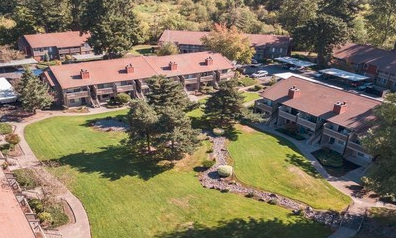
Security Properties of Seattle has purchased  Beaverton apartments Arbor Creek, a 440-unit, Class-B garden-style community located in Beaverton, Oregon for $84 million marking the company’s ninth asset in the Portland metro, according to a release.

Around the Beaverton apartments the area is best characterized by its suburban neighborhood feel, 25 minutes west of downtown Portland, and convenient access to the largest employers in the Portland area.

Arbor Creek is close to SW Tualatin Valley Highway, the primary thoroughfare connecting Hillsboro and Beaverton. Within a 10 minute drive, residents have access to grocers, Regal Cinemas, a MAX line, and the Tualatin Hills Nature Park. The park, sitting directly adjacent to the property, offers 5 miles of scenic wetland walking trails spread out over 222 acres.

“Arbor Creek was a target for our portfolio because of the clear value-add opportunity,” Davis Vaughn, Senior Director of Investments at Security Properties, said in the release.

“Additionally, with a significant supply-demand imbalance due to the suburban Portland job creation, Arbor Creek is well positioned for future growth.  We look forward to implementing our business plan and creating value for our investors,” he said.

Company plans improvements at Beaverton apartments

Seattle Company Buys Beaverton Apartments For $84 Million
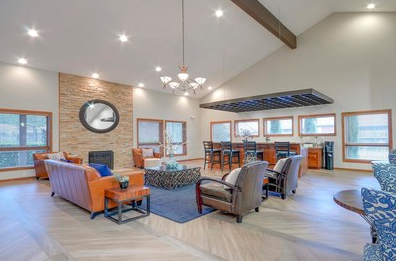
Security Properties will be improving the Beaverton apartments units by installing vinyl planks throughout and updating the clubhouse,

The units at Arbor Creek offer a mix of 1×1 and 2×2 floor plans.

Current ownership has renovated approximately 80% of the units with upgraded cabinets, resurfaced counters, vinyl flooring, faux stainless steel appliances, and upgraded light fixtures.

Security Properties will be improving the units by installing vinyl planks throughout, in addition to spraying the countertops. Security Properties will also be updating the clubhouse, revamping the pool deck and improving the outdoor common spaces, according to the release.

Beaverton is renowned globally for being the home of Nike whose world headquarters is located less than 10 minutes from the property.

Nike’s employment in Oregon has increased by almost 60% since 2007, bringing total employment in Beaverton to 8,500 and 56,500 worldwide. To accommodate the increased headcount, construction began on a $380 million, 3.2 million square foot expansion in January of 2015, and the project’s anticipated completion is slated for the end of 2018.

Additionally, the largest employer in Oregon, Intel, has four campuses within 15 minutes of the property. Ronler Acres, their most regarded campus, serves as their largest concentration of facilities and talent in the world.

The property will be managed by Security Properties-affiliate Security Properties Residential.

About Security Properties
Security Properties is a national real estate investment, development, and operating company headquartered in Seattle, Washington. For more than 48 years, Security Properties has provided quality housing to its residents as well as excellent financial performance for its investors. Since its founding, Security Properties has acquired or developed over 83,000 residential units at a cost of over $5.7 billion. Security Properties maintains a focused multi-family strategy supported by integrated teams of professional acquisition, development, construction, investment, and property management specialists. For more information, visit www.securityproperties.com

About Security Properties Residential
Security Properties Residential is the affiliated property management firm of Security Properties.

25-Story High-Rise Seattle Apartment Tower Opens

25-Story High-Rise Seattle Apartment Tower Opens

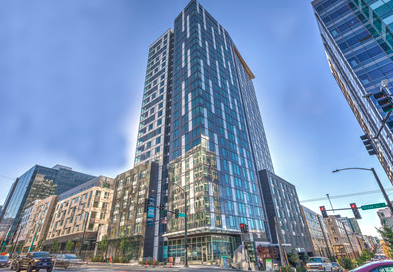
A Seattle apartment tower, South Lake Union’s first high-rise, has completed construction and opened welcoming new residents, according to a release.

Ascent South Lake Union by national multifamily developer Greystar, has 251 contemporary high-rise apartment homes inspired by the merging of modernity and nature in the 25-story building.

The apartment tower provides an all-inclusive living experience, signature interior design, unrivaled amenities, seamless resident services and 360-degree breathtaking views – all in one of Seattle’s most sought-after locations, according to the release.

“As we continue to experience strong demand in the high-end rental market in Seattle, particularly in the budding neighborhood of South Lake Union, we are thrilled to officially open the doors at Ascent South Lake Union and welcome our first residents to this distinguished building,” Aaron Keeler, Director of Development at Greystar, said in the release.

“We developed Ascent in response to the overwhelming market demand for condo-quality living in a high-rise apartment setting. With service and convenience as our key pillars, we have already received a strong response from prospective residents and anticipate a greater influx on the heels of opening our doors.”

Seattle apartment tower prices start at $2,600 per month

Designed by award-winning local architecture firm Weber Thompson, Ascent South Lake Union has one-, two- and three-bedroom residences and penthouses ranging in size from 669 square feet to 1,831 square feet.

Prices ranging from $2,600 to $9,355 per month.

All homes feature:

  • California Closets
  • Nest Thermostats
  • Blomberg stainless steel appliances
  • Custom kitchens
  • Gas ranges and marble inspired stone countertops

Penthouses feature hard wood floors, waterfall marble kitchen islands, Monogram 28-bottle wine reserve, charcoal filtered water with instant hot and cold settings, Brizo kitchen and bath fixtures, oversized windows, walk-in California Closets and smart home technology beyond Nest Thermostats including automatic window shades and light switches controlled by Amazon Alexa and secret TV screens embedded into the bathroom mirrors.

25-Story High-Rise Seattle Apartment Tower Opens
All Seattle apartment tower homes feature California Closets Nest thermostats Blomberg stainless steel appliances, custom kitchens, gas ranges and marble inspired stone countertops

Ascent South Lake Union features common areas styled by award-winning Seattle-based interior design firm Susan Marinello Interiors, whose notable work in Washington includes The Private Residences at The Four Seasons Seattle, Hotel Theodore and Woodmark Hotel.

The communal spaces were conceived to act as an extension of nearby Lake Union through the use of wood, stone and natural elements that are authentic to Seattle.

Nautical elements throughout the building, including custom imagery of seaplanes, polished chrome light fixtures, navy color accents and camel leather, marry the lake lifestyle in a contemporary and hospitality-inspired fashion. A modern reflection of Lake Union’s mirroring lake, the exterior of the high-rise was intentionally designed to resemble rain cascading down the building.

Seattle apartment tower deck features 360-degree views

Ascent South Lake Union offers residents a robust amenity collection highlighted by The Observatory, expansive rooftop lounge and open-air deck surrounded by captivating 360-views of the downtown skyline, Lake Union and the Space Needle. Designed to allow all-season outdoor-indoor living.

The Observatory features multiple indoor and outdoor social lounge areas with firepits, BBQ grills, overhead heaters, indoor entertainment kitchen complete with a Franke Espresso Cappuccino Machine espresso machine, a game room with life-size Scrabble board and a rooftop spa.

Additional resident amenities include a movement studio with virtual fitness classes, Luxer One package lockers, a 2,600-square-foot state-of-the-art fitness center with fitness courtyard and towel service, dedicated co-working space and a conference room, and 24-hour concierge service catering to resident’s every whim whether it’s dry cleaning or restaurant recommendations.

Seattle apartment tower pet friendly

The pet-friendly community also offers an industrial pet wash station and rooftop dog run.

Parking is also provided onsite with electric car charging stations and indoor bicycle storage.

As the base of the tower, a total of six different retailers will be among the new offerings coming to the building.

About Ascent South Lake Union

Developed by Greystar, Ascent South Lake Union is a 25-story luxury apartment tower in Seattle’s up-and-coming neighborhood of South Lake Union. Comprised of 251 modern residences and a full suite of amenities, Ascent South Lake Union is located adjacent to Amazon headquarters and within walking distance of major employers.

Did You Know Fair Housing Laws Apply To Vendors Working At Your Property?

Did You Know Fair Housing Laws Apply To Vendors Working At Your Property?

Apartment vendors and contractors should be provided with key points regarding fair housing laws so this week the Grace Hill training tip takes a look at this issue.

By Ellen Clark

Fair housing is a topic of great importance for anyone working in the multifamily industry.

In fact, it’s so important that fair housing law doesn’t just apply to your full-time employees.

If a vendor or contractor working on-site is accused of discrimination, there can be serious consequences for your community, property management company, and the individual accused of discrimination.

 How much do your vendors know about fair housing laws?

It is important that your vendors and contractors understand and comply with fair housing laws.

But you can’t teach a vendor everything there is to know about fair housing law – after all, you and your employees have spent years developing your understanding of the law and how to apply it.  What can you do?

 Consider making sure that, at a minimum, vendors and contractors know about the following topics

The basics of fair housing law:

  •         The purpose of the law and who is protected by it
  •         The definition of discrimination and some examples of discriminatory behavior
  •         The definition of harassment and some examples of harassing behavior
  •         What reasonable accommodations and modifications are

5 basic responsibilities of vendors on your property

It is important to follow the basic fair housing laws in every interaction. 

No. 1 – Don’t discriminate

Treat all residents fairly, equally, and consistently.

Treating one person differently from others could lead to a discrimination complaint.

 No. 2 – Be professional and watch out for unintended consequences

Maintain professionalism at all times.

What seems like a funny joke to one person can be offensive or threatening to another.

Something that is intended as a compliment can easily cross the line into inappropriate behavior.

No. 3 – Be careful with small talk

It’s easy to get into fair housing trouble simply by chatting with residents.

While there’s nothing wrong with being friendly, be very careful not to ask questions about any of the protected classes. In most situations, a polite smile and nod or “hello, how are you?” are sufficient.

 No. 4 – Don’t share information about residents

If someone asks you questions like, “What kind of people live here?” or “Does everyone speak English?” don’t give them specific information or invite them to walk around and see for themselves. Instead, let them know that anyone who meets the community’s qualification guidelines is welcome to live there. If pressed further, direct the individual to the leasing office.

 No. 5 – Don’t ask about a disability

Never ask about a resident’s disability, whether or not they have a disability, or what work an assistance animal performs.

More often than not, asking questions about a disability is a violation of the Fair Housing Act. It is best to avoid these types of questions altogether.

Most importantly, make sure vendors and contractors know that when in doubt, they should contact management with questions or concerns. This is truly a case of better safe than sorry!

Did You Know Fair Housing Laws Apply To Vendors Working At Your Property?
It is important that your vendors and contractors understand and comply with fair housing laws. Photo credit monkeybusinessimages via istockphoto.com

Read Ellen’s blog post here.

Recent Grace Hill training tips you may have missed:

Are You Confused By Requests For Service, Emotional Support And Assistance Animals?

What Do You Do When Assistance Animals Break The Rules?

7 Ways To Stay Out Of Trouble When Checking Criminal History

5 Ways To Protect Applicants, Residents And Employees From Sexual Harassment

Do You Have A Smoke-Free Policy That Adequately Protects Residents?

How To Handle Suspicious Documentation For Assistance Animals

How A No Pet Policy Can Be Discriminatory

Property Management Cyber attack Risks Overlooked, Underestimated

Do You Know How To Respond To a Sexual Harassment Complaint?

Have You Reviewed Your Criminal Background Checks Policy Lately?

Multifamily Managers And Marijuana: Caught In A Pot Crossfire

Fair Housing Discrimination Against Someone You’ve Never Talked To?

4 Ways To Avoid Screening Pitfalls With Applicants

Red Flags In Evaluating Documentation For Assistance Animals

About the author:

Ellen Clark is the Director of Assessment at Grace Hill.  Her work has spanned the entire learner lifecycle, from elementary school through professional education. She spent over 10 years working with K12 Inc.’s network of online charter schools – measuring learning, developing learning improvement plans using evidence-based strategies, and conducting learning studies. Later, at Kaplan Inc., she worked in the vocational education and job training divisions, improving online, blended and face-to-face training programs, and working directly with business leadership and trainers to improve learner outcomes and job performance. Ellen lives and works in Maryland, where she was born and raised.

About Grace Hill

For nearly two decades, Grace Hill has been developing best-in-class online training courseware and administration solely for the Property Management Industry, designed to help people, teams and companies improve performance and reduce risk. Contact Grace Hill at 866.472.2344 to hear more


Walking The Dog Leads To HUD Discrimination Charge Against Condo Association

Walking The Dog Leads To HUD Discrimination Charge Against Condo Association
Blind or visually impaired woman out for a walk helped by her guide dog. White cane in one hand while holding the dog with the other.

A resident walking her mother’s dog, an assistance animal, to a common area was fined $100 by a condo association and the U.S. Department of Housing And Urban Development (HUD) has filed a discrimination charge, according to a release.

Specifically, HUD’s charge alleges that the condo association only allowed the resident, who is sight and hearing impaired, to use the service door instead of the main entrance to the development or the common areas when accompanied by her assistance animal.

Rules said dog had to be in a crate

While the association, Hudson Harbour Condominium Association, Inc., in Newark, NJ,  waived the no pet policy, it would not modify requirements that demanded the 75-pound assistance animal be carried in a crate or carrier to common areas, according to the complaint.

HUD’s charge further alleges that the condominium association charged the resident’s daughter a $100 fee because she walked her mother’s assistance animal in the development’s common areas. Read the charge.

The Fair Housing Act prohibits housing providers from denying or limiting housing to persons with disabilities or from refusing to make reasonable accommodations in policies or practices.

“Subjecting someone to different residency requirements because they use an assistance animal prevents that person from fully enjoying their home and is against the law,” Anna María Farías, HUD’s Assistant Secretary for Fair Housing and Equal Opportunity, said in the release.

“Condo associations have an obligation to comply with the requirements of the Fair Housing Act when it comes to reasonable accommodations and HUD is committed to ensuring that they meet that obligation.”

Daughter had to walk the dog for the resident

The case came to HUD’s attention when the daughter of a condominium resident who uses an assistance animal filed a complaint alleging that the condominium association refused to waive its requirement that residents transport pets in carriers when in common areas. She was fined $100 for walking the animal in the development’s common areas.

Because of the resident’s mobility impairments, her daughter was primarily responsible for walking the dog. Additionally, when the resident was with her assistance animal, she was required to use the service door to enter and exit the building.

“Rules that limit access to condominium common areas for persons with disabilities who need an assistance animal violate the Fair Housing Act,” J. Paul Compton Jr., HUD’s General Counsel, said in the release. “This charge represents HUD’s commitment to ensuring that persons with disabilities are allowed to fully use and enjoy their homes.”

The charge will be heard by a United States Administrative Law Judge unless any party elects for the case to be heard in federal court. If the administrative law judge finds after a hearing that discrimination has occurred, he or she may award damages to the individual complainant for his or her loss as a result of the discrimination. The judge may also order other injunctive or equitable relief, as well as payment of attorney fees. In addition, the judge may impose civil penalties to vindicate the public interest.

Last April, HUD marked the 50th anniversary of the Fair Housing Act, joining local communities, housing advocates, and fair housing organizations across the country in a coordinated campaign to enhance awareness of fair housing rights.

Are You Confused By Requests For Service, Emotional Support And Assistance Animals?

Walking The Dog Leads To HUD Discrimination Charge Against Condo Association
Blind or visually impaired woman out for a walk helped by her guide dog. White cane in one hand while holding the dog with the other. Photo credit Reimphoto via istockphoto.com

Property Management Job Demand Up In Third Quarter

Property Management Job Demand Up In Third Quarter

Property management job demand was up during the third quarter, according to the National Apartment Association’s (NAA) Education Institute jobs report.

Austin, Portland and Denver had the greatest concentration of openings for property management professionals, each more than three times the U.S. average.

In Austin, a number of positions specifying “multi-site” or “floating” property managers was a testament to the talent shortage.

Overall apartment job openings increased

Property Management Job Demand Up In Third Quarter

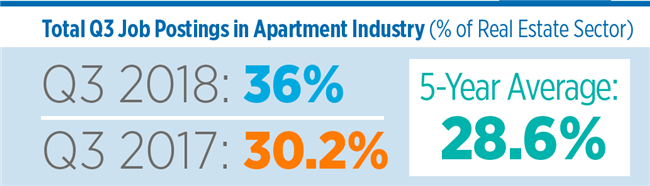
The apartment industry increased its share of job openings in the real estate sector during the third quarter, to 36 percent from 30.2 percent in Q3 2017, according to the NAA report.

New supply and a steady rate of demand contributed to strong growth and a pressing need for additional staffing.

Apartment jobs were available in markets of all sizes, but in terms of sheer numbers of job openings, Los Angeles, Dallas and Washington, D.C. came out on top. Over the past year, Denver and Atlanta dropped out of the top 5 for all types of positions. The pace of new deliveries in both markets slowed dramatically in 2018, according to CoStar data.

Property Management Job Demand Up In Third Quarter

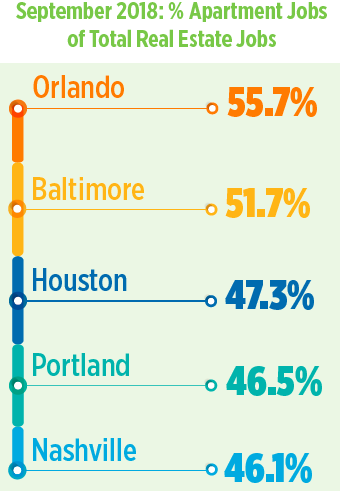
The NAAEI monthly ranking by city showed Orlando in the top 5 for the first time this year. Of these markets, Houston appeared the most frequently, four times during the first nine months of this year with increased activity post-Harvey and improving economic fundamentals.

The retail trade and hospitality sectors often compete for similar skill sets. The greatest share of job openings in those sectors fall within the lowest pay scale (below $35,000 per year). The apartment industry offered more competitive salaries with over 75 percent of jobs.

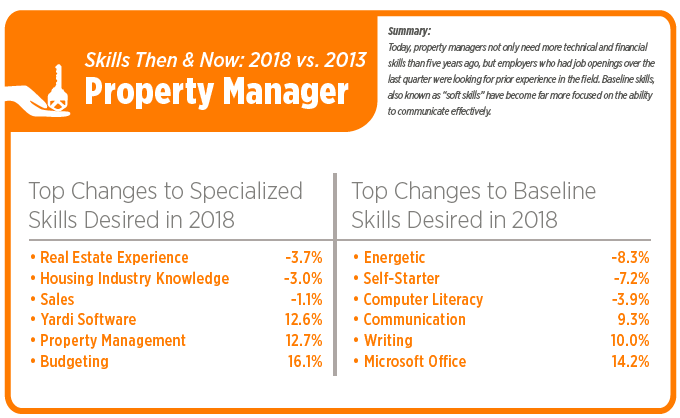
“Today, property managers not only need more technical and financial skills than five years ago, but employers who had job openings over the last quarter were looking for prior experience in the field. Baseline skills, also known as ‘soft skills’ have become far more focused on the ability to communicate effectively, the report said.

NAA a leader in education

The jobs report focuses on jobs that are being advertised in the apartment industry as being available, according to Paula Munger, Director, Industry Research and Analysis, for the National Apartment Association’s Education Institute.

“Our education institute is a credentialing body for the apartment industry. They hear often that one of the biggest problems keeping our industry leaders up at night is the difficulty in finding talent, attracting talent and retaining talent,” Munger said.

“Labor-market issues are happening in a lot of industries, certainly with the tight labor market we have.”

That is why NAA decided to partner with Burning Glass Technologies. “They have a labor-job posting database that is proprietary,” she said, and they can “layer on data from the Bureau of Labor Statistics (BLS).

We looked at that and thought we could do something that is really going to help the industry and help benchmark job titles and trends as we go forward,” she said.

Demand For Maintenance Techs Tops Apartment Jobs Need

About the National Apartment Association Education Institute:

NAAEI’s mission is to provide broad-based education, training and recruitment programs that attract, nurture and retain high-quality professionals and develop tomorrow’s apartment industry leaders.

Why Completing All Compliance Training Is Critical To Your Protection

Compliance training is important for landlords and property managers to keep up with ever-changing rental housing laws at federal, state and local levels. The Grace Hill training tip this week focuses on the second in the series on compliance training.

By Ellen Clark

Once I had a nagging running injury and was prescribed physical therapy.

In addition to sessions two times a week, the physical therapist gave me stretches to do daily, on my own.  Weeks went by and the injury still nagged.

Frustrated, I told the physical therapist, “This isn’t working.”

 Stretches don’t work if you are not actually doing them

She asked if I was doing the stretches every day.

After moment of thought, I told her I was doing the stretches almost every day. “Well,” she said, “we can’t say the stretches don’t work if you aren’t actually doing them.”

Ok, so she had a point.

Something similar can happen with training.

As trainers or administrators, we don’t see results and we get frustrated. We scrap what we’re doing for something new.

Are your employees actually completing the important compliance training?

But what we often don’t investigate first is, are people actually completing training, and are they completing it in the way it was designed to be completed?

In compliance this is particularly important to complete the training the way it was designed. Should you ever need to defend your training – in court, lawsuits, etc – the more you know about who did what and when, the better off you’ll be.

Measuring training implementation is the low hanging fruit of compliance training evaluation, but it is also one of the most important things to measure.

Here are some things to consider.

Track your employees’ training programs, both online and in real life.

Diligently track employee training via both your learning management system (LMS) and in-person training activities.

What’s Your Denominator? 

When tracking compliance training completion, absolute numbers are useful, but percentages are more informative.

It is generally more useful to know that 100% of people completed training than it is to know that 136 people completed training. Always track who is supposed to have completed training, so you have your denominator.

 Meticulously Track Participation

If you use online training, make sure employees are in the system correctly and that your LMS allows you to track training completion and retrieve the data at the employee level. Use a sign-in sheet for in-person training, and take roll call on a webinar. Always track the date training was completed.

Avoid pursuing a false path by collecting and evaluating complete information regarding your training program.

Collecting and evaluating compliance training implementation data helps to ensure you don’t get dragged down the wrong path when attempting to correct an issue or concern.

Go beyond Participation – Track Implementation 

In an ideal world, what are all the things a person would do to complete training the way you designed it?

    • Is there a follow-up assignment to an online training module?
    • Is there a role play activity during an in-person training?
    • List these things out and track who did them.

This will help you know how many people completed the training with fidelity. If your evaluation doesn’t show the results you’d hoped, maybe it isn’t that the stuff isn’t working, maybe it is that people aren’t doing all the stuff.

Collecting compliance training implementation data guards against drawing wrong conclusions about effectiveness. You don’t want to conclude that training didn’t work when, in fact, the issue was that people didn’t complete the training, or didn’t complete it with fidelity.

In compliance this is particularly important. Should you ever need to defend your training, the more you know about who did what and when, the better off you’ll be.

Next up, we’ll look at some basic tips for measuring learning in compliance training.

This is the second post in a series about how to measure the effectiveness of your compliance training program. Read Part 1 here.

Read Ellen’s full blog post here.

About the author:

Ellen Clark is the Director of Assessment at Grace Hill.  Her work has spanned the entire learner lifecycle, from elementary school through professional education. She spent over 10 years working with K12 Inc.’s network of online charter schools – measuring learning, developing learning improvement plans using evidence-based strategies, and conducting learning studies. Later, at Kaplan Inc., she worked in the vocational education and job training divisions, improving online, blended and face-to-face training programs, and working directly with business leadership and trainers to improve learner outcomes and job performance. Ellen lives and works in Maryland, where she was born and raised.


Compliance training is important to your protection as an owner, landlord and property manager


Photo credit Tumsasedgars via istockphoto.com