Home Blog Page 180

January 2019 Phoenix Metro Rent Report Shows Rents Continue Rising

January 2019 Phoenix Metro Rent Report Shows Rents Continue Rising

The Phoenix metro rent report for January shows rents continue to rise across the valley, with a couple of exceptions as Gilbert continues to lead with most expensive rents, according to Apartment List.

Phoenix rents increased slightly over the past month

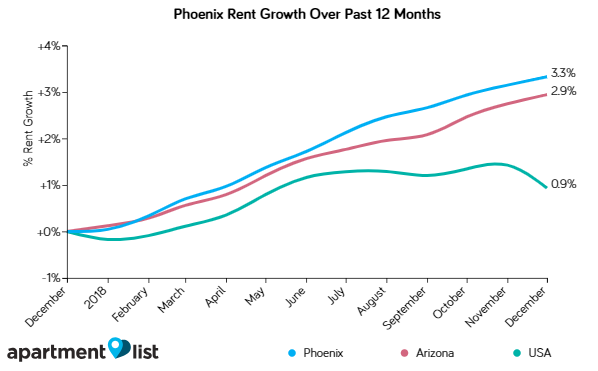
Phoenix rents have increased 0.2% over the past month, and are up moderately by 3.3% in comparison to the same time last year, according to Apartment List.

Currently, median rents in Phoenix stand at $850 for a one-bedroom apartment and $1,060 for a two-bedroom. The city’s rents have been increasing for 13 straight months – the last time rents declined was in November of last year.

Phoenix’s year-over-year rent growth leads the state average of 2.9%, as well as the national average of 0.9%.
Rents rising across the Phoenix Metro

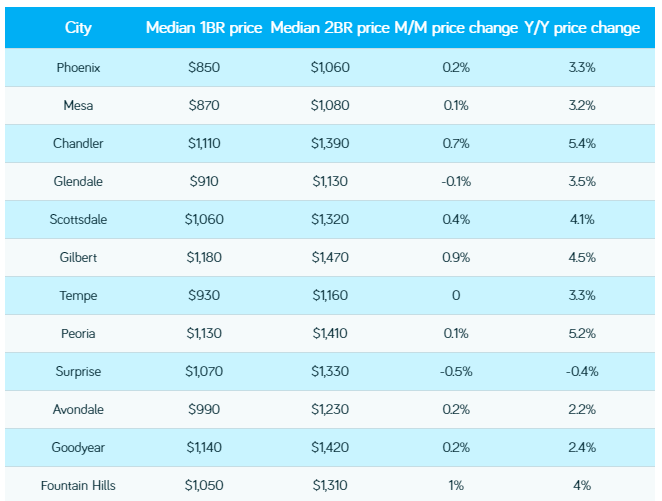
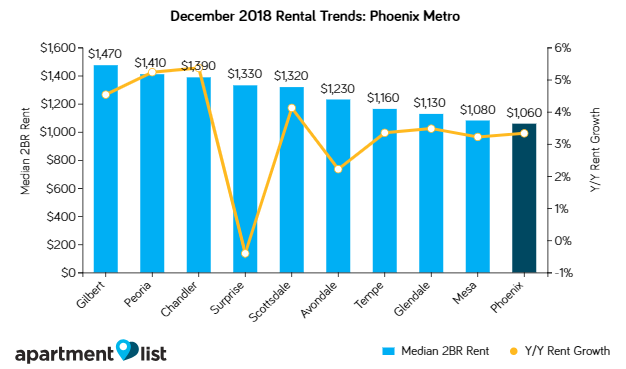
Throughout the past year, rent increases have been occurring not just in the city of Phoenix, but across the entire metro. Of the largest 10 cities that we have data for in the Phoenix metro, 9 of them have seen prices rise. Here’s a look at how rents compare across some of the largest cities in the metro.

  • Gilbert has the most expensive rents in the Phoenix metro, with a two-bedroom median of $1,470; the city has also seen rent growth of 0.9% over the past month, the fastest in the metro.
  • Over the past year, Surprise is the only city in the metro that has seen rents fall, with a decline of 0.4%. Median two-bedrooms there cost $1,330, while one-bedrooms go for $1,070.
  • Phoenix proper has the least expensive rents in the Phoenix metro, with a two-bedroom median of $1,060; rents grew 0.2% over the past month and 3.3% over the past year.

Gilbert rents increase sharply over the past month

Gilbert rents have increased 0.9% over the past month, and have increased significantly by 4.5% in comparison to the same time last year.

Currently, median rents in Gilbert stand at $1,180 for a one-bedroom apartment and $1,470 for a two-bedroom. This is the third straight month that the city has seen rent increases after a decline in September. Gilbert’s year-over-year rent growth leads the state average of 2.9%, as well as the national average of 0.9%.
January 2019 Phoenix Metro Rent Report Shows Rents Continue Rising

Scottsdale rents increased significantly over the past month

Scottsdale rents have increased 0.4% over the past month, and are up significantly by 4.1% in comparison to the same time last year.

Currently, median rents in Scottsdale stand at $1,060 for a one-bedroom apartment and $1,320 for a two-bedroom. The city’s rents have been increasing for 13 straight months – the last time rents declined was in November of last year. Scottsdale’s year-over-year rent growth leads the state average of 2.9%, as well as the national average of 0.9%.

Mesa rents increased over the past month

Mesa rents have increased 0.1% over the past month, and have increased moderately by 3.2% in comparison to the same time last year.

Currently, median rents in Mesa stand at $870 for a one-bedroom apartment and $1,080 for a two-bedroom. Mesa’s year-over-year rent growth leads the state average of 2.9%, as well as the national average of 0.9%.

Chandler rents increase sharply over the past month

Chandler rents have increased 0.7% over the past month, and have increased significantly by 5.4% in comparison to the same time last year.

Currently, median rents in Chandler stand at $1,110 for a one-bedroom apartment and $1,390 for a two-bedroom. This is the tenth straight month that the city has seen rent increases after a decline in February. Chandler’s year-over-year rent growth leads the state average of 2.9%, as well as the national average of 0.9%.

Tempe rent trends were flat over the past month

Tempe rents have remained flat over the past month, however, they have increased moderately by 3.3% year-over-year.

Currently, median rents in Tempe stand at $930 for a one-bedroom apartment and $1,160 for a two-bedroom. Tempe’s year-over-year rent growth leads the state average of 2.9%, as well as the national average of 0.9%.

January 2019 Phoenix Metro Rent Report Shows Rents Continue Rising

Glendale rents declined over the past month

Glendale rents have declined 0.1% over the past month, but are up moderately by 3.5% in comparison to the same time last year.

Currently, median rents in Glendale stand at $910 for a one-bedroom apartment and $1,130 for a two-bedroom. Glendale’s year-over-year rent growth leads the state average of 2.9%, as well as the national average of 0.9%.

Peoria rent trends were flat over the past month

Peoria rents have increased 0.1% over the past month, and have increased significantly by 5.2% in comparison to the same time last year.

Currently, median rents in Peoria stand at $1,130 for a one-bedroom apartment and $1,410 for a two-bedroom. Peoria’s year-over-year rent growth leads the state average of 2.9%, as well as the national average of 0.9%.

Tucson rents increased over the past month

Tucson rents have increased 0.1% over the past month, and are up slightly by 1.2% in comparison to the same time last year. Currently, median rents in Tucson stand at $700 for a one-bedroom apartment and $930 for a two-bedroom. Tucson’s year-over-year rent growth lags the state average of 2.9%, but exceeds the national average of 0.9%.

Phoenix rents more affordable than many comparable cities nationwide
January 2019 Phoenix Metro Rent Report Shows Rents Continue Rising

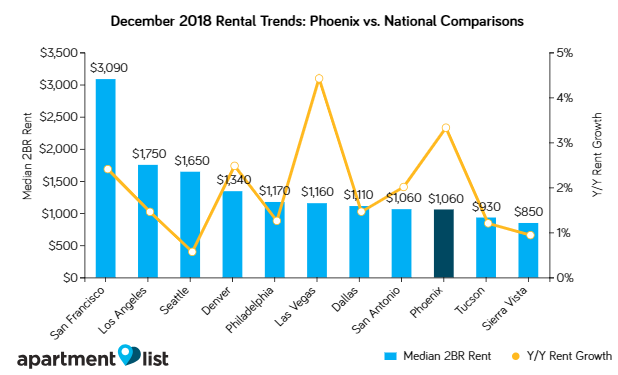
As rents have increased moderately in Phoenix, a few other large cities nationwide have also seen rents grow modestly. Phoenix is still more affordable than most similar cities across the country.

  • Rents increased slightly in other cities across the state, with Arizona as a whole logging rent growth of 2.9% over the past year. For example, rents have grown by 1.2% in Tucson.
  • Phoenix’s median two-bedroom rent of $1,060 is below the national average of $1,180. Nationwide, rents have grown by 0.9% over the past year compared to the 3.3% rise in Phoenix.
  • While Phoenix’s rents rose moderately over the past year, many cities nationwide also saw increases, including Las Vegas (+4.4%), Denver (+2.5%), and San Francisco (+2.4%).
  • Renters will find more reasonable prices in Phoenix than most comparable cities. For example, San Francisco has a median 2BR rent of $3,090, which is nearly three times the price in Phoenix.

Methodology:

Apartment List is committed to making our rent estimates the best and most accurate available. To do this, we start with reliable median rent statistics from the Census Bureau, then extrapolate them forward to the current month using a growth rate calculated from our listing data. In doing so, we use a same-unit analysis similar to Case-Shiller’s approach, comparing only units that are available across both time periods to provide an accurate picture of rent growth in cities across the country.

 

To Hub or Not To Hub? What You Should Know

To Hub or Not To Hub? What You Should Know

Sponsored blog

Sean Miller
President, PointCentral

I Started Out Against Hubs

They just seemed like an unnecessary cost and complication as part of home automation setup.

But, just as broadband internet needed WiFi routers to help permeate internet access through our households, so, too, do I now see hubs as a critical component to delivering IoT’s (internet of things) potential in the home.

Why are hubs critical to take full advantage of a smart home?

Let me start by explaining what a hub is. A hub is a device that facilitates communication between individual devices by serving as a common connection point for devices in a network. Hubs we most often use in our everyday life are WiFi routers, cell phones (just think of how many wearables, headphones and accessories communicate back and forth between our mobile devices), and cellular communication towers.

Great. There are already hubs around us. So, then, why do we need to use yet another hub for home automation? The short answer is that as home automation continues to be a bigger part of our everyday lives, we want those devices to use a communication method that fits the unique need of the devices and technology running home automation systems.

Why Do We Need Another Hub in Our Lives?

WiFi routers are the first thought many turn to as an option for a home automation hub because they are already in the vast majority of homes and thus carry upfront cost savings.

However, WiFi routers carry significant direct and indirect costs for home automation systems.

From a direct cost standpoint, once you start adding more than a couple WiFi-based devices, many routers have performance issues. The cost of buying a new router that can handle all of the home automation devices, plus the connected TVs, video game systems, tablets, computers, cell phones, and other connected devices that are now part of our everyday lives typically far outweigh the cost of a dedicated home automation hub.

From an indirect standpoint, WiFi is designed for delivering large amounts of data rather quickly, but it’s not always the most reliable (Cisco estimates that 43 percent of U.S. households have experienced an internet outage at least once a month) or secure (all it takes is a quick Google search to see the dangers of whatever is the most recent WiFi hack) communication method.

This is fine for data streams where the occasional data packet drop is inconsequential (pixelating Netflix, for example, doesn’t bug us much), but when home access or occupancy based HVAC control is reliant on the chosen communication method, you don’t want to have a communication breakdown.

There are a few hubs that use protocols designed for other applications, like Bluetooth, or proprietary frequencies, like Insteon or Lutron. These options have some benefits, but there are always concerns about the cost, long-term viability, and interoperability of proprietary technologies. Security can also be a concern when using technologies for purposes outside of their original design intent (for example, recently revealed Bluetooth vulnerabilities).

Home automation-specific hubs, such as PointCentral’s, are designed to use modern home automation-specific communication protocols, like Zwave or ZigBee.

These communication technologies allow hubs to balance security (Zwave uses the same 256-bit encryption as major banks) with performance (home automation protocols utilize mesh technology to bounce messages off the nearest device and daisy chain communication back to a hub versus having to have enough power to communicate directly back to the hub through dead spots and interference).

Factors to Consider When Buying a Hub

At one level, choosing a hub is about the method that different devices use to communicate to one another and to the internet.

But choosing a hub is also about the communication enhancements (i.e. apps, dashboards, and voice assistants that help facilitate interaction with the devices in the home) and the home automation provider.

At the end of the day, the hub is the embodiment of the greater home automation platform that is being purchased. A good platform has a lot going on but should still be easy to use and designed to leverage economies of scale to deliver a better experience than one individual or enterprise could deliver on its own.

Consider the following factors when choosing a home automation platform:

  1. Cost: Not just the upfront costs, but the recurring fees as well. While you may think you can find a solution that doesn’t require recurring fees, ask yourself how the vendor will provide updates without a revenue stream to fund software/app updates along with system enhancements and continual security improvements.
  2. Security: Nothing is completely hack-proof, but some options provide more robust hardware and software security than others. How does the hub you are considering keep communications secure within the network (between devices and the hub, and between apps and the hub/devices)? What about from the hub to the cloud? How is the cloud designed and tested for data security?
  3. Management Dashboards and End User App Experience: Different users require different things. If you are deploying home automation in a B2B or B2B2C scenario — like PointCentral’s for short- and long-term property managers and their tenants — does the system offer a dashboard tailored to business needs or is it simply a DIY hub designed for an individual homeowner? Also, for business applications, does the home automation system integrate with other systems — like property management systems — to help simplify work for staff? From an end user (or B2C), standpoint what apps and integrations are available to allow users to interact with all their devices and services via their computer, phone, tablet, wearable, and voice?
  4. Reliability: Will the vendor be here a year from now to continue providing updates and support? Do they have customer references (for business applications) or positive, unbiased customer reviews (for consumer hubs)?
  5. Installation: Does your potential home automation vendor provide adequate hardware and system training? Do they offer certified national installation partners in case you want to supplement or replace internal resources?
  6. Analytics: How is the system helping turn the data from the hardware devices into intelligence that helps improve operations? Does it have the scale to accurately test and refine algorithms to deliver accurate information? Do they have a policy to ensure customer data will not be sold without consent?

Summary

Market experts predict strong growth for hubs and the IoT. Gartner projects 20.4 billion connected devices will be in use by 2020, up from 8.4 billion in 2017.

NPD recently reported that there was a 50% increase in home automation adoption by U.S.  households between 2016 and 2017, jumping up to 15% of US households.

In the midst of all this growth, one thing will be certain — home automation (and the technologies that power it) will continue to evolve. In order to maximize your investment, make sure you choose a hub and a home automation provider that will be a long-term partner and not a short-term vendor.

Download the full PointCentral PDF On Hubs Here

Hubs

About PointCentral

PointCentral, headquartered in Portland, Oregon, and a subsidiary of Alarm.com, designs, manufactures and markets enterprise-grade Smart Home solutions for the vacation rental, residential, and multi-family property management markets. PointCentral solutions provide customers in these markets with the ability to monitor and control smart home technology across all properties in their inventory over a best-in-class secure and reliable network – reducing risk, improving security, controlling assets, reducing energy costs and improving guest/tenant satisfaction.

Efficient HVAC Systems For Multifamily Homes

Efficient HVAC Systems For Multifamily Homes

Which type of HVAC system is best for your rental property is the rental property maintenance checkup this week provided by Keepe.

The type of heating, ventilation and air-conditioning (HVAC) system that you install in your multifamily property is an important decision that will have long-term implications.

There are several options, depending on factors such as the size of the property and your energy-efficiency needs. Also do your tenants respond better to a centralized system? Or a decentralized system that gives them individual-unit control?

Consider the following centralized and decentralized HVAC systems that offer both heating and cooling as you update or begin your HVAC development.

Centralized vs. Decentralized HVAC Units

Both centralized and decentralized HVAC systems provide key elements that aid multifamily property management. HVAC systems are often easy to maintain, give tenants in-unit control that maximizes comfort, and allow for flexibility when handling peak demand.

Centralized HVAC Systems

 Centralized HVAC systems are supported from a central location such as a mechanical room in the basement of the building. Centralized systems tend to run more efficiently than decentralized HVAC systems. On the other hand, installation costs run higher, which make this ideal for a larger property that would be considered mid-rise or high-rise.

Efficient HVAC Systems For Multifamily Homes
Centralized HVAC systems installation costs run higher, which make this ideal for a larger property that would be considered mid-rise or high-rise.

Most common types of centralized HVAC systems:

  1. Four-pipe systems: This system includes four insulated pipes, two supply and two return lines. One is set to chilled water while the other is dedicated to hot. The pipes run to air handlers, which use the needed water to change the air temperature. The air handlers can be kept in mechanical rooms or in spaces above the ceiling. These systems are expensive to install, but run efficiently.
  2. Geothermal systems: Geothermal systems are one of the most efficient types of HVAC systems. This rental heating-and-cooling system transfers heat from the ground. The system relies on heat transfers between the air and the ground to provide heating and cooling to units. Geothermal heat pumps are considered a form of high-efficiency heat pump. Although the upfront costs are high, geothermal HVAC systems can cut utility bills by 30 to 70 percent.

Decentralized HVAC Systems

 Decentralized HVAC systems are compartmentalized, meaning that each unit in the building receives separate heating and cooling. Decentralized systems are more cost-effective to install, but most lack maximum efficiency.

efficient HVAC systems
Decentralized HVAC systems are easier and less expensive to install and convenient for properties with a smaller unit capacity.

Most common types of decentralized HVAC systems:

  1. Packaged thermal air conditioner: This HVAC option is a self-contained heating-and-air-conditioning system. PTCAs are designed to go through a wall, having vents and heat sinks both inside and outside the building, requiring comprehensive installation. This forced-air system unit tends to have a shorter life cycle, and is not very efficient when compared to alternatives.
  2. Self-contained systems: These systems are forced-air systems that deliver heating and cooling to individual units. These packaged systems are installed in each unit, allowing easy access in cases where HVAC services are required. In addition to being energy-efficient, these systems are easier and less expensive to install and convenient for properties with a smaller unit capacity.

In addition to a high-effect HVAC system, other factors in your property —  such as sealing heating and cooling ductwork —  can instantly optimize a system.

Smart control sensors are also a great high-tech tool to monitor HVAC performance and maintenance needs that could help you optimize your HVAC performance.

Other recent rental property maintenance Keepe posts you may have missed:

4 Outdoor Flooring Options For Your Rentals

20 Easy, Affordable Maintenance Projects To Update Your Rentals

7 Tech Gadgets For A Safer And More Efficient Rental Property

5 Maintenance Tips For Long-Lasting Rental Carpet Flooring

Is The Water Heater At Your Rental Property Ready For The Big One?

7 Types Of Kitchen Countertops For Your Apartments

Which Cooktop Is Best For Your Rental Property?

A Guide To 4 Types Of Flat Roof Systems

6 Ways To Trash Your Apartment Waste Management Issues

About Keepe:

Keepe is an on-demand maintenance solution for property managers and independent landlords. The company makes a network of hundreds of independent contractors and handymen available for maintenance projects at rental properties. Keepe is available in the Greater Seattle area, Greater Phoenix area, San Francisco Bay area, Portland, San Diego and is coming soon to an area near you. Learn more about Keepe at https://www.keepe.com


Young Adults And Retirees Continue To Choose To Live In Apartments

Young Adults And Retirees Continue To Choose To Live In Apartments

A new report analyzing the market shows that the multifamily market cycle is continuing strong as young adults and retirees choose to live in apartments.

The strong job growth plus the choice to live in apartments, Yardi Matrix says in U.S. Multifamily Outlook for Winter 2019, means “2019 should be another good year for the multifamily industry,” despite the fading impact of the 2017 tax reform and potential trade disruptions.

Rent growth trends show young adults and retirees like to live in apartments

“Fresh off another year marked by steady improvement, the rental sector looks to extend what is already a prolonged market cycle,” the report says.

“With year-over-year growth crossing the 3.0% mark nationally in 2018—slightly above initial expectations—the multifamily sector showed that it still has some legs going into 2019. We expect rents to continue to rise in 2019, at a rate of 2.8%, marking another year of consistent improvement.

Young Adults And Retirees Continue To Choose To Live In Apartments
Information provided by Yardi Matrix. Contact them for more in depth information.

“The market is underpinned by strong demand based on household formation that tops one million annually and positive employment growth. The number of young adult households is continuing to rise, families are remaining renters longer than they did in the past, and some retirees that sell homes with expensive property tax burdens are turning into renters,” the report says.

Supply of new apartments

“Development activity will remain strong in 2019. We expect deliveries to come in at about 300,000 units this year, 2.2% of total current stock and largely in line with 2018 totals,” the report says.

“This will mark the fourth year in a row of completions in the 300,000-units range, which is entirely appropriate given the strong demand that we expect to continue for another few years

Multifamily takes a larger share of total housing construction

“Another factor boosting multifamily development is that it is taking up a larger share of total housing construction,” the report says.

“Single-family construction is lagging, in part because rising costs make it difficult for developers to build at entry-level price points, which are in more demand than large suburban homes.

“With a wider availability of rentals and fewer costs attached to renting, that dynamic is likely to continue. Millennials, which now represent the largest population cohort in the labor force, are starting to buy their first homes, but affordability is a problem due to student loans and rising mortgage rates. Their propensity for technology- and entertainment-driven markets is effectively pricing some of them out of home buying,” the report says.

About Yardi

The data presented in this outlook is provided by Yardi Matrix, the data and information service for real estate professionals. Email or call them at 480.663.1149 to learn more and schedule a demo of the industry’s most comprehensive market intelligence service.

Governor Backs Bill To Limit Rent Increases In Oregon

rent stabilization and rent control in Oregon

Oregon Governor Kate Brown has signaled her support for a rent stabilization bill that would limit Oregon landlords to rent increases of 7 percent per year and eliminate no-cause evictions of long-term tenants, according to reports.

Brown believes those ideas “are innovative and will give renters some peace of mind,” spokeswoman Kate Kondayen told Oregon Public Broadcasting.

“We need to help Oregonians who have homes but are struggling with the high cost of rent,” Governor Kate Brown said in her inaugural address. “When problems arise, they need technical assistance to stay in their homes and not end up on the streets. We can help landlords and tenants navigate this tight housing market.

“Speaker Tina Kotek (D-Portland) and Senator Ginny Burdick (D-Portland) have innovative proposals that will give renters some peace of mind.  Oregon families are counting on us. They are counting on us so they don’t have to make a choice between paying the rent and staying home with their newborn,” the governor said.

A state-wide rent stabilization policy another word for rent control

Under the proposed legislation landlords of properties across the state could only raise rent by up to 7 percent per year, plus the annual change in the consumer price index.

That would amount to a statewide rent stabilization policy that officials say would be unique in the United States, according to Oregon Public Broadcasting reports.

Legislative action expected on rent stabilization or rent control in this term

Overall, the legislation this session in Oregon is expected to build on concepts from two years ago, including limits on no-cause evictions.

Rent control is a term of art.  Oregon Democrats are quick to distance themselves from old-school policies that place a hard cap on rents,” Willamette Week reports. They prefer instead the term “rent stabilization,” which technically would limit the amount by which landlords could increase rent.

Tenant protections, particularly limits on rent increases, have proved politically impossible elsewhere.

The real estate industry soundly defeated a rent-control ballot initiative in California in November.


West Coast Markets Dominate Demand for Apartment Jobs

apartment jobs

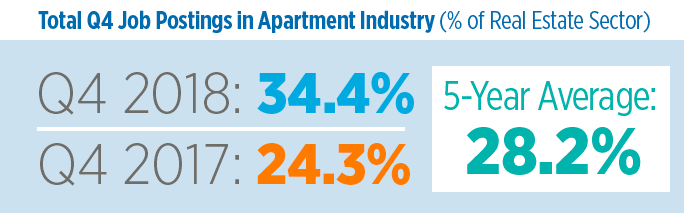
The apartment industry labor market held its momentum through the final three months of the year, with apartment jobs representing more than 34 percent of job openings in the real estate sector.

The latest National Apartment Association jobs report shows demand levels were well above the recent average of 28.2 percent for this quarter.

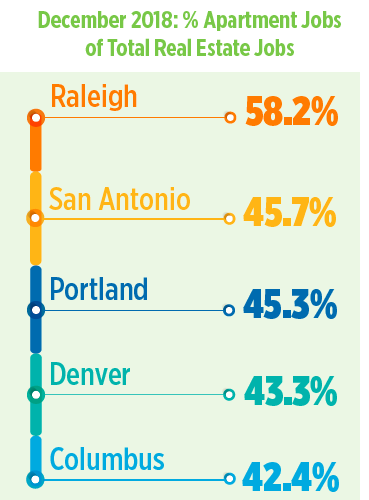
West Coast markets Los Angeles, Seattle and San Francisco dominated the top cities for apartment- job demand in terms of the sheer number of available positions.

Both Denver and Colorado Springs had the highest location quotients, meaning demand in these markets was three times the U.S. average.

West Coast Markets Dominate Demand for Apartment Jobs

Property manager jobs in high demand

Positions in property management were in the greatest demand, with leasing and maintenance fairly evenly split, according to the December report.

Property managers, assistant property managers and community directors were in the top five job titles, comprising more than 6,200 postings combined.

Salaries for apartment jobs more competitive than some industries

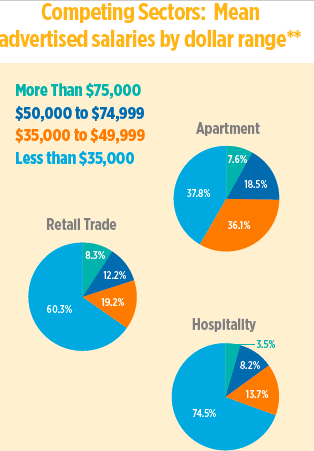
Salaries in the apartment sector have been more competitive than the retail trade and hospitality sectors, which have overlapping skill sets for some positions.

High location quotients in Denver, Colorado Springs, Seattle, and Phoenix, among others, present both opportunities and challenges as all sectors are competing for the same pool of labor.

West Coast Markets Dominate Demand for Apartment Jobs

West Coast Markets Dominate Demand for Apartment Jobs

 Maintenance-tech skill set still highly sought as titles change

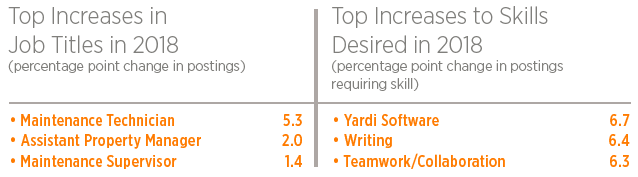
The change in the proportion of job titles over the past five years is not only reflective of demand, i.e. the highly sought-after maintenance tech, but of recruiters providing more focused and appealing titles.

The generic “apartment manager” has given way to “community manager,” while the surge of assistant property managers and maintenance supervisors reveals a clear career path within those sectors.

The greatest increases in skills desired for all types of positions included both specialized skills such as Yardi software, and soft skills, particularly writing and collaboration.

West Coast Markets Dominate Demand for Apartment Jobs

The jobs report focuses on jobs that are being advertised in the apartment industry as being available, according to Paula Munger, Director, Industry Research and Analysis, for the National Apartment Association’s Education Institute.

National apartment association jobs report background

 “Our education institute is a credentialing body for the apartment industry. They hear often that one of the biggest problems keeping our industry leaders up at night is the difficulty in finding talent, attracting talent and retaining talent,” Munger said.  “Labor-market issues are happening in a lot of industries, certainly with the tight labor market we have.”

NAA partnered with Burning Glass Technologies. “They have a labor-job posting database that is proprietary,” she said, and they can “layer on data from the Bureau of Labor Statistics (BLS). We looked at that and thought we could do something that is really going to help the industry and help benchmark job titles and trends as we go forward.”

Resources:

National Apartment Association Education Institute

Burning Glass Technologies

National Apartment Association

NAAEI’s mission is to provide broad-based education, training and recruitment programs that attract, nurture and retain high-quality professionals and develop tomorrow’s apartment industry leaders.

What To Expect From Millennial Renters In 2019

3 Of The Most Common Traps Rental Property Owners Encounter

A landlord’s ability to adapt has a substantial impact on their success such as adapting to the needs of millennial renters.

Potential tenants will always choose properties that align with their interests and values, and as these interests and values change, year after year, landlords need to remain aware of shifting trends to capitalize on them.

This fact is especially true of the millennial demographic. Projections show that millennials will soon surpass baby boomers as the nation’s largest living adult population, making them an even higher priority for landlords. So what can these landlords expect from millennial renters in 2019?

Let’s consider three trends that will shape the way landlords appeal to millennial renters

No. 1 – Desire for Smart-Home Technology

Millennial renters are familiar with the range of smart-home technology available on the market today. Many of them are interested in the benefits of smart thermostats, smart lighting, smart security systems and other products that provide convenience and energy efficiency. Landlords see the appeal as well.

For example, residents can save as much as 10 percent per year on heating and cooling by turning the thermostat back seven to 10 degrees from its average setting for eight hours a day. A smart thermostat allows for this kind of regulation without input, earning considerable energy savings for a rental.

While it’s often unrealistic for landlords to purchase smart lighting systems for every unit in an apartment complex, they can invest in smaller — though no less substantial — changes, like smart security. A wireless camera system allows landlords a more extensive view of their property, and they impress upon tenants a sense of safety and security.

Tech-savvy landlords who integrate smart-home devices into their properties also enjoy a higher profit. A survey from Wakefield Research found that 86 percent of millennials are willing to pay more for a rental property if it features smart-home technology. Both landlords and tenants see the value in these products.

No. 2 – Shifting To New Life Stages

Millennials are growing older, and as they settle down and have children, finding properties with family-friendly features becomes a higher priority for them. While more urban rental markets will largely miss this trend, smaller communities may see more tenants who are starting to raise families while paying rent.

millennial renters want family friendly features for their kids
Millennials are growing older, and as they settle down and have children, finding properties with family-friendly features becomes a higher priority.

Sure, home ownership becomes much more popular at this stage in life. But research shows that millennials are entering this stage later than generations in the past, and their first children are those most likely to live in rented housing. Buying a house takes a lot of capital, and renting still makes a lot of sense for some young families.

Landlords who are located in more suburban areas can benefit from understanding a young renting family’s needs. These landlords can market elements of the surrounding area – schools and parks, for example. A space for children to play and explore catches the attention of new families, and they’ll gravitate toward properties where these features are within walking distance. Accessibility is crucial.

More widely, millennials are also searching for rentals where their pets are welcome. Many of them have a furry family member, and they don’t want to have to pass over the perfect property just because the landlord doesn’t allow cats and dogs. Landlords who prohibit pets should consider an adjustment in their policies.

In short, landlords need to adjust their perception of the average millennial. Depending on your location, you can adjust your listings and marketing to attract the interest of households with small children and pets. This can set you apart in a market that largely caters to tenants with fewer obligations.

No. 3 – Commitment to an Eco-Conscious Lifestyle

Now more than ever, millennials are aware of their impact on the planet. In the face of fluctuating temperatures, unseasonable weather and more frequent natural disasters, many have taken it upon themselves to adopt an eco-conscious lifestyle. Sustainability and environmental conservation are significant considerations.

Millennials want to rent from a landlord who shares their values. Between a progressive, eco-friendly landlord and one who hasn’t made an effort to improve their buildings, most young tenants will choose the former. This decision not only lessens their carbon footprint, but it can save money on monthly utilities.

millennial renters are eco-conscious
Sustainability and environmental conservation are significant considerations.

Landlords can appeal to these young tenants in a number of different ways, such as by installing smart-home technology like the energy-efficient devices mentioned above. They can make smaller changes too, like fixing low-flow attachments to faucets and shower heads, as a comparatively inexpensive alternative.

However landlords choose to address this trend, it’s essential that they make a point to advertise their property’s eco-friendly features. Whether it’s something as simple as a set of new light bulbs or as complex and costly as solar panels, potential tenants are interested to know how their living space aligns with their belief system.

Learning to Adapt

Landlords need to at least be aware of trends to sustain interest in their properties. To attract millennial renters in 2019, they have to appeal to their desires for smart-home technology, their interest in family-friendly features and their commitment to an eco-conscious lifestyle.

As the priorities of these millennials renters continue to shift, landlords and property managers can benefit from adapting to meet their needs.


Multifamily Rent Growth In 2019 Will Be Led By Metros In the Southwest, West And South

Multifamily Rent Growth is tops in Phoenix in April according to Yardi Matrix report

The U.S. multifamily market sector enjoyed a solid year in 2018 in which multifamily rent grew by 3.2% according to a survey of 127 markets by Yardi® Matrix, and wrapped up the eighth straight year of growth.

Since January 2011, rents nationally have increased by 31%, while annual rent growth has been at least 2.9% in every year save 2017. Rent growth has topped 3% in six of the last eight years.

Multifamily national report shows calm amid the storm

  • U.S. multifamily rent remained at $1,419 in December, and year-over-year growth was 3.2%, also unchanged from November. Rent growth has been flat since the summer.
  • 2018 proved to be a solid year for the multifamily sector, and 3.2% rent growth slightly exceeded going-in expectations. Despite the recent volatility in the financial markets, we foresee more of the same in 2019, with strong demand producing rent growth just shy of 3% nationally.
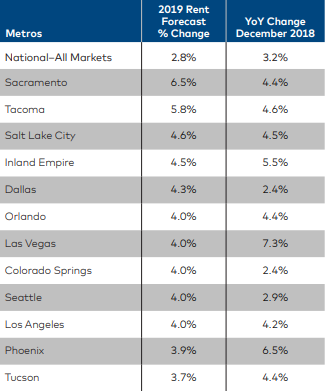
  • Las Vegas (7.3%), Phoenix (6.5%) and the Inland Empire (5.5%) are the Top 3 metros, highlighting a trend of outperformance among secondary markets.
  •  Rent growth in 2019 will again be led by metros in the Southwest, West and South regions.
  • Late-stage markets Las Vegas and Phoenix remain atop our rankings, as job and population growth drive demand in the desert.
  •  Both markets are benefiting from migration out of high-cost and tax-prohibitive areas in California and the Midwest. Job growth in tech and finance have attracted educated millennials, and warm weather and a lower cost of living continue to bring retiring Baby Boomers.
  • Considering the late stage of the current cycle and significant new supply that has been added in the past three years, multifamily rent growth performed quite well and exceeded expectations in 2018

While acknowledging concerns that the unusually long cycle has played out, a report on the survey cites “reasons to believe multifamily fundamentals will remain vigorous in 2019 and beyond,” YardiMatrix says in the report.

Chief among those reasons is ongoing strong demand is that job growth remains robust, and social factors—such as student loan debt that limits first-time homebuyers, families remaining renters longer, and retirees downsizing and moving into rentals—are also likely to maintain demand for multifamily.

Multifamily trend similar to hotels

Multifamily could be taking a trajectory much like hotels, which have had nine consecutive years of above-trend revenue growth.

Hotels benefit from business profitability and travel, but also from lifestyle changes that lead individuals to spend more on experiences.

multifamily rent

The financial market volatility issue

Indicators in employment, supply and occupancy trends forecast rent growth.

  • Volatility in the financial markets over the last few months has been caused by concerns about a slowdown in global economic growth and policy uncertainty that includes the potential for increasing tariff fights.
  • Despite the volatility in stocks and unexpected rally in Treasury prices, economic fundamentals such as employment and GDP remain healthy.
  • Demand for real estate such as multifamily is not likely to fluctuate much in the short term, and volatility could even bring capital into the sector.

    View the full Yardi Matrix Multifamily National Report for December 2018 for additional detail and insight into 127 major U.S. real estate markets.

    Yardi Matrix offers the industry’s most comprehensive market intelligence tool for investment professionals, equity investors, lenders and property managers who underwrite and manage investments in commercial real estate. Yardi Matrix covers multifamily, industrial, office and self storage property types. Email matrix@yardi.com, call 480-663-1149 or visit yardimatrix.com to learn more.

Rent Growth And Multifamily Trends Heading Into 2019

Stronger Rent Growth, Tightened Occupancy In U.S. Apartment Market In Fourth Quarter Of 2018

rent growth

The annual pace of U.S. apartment rent growth accelerated to 3.3 percent in the fourth quarter, according to a release from real estate technology and analytics firm RealPage, Inc.

The company said momentum in annual rent growth proved substantial in the last half of the year, pushing 2018’s performance ahead of the 2.5 percent growth recorded in 2017.

Apartment owners and operators gained pricing power due to robust demand that drove occupancy to a fourth-quarter rate of 95.4 percent, up from 95 percent in late 2017. The country’s occupied apartment count climbed by 323,290 units in 2018, the strongest demand realized since 2010. Demand topped annual completions that totaled 287,007 units.

The U.S. is gaining renters

“In contrast to the stumble seen in for-sale housing demand in recent months, the country is gaining lots of additional renters,” RealPage chief economist Greg Willett, said in a release.

“Job production is fueling household formation among younger adults who tend to rent, and loss of existing renters to purchase is running at levels below the historical norm,” he said.

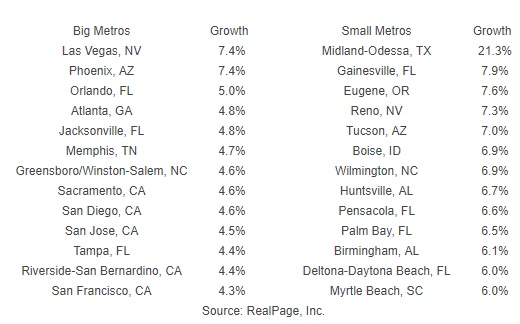
Among the country’s large metros, local rent growth leaders are Las Vegas and Phoenix, each posting price jumps of 7.4 percent in 2018. Rent growth reaches 5 percent in Orlando. Several California markets also are experiencing big rent increases, with prices up 4.3 percent to 4.8 percent in Sacramento, San Diego, San Jose, Riverside-San Bernardino and San Francisco.

Demand in the country’s 150 largest metros hits an eight-year high

Annual rent growth leaders in 2018

rent growth

Some small metros are experiencing even stronger rent boosts. Rents are up 21.3 percent in the West Texas Oil Patch markets of Midland and Odessa, while price increases between 7 percent and 7.9 percent are occurring in Gainesville, Fla.; Eugene, Ore.; Reno, Nev., and Tucson, Ariz.

Houston’s 0.3 percent rent growth is the weakest performance among big metros. Slight rent cuts of less than 1 percent are occurring in five small markets: College Station, Texas; Corpus Christi, Texas; Davenport, Iowa; Baton Rouge, La.; and Fargo, N.D.

Building in the U.S. apartment sector remains aggressive, the company said in the release.

 Within properties already under construction, there are 319,123 units slated to complete in 2019. However, delivery delays largely tied to labor shortages are routine, so this year’s new supply probably will fall a bit short of the 300,000-unit mark.

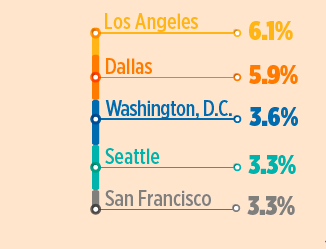
Near-term new supply leaders include Dallas, Los Angeles, Washington, D.C., Seattle and Atlanta. Dallas has the most product on the way, just over 27,000 units. Adding in the 7,000 or so apartments under construction in adjacent metro Fort Worth pushes ongoing building to nearly 35,000 units across North Texas.

“With so much high-end new product finishing in the near term, there will be a scramble to attract resident prospects in the luxury apartment niche,” Willett said.

“At the same time, vacant units available to lease can be very difficult to find in properties in the middle to lower end of the pricing spectrum. Few renters are moving around within the nation’s more moderately priced apartment stock, in part just because there are so few housing options available for all but the most affluent renters.”

About RealPage

RealPage is a leading global provider of software and data analytics to the real estate industry. Clients use its platform to improve operating performance and increase capital returns. Founded in 1998 and headquartered in Richardson, Texas, RealPage currently serves more than 12,400 clients worldwide from offices in North America, Europe and Asia. For more information about the company, visit http://www.realpage.com.

Seattle Rents Declined For Third Straight Month

Seattle Rents Declined For Third Straight Month

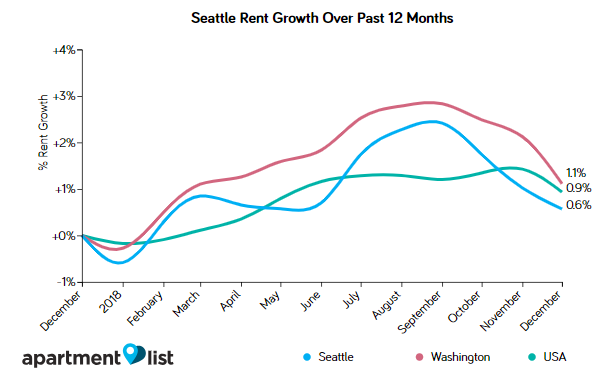
The January rents report shows Seattle rents have declined 0.4% over the past month, but have increased marginally by 0.6% in comparison to the same time last year, according to Apartment List.

Currently, median rents in Seattle stand at $1,320 for a one-bedroom apartment and $1,650 for a two-bedroom.

This is the third straight month that the city has seen rent decreases after an increase in September. Seattle’s year-over-year rent growth lags the state average of 1.1%, as well as the national average of 0.9%.

seattle rents

Rents rising across the Seattle Metro

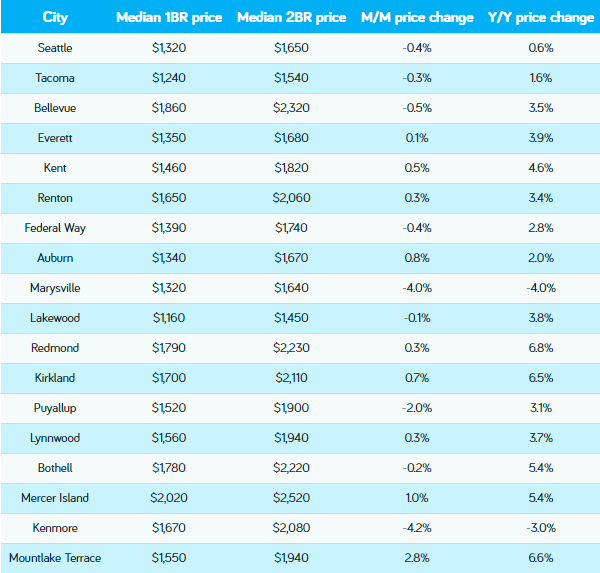
Throughout the past year, rent increases have been occurring not just in the city of Seattle, but across the entire metro. Of the largest 10 cities that we have data for in the Seattle metro, 9 of them have seen prices rise. Here’s a look at how rents compare across some of the largest cities in the metro.

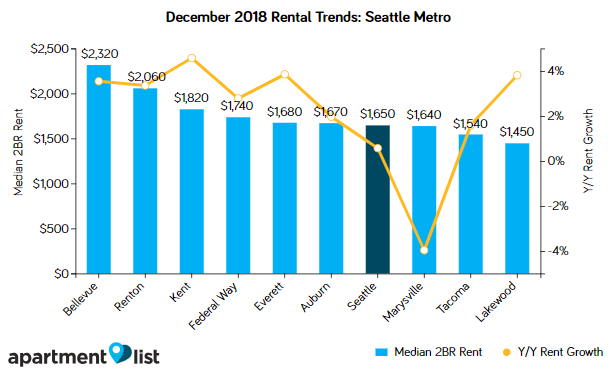
  • Kent has seen the fastest rent growth in the metro, with a year-over-year increase of 4.6%. The median two-bedroom there costs $1,820, while one-bedrooms go for $1,460.
  • Over the past month, Marysville has seen the biggest rent drop in the metro, with a decline of 4.0%. Median two-bedrooms there cost $1,640, while one-bedrooms go for $1,320.
  • Bellevue has the most expensive rents of the largest cities in the Seattle metro, with a two-bedroom median of $2,320; rents decreased 0.5% over the past month but were up 3.5% over the past year.
  • Lakewood has the least expensive rents in the Seattle metro, with a two-bedroom median of $1,450; rents fell 0.1% over the past month but rose 3.8% over the past year.
seattle rents

Other large cities nationwide show more affordable rents compared to Seattle

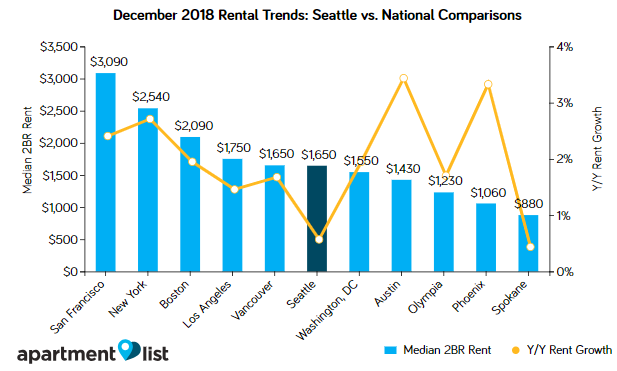
As rents have increased marginally in Seattle, a few similar cities nationwide have also seen rents grow modestly. Compared to most other large cities across the country, Seattle is less affordable for renters.

  • Rents increased slightly in other cities across the state, with Washington as a whole logging rent growth of 1.1% over the past year. For example, rents have grown by 1.7% in Vancouver and 0.4% in Spokane.
  • Seattle’s median two-bedroom rent of $1,650 is above the national average of $1,180. Nationwide, rents have grown by 0.9% over the past year compared to the 0.6% increase in Seattle.
  • While Seattle’s rents rose marginally over the past year, many cities nationwide also saw increases, including Austin (+3.4%), Phoenix (+3.3%), and New York (+2.7%).
  • Renters will generally find more expensive prices in Seattle than most similar cities. For example, Spokane has a median 2BR rent of $880, where Seattle is more than one-and-a-half times that price.
seattle rents

Methodology:

Apartment List is committed to making our rent estimates the best and most accurate available. To do this, we start with reliable median rent statistics from the Census Bureau, then extrapolate them forward to the current month using a growth rate calculated from our listing data. In doing so, we use a same-unit analysis similar to Case-Shiller’s approach, comparing only units that are available across both time periods to provide an accurate picture of rent growth in cities across the country.