Home Blog Page 179

Everett’s Lakeside Apartments Sell For $6.4 Million

Everett’s Lakeside Apartments Sell For $6.4 Million

The Lakeside Apartments, a 45-unit segment of a 56 total unit complex located on Beverly Lake in Everett, Washington, has been purchased by a Westland Apartment Investors led group.

The purchase cost is $6.4 million, with an additional $650,000 being committed by the investors for upgrades to the property.

“The Lakeside purchase is strongly aligned with our business model,” Erik Mattson, Westland Partner, said in a release.

“The complex is conveniently located near a rapidly expanding medical, technology & aerospace employment base.”

Lakeside Apartments improvements planned

The property was originally built as 56 apartment units but was converted to condominiums in 2006, with 45 of the units being converted back to apartments in 2008.

Exterior and landscaping upgrades are planned to improve the property’s appeal to apartment residents and condo owners alike.

With more projects such as this on the horizon, Westland is looking to establish relationships with additional accredited investor clients. Interested investors should contact Erik Mattson at erik.mattson@westlandinvestors.com  or by calling (503) 297-2575.

About Westland

Founded in 1974, the company has participated in the successful acquisition and management of more than $300 Million in multifamily real estate investments ranging in size from 25- to 120-apartment complexes in Washington, Oregon, Idaho and Arizona. The company’s strategy is to produce greater than average returns by purchasing and managing apartments that need upgrading in communities with strong rental markets.


Portland Rents Increased Moderately Over The Past Month

Portland Rents Increased Moderately Over The Past Month

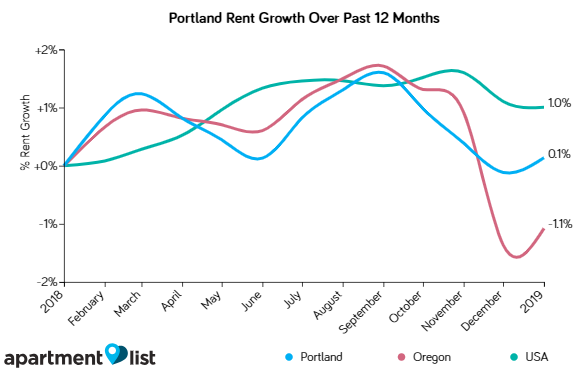
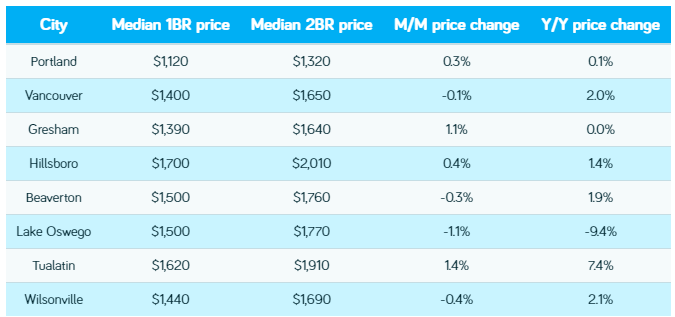
Portland rents have increased 0.3% over the past month, but have been relatively flat at 0.1% in comparison to the same time last year, according to the January report from Apartment List.

Currently, median rents in Portland stand at $1,120 for a one-bedroom apartment and $1,320 for a two-bedroom.

Portland’s year-over-year rent growth leads the state average of -1.1%, but trails the national average of 1.0%.

Rents rising across cities in the Portland Metro

Portland Rents Increased Moderately Over The Past Month

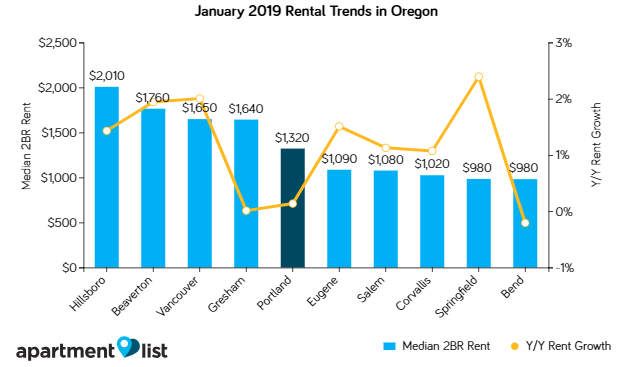
Throughout the past year, rents have remained steady in the city of Portland, but other cities across the entire metro have seen rents increase.

Of the largest 10 cities with data in the Portland metro, 9 of them have seen prices rise.

Oregon as a whole logged rent growth of -1.1% over the past year. Here’s a look at how rents compare across some of the largest cities in the metro.

  • Looking throughout the metro, Hillsboro is the most expensive of all Portland metro’s major cities, with a median two-bedroom rent of $2,010; of the 10 largest cities in the metro that we have data for, Bend, where a two-bedroom goes for $980, is the only major city to see rents fall year-over-year (-0.2%).
  • Springfield, Vancouver, and Beaverton have all experienced year-over-year growth above the state average (2.4%, 2.0%, and 1.9%, respectively).

Portland Rents Increased Moderately Over The Past Month

Portland rents more affordable than many comparable cities nationwide

Portland Rents Increased Moderately Over The Past Month

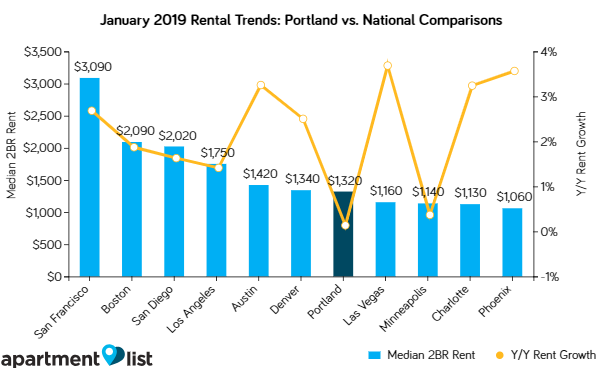
Rent growth in Portland has been relatively stable over the past year – some other large cities have seen more substantial increases. Portland is still more affordable than most similar cities across the country.

  • Portland’s median two-bedroom rent of $1,320 is above the national average of $1,170. Nationwide, rents have grown by 1.0% over the past year compared to the stagnant growth in Portland.
  • While rents in Portland remained moderately stable this year, similar cities saw increases, including Las Vegas (+3.7%), Phoenix (+3.6%), and Austin (+3.3%); note that median 2BR rents in these cities go for $1,160, $1,060, and $1,420 respectively.
  • Renters will find more reasonable prices in Portland than most other large cities. For example, San Francisco has a median 2BR rent of $3,090, which is more than twice the price in Portland.

Methodology

Data from private listing sites, including our own, tends to skew towards luxury apartments, introducing sample bias. In order to address these limitations and provide the most accurate rent estimates available, we now start with reliable median rent statistics from the Census Bureau, then extrapolate forward based on our own rental listing data, using a same-unit analysis similar to Case-Shiller’s approach, which compares only units that are available across both time periods to provide an accurate picture of rent growth in cities across the country.

Apartment List

Apartment List is a growing online apartment rental marketplace on a mission to make finding a home an easy and delightful process.

The Truth About The Home Gain Exclusion

The Truth About The Home Gain Exclusion

The home gain exclusion and important things to consider that may impact your eligibility and the amount of gain you are able to exclude under this provision.

Sponsored Blog

By Michael Bowman

Death and taxes—these are the only certainties in life. Yet, while the IRS rarely misses an opportunity to take a piece of your pie, there are several provisions in the federal tax code that are designed to give homeowners a break. One of these provisions is the home gain exclusion, also frequently referred to as the primary residence exclusion. Many individuals fail to understand the details and requirements of the home gain exclusion and, as a result, they fail to take advantage of this option or underutilize its potential benefits.

In this article, we will explore some common questions concerning the home gain exclusion and important things to consider that may impact your eligibility and the amount of gain you are able to exclude under this provision. It is important to consult a financial advisor and/or certified public accountant (CPA) to discuss your individual circumstances and eligibility for this significant tax benefit.

What is the home gain exclusion?

 If you sell your home for an amount greater than your adjusted basis in the home—your initial investment adjusted by various factors like improvements to the home—you have a capital gain that the IRS wants to know about. Capital gains are subject to a special tax, creatively known as a capital gains tax. Unsurprisingly, financially savvy individuals try to take advantage of every exclusion or opportunity that the tax code allows to avoid paying more taxes than necessary. One option you can utilize to avoid paying capital gains taxes on the sale of your home—or at least limit your capital gain tax liability—is the home gain exclusion.

If you qualify for the home gain exclusion, you may be able to exclude up to $250,000 from your income or up to $500,000 if you are married filing jointly. To qualify, you must meet the ownership test and the use test. The ownership test of the home gain exclusion requires that you owned the home for at least 2 out of the last 5 years prior to the sale of the home. Under the use test, you must have used the home as your primary residence for an aggregate period of at least 2 out of the last 5 years before the date of sale. While the ownership test and the use test must both be met in the 5 years immediately preceding the sale of the home, they can be satisfied in different 2-year periods.

Can I qualify for a partial home gain exclusion?

 Many people do not know that even if you do not meet all the criteria for home gain exclusion, you may still be able to exclude a partial amount of the capital gains you realize from the sale of your home. If you are not eligible for the home gain exclusion because you do not meet the ownership or use test as a result of moving early due to work, health reasons, or to care for an ill family member, you may be able to exclude a prorated amount.

Specifically, the IRS allows for an exception to the 2-year ownership and use requirement if you were forced to move due to a change in employment or health problems. In addition to these reasons, the IRS also provides somewhat of a catch-all provision for “unforeseen circumstances” that you did not consider when purchasing the home such as a natural disaster, a death in the family, unemployment, the birth of twins or another multiple birth, or not being able to afford to remain in the home due to a change in marital status or employment.

However, just because a situation causes you to move does not mean that the IRS will recognize it as an unforeseen circumstance. Some examples where the IRS has refused to approve unforeseen circumstances for the partial home gain exclusion include imprisonment, environmental problems, or a decline in the market.

How does investment into home improvements effect my home gain exclusion?

Money spent on home improvements is relevant to your overall home gain exclusion to the extent that it increases your adjusted basis in the home, thereby potentially lowering your capital gains at the time of sale. By failing to consider the investment you may have made by remodeling the kitchen, bathrooms, and any other home improvements, your capital gains will be calculated to be higher than they should be, as money spent on home improvements increases your basis in the home dollar for dollar. If you do not consider these costs and investments, then you might incorrectly calculate your capital gains to be higher than the amount subject to exclusion under the home gain exclusion and end up paying unnecessary capital gains taxes.

For example, let’s say you purchased your home in 1980 for $100,000. During the time you owned the property, you invested $50,000 into the home to add an addition, replace the roof, redo the plumbing, and remodel the kitchen. In 2018, you sold the property for $400,000. You are single and, when filing your taxes, you completely forgot or did not know to calculate your adjusted basis in the home to include the $50,000 in improvements that you made to the property. So, you calculate your capital gain to be $300,000. You are only eligible to exclude $250,000, so you determine that you are liable to pay taxes on your capital gain of $50,000. If you were knowledgeable about the role of home improvement investments in calculating your adjusted basis in the home, you would have known that your adjusted basis was $150,000 and your total capital gains were only $250,000. As a person filing single, you would be eligible to exclude the full amount of your gain of $250,000 and pay zero in capital gains taxes.

Can I simply gift my home to my child to avoid capital gains taxes?

There are very few instances where it is financially advantageous from a tax perspective to gift your home to one of your children. The most common reason for considering this strategy is to try to protect the assets from creditors or Medicare or avoid paying capital gains taxes. However, gifting your property does not guarantee that you will accomplish any of those objectives. When you gift your home to your child, they take your tax basis in the property and will owe capital gains taxes on the difference between that original basis and the selling price, unless the child lives there for at least two of the last five years before selling. Additionally, even if your family saved money on capital gain taxes by using this strategy, you would still be required to pay taxes on your gift. Depending on your individual circumstances, the amount of gift tax you owe will vary but you are only eligible to exclude $15,000 of the gift if you file as single or $28,000 if you are married filing jointly.

Can I combine my home gain exclusion with a 1031 exchange?

A particularly underutilized strategy for reducing or deferring your capital gains tax liability is to combine the benefits of a home gain exclusion with a 1031 like-kind exchange. A 1031 exchange allows you to reinvest the proceeds of a sale of real estate investment property, rental property, or property used for business purposes into a similar property without paying capital gains taxes. Effectively, this strategy allows you to defer your capital gains tax liability.

The tricky part about combining the home gain exclusion and a 1031 exclusion is that to be eligible for the home gain exclusion you must have used the property as your primary residence and to take advantage of a 1031 exchange, you must have held the property for investment of business purposes. However, there are three scenarios in which you can combine these seemingly opposing options: you acquired the property as rental property and later moved into the rental property yourself and lived there for at least 2 years; you acquired the property as a like-kind 1031 replacement property, held the property for a period of time as rental property and then later converted it to your primary residence for at least 2 years; or you acquired the property as a primary residence and lived there for at least 2 years of the 5 years preceding the date of sale of the property, but then moved out and converted the property to a rental property before selling it.

These requirements are very strict and specific, so it wise to consult a professional tax advisor when seeking to combine these strategies. Ideally, you will consider this benefit ahead of time when planning your decision to convert a rental property into your primary residence or move into a property that you acquired in a 1031 exchange.

The home gain exclusion can be a powerful advantage in your financial and tax planning strategy. It is very important to seek advice from your financial advisor on the best way to protect your assets and minimize capital gains tax liability. Our experts at Anderson Business Advisors have assisted countless homeowners on the most advantageous options for reducing or even completely avoiding capital gains taxes. Contact us today for a consultation.

About the author:

Mr. Bowman, Attorney and Author is a Partner with Anderson Law Group in the firm’s Las Vegas office. He received his Bachelor of Science degree in business from Arizona State University. After spending five years in the computer industry, Mr. Bowman received his Juris Doctor from Seattle University School of Law and is licensed to practice in multiple states. His experience includes commercial and civil litigation, construction defect law, complex real estate transactions, and business law. Throughout his career, Mr. Bowman has been known as an attorney who formulates and executes winning legal strategies. In addition to his legal experience, Mr. Bowman is an avid investor in real estate and the stock market.

Ways to Cover Up a Bad Rental Apartment Floor

Bad Rental Apartment Floor

A bad rental apartment floor can be an issue for many property managers so here are some ideas to help.

By Tracey Clayton

If there’s anything that can put you off of a decent rental property, it’s ugly flooring. It’s totally understandable that you don’t want crumbling tiles in the bathroom, splitting hardwood floors in the living room and outdated linoleum in the kitchen.

But what can you do if you just can’t say no to the apartment?

Here are a few ideas that will help cover up your disaster floors (when remodeling is not an option) and put some style into your apartment home.

Get rid of the problematic spots

bad rental apartment floor
Create a cozy reading nook to cover up a bad rental apartment floor.

If there are only a few spots on your floors that have seen better days, you’re in luck! A worn-out corner can be easily covered up with strategically placed floor cushions. If your shabby area is bigger,  you can create a cozy reading nook with an armchair and ottomans to hide the offending floor.

Be square for once

Covering floors with wall-to-wall carpet is a good idea, especially if you have kids who love to roam around barefoot and play on the floor, but sometimes that’s just not doable.

In that case, opt for carpet tiles that look modern and are super-practical. Some models come with little glue dots on the bottom for easy installation and easy removal. These carpet squares can be easily washed and kept clean and free of allergens. However, the best thing about them is that they are completely modular, which means you can come up with your own arrangement, shapes and patterns, and create truly unique flooring.

Layers, layers, layers

bad apartment rental floors
Grab a few beautiful rugs and combine them into one layered look.

This solution should always be at the top of your list—rug layering!

If you need a quick, cheap and absolutely gorgeous answer to your unappealing floors, grab a few beautiful rugs and combine them into one layered look. This flooring option will not only hide your problematic floors but also add color, softness, texture and visual interest to your space. Feel free to experiment with layering shapes and sizes until you find a unique and practical look, and when you get bored with it, just switch things up and voila—new aesthetics.

bad rental apartment floor
Grab a few beautiful rugs as this flooring option will not only hide your problematic floors but also add color, softness, texture and visual interest to your space.

Replicate luxury with fake marble

When you’re renting, it’s safe to assume that you’re not allowed to tear out the old floors and replace them with marble. But what you can do is fake the Carrera marble look with some top-shelf vinyl stickers. They might sound very kitsch, but these peel-and-stick tiles actually look amazing. They can replicate everything from wood to marble and stone – and they can even be grouted for an authentic look – for a portion of the price of the real thing.

Go gaga for geometry

bad apartment floor

If you’re looking for a durable but less-permanent solution than vinyl stickers, here’s what you need. You can find super-cute vinyl floor cloths that are tear- and wear-proof, non-slippery and easily maintained. But the best thing about this flooring option is that it comes in practically all colors, shapes, sizes and designs imaginable. The bold geometric patterns are the most popular and attractive. They fit amazingly in any bathroom and kitchen and give it that desired Instagram-ready look.

Add some fun with foam

If you’re looking for something soft and colorful yet very cheap, nothing beats foam tiles.

They are truly the best solution for covering shabby flooring in kids’ rooms and playrooms because they are super fun and comfy on little feet and palms.

The foam will also soften all the vibrations and noises kids might make when running around and playing, which is something you and your neighbors will love. Another reason these foam tiles are your friend is that they can be interlocked like a puzzle, so you can assemble and disassemble your floors in minutes. All colors, patterns and styles are available on the market (some options are even non-toxic, fire-retardant and waterproof), so just pick your little one’s fave color and you’re all set.

Bad Rental Apartment Floor

Mask your shower tiles with teak

If your shower tiles are your most critical issue, don’t worry. You don’t have to go looking for a sledgehammer, but hit your local store (retailers like Bed, Bath and Beyond or Overstock are a good starting point) and grab a teak or cedar floor mat. These look amazing in your shower and they are naturally water-resistant. But if you feel crafty, you can whip one up in a few hours or less with only a few materials and tools.

Ugly floors in your rental aren’t the end of the world. These practical and beautiful ideas will not only hide what’s not presentable but also improve the overall look of your home.


Bill To Ban Landlords From Charging Pet Rent Introduced In Oregon

pet rent

Saying it unfairly penalizes animal and pet owners, legislators in Oregon have introduced a bill to ban landlords from charging pet rent.

Three Oregon legislators—Reps. Rob Nosse (D-Portland), Karin Power (D-Milwaukie), and Tawna Sanchez (D-Portland)—have filed a bill that proposes to outlaw pet rent, according to The Oregonian‘s Gordon Friedman, who first spotted the bill.

“I understand the importance of deposits to account for possible tenant pet damage,” Power told Willamette Week, “but pet rent unfairly increases a tenant’s cost to rent without any causal relationship to the impact that their pet may or may not have on the premises.

Pet Rent Penalty

“Pet rent simply penalizes pet ownership by charging a premium to those tenants, and can be exorbitant—more than a few hundred dollars a year,” she said.

House Bill 2683 would prohibit landlords that allow pets from charging tenants additional rent or fees based on possession of pets.

The bill states a landlord may not increase the rent or charge to a tenant a one-time, monthly or other periodic amount based on the tenant’s possession of a pet.

If the bill passes it would “only apply to rental agreements that are entered into, renewed or modified on or after the effective date.”

The bill defines rent as “any payment to be made to the landlord under the rental agreement, periodic or otherwise, in exchange for the right of a tenant [and any permitted pet] to occupy a dwelling unit to the exclusion of others and to use the premises.” “Rent” does not include security deposits, fees or utility or service charges.

The bill also defines a security deposit  as a “refundable payment or deposit of money, however designated, the primary function of which is to secure the performance of a rental agreement or any part of a rental agreement.” “Security deposit” does not include a fee.

Outdoor Living Rooms Have Become An Important Amenity

Outdoor Living Rooms Have Become An Important Amenity

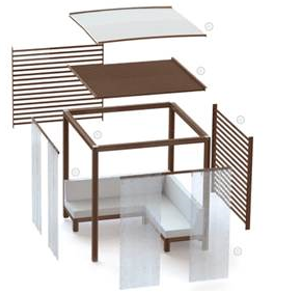
Outdoor living rooms have become an important apartment amenity and something you need to consider when attracting tenants.
Sponsored Blog

By Jeannie Flynn

Property owners are always looking for something new and exciting to offer their residents.

Pool areas play a huge role in the list of common-area amenities, which is why outdoor living rooms have become very popular.

Outdoor Living Rooms Have Become An Important AmenityOutdoor Living Rooms Have Become An Important Amenity

Outdoor Living Rooms Have Become An Important Amenity
Pre Wired outlets
Outdoor Living Rooms Have Become An Important Amenity
Built-in lights
Outdoor Living Rooms Have Become An Important Amenity
TV mounts

Outdoor Living Rooms Have Become An Important Amenity
Infrared Heaters and More!

The benefits of a “portable” product vs a building or permanent structure:

  • No building permit required
  • Easy to install
  • No down time at the pool
  • No construction mess.

When choosing a living space for your property, keep in mind there are many options out there.

Make sure the products you chose are designed for heavy commercial use and the outdoor elements.  Especially wind.

In general, any fabric should offer at least a 7- to 10-year warranty against fading or sun rot. Heavy aluminum frames normally offer a 5-year commercial warranty.  Aluminum will resist rusting and damaging pool decks.

About CMS Commercial Furniture

 CMS Commercial Furniture offers the finest selection in commercial rated outdoor furniture and accessories.  We are proud to announce our new cleaning service and repair division. Diversity and flexibility are what make CMS Commercial Furniture a leader in this industry.  We sell, service and maintain outdoor furniture.  For more information about designing the right Outdoor Living Space for your property please contact us at 480-892-3212 or visit our website at www.cmsfurniture.com


Slow Down Your Decision Making To Avoid Unconscious Bias

Slow Down Your Decision Making To Avoid Unconscious Bias

The Grace Hill training tip this week asks if you are too quick to judge sometimes and could that lead to unconscious bias in your housing decisions?

By Ellen Clark

Shortcuts can be based on social norms and stereotypes, which can lead us to form quick opinions that may not be accurate.

Unconscious bias is a phenomenon that affects almost everyone’s decision-making processes and is something we all have to some degree, although we may not be aware of it.

How does unconscious bias work?

Our past experiences affect the decisions we make, and we tend to create “mental shortcuts” to help us process new information.

Unfortunately, these shortcuts can be based on social norms and stereotypes, which can lead us to form a quick opinion about a situation or a person without really having enough information to form that opinion.

Unconscious biases can lead us to make incorrect assumptions based on flawed logic, stereotypes, and poor interpretations of data. These biases can be damaging in day-to-day interactions with others.

Fighting these biases requires first acknowledging that they exist and then employing purposeful strategies to overcome them. Here are some tips.

3 steps to avoid unconscious bias

  1. Perspective-taking: Putting yourself in another person’s shoes and focusing on how his or her experience in a situation may be different from your own may help you recognize biases you didn’t even know you had. When you can, before you make a decision, try to walk a mile in the other person’s shoes”or imagine the world from their vantage point.
  2. Creating processes: Because unconscious biases happen at lightning speed, overcoming them can be helped by slowing down our decision-making. For example, next time you are about to tell a joke or rib someone, ask yourself, “How would I feel if someone told a joke like that about me, or about something important to me, like my race, religion, or physical appearance?”
  3. Creating an inclusive environment: Think about new ways to engage, collaborate, and step out from your usual group at work. Share ideas or challenges with members of other teams—you may tap into expertise you didn’t realize was there. If you can, leave your desk and try working in a different area for a few hours. This change of perspective may lead you to interact with people you otherwise wouldn’t.
  4. Recognizing assumptions: Think of those teen movies where the shy guy doesn’t ask the girl out because he thinks she’ll say no. When he finally does, she says yes—and asks what took so long? Next time you find yourself making an assumption about someone, stop yourself. Ask the person the question so they can answer for themselves. Even if you confirm your assumption, you now have information that can help in future interactions.

Summary 

Stepping out from your usual group at work may provide a new perspective and lead you to interact with people you otherwise wouldn’t.

The topics of inclusion and diversity can seem overwhelming. But the more aware we are of our biases, and how important it is to look outside of our “group,” the more we can consciously challenge our decisions and help improve our work environment.
Remember, you are part of a larger team, and you can’t solve the inclusion problem all on your own. You do, however, play a part in minimizing the impact of biases and embracing the benefits of a diverse, and inclusive workforce.

Recent Grace Hill training tips you may have missed:

What Do You Do When Assistance Animals Break The Rules?

7 Ways To Stay Out Of Trouble When Checking Criminal History

5 Ways To Protect Applicants, Residents And Employees From Sexual Harassment

Do You Have A Smoke-Free Policy That Adequately Protects Residents?

How To Handle Suspicious Documentation For Assistance Animals

How A No Pet Policy Can Be Discriminatory

Property Management Cyber attack Risks Overlooked, Underestimated

Do You Know How To Respond To a Sexual Harassment Complaint?

Have You Reviewed Your Criminal Background Checks Policy Lately?

Multifamily Managers And Marijuana: Caught In A Pot Crossfire

Fair Housing Discrimination Against Someone You’ve Never Talked To?

4 Ways To Avoid Screening Pitfalls With Applicants

Red Flags In Evaluating Documentation For Assistance Animals

About the author:

Ellen Clark is the Director of Assessment at Grace Hill.  Her work has spanned the entire learner lifecycle, from elementary school through professional education. She spent more than 10 years working with K12 Inc.’s network of online charter schools – measuring learning, developing learning improvement plans using evidence-based strategies, and conducting learning studies. Later, at Kaplan Inc., she worked in the vocational education and job training divisions, improving online, blended and face-to-face training programs, and working directly with business leadership and trainers to improve learner outcomes and job performance. Ellen lives and works in Maryland, where she was born and raised.

About Grace Hill

For nearly two decades, Grace Hill has been developing best-in-class online training courseware and administration solely for the Property Management Industry, designed to help people, teams and companies improve performance and reduce risk. Contact Grace Hill at 866.472.2344 to hear more


Renters Typically Spend More For A Studio Apartment Than A One-Bedroom Rental

Renters Typically Spend More For A Studio Apartment Than A One-Bedroom Rental

Renting a typical studio apartment costs more each month than renting a typical one-bedroom home or apartment, according to a new HotPads analysis in a release.

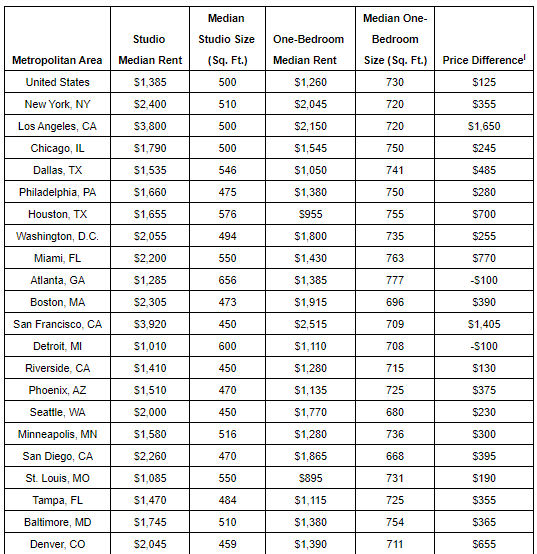
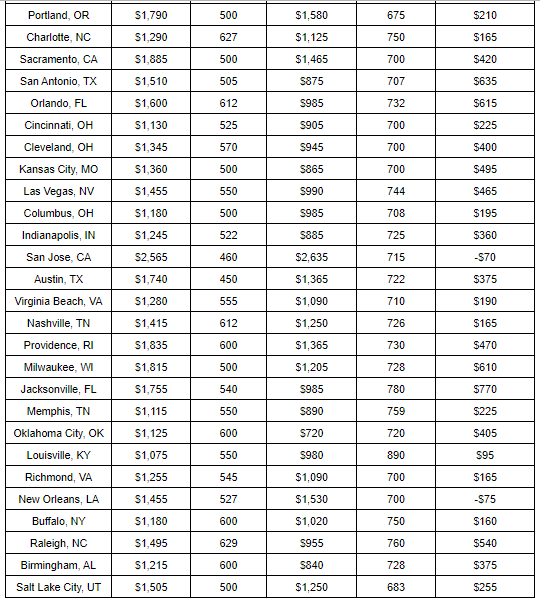
Across the United States, the median rent for a studio apartment is $1,385 per month. The median rent for a one-bedroom rental is $1,260 per month – about $125 per month less.

  • Los Angeles has the biggest price difference between studio and one-bedroom rentals – the median rent for a studio in Los Angeles is $3,800 per month, $1,650 more than the median rent for a one-bedroom unit.
  • In San Francisco, the median rent for a studio apartment is about $1,400 higher than for a one-bedroom.

Why this price difference for studio apartment?

“Many renters looking to strike out on their own assume they’ll get a rent discount if they sacrifice the privacy of a bedroom,” said Joshua Clark, economist at HotPads, in a press release.

“But when it comes down to it, location can be more important than floor plan or size when it comes to saving on rent. Renters determined to live in the heart of the city might still save by leasing a studio, but those looking for the best deal are likely better off searching for a slightly larger place farther from the middle of town,” Clark says.

One-bedrooms are typically 730 square feet, while studios are typically smaller, at 500 square feet. But the reason is location – in the metros analyzed, studios were typically a third of a mile closer to major job centers than one-bedroom rentals, and dense and desirable urban areas where studios are concentrated can yield higher rents.

One-bedroom units are more common overall, and locations range more broadly throughout a metro area and farther from a metro area’s core, where rents tend to be more affordable.

Renters Typically Spend More For A Studio Apartment Than A One-Bedroom Rental

In Detroit, Atlanta, New Orleans and San Jose, a one-bedroom rental is typically more expensive than a studio apartment. Atlanta and Detroit renters can expect to spend $100 more on a one-bedroom each month than they would on a studio, while renters in San Jose and New Orleans pay $70 to $75 more each month for a one-bedroom.

HotPads is a Zillow Group-owned apartment and home-search platform for renters in urban areas across the United States. For more information on the U.S. rental market, visit HotPads.com.

Oregon Senate Bill Aims To Set Rent Control Limits On Landlords

Oregon Rent Control Bill Moving Forward In The Senate

Oregon Governor Kate Brown has signaled her support for the bill. Brown believes those ideas “are innovative and will give renters some peace of mind,” said spokeswoman Kate Kondayen to Oregon Public Broadcasting.

Powerful house and senate leaders have lined up behind the bill, which looks to pass in this legislative session.

“Speaker Tina Kotek (D-Portland) and Senator Ginny Burdick (D-Portland) have innovative proposals that will give renters some peace of mind.  Oregon families are counting on us. They are counting on us so they don’t have to make a choice between paying the rent and staying home with their newborn,” the governor said.

House Speaker Kotek proposed in 2017 to eliminate no-cause evictions and lift the state’s 1985 ban on rent control, allowing cities to create their own rent-control policies. That effort failed in the Senate after passing in the House.

“We need to make progress here,” Kotek told OregonLive. “So, we needed to have a bill that could get support in the Senate.”

Portland Mayor Ted Wheeler has endorsed the concept of the bill but said he still has some questions about various aspects of the bill, including how it will affect affordable housing. On balance, however, he supports the Legislature pursuing it, although he said he will reserve final judgment until he sees the final version.

Oregon Senate Bill 608

  • Prohibits a landlord from terminating month-to-month tenancy without cause after 12 months of occupancy. Provides exception for certain tenancies on building or lot used by landlord as residence.
  • Allows a landlord to terminate tenancy with 90 days’ written notice and payment of one month’s rent under certain conditions. Exempts landlord managing four or fewer units from payment of one month’s rent.
  • Provides that fixed-term tenancy becomes month-to-month tenancy upon ending date if not renewed or terminated.
  • Allows landlord to not renew fixed-term tenancy if tenant receives three lease-violation warnings within 12 months during term and landlord gives 90 days’ notice.
  • Limits rent increases for residential tenancies to one per year.
  • Limits maximum annual rent increase to 7 percent above annual change in consumer price index.
  • Requires Oregon Department of Administrative Services to publish maximum annual rent increase percentage.
  • Declares emergency, effective on passage.

Read the Senate Bill here.

“Just-cause [evictions] and rent control need to go hand and hand for either to be effective,” Nicole B. Montojo, a housing research analyst at the University of California, Berkeley, told Willamette Week.

A landlord subject to rent control but not to restrictions on evictions could kick a tenant out for no reason and raise the rent, Montojo explains. “If you had a just-cause [bill] but no rent control, the landlord could just raise the rent and force someone out.”

Resources:

Everything You Need to Know About a Rent Control Bill That Oregon’s Power Brokers in Salem Have Lined Up Behind

Oregon lawmakers to hear bill on rent control, among others in legislative session

Oregon lawmakers propose unorthodox approach to rent control

Wheeler supports rent control, infill growth plan

Housing Leaders Warn of Shutdown’s Impact On Affordable Housing, Communities

Housing Leaders Warn of Shutdown’s Impact on Affordable Housing and Communities

Housing leaders are warning that the U.S. Department Of Housing and Urban Development (HUD) shutdown of most operations could be disastrous to Section 8 and other rental assistance programs, according to a release from the Council of Large Public Housing Authorities.

“Public housing authorities, which are responsible for housing over three million low-income households nationwide, are doing everything they can to keep things running during this period of tremendous uncertainty, but it is unclear how long they can continue with business as usual for residents and landlords,”  Council of Large Public Housing Authorities Executive Director Sunia Zaterman said in the release.

Shutdown unmitigated disaster for low-income families

“Without a guarantee from HUD that funding will be available in March, many PHAs will need to notify landlords and residents next month that delayed payments are a possibility. Anxious residents and landlords fearful of missed payments, combined with other cascading impacts due to lack of staffing at HUD, including program grants not being renewed and affordable housing development deals not being approved, amount to an unmitigated disaster for millions of low-income families,” Zaterman said.

Members of the Campaign for Housing and Community Development Funding (CHCDF) hosted a national call with over 2,200 registrants about the effects of the partial government shutdown on low-income people and communities and the affordable housing programs that serve them.

Experts from multiple affordable housing organizations shared information on the shutdown’s impact on federal affordable housing and community development programs and emphasized that the longer the shutdown continues, the more negatively it will impact people with the lowest incomes – seniors, people with disabilities, and families with children. Panelists spoke about the shutdown’s effects on public housing, project-based rental assistance, housing vouchers, rural housing, and housing and services for seniors, people with disabilities, the homeless, and those at risk of homelessness.

The panel encouraged listeners to contact their members of Congress and tell them to vote now—before residents in federally assisted housing experience rent hikes and evictions—to reopen the federal government and pass clean fiscal year 2019 spending bills.

700 property owners with HUD contracts and 70,000 renters at risk

“Nearly 700 property owners that have HUD contracts to operate housing affordable to the lowest-income seniors, people with disabilities, and families with children have seen those contracts expire due to the shutdown, and more will expire this month and next,” said National Low-Income Housing Coalition President and CEO Diane Yentel in the release.

“These contract suspensions put the homes of nearly 70,000 low-income renters at risk of serious rent hikes and evictions. HUD has asked owners of these properties to dip into their savings, if they have any, to cover the costs. Some will be able to do so, but not forever, and some have already communicated to their tenants that rent hikes are coming.

“The longer the shutdown goes on, the more untenable it will become for property owners to keep scraping by without their federal contracts – and the more the lowest-income renters will suffer,” she said.

HUD has not renewed 22 contracts for rental assistance

“HUD has made clear already, in December, [it has] not renewed 224 contracts for rental assistance in Section 202 Housing for the Elderly communities, and more are set to expire in January,” said LeadingAge President and CEO Katie Smith in the release. “LeadingAge’s members, all nonprofits, rely on regular and adequate funding to provide quality affordable housing to some of the nation’s lowest-income older adults.

“The average older adult in HUD’s Section 202 Housing for the Elderly program has an annual income of $13,300, an income far too little to make ends meet in any private housing market. More than 400,000 older adults rely on the Section 202 program, while another 1.2 million rely on other HUD programs for housing assistance. We urge Congress and the White House to end the shutdown so that . . . these 1.6 million older adults have the stable housing they need to age with dignity,” she said.

Private rental housing owners scrambling to cover costs

“Every day that it drags on, the needless government shutdown threatens more low-income seniors, people with disabilities, and seniors who rely on critically important federally assisted affordable housing,” said National Housing Trust Federal Policy Director Ellen Lurie Hoffman in the release.

“Private rental housing owners are scrambling to cover operating costs for which the federal government is contractually responsible, with no end in sight.”

Listen to the CHCDF national call on the impacts of the shutdown on affordable housing programs and community development at: https://bit.ly/2DersVM(link is external)   

Read NLIHC’s latest update on the shutdown at: https://bit.ly/2AzHoju(link is external)

Check out NLIHC’s interactive map(link is external) and a state-by-state breakdown(link is external) of how the shutdown is impacting some HUD-assisted housing.

About the Council of Large Public Housing Authorities (CLPHA): The Council of Large Public Housing Authorities is a national non-profit organization that works to preserve and improve public and affordable housing through advocacy, research, policy analysis and public education.