Home Blog Page 174

Can Tenants Have Multiple Service Animals Or Assistance Animals?

Ultimate guide to assistance animals in rental housing

The Grace Hill training tip of the week continues the focus on the confusing issue of service animals, assistance animals and emotional support animals.

By Ellen Clark

By now you’ve probably figured out that complying with assistance animal requests is confusing and difficult.

One of the situations that many people find particularly confusing is when there are multiple animals involved and an apartment complex that may have a one-pet rule.

    • Can residents have more than one assistance animal?
    • Can residents have pets and assistance animals?

 Can a resident have more than one service animal or assistance animal?

The Fair Housing Act (FHA) and Section 504 of the Rehabilitation Act of 1973 (Section 504) do not limit the number of assistance animals one person can have.

 Consider these service animal and assistance animals scenarios:

    • A person with a visual disability and a seizure disorder may use a guide dog to get around and another animal to be alerted to oncoming seizures
    • A person might need two assistance animals for the same task, such as two dogs for stability when walking

If a resident requests multiple animals, you may request documentation to show that each animal provides disability-related assistance or emotional support.

Remember that you can only request documentation for the animals where the disability-related need is not obvious or known to you.

 What if I have a one-pet policy and a resident with a pet requests a service animal or assistance animal, too?

If a person with a disability has a pet and makes a reasonable accommodation request to have an assistance animal too, you cannot deny the request just because of your one-pet policy.

Remember, assistance animals are not pets.

If the number of animals requested becomes unreasonable or you think it presents an undue hardship to your community, consult with your legal counsel to see if you can legally deny the request.

Open communication with residents is best solution

Remember, evaluating a reasonable accommodation request should be an individualized process with an ongoing dialog between you and the resident.

Often people file discrimination claims because they don’t feel heard, don’t understand the process, or aren’t kept in the loop.

Don’t underestimate the importance of good communication as you navigate these complicated issues.

Recent training tips you may have missed:

How A No Pet Policy Can Be Discriminatory

Assistance Animals Are Not Pets, Repeat, Assistance Animals Are Not Pets

Read Ellen’s full blog post here

About the author:

assistance animals and apartments


Ellen Clark is the Director of Assessment at Grace Hill.  Her work has spanned the entire learner lifecycle, from elementary school through professional education. She spent over 10 years working with K12 Inc.’s network of online charter schools – measuring learning, developing learning improvement plans using evidence-based strategies, and conducting learning studies. Later, at Kaplan Inc., she worked in the vocational education and job training divisions, improving online, blended and face-to-face training programs, and working directly with business leadership and trainers to improve learner outcomes and job performance. Ellen lives and works in Maryland, where she was born and raised.

About Grace Hill

For nearly two decades, Grace Hill has been developing best-in-class online training courseware and administration solely for the Property Management Industry, designed to help people, teams and companies improve performance and reduce risk.

Can A Resident assistance animals? - more than one?

Capt. Robert Baldwin and 1st Lt. Gregory Caliwag, 88th Medical Center clinical nurses pet Bailey, a pet therapy dog from the Miami Valley Pet Therapy Association on July 21, 2017. Pet therapy dogs visit the medical center seven days a week to provide comfort to patients and staff members. (U.S. Air Force photo/Stacey Geiger) via creative commons.


 

Oregon Senate Passes Bill Extending Property Tax Exemptions for Multifamily Housing

Lawmakers Extend Oregon Eviction Moratorium Through End of September

The Oregon Senate has passed, 26-0, Senate Bill 262, which extends the sunset on a program that permits cities and counties to grant property tax exemptions for multifamily housing rentals.

Multi-unit rentals can provide affordable housing options for Oregon families. This bill extends the incentives for builders and developers to create this type of housing, according to a release from Senate Democrats.

“In Senate Bill 608, we provided greater protections against rent-gouging and no-cause evictions. At the time, we acknowledged the need for greater affordable-housing supply in our state,” said Sen. Michael Dembrow (D-Portland), who carried the bill on the Senate floor, in a release.

“This bill will encourage developers to build affordable multi-family units. Local governments get to decide whether they want to participate and how they want that to happen. It’s a tool to help local governments spur affordable housing development in their communities.”

Property tax exemptions for multifamily housing

The program is scheduled to last until Jan. 1, 2022, and this bill will extend its availability until Jan. 1, 2032. As part of the program, cities and counties can grant property tax exemptions – if they choose to do that – for multiple-unit rental housing for a 10-year period. Several counties use this tool to create housing for their residents with less than 60 to 80 percent of the median- area income. The programs are designed by local governments. After the program sunsets, the property tax exemptions won’t be available anymore.

Some officials hope that extending the sunset and providing property tax exemptions for multifamily housing will entice more cities to participate in the program, which so far has been used more often by counties. The exemption was claimed by 36 properties last year and provided an incentive of $13.7 million in waived property taxes.

“More cities are exploring a variety of options to help with the development costs of long-term affordable units, and, for some communities, this tool will help them to meet their goals,” Erin Doyle, League of Oregon Cities intergovernmental relations associate, said in her written testimony on the bill.

Housing issues aren’t just affecting families in some communities; it’s a statewide crisis. Alison McIntosh, with Oregon Housing Alliance, testified that during the last school year 21,750 of the state’s school children in kindergarten through 12th grade experienced homelessness at some point.

“Today, we simply don’t have enough affordable homes for people who need them, and vacancy rates have dropped precipitously towards zero in communities across Oregon,” McIntosh wrote in her testimony on the bill. “People – our neighbors and members of our community – are struggling with homelessness, housing instability, rent burdens and to make ends meet and put food on the table.”

Senate Bill 262 now goes to the House of Representatives for consideration.

Why Is It So Hard To Build Affordable Housing In Portland?

Real Estate Syndication Investing – 10 Things To Know

If you are thinking of investing in a real estate syndication, especially for multifamily investing, here are 10 things to know from Kim Lisa Taylor, Esq., founding attorney of Syndication Attorneys, PLLC.

By Kim Lisa Taylor, Esq.

If you have a self-directed IRA or substantial investment funds, you no doubt have considered investing in real estate, especially multifamily.

However, you may lack the funds to invest on your own or the desire to deal with the hassles of property management. A viable option for you may be to invest in a real estate “syndication” (i.e., a group real estate investment, also known as a Private Placement Offering) as a passive investor.

Real Estate Syndication – What Is It?

In a real estate syndication, a “sponsor” or “syndicator (which may be an individual or an entity) will typically identify a real estate asset, such as an existing commercial or multifamily property (or vacant land for development) or single-family fix-and-flips that will yield a sufficient return to pay themselves and their investors from cash flow during operations and/or equity on resale.

The sponsor may obtain institutional financing for a portion of the purchase price and then pool funds from private investors to finance the down payment and closing costs, or he or she may raise all of the purchase money from private investors. The sponsor’s job will consist of finding a suitable property, putting the group of investors together and managing the asset on their behalf. In exchange for these efforts, the sponsor will receive fees and/or a percentage of the “distributable cash” (i.e., profits) left after all expenses and loan obligations have been paid.

Real Estate Syndication: What Kind of Returns Do Syndications Offer?

Typical investor returns can range from 6 % to 12% (or more) annualized, calculated against the amount of money invested. The range varies, based on the type of investment and the level of risk to which an investor may be exposed. The higher the return offered, the greater the risk.

For example, an investor or self-directed IRA might take a position as a “debt partner,” in which case the returns will be calculated as interest on the amount invested. Such returns may be in the lower ranges, but the debt partnership position may be “preferred” or “secured” by a lien against the real estate, which is a lower-risk position.

Another option for investors is an “equity partnership” position, where the distributable cash is split proportionately between the group of investors and the sponsor, whose compensation can range from 25% to 50% of the distributable cash. In this case, the investor returns may be greater, but they will be dependent on the performance of the property and the sponsor’s ability to maximize returns by increasing income and minimizing expenses.

What Information Should I Get from the Syndicator?

Prior to accepting any investor funds, the sponsor is required by securities laws to provide a set of offering documents that explains the terms and discloses the risks of the offering to prospective investors.

Further, sponsors typically answer to their investors by means of periodic newsletters, financial reports and/or teleconferences. Unlike a stock investment, investors may also have some limited voting rights regarding major decisions affecting the company or their investment.

Investing In A Real Estate Syndication – 10 Things To Know

Before investing in a real estate syndication, you should carefully review all of the offering documents provided by the sponsor and look for (or ask) questions regarding the following things:

1. The Sponsor’s background, education and experience with similar investments, if any.

2. The team members involved in acquisition and operation of the property, including attorneys, CPAs, other members of the sponsor, property managers and affiliates that may receive fees, etc.

3. Cash distributions to investors during acquisition, operation and disposition of the property, including the proposed timing and anticipated percentage returns.

4. Sponsor fees and cash distributions.

5. Anticipated duration of the investment.

6. Property information, including its type and condition, the purchase price, financial history, proposed “value add” and exit strategies and pro forma financial projections.

7. Dispute resolution provisions.

8. Voting rights of investors.

9. Provisions for removal of the sponsor.

10. Information about the law firm that structured the offering and drafted the offering documents, and whether the firm is experienced with securities offerings.

Seek Professional Advice

In addition to satisfying yourself with respect to all of the items listed above, you should seek the advice of your own attorney, financial adviser or accountant regarding the investment.

Your attorney should determine whether the offering complies with applicable securities laws. A sponsor that disregards the applicable laws (or drafts its own documents) may expose itself and the entire investment to unnecessary civil or criminal liability, or it may be unaware of its fiduciary obligations to its investors.

Your CPA or financial adviser should evaluate the financial merits of the investment based on past financial statements for the property and pro forma projections provided by the sponsor, as well as its suitability for your investment portfolio.

Where Can I Meet Syndicators?

Become a member of your local real estate investment clubs and attend their meetings on a regular basis, and attend the informational seminars offered by your self-directed IRA administrator.

DISCLAIMER: The discussion herein is of a general nature only and is not to be construed as specific legal advice, which requires the establishment of an attorney-client relationship and fee agreement. An issuer represented by securities counsel should rely on his or her own attorney’s advice with respect to the matters discussed in this article.

About the Author

Real Estate Syndication Investing – 10 Things To Know

Kim Lisa Taylor, Esq., is founding attorney of Syndication Attorneys, PLLC, a boutique corporate securities law firm that helps clients nationwide with their federal real estate securities offerings. She has been licensed in California since 2002 and in Florida since 2012 and has made securities transactional law the focus of her practice since 2008. The firm employs one additional contract attorney with securities experience as well as other support staff. Kim and her team are available for consultation in St. Augustine, Florida.

Related:

How Multifamily Investors and Others Raise Private Money Legally


Affordable Housing Community in Downtown Seattle Purchased by Security Properties

Affordable Housing Community in Downtown Seattle Purchased by Security Properties

A newly constructed 160-unit affordable housing community in downtown Seattle, called HANA, at the intersection of 6th and Yesler, has been acquired by Security Properties and Pacific Life, according to a release.

“Given the well-documented demand for affordable housing in Seattle, HANA is a being delivered at the perfect time,” said Steve TeSelle, Director of Affordable Housing for Security Properties, in the release.

“HANA will provide high-end units at a significant discount to market rents in the surrounding area,” he said.

This is the third affordable housing joint-venture by Security Properties and Pacific Life.

Affordable housing community in downtown Seattle

HANA is a mixed-use, podium-style community with more than 13,000 square feet of commercial space occupied by Bright Horizons daycare, and 160 apartment units.

Apartments feature floor‐to‐ceiling windows, hard-surface kitchen countertops, and vinyl-plank flooring that is consistent with Class-A market rate product. Residents will also benefit from a 7th floor rooftop deck with community kitchen and unobstructed views of Puget Sound and downtown Seattle. The property is minutes from light-rail as well as a wide variety of restaurants, retail amenities, and the Stadium District.

Affordable Housing Community in Downtown Seattle Purchased by Security Properties
HANA is minutes from light-rail as well as a wide variety of restaurants, retail amenities, and the Stadium District.

HANA was delivered in early 2019 and is presently undergoing lease-up.

The property participates in a variety of local affordability programs, including Seattle’s Multifamily Tax Exemption (MFTE) program, which together restrict all units to households earning between 50% and 80% of Area Median Income (AMI).

This translates to affordable rents for families earning up to $80,000, for a household of 4 people.

HANA is Security Properties’ fourth affordable housing acquisition in Washington state. The company’s Affordable Housing Group maintains a national footprint with an existing portfolio of more than 8,000 units across 58 low-income housing assets. Security Properties also owns more than 13,900 conventional units across 54 properties.

About Security Properties
Security Properties is a national real estate investment, development, and operating company headquartered in Seattle, Washington. For more than 50 years, Security Properties has provided quality housing to its residents as well as excellent financial performance for its investors. Since its founding, Security Properties has acquired or developed more than 83,000 residential units at a cost of over $5.7 billion. Security Properties maintains a focused multi-family strategy supported by integrated teams of professional acquisition, development, construction, investment, and property-management specialists. For more information, visit www.securityproperties.com

Seattle and Portland In Top 5 Cities in U.S. for Most Green Apartment Rental Units

Seattle and Portland In Top 5 Cities in U.S. for Most Green Apartment Rental Units

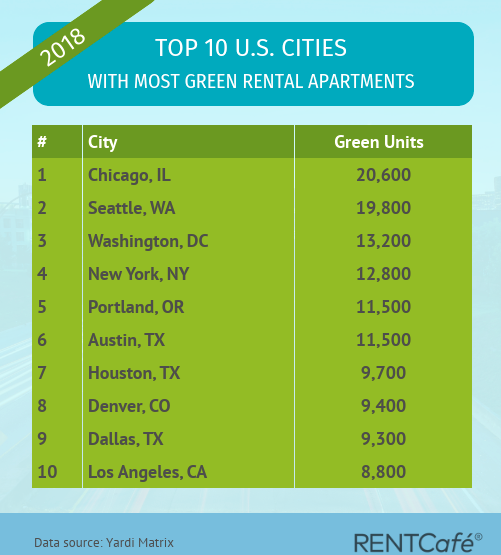
Seattle and Portland are in the top five cities in the United States with the most green apartment rental units, according to a new study by RentCafe.

The study shows that while green-apartment growth has slowed slightly recently, it is still up 300 percent over the past 10 years.

Seattle has the most green buildings of any city

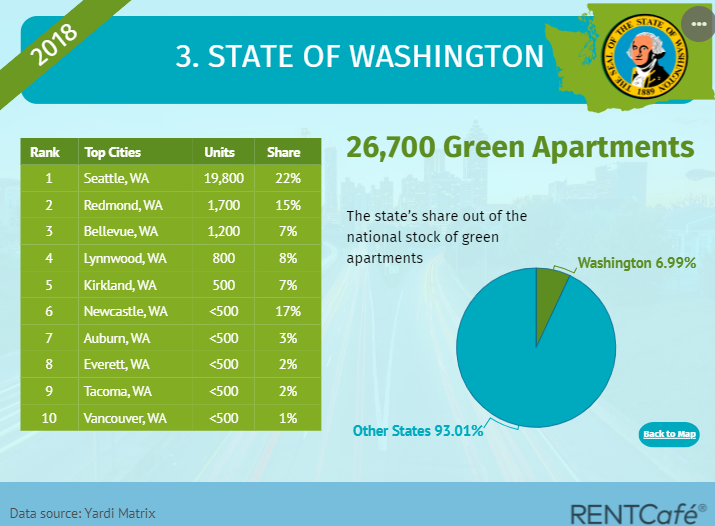
The Emerald City stays true to its colors with around 22% of all Seattle apartments being sustainable. With almost 20,000 green certified units in 94 residential buildings, Seattle has the largest number of green buildings of any city in the United States.

Portland right behind Seattle in green building

Seattle and Portland In Top 5 Cities in U.S. for Most Green Apartment Rental Units

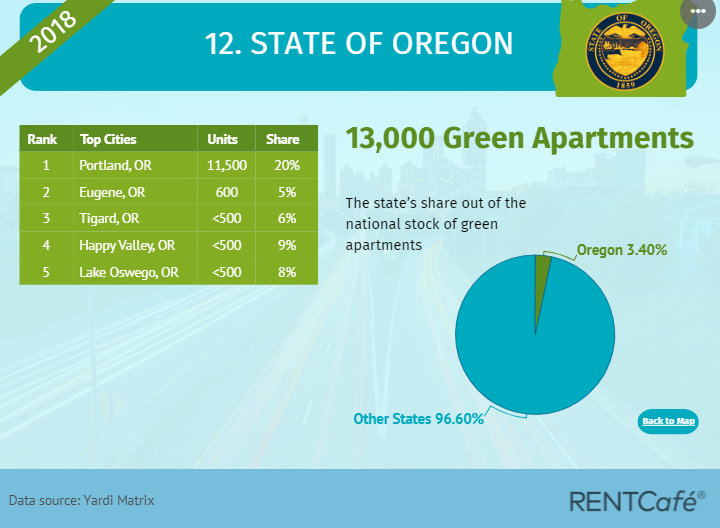
Portland, OR makes other cities green with envy with the second largest residential green share in the country after Seattle —  about 20% of what has been built there since 2009 is sustainable. As of 2018, the city offers more than 11,500 green apartments in 75 sustainable residential buildings.

“When discussing ideas for a healthier environment, we cannot overlook the part green-certified buildings play among verifiable eco-friendly solutions that reduce carbon emissions and waste, while using less energy and water. As commercial buildings embrace more resource-efficient options, it was only a matter of time before green construction development would contribute to the multifamily sector next,” RentCafe says in the report.

“In order to see how sustainable the U.S. rental market really is, we analyzed the evolution of green construction over the past decade, between 2008 and 2018. By examining Yardi Matrix‘s national inventory, we considered buildings of 50+ units that have already achieved or are proposed for LEED certification, the most widely used international sustainable building rating system. The verification system introduced in 2000 by the Leadership in Energy and Environmental Design confirms whether a building has been developed under eco-conscious principles or not.”

Seattle and Portland In Top 5 Cities in U.S. for Most Green Apartment Rental Units

Green apartment rental study highlights:

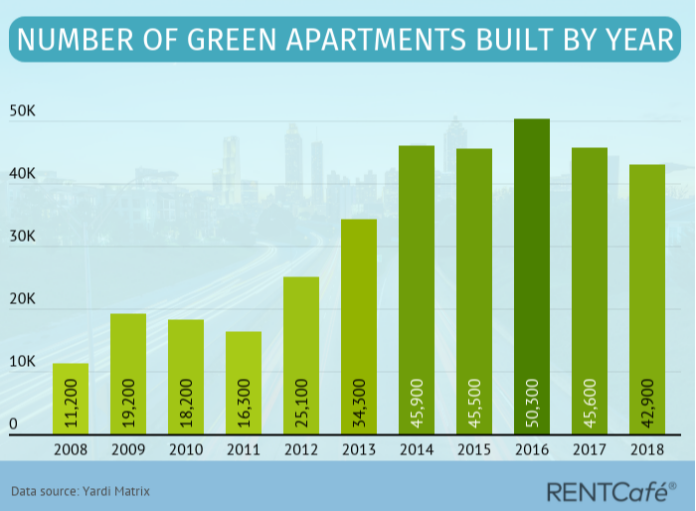
  • Ten years ago, only 5% of new apartments were green-certified, approx. 11,200. The number of sustainable rentals increased each year, peaking at 50,300 LEED-certified units in 2016, which accounted for 16% of the residential construction that year.
  • Since then, the number of sustainable units has dropped, seeing a 6% year-over-year decline in 2018, when about 15% of the apartments delivered had LEED certification. While the present is greener than the past, we cannot yet talk about a constant year-over-year increase in energy-efficient housing.
  • Which cities show significant eco-friendly development? Chicago leads the way with 20,600 green units delivered last year, followed closely by Seattle, with 19,800, which also boasts the largest number of LEED-certified buildings in the nation, 94.
  • Washington, D.C. follows up with 13,200 units. Its metro area, though, has the best offer for eco-conscious renters, with no more than 7 cities in the list of best ratios of people-to-green units.
  • Which is the greenest state? This title goes to California, which has the highest number of green residential units – 55,100. Texas and Washington also show significant green apartment development.

Seattle and Portland In Top 5 Cities in U.S. for Most Green Apartment Rental Units

Sustainable building construction and certification went down in the past two years, naturally following the deceleration trend in overall apartment construction, but never below the 42,000 mark. For example, even the -9% year-over-year drop registered in 2017 translated into 45,600 new buildings that got a green certification by the end of the year.

Read the full report from RentCafe here.

Methodology:

  • Property and rent data was compiled from Yardi Matrix, our sister company that specializes in multifamily market research.
  •  Property and rent data as of January 2019.
  • We consider “green buildings” multifamily projects that are LEED-certified or proposed for LEED certification.
  •  LEED-certification was cross-checked with USGBC’s public records; updates may occur.
  •  Study includes only large-scale apartment buildings of 50 units or more.
  •  Average rent comparisons were performed in U.S. cities with at least 5 green multifamily buildings and 500 units.


1031 Exchange Investors Are Choosing DST Properties for Passive Real Estate Ownership

Kay Properties and 1031 and 1033 exchanges and eminent domain options details

Sponsored Blog

By Jason Salmon
Senior Vice President; Managing Director of Real Estate Analytics
Kay Properties & Investments, LLC

Over the course of the past several years, Kay Properties has observed incremental growth in the number of investors choosing Delaware Statutory Trusts (DSTs) as a preferred means of passive real estate investing for like-kind, tax-deferred 1031 exchanges.

1031 Exchange Basics

Per section 1031 of the Internal Revenue Code, real estate investors—under specific guidelines—may potentially defer their capital gains tax, depreciation recapture tax, and other taxes (each investor should consult their own CPA/attorney since every situation is unique). Upon the sale of investment real estate, the proceeds would go to a Qualified Intermediary, then the investor must purchase real estate of equal or greater value and has 45 days to “identify” replacement property with a concurrent 180-day timeline to close.

IRS/DSTs

Through what’s known as the Internal Revenue Service’s Revenue Ruling 2004-86, DSTs have been recognized as vehicles for investors looking for like-kind real estate as 1031 exchange replacement property with the ability to conduct another 1031 exchange upon the sale of the DST property.

Passive Real Estate Investing

For many real estate investors that have had their lives consumed with being pinned to real estate property management and/or asset management responsibilities, DSTs offer the opportunity to be passive and diversified—via the 1031 exchange into multiple DSTs/multiple geographic areas/multiple property types. Diversification does not guarantee profits or protect against losses.

As of the time of writing this article, Kay Properties has over 35 DST offerings available to our clients from over 20 companies that most would consider sophisticated real estate asset managers. As such, real estate sectors represented include, but are not limited to healthcare, multifamily, net-leased real estate (NNN), industrial/distribution, and office, student housing and self-storage.

It is important to note that these real estate management companies do not call for investors’ funds, then go out to buy properties. Rather, they’ll typically acquire the real estate first—thereby helping to reduce investor 1031 exchange closing risk—and the DST can be comprised of multiple properties or just a single asset.

DSTs come either with or without debt, so investors conducting a 1031 exchange may find the non-recourse financing already in place useful for the purposes of their transaction. Others might seek out debt-free DSTs as 1031 replacement property if they sold real estate that was unencumbered by debt and do not want the added risks of using financing with real estate investing.

The minimum investment size for 1031 exchange investors is typically $100,000, so in many cases investors can diversify into multiple DST offerings–depending on the size of their transaction.

Several factors have contributed to the industry’s growing popularity including the passive nature of the DST structure in conjunction with the real estate portfolio strategy (by investing with varied DST sponsor companies/asset-managers, locations and property types), and the ability to close quickly. Accredited investors find DSTs to be quite accessible compared to the search for high-quality real estate, negotiating with sellers and having to potentially put all their eggs in one basket. We’re pleased to be able to offer DSTs to our clients with the goal to streamline their 1031 exchange process..

About Kay Properties and Investments, LLC:

Kay Properties and Investments, LLC is a national Delaware Statutory Trust (DST) investment firm with offices in Los Angeles, San Diego, San Francisco, Seattle, New York City and Washington DC. Kay Properties team members collectively have over 114 years of real estate experience, are licensed in all 50 states, and have participated in over $9 billion of DST real estate. Our clients have the ability to participate in private, exclusively available, DST properties as well as those presented to the wider DST marketplace; with the exception of those that fail our due-diligence process. To learn more about Kay Properties please visit: www.kpi1031.com

This material does not constitute an offer to sell nor a solicitation of an offer to buy any security. Such offers can be made only by the confidential Private Placement Memorandum (the “Memorandum”). Please read the entire Memorandum paying special attention to the risk section prior investing. This email contains information that has been obtained from sources believed to be reliable. However, Kay Properties and Investments, LLC, WealthForge Securities, LLC and their representatives do not guarantee the accuracy and validity of the information herein. Investors should perform their own investigations before considering any investment. IRC Section 1031, IRC Section 1033 and IRC Section 721 are complex tax codes therefore you should consult your tax or legal professional for details regarding your situation. This material is not intended as tax or legal advice.

There are material risks associated with investing in real estate, Delaware Statutory Trust (DST) properties and real estate securities including illiquidity, tenant vacancies, general market conditions and competition, lack of operating history, interest rate risks, the risk of new supply coming to market and softening rental rates, general risks of owning/operating commercial and multifamily properties, short term leases associated with multi-family properties, financing risks, potential adverse tax consequences, general economic risks, development risks and long hold periods. There is a risk of loss of the entire investment principal. Past performance is not a guarantee of future results. Potential cash flow, potential returns and potential appreciation are not guaranteed. For an investor to qualify for any type of investment, there are both financial requirements and suitability requirements that must match specific objectives, goals and risk tolerances.

Securities offered through WealthForge Securities, LLC. Member FINRA/SIPC. Kay Properties and Investments, LLC and WealthForge Securities, LLC are separate entities. This email, including attachments, may include non-public, proprietary, confidential or legally privileged information. If you are not an intended recipient or an authorized agent of an intended recipient, you are hereby notified that any dissemination, distribution or copying of the information contained in or transmitted with this e-mail is unauthorized and strictly prohibited. If you have received this email in error, please notify the sender by replying to this message and permanently delete this e-mail, its attachments, and any copies of it immediately. You should not retain, copy or use this e-mail or any attachment for any purpose, nor disclose all or any part of the contents to any other person. For your protection, please do not transmit orders or instructions by email or include account numbers, social security numbers, credit card numbers, passwords, or other personal information.

Portland Rents Increased Significantly Over the Past Month

Portland Rents Increased Significantly Over the Past Month

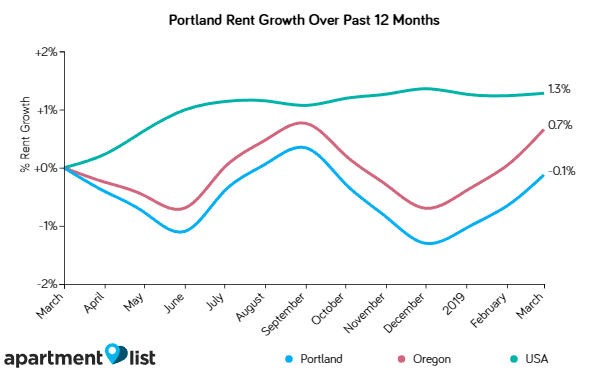
Portland rents have increased 0.4% over the past month, but are down slightly by 0.3% in comparison to the same time last year, according to a new April report from Apartment List.

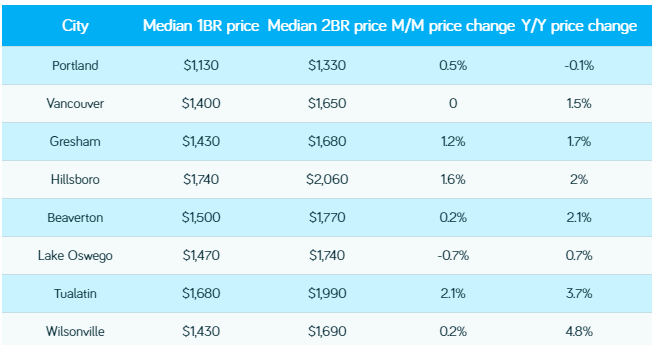
Currently, median rents in Portland stand at $1,120 for a one-bedroom apartment and $1,330 for a two-bedroom.

Second straight month for Portland rent increases

This is the second straight month that the city has seen rent increases after a decline in December of last year. Portland’s year-over-year rent growth leads the state average of -1.3%, but trails the national average of 0.9%.

Rents rising across cities in the Portland Metro

Portland Rents Increased Significantly Over the Past Month

While rent decreases have been occurring in the city of Portland over the past year, cities in the rest of the metro are seeing the opposite trend.

Rents have risen in 9 of the largest 10 cities in the Portland metro for which Apartment List has data. Oregon as a whole logged rent growth of -1.3% over the past year.

Here’s a look at how rents compare across some of the largest cities in the metro.

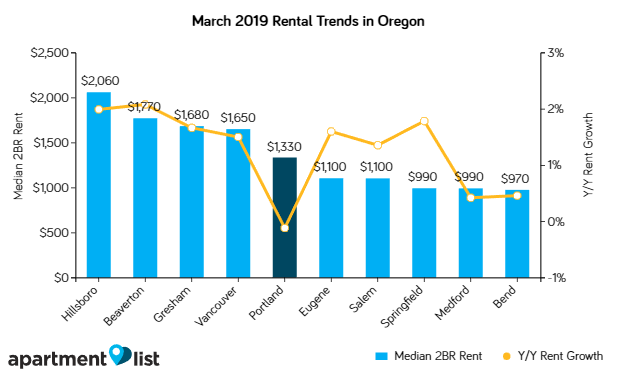
  • Hillsboro is the most expensive of all Portland metro’s major cities, with a median two-bedroom rent of $2,030; of the 10 largest Oregon metro cities that the company has data for, 9 have seen rents rise year-over-year, with Springfield experiencing the fastest growth (+2.7%).
  • Beaverton, Vancouver, and Eugene have all experienced year-over-year growth above the state average (2.0%, 1.7%, and 1.3%, respectively).

Portland rents more affordable than many similar cities nationwide

Portland Rents Increased Significantly Over the Past Month

As rents have fallen slightly in Portland, many comparable cities nationwide have seen prices increase, in some cases substantially. Portland is also more affordable than most other large cities across the country.

Portland’s median two-bedroom rent of $1,330 is above the national average of $1,170. Nationwide, rents have grown by 0.9% over the past year compared to the 0.3% decline in Portland.

While rents in Portland fell slightly over the past year, many cities nationwide saw increases, including Phoenix (+3.6%), Austin (+3.1%), and Las Vegas (+3.1%).

Renters will find more reasonable prices in Portland than most similar cities. For example, San Francisco has a median 2BR rent of $3,100, which is more than twice the price in Portland.

Eugene rents up slightly over the past month

Eugene rents up slightly over the past month

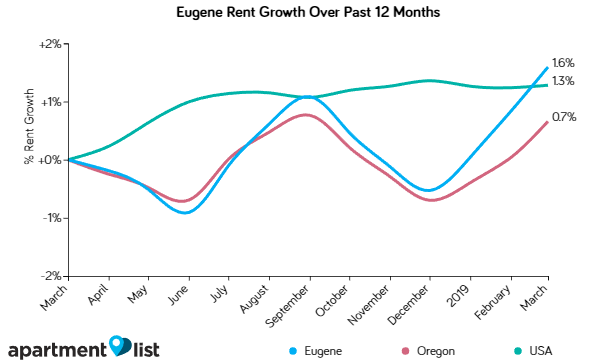
Eugene rents have increased 0.7% over the past month, and are up slightly by 1.6% in comparison to the same time last year.

Currently, median rents in Eugene stand at $830 for a one-bedroom apartment and $1,100 for a two-bedroom.

This is the third straight month that the city has seen rent increases after a decline in December of last year. Eugene’s year-over-year rent growth leads the state average of 0.7%, as well as the national average of 1.3%.

Salem rents also up

Salem rents also up

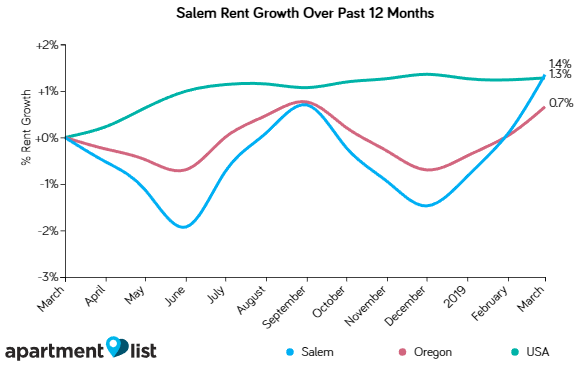
Salem rents have increased 1.3% over the past month, and have increased slightly by 1.4% in comparison to the same time last year.

Currently, median rents in Salem stand at $840 for a one-bedroom apartment and $1,100 for a two-bedroom. This is the third straight month that the city has seen rent increases after a decline in December of last year. Salem’s year-over-year rent growth leads the state average of 0.7%, as well as the national average of 1.3%.

Corvallis rents remain flat

Corvallis rents remain flat

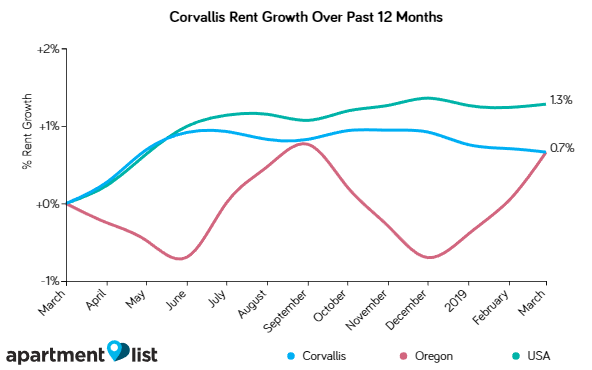
Corvallis rents have remained flat over the past month, however, they are up marginally by 0.7% year-over-year. Currently, median rents in Corvallis stand at $820 for a one-bedroom apartment and $1,020 for a two-bedroom. Corvallis’ year-over-year rent growth is level with the state average of 0.7%, but lags the national average of 1.3%.


HUD Charges Facebook With Fair Housing Discrimination Over Targeted Advertising Practices

Justice Department Sues Owner, Manager of Rental Properties for Sexual Harassment of Female Tenant

Facebook’s targeted advertising platform violates the Fair Housing Act by “encouraging, enabling, and causing” unlawful discrimination by restricting who can view housing ads, the U.S. Department of Housing and Urban Development (HUD) charged in a release.

“Facebook is discriminating against people based upon who they are and where they live,” HUD Secretary Ben Carson said in the release. “Using a computer to limit a person’s housing choices can be just as discriminatory as slamming a door in someone’s face.”

HUD has also alerted Twitter and Google that it is scrutinizing their practices for possible housing discrimination, a sign that more technology companies could be ensnared in a government probe of their lucrative demographic ad targeting tools, according to the Washington Post.

Read HUD’s Charge against Facebook.

Today’s action follows HUD’s investigation of a Secretary-initiated complaint filed on August 13, 2018. HUD alleges that Facebook unlawfully discriminates based on race, color, national origin, religion, familial status, sex, and disability by restricting who can view housing-related ads on Facebook’s platforms and across the internet. Further, HUD claims Facebook mines extensive data about its users and then uses those data to determine which of its users view housing-related ads based, in part, on these protected characteristics.

“Facebook is discriminating against people based upon who they are and where they live,” said HUD Secretary Ben Carson. “Using a computer to limit a person’s housing choices can be just as discriminatory as slamming a door in someone’s face.”

HUD General Counsel Paul Compton added in the release, “Even as we confront new technologies, the fair housing laws enacted over half a century ago remain clear—discrimination in housing-related advertising is against the law.

“Just because a process to deliver advertising is opaque and complex doesn’t mean that it exempts Facebook and others from our scrutiny and the law of the land. Fashioning appropriate remedies and the rules of the road for today’s technology as it impacts housing are a priority for HUD,” Compton said.

The Fair Housing Act prohibits discrimination in housing and in housing-related services, including online advertisements, based on race, color, national origin, religion, sex, disability, or familial status.

According to HUD, Facebook enabled advertisers to exclude people whom Facebook classified as parents, non-American-born, non-Christian, interested in accessibility, interested in Hispanic culture or a wide variety of other interests that closely align with the Fair Housing Act’s protected classes.

Showing ads only in certain neighborhoods

HUD is also charging that Facebook enabled advertisers to exclude people based upon their neighborhood by drawing a red line around those neighborhoods on a map. Facebook also allegedly gave advertisers the option of showing ads only to men or only to women.

HUD asserts that Facebook also uses the protected characteristics of people to determine who will view ads regardless of whether an advertiser wants to reach a broad or narrow audience. HUD claims Facebook combines data it collects about user attributes and behavior with data it obtains about user behavior on other websites and in the non-digital world.

Facebook then allegedly uses machine learning and other prediction techniques to classify and group users to project each user’s likely response to a given ad, and in doing so, may recreate groupings defined by their protected class.

By grouping users who have similar attributes and behaviors (unrelated to housing) and presuming a shared interest or disinterest in housing-related advertisements, Facebook’s mechanisms function just like an advertiser who intentionally targets or excludes users based on their protected class, HUD charges.

HUD seeks to address unresolved fair housing issues regarding Facebook’s advertising practices and to obtain appropriate relief for the harm Facebook caused and continues to cause.

In August 2018, the Department of Justice, joined by HUD, filed a statement of interest in the U.S. District Court for the Southern District of New York (SDNY) on behalf of a number of private litigants challenging Facebook’s advertising platform. Read SDNY’s statement of interest.

HUD’s charges will be heard by a United States Administrative Law Judge unless any party to the charge elects to have the case heard in federal district court. If an administrative law judge finds after a hearing that discrimination has occurred, he may award damages for harm caused by the discrimination. The judge may also order injunctive relief and other equitable relief, as well as payment of attorney fees. In addition, the judge may impose fines to vindicate the public interest. If the matter is decided in federal court, the judge may also award punitive damages.

Persons who believe they have experienced discrimination may file a complaint by contacting HUD’s Office of Fair Housing and Equal Opportunity at (800) 669-9777 (voice) or (800) 927-9275 (TTY).


Confused Over Service, Assistance Animals And Emotional Support Animals?

Apartment emotional support dog and nearby tenant with dog allergy

The Grace Hill training tip of the week focuses on the confusing issue and definitions of service animal, assistance animals and emotional support animals.

By Ellen Clark

You probably hear the terms service animal, assistance animal, and emotional support animal a lot. But do you really know what these terms mean? If not, you are not alone!

There are three laws that relate to rental housing and service and assistance animals:

    • The Fair Housing Act (FHA)
    • Section 504 of the Rehabilitation Act of 1973 (Section 504)
    • The Americans with Disabilities Act (ADA).

The FHA applies to almost all rental housing. Among other things, it prohibits discrimination based on disability and requires housing providers to make reasonable accommodations for people with disabilities, such as making an exception to a no-pet policy or a breed restriction.

Housing that receives federal financial assistance from the U.S. Department of Housing and Urban Development (HUD) must also comply with Section 504. Like the FHA, Section 504 prohibits discrimination based on disability and requires housing providers to make reasonable accommodations for people with disabilities.

Whereas the FHA and Section 504 prohibit discrimination in housing, the ADA prohibits discrimination based on disability in all areas of public life, including schools, transportation, and all public and private places that are open to the public.

 What does this mean for you in relation to support animals?


Confused Over Service, Assistance And Emotional Support Animals?


The ADA requires you to let service dogs accompany their owners in any area of the community that is open to the public, such as the leasing office.

These laws use different terms and definitions, which can be confusing.

The ADA uses the term “service animal” and defines it specifically as a dog trained to do work or perform tasks for people with disabilities.

The FHA and Section 504 use “assistance animal” as a broad term to describe any animal that works, provides assistance, or performs tasks for the benefit of a person with a disability or provides emotional support that alleviates one or more symptoms or effects of a person’s disability. Under the FHA and Section 504, service animals, emotional support animals, and companion animals are all considered assistance animals. An assistance animal may be any type of animal and is not required to have specific training.

The ADA uses the term “service animal” and defines it specifically as a dog that has been individually trained to do work or perform tasks for people with disabilities. Emotional support animals, companion animals and animals other than dogs (and sometimes miniature horses) are not considered service animals under the ADA.

 Consider these important takeaways:


    • You cannot deny a reasonable accommodation request because an animal does not meet the ADA definition of a service animal. Under the FHA and Section 504, reasonable accommodations must be granted for assistance animals, which include service animals, emotional support animals and companion animals.
    •  Residents making accommodation requests are not required to use specific terminology. If an animal works, assists, or performs tasks for the benefit of a person with a disability or provides emotional support that alleviates one or more symptoms or effects of a person’s disability, it doesn’t matter what term someone uses, it is an assistance animal under the FHA and Section 504.

ULTIMATE GUIDE TO ASSISTANCE ANIMALS IN RENTAL HOUSING

Recent training tips you may have missed:

How A No Pet Policy Can Be Discriminatory

Read Ellen’s full blog post here.

About the author:

Ellen Clark is the Director of Assessment at Grace Hill.  Her work has spanned the entire learner lifecycle, from elementary school through professional education. She spent over 10 years working with K12 Inc.’s network of online charter schools – measuring learning, developing learning improvement plans using evidence-based strategies, and conducting learning studies. Later, at Kaplan Inc., she worked in the vocational education and job training divisions, improving online, blended and face-to-face training programs, and working directly with business leadership and trainers to improve learner outcomes and job performance. Ellen lives and works in Maryland, where she was born and raised.

About Grace Hill

For nearly two decades, Grace Hill has been developing best-in-class online training courseware and administration solely for the Property Management Industry, designed to help people, teams and companies improve performance and reduce risk

Confused Over Service, Assistance And Emotional Support Animals?

Photo credit Bobbymn via istockphoto.com


A One-Size-Fits-All Approach by Governments To Multifamily Housing Does Not Work

A One-Size-Fits-All Approach by Governments To Multifamily Housing Does Not Work

Renting is now seen as a desirable housing choice, and government needs to help the multifamily industry with housing-finance reform to help create more affordable housing options in the future.

That was the message delivered recently by Susan Ansel, President and Chief Executive Officer, Gables Residential, to the Senate Committee on Banking, Housing and Urban Affairs.

Rental Housing Background – The Supply-Demand Imbalance

There has been a fundamental shift in our nation’s housing dynamics as changing demographics and lifestyle preferences have driven more people towards the convenience of renting, Ansel told the committee.

“This demand is fueled by several demographic factors. There are over 75 million people between 18 and 34 years old (traditionally the “prime renter” age group) who have recently entered or will soon be entering the housing market, primarily as renters.

“Similarly, nearly 93 million Americans aged 55 or older have the option of downsizing as their children leave the house, and many will choose the convenience of renting, and we are already seeing that. Over half (59.2 percent) of the net increase in renter households between 2007 and 2017 came from householders 55 years or older.

“Immigration accounts for a significant portion of apartment demand – over one in four (25.1%) apartment householders were born outside of the United States. Given these demographics, it is unsurprising that the apartment vacancy rate has remained at or below five percent for the past five years,” she told the committee.

A One-Size-Fits-All Approach by Governments To Multifamily Housing Does Not Work
Susan Ansel said, “The committee has an opportunity to examine what role the government-sponsored entities could provide in facilitating the reduction of these barriers and promoting the development of apartments for all income levels.”

Western states will have highest demand

The western United States, as well as states such as Texas, Florida and North Carolina, are expected to have the greatest need for new apartment housing through 2030, although all states will need more multifamily rental housing moving forward.

Across all markets, the supply of multifamily rental housing at a variety of price points will play a role in promoting economic growth, attracting and retaining talent and encouraging household stability for all American families.

32 percent of multifamily cost in local, state and federal regulation requirements

A recent study by NMHC and the National Association of Home Builders (NAHB) based on responses from a variety of multifamily developers throughout the country found that on average, 32 percent of multifamily development costs are attributable to the costs associated with complying with local, state, and federal regulations. In a quarter of the cases, that number can reach as high as 42.6 percent.

“The committee has an opportunity to examine what role the government-sponsored entities could provide in facilitating the reduction of these barriers and promoting the development of apartments for all income levels,” she said.


Principles of multifamily housing finance reform

Many factors influence the apartment industry’s health and its ability to meet the nation’s growing demand for rental housing, but the availability of consistently reliable and competitively priced capital is absolutely essential, according to the testimony before the committee.

“While our organizations remain agnostic regarding the source of our debt financing, we strongly believe capital must be consistently available across all markets and product types. In that spirit, NMHC and NAA urge the Committee to recognize the unique needs of the multifamily rental industry. We believe the goals of a reformed housing finance system should be to:

  • “Maintain an explicit, appropriately priced and paid-for federal guarantee for multifamily-backed mortgage securities available in all markets at all times;
  • “Recognize the inherent differences of the multifamily business from the single-family business;
  • “Promote private market competition;
  • “Protect taxpayers by keeping the concept of the enterprises’ multifamily first-loss risk sharing models;
  • “Retain the successful components of the existing multifamily programs in whatever succeeds them; and
  • “Avoid market disruptions during the transition to a new finance system.”

Recognize differences between multifamily and single-family businesses

“A one-size-fits-all solution will not work. The two sectors operate differently, have divergent performance records and require distinct reform solutions,” Ansel told the committee.

“The capital sources for multifamily are not as wide or as deep as those financing single-family and the loans themselves are not as easily commoditized. The GSEs’ (government sponsored enterprise) multifamily programs adhere to a business model that includes prudent underwriting standards, sound credit policy, effective third-party assessment procedures, risk-sharing and risk-retention strategies, effective loan portfolio management and standardized mortgage documentation and execution.

“Moreover, the financing process, mortgage instruments, legal framework, loan terms and requirements, origination, secondary market investors, underlying assets, business expertise and systems are all separate and unique from single-family home mortgage activities.

“We strongly recommend that any reform measure include a separate multifamily title. This separate title should not only address the successors to the GSEs’ multifamily programs, but also how the transition to that new system will be handled,” she said.

Summary

“As this committee continues its important work of assessing and crafting a reformed housing-finance model, Congress must understand that a one-size-fits-all approach will not work,” Ansel said.

“The meaningful differences between the single-family and multifamily sectors, both in how they operate and how they have performed, require different solutions to avoid putting at risk the 39 million Americans who rely on the apartment industry for their housing. In keeping with principles for housing-finance reform, the apartment industry asks that you focus your efforts on the importance of a government guarantee to ensure capital is available in all markets in all economic circumstances and the important role a government guarantee plays in the development and preservation of rental housing at all income levels in America today.

“The existing enterprise frameworks for protecting taxpayers and requiring private-capital participation should serve as a guide for any discussions on a reformed system. By retaining the successful elements of the current system and providing an explicit guarantee for multifamily debt, we believe this committee can succeed in ‘doing no harm’ to our industry, a goal expressed by members on both sides of the aisle and the administration,” she said.

Read the full statement here.
Susan Ansel is Chief Executive Officer and President of Gables Residential, a private real estate investment trust (REIT) focused on development, acquisition and management of institutional quality apartment communities throughout the United States. Ms. Ansel has been with Gables Residential since its Initial Public Offering and with its predecessor Trammell Crow Residential since 1987.