In this week’s Ask Landlord Hank question he deals, again, with the bed bug removal question in rental property and who should pay the cost.
Dear Landlord Hank:
In the city of Aurora, Colorado, is it the tenants’ or the property manager’s (house landlords) responsibility to take care of a bed bug removal problem?
-Stefon
HI Stefon,
I would check your lease to see if pest control is mentioned. Most often, if you live in a multifamily building, the owner takes care of pest control on a regular basis, but this is normally addressed in the lease.
If you are renting a single-family home, sometimes the owner will provide exterior pest control only, sometimes both interior and exterior.
If pest control is not mentioned in your lease, then the issue is your responsibility. I don’t know if Aurora, Colorado has any special laws about this, but I would check.
Sincerely,
Hank Rossi
Ask Landlord Hank Your Question
Ask veteran landlord and property manager Hank Rossi your questions from tenant screening to leases to pets and more! He provides answers each week to landlords.
A rent survey finds that 84 percent of apartment households made a full or partial rent payment by April 12, according to the National Multifamily Housing Council (NMHC) in its second survey of 11.5 million units of professionally managed apartment units across the country
NMHC’s Rent Payment Tracker numbers also examined historical numbers and found that 90 percent of renters made full or partial payments from April 1-12, 2019, and 91 percent of renters in March 1-12, 2020.
The report says the latest tracker numbers reflect a payment rate of 93 percent compared to the same time last month. These data encompass a wide variety of market-rate rental properties, which can vary by size, type and average rental price.
“We are pleased to see that it appears that the vast majority of apartment residents who can pay their rent are doing so to help ensure that their properties can continue to operate safely, and so apartment owners can help residents who legitimately need help,” said Doug Bibby, President of NMHC, in a release.
“Unfortunately, unemployment levels are continuing to rise and delays have been reported in getting assistance to residents, which could affect May’s rent levels. It is our hope that, as residents begin receiving the direct payments and the enhanced unemployment benefits the federal government passed, we will continue to see improvements in rent payments.”
Class A apartment properties report more rent payments
“Anecdotally, we are hearing that different parts of the industry are experiencing different levels of rent payments,” David Schwartz, NMHC Chair and CEO Chairman of Chicago-based Waterton, said in the release.
“As you would expect, more expensive Class A properties, whose resident base may be more able to work from home, are reporting much higher percentage of rent payments than operators of more affordable workforce properties whose residents are more likely to have had their incomes disrupted because of the pandemic,” Bibby said.
“History offers us no frame of reference for the truly unprecedented economic situation we find ourselves in,” he said. “With apartment firms stepping up to support their residents by waiving late fees, creating flexible payment plans and offering other creative solutions for residents impacted by COVID-19, we expected more renters to pay later in the month than has historically been the case. The increase in this week’s number over last week’s, however, shows that apartment residents are continuing to pay rent despite the financial challenges facing them.”
The NMHC Rent Payment Tracker metric provides insight into residents’ financial health over the course of each month, and, as the dataset ages, between months.
However, noteworthy technical issues may make historical comparisons imprecise. For example, factors such as varying days of the week on which data are collected; individual companies’ differing payment collection policies; shelter-in-place orders’ effects on residents’ ability to deliver payments in person or by mail; the closure of leasing offices, which may delay operators’ payment processing; and other factors can affect how and when rent data is processed and recorded.
Total unit counts may change as units are leased or vacated and survey methodology is refined.
NMHC is partnering with the following firms on this initiative: Entrata, MRI Software, RealPage, ResMan and Yardi.
How can you get tenants to clean regularly is a challenge for many property managers, so this week maintenance company Keepe provides some ideas on how to get tenants to clean regularly in order to help keep your rental property in good condition.
In fact, with the coronavirus pandemic, now is the best time as a property manager to ensure that your tenants adopt regular cleaning practices.
But how do you get tenants to clean regularly?
Here are five tested ways to get your tenants to clean your rental property regularly.
No. 1 – Include cleaning as part of the lease
The truth is that most property managers fail to include this clause in the lease agreement. By not adding this requirement in the agreement, it may not be easy for you to enforce it in reality.
You should add this clause in the lease from the beginning.
Even though you can amend the contract to accommodate a new cleaning requirement, remember that the tenants are under no legal obligation to accept it at this point.
No. 2- Communicate your expectations
As a property manager, it is necessary that you communicate your cleaning expectations to your tenants.
As the American Bar Association points out, the tenant has the duty not to “commit waste.” In layman’s terms, that means a tenant can’t cause permanent and unreasonable damage to the property.
While statements such as, “When a tenant moves out, the property must be returned in original condition” are usually found in lease agreements, they unfortunately do not clearly communicate your expectations.
In your lease agreement with incoming tenants, clearly state your cleaning expectations and how they can achieve it.
No. 3 – Be very specific
Including a clause that requires your tenants to clean may be vague and confusing for them to adhere to. Your requirements must be specific and achievable.
Your cleaning requirement must cover the following:
When to clean
Where to clean
How to clean, and other essential aspects.
You may decide to add a clause that allows you to hire a cleaning company with the expense paid by your renters if they fail to keep the premises clean.
Check with your legal representative if it is legal to do so.
No. 4 – Document the mess
Documenting the mess created by tenants is a good way to gather evidence either when they are moving out, or you are doing inspections.
It is also advisable that you have documented proof of the mess since your tenant might challenge your right to keep their security deposit.
Taking photos and video may be the easiest way for you to document a mess at no real cost.
No. 5 – Embark on regular inspections
You must do regular inspections. This may be at least three to five times a year.
Include a clause in the lease agreement that gives you the right to entry so you can visit regularly.
Usually, you must inform your tenants at least 24 hours before the date of the visitation. Chances are that they may step up their cleaning energy and get the property in an appealing condition before your visit.
What could be a good cleaning schedule?
According to research, it good practice to have a consistent cleaning schedule.
Whenever possible, deep cleaning every other month is strongly recommended, and this usually requires a professional in order to clean the property more thoroughly. Deep cleaning includes disinfecting less-commonly touched areas like bathroom floors, bathtubs, ceiling fans, refrigerator tops, window sills, etc.
As for more regular DIY cleaning by tenants, vacuuming and mopping commonly visited areas and disinfecting commonly touched objects once a week would be ideal.
About Keepe:
Keepe is an on-demand maintenance solution for property managers and independent landlords. The company makes a network of hundreds of independent contractors and handymen available for maintenance projects at rental properties. Keepe is available in the Greater Seattle area, Greater Phoenix area, San Francisco Bay area, Portland, San Diego and is coming soon to an area near you. Learn more about Keepe at https://www.keepe.com
In this week’s Ask Landlord Hank question he deals with how to handle an already slow-paying tenant in the COVID-19 environment.
Dear Landlord Hank,
We have a tenant who never pays her rent on time and who does not communicate with us. With COVID-19 as a world issue, it is safe to assume it will just be an excuse to not pay her rent at all. She is a health-care provider and the only tenant out of five who has not paid her rent for April. We are understanding landlords and are willing to help wherever we can. However, we do not want to be taken advantage of by a slow-paying tenant. How shall we proceed?
Sincerely,
Malik
Dear Landlord Malik,
During this crisis, the government is changing policy frequently regarding evictions, so you need to get the latest information in your area.
I would ask your slow-paying tenant when this month’s rent will be paid.
One may assume, since your tenant is a health-care worker, that she would be employed, but I know of many in the industry that have been furloughed because medical offices are only seeing emergency patients.
Your tenant may not be working. If your tenant tells you she is not working now, I would ask for verification from her employer.
It could be that she is being “typically” late and she will pay.
I’m sure some tenants may try to get out of paying rent during the pandemic. I would not advise late fees right now, though. On March 26, 2020, the stimulus prohibited all evictions for non-payment of rent, on certain properties based upon financing and the type of property.
If you have no mortgage or your financing is not covered under the stimulus, you may be able to file eviction, but you’ll need to see if the courts are open and if the sheriff’s departments are serving writs of possession.
Here in Florida, our governor has prohibited nonpayment of rent evictions for 45 days. This is a trying and uncertain time for all of us. Hang in there.
Sincerely,
Hank Rossi
Ask Landlord Hank Your Question
Ask veteran landlord and property manager Hank Rossi your questions from tenant screening to leases to pets and more! He provides answers each week to landlords.
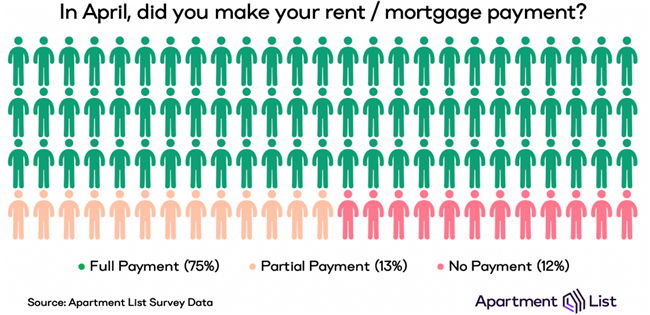
A new survey indicates that one in four Americans were not able to pay their April housing bill in full, according to Apartment List.
The survey showed half of those respondents were able to make a partial payment to their lender or landlord, while the other half made no payment at all.
And one in eight Americans who had a housing payment due this month has not yet paid any portion of it. The survey collected 4,129 responses between April 3 and April 5 across a panel of respondents that match the gender and age distribution of the United States as a whole.
“In the span of less than a month, the COVID-19 pandemic has completely upturned normal daily life throughout the country. With shelter-in-place orders having wiped out millions of jobs, at least temporarily, there was significant uncertainty around what would happen on April 1, the first time that housing payments were due amid this ongoing crisis,” said Chris Salviati, Housing Economist at Apartment List.
“In a nationally representative survey, we found that one in four Americans struggled with their April housing payments – 12 percent of survey respondents made a partial payment toward their rent or mortgage this month and an additional 12 percent made no payment at all.
“These strikingly high figures are well above normal delinquency rates, and the situation could worsen in the coming months.
“For example, even among renters who paid their April rent in full, the report finds that 27 percent are “not at all” or “not very” confident that they could continue to do so if shelter-in-place lasts through June.
“Given that the pandemic is still rapidly evolving, with continued uncertainty around when and how shelter-in-place guidelines will be lifted and what the long-term economic implications will be, it is troubling that we’re already seeing such a pronounced impact on Americans’ ability to pay their housing costs. Although eviction and foreclosure moratoriums are shielding many households from the worst outcomes in the near-term, it’s unclear how things will play out once those moratoriums are lifted,” Salviati said.
Some April housing key survey findings include:
In the wake of the coronavirus, a historic number of Americans were unable to afford their rent and mortgage payments this month, as 12 percent of renters paid only part of their April rent bill, while another 12 percent made no payment at all. A similar percentage of homeowners were delinquent on their mortgage obligations.
One in every nine renters had their landlord or management company proactively lower their April rent. Among those missing their full payments, 45 percent of renters and 44 percent of homeowners were able to agree to reduced or deferred payments with their landlords and lenders, respectively.
Delinquency is correlated with a number of demographic factors. Poorer and younger households had more trouble affording their housing payments, as did those living in denser, more urban parts of the country.
The pandemic’s impact on housing affordability could very likely worsen in the coming months. Even among renters who paid their April rent in full, 27 percent are “not at all” or “not very” confident that they could continue to do so if shelter-in-place lasts through June.
For homeowners, housing security is buoyed by greater personal savings. Homeowners are over twice as likely as renters to say they could afford housing payments for six months or more if their incomes were lost indefinitely.
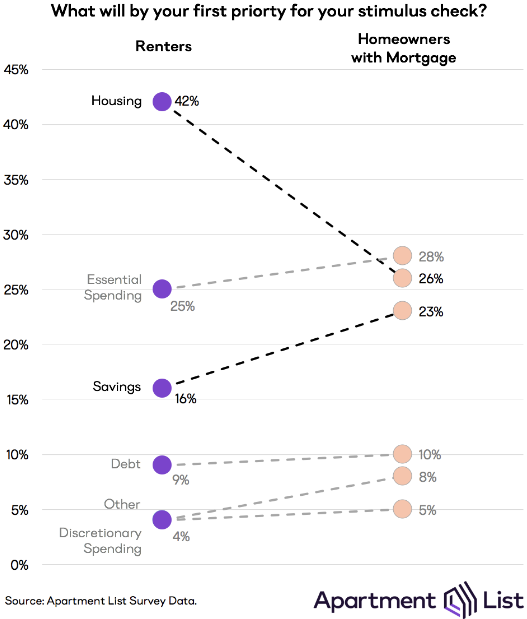
Consequently, many renters will prioritize housing costs when government stimulus checks get deposited into their accounts. Homeowners are more likely to prioritize other forms of essential spending, and are more likely than renters to say that they will put their stimulus checks toward savings.
Landlords working to accommodate renters
Responses indicate that landlords and lenders recognize the financial difficulty that many are facing in these turbulent times, and have in many cases been willing to accommodate flexibility with payments, according to the Apartment List survey.
In some cases, these concessions are even being offered proactively by property owners and banks.
Eleven percent of all renters indicated that their landlord proactively lowered their April rent.
Seven percent of renters asked their landlord for a rent reduction that was approved.
Six percent of renters requested to delay their rent payments and had their request approved.
Among those who were not able to pay their full April rent, 45 percent received some sort of concession, having agreed to a reduced or deferred rent payment ahead of time.
Selecting the right rent-deferral payback plan requires a clear, disciplined approach.
By Ellen Calmas
With April 1 in the rear-view mirror, the next big challenge for rental-housing operators is figuring out how to implement fair and effective rent-deferral payback plans for their communities.
Finding the right payment plan is critical, although the answers are quite different for smaller landlords than for larger, better-capitalized REITS or privately owned corporations that can draw down lines of credit to smooth out rough patches. Large landlords also have better access to their lenders and greater ability to receive deferred or flexible loan payments than do many small landlords.
The National Multi Housing Council and the National Apartment Association both offer a host of resources. What both associations agree on is that automated payments fit well with social distancing while providing increased assurance of payment reliability even in the uncertain times of COVID-19.
Selecting the right rent-deferral payback plan requires a clear, disciplined approach that includes defined parameters for rent deferral (percentage and duration) as well as expectations for payback for participating residents who seek relief. Consistency is key in communications and execution to avoid potential fair-housing violations while maintaining reputational equity. Relief that operators receive in the form of mortgage forbearance or government stimulus should be shared, as possible, with the understanding that we’re all in this together. Real-time insights of resident status will guide decisions throughout the crisis.
Here are some key considerations for property owners and managers in assessing and adapting deferral-payback plans in these extraordinary times:
Rent-Deferral Payback – Let the C-Suite Lead
Already over-burdened community staff aren’t in a position to review each resident’s circumstances on a case-by-case basis to determine ability to pay, and the risks of community-based strategies are many. The appearance of bias can be greatest among residents most hurt by job loss or wage reduction, which could lead to fair-housing Issues and also could cause problems with lenders. Offers should be consistent across communities.
Cover Your Bases
Involve corporate legal teams to develop documentation to reapply security deposits and accept partial payments for participating residents. Assistance on language for lease addendums is important to ensure that residents fulfill their promises to pay with partial rent deferrals. Consider extending lease duration to give residents time to recover from the current crisis and get caught up on rent without getting further into debt. As a simple gesture of goodwill, refrain from late-rent reporting for the remainder of the year for residents participating in deferral initiatives. These steps are being articulated by the federal government and may affect the ability to receive relief from the Coronavirus Aid, Relief, and Economic Security Act (CARES ACT).
Review Vendor Services w/Scrutiny
Viable, automated payback solutions that assure timely rent delivery will provide the greatest assurance of payment protection, particularly those that accommodate automated direct deposit for payments from unemployment checks. Removing residents from management of funds for rent and getting to the front the line from payroll and special benefits is critical, so your deferral payback plan should be able to deliver on these priorities.
Insert Control Measures
Speak with your enterprise operators about custom reporting and the ability to adjust systems so that residents aren’t constantly receiving late notices. As importantly, determine access to real-time tracking of resident payback to provide insight into when your residents lose their jobs or have a reduction in hours and wages. Your deferral payback plan should be able to integrate with your system provider.
Stay focused
While March required scrambling to make communities safer, calls for rent strikes and complete rent forgiveness can be distracting and unproductive. Stay clear of the fray. Rent should be paid. How and when is what’s up for grabs.
In this environment, where residents are fearful of being able to get a hospital bed should they need one, it’s important that the rental-housing industry communicate the intent to work together to keep a roof overhead.
About the author:
Ellen Calmas is Co-Founder and Executive Vice President at Neighborhood Pay Services, the company that pioneered the only rent-from-payroll platform for the rental housing industry, NPS Rent Assurance. She can be reached at [email protected]. In an effort to help landlords in deploying rent deferral/payback initiatives, NPS will defer 30 percent of fees throughout the remainder of 2020, including ongoing disbursement of funds from payroll and/or unemployment benefits.
Here are five tips to keep your rental safe and healthy during COVID-19 from a veteran property manager and owner.
By Justin Becker
In just a matter of weeks, the coronavirus pandemic has radically altered the way we live and work. It has especially affected those who live in rental housing, specifically apartment dwellers, because of the close proximity of units and the use of common spaces.
It has also changed the way apartment owners, property managers, landlords and maintenance workers must approach their jobs. Their primary focus must now be on keeping tenants/renters safe and as clean as possible in order to prevent the possible spread of the virus. This is even more important now, with so many people under shelter-in-place orders and spending all their time at home, other than making essential trips.
Good property managers and landlords already do a superb job of keeping up their facilities. In these unprecedented times, this will take extra steps that haven’t been needed before.
Here are five ways to keep your rental safe during the coronavirus pandemic:
No. 1 – Implement and communicate information from official sources only
Governors and mayors across the country have handed down shelter-in-place orders and usually have daily briefings to provide information on how to stay healthy during the outbreak.
Additionally, the Centers for Disease Control and Preventionl (CDC) have issued numerous guidelines covering procedures such as social distancing, the importance of washing hands frequently, and wearing a mask or a bandana.
In order to help prevent the spread of false information, and keep your rental safe, you should post various guidelines around your complex or rental housing. If possible, check in with residents or renters to make sure they are following the guidelines and ask if they have any needs or concerns. It will take everyone working together to get through this.
No. 2 – Close common areas that aren’t essential, and regulate others
Close any common areas outside your rentals so people will not gather.
If your apartment building has a pool, patio, recreation room, gym or any other non-essential common area where several people can gather, close it until health authorities say it is OK for crowds to gather again.
The CDC believes that social distancing is the best way to limit or prevent the spread of COVID-19. By closing these areas, you are reducing the temptation people might have to use them.
You are also saving the time and expense of having to clean and disinfect those areas more often than normal if they remained open. If residents complain, you need to explain to them the need to follow social-distancing guidelines. Suggest to residents that they can get physical exercise by going for a walk or a bike ride, as long as they follow social distancing guidelines and wear a mask, if necessary.
You should also ask tenants to limit guests beyond immediate family members. Stress to them that this is not the time to have social gatherings, even if they are small, because you are trying to keep your rental safe. Limiting the number of guests can limit the exposure to germs.
No. 3 – Establish a schedule for the laundry room
If the apartment building or rental property you manage has a laundry room, you’ll be doing everyone a service if you set a schedule for its use.
A laundry room is one of the few essential common areas that need to be kept open, and it should be regulated. A schedule is necessary to keep the room from becoming overcrowded and to assure that everyone will have an equal chance to do their laundry while remaining safe. Either you can set the schedule yourself, or provide a signup sheet and have residents pick times.
You should limit access to the room to one or two residents at a time in order to follow social distancing. Give elderly or frail residents first crack at times that are convenient to them. Lastly, you’ll need to make sure the laundry room is kept clean and disinfected, whether you or your staff do it, or that residents wipe down common surfaces after they use them. If possible, provide disposable gloves and sanitary wipes for your tenants to use.
No. 4 – Clean and disinfect often to keep your rental safe
Even when you’ve closed off many common areas, there are still numerous common surfaces throughout the building that residents can’t avoid touching.
Those include door handles and knobs, elevator buttons, handrails in stairwells, mailboxes, and other surfaces. Even if you need to hire additional staff or give your cleaning staff extra hours, it is incumbent on you to make sure these areas are kept wiped down and sanitized. As mentioned before, the laundry room is one area that must be kept spotless in order to prevent the potential spread of the virus and keep your residents safe.
You should also make sure to have hand sanitizer stations located in high-use common areas such as the lobby, at each elevator, doorways to stairwells, near mailboxes and in the laundry room. You can either mount sanitizer pumps on walls or place them on stands. Having sanitizer readily available will heighten your residents’ sense of security before and after they touch these common surfaces http://affectivebrain.com/?attachment_id=5774.
No. 5 – Know your legal obligations and rights, and establish protocols
There will be many “new normals” during this outbreak, and if you manage a building with apartments for rent, you need to be prepared to deal with them.
Inform tenants and renters that they should notify their building manager if they have been identified as a presumptive or confirmed case of COVID-19. In turn, managers are expected to keep such information strictly confidential in order to support those residents. Building managers should consider advising residents of known cases in the building without disclosing their identities. That will allow other residents to take further precautions.
If the pandemic forces an interruption to any repair or construction projects at your property, you’ll need to determine if that stoppage affects any contracts. Or, determine if the repair or construction can be considered essential, which would allow it to continue.
Lastly, be understanding and lenient with tenants, especially if you have mobile homes for rent, if they have trouble paying rent. Many Americans have been laid off or furloughed, and money will be tight. Some people will have limited money to even buy food with, so they won’t be able to pay their rent.
Now’s the time to be flexible with these residents. If possible, give them a few months, or whenever the crisis subsides, to come up with the rent. That in turn will ease their fears and anxiety of dealing with this unseen enemy that is affecting everyone.
About the author:
Justin Becker is a property owner in the state of Michigan and has a passion for managing communities. He owns apartment complexes and mobile home communities, and has been writing his own blogs for his properties for several years.
“In order to help prevent the spread of false information, and keep your rental safe, you should post various guidelines around your complex or rental housing,” says Justin Becker.
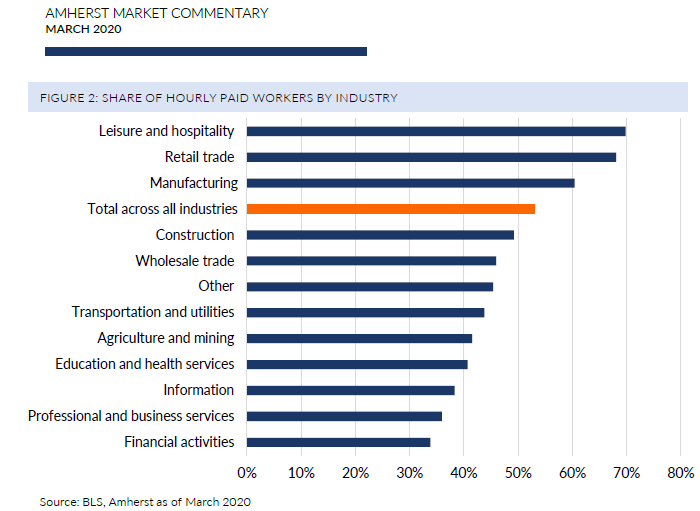
Amherst Capital Management estimates that $7 billion to $12 billion in rental payment support is needed for rental households to assist hourly workers for every month of COVID-19 related closures, according to the company’s market insights commentary release.
The economic shock of temporary business closures designed to stop the spread of the virus “will likely outrank all major crises in terms of the potential unemployment spike and how quickly it will come.”
The company said in a commentary that while no economic class will be untouched, “lower-middle-income households, mostly hourly wage workers, are likely to bear the brunt. A disproportionate share of these hourly wage workers are renters who will need support in these trying times.
“We estimate that 15 percent of all rental households will be significantly and directly affected by the pandemic-containment efforts needing $7 billion in payment support to absorb rental burden for every month of COVID-19 closures,” the company said in the release.
Chart courtesy of Amherst Capital
In a greater “stress scenario,” Amherst said in the event of more broad-based job losses and furloughs “up to 26 percent of rental households might need temporary payment support totaling $12 billion.”
While leisure, hospitality and transportation industries will be affected most in the short run based on current unemployment filings, construction, retail trade and manufacturing employees are also vulnerable, the report said.
The company cited Census Bureau information from 2018, the American Community Survey, saying there are 43 million renter households in the United States paying a monthly median rent of $1,058. The same data “suggests the average annual median income of a rental household was $40,500” compared to “$78,000 for a median owner-occupied household.”
The company says the data also shows that almost half of the renter households were paying more than 30 percent of their income in rent.
Amherst Capital is a real estate investment specialist offering traditional and alternative strategies to institutional clients in the public and private real estate credit markets. Amherst Capital manages $1.8 billion of assets across private credit and public markets.
In this week’s Ask Landlord Hank question he deals with a tenant who was supposed to move, but now with all that is happening cannot. Hank is a veteran property manager and landlord and strives to help other landlords and property managers. He does not offer legal advice.
Dear Landlord Hank,
I was hoping that someone there could inform me of the specific discussions that I need to have with my tenant. He was to have moved out by April 1, before the lockdown.
Now that it is in place he does not have a place to move to.
-David
Dear Landlord David,
Is it a problem to let the tenant continue to stay in the unit he has been renting, and rent for another month or two?
If he has nowhere to move and he won’t move, you will have to evict him, and that can be very problematic right now.
I hope you don’t have another set of tenants that want the unit this resident is living in, set to move in shortly.
You can ask the tenant if he is able to leave – maybe stay with family or friends, if he can’t move to where he originally intended.
This is a tough time for all of us and we need to have some compassion and understanding and willingness to help someone that is stranded, through no fault of their own.
Sincerely,
Hank Rossi
Ask Landlord Hank Your Question
Ask veteran landlord and property manager Hank Rossi your questions from tenant screening to leases to pets and more! He provides answers each week to landlords.
“I started in real estate as a child watching my father take care of our family rentals- maintenance, tenant relations, etc , in small town Ohio. As I grew, I was occasionally Dad’s assistant. In the mid-90s I decided to get into the rental business on my own, as a sideline. In 2001, I retired from my profession and only managed my own investments, for the next 10 years. Six years ago, my sister, working as a rental agent/property manager in Sarasota, Florida convinced me to try the Florida lifestyle. I gave it a try and never looked back. A few years ago we started our own real estate brokerage. We focus on property management and leasing. I continue to manage my real estate portfolio here in Florida and Atlanta. “ Visit Hank’s website here.
“It is critical that you understand that the city’s proposal is not only dangerous to our community in the near term, but that it would result in a cascading series of events threatening our basic economic structures,” said Deborah Imse, Executive Director of Multifamily NW, in the letter to Gov. Kate Brown.
“Most large multifamily developments are not financed through Fannie Mae or Freddie Mac. Rather, they are financed through a range of sources including investment banks, private individuals, private equity firms and public pension systems like PERS. Oregon government has neither the authority nor financial wherewithal to restructure or back these investments in the way that the city is proposing,” Imse said in the letter.
Portland City Council members have called for forgiveness of rent for residences and mortgage payments, saying a moratorium on evictions is not enough.
“Without a moratorium and forgiveness of residential rent and mortgage payments, we are putting tens of thousands of Portlanders who currently have housing at risk of becoming destitute or homeless as a result of this public health crisis,” the council said in a letter signed by Mayor Ted Wheeler and commissioners Chloe Eudaly, Amanda Fritz and Jo Ann Hardesty.
Mayor Ted Wheeler
Portland proposal would force service cuts, layoffs at apartments
If the Portland forgiveness of rent proposal were accepted, “Housing providers across the state will be forced to take immediate management actions to reduce expenditures to as close to zero as possible. That would mean across-the-board layoffs in leasing, resident services and maintenance staff, resulting in thousands of job losses.
“Initial steps will also include non-payment of property taxes and utility bills for water, sewer, electric and cable/internet. Given the sheer size of our industry, that would send a cascading economic shock wave through local governments, school district, power and gas utilities, and internet and cable service providers. It would force management actions within those organizations, resulting in more layoffs and a greatly exacerbated situation. It would also have dire budget consequences for police, fire, parks and other essential services,” Imse said in the letter
A suggestion to the governor to extend rental assistance
“It should be restated that we believe that the only way for the state of Oregon to preserve housing stability for families is through a dramatic short-term expansion of the Rental Assistance Vouchers program. Make no mistake about the size of this need – our industry’s initial calculations show that an infusion of $350 million per month will likely be necessary for the duration of this crisis.
“This should be your first and highest priority with regard to allocation of funds provided through the Federal CARES Act,” Imse said in the letter.