
Home Blog Page 144

Where the Major Candidates In Oregon Stand on Housing

candidates on housing oregon election

By Jennifer Shuch
HFO Research Analyst

As Oregon’s May 2020 primary approaches, a large number of local, regional, and national candidates have entered the race with housing as a top priority. Housing affordability, both for renters and homeowners, has become a flashpoint in political debate throughout the country.  Rent growth in Portland has begun to slow due to new units coming online. An increasing number of households are rent-burdened–defined by the U.S. Department of Housing and Urban Development (HUD) as spending more than 30% of household income on rent.

At the national level, public housing investment is well below historical levels. But the candidates vying for the Democratic nomination have all unveiled plans aimed at tackling affordability issues. Former VP and presumptive nominee Joe Biden has a policy calling for $640 billion in investments aimed at helping renters and homeowners.

In the Portland mayoral race, Mayor Wheeler’s reelection may hinge on whether city residents are as enthusiastic about his housing record as he is. An additional three city council seats are also up for election. Most hotly contested is the position held since 2017 by Chloe Eudaly, who campaigned on a platform focusing primarily on issues such as tenant rights and rent control. Metro—a government entity charged with overseeing regional planning, parks, and some major entertainment venues in Portland’s three-county metro area—passed a $652.8 million housing bond in 2018. Metro will ask voters again in May for up to $250 million for homeless services funding. There are currently three races for open Metro Councilor seats.

In light of all this, we have compiled an overview of candidates’ positions on housing issues in races for the City of Portland, Multnomah County, Metro, and the Democratic nominee for U.S. President.

City of Portland

Mayoral Race
Ted Wheeler is up for reelection as Portland’s Mayor
. Among his 18 competitors are leading contenders Sarah Iannarone, Teressa Raiford, and Ozzie Gonzalez. Both Iannarone and Gonzalez have released housing plans, while Wheeler’s website mainly touts what he sees as his most significant accomplishments so far.

Portland candidates on housing

On his website, Mayor Wheeler claims that he has more than doubled shelter capacity in the city, prevented 7,000 households from falling into homelessness, helped 6,000 people connect with transitional housing services, and built over 800 units of affordable housing [1]His office has also touted the city’s progress in exceeding its housing bond goals of creating or preserving 1,300 housing units. So far, however, of the 1,424 bond-funded units, only two complexes with 314 total units are open and occupied as of March 2020 While Wheeler’s campaign website emphasizes what the Mayor has accomplished over the last four years, it does not indicate what his plans are for the future if he’s re-elected. And there are differing opinions as to the validity of the Mayor’s claims.

Of Wheeler’s plethora of challengers, both Sarah Iannarone and Ozzie Gonzalez have released housing proposals, and Teressa Raiford limits herself to commenting on demolition and displacement in her platform statement. Iannarone’s housing plan calls for a five-year plan to end the housing state of emergency, which has been in place since 2015. She argues that the city needs a task force to assess housing inventory and resident needs. That city leaders must use this information to solve the problems that are persisting in the city’s housing market. Iannarone also calls for increased communication between city bureaus, nonprofit organizations, and private sector stakeholders. Her plan addresses the city’s taxation system – she advocates for recalibration to eliminate inequities between East Portland and other parts of town, as well as land value and real estate transfer taxes. Iannarone’s housing proposal also focuses on eviction prevention and tenants’ rights. She argues in favor of a tenants’ bill of rights, including the right to organize, and she believes that the city should fund the rental registration system and track eviction rates. Iannarone is in favor of using tourism tax revenue to create a rental subsidy reserve, and advocates for relegalizing SRO’s throughout the city. She is the only candidate calling for a moratorium on the development of self-storage facilities in mixed-use zones, centers, and corridors. She also seeks the reduction of costs and red tape for small-scale building projects.[2]

Like Iannarone, Ozzie Gonzalez advocates for collaborating with stakeholders to tackle housing issues. His housing plan calls on the city to partner with managers, developers, and real estate firms to establish a housing inventory system. Gonzalez’s strategy focuses on development-side issues – he would like to see more incentives for producing a variety of housing types and an emphasis on transit-oriented development. He also believes the city should find new uses for vacant units.[3]

While Teressa Raiford does not have a comprehensive housing proposal, her policy statement, which she calls The People’s Platform, calls for a moratorium on urban redevelopment. She believes demolitions should await the coming together of communities to decide what should be saved or replaced. She pushes back on “demolition, rezoning, and redevelopment,” which she believes serves only “big investors, large corporations, and the high-income earners.”[4]

Mayor Wheeler was endorsed by The Oregonian for re-election in its op-ed dated Sunday, April 26, 2020.

Portland City Council

Portland City Council Position No. 1, is currently held by Commissioner Amanda Fritz, who is vacating her seat. Of the nine candidates, Carmen Rubio, Candace Avalos, and Timothy DuBois are the only candidates that have put forth housing plans.

Carmen Rubio is assumed to be the front runner due to the large number of endorsements she has received from local elected officials. Rubio advocates for coordinating with state, regional, and federal partners to address housing affordability, and investing in homeless prevention and anti-displacement measures. She argues that the city needs to increase density if residents want better transit and more affordable housing options, and she stresses the need for data-driven solutions to the city’s problems. In a survey conducted by Portland Tenants United (PTU), Rubio did not commit to advocating for an end to the statewide ban on local rent control policies. While she did not explicitly back the state law, she argued that she would need to be sure that increased rent restrictions would not reduce the availability of affordable housing.

Candace Avalos believes the city should fully fund rental assistance programs and collaborate with service providers to support people who may be on the verge of homelessness. She advocates for an innovation hub dedicated to finding new ways to build affordable housing without subsidies. Avalos also believes that the city should incentivize building affordable housing ‘at scale’ and advocates for streamlining the permitting process. Like Sarah Iannarone, she calls on the council to fully fund the Office of Rental Services, which oversees the rental registration program. Unlike Rubio, Avalos has committed to overturning the state preemption of local rent control policies. Avalos argues that local jurisdictions must be allowed to use whatever tools may help keep residents housed.

Tim DuBois believes the city should do more to increase housing diversity and build more housing near transit and job opportunities. He also argues for a streamlined and expedited permitting process.

Carmen Rubio was endorsed by The Oregonian in its op-ed on Sunday, April 26, 2020.

Portland City Council Position No. 4 is also up for grabs this year, with incumbent Chloe Eudaly facing challenges from former Mayor Sam Adams as well as professor and prior public servant Mingus Mapps, Keith Wilson and four other candidates. Eudaly defeated incumbent Steve Novick in 2016, mainly by gaining the support of housing and tenants’ rights advocates. During her time as a commissioner, she has advocated for rent control and increased tenant protections. Eudaly’s staff devised the recent FAIR ordinances governing rental applications and safety deposits. As of March, Eudaly has not released a housing policy platform to indicate her priorities should she be re-elected.

Former Mayor Sam Adams has received an endorsement from Smart Growth Oregon, and his housing plan reflects the idea that more housing is needed at all affordability levels to make up for years of underbuilding between 2010 and 2018. While Adams supports the Residential Infill Plan, he believes that the city should also increase density along arterials and near transit stops. He also argues for expediting the permitting process for both affordable and market-rate projects. Adams’s goal, should he be elected, is to bring all stakeholders together to build a long-term plan to determine which type of housing is needed, and who should build it. He also wants to re-evaluate current design rules to make sure they meet city goals. Adams also intends to conduct regular surveys of renters and property owners to track affordability, rent increases, and demographic information, as well as property ROI and the amount an owner invests in updates and maintenance.[10] Adams is also in favor of ending the state preemption on local rent control laws and allowing local jurisdictions to establish individual policies.

Mingus Mapps has released plans on housing and homelessness, both of which emphasize the need for new housing units at a variety of income levels. His Ending Homelessness and Housing First proposal calls for a ban on price gouging in the rental market, as well as an additional 1,500 units of permanent supportive housing. He also believes the city should increase funding levels for short-term rental assistance to keep people in their homes when they may be experiencing temporary setbacks. In his Affordable Housing for All plan, Mapps advocates for fee reductions, streamlining, and faster inspections to increase development activity in the city. He also argues that the city should protect renters’ rights and increase housing density. In his public appearances, Mapps has argued that the City Council has neglected to bring all interested parties to the table to find the best solutions for housing and homelessness issues. In an interview with HFO, Mapps  agreed that the city has weaponized housing policy, and made it harder for smaller landlords to operate. He believes the city should do more to understand the consequences of policy decisions.

Also running for Position 4 is Keith Wilson, a University of Portland Business School graduate, world traveler, and President of Portland-based trucking company TITAN Freight. His housing plan focuses on the need for more housing units in the city. He advocates increased flexibility to allow for more SRO, micro, and cohousing units. He also argues for the conversion of single-family homes to multi-generational and multi-family residences and the reduction of development fees.

While an additional four candidates are running for Commissioner Eudaly’s seat on the City Council, none of these contenders have released a housing proposal.

Mingus Mapps won the endorsement of The Oregonian in its op-ed published Sunday, April 26, 2020.

Portland City Council Position No.2. Commissioner Nick Fish passed away suddenly in December. Since then, 13 candidates have filed. Of those candidates, four have housing policy details outlined on their campaign websites, while an additional two mention housing but do not discuss the details of their housing plans. Loretta Smith, who ran against Commissioner JoAnn Hardesty in 2018, is the highest-profile contender in this race. In her brief list of city priorities, Smith states that she will address homelessness through increased supportive services and affordable housing.[14]

Sam Chase, who has been the Metro Councilor for District 5 since 2013, touts his involvement in the creation and passage of the Metro housing bond as a major highlight of his career.[15] Chase’s housing plan includes implementing a plan originally championed by Nick Fish to create 2,000 permanent supportive housing units for homeless residents. He also believes the city should invest in creating new affordable housing, particularly in transit corridors, with infrastructure already in place to support these new units. He also believes that jurisdictions within the Portland Metro Area should be required to build adequate shelter beds and affordable housing.[16] Chase is in favor of lowering the rent increase threshold that triggers the relocation assistance requirement in Portland and overturning the statewide prevention on local rent control policies.[17]

Another frontrunner in the race is Julia DeGraw, progressive organizer, and director of nonprofit lobbying organization PDX Forward. DeGraw’s housing plan, which she calls Housing for All, argues that developers have too much influence on city policy. She believes housing is a human right, and the city should fully fund rental assistance programs as well as the Rental Services Office and build profoundly affordable housing throughout the city. She also argues that the city should go further in outlawing no-cause evictions and do more to enforce recently passed tenant protections—DeGraw advocates for redirecting subsidies to affordable housing projects and community land trusts. Like Candace Avalos, she believes the city should set up an innovation hub to come up with new ideas for producing affordable housing. She also urges the city to explore a vacancy tax.[18]

Also running is a longtime tenant advocate and former head of Portland Tenants United (PTU), Margot Black. Black advocates for lifting the state ban on rent control so that the city of Portland can enact what she refers to as ‘real’ rent control policies. She also advocates for increased tenant protections, including universal eviction defense, and a collective bargaining process for rental agreements. In addition to increased tenant protections, Black is in favor of a ‘housing wage for all’ and argues that the city should improve accountability for public and affordable housing providers.[19]

Both Jeff Lang and James Davis’s proposals focus primarily on homelessness and include big ideas for turning under-utilized city sites as campuses for homeless residents. Jeff Lang argues that the city should turn the Veterans Memorial Coliseum into such a school, including dorms with locking doors, a medical clinic, teaching facilities, and offices for local nonprofits.[20] Meanwhile, James Davis argues that Concordia University, which will shut down at the end of the Spring semester in 2020, should be purchased by the city and operated as a housing-first project.[21] Both Lang and Davis also argue that the city should allow for a wider variety of housing types, including co-ops, SROs, tiny home villages, and intentional communities. Davis believes the city can facilitate this by creating a public bank for nontraditional lending.

Sam Chase won the endorsement of The Oregonian in its op-ed published Sunday, April 26, 2020.

Other Local Elections and Candidates on Housing
While candidates in the Portland City Council and Mayoral races are prioritizing housing, candidates in other local races have not yet released housing plans. The vast majority of candidates running for Multnomah County and Metro Council positions have not released many details on how they will address the region’s most pressing issues. But with Metro planning to release housing bonds and homeless measure funding to cities and counties throughout the region, how these candidates propose to address housing needs may become more critical than ever.

Multnomah County Commissioner District 3
Jessica Vega Pederson
, who is running for Multnomah County Commissioner in District 3, has released a housing statement (not a plan). Pederson plans to work with community organizations to build coalitions with local government agencies, including Multnomah County, to address homelessness and affordable housing. She also believes the county should operate as a “one-stop-shop” for connecting residents with housing and social services.[22]

Metro Councilor District 3
Gerritt Rosenthal
has released a statement arguing that Metro should do a better job of evaluating data and listening to residents and developers when determining whether to expand the urban growth boundary. He also supports Metro’s housing bond.[23]

Metro Councilor District 5
Two candidates for Metro Councilor in District 5 answered PTU’s survey about rent control and tenant protections, though they have not put out comprehensive housing plans. Candidate Cameron Whitten is in favor of lowing the statewide rent cap but doesn’t believe local jurisdictions should be able to set individual rent control policies, arguing instead for a stronger relocation ordinance in the city of Portland.[24] Candidate Chris Smith disagrees with Whitten, arguing that housing stability is a crucial part of planning for climate-related investments. Smith believes cities and other local jurisdictions should be able to establish regulations that help keep people in their homes.[25]

About the author:

Candidates on housing in Oregon
Jennifer Shuch is the senior research analyst at HFO Investment Real Estate in Portland. She can be reached at [email protected] or (503) 241-5541.

Schedule for voting in the primary:
April 22-24 – Voters’ Pamphlets delivered
April 28 – Voter registration deadline
April 29 – First day ballots are mailed to voters
May 19, 2020 – Election day

Candidates on Housing Resources

[1] https://www.tedwheeler.com/record-of-making-progress-2/

[2] https://sarah2020.com/policies/housing-for-all

[3] https://ozzie4pdx.org/our-agenda/#vision

[4] https://www.teressaraifordformayor.com/the-peoples-platform

[5] https://www.carmenforportland.com/priorities/

[6] https://www.pdxtu.org/carmen_rubio_2020

[7] https://candaceforportland.com/platform/housing-houselessness/

[8] https://www.pdxtu.org/candace_avalos_2020

[9] https://www.timforportland.com/platform

[10] https://www.samadamspdx.com/post/affordable-housing

[11] https://www.mingusmapps.com/houselessness

[12] https://www.mingusmapps.com/housing

[13] http://www.keithforportland.com/affordable_housing_subpage

[14] https://www.votelorettasmith.com/priorities-accomplishments

[15] https://www.samchaseforportland.com/about/

[16] https://www.samchaseforportland.com/housing-and-homelessness/

[17] https://www.pdxtu.org/sam_chase_2020

[18] https://julia4pdx.com/housing-for-all/

[19] https://votemargot.com/housing/

[20] https://www.jefflang4citycouncil.com/homelessness-and-the-housing-shortage

[21] https://portland2020vision.org/issues#houselessness

[22] https://www.jessicavegapederson.com/priorities/

[23] https://gerrittformetro3.net/

[24] https://www.pdxtu.org/cameron_whitten_2020

[25] https://www.pdxtu.org/chris_smith_2020

Portland’s New F.A.I.R. Housing Ordinance

Many Apartment Tenants Staying In Place – For Now

Many Apartment Tenants Staying In Place – For Now

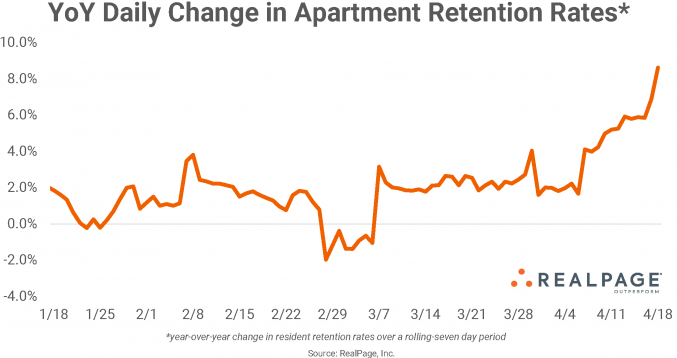
Apartment tenants are not moving out this time of year as normal patterns would dictate due to the impact of COVID-19, according to an article from RealPage.

“We are seeing a huge spike in rescinded non-renewal notices,” Jay Parsons writes in his blog. “This occurs when renters who previously intended to move out change plans and decide to stay put. Compared to the same time last year, rescinded notices have nearly doubled.”

The U.S. apartment industry has seen an unusual surge in retention rates. This is counter to the normal seasonal patterns. So managers are seeing more rescinded notices, more month-to-month leases, and more renewal demand, Parsons says.

“As property managers have these conversations with renters, they’re finding many want to stay put, but only for the short term while they wait out COVID-19,” Parsons said. “Apartment managers are providing unprecedented flexibility to help them out.

“But they’ve also gone even further. In some cases, they’ve allowed renters to remain in units that were already leased for a future date by a new resident – leading to a scramble to then re-sell the new renter on a replacement unit. Many have waived premiums for month-to-month leases or other short lease terms,” Parsons says.

apartment tenants staying in place
Chart courtesy of RealPage

He cautions this all means a summer leasing season with “heavier exposure and lighter new-lease demand than we would typically see in a normal summer.

“Lease-expiration management becomes more critical now than ever. Under normal circumstances, you would offer big premiums for short-term leases to help stagger expirations. That may not be an option right now for property managers concerned about both optics and the reality of taking care of residents in need.

“Even without short-term premiums, though, you can certainly incentive longer-term renewal commitments,” he writes

Read the full post here on RealPage.

April Rent Collection Better Than Expected; May is a Concern

Sign Up For Our Newsletter And Get Apartment News And Helpful, Useful Content Each Week.

* indicates required


New Rental Insurance Technology Tool for Property Managers

New Rental Insurance Technology Tool for Property Managers

Liberty Mutual has built a new set of innovative technical capabilities that allows the integration of the quoting and binding of rental insurance into property manager’s ecosystems.

During a recent interview, Kelly Piotrowski, Director, Ecosystem Partnerships for Liberty Mutual, said, “We say ‘ecosystem’ because it could be a website, it could be a mobile application, it could be the portal that someone uses to apply for an apartment and pay their rent.”

The Insurance Information Institute says only 37 percent of renters buy insurance leaving 63 percent uninsured, and “that’s pretty scary when you think about it because even just to replace an iPhone, a laptop, or your clothes, can be a pretty significant life event for a person,” Piotrowski said.

Liberty Mutual built the new renters API (application program interface) because “we wanted to build a set of capabilities that would allow us to partner with people to make it easier for those who should have renter’s insurance to get it,” she said.

“These capabilities are not partner specific and can easily integrate into a variety of partner experiences.  Partners work directly with the Liberty Mutual partner technology team and not a third party.”

“While the API is an easy digital solution, functioning on both mobile and desktop, the quote-and-bind offer is integrated into your digital experience, with no need for individuals to be rerouted to LibertyMutual.com or call an agent.

Piotrowski said they are seeking partnerships with other companies with a larger base of users, such as the one they already have with Rom8.io, which helps people find roommates. The goal is to engage renters while they are online using digital products and signing up for their housing.

“So we’re meeting people where they are and we’re making it easier and trying to reduce as many barriers as possible so that people will finally get the coverage that they need,” Piotrowski said.

Although selecting housing may be top of mind at the moment, “We can say, ‘You know what? You should really have renter’s insurance while you’re here. Why don’t you take a look at this?’ And then the person can actually engage with the renter’s-insurance product without ever having to leave,” she said.

She explained that if a property-management company had a website and used the API renters could actually buy the insurance through that API on the partner’s site, and it could proactively list the property management as the insured and potentially then send a proof of insurance.

A simplified rental insurance-buying experience

The technology and the product itself is the same full-coverage rental insurance someone would get from going to LibertyMutual.com or calling the company.

“It’s the same product, but it’s definitely a simplified product from a purchasing standpoint,” Piotrowski said, so it does not require as much information as other insurance products. She said partners in the program will most likely already have much of the data needed to apply for renters insurance with the company.

Property management typically already has the information that Liberty Mutual needs.

“Things like name, address, and data for email address, how long have you been living in this apartment? It is straightforward information, but it’s also things that our partners are likely to already have from their customers. So then you have the opportunity to further simplify the process by pre-filling it as well to expedite the process it takes for someone to then actually complete the quoting and binding,” Piotrowski said.

About the program:

Liberty Mutual Insurance has created a Renters Insurance API that will allow your customers or tenants to quote and buy renters insurance without ever leaving your digital experience. To learn more about the program, visit libertymutual.com/renters-api or contact [email protected].

Seattle Landlords Lose First-Come, First-Served Case Petition

A federal judge has ruled a landlord did not have to automatically waive its animal fee for a tenant with an emotional support animal

The U.S. Supreme Court declined to hear Seattle landlords’ appeal of the controversial first-come, first-served law, requiring landlords to accept the first qualified tenant who applies and clearing the way for the rule to stand permanently.

The Pacific Legal Foundation had sued on behalf of the landlords over the ordinance, claiming it violated landlords’ due process, free speech and property rights.

“The Supreme Court has turned down an important opportunity to strengthen constitutionally protected property rights and provide much-needed relief to Seattle property owners,” said Ethan W. Blevins, staff attorney for the Pacific Legal Foundation, in a statement.

“The Supreme Court’s decision to deny the petition means that Seattle landlords have no say over who ends up living on their property. As a result, small-time landlords have lost basic property rights, and tenants will struggle to find affordable housing that meets their needs. The city now has the green light to go forward with the regulatory slaughter of its own housing market.”

In an email reported by the Seattle Times, Blevins wrote, “Seattle’s law has caused some landlords to sell their units and others to tighten their rental criteria. The city’s victory in the courts, unfortunately, will not translate into a victory for either landlords or tenants,” he wrote.

Seattle Councilmember Lisa Herbold championed the first-come, first-served law in 2016, saying her goal was to ensure all renters were treated equally. At the time, officials said they were unaware of any other U.S. city with such a law.

In a statement hailing the news, Herbold said the first-come, first-served law was “a necessary tool” to guard against discrimination and even more important now that the city’s existing housing crisis has been “compounded by an economic crisis” because of the coronavirus.

The denial by the U.S. Supreme Court means the case has now run its course, City Attorney Pete Holmes told the newspaper.

A Seattle judge first struck down Seattle’s ordinance in 2018, saying landlords must accept the first qualified tenant who applies, according to reports. King County Superior Court Judge, Suzanne Parisien, struck down the ordinance, determining that “choosing a tenant is a fundamental attribute of property ownership.”

However, the Washington State Supreme Court heard the case and last year upheld the law, reversing the King County ruling.

Earlier this year the landlords asked the U.S. Supreme Court to hear the case but the court denied the petition Monday without comment.

First in Time Lawsuit: Yim et al. v. City of Seattle

Multifamily NW and Landlords File Suit to Stop Portland’s New FAIR Rules, But Judge Denies Request For Immediate Relief

Sign Up For Our Newsletter And Get Apartment News And Helpful, Useful Content Each Week.

* indicates required


April Rent Collection Better Than Expected; May is a Concern

April Rent Collection Better Than Expected; May is a Concern

April rent collection was better than expected, but May rent collection is still a concern, according to research presented in a recent National Apartment Association webinar.

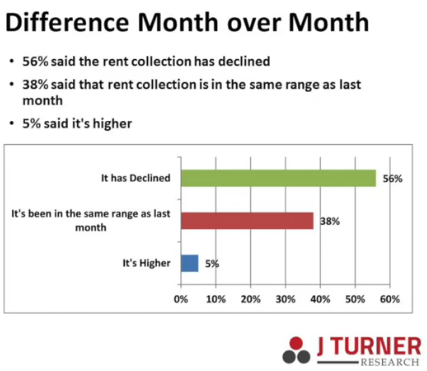
Mindy Price of J. Turner Research presented during the webinar and said, “We undertook a multifamily-leader survey to determine the impact of Covid-19 on rent collection. In the survey of 678 participants, 58 percent of those were mid-to- top-level management.”

The results compared April to March rent collection; 56 percent said they saw a decline, 38 percent said it stayed the same and 5 percent said it was higher.

Price said overall April rent collections were better than expected, and “We’re not hearing all that doom-and-gloom that some of the national media outlets have been reporting on. However, there is a consensus about the unknowns of May rent collection.”

So, how much was the decline in rent?

The survey showed that of the 56 percent who said they had a rent decline, the average decline in rent payments amounted to about 12 percent.

However, Price pointed out that “we’ve got a couple of conflicting events that are going on right now,” leaving open questions.

  • First, six weeks into this pandemic with people are being laid off, what impact is that going to have?
  • Second, many of those have applied for unemployment, stimulus checks are hitting the banks and money is getting into people’s hands, but what’s going to be their priority?

“That’s really the unsolved question,” Price said.

Payment options question

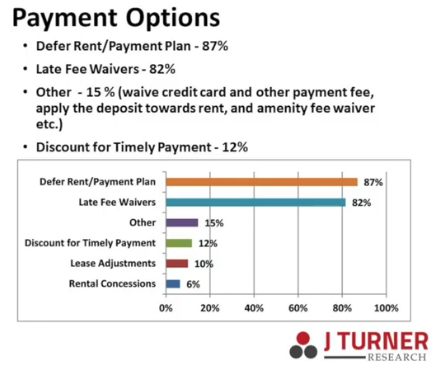
The survey also asked about what type of payment options property managers were offering. Price said there were different rent payments and payment plans being offered, along with waivers of late fees.

“Then there are also some discounts for early-payment options and also early incentives. If somebody pays early, they’re getting a percentage off of their rent, or if they’re paying early, they’re getting entered into drawings for free rent. Some are doing, if you pay early, you’re just getting some free rent.

“We’ve also heard of some discounts that have been offered, such as small discounts if you pay on time between the first and this date. We’ve heard about restaurant gift cards,” Price said.

April Rent Collection Better Than Expected; May is a Concern
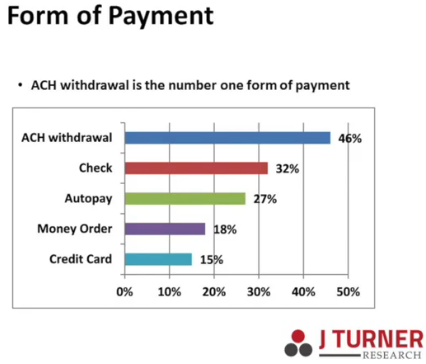
Charts courtesy of J Turner Research

She also pointed out that some unemployment is paid out weekly.

“So you’ve got your resident receiving that money weekly. Well, what about setting up a payment plan so that you can receive their rent dollars weekly? Just a suggestion,” she said.

Communication has to go along with rent payment options

Price pointed out that the survey showed different forms of payment used, from ACH withdrawals to checks, then money orders and credit cards. She said that responses showed that 32 percent are still paying by check.

“Well, there are companies that are trying to move over to no in-person payments, right? No forms of paper payments. The problem with of those is that the companies are sending out letters, paper letters stating they’re moving to virtual payments or online payments. And so the residents are complaining saying, ‘Wait, so what you’re saying is your paper is better, safer than ours?’

She said consistency in the message is important, so if no in-person payments “is something that you’re moving towards, you want to make sure you’re sending that information  any other way using social text, email, but not by paper.

April Rent Collection Better Than Expected; May is a Concern

“April was better than anticipated and we hope the same for May,” Price said. She added they will be doing follow-up surveys to report more on this in the future.

84% of Apartment Households Paid Full or Partial Rent in April

Sign Up For Our Newsletter And Get Apartment News And Helpful, Useful Content Each Week.

* indicates required


Top 4 Rental Property Upgrades That Pay Off

Top 4 Rental Property Upgrades That Pay Off

You will likely be faced with the need to do a rental property upgrades in the future, so this week’s maintenance tip from Keepe is a look at four upgrades that will help whether you are managing a multifamily apartment, condominium, townhouse or single-family property.

Your tenant has moved out, and your property is vacant. Before you do the typical make-ready projects, put some thought into rental-property upgrades.

These upgrades may be necessary for improving the general condition of the property or its aesthetic appeal. Notwithstanding, certain rental-property upgrades will offer you potential benefits in the long run.

Below is a list of four rental-property upgrades that are likely to offer you ample benefits in the long run.

No. 1 – Apply a Fresh Coat of Paint

Painting has a unique way of transforming any living space.

It is a low-cost upgrade and offers lots of immediate benefits. By using neutral colors on the interior of the home, you’re appealing to the largest possible number of potential tenants.

Remember, the goal is to upgrade the property to attract tenants, not to make a statement. A typical painting procedure for 1,200 square feet with lots of trim details will cost you an average of $1,000 – $4,000 plus materials.

No. 2 – Invest in Basic Security System

Regardless of the degree of safety in the neighborhood, security is one of the top priorities for any property manager.

In addition, the goal of any renter is to live in a well-secured apartment or environment. Installing basic security systems like alarm systems, security cameras, outdoor lighting, and quality deadbolt locks can go a long way in protecting your tenants and property.

Upgrading the security level of your rental property is a great way to attract potential renters. Most importantly, it doesn’t cost a lot to have security in place. The average cost of installing a monitored home-security system can be around $300- $700.

No. 3 – Install Quality Flooring

Flooring is one of Top 4 Rental Property Upgrades That Pay Off

Flooring can be a tricky upgrade choice, since renters may have different views when it comes to a preferred flooring option.

Usually, the choice comes down to wood floors versus carpets. However, most property managers seem to opt for wood floors over carpet.

While carpeting may be an inexpensive choice, it can easily turn off a majority of tenants and be a pain for property managers. This is because carpet as a flooring option requires regular maintenance and is susceptible to wear and tear.

On the other hand, while wood flooring isn’t cheap, it requires less maintenance and will last longer. An even more economical option is laminate flooring, which gives your apartment units a stylish hardwood appeal.

No. 4 – Install Better Countertops 

Upgrading your rental property’s countertops can add value to the heart of the home.

There are a variety of options to choose from, depending on your current kitchen decor. You can opt for high-end materials like quartz and cement, which seem to be popular in rental property kitchen renovations. Generally speaking, though, granite tends to be a superb choice.

When shopping for countertop upgrades for your property, keep functionality, durability, and style in mind. As for kitchen cabinets, you should upgrade to modern and functional ones if the ones you have outlived their functionality.

In conclusion

As a property manager in charge of a rental property, upgrades are a great way to increase the value of your property and improve tenant retention. Renters are more conscious today about their choice of rental properties. And investing in small-scale upgrades for your property may be the secret to an increase in your rental income.

About Keepe:

Keepe is an on-demand maintenance solution for property managers and independent landlords. The company makes a network of hundreds of independent contractors and handymen available for maintenance projects at rental properties. Keepe is available in the Greater Seattle area, Greater Phoenix area, San Francisco Bay area, Portland, San Diego and is coming soon to an area near you. Learn more about Keepe at https://www.keepe.com

How Can You Get Tenants to Clean Regularly?

Rental Property Maintenance and the Fight Against the Spread of COVID-19


Sign Up For Our Newsletter And Get Apartment News And Helpful, Useful Content Each Week.

* indicates required


Should I Pay The Taxes Or Defer?

Should I Pay The Taxes Or Defer?

Should I pay the taxes, or defer, and why doing a 1031 exchange may be smart financial planning now.

By Ehud Gersten
Vice President, Kay Properties and Investments, LLC

When selling real estate investment property, investors generally have two options: 1) pay the taxes on any gains from the sale, or, 2) conduct a 1031 exchange and defer the taxes owed.

Recently, because of the financial uncertainty surrounding COVID-19 and the overall state of the economy, some investors are choosing to pay the taxes on any gain from the sale of their investment properties and hold on to their cash rather than acquire replacement real estate utilizing the 1031 process.

While every investor is different and should make their own determination of their specific financial landscape and rely on the advice of their professional financial and legal counsel, there are generally two major points to keep in mind before choosing to pay the taxes rather than defer.

Point #1: the amount of taxes you might have to pay

If you choose to pay the taxes on your gain, you might be responsible for the following:

  • Long term federal capital gains tax rate may be as high as 20%, depending on your income bracket.
  • State tax can also add to the financial tax hit, depending on the State in which you live. For example, in California, an investor could possibly also pay up to 13.3% in income tax.
  • Depreciation recapture is taxed at a flat rate of 25%, which can be quite significant if you’ve held and depreciated your investment property for a long period of time.
  • Net Investment Income Tax (NIIT) applies to certain net investment income of investors that have income above the statutory threshold, at a rate of 3.8%.

Point #2: opportunity cost of any amount you pay in taxes

When an investor pays taxes, that could otherwise be deferred, they’re left with less capital that could otherwise be used for investment purposes that could generate more return for them.

Let’s use a simple example: Suppose that an investor sells an investment property for $1 million, and the total amount of taxes that they would owe on such sale is $350,000. That accredited investor then decides, for purposes of our example, that they will pay the taxes owed and take the $650,000 in cash remaining and invest it in some investment that pays 5% annual interest. That investor, based on our example, should make a return of $32,500 per year.

However, if that same investor had completed a 1031 exchange deferring all of their taxes and depreciation recapture, for example into a DST paying 5% annually, their annual return should be $50,000, a difference of $17,500. While the above is a simplified example, it helps illustrate the opportunity cost of paying the taxes rather completing a 1031 exchange.

Lastly, investors should note that if they pay their taxes the $350,000 in the above example is gone forever.  If they were to do an exchange they would have deferred their taxes, the $350,000 would be able to generate potential income for them AND when the investor passes, his or her heirs would receive a full step up in basis thereby eliminating the $350,000 of capital gains taxes forever.  So not only will the investor make $17,500 in income less per year but the investors estate would also lose $350,000 of principal.  This math above is the very reason why so many investors choose to utilize the 1031 exchange as it is one of the most tax efficient strategies that real estate investors can utilize.

Before an investor decides to pay any owed taxes on the sale of their investment property rather than completing a 1031 exchange and deferring those taxes, they should thoroughly understand the financial implications as everybody’s unique situation is different, by consulting with their professional tax advisor, CPA and attorney.

About Kay Properties and www.kpi1031.com

Kay Properties is a national Delaware Statutory Trust (DST) investment firm. The www.kpi1031.com platform provides access to the marketplace of DSTs from over 25 different sponsor companies, custom DSTs only available to Kay clients, independent advice on DST sponsor companies, full due diligence and vetting on each DST (typically 20-40 DSTs) and a DST secondary market.  Kay Properties team members collectively have over 115 years of real estate experience, are licensed in all 50 states, and have participated in over 15 Billion of DST 1031 investments.

This material does not constitute an offer to sell nor a solicitation of an offer to buy any security. Such offers can be made only by the confidential Private Placement Memorandum (the “Memorandum”). Please read the entire Memorandum paying special attention to the risk section prior investing.  IRC Section 1031, IRC Section 1033 and IRC Section 721 are complex tax codes therefore you should consult your tax or legal professional for details regarding your situation.  There are material risks associated with investing in real estate securities including illiquidity, vacancies, general market conditions and competition, lack of operating history, interest rate risks, general risks of owning/operating commercial and multifamily properties, financing risks, potential adverse tax consequences, general economic risks, development risks and long hold periods. There is a risk of loss of the entire investment principal. Past performance is not a guarantee of future results. Potential cash flow, potential returns and potential appreciation are not guaranteed. The above is not intended as tax or legal advice.

Securities offered through WealthForge Securities, LLC. Member FINRA/SIPC. Kay Properties and Investments, LLC and WealthForge Securities, LLC are separate entities.

Kay Properties Being Defensive Pays Off: Avoiding Hospitality and Senior Care

How You Can Run Maintenance Coordination at Zero Cost

How You Can Run Maintenance Coordination at Zero Cost

By Ethan Lieber

If you’ve been a property manager for long, you know that maintenance can easily be one of the biggest stressors of the business. But there are many ways to turn this stress into an opportunity. Property-management companies are beginning to utilize a new model that reduces time spent on maintenance by 80% and is not only run at zero cost, but can actually generate a new profit stream.

This model helps reallocate that time to other areas of the business, like growth. According to a recent Buildium study, 61% of property owners listed maintenance as the top pain point, and for good reason. You’re on call 24/7 and emergency maintenance not handled immediately can turn into long-term expensive property damage. On top of this, managing vendor and tenant schedules, follow-ups, and invoices can be a huge time suck.

Creating Efficiencies in Maintenance Coordination

Many property managers use a third-party service to handle maintenance coordination. Whether it’s software service, a call center, or a mix of both, these tools are meant to help ease the maintenance process. A fee is involved when you want to use a call center to handle your maintenance calls, whether it be only after hours or 24/7. There’s also a fee for utilizing a software service for scheduling, tracking, and invoicing all maintenance requests. Latchel is a maintenance-coordination service that uses both software and a U.S.-based call center to operate across over 55,000 units nationwide.

Being that now is a time of unprecedented economic struggle, Latchel has implemented a model for customers that gives maintenance coordination at zero cost to customers. How is this done?

Removing the Cost of Maintenance Coordination

Latchel packages its maintenance-coordination services into a resident benefit package, called the 24/7 Home Assistant, that gives residents a concierge-like maintenance service along with a few other financial protections and resident benefits. These benefits include:

  • A dedicated home-assistant phone line available 24/7/365 for in-home needs.
  • Easy scheduling via SMS or online portal.
  • Expedited scheduling and dispatching of vendors with 2-hour repair windows.
  • Move-out repair assistance and $50 reimbursements of tenant-caused damages.
  • Cancellation-fee reimbursement for appointments that need to be cancelled or rescheduled.

Similar to many resident-benefit packages already out there, residents pay a small monthly fee for these enhanced and added services. Residents do have the ability to opt-out of this benefit if they are not interested. Latchel is currently waiving the typical PM fees for tenants who choose to opt-out, so property managers still get maintenance coordination at zero cost.

Creating a Profit Stream from Maintenance Coordination

With customers currently using this model, Latchel has seen a 90% opt-in rate from residents, giving property managers immediate profits. Property managers can earn an additional $4 per unit for all units that opt in. A few other benefits for the property manager include:

  • Improvement in online reputation:
    • Latchel maintains a 4.7/5 star rating for tenant satisfaction; reviews are automatically pushed to the PM’s website.
  • 80% more time to re-allocate to other parts of the business operations, and freedom from maintenance headaches.
  • Added revenues of $4 per unit per month.

You can learn more about the 24/7 Home Assistant here, or schedule a call with the Latchel team. We’d love to hear about your current maintenance operations process, and chat with you about how we can help you create more efficiency and growth in your business.

About the author:

Ethan Lieber is the CEO of Latchel. Latchel is a Y-Combinator backed company that runs 24/7 maintenance coordination services for property managers and landlords. You can read about Latchel on the Wall Street Journal or on Tech Crunch.

How You Can Run Maintenance Coordination at Zero Cost

How To Handle Rental Maintenance During COVID-19

Top 50 Apartment Companies in 2019 Multifamily Industry

Top 50 Apartment Companies in 2019 Multifamily Industry

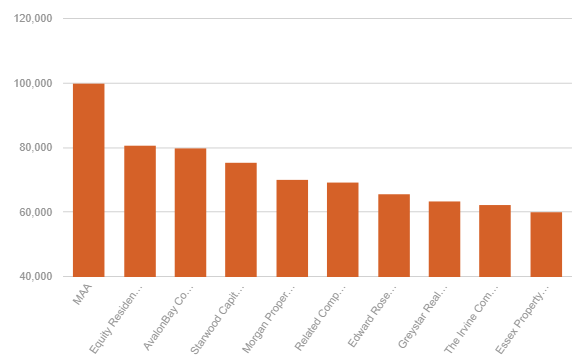
The National Multifamily Housing Council (NMHC) has released its 2020 NMHC 50, the sector’s chief ranking of the nation’s largest apartment owners, managers, developers, builders and syndicators for the year 2019.

“Before the outbreak of COVID-19 and the related economic weakening, the multifamily industry and the sector’s fundamentals were as healthy as they had been in years,” the report says. “While there is clearly going to be significant uncertainty in the days to come, the 2020 NMHC 50 highlights that the apartment industry continues to experience significant demand and is well-positioned to return to growth following the pandemic.”

“Demographic shifts and preference for renting have resulted in continued strong demand and positive performance for the apartment industry,” said Caitlin Sugrue Walter, Vice President of Research for the National Multifamily Housing Council, in a release.

“As is evident from the growth on this year’s builders and developers lists, the industry is continuing the pace of production to meet the needs of pent-up demand from years past. In addition, apartment transaction volume surpassed $100 billion for what’s now the seventh consecutive year.”

 No. 1 – Largest apartment owner

MAA (headquartered in Memphis, Tenn.) stayed atop the list of the country’s largest apartment owners with 100,031 apartment homes owned, breaking the 100,000-unit mark for the second consecutive year.

top apartment owners

 No. 2 – Largest apartment manager

Greystar Real Estate Partners (headquartered in Charleston, S.C.) remained the largest apartment manager with 492,967 apartments under their management, more than double the next firm on the list.

No. 3 – Largest apartment developer

Alliance Residential (headquartered in Phoenix, Az.) retained its place as the largest apartment developer with 8,009 apartments started in 2019 — over 1,000 more units started compared to when they first took the top spot last year.

No. 4 – Top apartment builder

Summit Contracting Group, Inc. (headquartered in Jacksonville, Fla.) kept their spot as the country’s highest-producing apartment builder, starting 9,065 apartments in 2019, nearly 1,500 more units than the next builder on the list.

No. 5 – Top syndicator

PNC Real Estate (headquartered in Portland, Ore.) also stayed on top as the nation’s largest apartment tax-credit syndicator with 132,179 apartments syndicated.

Additional Industry and NMHC 50 Highlights:

  • 2,210,931 – Number of total units owned by NMHC 50 top owners, representing 10.1 percent of the total U.S. apartment stock.
  • 3,617,624 – Number of units collectively managed by NMHC 50 top managers, breaking the record for the 12th consecutive year and representing 16.5 percent of the total U.S. apartment stock.
  • 95.8 percent – 2019 apartment occupancy rate according to RealPage, the highest since 2000.
  • 343,200 – Number of apartments completed in 2019 according to the Census Bureau, which is 7,600 units (or 2.3%) higher than in 2018.
  • 249,721 – Net absorptions in 2019 according to RealPage, a 17.3 percent drop from the highs seen the previous year.
  • $183.5 billion – Total multifamily transaction volume in 2019 according to Real Capital Analytics, a record high.

About the ranking:

This is the 31st annual edition of the NMHC 50 rankings. NMHC partners with Kingsley Associates, a leading real estate research and consulting firm, to conduct the research for the NMHC 50. All apartment owners, managers, developers, builders and syndicators are invited to answer a survey questionnaire that asks about their prior year’s activities. Apartment owners, managers and syndicators are ranked based on their portfolio holdings (either owned, managed or syndicated) as of January 1, 2020, while developers and builders are ranked based on the number of apartment units started in 2019.

84% of Apartment Households Paid Full or Partial Rent in April


Sign Up For Our Newsletter And Get Apartment News And Helpful, Useful Content Each Week.

* indicates required


6 Actions Landlords Can Take to Support Residents Now

6 Actions Landlords Can Take to Support Residents Now

On behalf of the 40 million Americans who call an apartment home and the 17.5 million jobs the industry supports, the National Multifamily Housing Council (NMHC) is suggesting six actions landlords can take to support their residents in light of the developments surrounding the coronavirus (COVID-19) pandemic, according to a release.

“This crisis is testing all of us – every industry, every family. No one should lose the roof over their head during a pandemic. That’s why our members are taking action and why NMHC proactively issued a series of principles to assist renters, including a halt to COVID-19 related evictions and the establishment of payment plans for residents who are unable to pay their rent because of the outbreak,” NMHC President Doug Bibby  said in a release.

“We welcome the Federal Housing Finance Agency’s decision  to offer mortgage forbearance to multifamily housing property owners who suspend evictions for those who have been financially impacted by this public health emergency. This is a necessary step. Most property owners are small businesses and they are committed to working with public officials and residents to keep families safe during this national crisis,” Bibby said.

6 actions landlords can take

The NMHC suggests landlords and apartment firms consider adopting the following principles to help America’s renters retain their housing during this crisis.

No. 1 – Halt evictions for 90 days for those who can show they have been financially affected by the COVID-19 pandemic. (This would not apply to evictions for other lease violations, such as property damage, criminal activity or endangering the safety of other residents of the community.)

No. 2 – Avoid rent increases for 90 days to help residents weather the crisis.

No. 3 – Create payment plans for residents who are unable to pay their rent because of the outbreak, and waive late fees for those residents.

No. 4 – Identify governmental and community resources to help residents secure food, financial assistance and healthcare, and share that information with residents.

No. 5 – Communicate to residents that it is a priority for the industry to partner with them to help them retain their housing.

No. 6 – Develop a response plan for potential COVID-19 exposure.

“We also recognize that most rental properties are owned by individuals and small businesses that have financial obligations, including mortgages, utilities, payroll, insurance and taxes,” the NMHC said in the release.

“If residents cannot pay their full rent obligations because of the COVID-19 outbreak, then owners are at risk of not meeting their own financial obligations. This puts the individual property and the larger community in which it is located at risk.

“Congress must extend mortgage forbearance to rental property owners and extend similar protections to other financial obligations such as insurance premiums, utility service payments and tax liabilities. Forbearance is needed to prevent foreclosure and other adverse actions such as lien placements, utility shut-offs, defaults, and judgments that would negatively impact the viability of the property’s continued operation and ultimately put its residents at risk of additional disruption.

“We also continue to call on Congress to provide disaster-housing assistance for renters who are suffering from income disruption as a result of the pandemic.

“At a time when many American workers are being encouraged to work from home, multifamily owners and operators are on the front lines, keeping residents cared for and safe in their apartment homes,” the NMHC said in the release about 6 actions landlords can take.

“These are trying, even desperate times, and all of us face grim uncertainty in the days ahead. However, by working together – apartment residents, owners and operators, and lawmakers at all levels of government – we can develop solutions to the evolving challenges and keep Americans housed,” the association said.

Additional materials and resources on from the NMHC on COVID-19 can be found here.

6 Actions Landlords Can Take to Support Residents Now

Based in Washington, D.C., the National Multifamily Housing Council (NMHC) is the leadership of the trillion-dollar apartment industry. NMHC provides a forum for insight, advocacy and action that enables both members and the communities they help build to thrive. For more information, contact NMHC at 202/974-2300, e-mail the Council at [email protected], or visit NMHC’s website at www.nmhc.org.

NMHC Multifamily Housing Quarterly Survey Shows Little Overall Change

Sign Up For Our Newsletter And Get Apartment News And Helpful, Useful Content Each Week.

* indicates required