
Home Blog Page 14

Top 4 Uncertainties Facing the Rental Housing Industry

The top four uncertainties facing the rental housing industry are set out in a new in-depth study by the National Apartment Association

The top four uncertainties facing the rental housing industry are set out in a new in-depth study by the National Apartment Association (NAA) that shows how operators across the country are navigating them.

The apartment industry is facing a complex landscape marked by economic uncertainties, technological disruptions, and evolving regulatory environments across the country.

The findings reveal these key insights about the top four industry uncertainties facing rental housing.
The top four uncertainties facing the rental housing industry are set out in a new in-depth study by the National Apartment Association

No. 1 – Expense levels

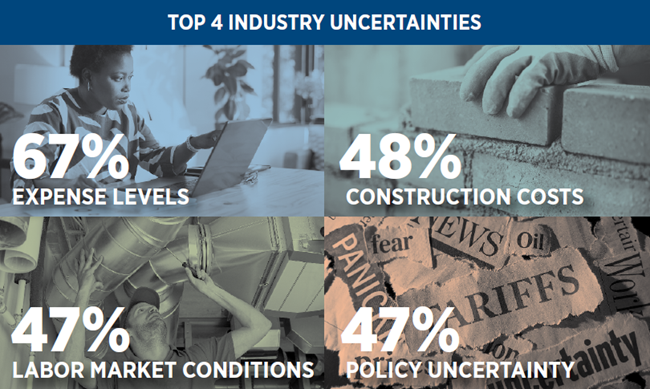
During the past 12 months, expense levels emerged as the most pressing operational challenge, outpacing interest rates and labor issues, with 67% of survey respondents rating rising expenses as a highly significant issue that has affected business operations.

These findings underscore the broad inflationary pressures on line-item costs such as materials, repairs, ongoing maintenance and vendor contracts. Companies are facing increased difficulty in maintaining profitability amid rising baseline operational costs.

No. 2 – Construction costs

Due to consistent labor shortages, supply-chain disruptions, extended project timelines and inflationary pressures, 48% of respondents believe that construction costs are second in severity of the challenges currently facing the industry.

The impact reflects the deep interconnectedness between macroeconomic trends and development feasibility.

No. 3 – Labor-market conditions

In the survey, 47% of respondents believe that labor-market conditions are highly significant, as operators have faced challenges finding skilled talent despite increased employment growth. Interest rates are a key concern, with 45% of respondents rating them as highly significant.

This indicates that while interest rates remain a central pressure point, staffing constraints and regulatory ambiguity are weighing more heavily on business operators.

No. 4 – Policy uncertainty

Policy uncertainties, including active and proposed tariffs, federal funding volatility, and shifting regulatory reforms at the state and local levels, continue to weigh heavily on operator decisions.

Here are more survey details from the respondents in the NAA study:

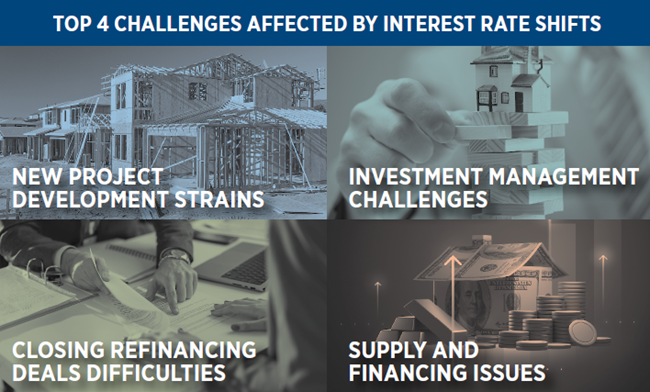
Interest rate shifts

The impact of higher rates is felt nationwide and across the property-value spectrum, affecting both large corporate entities and individual rental owners and operators. Interview participants highlighted several headwinds stemming from higher interest rates, including delayed acquisitions and a pause on new development projects.
The top four uncertainties facing the rental housing industry are set out in a new in-depth study by the National Apartment Association

Construction costs

There is a clear divide between those actively adapting to construction-cost pressures and those deferring action because of uncertainty or strategic misalignment.

Among active respondents, strategies span from contract renegotiation and value engineering to delayed execution and internal planning.

Those who remain inactive often do so intentionally, with valid operational or investment priorities elsewhere. As cost pressures persist, more firms may shift from passive observation to active preparation.

Labor-market challenges

Changes in the labor market over the past year have affected apartment owners and operators. Despite continued employment growth, companies emphasize that finding skilled talent remains both a priority and a challenge.

The survey results indicated that labor-supply challenges pose a greater threat to multifamily housing operations than wage increases. Sixty percent of survey respondents identified labor shortages as more disruptive than rising compensation costs. The inability to secure reliable, skilled labor – particularly in maintenance, repairs and other front-line roles – is straining operational capacity and elevating turnover risks.

Centralization

Centralization was not broadly perceived as a major disruptive force to operations in the current market environment. Only 11% of respondents rated it as a highly significant challenge. This suggests that while many firms are pursuing centralization for strategic efficiency or experimenting with centralized models, it has not created widespread operational friction in the rental housing industry.

Single-family versus multifamily

The responses revealed a varied and shifting landscape. Some industry professionals focus only on multifamily buildings, while others manage only single-family properties. And some larger firms own and manage a combination of both. The interviews highlighted a growing demand for both types of rentals with a renewed focus on affordability.
The top four uncertainties facing the rental housing industry are set out in a new in-depth study by the National Apartment Association

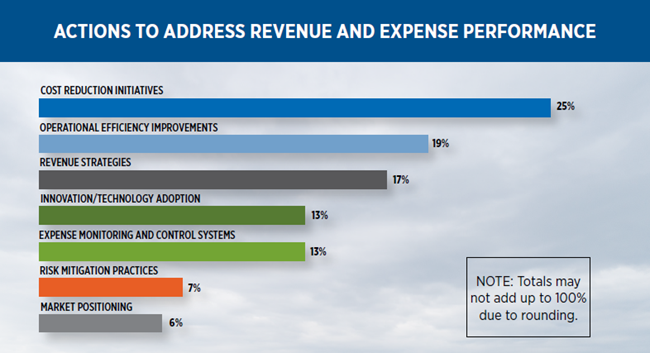
Revenue impact

For many professionals, rent growth has been moderate over the past year. In some cases, companies are resorting to concessions or rent reductions to either retain or attract renters. Respondents emphasized the importance of having strong rent-collection systems in place, including automation strategies.

Looking ahead, operators identified regulatory changes and pricing limitations as the biggest looming threats to their revenue strategy. Sixty-eight percent saw regulatory uncertainty as a moderate to severe risk, while 73% identified pricing limitations (e.g. rent control, market caps) as a major threat.

Fraud and bad debt in the rental housing industry

Fraud and bad debt have become more than routine nuisances; they are now recognized as persistent operational threats. Industry participants in NAA’s interview panel stated that fraud and bad debt are both rising concerns and challenges, especially with the technological advances of artificial intelligence.

On the fraud side, concerns are focused on the application process, where fake income documents, identification forms, credit history and other documents are much easier to create with AI.

About the survey:

The NAA study and survey about uncertainties facing rental housing, sponsored by MRI Software and conducted by the NAA, approached the research study with a two-pronged methodology. One prong involved fielding a survey of senior-level real estate professionals, collecting insights and information from more than 350 respondents across the industry.  The other prong consisted of a series of in-depth interviews with C-suite and Independent Rental Owners (IRO) to uncover deeper concerns and provide more detail about the ways in which the industry is responding to current challenges.


The top four uncertainties facing the rental housing industry are set out in a new in-depth study by the National Apartment Association (NAA)

Read the full in-depth report here

Sign Up For Our Weekly Newsletter And Get Rental Property And Apartment News And Helpful, Useful Content Each Week.

* indicates required

Can You Use Technology to Detect Tenant Smoking?

Can you use technology to detect tenant smoking is the question this week for Hank as tenant smoking is hard to detect and prove

Can you use technology to detect tenant smoking is the question this week for Ask Landlord Hank. Remember Hank is not an attorney and he is not offering legal advice. If you have a question for him please fill out the form below.

Dear Landlord Hank,

There are plug-in sensors that have been available for several years that I believe are tamper-proof and can detect various kinds of smoking and vaping.

Why is this not being talked about more?

-Nikki

Hi Nikki,

I’m aware of one company, Sentry, that has a very reliable detector that can detect and distinguish between cigarette, vaping, marijuana smoke and also noise.

You can’t buy it, though, you have to pay for it monthly.

One detector is about $200/year.

Sincerely,

Hank Rossi

Each week I answer questions from landlords and property managers across the country in my “Dear Landlord Hank” blog in the digital magazine Rental Housing Journal.    https://rentalhousingjournal.com/asklandlordhank/

Ask Landlord Hank Your Question

Ask veteran landlord and property manager Hank Rossi your questions from tenant screening to leases to pets and more! He provides answers each week to landlords.

  • This field is for validation purposes and should be left unchanged.

Can you use technology to detect tenant smoking is the question this week for Hank as tenant smoking is hard to detect and prove
Landlord Hank Rossi says, “Sentry, that has a very reliable detector.”

Can I Get Tenant’s Inoperable Car Towed Off My Rental Property?

How To Handle Ugly Feud Between Two Sets of Tenants?

Tenants Pouring Grease Down Sink And Flushing Paper Towels

Do You Know The 5 Questions Landlord Hank Asks Tenants When They Call?

Sign Up For Our Newsletter And Get Rental Property News And Helpful, Useful Content Each Week.

* indicates required

Photo credit Liudmila Chernetska via istockimages

Portland Metro Rental Housing Journal August Here

https://rentalhousingjournal.com/issues/metro/metro-august-2025/

See the Portland Metro Rental Housing Journal here with helpful, useful news and content for Portland rental housing owners, landlords, property managers and maintenance personnel.

Fix And Flip Real Estate Investors Pull Back

Fix and flip real estate investors are pulling back amid high interest rates and a fast-shrinking labor market due to immigration raids

Fix and flip real estate investors are pulling back amid high interest rates and a fast-shrinking labor market are taking their toll on the fix-and-flip housing market, Diana Orlick, senior real estate correspondent, writes in her CNBC Property Play blog.

Not only are costs rising, but the also the time it takes to sell a fix and flip home is taking longer and longer and finding workers due to immigration raids.

Roughly one third of flippers pointed to reduced labor availability due to immigration enforcement and fear-driven absences from jobsites. Labor and material costs for flips hit a record high, but costs as a percentage of sales price were flat.

The Fix and Flip Market

The fix-and-flip market contracted slightly in the second quarter of this year from the first quarter and even more sharply from the second quarter of last year, according to an index from John Burns Research and Consulting and Kiavi, a lender focused on the real estate investor.

“Sentiment remains muted, as economic uncertainty, elevated mortgage rates and rising resale inventory weigh on demand for flipped homes,” wrote Alex Thomas of John Burns Research and Consulting, the primary author of the report.

The index surveys roughly 400 flippers and measures current sales, expected sales and flipper competition for deals. All of those sub-indices fell last quarter. Days-on-market for flipped homes increased as the supply of both new and existing homes for sale rose.

Just 30% of flippers reported “good” sales in the second quarter of this year compared to the seasonal norm, down from 38% in the same quarter of 2024.

“We’re definitely seeing the more professional cohorts take a step back, be more conservative, be more choosy, right?,” Mohan said. “If they were going to buy four out of six opportunities a year ago now, they may be buying like two or three out of six just to make sure that they are prepared. As the market resets, they can reset their purchase price and keep the ROI metrics constant.”

Regionally, flippers in Florida, Northern California and the Southwest rated sales more poorly than flippers elsewhere.

Sign Up For Our Weekly Newsletter And Get Rental Property And Apartment News And Helpful, Useful Content Each Week.

* indicates required

Training For Gray Areas: Age in Fair-Housing Compliance

Age in fair housing compliance training can be a gray area as some state and local laws do apply to age as a protected class.

Age in fair housing compliance training can be a gray area as some state and local laws do apply even though in the Fair Housing Act age is not a protected class.

By The Fair Housing Institute

In the world of property management, training often zeroes in on the familiar—race, disability, familial status.

But what about age?

While not a federally protected class under the Fair Housing Act, age continues to show up in housing-related decisions, marketing language, and resident interactions.

For compliance professionals and property managers, the absence of federal protection doesn’t mean a free pass. Instead, it signals an opportunity to refine staff training and tighten internal policy to prevent unintentional bias.

When Age Isn’t Protected—But Still Matters

The Fair Housing Act doesn’t include age as a protected category, which can create a false sense of security.

Teams may think, “If it’s not federally regulated, we’re in the clear.” But that’s a risky mindset.

States and local municipalities across the country have filled in that legal gap by adding age as a protected class in their own civil rights or housing codes.

If you’re developing or delivering fair-housing training, this nuance needs to be front and center. Policies or preferences that appear neutral—like marketing to “working professionals” or “retirees”—could trigger compliance issues in states that recognize age-based protections.

Federal Funding Raises the Stakes

Properties that receive federal funding or subsidies operate under another set of rules.

The Age Discrimination Act of 1975 prohibits age discrimination in federally supported programs. Even if your staff is familiar with the Fair Housing Act, they may not be aware of how these layered protections work.

A key part of staff onboarding and continuing education should include understanding how different laws intersect and apply in federally supported housing communities.

Age-Adjacent Pitfalls: The Training Gap

The danger with age-based decisions isn’t always blatant.

A leasing agent might casually mention that a unit is “ideal for an older couple,” or that “young families may prefer something more spacious.” These comments, while seemingly harmless, can easily be interpreted as steering—especially if they intersect with familial status, a federally protected class.

Fair-housing education must emphasize how subtle, subjective language can lead to discriminatory practices.

And without proper training, staff may be unaware that they’re treading into legally questionable territory.

In today’s regulatory environment, good intentions are not a defense. Training should focus on clarity, consistency, and the importance of neutral language.

Older Adult Communities Require Clear Policy and Proof

Some communities are legitimately designed for older residents and can legally restrict families with children—but only if they meet specific criteria under the Housing for Older Persons Act (HOPA).

This exemption doesn’t happen automatically. Staff should be trained to understand what documentation is needed to prove compliance, how to advertise appropriately, and why vague marketing language can undermine legal protections.

“55 and older” is more than a tagline—it’s a legal threshold that comes with specific obligations. If your team isn’t trained to recognize the requirements, your community may unintentionally misrepresent its legal status and put your property at risk.

Managing the Legal Patchwork: Empowering Local Knowledge

Because age protections vary so widely across jurisdictions, training can’t rely on a one-size-fits-all approach.

Staff must be taught how to access and understand local housing laws. This is where property managers and HR leaders play a pivotal role—by reinforcing the expectation that teams stay informed about both federal and local obligations.

Even better? Build this flexibility into your policies. Instead of focusing solely on what’s legal, focus on what’s fair. Inclusive housing practices don’t just prevent violations—they strengthen community trust and enhance your company’s reputation.

Make Age Awareness a Core Training Topic

Age isn’t always front-of-mind during fair-housing training—but it should be.

Even when not explicitly protected, age-based assumptions and language can creep into housing decisions in ways that carry legal and ethical risks. By proactively addressing age-related concerns in your staff education, marketing policies, and resident interactions, you’re creating a stronger foundation for compliance—and for community.

Because when we say “fair housing,” it should apply to everyone—no matter their age.

About the author:

In 2005, The Fair Housing Institute was founded as a company with one goal: to provide educational and entertaining fair-housing compliance training at an affordable price at the click of a button.

Sign Up For Our Weekly Newsletter And Get Rental Property And Apartment News And Helpful, Useful Content Each Week.

* indicates required

Washington Rent Control Enforcement Makes Landlords Return Rent Increases

Washington rent control enforcement has started under the state's new rent control law forcing landlords to return rent increases

Washington Attorney General Nick Brown has entered into eight resolutions with landlords across the state in the first enforcement action under Washington’s new rent control law, according to a release.

The landlords — with properties in Bothell, Edmonds, Issaquah, Kennewick, Lakewood, Montesano, Port Angeles, Puyallup, Ridgefield, Royal City, University Place, Vancouver, and Yakima — agreed to withdraw rent increase notices they had sent and refund any excess rent amounts that tenants paid.

For the first wave of enforcements, Brown prioritized rent increase notices issued by landlords before the law was signed but that were slated to take effect for tenants after May 7. Because HB 1217 prohibits any increase higher than the rent cap that takes place on or after May 7, these increases run counter to the law.

The first rent control enforcement to make landlords return rent increases under Washington’s rent control law were filed in Superior Court in Clark, Grays Harbor, King, Pierce, and Snohomish counties.

“Our office will do all it can to address the housing challenges impacting Washingtonians across the state,” Brown said. “Protecting tenants under this new law is one piece of the work we’re doing to ensure more people have safe, affordable places to live.”

Washington Rent Control Law

The new rent control law (HB 1217) caps the amount landlords can raise a tenant’s rent under both the Residential Landlord Tenant Act (RLTA) and the Manufactured/Mobile Home Landlord Tenant Act (MHLTA).

The law was signed on May 7 of this year and went into effect immediately. The Attorney General’s Office has created a “Know Your Rights” flyer to help tenants understand the rent stabilization law.

The rent stabilization law applies to both residential and manufactured/mobile home communities. For manufactured or mobile home tenancies the maximum annual increase is 5%. For residential tenancies the maximum annual increase is 10% or 7% plus the Consumer Price Index (CPI), whichever is higher.

Rent Increases Allowed Under Washington Rent Control

The Washington state Department of Commerce determines the CPI and publishes the maximum annual rent increase percentage for residential tenancies on its website. The maximum annual increase allowed through December 31, 2025, is 10%. The maximum annual increase allowed between January 1, 2026, and December 31, 2026, is 9.683%.

Senate Republican Leader John Braun argued that HB 1217 will have negative impacts while imposing price controls on rent, according to mynorthwest.com.

“Price controls on rent have proven time and again to make the availability of affordable housing worse,” Braun stated.

Senator Keith Goehner, the lead Senate Republican on housing, claimed that rent increase caps reduce housing supply by discouraging developers from building new units, lead to housing deterioration due to a lack of available funds for landowners, and encourage black-market practices.

“Let’s call it what it is — House Bill 1217 is price control, plain and simple,” Goehner said. “And price control has a long, proven track record of failure.”

Sign Up For Our Weekly Newsletter And Get Rental Property And Apartment News And Helpful, Useful Content Each Week.

* indicates required

Greystar Reaches Settlement to End Algorithmic Rent Pricing

Greystar has reached a settlement with the Justice Department to end its participation in algorithmic rent-pricing schemes

The nation’s largest landlord, Greystar, has reached a settlement with the U.S. Department of Justice to end its participation in algorithmic rent-pricing schemes, according to a release.

The Justice Department’s Antitrust Division filed a proposed settlement to resolve the United States’ claims against Greystar Management Services LLC as part of its ongoing enforcement against algorithmic coordination and other anticompetitive practices in rental markets across the country, according to the release.

The settlement proposal was filed in the federal district court for the middle district of North Carolina.

Greystar manages almost 950,000 rental units across the country.

“As alleged in plaintiffs’ complaint, Greystar and other landlords, including five co-defendants, shared competitively sensitive data to generate pricing recommendations using RealPage’s algorithms, which also included anticompetitive rules that aligned competitors’ pricing.

“In addition, Greystar and other landlords discussed competitively sensitive topics — including pricing strategies, rents, and selected parameters for RealPage’s software — directly with each other,” according to the release.

What the Settlement to End Algorithmic Rent Pricing Says

If approved by the court, the proposed consent decree would require Greystar to:

  • Refrain from using any anticompetitive algorithm that generates pricing recommendations using its competitors’ sensitive data or that incorporates certain anticompetitive features;
  • Refrain from sharing competitively sensitive information with competitors;
  • Accept a court-appointed monitor if it uses a third-party pricing algorithm that is not certified pursuant to the terms of the consent decree;
  • Refrain from attending or participating in RealPage-hosted meetings of competing landlords; and
  • Cooperate with the United States’ monopolization claims against RealPage.

“American greatness has always depended on free-market competition, and nowhere is competition more important than in making housing affordable again,” Attorney General Pamela Bondi said in the release.

Assistant Attorney General Abigail Slater of the Justice Department’s Antitrust Division said the department is committed to promoting competition to help working class Americans pay for life’s necessities, including rent.

“Whether in a smoke-filled room or through an algorithm, competitors cannot share competitively sensitive information or align prices to the detriment of American consumers,” she said.

“Greystar remains committed to being at the forefront of innovation in service of its clients and residents, all within the bounds of the law,” the company said in a statement.

ProPublica reported in 2022 that some of the biggest landlords in the country were using an algorithm developed by RealPage to set rents on open units. RealPage’s algorithm uses data collected from its clients — landlords who compete with each other for renters — to create price recommendations.

In August 2024, the DOJ and several state attorneys general, sued RealPage for “its unlawful scheme to decrease competition among landlords in apartment pricing and to monopolize the market for commercial revenue management software.”

Read the full proposed settlement agreement here.

Sign Up For Our Weekly Newsletter And Get Rental Property And Apartment News And Helpful, Useful Content Each Week.

* indicates required

Tariffs, Rising Construction Costs Mean Trouble Ahead for Supply?

A growing pullback in multifamily development is driven by rising construction costs and new tariffs on such key materials as aluminum, steel

A growing pullback in multifamily development driven by rising construction costs and new tariffs on such key materials as aluminum and steel is signaling potential trouble ahead for future rental supply, according to the July Realtor.com Monthly Rent Report.

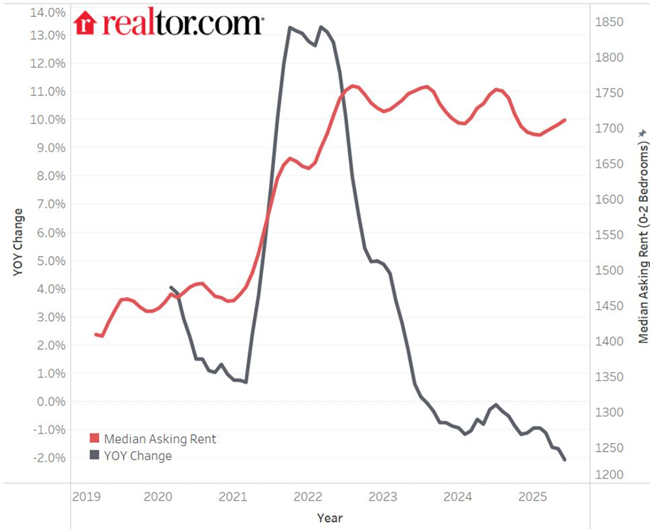
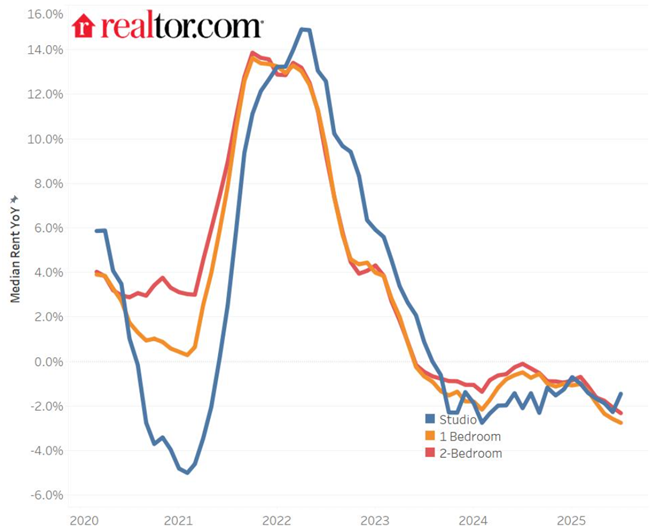
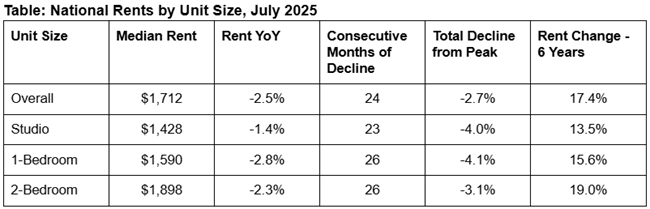
Rent prices declined for the 24th month in a row in July, marking a full two years of easing rental pressure in the U.S. rental market.

The median asking rent for 0–2-bedroom properties in the 50 largest metros fell to $1,712 in July, a $43 (-2.5%) decline compared to the same time last year.

Rents Decline Again, but Nationwide Rent Is 2.7% Below 2022 Peak

A growing pullback in multifamily development driven by rising construction costs and new tariffs on such key materials as aluminum and steel

While monthly rent growth continues to follow a typical seasonal pattern, it has consistently lagged behind last year’s pace, indicating a persistently cooler rental market. Rent prices remain $254 (17.4%) higher than their pre-pandemic levels, but are now $47 (-2.7%) below the peak reached in August 2022.

“Rents have now declined for two full years, giving renters more leverage and financial breathing room than they’ve had in some time,” said Danielle Hale, chief economist at Realtor.com in a release. “But there are early signs that relief may not last forever. Developers are pulling back in key markets, and construction headwinds—especially tariffs on steel, lumber and aluminum—could create a shortfall in new rental supply down the line.”

All Units Saw Rent Declines

A growing pullback in multifamily development driven by rising construction costs and new tariffs on such key materials as aluminum and steel

Multifamily Development Pulls Back Sharply

In June 2025, multifamily completions for buildings with two or more units fell 38.1% year-over-year, dropping from a seasonally adjusted annual rate of 656,000 units in June 2024 to just 406,000.

This significant decline reflects the growing challenges facing developers, including elevated construction costs, shrinking profit margins due to lower rents, and newly expanded tariffs on imported building materials.

The impact is being felt unevenly across the country. The Midwest saw the steepest annual drop in completions (–55.7%), followed by the South (–33.5%), Northeast (–33.0%), and West (–28.9%).

Disrupted Local Permitting Trends with New Higher Tariffs Signals More Pullbacks Ahead

Permitting trends across large metro areas show that some markets are already feeling the effects from rising construction costs and compressed profits:

  • Orlando: Permits for multifamily units dropped -54.9% from Q1 to Q2 2025—the first Q2 decline since 2022.
  • Philadelphia and San Antonio, Texas also saw their first Q2 permitting dips in three years.
  • Charlotte, N.C. and Las Vegas experienced their largest quarterly permitting declines in Q2 since 2022.
  • Even San Francisco, which saw a modest increase, posted its slowest Q2 growth in permitting in three years.

These local slowdowns suggest that developers are responding to worsening conditions by reducing plans for new projects—an early warning sign that the supply of new rental units could tighten over time.

Looking ahead, the doubled tariffs on imported steel and aluminum announced in June could make this condition worse.

“If construction pullbacks continue, today’s renter-friendly market could give way to a tighter, more competitive landscape,” said Hale. “It’s a trend we’ll be watching closely, especially in markets that had previously led the way in multifamily development.”

Rent Trends by Unit Size

While rent prices typically rise during spring and summer, this year’s seasonal lift in rent trends has been softer than usual. As of July, rents were up just 1.2% year-to-date, compared to 2.8% growth over the same period in 2024.

Despite near-term affordability gains for renters, the sharp drop in multifamily completions and early signs of weakening permitting activity may shift market dynamics later this year or in 2026, the report says.

A growing pullback in multifamily development driven by rising construction costs and new tariffs on such key materials as aluminum and steel

Read the full report here.

Sign Up For Our Weekly Newsletter And Get Rental Property And Apartment News And Helpful, Useful Content Each Week.

* indicates required

Greystar Reaches Settlement to End Algorithmic Rent Pricing

Photo credit Michael Vi via istockimages.

ICE Agents Seek Tenant Info, Calling It ‘Welfare Check’

ICE agents seek tenant information at apartment leasing offices saying it is a welfare check to make sure kids are not being trafficked

Some apartment leasing offices in Oklahoma City say Immigrations and Customs Enforcement (ICE) agents are showing up asking for tenant information, saying they are doing “welfare checks” to make sure kids are not being trafficked, according to reports.

Oklahoma is among other states, including Georgia, where immigration authorities are demanding landlords turn over leases and rental applications, and even want them to provide forwarding addresses.

ICE agents seek tenant information

On Wednesday, leasing office staff in Oklahoma City told News 9 that ICE agents came into their office saying they were doing welfare checks to make sure kids were not being trafficked.  Leasing office staff declined to give their names out of fear of retaliation.

Oklahoma Sen. Michael Brooks-Jimenez, who is a lawyer and a Democrat, said he is aware that something similar is happening.

Brooks-Jimenez said, “ICE officers are showing up, and they’re – they’re going to the leasing offices and asking for tenant information, the leases, and they’re saying that they’re doing welfare calls.”

Brooks-Jimenez said this makes him suspicious. He added, ” I would anticipate that landlords wouldn’t be able to share this type of information without a subpoena.”

One leasing office told News 9 that ICE officers showed up and were looking in different apartments and car windows.

Brooks-Jimenez adds that the area is a part of town that is heavily populated with Central Americans.

He said it makes sense that this is an area being targeted but also said many of these people had received temporary protected status, allowing them to work for a period of time. “President Trump has begun to terminate that status in those programs. And so as a result, those people are now here without permission,” added Brooks-Jimenez.

He adds that tenants, regardless of where they are from, have a right to privacy and they do not have to open their doors.

ICE agents sometimes show up with subpoenas in leasing offices.

Denise Holliday, an Arizona attorney, noted that ICE commonly issues administrative subpoenas that can feel a bit intimidating but she encourages all business owners to learn the difference between a court-ordered subpoena and an administrative subpoena and create a policy under which they will response to ICE-related communications.

Sign Up For Our Weekly Newsletter And Get Rental Property And Apartment News And Helpful, Useful Content Each Week.

* indicates required

More New Completions Now Expected in 3rd Quarter

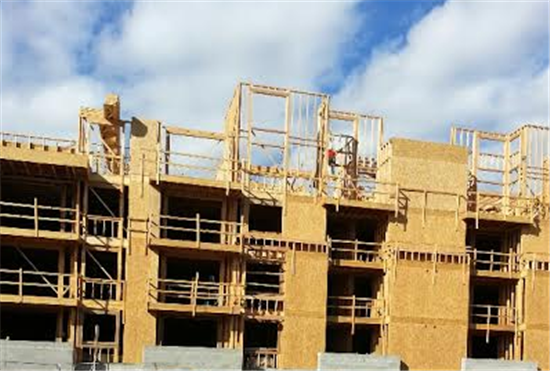
A declining but still sizable under-construction pipeline is leading to more new completions, up 2%, in the full-year 2025 and 2026 forecasts

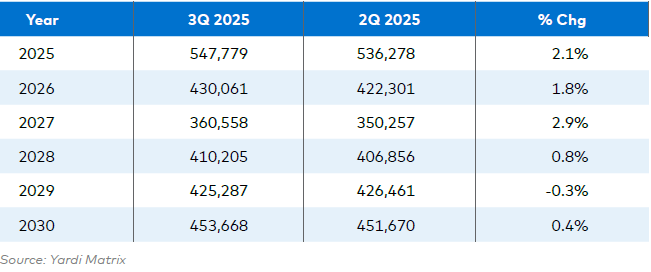
A declining but still sizable under-construction pipeline is leading to more new completions, up 2%, in the full-year 2025 and 2026 forecasts, Yardi Matrix says in a special bulletin.

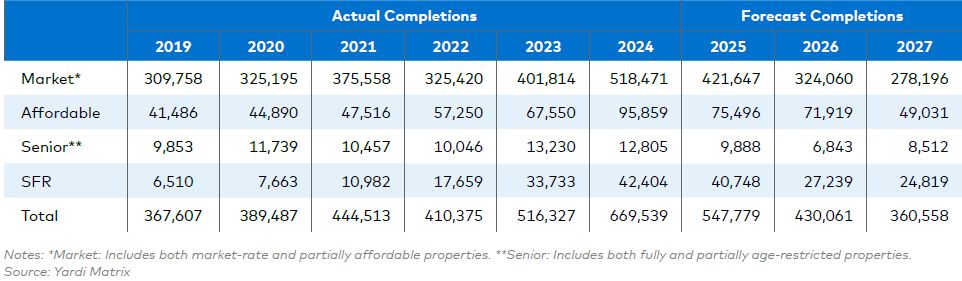
“New multifamily construction starts through mid-year 2025 are at a similar pace to the same period a year ago. As a result, the Q3 forecast update has increased 2027 completions by nearly 3.0% to 360,000 units,” the report says.

Ben Bruckner, senior research analyst writes, “the increase was driven by a slightly larger-than-anticipated under-construction pipeline at mid-year 2025.

“On a year-over-year basis, the under-construction pipeline has declined by 16.4% to 1.027 million units. Despite the decline, this level easily supports a modest increase in forecast completions to nearly 550,000 units for 2025 and 430,000 units in 2026.”

A declining but still sizable under-construction pipeline is leading to more new completions, up 2%, in the full-year 2025 and 2026 forecasts

Forecast Coverage

The supply forecast covers market rate, senior housing, multifamily property types, as well as single-family rental units.

Since most under-construction and planned properties have identified property types, the first three years of the forecast can be broken out by sector.

A declining but still sizable under-construction pipeline is leading to more new completions, up 2%, in the full-year 2025 and 2026 forecasts

Long-Term Forecast: 2027 Through 2030

The Yardi Matrix report says the administration’s tariff policies will not be sufficient to push the economy into recession.

“The longer-term forecast assumes continued steady but unspectacular economic and employment growth, continued deceleration in service-related inflation, and a transitory increase in goods-related inflation. This leaves room for the Federal Reserve to lower short-term rates by 50 basis points in late 2025, with additional moderate easing to follow in 2026,” Bruckner writes.

“Lower interest rates and continued modest economic growth provide a tailwind for new multifamily development in 2026. As a result, the forecast continues to model construction starts bottoming in 2025 and rebounding in 2026, with further growth in new development activity in subsequent years. The end result is new supply increasing to 410,000 units in 2028 and gradually increasing to more than 450,000 units by 2030.”

Read the full report here.

About Yardi Matrix

Yardi Matrix researches and reports on multifamily, office and self-storage properties across the United States, serving the needs of a variety of industry professionals. Yardi Matrix Multifamily provides accurate data on 18+ million units, covering more than 90 percent of the U.S. population. Contact the company at (480) 663-1149.

About Yardi Matrix

Yardi Matrix researches and reports on multifamily, office and self-storage properties across the United States, serving the needs of a variety of industry professionals. Yardi Matrix Multifamily provides accurate data on 18+ million units, covering more than 90 percent of the U.S. population. Contact the company at (480) 663-1149.

Sign Up For Our Weekly Newsletter And Get Rental Property And Apartment News And Helpful, Useful Content Each Week.

* indicates required