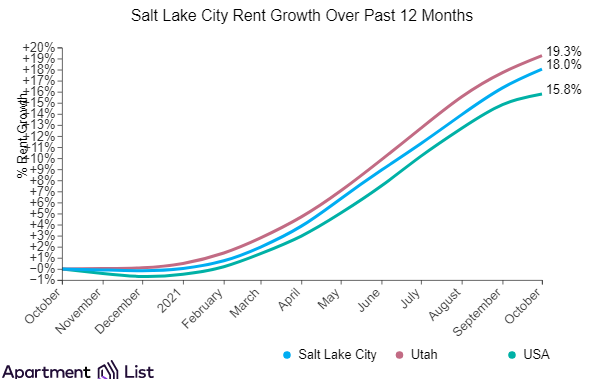
Salt Lake City rents increased 1.5 percent over the past month, and have increased sharply by 18.0 percent in comparison to the same time last year, according to the most recent report from Apartment List.
Currently, median rents in Salt Lake City stand at $1,082 for a one-bedroom apartment and $1,383 for a two-bedroom.
This is the tenth straight month that Salt Lake City rents increased after a decline in December of last year.
Salt Lake City’s year-over-year rent growth lags the state average of 19.3 percent, but exceeds the national average of 15.8 percent.
West Valley City rents also up sharply over the past month
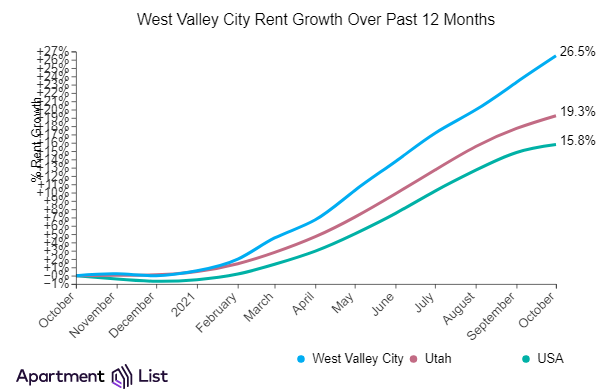
West Valley City rents have increased 2.6 percent over the past month, and have increased sharply by 26.5 percent in comparison to the same time last year.
Currently, median rents in West Valley City stand at $1,315 for a one-bedroom apartment and $1,550 for a two-bedroom.
West Jordan rents also increase
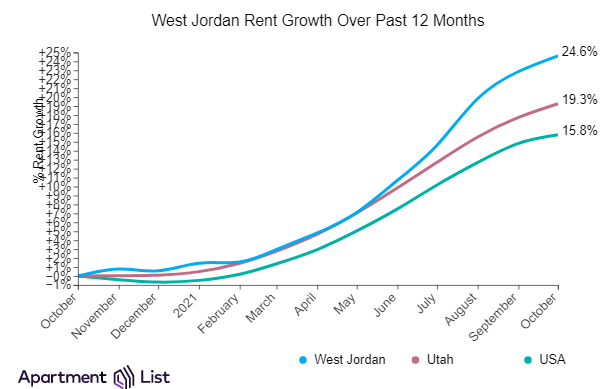
West Jordan rents have increased 1.4 percent over the past month, and are up sharply by 24.6 percent in comparison to the same time last year.
Currently, median rents in West Jordan stand at $1,403 for a one-bedroom apartment and $1,709 for a two-bedroom.
Can tenants go overboard with holiday lights especially in a multifamily property is the question for Ask Landlord Hank this week. Remember Landlord Hank is not an attorney and is not giving legal advice.
Dear Landlord Hank:
Do you have any rules for Christmas lights or yard art tenants can put up outside your rentals?
We just saw a tenant nailing up lights to the frame around the front door and are concerned about how far this could go in terms of potential damage.
We don’t want to be the Grinch, but what is reasonable?
-Sarah
Dear Landlady Sarah,
I understand your concerns and sometimes residents don’t use the best judgement in holiday decorating.
I make sure tenants know that they are not permitted to get on the roof, nor attach anything to the structure of the property by any intrusive means-no nails, no staples, etc. but there are many other options that don’t damage anything.
I’ve had folks use zip ties, string, wire, putty, hooks with adhesive, tape, winding lights around columns, you get the idea.
Holiday yard art could be an issue
Yard art could be problematic depending upon the situation.
If this is a single-family home you are talking about, then the more the merry, in my opinion. The lawn won’t be damaged as the grass isn’t growing, in cold climates.
Multifamily properties are different
If this is a multifamily property, I like tenants to keep the decorations confined to their own units or balconies or porch.
Holiday celebration in this manner is a very good sign to me. It means that your tenant is thinking of your place as home.
Most folks take care of their home, they want to stay and make more family memories and they may be putting down roots.
Long-term tenants are stable assets that I like to groom.
But do what feels right for you and your situation.
If you haven’t set some boundaries, maybe you could talk to your tenants? See what they have in mind, as far as decorating? Then, you can give them some pointers.
Happy Holidays!
Sincerely,
Hank Rossi
Can tenant holiday lights go overboard in multifamily properties? Landlord Hank says, “I like tenants to keep the decorations confined to their own units or balconies or porch. “
Ask Landlord Hank Your Question
Ask veteran landlord and property manager Hank Rossi your questions from tenant screening to leases to pets and more! He provides answers each week to landlords.
The question this week for Landlord Hank is whether a landlord can evict tenants for drilling holes in an exterior wall. On his page, Ask Landlord Hank answers questions from other landlords and property managers around the country about their rentals so fill out the form below if you have a question for him. Remember Hank is not an attorney and is not offering legal advice.
Dear Landlord Hank:
Can I evict tenants because they altered the house by attaching Internet cables to the house and drilling a couple of holes through the exterior walls?
The lease agreement states that they may not alter any part of the premises, and I sent a follow-up email as well, reminding them that they were not allowed to attach anything to the house.
These tenants, who have lived there for a week, and who called the police on me when I refused to strike a line from the pet agreement, have behaved horrendously, intimidating me at every turn.
I don’t want a cure. I just want to evict them. You should know that they’re on a two- year lease. I know. I feel pretty stupid.
-Maureen
Hi Landlady Maureen,
Don’t feel stupid.
This business is simple in theory but complicated in reality, sometimes.
Can you evict tenants for attaching Internet cables to the house, even though you warned them they couldn’t alter the house in any way?
The most likely test the judge would use when hearing your case would be if your demand was reasonable to not allow the running of two wires for Internet connection. I would think that it is not reasonable for you to refuse to allow this Internet connection – unless you already had a great connection for the Internet and some real damage would occur by drilling two holes.
Maybe if they drilled through a support beam or damaged Venetian plaster on the wall, etc.
I can’t believe the tenants called the police because you wouldn’t alter the lease. They sound unrealistic.
You may have to put up with them until they don’t pay rent or have a serious breach of the lease.
I suggest you speak to an attorney who specializes in landlord/tenant law. I’d hate to see you go to court and lose.
I know many folks like the idea of having a tenant locked-in to a two-year lease, but you don’t really know who you are dealing with until the tenants take occupancy. I don’t recommend multi-year leases for that reason.
And, if the market goes crazy, like now, you could be missing out on rent appreciation. The increases in my area have been staggering.
Sincerely,
Hank Rossi
Landlord Hank says, “I know many folks like the idea of having a tenant locked-in to a two-year lease, but you don’t really know who you are dealing with until the tenants take occupancy.”
Ask Landlord Hank Your Question
Ask veteran landlord and property manager Hank Rossi your questions from tenant screening to leases to pets and more! He provides answers each week to landlords.
About the author Landlord Hank:
“I started in real estate as a child watching my father take care of our family rentals- maintenance, tenant relations, etc. , in small town Ohio. As I grew, I was occasionally Dad’s assistant. In the mid-90s I decided to get into the rental business on my own, as a sideline. In 2001, I retired from my profession and only managed my own investments, for the next 10 years. Six years ago, my sister, working as a rental agent/property manager in Sarasota, Florida convinced me to try the Florida lifestyle. I gave it a try and never looked back. A few years ago we started our own real estate brokerage. We focus on property management and leasing. I continue to manage my real estate portfolio here in Florida and Atlanta. “ Visit Hank’s website here.
Fair housing and the U.S. Supreme Court ruling for the LGBTQ+ community means it is time to review your policies and make any needed changes according to the expanded understanding of the category of sex. Here is some help with the issues and remember this is not legal advice so check with your attorney on specifics.
In line with the Supreme Court’s decision regarding discrimination based on sexual orientation or gender identity, President Biden signed an executive order earlier this year mandating that all federal agencies review the ruling and make needed adjustments.
So, what can property-management companies expect?
Should we wait on updated guidelines from HUD (Department of Housing and Urban Development) or should we make changes now to avoid any appearance of housing discrimination against LGBTQ+ prospects?
A Quick Legal Recap
President Biden signed an Executive Order on January 25, 2021, requiring protections of LGBTQ+ community people in housing, health care, and education. The Executive Order cites the recent Supreme Court decision, Bostock v. Clayton County, that held that the prohibition against sex discrimination in the Equal Employment Act prohibits discrimination on the basis of sexual orientation and gender identity. The Executive Order requires the applicable federal agencies, including HUD, to promulgate actions consistent with Bostock and the various civil rights laws. This Executive Order will result in new HUD regulations explaining the protections of LGBTQ+ persons under the Fair Housing Act.
A New Protected Category?
There is always confusion with any change. With this new ruling, questions have been raised as to whether this ruling meant a new protected category. To clarify, we do not have a new protected category, rather we now have an expanded protected category of sex. Under this expansion, it is illegal to discriminate against anyone based on their sexual orientation or the gender they are presenting.
The Time to Act Is Now
The next question raised is whether or not housing providers should start making changes now or wait for guidance from HUD. We believe there will be a notable increase in testing and enforcement of the new fair-housing protections of LGBTQ+ people. Whenever changes in regulations occur, housing providers can expect an increase in testing by housing-advocacy agencies. To avoid unnecessary liability, all housing providers should be educated about these changes, and ensure that all employees are properly trained and prepared for testers now.
Fair Housing Compliance and LGBTQ+ Prospects
Consider a few situations that may arise. A same-sex couple is interested in renting an apartment. Can you ask them for a marriage certificate? How would you handle an individual who is dressed as a woman and the name they give doesn’t match their government-issued ID?
Fair housing best practices in both of these situations are to ensure your policies are up to date according to the new laws and that they are applied across the board. If your policy does not require a heterosexual couple to produce a marriage certificate, then you cannot request one from any other type of couple. As far as a person who uses a name other than what is on their ID, your policy needs to be the same for everyone regardless of how they are dressed.
Now is the time to review your policies and make any needed changes according to the expanded understanding of the category of sex. Expect that testers will be focusing their attention on compliance with the new law. Up-to-date training is also absolutely necessary to make sure that every staff member is prepared to handle any situations that will arise. Remember, the best way to avoid a fair-housing complaint is to be fair-housing compliant!
About the author:
In 2005, The Fair Housing Institute was founded as a company with one goal: to provide educational and entertaining fair housing compliance training at an affordable price, all at the click of a button.
Ask attorney Brad is a feature with attorney Bradley S. Kraus and this week the question is about tenant smoking and how to prove it if you go to court. If you have a question for Brad, please feel out the form below.
Ask Attorney Brad:
I trust this message finds you well. I’m wondering this: How can I prove in court that my tenants are smoking inside the home rented to them? Can you please advise?
-Arun
Hello Arun,
Thank you for your question. Proof of smoking can be a challenge.
Obviously, the best proof is when you catch a tenant in the act. However, that’s not always easy, and short of putting cameras in your tenants’ unit—please don’t do that—you may need to do your homework.
It’s important to verify the smoking with neighboring tenants (i.e., those above, below, and on the sides of the smoker) if possible. That way, you may be able to “box-in” the smoking, and rely on that circumstantial evidence to buttress your case.
If you have properly inspected the unit, and found ashtrays in the unit, disposed/used cigarettes therein, and/or lingering odors in the unit, those are all items you may be able to rely on as well.
Finally, if smoking has been pervasive inside the unit, the walls can collect smells and stains which, if combined with the proper testing and testimony, could rebut any tenant contention that they weren’t smoking inside the unit.
Ultimately, your tenant will deny they are smoking in the unit.
Some judges may require you to have more than just circumstantial evidence, so there’s risk of attempting a termination strategy without stronger proof.
However, enforcing other tenants’ rights to live in a smoke-free area can be a worthy fight at times, even without rock-solid proof. Showing them you’re fighting for them may keep their focus and frustration on the smoking tenant . . . as opposed to you.
-Brad
Bradley S. Kraus is an attorney at Warren Allen LLP. His primary practice area is landlord/tenant law, but he also assists clients with various litigation matters, probate matters, real estate disputes, and family law matters. You can reach him at [email protected] or at 503-255-8795.
Bradley Kraus, Portland attorney
Ask Attorney Brad
Please enter your rental housing management question below for Ask Attorney Brad Kraus. Unfortunately he cannot answer questions from tenants.
The Consumer Financial Protection Bureau (CFPB) is warning tenant screening companies and employment-screening companies that they are violating the law if they engage in shoddy name-matching procedures, saying that regulators will crack down on false identity matching.
In an advisory, the CFPB says regulators are concerned about the significant harms caused by false identity matching, where an applicant is disqualified from rental housing or a job based on having the same name as another individual who has negative information in their credit history. Specifically, the CFPB affirmed that the practice of matching consumer records solely through the matching of names is illegal under the Fair Credit Reporting Act (FCRA).
“This advisory opinion focuses on one method of matching being used in the industry, known as ‘name-only matching.’ This method is especially likely to lead to inaccuracies in consumer reports. Name-only matching occurs when a consumer-reporting agency uses only first and last name to determine whether a particular item of information relates to a particular individual, without using other personally identifying information such as address, date of birth, or Social Security number,” the CFPB statement said.
False identity matching hurts landlords and tenants
“These sloppy practices hurt all of us,” CFPB Director Rohit Chopra said in a statement. “They hurt prospective renters in search of affordable housing. Even when they are able to locate a safe and affordable unit, many prospective renters are unlawfully blocked from an opportunity to live in the home of their choice due to careless data practices by tenant screeners.
“These inaccuracies also hurt the small landlords who rely on tenant-screening companies to help them make smart decisions about their business, and who themselves often confront an opaque and uncompetitive market in information about tenants.”
Also, disclaimers from the companies are not good enough, according to the CFPB.
Chopra added, “I would warn consumer-reporting companies against trying to evade their responsibilities under the Fair Credit Reporting Act simply by issuing a disclaimer that their report might not be matched to the right person.”
He said false identity-matching “is especially harmful for communities of color who are disproportionately impacted by these sloppy practices. The risk of mismatching from name-only matching is likely to be greater among Hispanic, Black, and Asian individuals because there is less surname diversity in those populations than among the non-Hispanic white population.”
Following the issuance of the opinion, the Consumer Financial Protection Bureau intends to take a number of additional steps:
First, closer collaboration with the Federal Trade Commission (FTC). In the background-screening context, the FTC may be able to prosecute unfair or deceptive conduct not covered by the Consumer Financial Protection Act.
Second, when prosecuting violations under the Fair Credit Reporting Act, in addition to civil penalties, the CFPB will seek to redress the full range of harms to victims. The law authorizes the CFPB to seek restitution and damages for violations of the FCRA.
Third, the bureau will make referrals to the Department of Justice’s Civil Rights Division when the conduct might implicate violations of anti-discrimination laws.
Finally, the CFPB will be supporting the FTC in its work to monitor business models that rely on harvesting and monetizing personal data. Big Tech giants and less well-known data brokers may be trafficking data and consumer reports that trigger obligations under the FCRA, including restrictions on permissible purposes. The CFPB will be using its tools to ensure that individuals are protected in accordance with the law.
With no sign of slowing, multifamily rents continued upward in October, reaching new highs as the surge in demand continues to push up rental rates, according to the Yardi Matrix Multifamily Report.
Since March, the average U.S. asking rent has increased by $179, or roughly the amount of increase over the previous five years combined for rental rates, Yardi Matrix reports, driven by demand.
Highlights from the report
Recent signs that multifamily rent growth might slow down proved to be premature, as the average U.S. asking rent increased by $23 in October to a record high $1,572.
Asking rents were up 13.7 percent year-over-year, also a record high recorded by Matrix.
The growth is driven by an ongoing surge in demand that started in the spring and has yet to subside. The average U.S. occupancy rate of stabilized properties reached a record-high 96.1 percent in September, up 1.4 percent year-over-year.
Single-family home rents also continued their upswing and were up 14.7 percent nationally year-over-year. Demand is especially strong in fast-growing regions in Florida and the Southwest that are seeing a wave of in-migration.
Average U.S. occupancy also broke records, reaching a high of 96.1 percent in September.
Seasonal rental rates tend to flatten in a normal year between September and March, but this has not been a normal year. How long before things slow down to what would be normal in a rental year is an unknown at this point.
Renter households looking for detached living space
The build-to-rent community continues to grow as asking rents in the single-family market are up 14.7 percent year-over-year.
“One difference is that there is a larger divergence in growth in the single-family market. Growth on the metro level is led by Miami (41.9 percent), Tampa (41.0 percent), and Phoenix (24.8 percent), with a large gap between those metros and those at the bottom of the rankings, San Antonio (6.9 percent), Kansas City (6.4 percent), and Pittsburgh (6.2 percent).
Summary
“If there is a surprise with the 2021 demand numbers, it comes from the turnaround of the gateway markets. Gateway markets—which we define as New York, Boston, Washington, D.C., Miami, Chicago, San Francisco and Los Angeles—saw negative absorption in 2020. With offices and recreation venues closed, some renters left for the suburbs and less expensive markets.
“It’s not a given that gateways can maintain this year’s success. All of them have challenges that include expensive rents, high taxes, concerns about crime and schools, and movement of corporate headquarters to tech hubs in the South and Southwest. Plus, growth in work-from-home policies means fewer knowledge workers will be compelled to live near urban office towers. That said, multifamily performance in 2021 demonstrates that gateway markets continue to have an allure for many, including young workers looking for life experience and retirees seeking amenities, which should provide a consistent base of demand,” Yardi Matrix said in the report.
About Yardi Matrix:
Yardi Matrix researches and reports on multifamily, office and self-storage properties across the United States, serving the needs of a variety of industry professionals. Yardi Matrix Multifamily provides accurate data on 18+ million units, covering more than 90 percent of the U.S. population. Contact the company at (480) 663-1149
While Houston may have many nicknames that reflect the city’s culture (H-Town), climate (Bayou City), and chronology (Space City), Houston could also be called a “boom city” as it is also home to one of the fastest growing tech centers in the nation and to one of the most appealing markets for real estate investors. Why? Well, Houston has everything: the people, the diversity, the business climate, and a world-recognized center for energy, medicine, space, and manufacturing.
Located in Southeast Texas, Houston and is the most populous city in Texas, the fourth most populous city in the nation, and covers nearly 700 square miles – big enough to fit Washington D.C., San Francisco, New York, Boston, Seattle, Minneapolis and Miami all within its borders.
Sitting near the Gulf of Mexico, Houston also has a great waterfront history as well. For example, the Port of Houston ranks first in the United States in international waterborne tonnage (weight in tons) handled, and is recognized as a critical hub to the world’s commerce. Not so surprising, Houston is also home to nearly 50 Fortune 1000 companies, which is the second largest concentration of any other city in the country(behind only New York City with 72).
Top Five Reasons Kay Properties Likes the Houston Real Estate Market
In addition to the briefly stated areas above, Kay Properties & Investments likes the Houston market for the following reasons:
1. Rapid Population Growth
Greater Houston is one of the most diverse and rapidly growing major U.S. metropolitan areas in the nation. With a population of 7 million people, Houston is the largest city in the state of Texas, and the 4th most populous city in America.
With a thriving business culture that runs across just about every industry including fashion, sports, technology, energy, and education, the Houston real estate market is booming. According to Realtor.com, Houston’s real estate prices have risen more than 6% year-over-year for the past five years, and inventory has dropped nearly 25% in the past year.
2. Houston Real Estate Market Is Still Developing
Unlike fully-built cities like New York, San Francisco, Washington D.C. etc, Houston has lots of room to grow and develop. According to Houston’s central office of economic affairs, Houston’s moderately priced housing market combined with its sound business infrastructure makes the city a great place for investors who are looking for opportunities. From multifamily to industrial to residential, Houston continues to be an attractive market in which to invest.
3. Strong Economy and Job Growth
Anyone who understands real estate fundamentals gets that a strong economic base is critical to creating a good real estate market. The Houston market is one of the most important industrial bases in the world with the second largest manufacturing-based GDP in the nation, the world center for nearly every segment of the oil and gas industry, and home to the largest medical complex (Texas Medical Center) in the world. On top of these economic power houses, Houston also has more than 1,760 life sciences and biotechnology companies, cutting-edge hospitals, health facilities, and research institutions and 6,400 manufacturers who employ more than 240,000 skilled workers and produce $80 billion in goods annually.
Recent headlines abound with recently relocated corporations choosing Houston as their central location including the world’s largest online marketplace and fulfillment center that has absorbed more than 1 million-square-feet, and has eyes on another 3 million square feet in the near future. That’s approximately the size of 74 football fields!
Booming International Trade
Another strong appeal for real estate investors to Houston is the city’s reputation as an international trading hub. People have historically migrated to places of international trade and access to commerce, and Houston is no exception. For example, Houston has the largest US port as measured by total cargo tonnage handled, and one of the busiest ports in the United States when it comes to foreign trade. This level of activity translates into lots of jobs for the Houston market, as well as acting like a giant magnet for tens of thousands of business people and travelers from around the world. That means that these people need a place to stay in either temporary or permanent housing, which is why Houston is also a great market for investment real estate.
5. Education & Quality of Life
Quality of life and educational opportunities are other motivators that encourage people to migrate from one region to another. While much younger than some of its counterparts like Boston, New York and Chicago, Houston is one of the fastest growing big cities in the country. It continuously lures more and more residents from around the globe drawn by the city’s mix of cultural amenities, diverse communities and a low cost of living. Houstonians also take their dining very seriously which is a good thing since the city has more than 11,000 restaurants offering just about any type of cuisine imaginable. Some describe it as the perfect mix between Southern hospitality and urban sophistication, with tons of waterways and public parks to reinforce its reputation as a quality of life city.
Education is one of the major elements of quality of life. Houston boasts more than 40 colleges, universities, and institutions – offering higher education options to suit all interests. The Greater Houston area has 14 major institutions of higher learning including Baylor College of Medicine, University of Houston, and Rice University. According to U.S. News & World Report, the University of Houston has been ranked among the best colleges in the United States across a number of different categories in 2021 while University of Houston landed on the lists for “Top Public Schools” and “Best Value Schools” in the same report.
Where To Invest in The Houston Real Estate Market?
With a strong economic base, an internationally recognized commerce center, and a growing population, Houston is becoming an attractive city for real estate investors.
Kay Properties often has Delaware Statutory Trust (DST) offerings for both 1031 exchange and direct cash investors available in the Houston, TX market. To learn more about these and other DST investment opportunities available nationwide please visit www.kpi1031.com or call 1 (855) 875-2781
Kay Properties is a national Delaware Statutory Trust (DST) investment firm. The www.kpi1031.com platform provides access to the marketplace of DSTs from over 25 different sponsor companies, custom DSTs only available to Kay clients, independent advice on DST sponsor companies, full due diligence and vetting on each DST (typically 20-40 DSTs) and a DST secondary market. Kay Properties team members collectively have over 115 years of real estate experience, are licensed in all 50 states, and have participated in over $21 Billion of DST 1031 investments.
NOTE: Past performance does not guarantee future results and DST investments may result in a complete loss of investor principal. This is an example of the experience of one of our clients and may not be representative of the experience of other clients. These clients were not compensated for their testimonials. Please speak with your attorney and CPA before considering an investment.
Risks and Disclosures Please Read
This material does not constitute an offer to sell nor a solicitation of an offer to buy any security. Such offers can be made only by the confidential Private Placement Memorandum (the “Memorandum”). Please read the entire Memorandum paying special attention to the risk section prior investing. IRC Section 1031, IRC Section 1033 and IRC Section 721 are complex tax codes therefore you should consult your tax or legal professional for details regarding your situation. There are material risks associated with investing in real estate securities including illiquidity, vacancies, general market conditions and competition, lack of operating history, interest rate risks, general risks of owning/operating commercial and multifamily properties, financing risks, potential adverse tax consequences, general economic risks, development risks and long hold periods. There is a risk of loss of the entire investment principal. Past performance is not a guarantee of future results. Potential cash flow, potential returns and potential appreciation are not guaranteed. This material should not be interpreted as tax, legal, insurance or investment advice.. Securities offered through Growth Capital Services, member FINRA, SIPC, Office of Supervisory Jurisdiction located at 2093 Philadelphia Pike Suite 4196 Claymont, DE 19703.
Crawl spaces are great for storage, but because humans don’t frequent this area of the house, they can also provide a great home for rodents, mold, asbestos, and other fun things. Conducting a DIY inspection of your rental property crawl space can be a good way to keep tabs on the area, but bringing in a pro will give you the full picture.
Because lists are always helpful, let’s start with a general list of what to focus on while performing an inspection of your crawl space (in no particular order):
No. 1- Ventilation
A lack of airflow is a problem for several reasons. Mold and other types of moisture damage can become much worse and spread faster without ventilation. This is especially true here in the Pacific Northwest.
No. 2 – Foundation Cracks
Cracks in the foundation can be very bad news (especially horizontal cracks), or not a big deal at all (vertical cracks). Horizontal cracks usually mean ground forces are causing the foundation to bow – not good. Vertical cracks are common and not a cause for concern. Vertical cracks are usually caused by precipitation putting pressure on the foundation, but stability remains.
No. 3 – Electrical
We recommend having an electrician come in to evaluate the situation. What you want to be wary of is any electrical wiring or equipment near moisture build-up. Knob and tube wiring is common in the Puget Sound region and it should be replaced or at least inspected somewhat regularly.
No. 4 – Mold
Per the Environmental Protection Agency, every type of mold can cause some health effects. Three types of mold typically occur in crawl spaces: black, white, and yellow. Mold can cause serious allergic reactions and should be dealt with as quickly as possible. Again, unfortunately in the Northwest, mold is common. Black mold (sometimes looking grey or greenish) is the most dangerous. White mold is still dangerous (often looking fuzzy) but not as bad as the black variety. Yellow mold occurs on organic material (wood) and can cause decay and destruction of the material it inhabits. Vapor barriers can be installed on your crawl space floor and up the walls to prevent mold.
No. 5 – Pests
Insects and little critters love these areas in a house. Termite damage is easy to spot and mice/rats/squirrels leave their droppings everywhere. It’s best to get ahead of these issues and they’re pretty easy to fix (call a pest-control company); doing so just requires some diligence and the occasional inspection.
No. 6 – Asbestos
Another really bad one, along with the black mold. With many, many houses in the Puget Sound region being built before 1980 (when asbestos was used frequently) this is a point of concern for homeowners. Asbestos can be in the walls, ceilings, floors – virtually anywhere in a crawl space. When this material is destroyed the toxic fibers go airborne and can seriously contaminate the air, possibly making a home unlivable. If you haven’t had a professional out to your house to check on this, please do!
In conclusion, crawl spaces can be a source of property maintenance headaches for a landlord. It’s best to have a look in this area at least a couple of times a year. Here at RentalRiff, we can definitely help.
About the author:
Phil Schaller is an experienced landlord and the founder/CEO of RentalRiff – an alternative service to traditional property management that provides ongoing oversight and upkeep of rental properties, while serving as the main point of contact for tenants. Maintenance and repair costs are included and property specialists are licensed/insured. Phil is a Pacific Northwest native, father of two, and fly-fishing addict.
There are over 10 million individual landlords in the United States, each with its own methods for rent collection. How a landlord collects rent, what they charge, and how they deal with late payments has to do both with their personal preferences and the laws in their state.
Renting is a great way to earn side money or even a full livable income, but there are many things to consider before you begin looking for tenants. If you have a property you’re interested in renting, you need to understand how rent collection works and what options there are. You’ll also need to know how you plan to handle late fees and related issues.
We’ve compiled some of the most important information about these topics down below, so keep reading if you’re ready to begin learning what you’ll need to know.
Determining Rent
Typically, your rent should be between 0.8% and 0.10% of your property’s value. You’ll also want to be aware of what others are charging in your area, as you will have a far harder time finding a tenant if your asking rent is noticeably larger than your competition.
An easy way to compare your prospective rent to the local trends is to visit sites like Zillow. There, you can quickly see common asking prices for property’s similar to your own.
You should also note that depending on which state you live in, there may be guidelines for what you can charge. Be sure to check your local laws before finalizing your rent decision, as there could be limits or minimums you need to know about.
Laws for Landlords is a resource for Landlords and Tenants that provides helpful information regarding legislation and the laws affecting Landlords, Tenants and Housing Industry Professionals.
Rent Collection Methods
Most landlords accept more than one form of payment. This allows the renter to select which works best for them. Some methods are better than others, but what you decide to use will depend on you.
Cash
While collecting cash takes the wait time out of receiving funds, it has its own downsides. These types of payments are difficult to keep track of, and disputes over what was paid and when can easily occur if you don’t have a good system.
On the other hand, you have access to your collected rent instantly and don’t need to worry about bouncing checks or failed deposits. Still, if you are going to accept cash payments, be aware of the ways they could get complicated quickly.
In most cases, we recommend choosing a different method.
Direct Deposit
If you choose, your renter can set up direct deposit from their bank account to yours, though there is typically a transaction fee. Just be aware that like checks, this method can bounce when sufficient funds aren’t present.
Direct deposit payments are also not typically immediate, and you may even wait up to a week for your money to arrive in your account.
Online Platforms
This method is ideal if you’re looking for an option that is automated and digital. With online platforms like Rent Merchant and Rent Track, your renters can pay via credit or debit.
By setting up an account through one of these sites, your renter can view balances on their account. They can also pay, set up an automatic payment, and view any late fees or charges they have.
These sites are safe and fairly easy to use, but they are more tech-involved than cash or check payments.
Check
Checks are a classic form of rent payment, and plenty of landlords accept them. Now that many banks have mobile apps that allow for instant digital check deposits, you may not even have to leave your home to cash your renter’s payment.
If you choose to accept checks, just remember that it may take time for funds to clear, and it’s always possible the check will bounce.
Payment Services
Websites and apps like PayPal, Venmo, and Zelle allow you to easily transfer money from person to person.
While these apps may be convenient for your renter, you should know that they aren’t meant to be used as long-term rent payment systems. You may have a hard time viewing payment history, and it can often take a day or two for funds to transfer.
Once you’ve determined what your rent is and the payment methods you’ll accept, the next step is determining a due date. Rent is typically due on the day the lease begins, and as most leases begin on the first of the month, this is the most common rent collection date.
Late Fees and Grace Periods
Most landlords charge a late fee for rent paid after the set due date. Check to see if landlords can charge late fees in your state, as some prohibit this practice or regulate their max limits. If your state allows late fees, you can now consider your policy.
A late fee policy should include the rate as well as any grace period you may allow. A grace period for rent is the amount of time after the due date a tenant can pay rent without being subject to a late fee, typically 3-5 days.
A standard late fee for rent is 5% of the monthly rent, though luckily most landlords rarely need to charge this.
What you charge and how lenient you’ll be is up to you. Just be sure to include everything about your grace period and late fee policy in your lease, as charging a late fee without a written agreement can spur legal issues.
It’s important that you be firm and clear about how much rent is and when it’s due. This is the best way to avoid confusion and ensure you get your income on a dependable schedule.
The Best Rent System for You
Making the most of your renting property means setting the right prices, finding a reliable rent collection system, and dealing with issues such as late fees. Whatever options you decide to go with, make sure you’re choosing what works best for you and your renters.
By making careful choices, you can easily start your renting venture out on the right foot and avoid a few stumbling blocks.
Want to learn more?
Check out the rest of our site for more information and have a look at our videos designed specifically for landlords. Or, take a look at the rest of our articles.
About the author:
We are an established property management firm that represents the Denver, Broomfield, Colorado Springs and Fort Collins region with reliability, professionalism, and knowledge. We specialize in single-family, residential homes, duplexes, condominiums, townhomes and student rental properties.