By Arbor Realty Trust
Arbor Realty Trust’s latest Small Multifamily Investment Trends Report, developed in partnership with Chandan Economics, evaluates what’s driving this sector’s ongoing stability as macroeconomic conditions remain mixed. Loan originations rose last quarter, and valuations are rebounding, signaling that normalization is taking hold.
Key Findings
- Small multifamily investment lending activity remained steady as first-quarter originations rose modestly above last year’s pace.
- Cap rates retreated sharply while valuations rebounded.
- Underwriting conditions slightly eased, with higher leverage and lower debt yields supporting credit availability.
Small Multifamily Investment Trends State of the Market
The small multifamily sector entered the second quarter of 2026 on firm ground as capital market conditions remained stable amid a mixed macroeconomic environment. Loan originations continued to rise last quarter as valuations rebounded and underwriting conditions eased modestly.
Across the rental housing market, conditions remain measured. The April 2026 NMHC Quarterly Apartment Conditions Survey showed modest improvement in sales volume and debt financing conditions, even as market tightness remained roughly balanced and respondents became slightly more cautious about full-year transaction expectations. This mix of conditions is another signal to commercial real estate investors that small multifamily has settled into a stabilizing, selective marketplace.
A recent sharp reversal in cap rates and a rebound in valuations are two key developments that suggest some of the softness in late 2025 was shaped by a unique refinancing window, which appears to have shifted the composition of new loans, temporarily placing upward pressure on observed cap rates and downward pressure on valuations. Once these forces moderated in the first quarter, pricing measures moved back in a more constructive direction. At the same time, higher expense ratios and softer occupancy continued to weigh on net operating income, pointing to ongoing operating-cost pressure even as rent growth remained positive.
Overall, the small multifamily sector is in a gradual normalizing trend. Occupancy rates remain above the national rental average, credit availability has improved incrementally, and refinancing remains the primary force shaping market activity. While recoveries are not often linear, small multifamily has moved towards a more balanced phase of the cycle.
Small Multifamily Lending Volume
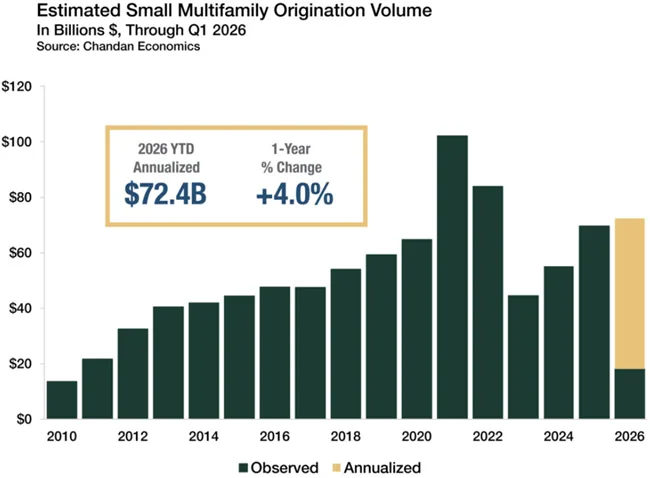
Small multifamily lending activity remained solid at the start of 2026, recording growth for the second consecutive year. After an upward revision to 2025 originations, the finalized full-year estimate of new small multifamily lending volume on loans with original balances between1 $1 million and $9 million reached $69.6 billion, up 26.2% from 2024 (Chart 1).
Through the first quarter of 2026, originations were running at an annualized pace of $72.4 billion, or 4.0% above the 2025 full-year total. While that pace suggests lending activity has continued to expand, the increase was modest relative to the stronger rebound recorded in 2025. However, origination volume remains below the elevated levels of 2021 and 2022 when the lower interest rate environment resulted in historically high lending activity.
About the author:
Arbor Realty Trust is a nationwide real estate investment trust and direct lender, that specializes in loan origination and servicing for multifamily, single-family rental (SFR) financing, and other diverse commercial real estate assets.