
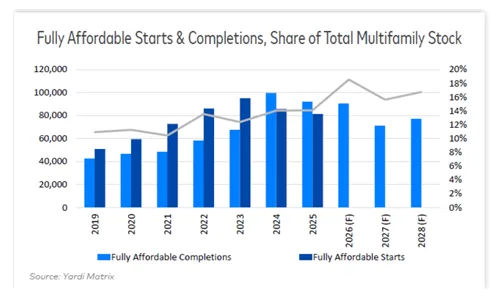
After several years of record-high deliveries fueled by increased funding, starts in the affordable-housing market in the U.S. are decelerating, Yardi Matrix says in an Affordable Housing National Report.
Financing affordable developments remains a thorny issue.
“While many states have prioritized building new subsidized apartment units to solve the growing affordability problem, the affordable multifamily new construction market is running into the same issues faced by market-rate developers. Construction costs are rising, labor in some areas is scarce and each project is subject to the demands and timelines of local authorities,” the report says.
Affordable apartment deliveries had been increasing for the past five years and peaked in 2023. Now, however, every year has seen a decline, dropping from 94,873 in 2023 to Yardi’s projected 70,977 in 2027.
“The question going forward is how much increased funding and legislative efforts by states to reduce barriers to affordable-housing construction will be offset by market conditions that have contributed to the drop in housing starts,” the report says.
“Over the past two years, higher construction costs, elevated interest rates and declining tax credit pricing have altered the economics of affordable housing development. Many projects that were viable when market conditions were different now require additional subsidies, more complex capital stacks or longer timelines to move forward. Some deals are being delayed, resized or not pursued at all.”
Local Conditions Govern Affordable-Property Supply Growth
Even in markets with strong demand for affordable housing, the report says regulatory and entitlement constraints and funding programs and allocation processes introduce additional uncertainty.
“There are complications that could stymie growth in affordable development. Government programs are often slow to translate into actual construction. All deals remain subject to the same construction timelines, delivery risks and cost pressures faced by market-rate developments. Affordable projects also face extended permitting, funding application and compliance processes that can delay delivery and dilute the impact of increased funding. Speeding the entitlement process is a key component to building more housing,” wrote Jacob Gonzalez, senior research analyst, and Paul Fiorilla, director of research in the report.
Read the full report here.