
Home Blog Page 9

Pets Are Family, Not an Apartment Amenity

Pets are family and apartment amenity-based pet fees and restrictions imply that a pet is no different from access to a gym or parking spot.

Pets are family and apartment amenity-based pet fees and restrictions imply that a beloved companion is no different from access to a gym or a parking spot.

By Pet-Inclusive Housing Initiative

Across the country, pets are often treated as lifestyle add-ons — conveniences or “amenities” – that justify extra fees and restrictions.

Yet for roughly two-thirds of U.S. households, pets aren’t luxuries. They’re family. And when housing policies treat them otherwise, the human and financial costs ripple through communities.

A growing body of research confirms what most property managers already know in their hearts: Pets are part of people’s families, and pet-inclusive policies make good business sense. In fact, 93% of owner/operators agree that pets are important members of the family, and 71% of residents — pet owners and non-owners alike — say pets help bring people together within a whole community.

So why does the rental-housing industry still treat them like profit centers?
Pets are family and apartment amenity-based pet fees and restrictions imply that a pet is no different from access to a gym or parking spot.

The Problem with Treating Pets Like Amenities 

When property owners frame pets as “amenities,” they inadvertently put a price on family. Amenity-based pet fees and restrictions imply that a beloved companion is no different from access to a gym or a parking spot — something to be purchased, managed, and monetized.

But pets don’t just use housing — they complete homes. A renter’s relationship with their dog or cat is rooted in love, stability, and security, not luxury. Research shows that pet-inclusive housing leads to residents staying 21% longer and vacancies filling faster and more easily.

These are not signs of a burdensome “amenity.” They are hallmarks of strong, thriving communities.

When restrictive or profit-driven pet policies push families out, the consequences extend beyond the lease. In fact, housing-related issues are one of the leading causes of pet surrender to shelters, accounting for roughly 14% of owner surrenders nationwide.

Every unnecessary restriction or fee risks breaking up a family — a moral and economic loss that can be prevented through simple, humane policy changes.

Pets are family and apartment amenity-based pet fees and restrictions imply that a pet is no different from access to a gym or parking spot.

What the Data Say: Inclusive Equals Accountable

Many housing providers express legitimate concerns about safety, property damage, or resident satisfaction. Fortunately, the data tell a reassuring story:

  • Safety: A dog’s breed is not a predictor of behavior. Diet, training, environment, and socialization matter far more, according to research published in the journal Science.
  • Damage: According to PetScreening’s 2024 report, property managers report an average of $596 in pet damage – an amount covered by most regular security deposits – with just 28% of pet-occupied units showing any damage. Meanwhile, PIHI’s 2021 report shows renters reports just $210 in damage on average, and only 9% of pet-occupied units reporting any damage at all.
  • Community harmony: 73% of dog owners and 49% of cat owners say their pets brought them closer to their neighbors — evidence that pets build social capital, not division.

These statistics dismantle the myths that often justify pet fees, deposits, or restrictions. As Pet-Inclusive Housing Initiative’s research shows, most fears about pets in multifamily living simply don’t match reality.

The Human and Economic Costs of Exclusion

Restrictive pet policies often carry unseen consequences — and they’re not distributed equally. Studies show that nonrefundable pet fees and breed or size restrictions disproportionately affect renters who are Black, Indigenous or People of Color (BIPOC) and low-income renters, perpetuating cycles of inequity.

These barriers compound existing challenges for families who already face limited access to affordable housing.

Meanwhile, renters with pets are often forced into informal or unstable living arrangements, or even homelessness. The National Coalition for the Homeless estimates that up to 10% of people experiencing homelessness have a pet, and many will forgo shelters entirely rather than abandon their companions.

Pet-inclusive housing isn’t just compassionate policy — it’s a lifesaving one.

Concerned About Pets At Your Rental Communities? Pets are family, not an amenity to pull in fees

The Better Way: Pets as Family, Housing as Home

When we reframe pets as family members, we unlock a cascade of benefits — for residents, communities, and housing providers alike:

  • Higher resident retention and satisfaction;
  • Stronger community bonds and reduced isolation;
  • Reduced shelter intake and animal welfare costs;
  • A larger, more motivated rental pool — since two-thirds of U.S. households include pets.

Inclusive policies don’t require landlords to give up agency. Practical tools such as Pet Personality Profiles and Companion Animal Addenda allow providers to evaluate individual animals, set clear expectations, and promote accountability without resorting to outdated breed or weight limits.

A Call to Action for the Rental Housing Industry

If 93% of property owners already agree that pets are family, it’s time for policy and practice to reflect that shared truth.

Let’s retire the notion that companion animals are an amenity to be monetized — and instead embrace them as the living, loving extensions of our residents’ families that they are.

Creating pet-inclusive housing isn’t about bending to a trend; it’s about aligning business operations with the modern realities of life. When we open our doors to pets, we also open them to loyalty, community, and compassion — the real cornerstones of successful multifamily living. Learn more at petsandhousing.org.

About the author:

Dr. Gary Michelson started Found Animals in the aftermath of Hurricane Katrina. With a commitment to continue keeping people and pets together, he turned to the next scalable solution: increasing the availability of truly pet-inclusive housing.  Pet-Inclusive Housing Initiative develops resources, partnerships, and actionable tools to increase the availability of truly pet-inclusive housing. We are working hard to increase pet-inclusive housing because everyone should have access to the joy of pets. After all, pets help communities grow stronger.


pets and housing

Sign Up For Our Weekly Newsletter And Get Rental Property And Apartment News And Helpful, Useful Content Each Week.

* indicates required

Pet Owning Renters Face Barriers Despite “Pet-Friendly” Ads

Pet-Friendly Rental Listings Lease Faster

Will 2026 Be A Reckoning Year for the Rental Market?

Photo credit Massonstock via istockimages and RossHelen

Fear Of ICE Creating Headaches for Chicago Landlords

Fear has become a new expense cost for Chicago landlords as ICE raids across the city have led to missing tenants and contractors

Fear has become a new expense cost for Chicago landlords as Immigration and Customs Enforcement (ICE) raids across the city have led to missing tenants, contractors not showing up for work and headaches for property managers, according to reports.

The Chicago Sun-Times reports that tenants cannot pay rent on time because they are missing work due to fear of agents. Tenants are just staying home in fear of ICE.

Maintenance staff members also are not showing up for work. Contractors working on building repairs for rental units are also missing. Landlords estimate up to 40 percent of their contractors are now absent.

Property owners and property managers worry this is all going to lead to rent increases for the existing tenants to cover losses.

John Warren of Forte Properties, who has been in the real estate business for a decade, talked about the fear among residents and workers – both documented and undocumented – with the Sun-Times.

“Residents are scared to open their doors” for maintenance workers, he said, and it has become harder to schedule repairs with his work force

“All the risk you try to factor into making a business decision to lease and buy property, never had I had to compute ICE or federal authorities,” said Gene Lee, founder of TLG Development, who has been in the real estate industry for 10 years.

Lee said most of his workers are of Hispanic descent, and he has noticed absenteeism and disguises, with workers wearing street clothes and then changing into work gear once inside the building. The absences have caused paint and electrical jobs to be deferred, and Lee’s labor costs to rise. He’s had to spend time finding new vendors, as opposed to relying on workers who he has known for years.

“We didn’t need them here,” said Tracy Scanlon, who manages 70 buildings totaling around 1,000 units on the North Side. “Nobody is benefiting by this. It is making even my American residents and staff, who are Black and brown, scared to go to work.”

Scanlon had contractors tell her two weeks ago that they could not come fix a clogged bathtub and overflowing toilet at one of her buildings because ICE was in the neighborhood.

Sign Up For Our Weekly Newsletter And Get Rental Property And Apartment News And Helpful, Useful Content Each Week.

* indicates required

National Rents Dip for 3rd Consecutive Month

National median rent dipped by 0.8 percent in October, the third straight monthly decline of rent prices in the rental market’s slow season

The rental market slow season is here as the national median rent dipped by 0.8 percent in October, marking the third straight monthly decline, according to the November report from Apartment List.

“We’re now solidly into the rental market’s slow season, and it’s likely that rent prices nationally will continue to decline through the remainder of the year,” the Apartment List Research Team writes in the November report.

“This is in keeping with the typical seasonal pattern of rent growth, as fewer renters are generally looking to move as temperatures turn cooler and the holiday season approaches.”

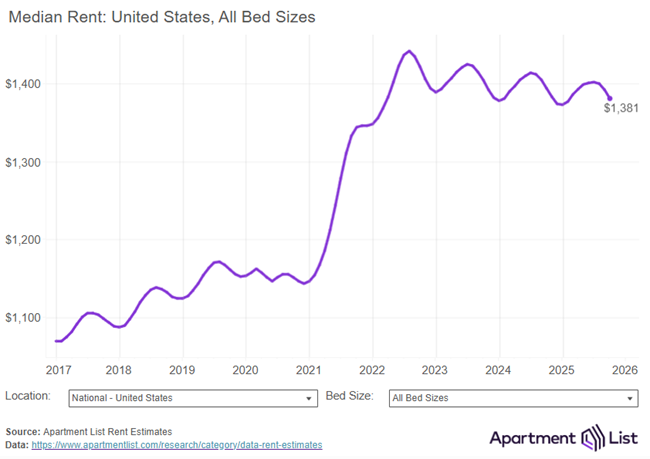
Chart shows trends in all bedroom sizes

Highlights of the national rents dip report

  • The national median rent now stands at $1,381, down $13 per month compared to October 2024.
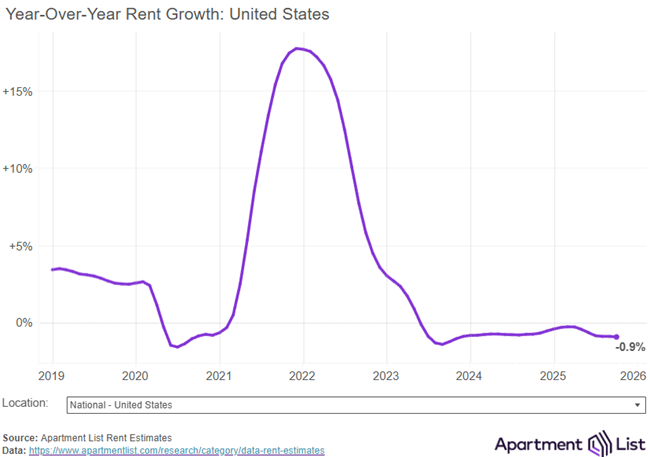
  • Rent prices nationally are down 0.9% compared to one year ago. Year-over-year rent growth has been slightly negative for more than two full years, and the national median rent has now fallen from its 2022 peak by a total of 4.2%.
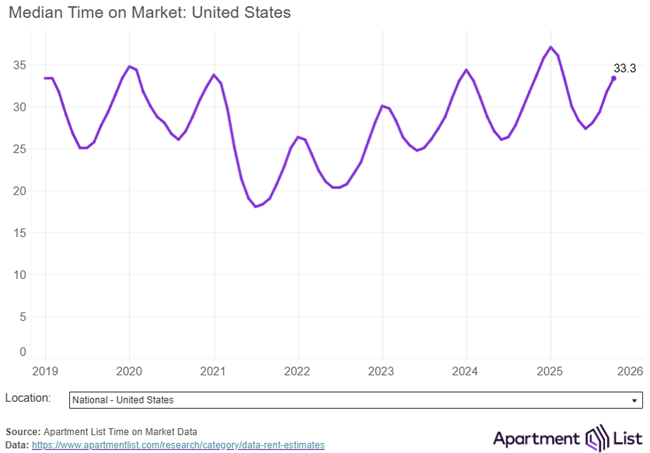
  • Units are taking an average of 33 days to get leased after being listed.
  • Although rents fell more in October than they did in September, this month’s decline was right in line with what we saw in October of last year, and as a result, year-over-year rent growth held steady at the -0.9 percent mentioned above.

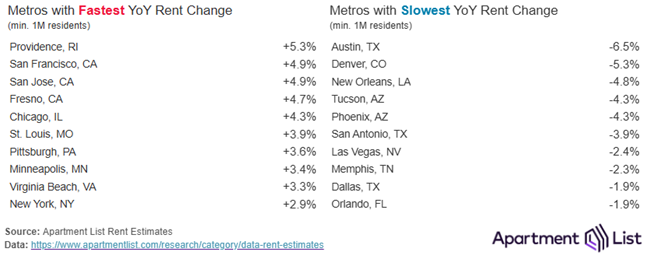
Chart shows cities with the fastest year over year results

National median rent dipped by 0.8 percent in October, the third straight monthly decline of rent prices in the rental market’s slow season

Multifamily vacancy rate hits 7.2%, a new peak

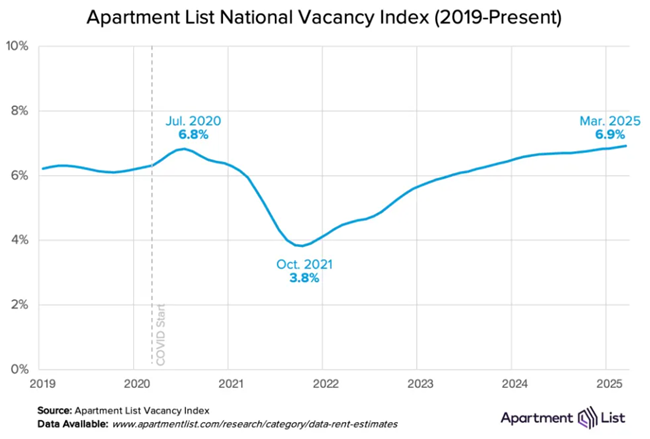
The Apartment List national vacancy index – which measures the average vacancy rate of stabilized properties in the marketplace – ticked up to 7.2 percent in October. This represents an all-time high for this data series, going back to the start of 2017.

As the supply wave continues to recede, these occupancy and pricing trends should begin to gradually shift, but for now the market is still absorbing a swell of new units.

National median rent dipped by 0.8 percent in October, the third straight monthly decline of rent prices in the rental market’s slow season

List-to-Lease time ticks up for fourth straight month

As more vacant units have come onto the market, those units have also been sitting vacant for somewhat longer.

In addition to that seasonal trend, units are also sitting a bit longer than they typically do at this time of year, a signal of market softness that’s also in line with rent growth and vacancy estimates.

National median rent dipped by 0.8 percent in October, the third straight monthly decline of rent prices in the rental market’s slow season

Rent Prices Conclusion

“All of our key indicators are pointing toward ongoing sluggishness in the multifamily rental market – rent prices are down and the vacancy rate is at an all-time high. As construction slows further during the tail end of this year and into 2026, rent prices and occupancy should begin to stabilize, and a return to tighter market conditions remains on the horizon.

“That said, the supply boom still has a bit of runway remaining, and the demand outlook has begun to appear weaker amid a shaky labor market. These factors could lengthen the time that it takes for the market to metabolize the recent growth in the rental stock,” the Apartment List Research Team says in the report.

Read the full report here.

Sign Up For Our Weekly Newsletter And Get Rental Property And Apartment News And Helpful, Useful Content Each Week.

* indicates required

New Supply Dampens Rent-Growth Projections

Rental Application Fraud Jumps As High As 50% In Some Cities

Rental Concessions Rise to New Level


New Apartment Completions Hide Long-Term Housing Shortage

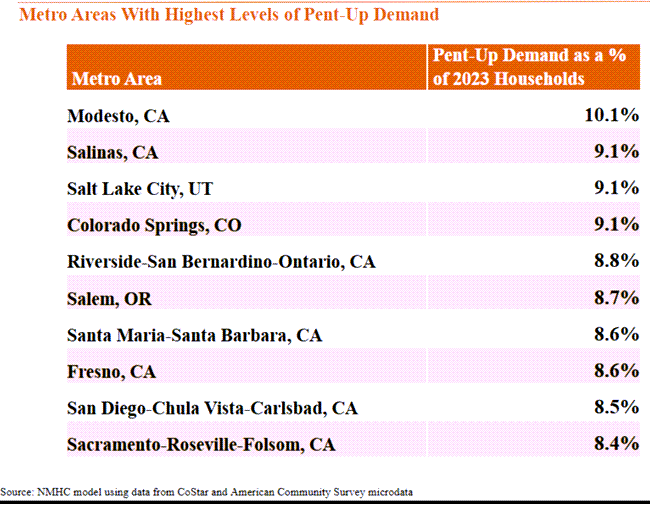
pent up demand and new apartment completions hide long-term housing shortage and household formation, which means not enough homes are being built

Record levels of new apartment completions in many metro markets hide longer-term trends in household formation, which means not enough homes are being built in the long run, according to a report from the Multifamily Housing Council (NMHC).

Chris Bruen writes that housing economists have agreed for many years that the U.S. is short millions of housing units, constraining affordability and limiting options for renters and owners.

“This Research Notes explains why we are observing both of these phenomena simultaneously. While there are short-term supply imbalances in certain markets, examining longer-term trends in household formation reveals longer-term underbuilding,” writes Bruen, senior director of research and chief economist for the NMHC.

Quantifying the Housing Shortage

A range of studies underscore how large our nation’s housing shortage has become:

  • Freddie Mac, for example, estimates a shortfall of 3.7 million housing units as of the third quarter of 2024.
  • Researchers at the Brookings Institution calculated a shortage of 4.9 million housing units in 2023 relative to the mid-2000s.
  • A 2022 study by Hoyt Advisory Services and Eigen10 Advisors estimated that, as of 2021, the U.S. was short 600,000 apartment units (units in structures with five or more units).

The definition of a housing shortage employed by institutions such as Freddie Mac and the Brookings Institution captures more long-term, structural issues within the housing market that account for pent-up demand.

Specifically, Freddie and Brookings estimate how many households would have been formed if housing costs didn’t increase as much as they did since a specific reference year—the year 2000, in the case of Freddie Mac, or 2006 in the case of Brookings.

“Yet this seems difficult to reconcile, particularly in the apartment segment, when the share of vacant apartments is the highest it’s been in decades,” Bruen writes.

“According to data from CoStar, the multifamily vacancy rate rose to 8.3% in fourth-quarter 2024 (the highest rate since recordkeeping began in 2000) before falling slightly to 8.2% during the first half of 2025,” he writes in the report.

Structural Shortage: A Longer-Term Challenge

While many U.S. housing markets are currently recording high levels of vacancy and declining rents—features typically associated with a housing surplus (rather than a shortage)—these markets still have a significant shortage when we consider “latent” or “pent-up” demand (individuals who would form households if housing costs were lower).

“Thus, when we say that the U.S. suffers from a national housing shortage, what we mean is that housing prices have increased significantly over time (more than the rate of inflation), and that this has locked many Americans out of the housing market altogether. This is true even in markets that have seen moderate rent decreases in recent years.

“Unlike the traditional, textbook definition of a housing shortage—which is short-term and corrects on its own as housing providers adjust prices—a shortage that accounts for pent-up housing demand can only be addressed through lowering the cost of housing development or operations, increasing supply in the long run.” Bruen writes in the Research Notes.

Real his full report and detail here.

Sign Up For Our Weekly Newsletter And Get Rental Property And Apartment News And Helpful, Useful Content Each Week.

* indicates required

National Rents Dip for 3rd Consecutive Month

New Supply Dampens Rent-Growth Projections

Rental Application Fraud Jumps As High As 50% In Some Cities

Rental Concessions Rise to New Level


Strong Retention Offsets Cooling Apartment Demand

multifamily resident retention is approaching an all-time high as the strong retention trend offsets the cooling demand for apartments

With homeownership exceeding the cost of renting, multifamily resident retention is approaching an all-time high, according to recent data from RealPage, a leading global provider of AI-enabled software platforms to the real estate industry.

In addition to strong resident retention, RealPage also identified specific markets where rent prices are decreasing, such as:

  • Denver and Austin: Rents are down nearly 8%
  • Phoenix: Rents have dropped a little more than 5%
  • Regional trends: The South saw a decline by 1.7% in the past 12 months while the West saw rents fall 0.4%

Looking ahead, RealPage predicts the multifamily industry could see an improved market momentum into 2026

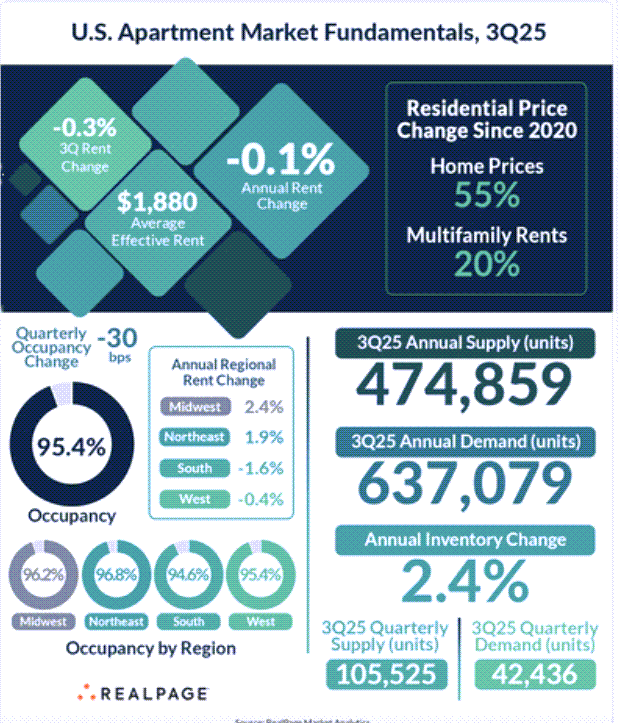
In its third quarter 2025 analysis of the multifamily housing sector, the report noted that the average advertised rent price decreased for only the second time since 2009. Home values have risen at twice the pace of market-rate rental units since 2020, pushing the typical mortgage payment well above the nation’s average rent and keeping many households in the rental market longer.

“Resident retention has increased and is approaching an all-time high as the current cost of renting is significantly less expensive than homeownership,” said Carl Whitaker, chief economist at RealPage. “With residents staying put longer, owners and operators have an opportunity to create an even higher-quality resident experience and build a stronger sense of community at their properties.”

Q3 Industry Takeaways

  • Occupancy backtracked quarter-over-quarter to 95.4%.
  • The South region has added a quarter of a million units in the past 12 months (more than twice the second-fastest growing West region). As such, rents are down 1.7% in the past 12 months in the South while the West saw rents fall 0.4%. Conversely, the Midwest & Northeast regions have seen rents grow 2.3% and 1.9%, respectively.
  • San Francisco’s 7.1% rent growth in the past 12 months is far ahead of second-ranking Chicago (4.5%).

“According to RealPage data, the outlook for the U.S. apartment market in the next 12 months is that supply will cool considerably from its current level,” added Whitaker.

Q4 Industry Outlook

  • Nationwide, supply is starting to cool, with 105,000 units delivered in the third quarter, the fewest since the second quarter of 2023 and a 35% decline versus third quarter 2024.
  • The 324,000 units scheduled to be completed in the next 12 months would be the fewest in a given 12-month window since the second quarter 2020.
  • Construction activity shows supply will remain below normal for some time once this current wave of deliveries subsides.
  • Currently, just 519,000 market-rate apartment units are under construction nationally; the fewest number in more than 10 years.

The continued rise in resident retention with new lease shopping suggests that demand for market-rate apartments remains healthy. Current trends do not mirror past economic downcycles, when both retention and new lease activity contracted significantly. In fact, should strong resident retention persist, the multifamily industry could see an optimistic client base and improved market momentum heading into next year.

For a deeper perspective on these trends and RealPage’s 2026 outlook, watch the Q3 Apartment Market webcast replay. https://www.realpage.com/webcasts/market-intelligence-us-multifamily-update-q4-2025/.

Sign Up For Our Weekly Newsletter And Get Rental Property And Apartment News And Helpful, Useful Content Each Week.

* indicates required

New Supply Dampens Rent-Growth Projections

Rental Application Fraud Jumps As High As 50% In Some Cities

Rental Concessions Rise to New Level


New Supply Dampens Rent-Growth Projections

Anticipated increases in multifamily supply have prompted Yardi Matrix to reevaluate its rent-growth projections for 2027

Anticipated increases in multifamily supply have prompted Yardi Matrix to reevaluate its rent-growth projections for 2027, according to Yardi Matrix Multifamily Rent Forecast Update.

“The main change to our forecast is a more tepid 2027, with a national asking rent growth of 2% vs. 3%” from previous forecasts, said Andrew Semmes, senior research analyst, in the report.

This forecast is the result of more than 400,000 new units expected to come online in 2027, more than previously estimated, leading to tepid rent growth that year.

In addition to new units coming onboard, the projection is for “a more modest trajectory of household formation as the labor market moderates and population growth returns to its pre-COVID decelerating trajectory. Continued decent GDP growth and high federal government financing needs do not warrant reduced long-term interest rates, which we expect will keep mortgage rates high and multifamily turnover at its current lower level,” Semmes said in the report.

Anticipated increases in multifamily supply have prompted Yardi Matrix to reevaluate its rent-growth projections for 2027

Factors driving the projection

The multifamily sector closed the summer leasing season with disparate results by market reflecting complex and uneven economic signals that have come further into focus, such as:

  • Payrolls and employment gains have slowed with data revisions
  • Consumer spending remains but sentiment has weakened
  • Policy to reduce short-term interest rates remains intact but not without some pushback
  • Slower growth on a longer timeline before rising to moderate growth

“Seasonal advertised rent growth continues to flatten and underperform historical norms. On a national basis, the average month-over-month asking rent growth was in the 0.1% range, well below the previously reported 0.4% pace for 2010-19,” the report said.

Key takeaways:

  • Different economic and policy headwinds reveal the United States is in a more vulnerable position than previously reported, though the effects differ in severity by market.
  • The result of all these forces is a slowly recovering apartment market in areas of high supply, but one which is fragile.
  • Year-over-year national rent growth for 2026 is expected in the mid- to low-1.2% range, before a modest ramp-up in 2027 to 2% and then a stronger 2028 and beyond, with forecast increases of 3.4% to 3.8%.

Sign Up For Our Weekly Newsletter And Get Rental Property And Apartment News And Helpful, Useful Content Each Week.

* indicates required

Rental Application Fraud Jumps As High As 50% In Some Cities

Rental Concessions Rise to New Level

Up-Front Fee Transparency Reshapes Multifamily Marketing

Up-front fee transparency for tenants used to the instant price clarity they receive ordering a rideshare builds multifamily marketing trust

Up-front fee transparency for tenants who are used to the instant price clarity they receive when ordering a rideshare or booking travel plans builds trust.

By Andrew Ruhland

Price transparency has become an expectation of consumers spanning nearly every industry, and the multifamily space is finally catching up.

Unlike other industries, such as travel and retail, which might have two or three factors contributing to a total cost, multifamily operators are having to account for countless different factors from multiple sources when calculating a renter’s final monthly payment.

To provide clarity, many operators are now offering fee calculators on their websites, giving prospective renters a complete picture of required, recurring and optional costs.

At first, the idea of showing all-in pricing can feel risky. Listing fees upfront may raise the apparent cost, which seems dangerous in competitive markets. But operators adopting calculators are finding the opposite: they’re spending less on marketing, improving conversion rates and reducing stress for both renters and onsite teams.

“Transparency builds trust and gives prospects confidence before they even step foot onsite,” said Joya Pavesi, president, brand and strategic services, RKW Residential. “Today’s renters are used to the instant price clarity they receive when ordering a rideshare or booking travel plans. Leasing should be just as straightforward.”

When prospects understand total costs from the start, not only do renters tend to be better qualified, tours tend to be more efficient and leasing teams spend less time managing fee-related confusion. And because clarity builds trust and trust drives decisions, renters notice the difference.

Transparency as an Advantage

The cornerstone of fee calculators is transparency. What often begins as a fear of showing too much has become a competitive edge. By setting expectations upfront, operators create trust and reduce friction throughout the leasing process. Renters see exactly what they are committing to and what to expect, which makes move-ins smoother and renewals more likely.

“Providing fee transparency is a prime opportunity to align our digital channels with the expectations of customers,” Pavesi said. “By streamlining the process online, renters navigate pricing more easily while leasing teams benefit from fewer misaligned conversations.”

For operators, clarity means efficiency. For renters, it means confidence. And for all parties involved, transparency is no longer a burden—it’s a differentiator.

Shifting the Marketing Narrative

 The demand for transparency is reshaping multifamily marketing. Historically, only base rent was publicized, forcing prospects to compare communities based largely on amenities and finishes. Today, the focus has shifted—renters want to understand the total cost of living.

In order to make the most informed decisions, renters need a combination of total pricing, interactive floor plans and unit-level maps. Rapidly evolving technology is being implemented to incorporate all of these features into a single interface that can be leveraged across multiple channels.

Complementary tools such as interactive floor plans, virtual tours and maps showing exact unit locations further enhance the digital journey. By pairing transparency with engaging digital experiences, operators ensure consistency between the online search and in-person leasing, which helps renters feel more confident in their choices.

Driving Operational Consistency

 Fee transparency doesn’t just improve marketing, it strengthens operations. For operators with large, diverse portfolios, variations in fees and vendor structures across communities were once unavoidable. These inconsistencies not only created friction for prospects but also complicated efforts to centralize processes.

To address this, some companies have formed cross-department committees to manage fee transparency initiatives. By standardizing fee structures and pricing practices, operators not only simplify internal processes but also deliver clearer, more consistent customer experiences.

Just as internal consistency builds efficiency, external transparency plays a crucial role in building trust and shaping how prospects first encounter a community.

First Impressions are Digital

 A renter’s first impression almost always begins online. Even before connecting with a leasing agent, prospects use websites, reviews, fee calculators, interactive maps and video tours to self-educate and pre-qualify.

“It’s not a stretch to say that a prospect’s shopping experience starts online,” Pavesi said.  “Our paid ads, social media and website, not a leasing agent, is responsible for first impressions.”

That means transparency carries the brand long before an agent steps in. Imagery must be visually compelling, but equally important is providing accurate and complete pricing information. By delivering clarity and consistency across digital channels, communities empower renters and further demonstrate credibility—ultimately leading to more leases signed.

The Road Ahead

 What began as a regulatory requirement has become a defining feature of successful multifamily marketing and operations. Communities that embrace fee transparency are seeing higher conversions, reduced wasted marketing effort and more satisfied residents.

“Digital experiences play an extremely important part of the customer experience,” Pavesi said. “Not only do renters expect unit-level specifics and detailed maps, they also want access to accurate and comprehensive pricing information. It’s our duty to provide them the tools to facilitate that.”

By combining fee calculators, interactive tools and standardized practices, operators are reshaping the entire leasing journey. Transparency is no longer optional—it’s become the foundation of trust, efficiency and long-term renters.

About the author:

Andrew Ruhland is an account executive and content writer for LinnellTaylor Marketing, which focuses exclusively on the rental housing industry, its trends and technology innovations.

Sign Up For Our Weekly Newsletter And Get Rental Property And Apartment News And Helpful, Useful Content Each Week.

* indicates required

New Supply Dampens Rent-Growth Projections

Rental Concessions Rise to New Level

What Should I Ask A Previous Landlord About My Tenant Applicant?

Photo credit Francesco Scatena via istockimages

Rental Application Fraud Jumps As High As 50% In Some Cities

Renters are conning their way into luxury apartments as landlords are seeing a jump in rental application fraud

Renters are conning their way into luxury apartments as landlords are seeing a jump in rental application fraud, according to a story in the Wall Street Journal.

The Journal reports that Atlanta is at the center of the national surge in rental application fraud.

Greystar, one of the country’s largest landlords, says fraudulent applications are a real problem.

Toni Eubanks, Greystar’s managing director of property management, said in an interview recently with Bisnow that in some markets 50% of their applications are fraud.

“What we’re faced with as an industry is fraud. We’re finding it particularly prevalent in certain markets. In some of our markets, 50% of our applicants are fraudulent applicants. It’s our responsibility to catch those, you know, so that we can avoid that kind of disruption at the community level, for the owner and team members. We’re trying to stay very on top of that,” Eubanks told Bisnow.

The National Multifamily Housing Council says a survey it did showed owners reported a 40% increase in rental application and payment fraud.

The Wall Street Journal reported that Atlanta has a large number of high-end apartments for rent and that social media is spreading word about these listings.

“Influencers on Tik Tok say renters can boost their chances of getting approved by fudging financial information on their applications,” the Journal reports. The newspaper also said there are promoted ads that sell fake application packages and more.

“It is becoming a bigger and bigger problem coast to coast,” said Damon McCall, chief executive of ApproveShield, a fraud-detection software company for property managers, to the Wall Street Journal.

Leasing fraud appears to be a fairly widespread issue. According to a 2024 study by RealPage and Dimensional Research that looked at 400 property managers in the country’s largest metros, 75% of them reported experiencing an increase in fraudulent applications.

Read the full story in the Wall Street Journal here.

Sign Up For Our Weekly Newsletter And Get Rental Property And Apartment News And Helpful, Useful Content Each Week.

* indicates required

?️ Are the new tariffs hurting your business?

We’d like to know how the new tariffs are affecting property managers, owners, and suppliers in the rental housing industry.


Your feedback helps Rental Housing Journal track real-world impacts in our industry.

Rental Concessions Rise to New Level

A record number of landlords are giving more and more rental concessions, reaching a high of 37% in September Zillow says

A record number of landlords are giving more and more rental concessions, reaching a high of 37% in September, according to a release.

Subdued rent growth and record-breaking concessions from landlords are turning up now after a deluge of newly built apartments hit the market last year, according to the company’s latest rental market report.

Rental managers have turned to concessions – such as free months of rent or free parking – instead of lowering rents. The 37.3% of rentals on Zillow offering some sort of freebie in September is an increase from 14.4% in 2019.

“Those concessions likely will continue to rise; they typically peak in winter or early spring. As concessions become the norm, property managers may need to consider price cuts, particularly as the year winds down. Competition among prospective renters tends to fall off over the cooler winter months,” the release says.

Rent-concession highlights from the report

  • 37.3% of rentals on Zillow offered concessions in September, up from 36.7% in August and 35.8% in September 2024.
  • The share of rentals with concessions is lower, on a monthly basis, in 13 major metro areas. The largest monthly drops in the share of rentals with concessions are in Birmingham (-3ppts), Los Angeles (-1.9ppts), Minneapolis (-1ppts), Cleveland (-1ppts), and San Francisco (-0.8ppts).
  • The share of rentals with concessions is higher, on a monthly basis, in 37 major metro areas. The largest monthly increases in the share of rentals with concessions are in Pittsburgh (4.5ppts), Seattle (3.7ppts), Richmond (3.3ppts), Raleigh (3.2ppts), and Hartford (3.1ppts).
  • Rent concessions are up from year-ago levels in 33 of the 50 largest metro areas. The annual increase in share of rental listings with concessions is highest in Memphis (10.9ppts), Denver (10.6ppts), Houston (9.4ppts), Orlando (8.1ppts), and Las Vegas (8ppts).

Affordability rises nationwide as rents ease

Cooler growth and even declining rents in some rental markets are contributing to better nationwide affordability than renters have seen in four years.

A typical rental now requires 28.4% of the median household income nationally, down slightly from 28.8% a year ago and below the roughly one-third threshold where housing becomes a financial burden.

Read the full report here.

?️ Are the new tariffs hurting your business?

We’d like to know how the new tariffs are affecting property managers, owners, and suppliers in the rental housing industry.


Your feedback helps Rental Housing Journal track real-world impacts in our industry.

Sign Up For Our Weekly Newsletter And Get Rental Property And Apartment News And Helpful, Useful Content Each Week.

* indicates required

74% Of Renters Lose Trust If AI Not Disclosed During Leasing

Three out of four renters say they lose trust when AI is hidden in the leasing process, and they’re not shy about what they expect instead

Three out of four renters say they lose trust when AI is hidden in the leasing process, and they’re not shy about what they expect instead.

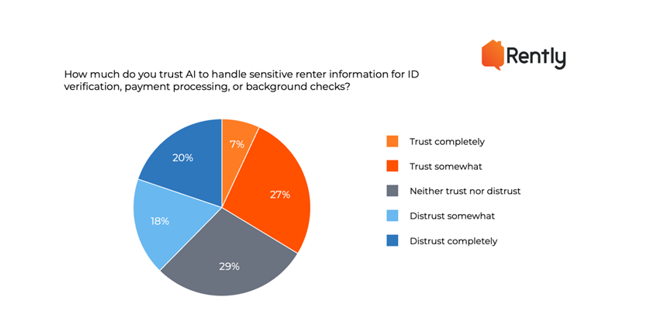
New research from the property-technology company Rently says that renters want AI to handle the hassle, from filtering out stale listings to securing after-hours tours, but demand transparency and human backup when the stakes get high.

The Rently 2025 Report on AI in Leasing polled 800 U.S. adults in September 2025 via the third-party platform Pollfish, examining attitudes across AI-assisted search, self-guided touring, leasing, and support.

Three out of four renters say they lose trust when AI is hidden in the leasing process, and they’re not shy about what they expect instead

The report findings illustrate a balancing act for property managers and operators. Renters are open to AI-powered tools when they make the experience faster and easier–such as delivering real-time pricing or suggesting credible alternatives–but they expect clear disclosure when automation is involved. They’ll pay a little more for peace of mind in areas like security and 24/7 maintenance, yet they draw the line when money, contracts, or disputes are on the table, insisting those moments stay human-led.

Key findings include:

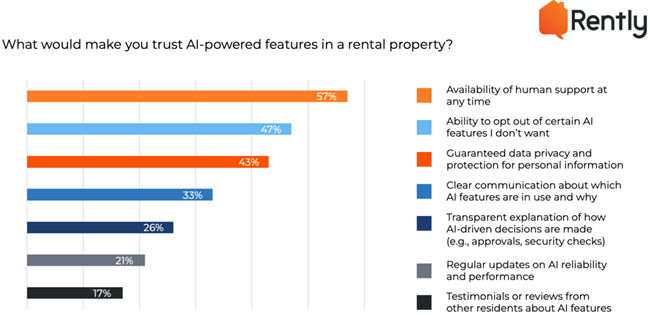
  • Transparency and control set comfort levels. 74% of respondents say they are less comfortable when AI use isn’t disclosed; 57% want human support available anytime; 47% want the ability to opt out of AI features.
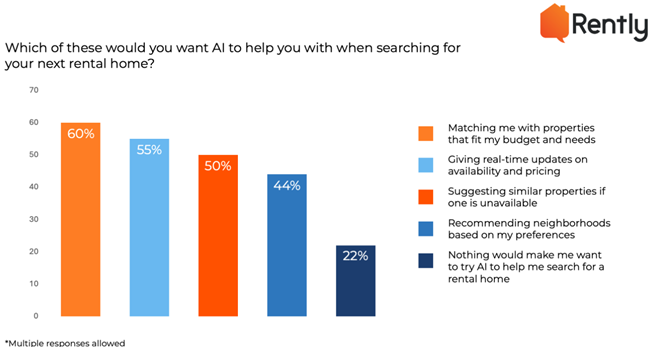
  • Renters want smarter search tools. 60% want home recommendations that match their budget and needs, 55% want availability and pricing updated in real time and 50% want to be suggested comparable units when a listing is no longer available.
  • Self-tours win on access and safety. 50% of renters value the ability to tour after hours, 49% want property details on their phone during the visit and 46% want secure entry with ID verification and one-time codes.
  • Renters will pay small premiums for assurance. 42% would pay more for security monitoring and 37% for 24/7 maintenance support; 64% would cap added tech costs at $20/month or less; 5% would exceed $60.
  • Humans are wanted for high-stakes moments. 71% want to contact a person first when a problem arises, especially for rent negotiations, payment concerns, and disputes.

Three out of four renters say they lose trust when AI is hidden in the leasing process, and they’re not shy about what they expect instead

Taken together, the findings point to a simple expectation for the rental journey: It should be fast, relevant and transparent, with safe access to properties and real people available when judgment is needed. Renters want tools that make decisions easier and teams that stand behind the experience, so the path from search to keys feels predictable and fair.

“The rental process isn’t just about square footage or price. It’s about how the experience feels,” said Merrick Lackner, CEO at Rently. “Renters want listings that are accurate, tours that are flexible and support that’s responsive. AI can make those interactions faster and easier, but only when it’s transparent. Leasing technology that reduces friction while keeping people in control is what will define the next era of rental technology.”

Lackner continued, “AI can deliver faster searches and real-time updates, and safer communities, but its real value is empowering renters to make better decisions. When paired with human support, technology doesn’t just streamline leasing, it elevates the entire renter experience.”

Visit the Rently 2025 Report on AI in Leasing at the company’s website for the complete survey results and additional insights.

Sign Up For Our Weekly Newsletter And Get Rental Property And Apartment News And Helpful, Useful Content Each Week.

* indicates required