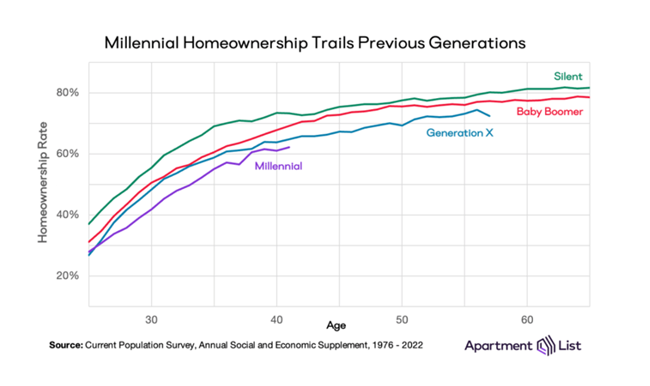
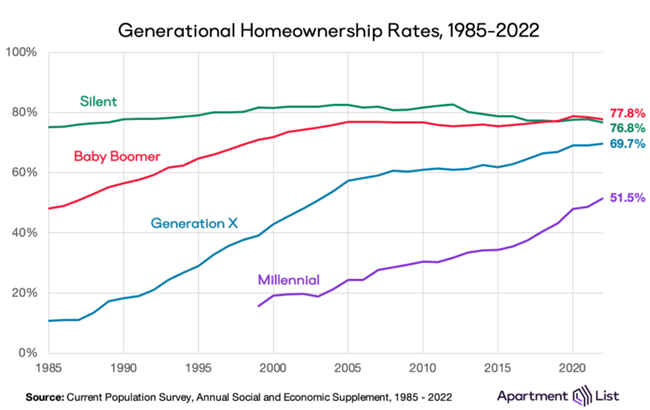
Millennials have finally reached a significant milestone as more than 50 percent of millennials now own their homes, according to the latest data from the Census Bureau, Apartment List writes in the fourth installment of their annual Apartment List Millennial Homeownership Report.
“For a generation whose identity has been shaped by a tumultuous relationship with the housing market, homeownership has been a lofty goal, growing exceedingly expensive and competitive compared to when their parents were coming of age.
“But today the median millennial is a homeowner, with the latest millennial homeownership rate standing at 51.5 percent,” Apartment List economists say in the report.
Highlights from this year’s report:
Nationwide, millennials have finally passed 50 percent homeownership, but they have purchased homes slower than previous generations. For instance, when Gen X was the same age as millennials today, their homeownership rate was 58 percent.
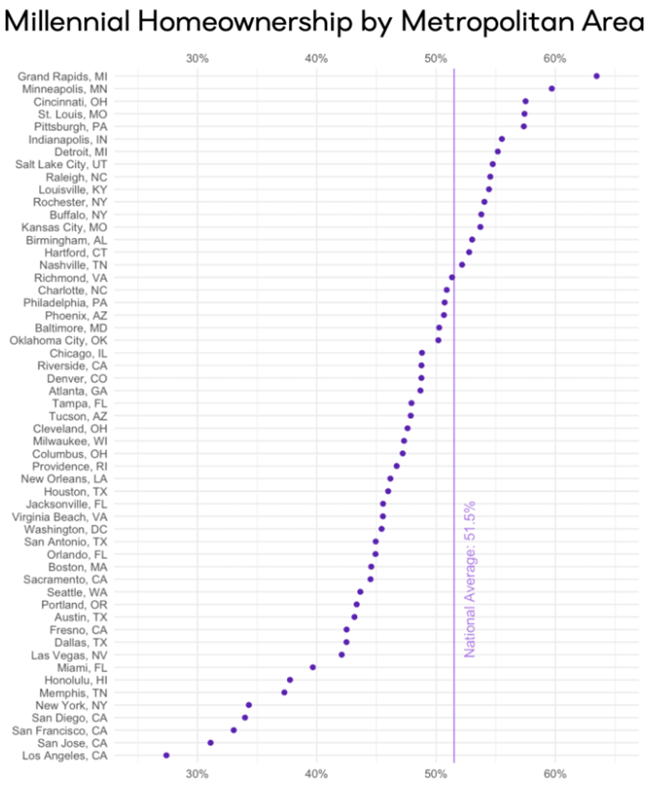
Homeownership varies greatly by location. In Phoenix metro, the millennial homeownership rate is 51 percent, just shy of the national average. In general, millennials own more homes in the nation’s smaller markets, particularly those in the Midwest and Great Lakes regions.
Millennials who continue to rent are getting priced out of homeownership by rapidly rising prices. In our latest survey, 25 percent of millennial renters say they will rent forever, and two-thirds have no money set aside for a down payment.
Impact of the Great Recession of 2008
The report says the most important factor in millennial home purchase was the Great Recession, “which suppressed homeownership across all generations but was particularly damaging to millennials, whose early career trajectories were shaped by a historically unstable economy.
“During the economic recovery that followed, many millennials were drawn to centrally located jobs in cities where starter homes became increasingly scarce and expensive. While many millennials purchased homes during these years, others spent more time living at home or in rentals, delaying major life events like homeownership, marriage, and childbearing when compared to earlier generations,” the economists write.
The Growing Importance of the Multifamily Industry
The report points out that many millennials will continue to rent, as housing is in short supply and prices are high.
“This highlights the growing importance of multifamily housing, the industry sector that rebounded fastest after the Great Recession and has continued to receive steady investment over the past year even as rising interest rates tempered single-family development.
“The record number of new multifamily units currently under construction are expected to bring some relief to the rental side of the housing market this year and beyond. Historically, the vast majority of these units have been built for rent, but as YIMBY (Yes In My Backyard)-backed zoning reforms and densification slowly gains traction, we may see more of them built for sale in the years ahead.
“It is possible that if attitudes towards homeownership shift to de-emphasize single-family homes, multifamily could provide an alternate path to homeownership as Gen Z reaches their homebuying years,” the Apartment List economists write in the report.
Chart courtesy of Apartment List. Source U.S. Census Bureau. Cities with at least one million residents.
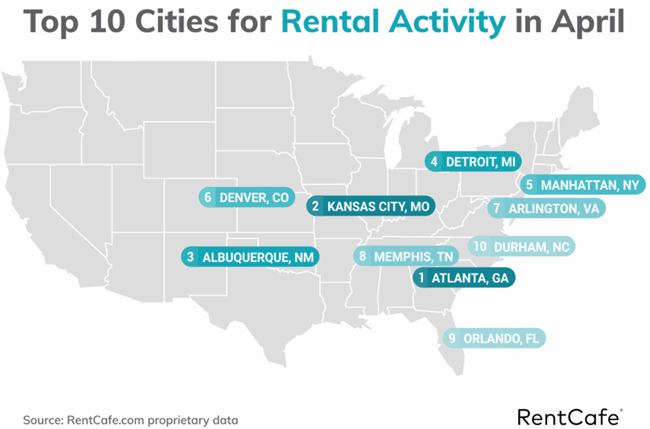
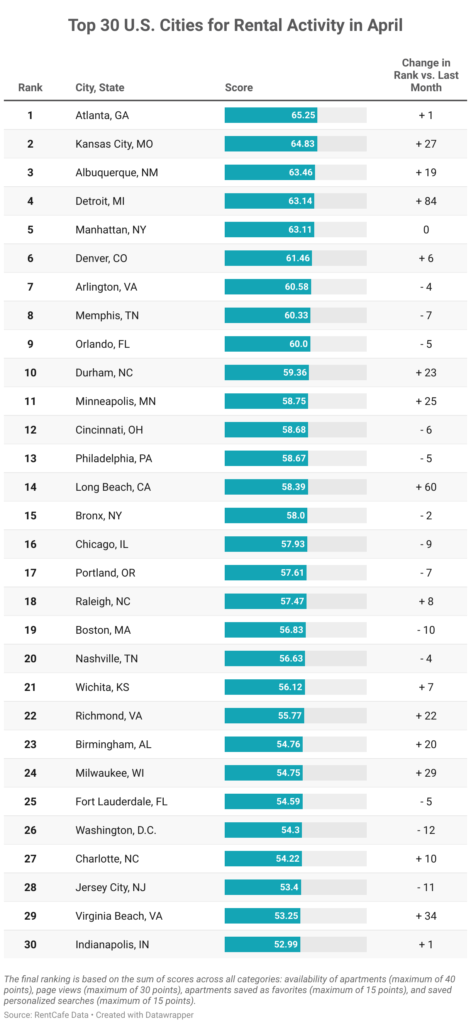
Atlanta is the most sought-after city for renters, according to a new April renter-activity report from RentCafe.
The report says “renting is now the new buying,” due to high home prices. Also, the spring season brings out more renters looking for apartments.
RentCafe analyzed millions of interactions “on our own apartment search website, RentCafe.com, to find the most active locations for renting in the nation. Our brand-new monthly rental activity report will keep you updated on the latest movements and shifts in renting demand across the 150 largest cities” in the United States.
The RentCafe ranking was based on:
availability of apartments
listing views
apartments saved as favorites
saved personalized searches
Which cities are most popular with renters?
Atlanta is the most popular, with the highest search activity this month. Apartment hunters in Atlanta added twice as many listings to their favorites lists compared to this time last year.
Apartment listings in Kansas City, Mo., and Albuquerque, N.M., were in second and third place respectively, according to the listing’s activity data. They climbed +18 positions and +27, respectively, compared to last month, thanks to the highest page views on properties.
Detroit landed in fourth place with the highest climb in rankings from March, rising by 84 spots. Minneapolis (11th place), Milwaukee (24th place) and Indianapolis (30th place) are the other newcomers in the Top 30 most-searched renting cities this month.
Manhattan completed the top five, maintaining its position on the top compared to the first month of spring. The big comeback as a top favorite for renters is driven by a quick rise in the number of apartments saved to favorites on Rentcafe.com: eight times more than one year ago.
Big cities like Philly, Boston and Chicago are seeing a surge in rental activity, with more favorites, saved searches and high demand resulting in fewer listings and decreased availability. Northeastern cities are popular with renters, claiming five spots on the top 30 list.
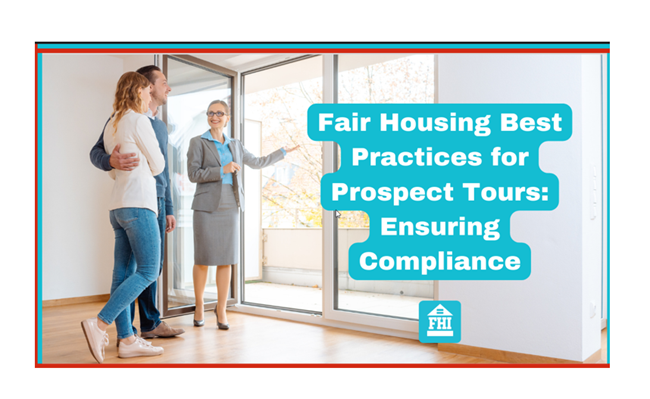
Any disparity in how you conduct your prospect tours could leave you open for potential fair housing complaints so here are four fundamental areas to review for best practices.
As a leasing professional, conducting prospect tours is an everyday task that requires you to be mindful of fair housing laws.
Discrimination in housing is illegal and can result in severe legal consequences. Therefore, implementing fair housing best practices can help ensure that you and your team remain compliant at all times.
Consistent Tour Policy
Having a consistent policy on how and when tours are offered is essential to avoid potential fair housing violations.
Discrimination can occur if one prospect is offered a tour while another is not based on their protected class. Another thing to keep in mind is what is shown on the tour.
For example, you shouldn’t give a tour of the grounds, amenities, and units to Prospect A and then only show the grounds and units to Prospect B. Any disparity in how you conduct your tours is leaving you open for potential fair housing complaints.
Documentation
Why is documentation a critical part of prospect tours? Consider the following scenario:
Several tours have been scheduled, but the leasing agent was called away before they could complete them. What should you do?
We all know that a leasing office can be incredibly busy at times and potentially short-staffed. Documentation is crucial when situations arise and you must reschedule a tour or have another leasing agent step in. Ensure that all information about what happened, why it happened, and what alternatives were offered are clearly noted. If there is ever a question as to why some tours were done and not others, you will have clear documentation to show precisely what happened.
Unit Tours
Having a policy regarding which units are shown is also essential.
Of course, we want to show potential residents what we think will interest them based on their guest card or conversations you have had. However, if leasing agents offer different units to different prospects, the reasons for showing those particular units must be noted to avoid any appearance of discrimination or illegal steering.
Non-Accessible Units and Media Accessibility
Showing units that are on a second floor or higher to a disabled prospect can prove to be a challenge, notably if the building happens to be older and does not have elevators. You cannot just shrug your shoulders and only show units on the first floor, as this is blatant discrimination.
Offering an alternative tour is crucial. A video or picture book can be used as a substitute as long as it provides a complete description of the unit. Additionally, when using videos or offering virtual tours, it is crucial to ensure that the media is accessible to people with visual or auditory impairments. All media must include full-text descriptions and audio components.
Final Thoughts
Implementing fair housing best practices in your leasing operations is essential. This article reviewed four fundamental areas that need to be regularly reviewed for fair housing compliance. With a little bit of thought, thorough documentation, and a clear tour policy, you can avoid potential fair housing problems. And as always, remember: fair housing training for all staff is critical to help everyone stay compliant.
About the author:
In 2005, The Fair Housing Institute was founded as a company with one goal: to provide educational and entertaining fair-housing compliance training at an affordable price at the click of a button.
Operators are now seeing that improving how resident communication is directly correlated to lease renewals and how long residents will choose to stay at their property.
By Andrew Ruhland
The tides of renewals may be changing, but that doesn’t mean operators need to be left underwater. There are some lifeboats available to help keep them afloat and even thrive in these ever-evolving digital times.
While many communities have found innovative ways to attract new residents and satisfy current residents, the day will come when an individual heavily considers moving on to another property. However, operators are looking for new ways to sway a resident’s renewal decision in an effort to increase renewal rates and keep residents within their ecosystem.
According to internal data from Nurture Boss, nearly 60 percent of residents will move out when their initial lease is up. Although modern residents have their reasons for moving out –moving to a new city, upgrading to a single-family home or simply wanting different apartment features and amenities – it’s worth building relationships with residents from the very beginning, before they even move in. Not only will establishing a meaningful relationship with prospective residents escalate the likelihood of them signing a lease, it will also enhance the chances of them choosing to renew their lease agreement when the time comes.
Implementing an effective strategy that facilitates hyper-personalized and consistent communication and marketing practices helps to establish that relationship with residents earlier on in the customer lifecycle. Once a lease is signed, some communities may halt communicating with residents until it’s time to renew, but this strategy causes them to lose out on potential renewal opportunities. After all, the manner in which operators communicate with prospective residents and current residents alike influences their decision when signing a lease or renewal.
“The biggest impact on renewals continues to be the communication between residents and onsite teams,” said Tony Sousa, vice president of operations at RPM Living. “The pandemic seemed to have amplified the residents’ expectation of receiving personalized communication on a frequent basis in the manner that they prefer, and we’ve found it’s that consistent, customized messaging that really strengthens the relationship between the residents and onsite teams.”
In an effort to replace the antiquated communication and marketing tactics operators previously turned to, a number of them are opting to implement leasing and renewal conversion automation tools. Having a relationship with onsite teams and receiving personalized communication is vital to a residents satisfaction with the community in which they live.
Operators are now seeing that improving how they communicate with residents is directly correlated to how long they will choose to stay at their property. Enhancing resident communication efforts and crafting more customized messaging not only strengthens relationships, but it incentivizes residents to sign a renewal.
“The more you engage with your residents and provide them with the information that pertains uniquely to them, the probability that they will renew their agreement significantly rises,” said Lindsay Duffy, director of marketing and training at Western Wealth Communities. “Connecting with residents and maintaining those relationships is essential for properties to be successful and automation has allowed us to never miss a beat and keep those channels of communications open and fluid.”
Engaging with residents at multiple touchpoints throughout their journey provides operators with the information necessary to message residents regarding the areas that they show the most interest in. Automation allows for the augmentation of communication in ways never seen before and that undisputedly leads to both higher lease and renewal conversion rates. Of course there’s still a human component that impacts resident satisfaction but automation certainly fills in the gaps and facilitates the communication when onsite teams simply cannot.
Despite having the most knowledgeable and experienced teams available, there is just not enough time in the day to respond to every inquiry that comes into a community and automation ensures a timely response no matter how or when a resident reaches out.
“The golden rule is to respond back swiftly and in a way that the residents choose, which is generally the same way they reached out to us,” Sousa said. “Email still accounts for a large percentage of our communication but text messaging is definitely gaining traction. Either way, automation makes it possible for us to contact each and every lead and create a bond with them, not just with onsite associates but the entire community. Once that relationship exists, the chances of a resident renewing skyrockets.”
Great communication is no longer a bonus attribute of a community, it’s now an expectation of residents. Operators that utilize the technology available to communicate in an ongoing fashion typically see higher retention rates. Effective communication is key to maintaining resident satisfaction and optimal occupancy rates, and even if it’s not at their current property, truly satisfied residents will at least consider a community’s sister property.
“Creating a consistency of communication is of paramount importance to meeting the expectations of both prospects and residents, “Duffy said. “It really opens up a channel for us to continue that personalized interaction with them regularly and gain tremendous insights as to what they’re looking for in a community.”
Automation gives way to an efficient, centralized mode of communication and marketing that continues to engage residents throughout their entire life cycle at a community. It also helps leasing teams establish relationships with residents up front and set the foundation needed to increase renewals and maintain long-term residents.
About the author:
Andrew Ruhland is an account executive and content writer for LinnellTaylor Marketing, which focuses exclusively on the rental housing industry, its trends and technology innovations.
The new numbers showing the rent component of the consumer price increase is no longer rising is crucially important as housing costs have been a major driver of inflation, Apartment List economists say in a new report.
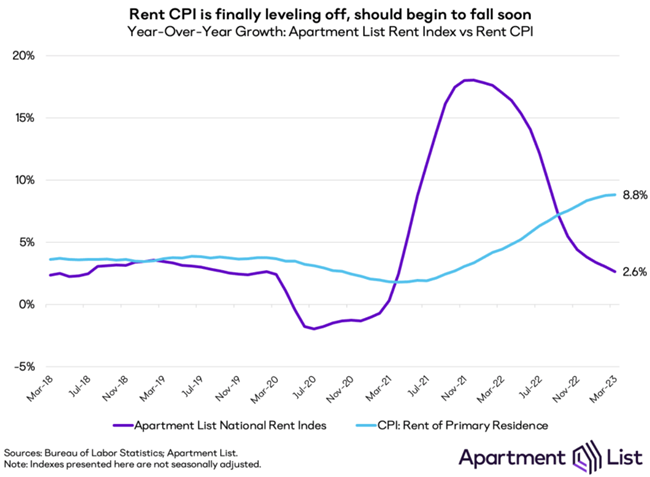
The report says the year-over-year growth rate of the rent component “has finally leveled off, coming in at 8.8 percent in March, which is flat compared last month.
“On a month-over-month basis, rent CPI increased 0.5 percent in March, down from 0.7 percent in February. In contrast, the Apartment List national rent index is currently up by just 2.6 percent year-over-year, a growth rate that has been cooling rapidly for over a year after peaking at a staggering 18 percent in December 2021.”
Topline CPI increased 0.3 percent month-over-month, but year-over-year inflation continued to cool, falling to 5 percent, down from 6 percent last month. Even though overall inflation is cooling, the housing component is continuing to keep it elevated, and was the dominant factor contributing to this month’s overall increase.
CPI rents, however, reliably lag movements in market rents by 3-5 quarters. The Federal Reserve is well aware of this relationship, clarifying that they also track private market-based indices, including Apartment List Rent Estimates, to understand where CPI rents will trend in coming months.
“Because our index serves as a leading indicator for the housing components of CPI, we expect rent CPI to cool steadily in the months ahead,” the report says.
Why Housing Costs Are Keeping Overall Inflation Elevated
As a reminder, the “shelter” component of CPI – which includes both renter-occupied and owner-occupied housing costs – is the single largest component of topline CPI, comprising one-third of the overall index.
“And because costs for owner-occupied housing are measured with the concept of “owner’s equivalent rent,” trends in market rents are the key determinant of not just the rent component, but of the shelter component as a whole,” Apartment List economists write.
Despite a first quarter that showed little rent gains, March did come through with a slight uptick in rent gains in some markets, according to the Yardi Matrix report.
“Multifamily demand held up well despite the attention given to the Federal Reserve-induced economic slowdown, bank failures and the deceleration from the outsize rent gains of the last two years.
“Rents and occupancy are stable as the market heads into the growth season,” writes Yardi Matrix in the report.
Highlights of the report
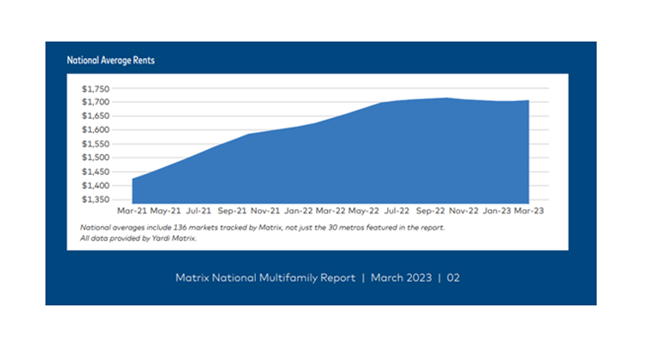
With demand remaining firm, multifamily rents rose slightly in March. The average U.S. asking rent rose $3 in March to $1,706. Year-over-year growth fell to 4.0 percent nationally, 90 basis points less than February and the lowest level since rents started an unprecedented climb in April 2021.
Although financial markets remain volatile due to the collapse of two banks in 2023 (there were none in 2022), multifamily property fundamentals are stable. Rents and the national occupancy rate were unchanged during the first quarter of 2023, and 21 of the top 30 Matrix metros recorded rent gains in March.
Single-family rental rates increased in March by $5 to $2,079, while the year-over-year increase fell by 80 basis points to 2.8 percent. Occupancy rates decreased in February by 10 basis points, but remain strong at 95.5 percent.
Watching for the impact of interest rates later this year
With inflation still an issue and uncertainty with potential interest rates continuing to rise, “affordability (is) a growing concern” that the consumer may be “constrained by high inflation.”
“It is likely that rent growth in 2023 will be modest,” Yardi Matrix writes. “Yet a multifamily hard landing is not yet in the cards, since household formation is still boosted by the tight job market.”
Also, high prices for single family homes and increasing mortgage rates “are keeping homeownership out of reach for some renters.” Meanwhile, “consumer balance sheets remain strong (for now). The big question continues to be how the economy will react to sharp interest rate increases.”
Lease renewals
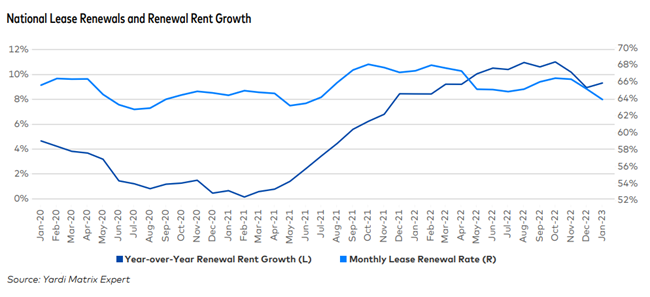
Yardi Matrix says many renters have the wherewithal to afford increases at lease renewal time and that demand “is not falling as significantly as feared, and that tenants looking to move to reduce their monthly charges have limited options in many metros”
National lease renewal rates were 63.9 percent in January, down from 65.2 percent in December. “Renewal rates have been very consistent over the past year, both nationally and on a metro level. That could change as a wave of supply comes online if absorption does not stay positive,” Yardi Matrix says in the report.
Yardi Matrix researches and reports on multifamily, office and self-storage properties across the United States, serving the needs of a variety of industry professionals. Yardi Matrix Multifamily provides accurate data on 18+ million units, covering more than 90 percent of the U.S. population. Contact the company at (480) 663-1149.
Multifamily operators are finding new revenue streams by identifying new net operating income (NOI) strategies within day-to-day operations and things such as short-term leases and flexible stay.
A historic period of rent growth ended last year, subsequently followed by several months of decline that have carried into 2023. According to the April Apartment List National Rent Report, year-over-year rent growth continues to decelerate. Those headwinds pose a significant challenge to multifamily owner/operators, and their response to eroding market factors could dictate their portfolio performance for the foreseeable future.
While the typical industry reaction is to cut costs and batten down the hatches, inflation rates continue to limit the efficacy of expense reductions. Cutting staff and services can trim budgets but also impairs resident retention efforts. Operators are finding that focusing on resident renewals and identifying new revenue streams and net operating income (NOI) strategies within day-to-day operations better positions them to weather the storm.
Budget cuts enable owner/operators to survive economic challenges, but they represent a reactionary approach. From an NOI perspective, creating new revenue streams for growth is easier and more effective than cutting costs, and enables operators to maintain full-scale operations. Here are a few proactive revenue-generating tactics owner/operators can implement to thrive in the face of rent growth challenges.
Flexible Leases
One of the most effective generators of new revenue streams in multifamily is short-term leases, which command higher premiums.
But, historically speaking, they haven’t been effectively leveraged in the industry. Savvy owners have finally recognized that any-length-of-stay management models, which offer furnished short-term homes alongside traditional 12-month leases, can be powerful revenue drivers as it de-risks the asset by attracting an array of customers. Variable-stay programs that allow the agility to customize the unit mix based on market and seasonal demand have proven capable of boosting upside revenue by as much as 40%, and averaging a 10% NOI uplift.
“Flexible stay models are effective because they cater to consumer demand, whereas communities with 100 percent traditional leases require the renter to conform to a pre-established structure with limitations on revenue,” said Lisa Yeh, chief operating officer with Sentral — a full-service, whole-community management and hospitality company that features any-length-of-stay leases. “The continually growing remote workforce means a large percentage of renters aren’t tethered to a desk in an office or a specific city. They have the freedom to roam because they aren’t required to live where they work. People want to take advantage of that newfound flexibility, they want to travel and experience new places, and they’re willing to pay more for homes that accommodate that lifestyle. Additionally, flexible leases accommodate others wanting flexibility including those in between homes and second homes.”
Communities with flex living models attract not only traditional renters, but also business travelers, vacationers and digital nomads. By eliminating dependency on a particular renter demographic, variable stay programs also mitigate operational risk by diversifying a community’s renter profile. And owners always retain the ability to default back to 100% traditional leases.
Repurposing Package Facilities
In addition to leveraging their homes, owner/operators have also found opportunities to repurpose former amenity spaces to drive revenue. Due to explosive e-commerce trends, third-party, off-site package management is rapidly replacing untenable package rooms and package locker systems. The switch makes on-site package facilities unnecessary, enabling owners to repurpose the physical space previously dedicated to those amenities.
Reclaimed space within a multifamily community is ripe with revenue-generating potential. Former package rooms have been converted into leasable offices, podcast or recording studios, and storage facilities. Depending on the recovered square footage, communities have even turned package rooms into short-term guest rentals or an extra studio apartment home.
“If we acquire an asset that has a package system or package room, we talk about how we can repurpose that area into an income generator as part of our value-add projects,” said Dana Caudell, executive vice president of operations at Wood Residential. “There are all sorts of things you can do to repurpose a package room. You can turn it into work from home stations that you rent out, or even into an amenity like a dog spa to attract prospective renters. As a forward-thinking operator, there are so many things you can do with the former package room space to add asset value to the owner.”
Electric Vehicle Charging
Electric vehicles are now undeniably the future, and sales reached the tipping point in the United States in 2022, achieving a level where new technology reaches the point of acceptance. This means that the increases in EV model introductions aren’t going to subside, and annual sales records will continue to be broken. A YouGov poll showed that 23% of licensed U.S. drivers planned to make their next vehicle EV or PHEV with 65% stating a belief that electric vehicles are the future of the automotive industry. The federal government is making increased infrastructure investments in EV charging to help encourage growth. Multifamily investors are also beginning to realize that EV charging stations are becoming an essential part of their revenue stream structure.
“We asked our residents about EVs and other sustainability topics with a series of surveys. An overwhelming two-thirds indicated they had very high interest in making the switch to an EV,” said Thomas Stanchak, director of sustainability at Stoneweg US. “We’re confident our addition of EV chargers is helping us to attract and retain the best tenants. In a competitive rental market, amenities like EV charging can make your property stand out from the competition. EV charging is also a meaningful part of Stoneweg’s overall environmental strategy, which is to implement practical and effective solutions that support residents through this transition to a cleaner energy future.”
Not only does the early installation of reliable, well-placed EV stations provide communities with a competitive advantage for environmentally and socially conscious residents, but they can also share in the revenues generated by EV owners bringing their batteries to 100%. According to Xeal, an EV charging provider for the multifamily and commercial industries, EV charging stations enable owner/operators to provide a necessary service to residents while also achieving an ROI on each session by installing chargers at their communities.
Reduced Pet Restrictions
Breed and weight restrictions have been the norm in many multifamily communities, even among those that are pet-friendly. However, this approach could also restrict NOI across a portfolio. Numerous case studies have shown the lifting of restrictions and resulting increase in the number of pets on site leads to more connected communities and boosts retention rates, which minimizes vacancy loss and turn costs.
“Setting aside that many of the reasons for restrictions are based on long-held misconceptions and have been proven to be scientifically inaccurate, lifting them has proven to be of significant financial benefit for rental housing operators,” said Judy Bellack, Industry Principal for Michelson Found Animals. “Research shows that pet-owning residents build community through their shared love of pets and the activities surrounding them. This creates strong bonds that in turn create longer-tenured residents. And while many operators cite the potential for damages as a key concern, only about 9% of units report pet damages, averaging only $210 per unit – a number more than covered by the average security deposit.”
Upside revenue is available for owner/operators looking for a new approach and tired of negatively impacting operations through continual cuts to labor and services. Expense reductions aren’t the only way to balance the NOI ledger in times of rent growth decline. An emphasis on new revenue generation, either through subtle or wide-scale operational changes, could permanently tip the scales to the red.
Lease renewals are evolving and things like social perks are less important so what attracts modern renters to an apartment community so they stay longer?
By Andrew Ruhland
Community events and amenities that encourage social interaction used to drive renewal rates and increase resident satisfaction. The idea was if residents form relationships with one another they would be more likely to renew their lease. That isn’t the case anymore – social media and digital communication flipped the script on everything.
Becoming friends with the person next door isn’t as important as it once was, and it certainly doesn’t influence renters to sign a new lease or renewal as it once did. So what attracts modern renters to a community and makes them want to stay long term? It all boils down to a lifestyle enhancing experience and technology.
Technology without a doubt helps deliver a higher caliber resident experience, leading to a better community reputation and higher occupancy and renewal rates. From smart home technologies that create convenient living experiences to the tech that improves community aesthetics, more and more residents are making renewal decisions based on the tech-centric community features that add value to their lives.
WiFi: The lifeblood of the tech experience
Smart home tech like keyless locks and smart thermostats have become increasingly popular with both residents and operators and a key that attracts modern renters.
These features make renters’ lives more convenient and also provide the edge of energy efficient living. While smart home tech has become an in-demand amenity, it’s only as good as the connectivity throughout the community.
Tech amenities like smart home require a connection, whether it’s a mobile connection, Z Wave or WiFi. The reality of apartment living is the mobile reception isn’t always great and Z Waves have some location-based limitations. Community-wide WiFi can alleviate the connection burdens, attract modern renters, and make tech amenities like smart home run smoothly, allowing residents and operators to reap the full benefits.
The renters of today have also expressed the need for WiFi as a community amenity. Technology is the foundation of modern lifestyles, and without reliable connectivity, renters won’t be afforded the convenience and flexibility they crave. Unreliable connectivity is a barrier to remote work, streaming services and other tech-supported amenities within the community. WiFi isn’t just a nice-to-have anymore – it’s a necessity.
“Technology has not only become a foundation for modern leasing, but also for community amenities and day-to-day operations,” said Andrew Kusminsky, CEO of GiGstreem, a ubiquitous WiFi provider. “The lifestyle of today revolves around technology, for work or play, and WiFi has become a major part of the apartment living experience. If renters struggle with connectivity, they’re probably going to look elsewhere to find a better experience and somewhere that better supports their lifestyle.”
Next-gen resident communication
Great communication is now an expectation of residents and many operators are leveraging technology to deliver the hyper-fast, hyper-personalized messaging that renters crave. Communication is also a key in modern resident retention, and the communication between residents and onsite teams has made one of the largest impacts on renewals post-pandemic.
Communication is also a long game; it starts once a prospect reaches out to a community for more information during their apartment search. The communication that prospect receives during their leasing journey sets the stage for their community expectations and living experience and will impact their renewal decision.
“Communities that utilize technology to communicate in an ongoing fashion typically see a higher retention rate, but there are some variables, such as submarket,” said Tony Sousa, vice president of operations of RPM Living. “Consistent and ongoing communication with residents also creates more brand loyalty. We have seen renewal boosts, but also a migration of residents to sister properties. Even if the renewal rate isn’t exactly what a resident wants at a select property, they’re still willing to consider another RPM property with the expectation that the communication style is the same. And our goal is that it is.”
Leasing teams that leverage automation, AI and trigger-based CRM functions are now communicating with residents throughout their entire lifecycle, from pre-move-in to renewal time. In the past, leasing teams have communicated with residents up until they’ve moved in, and residents wouldn’t hear from them until renewal time. That isn’t the case anymore – residents and leasing teams are always connected and it’s enhanced the overall relationship. That relationship greatly impacts renewals.
Tech-supported curb appeal
Residents may choose not to renew at a community for endless reasons, but a sneaky culprit is poor curb appeal.
Residents want to live in clean spaces, and if their community is messy or unkempt, they will likely move somewhere cleaner, and they’ll also let everyone online know. Prospects will then see reviews online – the digital curb appeal – and pass on a community that repeatedly gets called out for being a mess.
“A main reason for occupancy and renewal challenges is poor or even mediocre community reputation,” said Valerie Lacy, senior regional manager at Cushman & Wakefield. “If your residents are happy or not, they will reflect that by word of mouth, or in most cases, online reviews. If a resident is not satisfied, they will let others know, and you have to identify why they’re unhappy and fix it. One challenge we identified in online reviews was that we needed to improve the curb appeal of our communities.”
A large part of the curb appeal effort lies in reducing the amount of trash or unscooped pet waste in a community. Some solutions are purely reactive – hiring a vendor to pick up trash and pet waste once a week – and don’t actually solve the problem in the long run. Proactive solutions – holding residents accountable and immediately checking them when they litter or leave pet waste behind – eliminate the problem before it gets out of hand and yield long-term results.
“We use a biotechnology service called PooPrints and it is really making a difference in the amount of unscooped pet waste at communities,” Lacy said. “Unscooped pet waste is one of the top reasons residents complain in online reviews, so we decided to implement a tech-based DNA registration program to proactively combat this challenge and create better experience for residents. Resident satisfaction has since skyrocketed and that also reflects in our online reviews and renewals.”
Benefits for furry friends
More communities are becoming pet-friendly to cast a wider net to attract modern renters and accommodate pet-owners. Pets are an extension of the resident, and operators are looking to improve living experiences for both residents and pets. Operators are leveraging pet DNA registration to provide additional perks for pet-owners.
“When a resident moves in, the onsite team collects a DNA sample from their pet via gentle cheek swab and sends it to our lab, which we register in a DNA database,” said J Retinger, CEO of PooPrints, a pet DNA testing provider. “In the case the pet may become lost or stolen, our DNA registration can help locate that animal. It’s really a unique benefit and pet-owning residents really appreciate having that peace of mind should anything happen.”
Unlike previous methods of diminishing unscooped pet waste in a community, biotechnology services are not a short-term solution – they offer long-term benefits for people, pets and the environment and pet waste management.
Communities that implement technologies to improve the resident experience gain a competitive edge. Individuals are innately loyal to the people and places that treat them well, and operators are tapping into the unique services and technologies available to help them provide the best experience possible for residents and improve lease renewals.
When technology is leveraged to enhance the resident lifestyle and create conveniences and flexibility for them, they are more likely to stay at a community long-term because they recognize the value and comfort it affords them.
About the author:
Andrew Ruhland is an account executive and content writer for LinnellTaylor Marketing, which focuses exclusively on the rental housing industry, its trends and technology innovations.
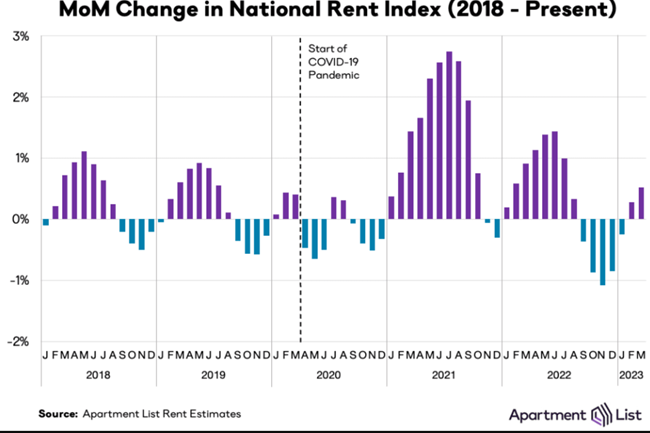
The national rent index increased by 0.5 percent over the course of March, the second straight monthly increase and a slight acceleration over last month’s pace, Apartment List said in their April report.
The report says 78 of 100 largest cities saw rent increase in March while 28 cities have seen prices fall year-over-year.
“This month’s increase is of a similar magnitude to the typical March price change that we saw in pre-pandemic years. After 2022 closed out with record-setting price declines, it appears that rental demand is rebounding in line with the usual seasonal trend,” the Apartment List research team writes in the report.
However, year-over-year rent growth is continuing to decelerate despite some recent small gains and is expected to continue to decline in coming months.
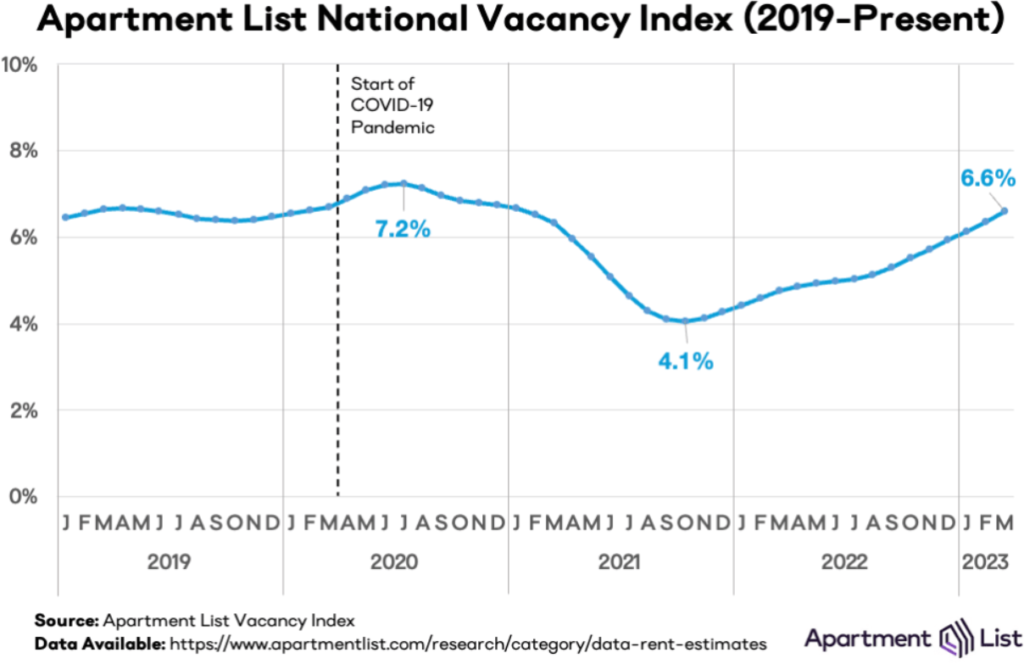
Meanwhile, on the supply side, “Our vacancy index currently stands at 6.6 percent, which now puts it back in-line with the average pre-pandemic rate.
“With a record number of multifamily apartment units currently under construction, we expect that supply constraints will continue to soften and 2023 could be the first time since the early stages of the pandemic that we see property owners competing for renters, rather than the other way around,” the research team writes.
Rents nationally increase by 0.5 percent month-over-month; prices up 2.6 percent year-over-year
With the 0.5 percent national rent index increase in March, it “marks the second straight month of positive rent growth following a five-month period of prices falling. This month’s increase represents a slight acceleration from the 0.3 percent increase we saw in February.
“The timing of this recent turn is consistent with the usual seasonal trend in the rental market. It’s typical to see prices dip in the fall and early winter as moving activity slows, but things normally begin to pick back up around this time of year, and rent growth then tends to accelerate until the early summer peak,” the report says.
Vacancy index back at pre-pandemic baseline
The report says the vacancy rate now sits at 6.6 percent, exactly matching the average rate from 2018 to 2019. Also, it is like the vacancy rate will surpass that pre-pandemic threshold in the months ahead. New apartment construction is recovering from pandemic-related disruptions, and there are now more multifamily units under construction than at any point since 1970.
“As this new inventory hits the market over the course of the year, we could begin to see property owners competing for renters to fill their units, a marked change from the prevailing conditions of the past two years, in which renters have been competing for a limited supply of available inventory,” the report says.
Oregon Senate Bill 611 that would restrict landlords’ ability to raise rents has plenty of opposition from landlords.
Senate Bill 611 would adjust the current rent cap from 7 percent plus consumer price (CPI) index to 5 percent plus CPI. Because CPI changes with inflation the bill would cap the max increase at 10 percent regardless of CPI.
“It sends a signal to investors that Oregon is not open for business,” Molly McGrew, a lobbyist for the landlord association Multifamily Northwest told kcby.com. “Washington State did not pass their rent control law that they had up, and instead went full speed on addressing the supply issues. And I think that is something that Oregonians need us to do as well.”
Oregon’s rent cap laws exempt buildings with a first certificate of occupancy issued within the last 15 years. The original bill would have changed that number to three, but that protection was gutted in the amendment.
Also eliminated from Senate Bill 611 was a requirement that called on landlords to provide three months’ worth of rent when serving a tenant with a no cause eviction. The current standard is one month’s worth of rent to help with relocation
Landlords say the increase in cost of labor, homeowners’ insurance, maintenance and utilities are what’s driving the spike.
“Everything that someone who owns their own home has to take care of, a housing provider has to take care of, for their renter,” said Deborah Imse, executive director of Multifamily NW, an association of landlords.
She feels that more regulations will cause landlords to sell their property and relocate and will drive developers to build elsewhere.
“In our view you don’t do things that will cause investors to go to Idaho or across the river to Clark County and build there,” she said.
She suggests that giving renters more rental assistance while building more homes is the solution to the problem.