Home Blog Page 53

High Costs Continue to Challenge Buyers and Renters

High mortgage interest rates, high home values, and high rents continued to fuel affordability challenges for buyers and renters

High mortgage interest rates, high home values, and high rents continued to fuel affordability challenges for buyers and renters, Zillow says in a new survey.

Low vacancy rates that limit mobility and also put pressure on rental rates are also a challenge.

However, the report says, “Many renters’ behaviors, intentions, and preferences have remained relatively stable over the years.”

The 2023 Consumer Housing Trends Report (CHTR) provides a snapshot of what housing consumers were thinking and doing in early-to-mid 2023.

Here are some key findings:

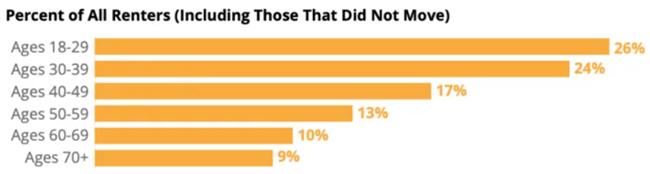
  • Renters make up 30% of the U.S. population. The typical renter is 39 years old. Compared with the adult population as a whole, the renting population tends to be younger, more racially diverse, less likely to have ever been married, and more likely to identify as LGBTQ+.
  • Most renters (53%) live in an apartment building.
  • About three in five renters (61%) say they are considering moving within the next three years.
  • The typical recent renter submitted two applications — one online and one on paper/in person. For these rental applicants, the typical application fee to apply for their current rental was $50 and the typical recent renter reported paying $60 in total across all the rentals they applied for.
  • About half (52%) of recent renters who moved from a previous rental say they disagreed with their landlord or property manager about something.
  • Almost half (45%) of renters say that they would be very or extremely likely to buy a home if rates fell, versus only one in five (20%) who say the same if rates rise.
High mortgage interest rates, high home values, and high rents continued to fuel affordability challenges for buyers and renters

Also, the survey says half of recent renters report at least one move-out disagreement with their previous landlord or property manager.

  • 27% said they disagreed about repair, damage or maintenance on the property.
  • 22% disagreed about the responsibility for utility payments such as electricity, heat, gas, or Internet access.
  • 19% said they disagreed about move-out costs or fees.

Renters that Stayed Put Cite Good Deals, Affordability as Their Reasons

When asked what encouraged them to stay at their current rentals, tenured renters were most likely to say that their rental costs were a good deal (72%), followed by not being able to afford to move somewhere else (66%).

Smaller shares cited liking their landlord or property manager (60%), a floor plan or layout that fit their preferences (61%), and private outdoor space (50%). Tenured renters were least likely to cite their rental’s common amenities like a gym or conference room (33%) as encouragement for staying put.
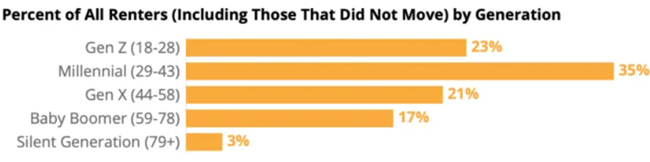
High mortgage interest rates, high home values, and high rents continued to fuel affordability challenges for buyers and renters

What did renters say was most important in choosing a home?
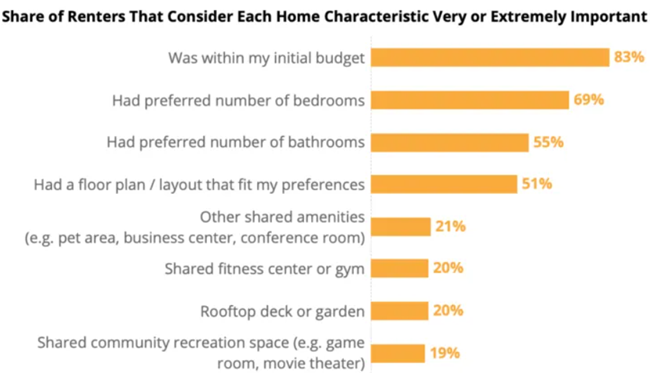
High mortgage interest rates, high home values, and high rents continued to fuel affordability challenges for buyers and renters

Half of Renters Pay Rent Online – More Would Like To

In fall of 2020, half (50%) of recent renters said they typically pay their rent online. Since then, the share has risen 10 points to 60%. Over the same time, the share of recent renters that said they would ideally prefer to pay their rent online remained similar: 69% in fall 2020 and 69% in spring/summer of 2023.
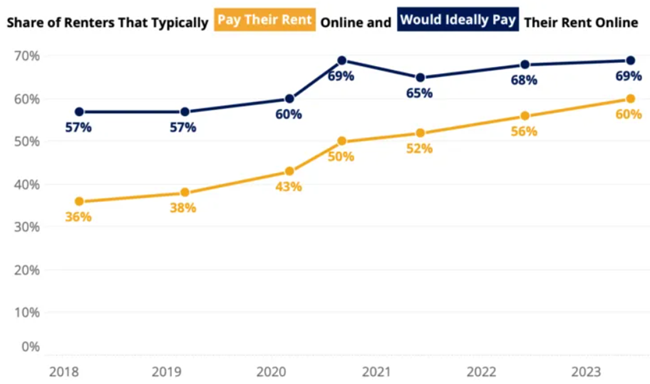
High mortgage interest rates, high home values, and high rents continued to fuel affordability challenges for buyers and renters

A majority of renters plan to move within three years

Similar to both before and after the pandemic, recent renters consistently consider moving; 72% say they are considering it within the next 3 years.

About a quarter (25%) say they are currently considering moving, and almost one in three (29%) say they’re considering moving in the next year.

Another fifth (19%) say they’re considering it within the next two to three years. About one in 10 (12%) say they might consider moving, but not within the next 3 years. And the remaining 15% say they have no plans to move

Read the full survey here.

Do You Know The Changing Priorities Of Renters?

Sign Up For Our Weekly Newsletter And Get Rental Property And Apartment News And Helpful, Useful Content Each Week.

* indicates required

Apartment Development Pipeline to Slow Dramatically In 2024

Apartment developers expect new starts to slow significantly now in the post-pandemic era as high interest rates have sidelined investors

Apartment developers expect new starts to slow significantly now in the post-pandemic era as high interest rates have sidelined investors, John Burns Real Estate Consulting says in a new survey.

The Burns Apartment Developer and Investor Survey, a new quarterly report, says, “We aim to cast light on areas of the apartment market where the industry has lacked clarity, including the long-term development pipeline, access to capital, and lease-up challenges.”

Apartment development survey

The report surveyed 56 developers, investors, and operators with a collective portfolio of 241,850 units in September and October. It confirmed the following:

  • Post-COVID construction has peaked, and developers expect starts to slow at least -20%, with 25% of participants believing apartment starts will slow at least -50%.
  • High interest rates and cautious lenders have sidelined investors.
  • Leasing has slowed in part due to rent hikes.
  • Thoughtful project design and competitive amenities drive demand.
  • A wave of under-construction apartments will finish in 2024 and into 2025.
  • 40% of the surveyed developers have 500+ units under construction.
  • Future apartment starts will slow dramatically, with the pipeline shrinking significantly once the current round of development is delivered.
  • Almost all respondents say securing development financing is becoming more difficult.

Very few apartment deals are taking place

The John Burns report says transactions and deals have stalled, with only 16% of respondents selling an apartment property in the last six months and no reported acquisitions.

Financing has dried up for new apartments and the current rising supply of apartments leads to soft fundamentals for revenue.

Affordability a key issue

The survey says affordability is a key issue in retaining tenants.

“Commonly cited reasons for non-renewal of leases include moving into a less-expensive apartment and moving in with roommates,” the report says.

John Burns invites those who would like to participate in upcoming surveys to fill out the form, below.

“For participating, you’ll receive the survey results and high-level proprietary JBREC analysis. Join us in refining the industry’s market understanding, and gain valuable data to guide your next venture.”

Fill out the form to participate here.

About John Burns Real Estate Consulting:

John Burns Research and Consulting produces independent research and custom consulting advice to help executives make the most informed decisions possible.

Multifamily Rents Drop Amid Supply Surge

Portland Rents Continue Downward Trend

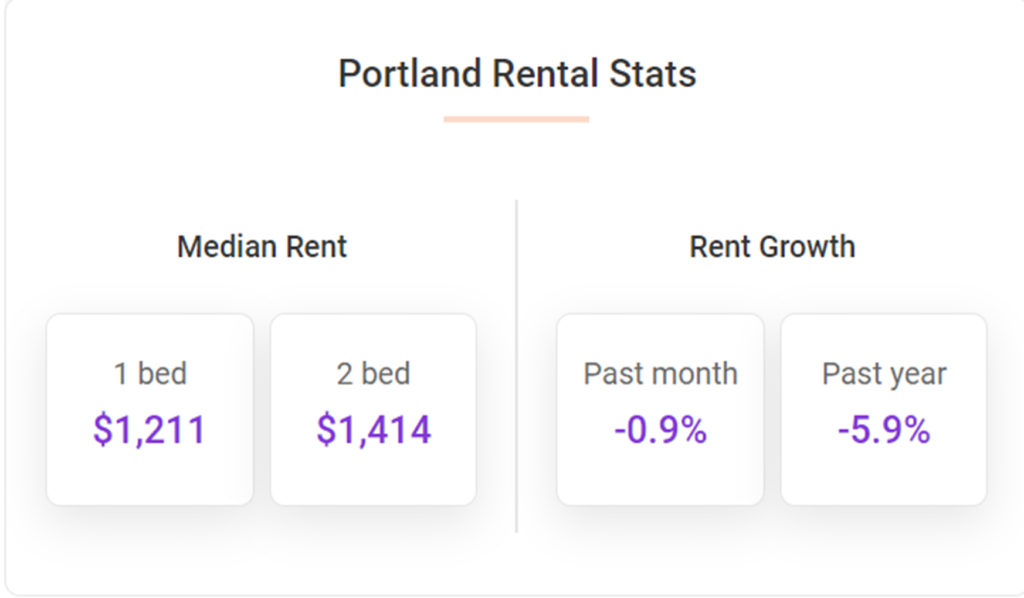
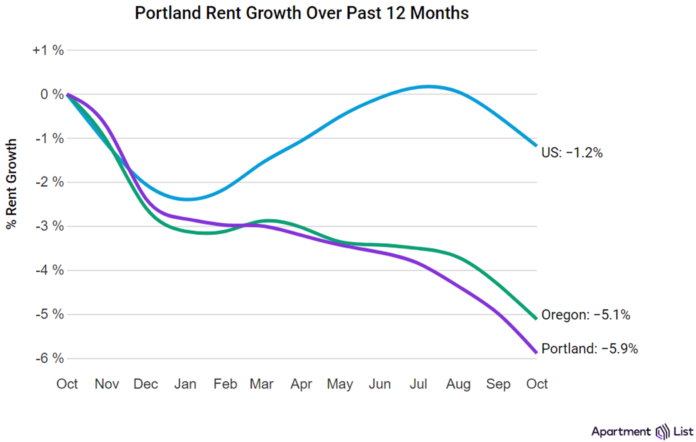
The median rent in Portland fell by 0.9% over the course of October, and has now decreased by a total of 5.9% over the past 12 months

The median rent in Portland fell by 0.9% over the course of October, and has now decreased by a total of 5.9% over the past 12 months, Apartment List says in the November report.

Citywide, the median rent currently is $1,211 for a 1-bedroom apartment and $1,414 for a 2-bedroom. Across all bedroom sizes (i.e., the entire rental market), the median rent is $1,346. That ranks No. 60 in the nation among the country’s 100 largest cities.

Also, Portland rents are 10.8% lower than the metro-wide median.

The median rent in Portland fell by 0.9% over the course of October, and has now decreased by a total of 5.9% over the past 12 months

Across the metro outside the city of Portland, the median rent is $1,509. Metro-wide annual rent growth stands at -5.2%, above the rate of rent growth within just the city.

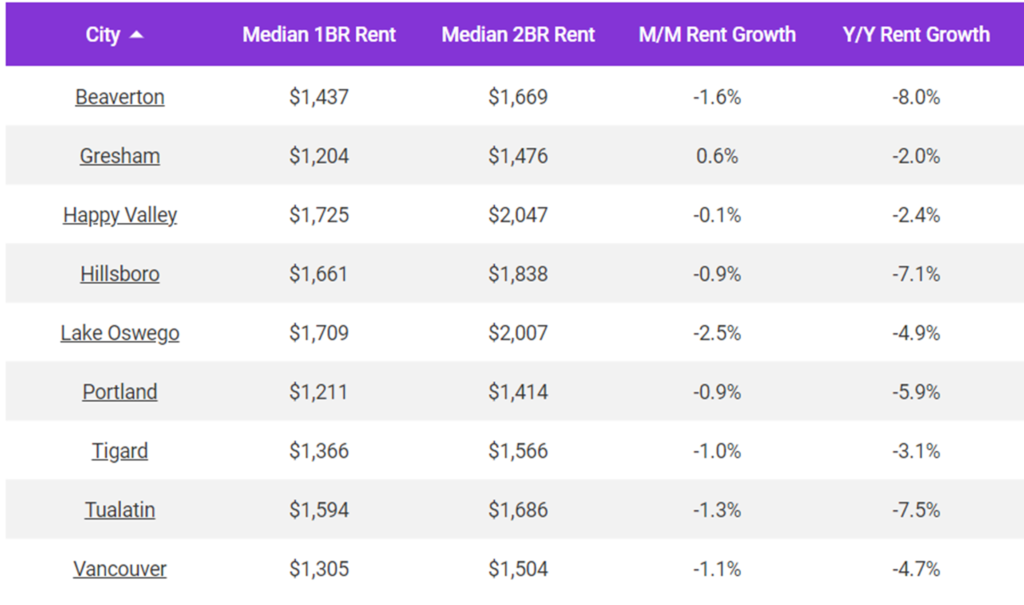
The table below shows the latest rent stats for nine cities in the Portland metro area that are included in the Apartment List database.

Among them, Lake Oswego is currently the most expensive, with a median rent of $2,009. Portland is the metro’s most affordable city, with a median rent of $1,346. The metro’s fastest annual rent growth is occurring in Gresham (-2.0%) while the slowest is in Beaverton (-8.0%).

The median rent in Portland fell by 0.9% over the course of October, and has now decreased by a total of 5.9% over the past 12 months
  

Portland Update: Changes to FAIR Ordinance Bring (Some) Necessary Changes

Dealing with Habitability issues and Substitute Housing


Salt Lake City Rents Down 1.5% Month-Over-Month

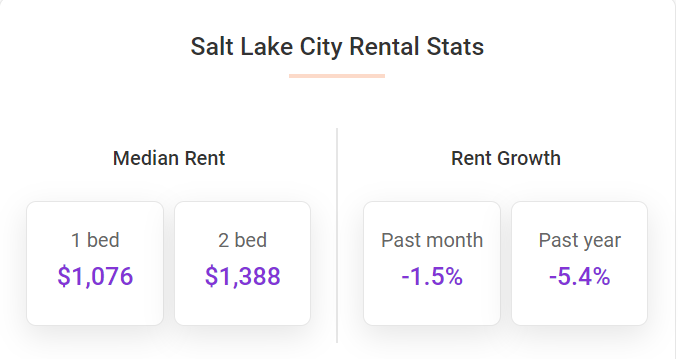
Ten months into the year, rents in the city have fallen 1.2%.

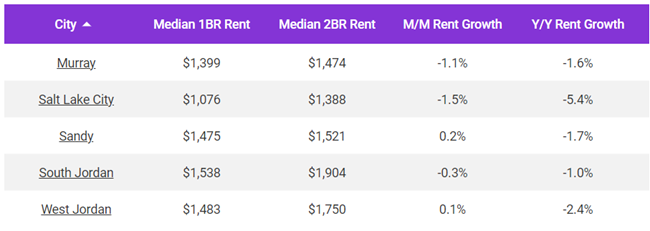
The median rent in Salt Lake City fell by 1.5% over the course of October, and has now decreased by a total of 5.4% over the past 12 months, according to the Apartment List report for November.

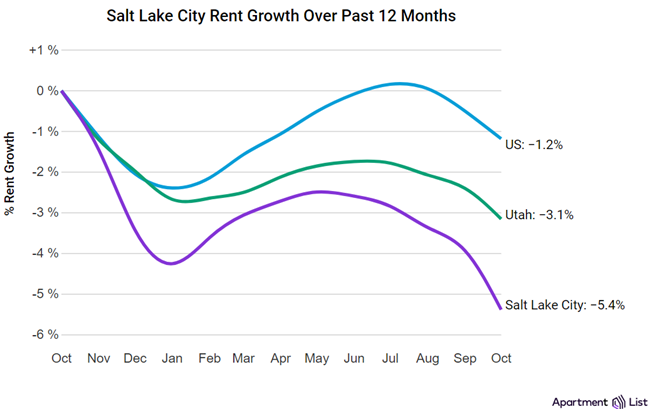
Salt Lake City’s rent growth over the past year has fallen behind both the state (-3.2%) and national averages (-1.2%

Ten months into the year, rents in the city have fallen 1.2%. This is a slower rate of growth compared to what the city was experiencing at this point last year: from January to October 2022 rents had increased 5.7%.

Across the Salt Lake City metro area, the median rent is $1,445 meaning that the median price in Salt Lake City proper ($1,262) is 12.7% lower than the price across the metro as a whole.

Metro-wide annual rent growth stands at -4.3%, above the rate of rent growth within just the city.

The table below shows the latest rent stats for 5 cities in the Salt Lake City metro area that are included in the Apartment List database. Among them, South Jordan is currently the most expensive, with a median rent of $1,878. Salt Lake City is the metro’s most affordable city, with a median rent of $1,262. The metro’s fastest annual rent growth is occurring in South Jordan (-1.0%) while the slowest is in Salt Lake City (-5.4%).

Apartment List methodology

Apartment List is committed to the accuracy and transparency of our rent estimates. We begin with reliable median rent statistics from the Census Bureau, then extrapolate them forward to the current month using a growth rate calculated from our listing data. In doing so, we use a same-unit analysis similar to Case-Shiller’s approach, capturing apartment transactions over time to provide an accurate picture of rent growth in cities across the country. Our approach corrects for the sample bias inherent in other private sources, producing results that are much closer to statistics published by the Census Bureau and HUD.

Renters Survey Shows Many Residents Plan To Move

NOI Drivers to Combat Rent Growth Decline Part 2: Revenue Recovery

Landlords: Maintenance, Tenant Screening Are Biggest Struggles

Do You Know The Changing Priorities Of Renters?

Do you really know the changing priorities of renters a new survey study from the National Multifamily Housing Council asks.

As a housing provider, do you really know the changing priorities of renters a new survey study asks.

The new report from the National Multifamily Housing Council (NMHC) and Grace Hill of more than 170,000 renters in over 4,000 communities is designed to help rental property investors, owners and property managers better understand  the shifting priorities of renters.

The 2024 Renter Preferences Survey Report  sheds light on trends showing a mix of financial motivations, evolving expectations and the influence of remote work in the post pandemic era on renters.

“In analyzing this data, it becomes evident that today’s renter is navigating a landscape of emerging technologies and practical considerations. While they continue to desire creature comforts, they also seek modern features and amenities that reflect a very mobile and connected lifestyle.

“This is evident in the strong interest in things like shared workspaces, with respondent interest growing from 35% in the previous survey to nearly half of respondents (48%) today, or high-speed internet, which 86% of respondents say is either very important or absolutely essential. Understanding these shifting priorities is paramount for property investors, property managers, developers and architects,” the report says.

“These findings present an opportunity for policymakers to better appreciate that the vast majority of renters have a high level of satisfaction with their housing situation,” NMHC President Sharon Wilson Géno, said in a release. “This information also illuminates the needs, both desired and necessary, of residents and the realities that housing providers face in providing homes that are the foundations for renters to build their lives.”

The survey on changing priorities of renters, which is available for purchase here, covered the following:

  • Resident Demographics & Lifestyle
  • Financial Health & Wellbeing (*new in 2024)
  • Apartment Search and Touring
  • Technology & Connectivity Needs
  • Lease Decision Factors
  • Commuting & Remote Work
  • Apartment Features
  • Community Amenities
  • Pricing Expectations
  • Future Rental Behavior

Some Major Highlights of the Survey Report

Renter satisfaction and demographics of renters finds that, by and large, renters enjoy living in their rental communities and feel valued by their housing providers.

Most respondents reported that they agree or strongly agree (85%) with this statement: I enjoy living in my community. A majority of respondents also reported that they feel included and accepted in their community (86%), their property staff demonstrate a culture of respect and kindness (85%) and they feel their wellbeing is important to community management (75%).

The survey also revealed that, across income spectrums, three top factors contributed most to a renter’s positive sense of community: neighbors respecting the rules; feeling welcomed by the community staff; and access to services that can enhance residents’ wellbeing.

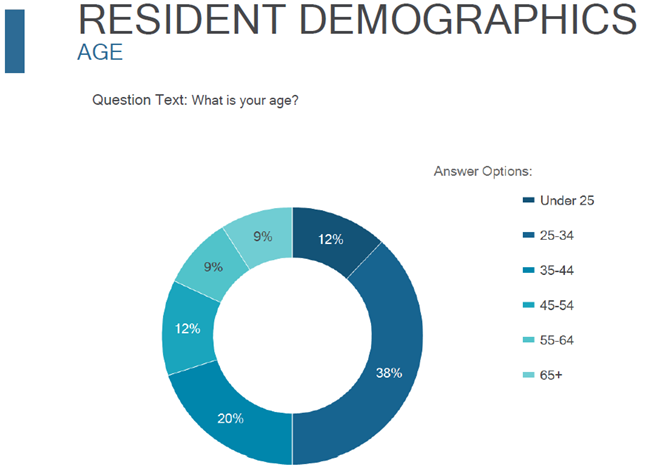
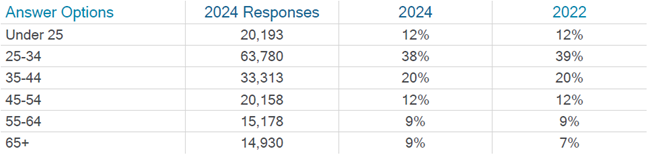
Here is a look at the demographics in the report and monthly rent. Much more is available in the full report.

Do you really know the changing priorities of renters a new survey study from the National Multifamily Housing Council asks.

Do you really know the changing priorities of renters a new survey study from the National Multifamily Housing Council asks.

Remote Work From Home Continues To Be Strong

The changing priorities of renters shows up in remote work. The largest group (39%) reported they worked from home several days a week, followed by those who worked from home every day (31%), a few times a month (21%) and once a month or less (9%).

Most important, the share of renters who did not anticipate changes in their remote work frequency increased from 64% in the 2022 report to 73%.

Do They Stay Or Do They Go?

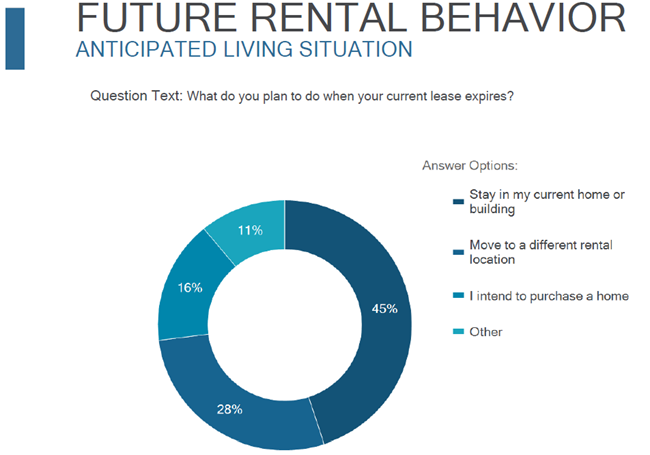
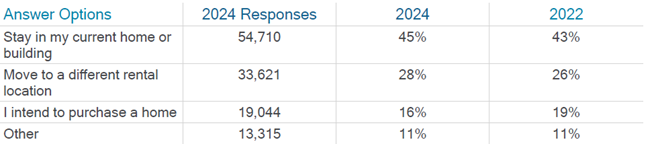
The survey shows more residents plan to stay longer in their current rental apartment or building, and fewer plan to purchase a home.

Do you really know the changing priorities of renters a new survey study from the National Multifamily Housing Council asks.

Do you really know the changing priorities of renters a new survey study from the National Multifamily Housing Council asks.

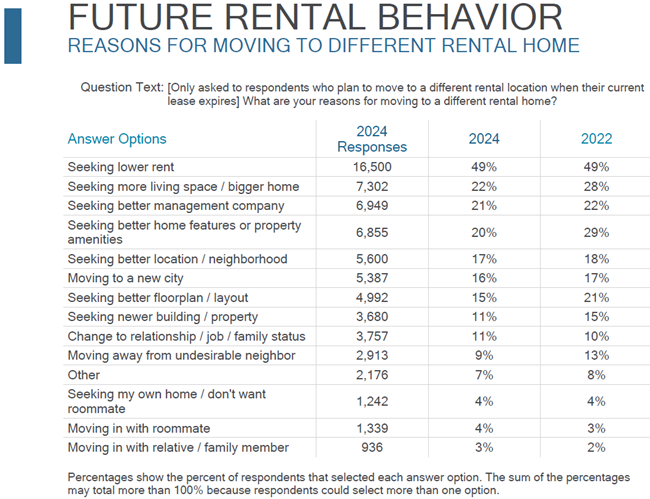
Also, the survey shows the most common reason for moving by far is seeking lower rent.

reasons for moving

“This year’s survey provides critical insights to rental housing providers about every stage of the customer journey,” Grace Hill CEO Kendall Pretzer said in the release. “With our new interactive dashboard, organizations have access to a more enhanced and comprehensive analysis of the in-unit features and community amenities that are paramount to renters, informing growth strategies for 2024 and beyond.”

Purchase the full report here.

About the National Multifamily Housing Council

Based in Washington, D.C., the National Multifamily Housing Council (NMHC) is the leadership of the trillion-dollar apartment industry.  NMHC provides a forum for insight, advocacy and action that enables both members and the communities they help build to thrive. For more information, contact NMHC at 202/974-2300, e-mail the Council at [email protected], or visit NMHC’s website at www.nmhc.org.

About Grace Hill

Grace Hill provides technology-enabled performance solutions that help owners and operators of real estate properties increase property performance, reduce operating risk and grow top talent. Its industry-leading solutions covering policy, training, assessment, survey and data-driven insights are bolstered by years of real estate experience, in-depth service-level expertise and outstanding customer support. Today, more than 500,000 real estate professionals from more than 1,700 companies rely on talent performance solutions from Grace Hill. Visit us at gracehill.com.

Can Oregon Landlord Increase Rent Mid-Month?

Given all the rules for rent increases and rent control can an Oregon landlord increase rent mid-month asks an Oregon landlord

Given all the rules for rent increases and rent control, can an Oregon landlord increase rent mid-month?

Hi,

I own a rental property in Lake Oswego and my tenants have been in the home for 13 months. Their fixed term lease expired on Oct. 31 (spooky) and we are currently in a month-to-month set-up.
I’d like to increase the rent, and plan to do so by 9.5%. I’ll follow all the rules, including the 94-day notice if mailed.
My question for you is: Can I make the rent increase effective date on the 15th of the month? This would require a prorated rent in February of next year. I want to make sure there aren’t any rules about making the effective date on the first of the month.
I really appreciate any help you can provide.
Best regards,
-Mike

Hello Mike,

Thank you for the question. Truth be told, there’s nothing illegal with making a rent increase effective in the middle of the month, assuming you provide the requisite 90-day notice.

The problem that you can run into is miscalculation. What is the prorated amount? How are you calculating February, since it will be 29 days (as opposed to 30). Are you using a per-diem based upon a 365-day (or 366-day) calendar?

Making a rent increase effective on the first of the month is the one way to avoid this, and have everything “clean.” In short, while you are within your legal right to make a rent increase effective in the middle of the month, it can cause more headaches than it’s worth down the road.

-Brad

Given all the rules for rent increases and rent control can an Oregon landlord increase rent mid-month asks an Oregon landlord

Bradley S. Kraus is an attorney at Warren Allen LLP. His primary practice area is landlord/tenant law, but he also assists clients with various litigation matters, probate matters, real estate disputes, and family law matters. You can reach him at [email protected] or at 503-255-8795.

Local Exceptions Complicate Oregon’s Post-SB 611 Rent Regulations


Portland Update: Changes to FAIR Ordinance Bring (Some) Necessary Changes

Dealing with Habitability issues and Substitute Housing


Secure Your Monthly Cash Flow With One Easy-to-Miss Coverage: Business Income Insurance for Utah Landlords

Secure your monthly cash flow with one easy-to-miss coverage: Business income insurance for Utah landlords to protect cash flow

By Andres Dominguez III

Owning and managing rental properties in Utah can be a lucrative business, providing a steady source of monthly income. Like any investment, you have risk exposure. One crucial aspect of risk management for landlords is protecting their cash flow, and that’s where business income insurance comes into play. In this article, we’ll explore the importance of business income insurance for Utah landlords and how it can safeguard your monthly cash flow.

The Utah Landlord Landscape

Utah’s real estate market has been booming, making it an attractive market for property investors. As a landlord, you enjoy the benefits of rental income, which helps cover property expenses, including mortgages, maintenance, and property taxes. A stable cash flow is essential for a landlord’s financial security, making it vital to protect against unexpected disruptions that can jeopardize your income stream.

Business Income Insurance: A Lifeline for Landlords

Business income insurance typically covers losses from fires, water damage, and other covered perils.  This coverage can be easy to miss. Many apartment and multi-family risks are quoted on an insurance platform that requires the agent to add coverage for business income. Make sure your agent has not omitted this coverage or not factored in enough coverage.

Protecting Your Cash Flow

As a landlord, your monthly cash flow is the lifeblood of your business. It covers not only your property-related expenses but also your livelihood. Without adequate protection, a temporary loss of rental income can have severe financial repercussions.

Here are some key benefits of business income insurance for Utah landlords:

  1. Continuity of Income: Business income coverage ensures that your rental income continues even when your property is not generating revenue due to a covered loss. It can also cover lost rents or additional expenses related to temporary relocations of your tenants.
  2. Property Restoration: When your rental property sustains damage, repairing it can be costly and time-consuming. Business income insurance helps cover the cost of lost rents during repairs, allowing you time to restore your property to its income-generating state.
  3. Peace of Mind: Knowing your cash flow is protected in the event of an unexpected loss can provide peace of mind and reduce the financial stress associated with property ownership.

How to Obtain Business Income Insurance

To secure your monthly cash flow as a Utah landlord, obtaining business income insurance is a smart move. Here’s what you can do:

  1. Consult an Insurance Professional: Call our office at 801-262-1551 or Click Here for a for a consultation with our experienced team. We can tailor your policy to suit your unique needs.
  2. Review Policy Terms: Carefully review the terms and conditions of the policy, including coverage limits, waiting periods, and any exclusions. Ensure that the policy aligns with your risk tolerance and financial goals.
  3. Budget for Premiums: Factor the cost of business income insurance into your overall financial plan. While it’s an additional expense, it is an investment in safeguarding your cash flow.

Conclusion

As a landlord in Utah, securing your monthly cash flow is essential for maintaining financial stability and growing your real estate investments. Business income insurance is an invaluable tool that can protect you against unforeseen disruptions and income loss. By taking the proactive step of obtaining this coverage, you’ll have peace of mind, knowing that your rental properties are protected from potential financial setbacks. Secure your cash flow and protect the future success of your property investments.

About the author:

Lance Anderson and Andres Dominguez III specialize in multifamily policies and are standing by to answer all your questions.


Seasonal Slowdown In Rents Continues

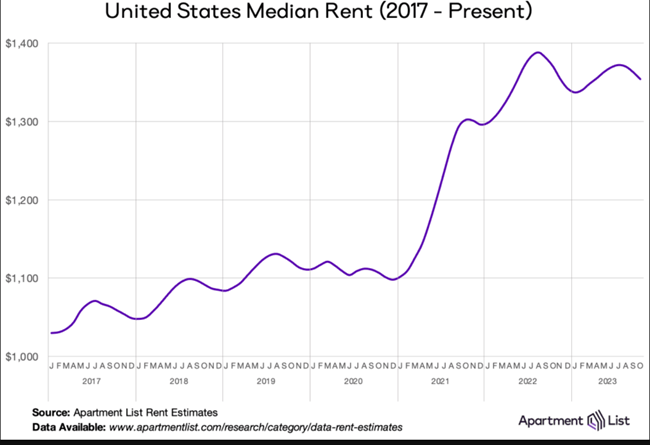
The seasonal rent slowdown continued in October as nationwide median rent fell 0.7 percent to $1,354 the third month of negative rent growth

The seasonal slowdown in rents continued in October as the nationwide median rent fell 0.7 percent to $1,354 marking the third consecutive month of negative rent growth and “declines are likely to persist in the coming months as we head into the winter,” Apartment List says in their November report.

On average this means apartments across the country are cheaper now than they were a year ago.

But despite the cool down recently, “the national median rent is still nearly $250 per month more expensive than it was just three years ago,” the report says.

Regionally, rents fell in October in 81 of the nation’s 100 largest cities, and prices are down year-over-year in 66 of these 100 cities.

The seasonal rent slowdown continued in October as nationwide median rent fell 0.7 percent to $1,354 the third month of negative rent growth

Rents are down 0.7% month-over-month, down 1.2% year-over-year

Rent growth follows a seasonal pattern – rent increases generally take place during the spring and summer, whereas the fall and winter usually see a modest price dip.

This year, the slow season started a month earlier than usual, with a slight 0.1 percent decline in rents in August. Those monthly declines have gotten progressively steeper in the months since, with rents nationally falling by 0.5 percent in September and 0.7 percent in October, the report says.

Portland rent growth among slowest in the nation

The Portland and San Francisco metro areas are also experiencing some of the nation’s slowest year-over-year growth, showing that high-cost coastal metros are also seeing a slowdown in rental demand. These markets were among those that saw rapid declines in 2020, and are seeing it again now but more slowly. The Portland metro in particular ranks in the top 10 for slowest rent growth over the past 6, 12, and 36 months.

Apartment vacancies are back above pre-pandemic levels

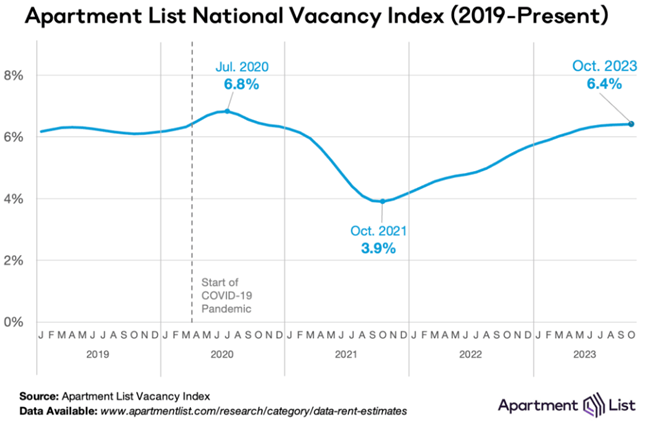
The vacancy index stands at 6.4 percent, representing a return to pre-pandemic levels.

“This easing has plateaued in recent months, but we don’t expect it to tighten again anytime soon. Despite a recent slowdown in new building permits being issued, the number of multifamily units under construction remains near record levels,” Apartment List researchers write.

The seasonal rent slowdown continued in October as nationwide median rent fell 0.7 percent to $1,354 the third month of negative rent growth

As developers work through this robust construction pipeline, the supply of new apartment inventory should remain strong in the year ahead. This means that renters should have more available options than they have in some time, especially in the Sun Belt markets where construction activity has been strongest.

However, vacancy trends are highly localized, and they have been a key indicator of rapidly evolving conditions in local markets across the U.S.

Read the full report from Apartment List here.


Sign Up For Our Weekly Newsletter And Get Rental Property And Apartment News And Helpful, Useful Content Each Week.

* indicates required

Jury Finds Conspiracy On Home Sales Commissions Awards $1.78 Billion

A federal jury found the National Association of Realtors and large residential brokerages conspired to keep home sales commissions high

A federal jury in Kansas City has found that the National Association of Realtors and large residential brokerages conspired to keep commissions for home sales artificially high and set damages at $1.78 billion, according to reports.

Bloomberg reported that Zillow Group Inc. and other real estate stocks plunged after the jury found the National Association of Realtors and other industry players guilty of colluding to maintain high brokerage commissions.

The lawsuit was filed in Kansas City, Missouri, against the Realtors association, Keller Williams and Berkshire Hathaway’s HomeServices of America. Two other brokerages, Re/Max and Anywhere Real Estate Inc., settled with plaintiffs earlier this year, agreeing to pay $55 million and $83.5 million, respectively, and to no longer require agents to belong to NAR.

In separate statements, NAR and HomeServices said they intend to appeal. Keller Williams said it “will consider all options as we assess the verdict and trial record, including avenues of appeal.”

“Today’s decision means that buyers will face even more obstacles in an already challenging real estate market and sellers will have a harder time realizing the value of their homes,” HomeServices said. “It could also force homebuyers to forgo professional help during what is likely the most complex and consequential financial transaction they’ll make in their lifetime.”

The jury awarded $1.785 billion in damages in the case, which was the smaller of two lawsuits concerning brokerage commission practices. In a third matter, the Justice Department is focused on a commission-sharing system that typically puts home sellers on the hook for a 5% to 6% cut of the sale, split between their agent and the buyer’s agent.

An NAR spokesman said that while the group plans to appeal, the matter will take years to resolve. “In the interim,” Mantill Williams said in a statement, “we will ask the court to reduce the damages awarded by the jury.”

Sign Up For Our Weekly Newsletter And Get Apartment News And Helpful, Useful Content Each Week.

* indicates required

Why Verification Forms are Critical in Property Management

One In Three Small Portfolio Owners Say They Are Profitable

6 Takeaways From The National Multifamily Housing Conference

Rent Control Contributes To Affordable Housing Shortage

Rent control laws are contributing to a shortage of affordable housing, according to economists as the supply of housing declines

Rent control laws are contributing to a shortage of affordable housing, according to economists.

When rent caps are imposed, developers build fewer new rental units, the supply of available housing declines and housing costs increase. Instead of rent control, policymakers should focus on supply-side solutions: reforming their local zoning code and providing tax incentives for developers to bring new units online, economists say.

Ryan Bourne, chair for the public understanding of economics at the Cato Institute’s Center for Economic Studies, said economists overwhelmingly agree that imposing rent control tends to reduce the amount and quality of affordable housing and explained why in an interview with FOX Business.

“Capping rents at a time when you know demand for property is growing strongly creates a situation where you have a shortage of rental accommodation relative to demand, so it creates shortages,” Bourne said. “And to the extent they create shortages, that can actually kind of raise the underlying market rents because if you kept rents below market rates, a lot of landlords will decide to convert their properties to condos or sell them for owner occupation.”

“So quite often,” he added, “it makes the kind of underlying market rate of property actually more expensive, rather than less expensive.”

Despite warnings from economists, rent control is becoming more and more popular.

Oregon led the charge in 2019 when the state imposed a cap on older units, and California followed suit in 2020. Since then, municipalities in Illinois, Colorado, Massachusetts and elsewhere are considering similar moves.

The Housing Solutions Coalition provided this update on the status of rent control around the country.

RENT CONTROL UPDATES

MINNESOTA: Rent Control Continues to Chill Development in St. Paul: The ramifications of rent control are continuing to be felt in St. Paul as the planned construction of 2,000 market-rate units remains on hold. The developer stated that the pause results from an inability to find financing after St. Paul voters passed a rent control ballot measure in 2021. The project, which was planned years before the ballot measure, was slated to include a variety of housing options, including row homes, apartments, senior living and custom home lots. – MinnPost

ILLINOIS: State Lawmakers Push to Allow Rent Control in Illinois: State lawmakers kicked off a six-day legislative session over the next three weeks to consider bills recently vetoed by Governor J.B. Pritzker. Among the legislative proposals under consideration this session is HB 4104, a bill to allow local governments to enact rent control. If the bill passes, any Illinois municipality could hold a local referendum to exempt itself from the state’s existing preemption against rent control. – The State Journal Register

MAINE: Portland Voters Could Loosen the City’s Rent Control Ordinance: In Portland, Maine, voters will decide whether landlords will be allowed to set rents of their choosing between tenancies. As it stands, the city’s rent control ordinance does not allow for so-called “vacancy decontrol.” Thus, even between tenancies, landlords may not raise rents by more than a prescribed amount. But if the ballot initiative, Question A, is approved by Portland voters this November, then landlords would be allowed charge market rates to new tenants. – FOX 23

MARYLAND: Prince George’s County May Make Temporary Rent Control Permanent: This past February, Prince George’s County, Maryland, capped rent increases for one year at three percent. This policy was billed as a temporary, emergency measure. But now county officials are considering capping rent increases permanently. The uncertainty surrounding this policy has chilled housing investment in the county. Greg Reaves of Mosaic Development Partners warns that until these questions are resolved, many builders will look elsewhere to bring new units online. – Bisnow

MARYLAND: Rent Control Could be Coming Soon to Howard County: Howard County, Maryland, is struggling to keep housing costs low. To address the issue, the Howard County Executive, Calvin Ball, outlined a plan called the Housing Opportunity Meant for Everyone (HOME) plan. Regrettably, in addition to policy changes that would allow more housing construction, Ball’s plan includes a proposal to enact rent control. – The Baltimore Sun

Governor Signs Revised Oregon Rent Control Law

Portland Update: Changes to FAIR Ordinance Bring (Some) Necessary Changes

Dealing with Habitability issues and Substitute Housing