
Home Blog Page 27

2025 Pets and Housing Awards Are Open for Nominations!

Nominations are open for the fourth-annual 2025 pets and housing awards presented by the pet-inclusive housing initiative.

Raise the woof: the nominations are open for the fourth-annual 2025 pets and housing awards presented by the pet-inclusive housing initiative from the Michelson Found Animals Foundation.

By Judy Bellack
Industry Principal, Pet-Inclusive Housing Initiative

The connections between people and their pets has never been stronger, and the multifamily housing industry is leading the charge in celebrating this bond. With more renters seeking pet-inclusive communities, forward-thinking operators are redefining what it means to be a “pet-friendly” property—and now it’s time to recognize their groundbreaking work.

Michelson Found Animals Foundation is thrilled to announce that nominations are now open for the Fourth Annual Pets and Housing Awards, presented by the Pet-Inclusive Housing Initiative. These awards honor the trailblazers, innovators, and community champions who are making housing more welcoming for pets and their people. Ross Barker, Director of the Pet-Inclusive Housing Initiative, describes the event as a highly anticipated opportunity to highlight outstanding efforts in pet-inclusive housing. “We eagerly anticipate this event every year because it lets us shine a spotlight on the outstanding organizations leading the pack with their pet-inclusive housing solutions,” Barker said. “This fourth annual event will be our best yet, and we’re excited to see the great work organizations nominate!”

Why Nominate?

This is your chance to showcase your achievements and gain industry-wide recognition as a leader in pet inclusivity.

Whether you’ve launched an innovative amenity, hosted successful adoption events, or reimagined pet policies by easing or eliminating size and breed restrictions, we want to celebrate your dedication to improving the lives of pets and residents alike. Whether you’re part of a large company spanning multiple states, an independent rental operator serving a local community, an advocate for pet policy change or a nonprofit champion for pets in housing, we want to hear from you! Or you may know some great work in one of these categories you would like to nominate on behalf of someone else – go for it!

According to Diane Yensen, representing Rainier Properties and one of last year’s award winners, “To be recognized with the Best Leap Forward in the Pet-Inclusive Housing Awards was very exciting. It helps validate the fact that we really do live this and are passionate about it, and I hope other companies in the industry see this and get excited about it, too.”

Award Categories

With nine exciting categories, there’s a spotlight for every kind of innovation:

  • Best Leap Forward: Recognizing significant progress in pet inclusivity.
  • Most Impactful Adoption or Foster Event or Program: Applauding efforts that connect pets with loving homes.
  • Most Innovative Pet Amenity or Amenity Group: Shining a light on creative spaces and services for pets.
  • Most Innovative Pet Marketing Campaign: Showcasing campaigns that engage and attract pet-loving residents.
  • Most Pet-Inclusive Property: Celebrating a property that goes above and beyond for pets and their people, setting the pet-inclusive standard.
  • Outstanding Pet Citizen: Highlighting a resident pet that has made a meaningful impact.
  • Paws & Progress Nonprofit Award: Celebrating nonprofits driving positive change in pet-inclusive housing.
  • Pets & Housing Policy Advancement Award: Recognizing advocacy and policy advancements that benefit pets and housing.
  • Vanguard Award: Honoring a company advancing leading-edge initiatives that set new standards and serve as an example to the rental housing industry.

Key Details

  • Nomination Deadline: March 30, 2025
  • Winners Announced: Virtually (details to follow)

How to Nominate

Submitting a nomination is simple and unlimited! Highlight the achievements in any—or all—categories. Share your (or another’s) story, inspire your peers, and claim your place as an industry leader. Simply click here to get started.

Let’s Celebrate Together

The Pets and Housing Awards are more than just accolades—they’re a celebration of the innovative and heartwarming ways the multifamily housing industry improves lives. Let’s honor the creativity, compassion, and commitment that make pet-inclusive housing a reality.

Don’t wait! Start your nominations today, and join us in setting the standard for pet-inclusive communities. Together, we’ll keep raising the woof!
!– Begin Mailchimp Signup Form –>

Sign Up For Our Weekly Newsletter And Get Rental Property And Apartment News And Helpful, Useful Content Each Week.

* indicates required

Tenants Sue Portland Apartments Over Heating Issues

A group of tenants has filed a $1.8 million lawsuit against a Portland apartment complex over heating issues,

A group of tenants has filed a $1.8 million lawsuit against a Portland apartment complex over heating issues, according to reports.

The complaint alleges the landlords breached their duty to remedy maintenance issues and are seeking $1.8 million for economic and non-economic damages, koin.com reported.

The complaint — which was first reported by The Oregonian — was filed on January 22 by 15 tenants who live in the Glencourt Apartments, against the apartment complex, property managers with The NWV Group, and Turk Investments, LLC. The lawsuit was filed in Multnomah County Circuit Court.

Tenants say they pay between $935 and $2,265 per month for their units in the Portland apartment complex and claim the complex’s owners and managers are violating the Oregon Residential Landlord and Tenant Act, which requires all landlords to provide adequate heating systems maintained in good working order.

A representative with NWV Group told KOIN 6, “Both NWV Group and Glencourt ownership take tenant complaints very seriously and work together to address reported concerns.  Glencourt ownership and NWV Group value our residents and their habitability.  At this time, we have no open heat or habitability issues that have been submitted by tenants at Glencourt.”

According to the lawsuit, the “lack of heat” in the apartments on East Burnside Street has been well-known by the landlords and “ignored since well before 2021.”

“Defendants have outrageously delayed conducting long overdue repairs, instead forcing their tenants to endure winter after winter of unprecedentedly low temperatures, storm after storm,” the lawsuit states.

The lawsuit alleges that the landlords have received “incessant reports” over the course of many years, and since at least 2021, “there has been no significant period of time that the heating system has been properly maintained and provided adequate heat.”

One renter claims six of her eight windows have been in disrepair and do not fully close, allowing frost to enter her home, and similar to other tenants, she has isolated one room to try to stay warm, the lawsuit alleges. Another tenant claimed her windows also failed to protect the apartment from the weather, causing snow to pile up on her window inside the apartment.

Sign Up For Our Weekly Newsletter And Get Rental Property And Apartment News And Helpful, Useful Content Each Week.

* indicates required

Ask Landlord Hank: I Think My Tenants Have Been Smoking Inside; How Do I Prove it?

Ask Landlord Hank: I Think My Tenants Have Been Smoking Inside; How Do I Prove it?

Tenants smoking inside rental property can be a real headache for property managers so in this week’s Ask Landlord Hank question he offers some suggestions on how to know find out if tenants have been smoking in the rental unit.

Dear Landlord Hank,

My lease specifies no smoking in the unit and even goes so far as to state that tenants may be responsible for all costs to repaint/clean if they do smoke in the unit, but I am struggling with how to enforce this clause because it’s difficult to prove.

When my latest tenants moved out I found the entire inside of the unit had a grey haze on everything (walls, ceiling, doors, and cabinets). They insist they didn’t smoke inside the unit and suggested that it may have been caused by candles.

I’ve had tenants who used candles regularly before and have never seen this kind of thick haze. I’m certain they were smoking inside the unit, but don’t have any evidence other than photos of how bad the haze was and my receipts for painting the walls/ceiling.

Is this sufficient if they challenge my deductions from their security deposit or is there a better way to prove this in the future?

-Gordon

Dear Landlord Gordon,

Usually, tenant smoking is easy to detect by the distinctive smell on walls, in carpeting and furniture, signs of ash or cigarette butts, and yellow or brown discoloration on walls, counters, cabinets, doors and trim.

Even with camouflage, you can usually find enough signs to prove indoor smoking.

If you want to know for sure if the haze you are finding is related to smoking, there are air-quality detection companies and devices that can confirm the presence of smoke residue from cigarettes.

You may also try a home air-quality test, but the accuracy is not as high as with a professional assessment. The Bosch Macurco D381 Air Quality Detector can detect cigarette smoke.

There are also smoke detectors available to alert you to someone smoking in your property, and a new “smoke sensor” should be coming to market this year.

Detection may be tougher to do now though since you’ve tried to erase all signs of this issue, including painting your property. Have you checked your vents and ducting for signs of smoking?

We deal with companies that have “ozone” machines that will be attached to your ducting and clean ducting and air handler as well as your unit to get rid of the smoke smell, and this is a great and cost-effective way to take care of the issue.

Sincerely

Hank Rossi

Ask Landlord Hank Your Question

Ask veteran landlord and property manager Hank Rossi your questions from tenant screening to leases to pets and more! He provides answers each week to landlords.

  • This field is for validation purposes and should be left unchanged.
Tenant smoking inside rental unit and how to prove it ask Landlord Hank
Landlord Hank Rossi

How Can I Monitor Tenant Smoking In My No-Smoking Rental?

Do Your “No Smoking” And Odor Policies Stink?

Can I Say “No Pot In My Apartments” When It’s Legal In My State?

Sign Up For Our Newsletter And Get Apartment News And Helpful, Useful Content Each Week.

* indicates required


Ask Landlord Hank: I Think My Tenants Have Been Smoking Inside; How Do I Prove it?
Photo credit ontop via istockphoto.com

Multifamily Groups Praise FCC Decision To Allow Bulk Internet Billing

The FCC ended a bulk internet service plan that would have curbed landlords’ ability to force residents to pay for a single internet provider

In a move praised by the multifamily industry, the Federal Communications Commission (FCC) is eliminating a Biden administration proposal on bulk internet service that would have curbed apartment landlords’ ability to force residents into paying for a single internet service provider, according to reports.

The change in bulk billing arrangements would allow landlords to make deals with ISPs that would make residents pay for internet, cable, and/or satellite television services from a specific provider even if they don’t want them.

The change was praised by multifamily groups saying it will lower costs.

“By making this move, the new FCC is acknowledging the critical role these agreements play in encouraging broadband investment, bridging the digital divide and lowering internet costs,” Bob Pinnegar, National Apartment Association President and CEO, said in a release.

“NAA looks forward to working alongside the FCC to develop policies that further expand broadband access and deliver results for the nation’s renters and housing providers.”

Deals renters can’t escape

Ars Technica reported that with bulk billing, deals in which a company agrees to provide service to every tenant of a building, residents are billed a prorated share of the total cost. Tenants may be billed by either the landlord or the provider. Bulk billing contracts are only banned by the FCC when they give a provider the exclusive right to access and serve a building. But when tenants are forced to pay for one provider’s service, other providers aren’t likely to see much opportunity in entering the building.

The proposal, announced by FCC Chairwoman Jessica Rosenworcel in March of 2024, sought to lower costs and address the lack of choice for broadband services. “Everyone deserves to have a choice of broadband provider,” she said. “That is why it is not right when your building or apartment complex chooses that service for you, saddling you with unwanted costs, and preventing you from signing up for the plan and provider you really want. This proposal shuts down these practices. It boosts competition and consumer choice and builds on our ongoing efforts to improve broadband transparency.”

FCC Chairman Brendan Carr ended the commission’s consideration of a 2024, Biden-Harris Administration proposal that sought to regulate so-called “bulk billing” arrangements

“During the Biden-Harris Administration, FCC leadership put forward a ‘bulk billing’ proposal that could have raised the price of Internet service for Americans living in apartments by as much as 50 percent,” Carr said in a release.

“This regulatory overreach from Washington would have hit families right in their pocketbooks at a time when they were already hurting from the last Administration’s inflationary policies.  That is why you saw a broad and bipartisan coalition of groups opposing the plan.  After all, seniors, students, and low-income individuals would have been hit particularly hard.

“There is a lot of work ahead to reverse the last Administration’s costly regulatory overreach.  I am glad to take a step in the right direction by ending the FCC’s consideration of a Biden-era plan that would have artificially raised the cost of Internet service,” Carr said in the release.

Change praised by multifamily groups

The National Multifamily Housing Council (NMHC), the National Apartment Association (NAA) and the Real Estate Technology and Transformation Center (RETTC) applauded Carr’s withdrawing a recent proposal to restrict high-speed internet bulk-billing agreements. His decision to withdraw the proposal will ensure that millions of consumers – renters, homeowners and condominium owners – will continue to reap the benefits of bulk billing,” the groups said in a release.

“We’re glad to see that Chairman Carr has taken banning bulk billing off the table. That’s a huge win for renters,” Sharon Wilson Géno, President of NMHC, said in the release.

“Bulk-billing arrangements have made high-speed internet more accessible and affordable for millions of Americans, especially for low-income renters and seniors living in affordable housing. We’re glad that the Chairman and the FCC are sticking up for housing providers and renters, rather than threatening the existing regulatory framework that has been so successful in deploying affordable and reliable broadband to communities across the nation,” she said.

Bulk-billing agreements allow property owners to negotiate directly with internet-service providers, typically securing high-speed internet for renters at rates up to 50 percent lower than standard retail pricing. In addition to the savings, bulk billing removes barriers to broadband adoption like credit checks, security deposits, equipment rentals, or installation fees, according to the release.

Beyond affordability, bulk billing can be key to powering next-generation services in rental housing. From smart-home technologies that make daily life more convenient to sustainability solutions that cut energy use, bulk billing helps renters meet the demands of modern life while also saving them money, the release said.

“The FCC has once again affirmed that bulk billing and managed WiFi solutions are of strong benefit to consumers and should be leveraged to overcome barriers to deployment, affordability and adoption, not regulated or restricted,” said Kevin Donnelly, Executive Director & Chief Advocacy Officer of the Real Estate Technology and Transformation Center (RETTC).

He said the change will “ensure housing providers and renters continue to have access to affordable, reliable broadband to support property operations and enable resident-desired services and seamless connectivity.”

Sign Up For Our Weekly Newsletter And Get Rental Property And Apartment News And Helpful, Useful Content Each Week.

* indicates required

Rents Decline Again In January- Have They Hit Bottom?

Nationwide rents declined again in January a month that typically marks the “bottom” of the rental market each year before rents rise

Nationwide rents declined again in January for the sixth month in a row, according to the February report from Apartment List.

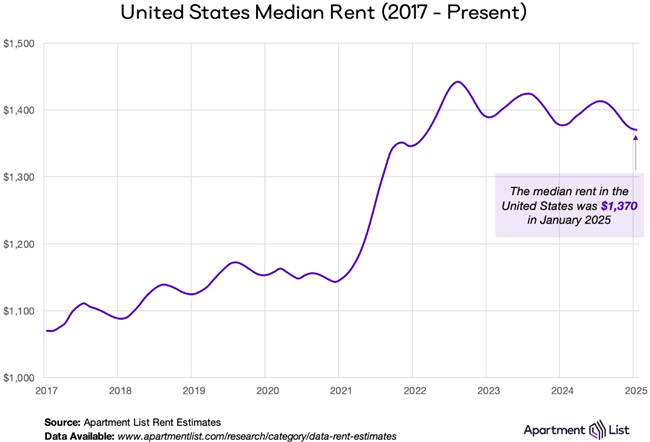
Rents fell 0.2% in January a month that typically marks the “bottom” of the rental market each year, before rents start to rise in the spring. Rents declined less in January than they did in December, indicating a slight pickup in moving activity even as the market remains in its off-season.

But as it stands now, the national median rent is $1,370, its lowest point in nearly three years. And in January, the typical apartment was “on market” for 37 days before renting, an all-time high.

“Year-over-year growth also remains negative at -0.5 percent, but is slowly inching back toward positive territory,” write the Apartment List Research Team in the report. “63 of the nation’s 100 largest cities saw rents fall in January, but on a year-over-year basis, rent growth was positive for 52 of these cities, as more individual markets gradually return to positive rent growth.”

Nationwide rents declined again in January a month that typically marks the “bottom” of the rental market each year before rents rise

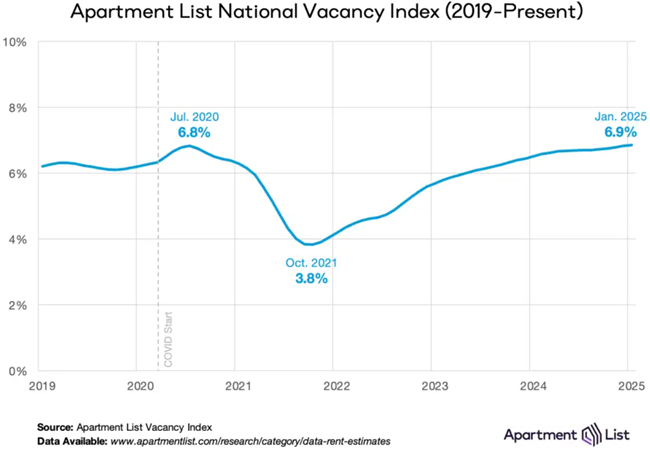
Vacancy index hits 6.9%, a new peak

“Our national vacancy index ticked up to 6.9 percent in January, the highest reading in the history of that monthly data series, which goes back to the start of 2017,” the research team writes.

The rising vacancy rate in recent years is largely attributable to an influx of new multifamily inventory hitting the market. 2023 marked a 30-year high for new multifamily units completing construction, and 2024 saw new completions increase even further. However there are more new units coming in 2025 as there are still 800,000 new multifamily units under construction.

Nationwide rents declined again in January a month that typically marks the “bottom” of the rental market each year before rents rise

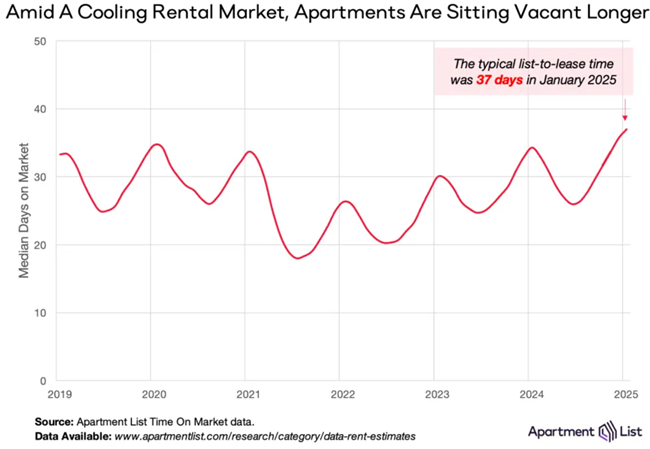
List-to-Lease time hits a new high

“The median time on market of 37 days in January is the highest reading that we’ve seen for this metric in any month going back to the start of 2019, when the data series begins,” the research team says.

The influx of new supply is resulting not only in a growing number of vacant units, but also in an increase in the length of time those units remain unoccupied.

Nationwide rents declined again in January a month that typically marks the “bottom” of the rental market each year before rents rise

Conclusion

“Demand for rentals going forward remains a bit more uncertain, and will likely hinge on broader macroeconomic conditions. Currently, it appears that 2025 is set to be another soft year for the rental market, though not as soft as 2024,” the report says.

Read the full report here.

Sign Up For Our Weekly Newsletter And Get Rental Property And Apartment News And Helpful, Useful Content Each Week.

* indicates required

Addressing Pet Nuisance Complaints in Rental Housing

Addressing pet nuisance complaints as pet ownership in rental housing continues to grow to foster a community for owners

As pet ownership in rental housing continues to grow addressing pet nuisance complaints is essential to foster a community where both pet owners and non-pet owners feel at home. Proactively and fairly addressing common pet nuisances—such as barking, unattended waste, off-leash dogs, or overly enthusiastic jumpers—can build a more harmonious living environment and even boost resident retention and net operating income.

So here are some tactics for living in harmony so operators can manage these challenges collaboratively and successfully, from the Pet Inclusive Housing Initiative.

 By Judy Bellack
Michelson Found Animals

1. Start with clear and inclusive policies.

A strong foundation of well-defined pet policies helps mitigate issues early. Make sure your guidelines are practical and address common concerns:

  • Pet-waste management: Detail proper cleanup and disposal processes and provide resources to make compliance easier.
  • Noise disturbances: Specify quiet hours and expectations for minimizing disruptive behaviors.
  • Unruly behavior and off-leash pets: Clarify leash requirements, expectations for public spaces, and handling fearful, reactive or overly excitable pets.
Addressing pet nuisance complaints as pet ownership in rental housing continues to grow to foster a community for owners
For pet-waste management detail proper cleanup and disposal processes and provide resources to make compliance easier.

These policies should be prominently shared during leasing and in your pet agreement, and reinforced through signage, digital platforms, or community announcements.

Impact: Clear expectations reduce misunderstandings and encourage compliance, which minimizes the number of complaints and creates a better overall experience for all residents.

2. Communicate with empathy and solutions

When addressing pet-related concerns, a respectful and solution-oriented tone fosters better outcomes:

  • Seek to understand: “We’ve received reports of your dog barking. Is there a new stressor in their routine that might be causing this?”
  • Assume good intent: Most pet owners don’t want to cause disruptions and will appreciate help in resolving the issue.
  • Frame it as a partnership: Position solutions as mutually beneficial, emphasizing the goal of a peaceful community.

Impact: Empathetic and solution-focused communication transforms pet-related concerns into opportunities for collaboration, strengthening community harmony and trust.

3. Equip residents with tools and resources

Instead of just issuing warnings, empower pet owners to solve problems with accessible tools:

  • Noise complaints: Share local trainers’ contact information or recommend interactive toys (Kongs, snuffle mats, and automatic treat dispensers can help keep dogs enriched and entertained) and noise-reducing tools (white-noise machines can often help mask external noises that trigger barking). Consider partnering with local pet-care services to offer discounts.
  • Pet waste: Make sure there are an adequate number of waste stations and regularly stock them with bags. Friendly reminders and campaigns like “Community Pet Parent of the Month” awards can encourage positive habits.
  • Leash laws: Know your local community’s leash laws and have the details handy for residents who may not be familiar. Provide maps of nearby off-leash parks to encourage proper exercise.
  • Unruly behavior: Dogs will occasionally become excited and jump up on or pull to approach a new person; suggest simple potential remedies like maintaining a minimum distance, utilizing a gentle leader, or changing to a harness with a front- or side-attaching leash.

Impact: Communities offering support to resolve pet challenges see better compliance and happier residents, leading to better community reviews and fewer negatives affecting retention.

4. Leverage technology to improve fairness

Adopting technology tools ensures consistent and objective handling of nuisance complaints:

  • Pet DNA tracking: This system identifies waste violators while maintaining fairness and anonymity for compliant residents.
  • Pet-management platforms: Use apps to communicate reminders, track training certifications, and document incidents for transparency.

Data point: Communities that integrate pet-management tools report up to a 15% decrease in pet-related complaints, streamlining operations and fostering a sense of fairness among residents.

5. Build a supportive pet community

Fostering connections among pet owners encourages accountability and reduces incidents. Offer community-building activities:

  • Training workshops: Partner with local trainers for onsite or virtual classes to help address barking, jumping, and other behaviors.
  • Pet-friendly events: Host puppy playdates, costume contests, or “meet the pets” socials to strengthen bonds among residents.
  • Exclusive pet-owner forums: Create a space for sharing tips, asking for advice, and fostering community accountability.

Impact: Building a culture of community and support reduces isolation-related behaviors like barking and helps pet owners feel valued.

6. Address persistent issues fairly and transparently

For recurring problems, follow a structured and documented approach:

  • Document incidents: Track complaints, responses, and resolutions for accountability.
  • Propose solutions: Offer options such as professional training, temporary dog-walking services or mediation between affected residents.
  • Set consequences as a last resort: Clearly outline steps for ongoing noncompliance in lease agreements, but emphasize resolution over eviction.

Impact: A balanced approach improves relationships with residents, reducing turnover and building trust in management.

7. Celebrate success stories

Highlight resolved issues to inspire cooperation and a sense of achievement. For example:

  • Share a resident’s journey of reducing barking through training.
  • Recognize responsible pet owners publicly in newsletters or on social media.

Impact: Celebrating success stories helps create a culture of cooperation and pride, inspiring residents to contribute positively to a pet-inclusive community.

Conclusion: Building a Balanced and Pet-Inclusive Community

Managing pet nuisance complaints is a vital part of operating a thriving rental community. By adopting empathetic communication, providing resources, leveraging technology, and encouraging collaboration, operators can resolve concerns effectively while boosting resident satisfaction.

These efforts don’t just benefit the immediate community—they also contribute to long-term retention and NOI growth, making pet-inclusive policies a true win-win.

For more resources on achieving your ideal pet-inclusive community, visit the Pet-Inclusive Housing Initiative.

About the author:

Addressing pet nuisance complaints as pet ownership in rental housing continues to grow to foster a community for owners

Judy Bellack is the multifamily housing industry principal for Michelson Found Animals, a nonprofit focused on improving the lives of pets and their owners. A 30-year veteran of multifamily, she is utilizing her expertise to spearhead Michelson’s Pet-Inclusive Housing Initiative to provide data and resources to create more pet-inclusive communities in ways that make good business sense for owners and operators.

Sign Up For Our Weekly Newsletter And Get Rental Property And Apartment News And Helpful, Useful Content Each Week.

* indicates required

Strengthening Policies, Procedures, and Written Communication in Property Management

Property management and the essential role of policies, written communication and procedures for the year ahead.

Property management and the essential role of policies, written communication and procedures for the year ahead.

By The Fair Housing Institute

As the new year begins, property management professionals have the opportunity to reflect on foundational practices that ensure both compliance and operational excellence.

Among these, few aspects are as critical as robust fair housing policies, well-defined procedures, and professional written communication.

These elements not only safeguard against legal risks but also foster trust and professionalism in interactions with residents, prospects, and team members. This article explores the essential role of policies and written responses, offering a timely reminder to recalibrate for the year ahead.

The Importance of Fair Housing Policies and Procedures

Fair housing policies and procedures serve as the backbone of any property management operation, regardless of the size of the portfolio.

They provide a clear framework for staff to understand their responsibilities and adhere to fair housing laws, ensuring consistent application of these principles across the board. Moreover, well-documented policies act as a vital defense mechanism during fair housing investigations, demonstrating that actions taken were in line with established guidelines.

For property management companies of all sizes, the creation of a basic fair housing policy is non-negotiable.

However, it is not enough to simply draft a policy and let it sit idle. These documents must be living resources, regularly reviewed and updated to reflect changes in legislation or operational needs.

In addition to a general fair housing policy, companies should implement specific procedures addressing reasonable accommodations and modifications. These procedures must clearly outline the steps for processing requests and define the roles of staff members responsible for decision-making.

To ensure these policies are accessible and actionable, many companies utilize a centralized policy manual.

This resource serves as a go-to reference for staff, housing key documents such as fair housing policies, reasonable accommodation procedures, and supporting forms. Regular training sessions are critical to reinforce the importance of these policies and ensure all employees understand their role in maintaining compliance.

The Role of Written Communication in Fair Housing Compliance

In the property management industry, written communication is not merely transactional; it is a direct representation of your company’s brand and commitment to professionalism.

Emails, letters, and even social media responses all fall under the umbrella of marketing and must align with fair housing principles. As such, every written response must be crafted carefully to avoid potential issues of discrimination or misrepresentation.

One area where this is particularly critical is in responding to inquiries about unit availability.

Consistency in responses is essential to prevent any appearance of favoritism or bias. For example, if two prospects inquire about the same unit, the responses they receive should not differ in ways that could be perceived as discriminatory.

All leasing professionals should be equipped with standardized language to address these situations, ensuring a uniform and compliant approach.

Another consideration is the tone and content of written communication with residents.

Professionalism must be maintained at all times, even when dealing with difficult or hostile situations. Emails represent an official form of communication, and as such, they should be approached with the understanding that their contents may later be scrutinized in legal or regulatory contexts.

It is critical to remain composed, clear, and respectful, avoiding language that could escalate tensions or be misinterpreted.

Balancing Efficiency and Personalization in Written Responses

While templates and canned responses can improve efficiency, their use must be approached with care.

Generic responses may be suitable for common inquiries, but personalized communication is necessary for more nuanced or unique situations.

A failure to adapt responses to the context can leave residents or prospects feeling dismissed, potentially damaging the relationship and raising questions about the company’s commitment to fair housing principles.

This is where training becomes invaluable.

Staff must be equipped with the knowledge and judgment to discern when a situation requires a tailored response. Ongoing training programs should address not only the technical aspects of fair housing compliance but also the soft skills necessary to bring a human element to written communication.

This balance between professionalism and empathy is what distinguishes truly effective property management operations.

Preparing for Success in the Year Ahead

The start of a new year offers the perfect opportunity to review and strengthen your company’s policies and communication practices.

Begin by conducting a thorough audit of your fair housing policies and written communication guidelines. Identify any gaps or areas in need of refinement, and make it a priority to address them.

It is equally important to engage your team in this process. Gather feedback from staff on the challenges they face when applying policies or crafting responses, and use this input to inform updates and training programs.

Establish a schedule for regular policy reviews and training sessions to ensure these foundational practices remain top of mind throughout the year.

Finally, remember the power of written communication as a tool to build trust and foster positive relationships.

By prioritizing consistency, professionalism, and a human touch, your team can set the tone for a successful year while reinforcing the company’s commitment to fair housing compliance and exceptional service.

Conclusion

In the property management industry, success is built on a foundation of strong policies, clear procedures, and professional communication.

As the new year begins, take this opportunity to reaffirm your commitment to these principles. By investing time and effort into refining your fair housing policies and enhancing written communication practices, you can navigate the complexities of property management with confidence, fostering trust and compliance in every interaction.

Let this year be one of growth, consistency, and renewed dedication to excellence.

About the author:

In 2005, The Fair Housing Institute was founded as a company with one goal: to provide educational and entertaining fair-housing compliance training at an affordable price at the click of a button.

FTC, Colorado Sue Greystar For Deceiving Tenants On Rent Prices

The FTC and state of Colorado has sued Greystar for deceiving tenants over rent prices and mandatory fees and monthly rent costs

The Federal Trade Commission and the state of Colorado have sued Greystar, the largest multifamily operator in the United States, for deceiving tenants ”about monthly rent costs by tacking on numerous mandatory hidden fees on top of advertised prices,” according to a release.

Since at least 2019 Greystar has “used deceptive advertising to entice consumers into applying for rental housing, and then bilked those consumers out of hundreds of millions of dollars by charging “hidden fees” (mandatory, fixed fees that are not included in the advertised price) for itself and its landlord clients,” according to the complaint filed in federal court in Colorado.

“Greystar is responsible for advertising available units at the properties it manages. Greystar is also responsible for finding qualified tenants to apply for available units. After a unit is filled, Greystar communicates with and collects the rent and hidden fees from the tenant on behalf of the owner.

“Greystar advertises its available apartments widely. Greystar knows that price is the most important factor for the majority of consumers searching for an apartment, and the rental price is a key aspect of Greystar’s apartment listings. Despite this, Greystar consistently omits various mandatory fees from the advertised price. Simply put, consumers cannot lease a Greystar-managed apartment by paying only the advertised price,” the complaint says.

“The FTC is suing Greystar for deceptively advertising low monthly rents only to later saddle tenants with hundreds of dollars of hidden junk fees,” said FTC Chair Lina M. Khan in the release.

“The FTC should continue its work taking on corporate landlords that use illegal tactics to jack up rent, exploit tenants, and deprive Americans of safe and affordable housing.”

Colorado Attorney General Phil Weiser said, “Because of Greystar’s deceptive advertising and hidden fees, tenants are on the hook in their lease for hundreds, if not thousands, of dollars more than they anticipated that their apartment would cost.

“Through their actions, Greystar is thwarting apartment hunters from comparison shopping and choosing a home that fits within their budget. To the extent that other corporate landlords are not advertising their all-in pricing and are engaging in similar tactics, they are on notice that such conduct is illegal and will not be tolerated in Colorado,” Weiser said in the release.

Greystar says on their website they have more than a million multifamily units and student beds under their management.  For example, in Portland, Ore., Greystar manages more than 18,000 units, according to the Portland Business Journal.

How the fees work in the leasing process

Greystar’s hidden fees allegedly range from tens to hundreds of dollars a month, which add up substantially over the course of a tenant’s lease. Among the fees noted in the complaint are “valet trash” fees, package-handling fees, utility fees, fees to distribute utility bills, “verification fees” when consumers use non-Greystar-provided renters’ insurance, and media/smart home packages, among numerous others. The FTC and Colorado say in the release that tenants cannot opt out of these fees even if they do not want or use the related services.

In many instances, tenants who saw an advertisement for a Greystar apartment had no way to learn about these hidden fees until after they filled out inquiry forms with their personal information or clicked through small-print hyperlinks, according to the complaint.

The complaint also explains that Greystar, in some cases, waited to reveal fees until after consumers had paid a substantial application fee or holding deposit, and then only deep in a 40- to 60-page lease agreement. The complaint further charges that if consumers discover the existence of the fees after their application is approved and choose not to sign the lease, Greystar does not refund the application fees or holding deposits they paid, which can be hundreds of dollars.

The complaint cites multiple examples of Greystar-managed properties where its advertisements on third-party real-estate listing sites, like Zillow, failed to list the company’s mandatory fees, despite those sites having a specific “fees” section where the company does list optional fees like those for parking or pets. According to the complaint, even on websites Greystar operated, apartment listings did not include information about mandatory fees, even where optional fees were listed.

The complaint charges that Greystar and a number of its subsidiaries violated the FTC Act, the Gramm-Leach-Bliley Act, and the Colorado Consumer Protection Act.

The commission vote authorizing the staff to file the complaint was 5-0. The complaint was filed in the U.S. District Court for the District of Colorado

The commission files a complaint when it has “reason to believe” that the named defendants are violating or are about to violate the law and it appears to the commission that a proceeding is in the public interest. The case will be decided by the court.

Read the full press release here.

Read the complaint filed in federal district court here.

Sign Up For Our Weekly Newsletter And Get Rental Property And Apartment News And Helpful, Useful Content Each Week.

* indicates required

Frank Roessler On How The Multifamily Industry Could Perform in 2025

How the multifamily industry could perform in 2025 with a Q&A from Ashcroft Capital's Frank Roessler who has cautious optimism for 2025.

How the multifamily industry could perform in 2025 with a Q&A from Ashcroft Capital’s Frank Roessler who has cautious optimism for 2025.

Editor’s note: As the founder and CEO of New York-based Ashcroft Capital, Frank Roessler leads a fully integrated multifamily investment firm that owns and operates approximately 14,000 apartment homes across the Sun Belt states of Georgia, Florida, North Carolina and Texas. In this Q&A with Rental Housing Journal, Roessler offers his take on how the apartment industry could perform in 2025, reviews Ashcroft’s 2024, outlines the company’s goals for 2025 and details the multiple benefits of his firm’s centralized procurement department.

As you look ahead to 2025, what do you think is in store for the apartment industry in the coming year? What do you expect in terms of operating fundamentals and the pace of investment sales?

Roessler: I would describe my outlook as one of cautious optimism. The past couple of years have certainly been challenging for the apartment industry, as a big increase in the delivery of new units has caused an uptick in vacancy rates and softened rent growth. Also, high interest rates have dramatically slowed the pace of investment sales.

But various data points indicate that 2025 could represent an improvement in both operating fundamentals and investment sales volume. We’re seeing a slowdown in the delivery of new apartment communities, and the existing supply is being absorbed, although more slowly than one would hope. This dynamic combined with the ongoing resilience of the U.S. economy could set the stage for more significant rent growth.

At the same time, an uptick in Treasuries may create headwinds as this will adversely impact values and create a further bid-ask spread. This piece of the puzzle will play out as the year rolls on. If inflation continues to come down and the economy cools moderately, we will likely see transactional volume increase. If this happens, 2025 could mark a return to a fairly normal year when it comes to investment sales. Not a historic year, but a normal one.

How would you summarize Ashcroft’s 2024, and what are your company’s goals and plans for the next 12 months?

Roessler: Ashcroft had a strong 2024. We were laser-focused on strengthening our platform of vertical integration, our staffing and our onsite operations.

And given the overall climate, we’re satisfied with our activity in the investment sales market. We completed two acquisitions in the latter part of the year. We recapitalized The Avery, a 20-year-old garden-style community in the Dallas-Fort Worth metroplex. The recapitalization took place when the previous owner—a joint venture between a private equity limited partner and us—sold the property to a joint venture between Ashcroft and Virtus Real Estate Capital. In August, we also acquired Halston Waterleigh, which is a garden-style community just outside of Orlando, in Winter Garden, Florida.

Looking ahead to this year, we are currently under contract to acquire three apartment communities in the first quarter, and we’re also slated to sell two properties as well. Our goal is to acquire a total of five to eight properties this year while remaining disciplined, strategic and conservative in our underwriting.

Ashcroft touts its centralized procurement department as one of the company’s unique characteristics. Describe how that program works.

Roessler: One of our goals is to improve the resident experience at our communities after we acquire the properties. We strive to achieve that by optimizing onsite operations and undertaking thoughtful, strategic renovations of the homes and common-area amenities.

Through our in-house procurement department, we are able to source and acquire renovation materials directly from overseas manufacturers, which provides roughly a 30% discount when compared to buying in bulk from U.S. retailers. All things being equal, this enables us to pass along higher returns to our investors, and it also allows our company to navigate international supply chain disruptions, as well as domestic disruptions like hurricanes and other severe weather events.

Looking beyond 2025, do you see any particular challenges in store for the apartment industry? What is your assessment of the sector’s long-term health?

Roessler: I certainly can’t predict the future. I don’t have a crystal-clear crystal ball. But the available information would indicate that multifamily investment fundamentals remain strong compared with other asset classes. New supply appears set to fall in the coming years, which would help operations, and the cost of buying a home, in an era of still relatively high interest rates, would seem likely to support strong renter demand.

As far as challenges, the Treasury market continues to serve as a headwind for our industry.

About the author:

How the multifamily industry could perform in 2025 with a Q&A from Ashcroft Capital's Frank Roessler who has cautious optimism for 2025.

Frank Roessler is the founder and CEO of New York-based Ashcroft Capital.

Sign Up For Our Weekly Newsletter And Get Rental Property And Apartment News And Helpful, Useful Content Each Week.

* indicates required

LA’s Wildfires Have Left Families in Turmoil. Here are 4 Things Rental Property Owners Can Do Now to Help

Here are 4 things rental property owners can do now to help keep people, pets and families together after LA's historic wildfires.

Here are 4 things rental property owners can do now to help keep people, pets and families together after LA’s historic wildfires.

By The Pet-Inclusive Housing Initiative

In the aftermath of Los Angeles’ extraordinary wildfires that have left thousands of families without homes, one thing is clear: The city’s tight housing market will be strained further. For families with pets, this strain is compounded by breed and weight restrictions and additional fees and deposits for pets in rental housing. According to the Pets in Rental Housing 2025 Outlook from Michelson Found Animals Foundation’s Pet-Inclusive Housing Initiative, 80% of rental properties that allow pets still enforce breed restrictions, and 64% impose weight limits. Renters with pets cite additional hurdles, such as refundable pet deposits, monthly pet rent, and nonrefundable pet fees, making housing accessibility even more challenging.

Families with pets seeking rental housing in the aftermath of LA’s wildfires will need true inclusivity for their furry family members, regardless of breed or size. Housing providers who respond to this demand can expect stronger resident loyalty, reduced vacancies, and goodwill in the community. Here’s how housing providers can help meet this need and support families as they recover:

1. Reduce or eliminate breed restrictions

Research shows that an individual dog’s breed is not a reliable indicator of behavior. Factors such as diet, environment, health, training, breeding, genetics, management, and socialization all influence behavior. More importantly, when prospective residents encounter breed and weight restrictions, they may be more likely to hide their pet or falsely declare it an emotional support animal (ESA). This makes it harder to hold all pet owners accountable to community guidelines.

2. Increase pet weight limits or remove them altogether

There is no evidence that larger pets cause more damage to rental units. Instead of relying on outdated stereotypes for pet policies, properties can assess each pet individually by eliminating restrictions and fostering transparency with residents.

3. Reconsider pet fees

Generally, the industry believes pet fees are necessary to cover potential damages and support pet amenities. However, average pet damages occur in less than 10% of pet-occupied units, and some properties lack even basic pet amenities, making multiple fees—like a pet deposit, nonrefundable pet fee, and monthly pet rent—challenging to justify. Specifically in California, the California Apartment Association strongly recommends against charging “pet rent” or similar fees because they are not plainly permitted by law. Finally, considering that 92% of renters consider pets important members of the family, it is no surprise that renters, when faced with pet fees they cannot afford, may be tempted to hide their pets or have them declared ESAs to avoid having to choose between keeping their pets or remaining housed.

4. Welcome more families with pets while prioritizing safety

Properties can adopt a set of pet personality questions and a comprehensive pet agreement to establish clear expectations for all residents with pets. These steps create a safer and more supportive environment for everyone.

By implementing these changes, housing providers can meet the needs of renters with pets and foster a pet-inclusive community. Supporting families during such a critical time helps build trust and long-term resident relationships, creating lasting benefits for everyone involved.

In this time of devastation, families need the safety and security of a place they can call home—with their pets. Pets are family, and with simple and immediate changes to pet policies, housing providers can help keep families together while still addressing their business needs.

For more pet-inclusive housing information and resources, visit petsandhousing.org.

Read the article here.

Sign Up For Our Weekly Newsletter And Get Rental Property And Apartment News And Helpful, Useful Content Each Week.

* indicates required