An Illinois court has ordered a landlord to pay more than $80,000 for threatening to call immigration authorities (ICE) on a tenant couple who rented an apartment from him in 2020, according to reports.
The couple sued the landlord, Marco Antonio Contreras, under the Illinois Immigrant Tenant Protection Act (ITPA), which protects tenants from discrimination or harassment based on their immigration status, said the Mexican American Legal Defense and Educational Fund, (MALDEF) which filed the lawsuit on behalf of the couple in 2022.
MALDEF filed the suit because the family’s landlord “threatened to call U.S. Immigration and Customs Enforcement (ICE) during a rent dispute, solely based on the parents’ perceived immigration status. The suit was the second brought by MALDEF under ITPA, which bans landlords from discriminating against or harassing a tenant based on the tenant’s actual or perceived immigration status,” according to a release.
According to the lawsuit, the tenant family rented a basement apartment from Contreras and his wife beginning in 2017. On June 30, 2020, the landlord went to the family’s apartment and demanded payment of the July rent. During the discussion, Contreras threatened to report the couple to federal immigration officials, in violation of the law.
“We decided not to stay silent because our landlords threatened us with calling immigration, and we do not believe that anyone has a right to threaten us,” the tenant couple said in a statement. “No one should feel or act superior to others. We are all equals and deserve respect. Just because someone is your landlord does not mean that they get to do whatever they want to you.”
Landlord ordered to pay
On February 19, 2025, Illinois Circuit Court Judge Catherine A. Schneider ordered landlord Contreras to pay more than $80,000 in damages as well as attorneys’ fees and costs for violating the ITPA. The judge also awarded a smaller sum in compensation for denying the tenants access to their belongings.
“Everyone has rights under the rule of law regardless of their actual or perceived immigration status. In Illinois, landlords are prohibited from wielding the threat of immigration enforcement as a weapon against their tenants,” said Susana Sandoval Vargas, MALDEF Midwest Regional counsel, in the release.
“This decision shows that those who choose to disregard these protections will face serious consequences. This is an important victory for all tenants in Illinois, who, like our clients, just want a safe place to call home.”
Illinois was the second state in the United States to enact legislation in 2019 protecting immigrant tenants’ rights. Both New York City and the state protect immigrant tenants’ rights. California passed an immigrant tenant law in 2017. In 2021, a Colorado Tenant Protection Act went in
You can hardly turn on a television or read a newsfeed where you don’t encounter the term “trigger words.” While there are some universally accepted trigger words, like racial or ethnic slurs, most people or groups have their own unique lexicon of words that send them immediately into orbit. Our industry is no different, and over the years the way we identify the players in our game have even fallen victim. In many circles, “landlords” are now more generically referred to as “housing providers,” while tenants are now more often called “residents.”
As a landlord (I can call myself that because I am one) for more than 20 years, I have encountered thousands of applicants who are looking to rent my property. In looking at them as a potential “business partner,” I engage several of my senses to get a read on what kind of potential partner they might be. More important than anything, I listen closely to the questions they ask as we tour the property. The following is a list of the top trigger words or phrases that every landlord, old and new, should intently listen for to ensure they are getting the best possible read on a person for their property and partnership.
1. Are you going to perform a background check on me?
Has an innocent person with nothing to hide ever asked this question?
The likely answer is no. Why would they?
If I have no criminal background history, then I have nothing to fear; run all the background checks you want. As an applicant, if I have something in my past that I am trying to keep from you as my potential landlord, I’d rather know up front, so I don’t waste time or money on trying to qualify for your property. If this question ever comes up, now is the perfect time to introduce your rental criteria. Let the applicant know that you have a standard criteria and that these rules are applied evenly and fairly to all applicants. It’s easier to let the criteria work for you in showing exactly where the standard is for qualifying for your property. Make sure the criteria are clear in defining exactly what you are looking for when it comes to disqualifying criminal history. And if you don’t have a criteria, consult with your attorney or local experts to ensure that what you are doing in regard to background checks is legal. We have a great detailed sample criteria we would love to send to you. Just email [email protected]
2. Do you require a deposit up front?
I can’t tell you how many times I’ve heard this question, or one similar to it.
I’ve been asked to spread out a deposit over a few months, or even the entire term of the lease. Whatever form it comes in, it puts me on alert. Why? Because it usually indicates that money is tight and that I may not be a priority when finances are stretched thin. When a medical bill or car-repair charge hits a tenant hard, you may be the last person to get paid, if you get paid at all. Now is the time when you really have to stick to your guns and require that deposit, as it may be the only protection you have moving forward.
3. Can I move in immediately?
I’ve shown properties where the individuals have arrived at the showing with the moving van packed and ready to unload.
This concerns me, as I have to ask them why they are needing to move so quickly. Did they just get evicted? Did they leave their last residence in the middle of the night to avoid being seen by their landlord? Granted, there are times when an applicant just suffered a devastating loss by flood or fire and needs immediate housing. Asking follow-up questions on why they need to move so quickly will help you analyze the situation and make the best decision for you and your property.
4. How many people can stay here?
While it might seem harmless, this question could lead to more people living in your property than it can accommodate.
When an applicant sees your listing as a 3-bedroom, 2-bath, it’s pretty safe to expect it can accommodate up to 6 people. Establishing the maximum occupancy in an applicant’s mind lets them know what you expect and consider as “too many” people in the home. This question is often accompanied by “how long can someone stay and still be considered a guest?” Both of these together or individually are cause for you to ask a lot of follow-up questions to determine exactly how your property will be used. Again, clear criteria can protect you in this area.
5. How many pets can I have in the property?
Pets are just part of the business and having a firm policy regarding number or type is a great way of protecting your investment. While you don’t want a zoo moving in, having a no-pet or one-pet policy is pretty standard. Make sure to require an additional deposit (see point No. a 2) and collect all of it before move-in. It’s beneficial to define what is considered a pet and to clearly communicate what animals are and are not allowed in or on the property. I’ve seen tenants who tried raising chickens in the back yard use the excuse that, a) they aren’t pets and b) they never go inside the residence. Along with violating our lease, they also violated the CCR’S of the Homeowners Association and made me subject to a pretty hefty fine with the city. Clarity, especially when it comes to pets, will save you a lot of headaches.
6. My current landlord is a jerk
This trigger word lets me know that I just might be the next “jerk”.
Most landlords I meet just want to maintain their property value and make money, and keeping tenants happy is an integral part of that game. No one wants to discourage a good, paying tenant who is taking care of the property; ask your applicant why they feel that way. Often, I hear the current landlord will not return their calls. I see a frustrated landlord when this action starts and, in my mind, it always takes two to tango.
There are countless other things to listen for as you meet with a rental applicant; you likely have stories to tell that top my experiences. Listen intently, ask as many follow-up questions as you need, and communicate your criteria and policies clearly. After all, when you are getting ready to turn your keys over to a sizable asset, knowing who you are renting to is critical to your success in this business.
About the Author:
David Pickron is President of Rent Perfect, a private investigator, and fellow landlord who manages several short- and long-term rentals. Subscribe to his weekly Rent Perfect Podcast (available on YouTube, Spotify, and Apple Podcasts) to stay up to date on the latest industry news and for expert tips on how to manage your properties.
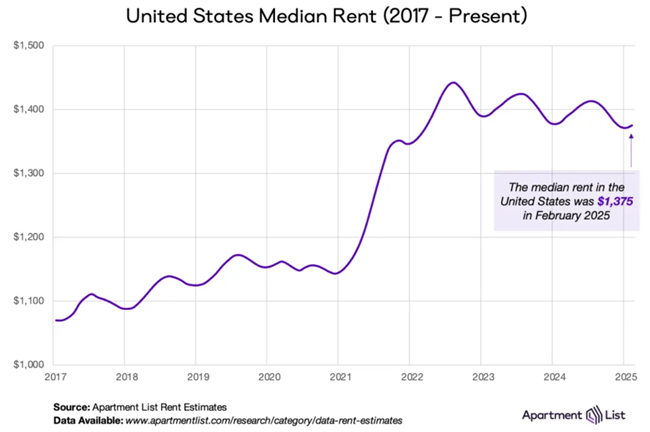
National rent growth flipped back to positive in February for the first time since July 2024, according to the March report from Apartment List.
National rents fell 0.2% in January, a month that typically marks the bottom of the rental market each year, but then grew by 0.3 percent in February following six straight monthly declines.
Year-over-year national rent growth also remains negative at -0.4 percent, but is slowly inching back toward positive territory. In dollar terms, the national median monthly rent now stands at $1,375, up $4 per month compared to February but down $5 compared to February 2024, the Apartment List research team writes in the report.
At the local level, 75 of the nation’s 100 largest cities saw rents rise in February.
On a year-over-year basis, rent growth is now positive for a majority of large cities (58 of the top 100).
The Apartment List national index remains negative largely due to steeper declines in a concentrated set of Sun Belt metros that are rapidly expanding their multifamily inventory; these include Austin (-6.9 percent year-over-year), Denver (-4.7 percent), and Raleigh (-3.2 percent).
“Rent growth follows a seasonal pattern – prices tend to go up during the spring and summer and dip during the fall and winter,” the research team writes. “The end of the year, in particular, generally sees the slowest rental market activity as few households move during the holiday season.
“Demand tends to bounce back in the new year, gradually ramping up to peak season activity in the late spring and early summer. In keeping with that pattern, February saw a return to positive rent growth, with prices ticking up for the first time since last July.”
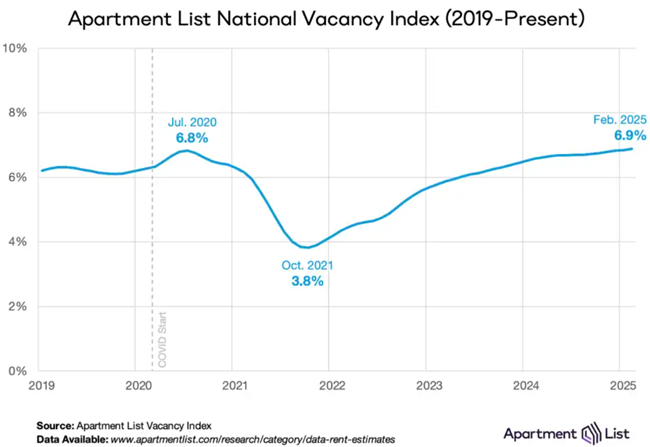
Multifamily vacancy rate hits 6.9%, a new peak
The rising vacancy rate in recent years is largely attributable to an influx of new multifamily inventory hitting the market.
“As new apartment completions decline, the vacancy index could begin to tighten again, but for now, we’re still seeing vacancies rise, even as rent declines gradually moderate,” the research team says.
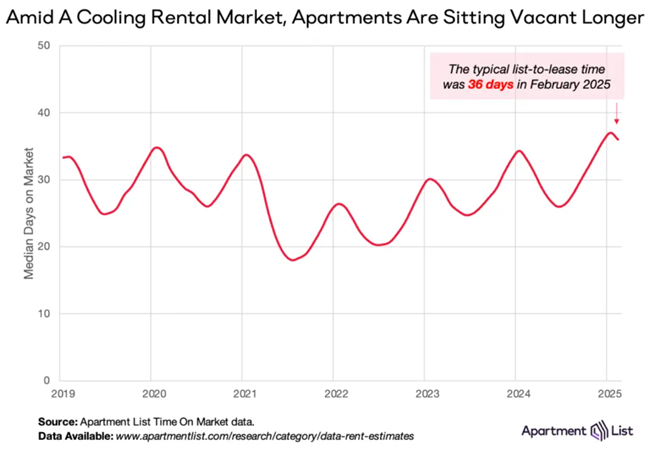
List-to-Lease time retreats from all-time high
The slight decline in time-on-market in February is in line with the seasonal return to positive month-over-month rent growth.
“That said, this is still the highest time-on-market reading that we’ve seen in February of any year going back to the start of 2019, when the data series begins. Units are currently sitting vacant for three days longer than they were at this time last year, and for 10 days longer than they were in February 2022, when the market was just beginning to loosen. The influx of new supply is resulting not only in a growing number of vacant units, but also in an increase in the length of time those units remain unoccupied,” the research team writes.
Multifamily new supply construction starts are now 40% below the peak level recorded in 2022, Yardi Matrix says in a new Multifamily Supply Forecast report.
This decrease, however, comes from a very high starting level, and a still-large inventory of properties remains to be completed.
Overall, the number of units under construction tracked by Yardi Matrix is declining. However, in 2025 the still-large under-construction pipeline will deliver the second-highest amount of annual new supply since the 2008 financial crisis, trailing only 2024’s record volume.
“This slowdown has begun to work its way into the under-construction pipeline, which will result in a contraction of new supply from 2025 through 2027. That follows a very high level of development activity and a large inventory of properties still to be completed.
“As a result, forecast completions for 2025 have been increased by 3.3% to roughly 525,000 units, with a 2026 increase of 11.5% to 414,000 units,” writes Ben Bruckner, Senior Research Analyst, for Yardi Matrix.
For the Q1 2025 update, the Yardi Matrix Multifamily Supply Forecast was increased for years 2025 through 2027. The forecast for the remaining years is substantially unchanged. Chart courtesy of Yardi Matrix.
The continued elevated construction completion times are a key factor here, the report says, and some amount of the current under-construction inventory will not be completed until 2026. The current forecast update, therefore, anticipates new supply will not fully bottom until 2027.
“For the longer term, the current forecast assumes a higher-for-longer Federal Reserve policy will keep short- and longer-term interest rates elevated. Continued tight new development financing combined with long development lead times will cause construction starts to remain at the same level in 2025 as seen in 2024, resulting in new supply bottoming in 2027,” Bruckner writes.
Yardi Matrix researches and reports on multifamily, office and self-storage properties across the United States, serving the needs of a variety of industry professionals. Yardi Matrix Multifamily provides accurate data on 18+ million units, covering more than 90 percent of the U.S. population. Contact the company at (480) 663-1149.
California is preparing for new move-in, move-out documentation law that requires landlords take photos of rental units before and after a tenant moves in. Digital photography and storage through property management software could help.
By Richard Berger
A layer of complexity will be added to onsite and maintenance teams in California regarding move-ins, move-outs, and security deposits when California law Assembly Bill (AB) 2801 goes into effect this year.
The new documentation law requires landlords to take photos of rental units before and after a tenant moves in. The law also requires landlords to provide these photos to tenants along with any itemized deductions.
Apartment owners or management companies must take high-resolution, date-stamped photos of the unit before the tenant moves in and immediately after the tenant moves out.
Beginning April 1, an owner or management company must take photographs of the unit within a reasonable time after the possession of the unit is returned to the owner/manager but before any repairs or cleanings for which the owner/manager will deduct from the deposit are completed, and that the owner/manager take photographs of the unit within a reasonable time after the repairs or cleanings are completed.
Owners must take photos of the unit after repairs or replacement items such as appliances are complete or the new item is installed.
AB 2801 takes effect for move-ins on or after July 1, 2025.
AB 2801 also imposes stricter limits on security deposit deductions. It clarifies what qualifies as “reasonably necessary” charges for cleaning and repairs
The bill restricts any deductions taken by a housing provider against a tenant’s security deposit, limiting such deductions to reasonable amounts and repairs that are “reasonable and necessary” to restore the premises to their condition before the tenancy, except for ordinary wear and tear.
Assembly Bill 2801 prohibits operators from deducting the cost of professional services such as professional carpet cleaning, unless reasonably necessary.
“In the long run, this is going to help reduce disputes,” Kim Arnold, Vice President – Management, Atlantic Pacific Management, said.
Arnold said her on-site team would handle the photography during the initial walk-through, and her maintenance team would handle the photography at the move-out stage.
Her firm operates 2,500 units in San Diego and Riverside County with an annual turnover rate of 24.1 percent, well below the industry average of 50 percent.
Her teams also must manage the process, such as labeling the photos and downloading and preserving the images.
Mobile maintenance apps have grown in popularity in recent years. Software tools such as AppWork and others streamline and simplify the process, allowing digital photography and storage to be handled through an onsite team member’s company-issued phone.
“The move-out post-repair photos will be the most difficult logistically and administratively because, for example, when replacing a stove, the new stove doesn’t always arrive within 21 days, so you must wait for it,” Arnold said.
“In the end, we don’t want to go to small claims court over security deposit complaints. We give our managers a lot of latitude when deciding how to handle the situation. We haven’t been to court in eight or ten years.”
The documentation law, AB 2801, could create unnecessary delays in the turnover process, directly impacting unit availability and operational efficiency. According to Sean Landsberg, CEO of AppWork, the key will be leveraging technology to streamline photo capture, organization, and retrieval while minimizing disruptions to day-to-day maintenance work.
“Meeting the requirements of AB 2801 means going beyond just taking photos, it requires a structured process for taking, storing, and accessing images efficiently,” Landsberg said.
“Maintenance software allows teams to capture high-resolution, time-stamped photos directly within a work order, automatically linking them to the unit’s history for easy compliance. By automating this process, operators can ensure they meet legal requirements while keeping their teams focused on core maintenance responsibilities rather than administrative tasks.”
Windell Mollenido, VP of Marketing & Technology, REMM Group, called AB 2801 a big deal.
“That’s going to take a lot of time for our maintenance and onsite teams,” he said. “It’s almost as if they have to record a virtual unit tour with their smartphones. That’s not to mention having to label the images, upload them to our property management platform, and manage them.
“This is not exactly what we have in their job descriptions. They’ll need to focus on taking consistent images – that means focusing on the right things and not blurry. We’d rather have them spend more time maintaining our apartments by handling work orders.”
REMM manages approximately 6,000 apartments throughout Southern California – from San Diego to Los Angeles to the Inland Empire.
About the author:
Richard Berger is a freelance journalist who has 20+ years of experience covering commercial real estate for various media sites and CRE-related associations. He lives in Northern Virginia.
Rising vacancies challenge property management the real estate property-management software company AppFolio says in its 2025 Property Management Benchmark Report, based on insights from more than 2,000 property management professionals.
“The property-management industry is entering 2025 at a moment when rising vacancies, growing competition for renters, and increasing concerns around fraud and cybersecurity are creating a more challenging business environment,” AppFolio writes in the report. It “reveals what’s on the industry’s mind, as well as the strategies and tools that forward-thinking businesses are using to stay ahead.
“These challenges, however, also present an exciting opportunity to innovate, streamline operations, and deliver even greater value to residents and property owners alike.”
Highlights of the report
Challenges Facing Property Managers
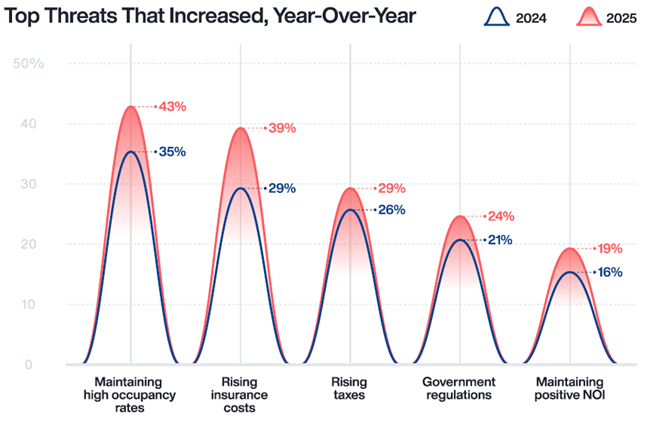
In the proptech (real estate + technology) industry, top concerns have shifted from macroeconomic issues, such as inflation, to more industry-specific challenges, such as rising insurance costs.
Difficulty in maintaining occupancy rates is now the No. 1 threat, with a 20% increase since 2023, overtaking inflation.
40% of property managers consider rising insurance costs a top threat, particularly in natural disaster-prone Southern/Western states.
70% of property managers now track resident satisfaction, up 10% from last year.
Rise in AI usage
Property managers are increasingly turning to AI to tackle key challenges such as resident retention and fraud prevention. The use of AI increased by 13% year over year (YoY), from 21% in 2024 to 34% in 2025.
The most common use of AI is resident communication (60%), and over half (51%) of property managers now use AI to improve resident satisfaction (an 8% YoY increase).
A quarter (25%) of companies are encouraging employees to use AI (an 8% YoY increase).
The percentage of property managers with no plans to start using AI decreased YoY by 14%.
On the flipside, the top concerns with AI implementation are security and data breaches (41%) and AI regulation and compliance (33%).
The Rising Threats of Fraud and Security:
Property managers are facing increased pressure to protect both their businesses and their residents from a rise in fraud
Compared to last year, property managers are 40% more concerned about online fraud incidents and 37% more concerned about data security.
In the past year, 79% of property managers experienced payment fraud and 88% experienced data issues.
Only 16% of property managers are completely confident in the authenticity of applicant-provided documentation.
In 2025, the U.S. real estate sector stands at a pivotal crossroads, with the new year promising a mix of opportunities and challenges.
While recent years have brought turbulence, from rising insurance costs to fluctuating interest rates and persistent labor challenges, 2025 offers glimmers of hope alongside continuing complexities.
Interest rate adjustments and stabilizing insurance premiums provide reasons for optimism. At the same time, natural disasters, labor shortages and evolving litigation trends demand vigilance.
Real estate owners and operators must adopt robust strategies that integrate risk management, employee engagement and financial planning to stay ahead. By preparing for shifting market dynamics and addressing key challenges, those within the sector can position themselves for resilience and profitability.
Retaining and attracting talent amid persistent labor shortages
The tight labor market continues to challenge the real estate industry, impacting property management, construction and tenant operations.
High turnover rates among maintenance staff, security personnel and cleaners create operational vulnerabilities, including increased property risks and insurance costs.
For tenants, the issue is equally pressing.
Businesses in hospitality, retail and food services face staffing shortages that hinder their ability to meet lease obligations and operate safely. Property owners must invest in recruitment and retention strategies, while also creating environments that attract tenants’ employees back to the workplace.
Enhancing workforce engagement requires a multifaceted approach that addresses both employee needs and operational challenges. Offering personalized benefits through data-driven strategies can significantly improve employee satisfaction and retention, creating a more stable and motivated workforce.
Additionally, investing in property enhancements, such as upgraded amenities and improved safety features, not only makes workspaces more appealing but also fosters tenant satisfaction.
To address construction labor gaps, collaborating with contractors and workforce development programs is essential for ensuring that projects are completed efficiently and on schedule.
Profitability in a complex landscape: Balancing rising costs and new opportunities
Profitability in real estate remains under pressure, with operating expenses such as construction, insurance and labor costs rising steadily.
Additionally, the industry grapples with high borrowing costs and increased vacancy rates, particularly in the office and industrial sectors. Office vacancies surpassed 20% in 2024, a stark indicator of ongoing challenges. Close to $1 trillion in commercial real estate mortgages are also slated to mature by the end of the new year, creating additional refinancing pressures.
Yet, 2025 could mark a turning point. The Federal Reserve’s recent interest rate cuts of 50 basis points, combined with expectations for further reductions, are likely to lower borrowing costs, spurring new demand and alleviating refinancing pressures. Investors and operators could also see relief in stabilizing insurance premiums, particularly for properties with strong risk management programs.
Real estate owners looking to improve profitability in 2025 can employ several key strategies. First, evaluate exposures by collaborating with a broker to assess risks and uncover opportunities for securing comprehensive yet affordable insurance coverage.
Next, leverage rate stability in the insurance market by refining your risk management practices, making your properties more attractive to insurers and securing favorable terms.
Finally, adapting to shifting demand is crucial; targeting investments in high-growth sectors such as multifamily housing and logistics properties can help capitalize on emerging opportunities and drive profitability.
Preparedness for emerging risks and adapting to new threats
The real estate industry must prepare for an evolving risk landscape in 2025. Climate change continues to intensify natural disasters, while litigation risks, including ADA compliance lawsuits and cybersecurity threats, are on the rise.
Third-party litigation financing is a growing concern, as it enables lawsuits that target real estate operators for perceived regulatory noncompliance. Cyberattacks also pose significant risks, with potential for both financial losses and reputational harm.
Effective risk preparedness in 2025 hinges on adopting best practices that address evolving threats and regulatory demands. Developing a robust Enterprise Risk Management (ERM) framework is essential for identifying and mitigating risks across all aspects of operations.
Staying ahead of compliance requirements, such as those outlined in the Americans with Disabilities Act, can help real estate owners and operators avoid costly litigation.
Additionally, strengthening cybersecurity through investments in advanced technology and employee training is critical for protecting against data breaches and other digital threats, ensuring both operational continuity and reputation management.
Building resilience through rate stabilization
After years of sharp increases, 2025 is set to bring relief to property insurance costs. Stabilization in the market is expected as insurers restore profitability and competition increases. Properties with strong risk management programs could even see premium reductions.
However, challenges remain for properties in disaster-prone areas. Events like convective storms and wildfires drove $42 billion in insured losses in the first half of 2024, highlighting the importance of proactive risk management.
Building resilience in 2025 requires a proactive approach to property management and risk mitigation. Maintaining properties in top condition, particularly by ensuring they are built or upgraded to withstand natural disasters, is a key factor in attracting favorable insurance terms.
Accurate property valuations are equally important, as they help avoid disputes with insurers and ensure fair premium assessments. Additionally, implementing targeted mitigation plans, such as addressing vulnerabilities like water damage risks, can significantly enhance a property’s insurability and overall resilience to potential threats.
Practical steps for success in 2025
Navigating the complexities of 2025 will require a thoughtful approach to risk management, workforce vitality and financial planning. By partnering with industry experts, real estate owners and operators can safeguard their assets, support their employees and seize new growth opportunities.
Five key considerations for the new year include:
Safety first: Emphasize safety training and regulatory compliance to reduce exposure to nuclear verdicts.
Monitor loss trends: Use analytics to address root causes of claims and present a strong case to insurers.
Risk management: Adopt proactive strategies, including higher deductibles and alternative risk transfer vehicles, to manage rising costs.
Enhance workforce benefits: Personalized benefits can foster a more engaged and productive workforce.
Communicate with brokers: Maintain transparency about operational changes to secure optimal insurance terms.
Thriving amid uncertainty
By staying informed and adaptable, real estate stakeholders can turn challenges into opportunities in 2025. From stabilizing costs to fostering resilience, the new year offers pathways to sustained growth and success.
About the author
James “Chip” Stuart
James “Chip” Stuart is the corporate Chief Sales Officer and Practice Leader for global insurance brokerage Hub International’s real estate specialty in North America.
Preventing Fair Housing violations requires a proactive approach by housing providers to catch issues before they arise and stop harassment before it starts.
In property management, ensuring a safe and respectful living environment isn’t just about reacting to problems—it’s about preventing them before they arise. Illegal harassment by employees or contractors can lead to fair housing complaints, legal consequences, and damage to a company’s reputation. Rather than waiting for issues to surface, housing providers must take a proactive approach to prevention.
By implementing strong policies, educating all staff and contractors, and fostering a culture of accountability, property management companies can significantly reduce the risk of harassment and discrimination claims.
Education and Training: The First Line of Defense
One of the biggest mistakes a housing provider can make is assuming that fair housing compliance is “common sense.” Every employee, from leasing agents to maintenance workers, and every contractor who interacts with residents needs proper training on:
What constitutes illegal harassment under the Fair Housing Act.
How to handle resident interactions professionally and respectfully.
The importance of cultural sensitivity and inclusive communication.
The consequences of non-compliance for individuals and the company.
Annual training sessions should be mandatory for all employees. Additionally, housing providers should offer refresher courses when policies are updated or when incidents indicate a need for further education.
Establishing Clear Policies and Expectations
Setting clear expectations ensures that everyone—employees, contractors, and residents—understands what is acceptable and what is not. Housing providers should:
Develop and distribute an anti-harassment policy outlining prohibited behaviors.
Require written agreements with contractors that include adherence to fair housing policies.
Implement a zero-tolerance stance on discrimination and harassment.
Communicate clear reporting procedures for residents and staff.
By putting these policies in writing and enforcing them consistently, companies create a structure that prioritizes respect and compliance.
Creating a Culture of Accountability
Preventing fair housing violations is not just about policies—it’s about culture. A property management company that fosters accountability and respect will naturally have fewer fair housing complaints. This starts with leadership.
Managers should:
Model respectful behavior in all interactions.
Regularly discuss fair housing and anti-harassment policies in team meetings.
Conduct spot-checks or resident surveys to gauge experiences with staff and contractors.
Hold all employees and contractors accountable for violations—no exceptions.
If complaints arise, management must act swiftly to investigate and remedy the issue. Failure to take reports seriously sends a dangerous message that harassment is tolerated.
Strengthening Contractor Oversight
One common misstep in property management is assuming that because a contractor is not an employee, their behavior is not the company’s responsibility. However, under fair housing laws, housing providers are still liable if a contractor harasses a resident.
To prevent contractor-related violations:
Review your fair housing policies and procedures with contractors.
Encourage residents to report issues involving anyone they interact with on the property.
Take immediate action if a contractor’s behavior is inappropriate, working with their company to find a resolution.
Housing providers must ensure that every individual on site—whether an employee or contractor—understands and follows fair housing laws.
Encouraging a Safe Reporting Environment
A proactive approach isn’t just about stopping harassment before it happens—it’s also about ensuring that when concerns arise, residents and staff feel safe reporting them.
To create an open and fair reporting process:
Make it easy for residents to report issues through multiple channels (e.g., online forms, anonymous hotlines, or direct contact with management).
Assure residents that their complaints will be taken seriously and investigated.
Train managers and supervisors to handle complaints professionally and without bias.
Remind all employees that retaliation is illegal and will not be tolerated.
When residents and employees feel comfortable reporting concerns, housing providers can address problems early, before they escalate into major legal issues.
Final Thoughts: Prevention is Protection
In today’s property management industry, waiting until a fair housing complaint arises is too late. Housing providers must be proactive, not reactive, in preventing illegal harassment. Through comprehensive training, clear policies, strong leadership, contractor oversight, and a safe reporting culture, companies can create communities where respect, compliance, and fairness are the standard.
By investing in prevention, housing providers protect their residents, their employees, and their company’s reputation—ensuring that fair housing compliance isn’t just a requirement, but a core value.
About the author:
In 2005, The Fair Housing Institute was founded as a company with one goal: to provide educational and entertaining fair-housing compliance training at an affordable price at the click of a button.
Emotional support animals can be a challenge for landlords and requests for accommodation may catch a property manager off guard when presented with their first emotional support animal letter, so here are some options to think about.
By Holly Welles
Owning a rental property presents many challenges landlords may not anticipate until they become reality. Landlords may not think about certain kinds of insurance until it’s too late, or value community outreach until tenants leave online reviews when their leases end.
It’s also common for landlords to feel caught off-guard when presented with their first emotional-support-animal (ESA) letter.
Many communities, including those that don’t allow pets, find themselves home to individuals who need support pets to live their daily lives. It may challenge landlords to take a second look at their rules and guidelines while they figure out what is or isn’t allowed under each lease.
Read on to learn everything landlords should know about emotional support animals. After brushing up on federal guidelines, the options available to tenants and landlords will become apparent, and will make the conversation easier for everyone involved.
Tenants Need a Signed Letter
Landlords unfamiliar with emotional-support animals may wonder if some tenants want to circumnavigate no-pet rules when they don’t actually require the support. If they present a signed letter, it means they’ve visited with a licensed mental-health professional and have received a diagnosis that requires a companion.
Legally, landlords cannot call the health-care provider unless they receive written and signed consent from the tenant. The doctor may also leave a note welcoming landlords to call him or her with any questions or concerns. During that call, rental management cannot ask for someone’s medical history, even if the tenant gives written consent.
A signed letter means a potential tenant had a visit with a licensed mental-health professional and a diagnosis that requires a companion emotional assistance animal. Photo credit Lady-Photo via istockimages.com
Emotional Support Animals Don’t Count as Pets
Some landlords may struggle with allowing an emotional support animal on their property because they’ve already established a no-pet policy.
According to guidelines from the Department of Housing and Urban Development (HUD), assistance animals don’t count as pets because they work to provide service, tasks or assistance to make life easier for people with disabilities.
Whether a person has a dog, cat or another kind of animal, if they’ve received a verified letter from a medical professional, landlords must make changes to accommodate them on the property.
Emotional support animals are not pets. Photo credit fcscafeine via istockphoto.come
Tenants Have Rights
As long as a tenant meets the definition of being disabled, they’re allowed to have an emotional-support animal. When they require one, landlords must change their policies and services to accommodate them. This includes strict no-pet communities.
Even if a tenant has already signed a lease and agreed to having no animals in their unit, they can still bring home an emotional-support animal if it’s verified. It’s illegal to nullify a lease based on a person’s need to accommodate their disability or reject a potential candidate because they require a service animal.
Liability Insurance May Increase
Because emotional-support animals don’t legally count as pets, they’re not required to meet any community rules regarding restricted breeds and weight limits. It’s one less barrier for people in need to worry about, but it can cause some concerns for landlords.
Restricted breeds and animals above the required weight limit may increase the property’s liability insurance, causing landlords to pay more or lose their policy altogether. Property managers struggle with this, and it’s often the reason a few of the rare emotional-support-animal cases go to court.
If the court is to rule in a landlord’s favor, the landlord must prove that the increased or lost insurance creates an undue administrative or financial burden. Although this is a legal route for landlords to take, these cases rarely result in rulings in their favor. Most of the time, tenants are allowed to keep their emotional-support animals as long as they have their verified letter from a mental-health professional https://www.pharmacybc.com/xanax-alprazolam/.
Rules Landlords Can Follow
To help navigate these sometimes-tricky situations, HUD has issued an assistance-animal notice to clarify the terms and legal allowances for emotional-support animals. It guides both landlords and tenants by getting into the finer details of common questions regarding what is and isn’t legal.
Landlords should also be aware that they may need to navigate these waters more often. Emotional-support companions are becoming more common each year, causing people to worry that this allowance will be taken advantage of. Federal law has already considered this because it limits one service animal per person, although in some cases people are allowed to have two or more depending on their disability.
As long as the emotional-support animal doesn’t have a documented history of harming others, landlords cannot reject it from living on their property. Any shown history of threats to other tenants must contain overwhelming evidence to hold up in court.
Look to the Future of Pet Policies
It’s smart for landlords to look to the future and plan for pet-policy changes as the rental landscape adjusts to the needs of tenants. More young people are living in rental units for more extended periods, including when they start families. As their families expand, individuals in their unit may require emotional-support animals and an understanding landlord.
If property managers have any questions or concerns regarding their rights or the rights of tenants, they can look to the assistance-animal notice recently published by HUD for more clarity. It covers most situations that could occur so disputes may find a resolution without the need to go to court.
Federal lawmakers have introduced a bill to allow landlords to give tenants in federal subsidized housing 3-day eviction notice, according to reports.
Landlords had been required to give 30 days’ notice to tenants in federally subsidized housing before evicting them for non-payment of rent, after COVID-19 protections had ended.
The U.S. Department of Housing and Urban Development (HUD) had made the 30-day eviction rule permanent. It has served as a buffer to state laws in 20 states that allow landlords to evict tenants with three days’ notice or less, which include Missouri, New Jersey, California and Ohio.
According to the New York Times, about 3.7 million families live in public housing or in properties with federally backed mortgages and those who rely on housing vouchers.
Advocates for the elimination of the requirement say a 30-day notice places an unfair burden on landlords and property owners. They say states, not the federal government, should set eviction laws.
U.S. Senators Cindy Hyde-Smith (R-Miss.) and Bill Hagerty (R-Tenn.) have introduced the legislation to “restore the right of states and localities to regulate eviction policies by striking a federal pandemic-era requirement that continues to roil the rental market years after the national health emergency ended,” according to a release.
The Respect State Housing Laws Act (S.470) would strike a section of the Coronavirus Aid, Relief, and Economic Security (CARES) Act of 2020 that continues to require landlords and property owners to issue a 30-day Notice to Vacate (NTV) before filing to evict a tenant for nonpayment of rent. Prior to the CARES Act federal mandate, NTV requirements were set on a state-to-state basis with an average eight-day notice.
“Landlords and property owners have been under significant stress since the federal government inserted itself into the realm of state and local housing regulations,” Hyde-Smith said in the release.
“We must acknowledge that precautions enacted during a long-ended national emergency were never meant to last forever, and that couldn’t be truer for the federal 30-day notice-to-vacate rule. It’s well past time to eliminate rule.”
These households are disproportionately made up of single parents and children, with no other housing options and little to no savings.
The National Housing Law Project, which provides legal assistance to affordable housing residents, says that the federal statute helped to significantly decrease evictions among this group, because it gave renters who were short on cash at the end of the month some time to figure out how to pay, and stay in their homes.
The New York Times reported that this is the second time the bill has been introduced; it was introduced last year but never advanced to a full vote on the House floor and never had a hearing in the Senate.
It’s backed by some of the most powerful landlord and developer groups in the country, including the National Apartment Association, the National Association of Home Builders and the National Multifamily Housing Council.