Home Blog Page 24

Tenants Want Deposit Back After Leaving Damages Now What?

If tenants leave damage in your rental and then want their deposit back what should we do is the question this week for Hank

If tenants leave damage in your rental and then want their deposit back what should we do is the question this week for Ask Landlord Hank. Remember Hank is not an attorney and he is not offering legal advice. If you have a question for him please fill out the form below.

 Dear Landlord Hank,

We have a rental house and the tenants gave 30-day notice. However, we were leaving for a 3-week trip that had been planned for over a year.

They agreed on a date before the end of the month, for a walk-thru. When we arrived at the house, they had already turned the electricity off.

We of course could not check anything.

We turned on the electricity the next day before we left for our trip and found the built-in microwave not working and several gas stove burners not working. Neither of the two heating units were working. We had a repairman out to fix these and found they never changed the filters during the years’ time. The repairman said the issues the unit was having was caused from lack of air flow due to the dirty filters. There were also broken sprinklers that they knew needed replacing; they had been run over with a lawn mower.

-Richelle

Hi Landlady Richelle,

I don’t know what state you are in but be very mindful of the law regarding timing of deposit return.

Hopefully you made a very detailed walk-thru inspection when your tenants first moved in, with photos of the property and the condition of the property and contents.

Then on the exit walk-thru make a detailed list – with photos if possible – of the condition of the property, appliances, etc. If the tenants caused damage to your property, then you are within your right to use the security (damage) deposit for repairs.

I normally send in photos and receipts for work done with the accounting. Even if the tenants are not receiving any refund, make sure you account for how you spent the funds and follow the law to impose a claim on this deposit. Good luck!

Sincerely,

Hank Rossi

Editor’s note: Check your local and state regulations on issues such as this as it varies across the country.

As a child, Hank Rossi sometimes helped his father take care of the family rental-maintenance business.  In the mid-’90s he got into the rental business for himself. After he retired, he started a real-estate brokerage business with his sister that focuses on property management and leasing. Visit his website: https://rentsrq.com.

Ask Landlord Hank Your Question

Ask veteran landlord and property manager Hank Rossi your questions from tenant screening to leases to pets and more! He provides answers each week to landlords.

  • This field is for validation purposes and should be left unchanged.


If tenants leave damage in your rental and then want their deposit back what should we do is the question this week
Landlord Hank Rossi says, “Even if the tenants are not receiving any refund, make sure you account for how you spent the funds.”

Landlords: What To Do When ICE Arrives At Your Rental

How Can I Monitor Tenant Smoking In My No-Smoking Rental?

Do Your “No Smoking” And Odor Policies Stink?

Can I Say “No Pot In My Apartments” When It’s Legal In My State?

Sign Up For Our Newsletter And Get Rental News And Helpful, Useful Content Each Week.

* indicates required


photo credit megaflopp via istockimages

Oregon Considers Rent Control Expansion To Newer Projects

Oregon lawmakers are considering expanding rent control, called rent stabilization, to include some newer buildings

Oregon lawmakers are considering rent control expansion, called rent stabilization, to include some newer buildings, according to reports.

The current law applies only to residential rental units 15 years and older and limits rent increases to 10% a year. The bill would change that to buildings that are seven years or newer.

Also, lawmakers are considering banning the use of AI to set rents.

Adriana Grant, a policy associate with the Eugene Tenant Alliance, told lawmakers that allowing new buildings to remain exempt from rent-increase restrictions and allowing corporate landlords to trade insider information through software undermines the state’s efforts to address the housing crisis.

“Corporate landlords are using these predatory algorithms across the state,” Grant told Oregon Public Broadcasting. “If we don’t act now, Oregonians will continue to be priced out of their homes by software that treats housing as nothing more than a financial asset.”

Landlords would be banned from using AI algorithm software to determine rents.

A few groups representing real estate, as well as  multi-family rental companies, testified in opposition, arguing that reducing the rent cap to seven years might make it harder for developers to attract investment and could make building housing less profitable.

The bill,  Senate Bill 722, provides a ban on algorithm-based pricing software by rental companies and includes a provision to remove the rent cap exemption for buildings older than seven years old. The bill is likely to face amendments going forward.

The Oregon Department of Administrative Services (DAS) will calculate and post the percentage allowable rent increase for the 2026 calendar year by Sept. 30, 2025.

Sign Up For Our Weekly Newsletter And Get Rental Property And Apartment News And Helpful, Useful Content Each Week.

* indicates required

Entrata Expands AI and Platform Innovations to Advance Autonomous Property Management

Entrata has announced major enhancements designed to automate property management and optimize operations across diverse portfolios.

Entrata has announced major enhancements designed to automate property management, optimize operations across diverse portfolios, and elevate the resident experience, according to a release.

With expanded AI capabilities—including new tools for commercial and manufactured housing, as well as enhanced resident rewards through Homebody® Rewards—Entrata is accelerating toward Autonomous Property Management™, where AI-powered workflows anticipate resident needs, streamline operations, and drive efficiency.

AI-Powered Leasing and Invoice Management

Entrata’s ELI+ (Entrata Layered Intelligence®) goes beyond traditional chatbots. Leasing AI offers a seamless blend of chat, voice, email and text to create real-time, personalized interactions, available 24/7. Leveraging the full data layer of the Entrata OS, ELI+ streamlines the leasing process, eliminates guesswork, and improves conversion rates—allowing site teams to focus on higher-value engagement, while helping owners and operators decrease cost. Unlike other systems that depend on third-party integrations that lack comprehensive data availability, Entrata’s AI is natively built into its platform, ensuring seamless, data-driven optimization at every stage of the resident journey.

Similarly, ELI Invoice Entry accelerates invoice processing through AI-driven data extraction, automatically pulling details from uploaded PDFs, eliminating manual entry, and integrating seamlessly into approval workflows to minimize errors and enhance operational efficiency.

“Our ELI+ offerings are transforming how property managers utilize AI within their operations—enabling smarter workflows, automating complex processes, and delivering highly personalized resident experiences,” said Catherine Wong, Chief Operating Officer at Entrata, in a release. “Entrata’s advantage lies in its deep, first-party unified data layer, allowing us to provide proactive, contextualized insights that empower property owners and operators to drive real impact.”

Expanding Support for Commercial and Manufactured Housing

Entrata is elevating its platform for commercial real estate and manufactured housing, unleashing AI-powered efficiencies that streamline operations and breathe new life into property management across diverse asset classes. With this expansion, property owners can now manage their diverse portfolios—residential, commercial, and manufactured housing—all within a single, integrated platform.

  • For commercial properties, Entrata simplifies Triple Net (NNN) leasing with intuitive tools that enhance transparency, streamline workflows, and improve financial accuracy.
  • For manufactured housing, Entrata introduces purpose-built tools to optimize lease management, resident oversight, and operational efficiency.

Homebody Rewards Expands: Travel Portal & Rent Redemption

Entrata is enhancing Homebody Rewards to offer residents even greater flexibility and value. With the new and improved Travel Portal, residents can now redeem their Homebody points for flights and hotel stays, accessing a vast network of hundreds of travel partners worldwide. Additionally, for the first time, residents can apply Homebody points directly toward rent payments via ResidentPortal, providing financial flexibility and meaningful savings.

 “Whether it’s booking a trip home for the holidays or planning a dream vacation, Homebody Rewards allows residents to turn points into real-world experiences,” said Wong. “And with rent redemption, we’re giving residents even more control over how they use their rewards to support their lifestyle and financial well-being.”

Shaping the Future of Autonomous Property Management

Entrata is revolutionizing the property management industry with autonomous solutions, seamlessly integrating ELI+—a suite of interconnected AI modules designed to provide relevant context switching that enhances every stage of the resident journey. Starting with an AI-powered leasing experience that personalizes interactions and converts leads with precision, the platform then streamlines financial operations through intelligent, real-time payments, and culminates in a renewals module that leverages predictive analytics and deep first-party insights to optimize tenant retention. By combining these robust, interlinked workflows with a human-first approach, Entrata empowers property managers to drive operational and cost efficiency while delivering an exceptional, data-driven resident experience.

To learn more about Entrata and its suite of products, visit www.entrata.com.

About Entrata

Entrata is a leading operating system for multifamily communities worldwide. Setting the bar for innovation in property management software since 2003, Entrata offers solutions for every step of the leasing life cycle and empowers owners, property managers, and renters to create stronger communities. Entrata currently serves over three million residents across more than 20,000 multifamily communities around the globe. Learn more at www.entrata.com.

Sign Up For Our Weekly Newsletter And Get Rental Property And Apartment News And Helpful, Useful Content Each Week.

* indicates required

Quartz Countertops: Why Property Owners Are Making the Switch

Quartz countertops are consistent and quick to fabricate, require few components, and manufacturers are keeping large amounts ready to cut and install.
Many management companies are making this change for every one of their properties, just because the expectation for it is becoming so prominent.

Quartz countertops are consistent and quick to fabricate, require few components, and manufacturers are keeping large amounts ready to cut and install.

By Precision Countertops

Countertop industry professionals often speak on the merits of 2cm Quartz material, but what do the actual property owners and management companies have to say about it?

We spoke with several of them to ask why they’re choosing 2cm Quartz over the multitude of other options available to them.

Keeping Up with the Competition

It’s true that the rental property industry is amid a massive shift toward the 2cm Quartz look. It’s striking, elegant, and holds up much better to what renters tend to put them through.

And with the growing consumer demand, no rental property wants to be left in the dust. Many management companies are making this change for every one of their properties, just because the expectation for it is becoming so prominent.

Fast Turn-around

For already established properties that are renovating, every day that a unit goes unrented is money lost. The old standard of Laminate Countertops require many different elements, and lead times can vary greatly due to unpredictable stock. Quartz countertops are consistent and quick to fabricate, require very few components, and manufacturers are keeping large amounts of the material on hand and ready to cut and install. If time is a factor, Quartz is by far the best answer.

An Affordable Upgrade

Money truly talks, and when it comes to making the biggest aesthetic impact for your investment, you can’t do better than replacing old laminate countertops with beautiful new Quartz. The difference in cost between Laminate and 2cm Quartz is getting smaller every day, and the amount of money a property owner can save on future repairs and replacements means they’ll be spending much less over time.

The Choice Is Clear

One thing is certain, property owners and management companies know what’s best for their rentals, and more of them are choosing to take advantage of the benefits of 2cm Quartz Countertops every day because of their beauty, durability, availability and affordability! And with a list of reasons like that, it’s easy to see why!

About the author:

Precision Countertops is the leader in rental housing countertop replacement. With a track record of over 10,000 successful apartment countertop upgrades in the Portland metro area, Precision Countertops specializes in transforming apartments with durable and visually appealing quartz countertop.

Quartz Countertops: The 2cm Revolution

Quartz: The Future of Countertops in Rental Housing

Multifamily Market Set To Be Tested With Challenges

The multifamily market is set to be tested with challenges coming from the current economic volatility and a decline in consumer confidence

The multifamily market is set to be tested with challenges coming from the current economic volatility and a decline in consumer confidence, Yardi Matrix says in a March rent-forecast report.

“While rents traditionally get a bounce during the spring leasing season, the market now faces declining consumer confidence and unsettled financial markets.

“Will economic volatility impact the robust demand for apartments?” asks Andrew Semmes, senior research analyst for Yardi Matrix, writing in the report.

“While the rent and occupancy forecasts remain relatively unchanged, the change in U.S. federal administrations has inserted a degree of volatility, which is, for now, difficult to encapsulate in any of our forecasts,” Semmes says.

The report says it remains unclear how the new policies of the administration will play out and how the multifamily market challenges will be due to:

  • The threat of increased tariffs
  • Impact of government employee reductions under Elon Musk
  • Impact of inflation

“We do not anticipate a recession, but we expect a continued chaotic environment between what is said and what is done.  It is clear that lower-end consumers are under pressure, as credit-card and auto-loan delinquencies increase and layoffs continue in the technology sector.

“At present, it is unclear how the mix of policies will play themselves out, but the timing will have a meaningful impact on the direction of the U.S. economy,” Semmes writes.

Read the full report from Yardi Matrix here.

About Yardi Matrix

Yardi Matrix researches and reports on multifamily, office and self-storage properties across the United States, serving the needs of a variety of industry professionals. Yardi Matrix Multifamily provides accurate data on 18+ million units, covering more than 90 percent of the U.S. population. Contact the company at (480) 663-1149.

Sign Up For Our Weekly Newsletter And Get Rental Property And Apartment News And Helpful, Useful Content Each Week.

* indicates required

New Portland Renters Coming from Seattle

In 2024, 39% of Apartment List users searched for their next rental in a new metropolitan area with new Portland renters coming from Seattle

Nationwide in 2024, 39% of Apartment List users searched for their next rental in a new metropolitan area, while 25% considered a new state entirely, according to Apartment List’s annual renter migration study.

Researchers say this data highlights strong migration channels out of expensive states, particularly along the coasts, to more affordable ones, particularly in the southeast and Mountain West, a trend that emerged early in the COVID-19 pandemic and has remained steady to this day.

New Portland Renters Coming From Seattle

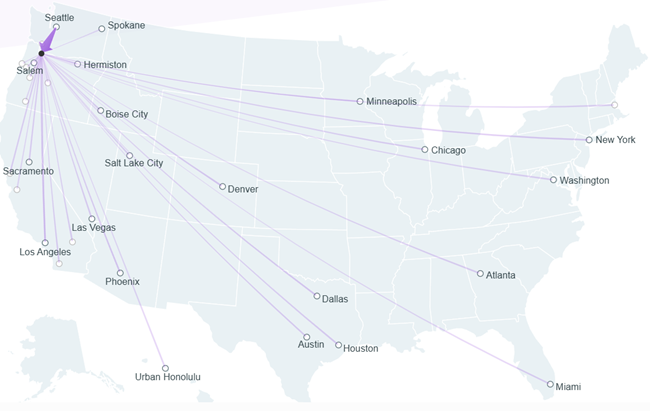
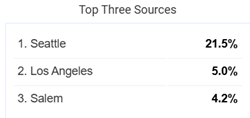
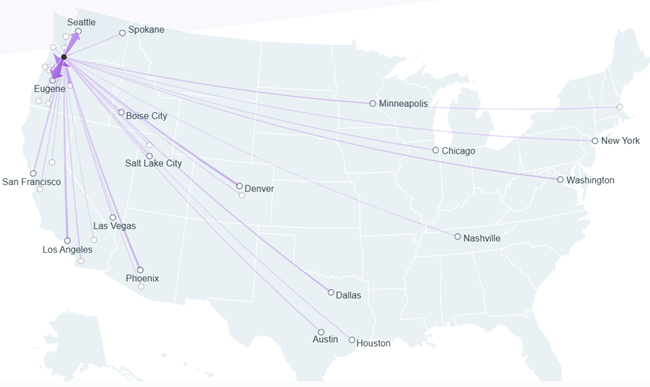
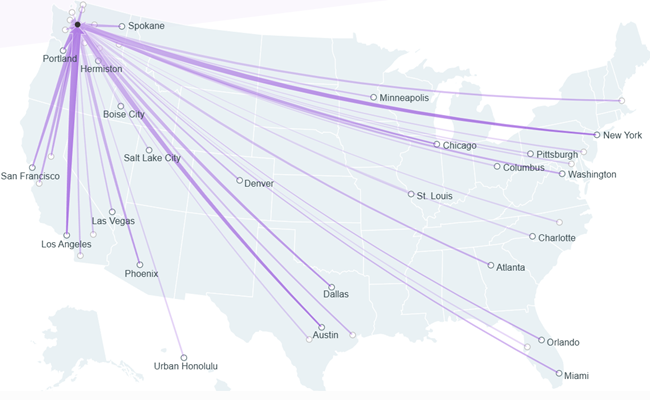
Of renters moving to Portland, the highest percentage, 21.5%, are from Seattle, according to the report. That number is followed by 5% from Los Angeles and 4.2% from Salem, Ore.

On the flip side, renters who are leaving Portland are choosing to move to Eugene (12.1%), Salem (12%), and Seattle (9.6%).

In 2024, 39% of Apartment List users searched for their next rental in a new metropolitan area with new Portland renters coming from Seattle

Renters moving to Seattle from Los Angeles

In the case of Seattle, the most renters, 5.4%, are moving from Los Angeles, followed by 4.1% from Portland and 3.9% from New York.

In 2024, 39% of Apartment List users searched for their next rental in a new metropolitan area with new Portland renters coming from Seattle

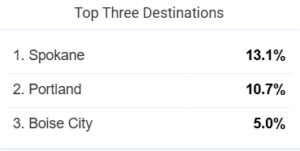
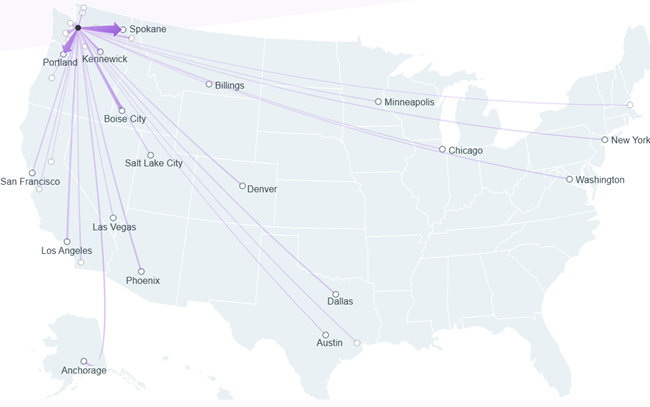
Moving out of Seattle, renters are going to Spokane, Portland and Boise City.

In 2024, 39% of Apartment List users searched for their next rental in a new metropolitan area with new Portland renters coming from Seattle

In 2024, 39% of Apartment List users searched for their next rental in a new metropolitan area with new Portland renters coming from Seattle

Where Are LA Renters Going?

In the case of Los Angeles itself, 15.,6% of renters looking to move to LA are coming from Riverside, with 11.4% from San Diego and 6% from San Francisco.

Those renters moving from Los Angeles are headed to Riverside with 16.1%, San Diego with 12.3% and Phoenix with 5.7%.

Renter-Migration Patterns Settling Down After Covid

The Apartment List report says since the COVID-19 pandemic, developments in remote work, housing affordability, and local economic growth/decline have shifted American migration patterns.

“Most notably, there have been outflows from some of the nation’s largest and most-expensive housing markets to more-affordable and less-densely populated ones. Overall migration has slowed somewhat, as have long-distance moves to a new state or a new metropolitan area,” the company’s researchers write.

Read the full article here and select your location to see results.

Sign Up For Our Weekly Newsletter And Get Rental Property And Apartment News And Helpful, Useful Content Each Week.

* indicates required

A Caution on AI: The Possibility of Fair-Housing Violations in Communication and Payments

AI tools and the possibility of fair-housing violations in communication and payments with tenants and how to navigate the risks

AI tools and the possibility of fair-housing violations in communication and payments with tenants and how to navigate the risks.

By The Fair Housing Institute

Technology has fundamentally reshaped the way property managers and their staff members interact with residents. With new advancements in artificial intelligence (AI), many tools that properties use for payments and resident communication are being upgraded.

These innovations offer efficiency and convenience, but also raise important fair-housing considerations.

Property managers must ensure these tools remain inclusive, accessible, and compliant with fair-housing laws. In this article, we’ll explore how AI is reshaping communication and payments in property management—and how to navigate the risks while leveraging the benefits.

The Evolution of Communication in Property Management

AI-powered chatbots and automated messaging systems are becoming the norm, helping property teams respond to resident inquiries, process maintenance requests, and even screen rental applications. While these tools increase efficiency, property managers must be mindful of accessibility challenges and compliance risks, particularly under the Fair Housing Act.

AI-driven communication must be equitable and accessible for all residents, including those with disabilities.

Over-reliance on automated digital tools could unintentionally exclude residents who require verbal communication due to visual impairments, speak languages not supported by AI systems, or have limited digital literacy or internet access.

Ensuring fair-housing compliance means offering multiple communication channels, regularly auditing AI tools for potential bias, and training staff to override AI responses when necessary.

Remember, you understand that compliance is non-negotiable, whereas AI is continually learning. A balanced approach allows property managers to take advantage of AI’s efficiency while maintaining fairness in resident interactions.

The Shift Toward Digital Payments

Property-management companies are increasingly moving away from cash and check payments, instead encouraging residents to use online portals, digital wallets, and automated bank transfers.

These systems streamline financial operations, reduce late payments, and provide residents with greater flexibility. AI-powered financial tools are now capable of predicting rent-payment trends, sending automated reminders, and even offering customized payment plans based on resident behavior. The ability to automate these processes allows management teams to focus on more pressing concerns while maintaining smooth financial transactions.

Despite the benefits, digital payment systems present challenges that property managers must address. Many residents, particularly those from lower-income households, may not have access to online banking or credit cards. Others may rely on government-issued checks or prefer cash payments for personal reasons. When digital payments become the sole method of rent collection, these individuals may face unnecessary barriers.

To remain inclusive, property managers should ensure that multiple payment options remain available to meet the diverse needs of their residents. Moreover, AI-driven payment reminders and automated late notices must be carefully managed to avoid unintended pressure or harassment, which could lead to compliance concerns.

The Risks of AI in Property Management

As AI becomes more embedded in property management operations, it is essential to recognize the potential risks it introduces.

AI systems are built on data, and if that data contains inherent biases, the AI may unintentionally perpetuate discrimination. This is particularly concerning in areas such as resident screening, maintenance prioritization, and customer-service interactions. When AI is used to assess rental applications, there is a risk that it may favor certain demographic groups based on historical trends rather than making neutral, fair decisions. Similarly, automated maintenance scheduling may inadvertently prioritize certain buildings or residents over others, based on flawed algorithms.

To mitigate these risks, property managers must take proactive steps to ensure that AI-driven processes remain fair and compliant.

AI systems should be regularly audited to identify and correct any biases that may influence decision-making. Transparency is also critical, as residents should have a clear understanding of how AI is used in property operations, particularly when it affects their housing opportunities.

Additionally, human oversight must remain a fundamental part of the process. While AI can enhance efficiency, it should never serve as the sole decision-maker in matters that affect residents’ rights and fair housing compliance.

Implementing AI Responsibly in Property Management

Responsible implementation of AI requires a thoughtful and strategic approach.

Property managers should work closely with technology vendors to ensure that the AI tools they adopt align with fair-housing requirements. This includes understanding how the AI’s algorithms function and verifying that they have been tested for potential biases. Relying on third-party software without reviewing its compliance features can lead to unintended fair-housing violations, making due diligence essential when selecting AI-powered solutions.

Equally important is the need for ongoing training.

Property management staff must be educated on how AI tools operate and how they interact with fair housing laws. Regular training sessions can help teams recognize when an AI-driven decision may be problematic and when human intervention is necessary. AI should function as a support system rather than a replacement for human judgment, and staff members should feel empowered to override AI recommendations when fairness or compliance is at stake.

Continuous monitoring and adaptation are also essential. As AI technology evolves, so do its potential risks and benefits. Regular audits can help property managers assess whether their AI tools are operating as intended or if adjustments are needed to maintain compliance. By staying informed about advancements in AI and fair-housing regulations, property managers can ensure that their use of technology remains both effective and ethical.

The Future of AI and Fair-Housing Compliance

Looking ahead, AI will continue to play a significant role in property management, with advancements in predictive analytics, automated leasing, and personalized resident experiences.

However, as AI becomes more sophisticated, regulatory scrutiny will also increase. Housing authorities and fair-housing advocates are already paying close attention to how AI influences rental decisions, and new guidelines may emerge to address concerns about algorithmic discrimination. Property managers who stay ahead of these changes by proactively refining their AI strategies will be better positioned to navigate the evolving regulatory landscape.

The challenge moving forward will be balancing technological innovation with fair-housing compliance.

AI and digital-payment systems offer undeniable benefits, but they must be designed and implemented in a way that enhances, rather than restricts, resident access and equality. The key to success lies in adopting technology responsibly, ensuring transparency, and maintaining a strong commitment to fair-housing principles and training.

Conclusion

AI-driven communication and digital-payment systems are revolutionizing property management, offering increased efficiency, cost savings, and improved resident experiences.

However, these benefits come with the responsibility to uphold fair-housing standards. Property managers must take an active role in ensuring that AI and digital tools do not create unintended barriers for residents. By maintaining multiple communication and payment options, auditing AI-driven decisions, and providing ongoing staff training, property managers can embrace innovation while fostering an inclusive and compliant housing environment.

As the industry moves forward, the most successful property management companies will be those that integrate AI and digital solutions thoughtfully—enhancing operations while safeguarding the principles of fairness, accessibility, and equal opportunity for all residents.

About the author:

In 2005, The Fair Housing Institute was founded as a company with one goal: to provide educational and entertaining fair-housing compliance training at an affordable price at the click of a button.

Sign Up For Our Weekly Newsletter And Get Rental Property And Apartment News And Helpful, Useful Content Each Week.

* indicates required

Multifamily Rents Were Flat In February But Tests Coming

Multifamily rents were flat in February according to Yardi Matrix, but the company sees tests and challenges coming.

Multifamily rents were flat in February according to Yardi Matrix, but the company sees tests and challenges coming.

The report asks, “Will economic volatility impact the robust demand for apartments?”

Highlights of the monthly report:

  • With economic uncertainty on the rise, U.S. multifamily rents continued in a holding pattern in February. The average U.S. advertised asking rent increased $1 nationally in February to $1,751, while year-over-year rent growth was unchanged at 1.2%.
  • Multifamily rent growth performance continues to be exceptionally regional. The top 10 in the Matrix ranking of major metros comes entirely from the Midwest and Northeast.
  • Single-family build-to-rent advertised rates were unchanged at $2,165, while year-over-year growth remained at 0.2%. There is a wide variance among metros, with Detroit (6.0%), the Inland Empire (5.2%) and Nashville (5.1%) leading the way and Austin (-4.6%) at the bottom.

In typical seasonal pattern, advertised rents “have treaded water of late, which is not a knock given that 2024 recorded its highest number of deliveries in decades,” the report says.

There are questions around the absorption of supply in key markets and whether rents will turn positive in these markets. High-supply markets continue to record some of the largest declines as absorption fails to keep pace with deliveries. In Austin, advertised rents fell 0.4% month-over-month and in Denver, rents fell 0.5% month-over-month

Where the economy goes is a question

“After years of stability and consistent job growth, the country is getting a dose of new policy that has roiled the financial markets. Some estimates put the number of layoffs in February at more than 170,000, the largest number since the global financial crisis,” the report says.

Too, the report says, tariffs and the uncertainty about policy is leading some businesses to wait for clarity before investing.

Read the full report here.

About Yardi Matrix

Yardi Matrix researches and reports on multifamily, office and self-storage properties across the United States, serving the needs of a variety of industry professionals. Yardi Matrix Multifamily provides accurate data on 18+ million units, covering more than 90 percent of the U.S. population. Contact the company at (480) 663-1149.

Diversify Your Approach to Stay Ahead in Multifamily Marketing

What's your 2025 digital marketing strategy for apartments and how to stay ahead in multifamily marketing in the peak leasing season?
What is your 2025 digital strategy for marketing your rental properties?

What is your 2025 digital marketing strategy for apartments and what do you have to do to stay ahead in multifamily marketing heading into the peak leasing season?

By Kevin Juhasz

In a fiercely competitive multifamily market, digital marketing is crucial for attracting qualified leads and increasing occupancy. An effective marketing strategy is equally vital as the industry approaches the 2025 peak leasing season, and success requires a more diverse and sophisticated approach.

Multifamily marketing professionals must continue expanding their digital presence across multiple channels, even though many face flat or decreased marketing budgets.

While 88% of marketing teams use an Internet Listing Service (ILS) and plan to keep investment relatively steady, about three-quarters of them are planning on investing more across digital channels to find their next renters, according to Rent. However, there is a fundamental change in how teams are using marketing channels.

Diversifying the Channel Mix

A community’s marketing mix typically includes such reliable industry standards as ILS, community websites and social media platforms.

However, to maximize reach and engagement, multifamily marketers are starting to incorporate additional strategies that are both cost-effective and proven to attract high-intent prospects.

By integrating geofencing/digital display, paid search and paid social into their marketing strategy, multifamily teams are enhancing visibility, increasing lead quality and improving leasing performance in 2025.

  • Paid search: Paid search remains one of the most efficient lead-generation strategies for multifamily communities. By targeting high-intent searchers who are actively looking, communities can drive qualified traffic to their websites. The key to success is rooted in keyword strategy, bid management and ongoing optimization to maintain high conversion rates while keeping cost-per-lead (CPL) low. Multifamily marketers should activate paid-search campaigns now for maximum impact when peak season begins. By launching early, campaigns can go through the learning phase, allowing the Google Ads algorithm to refine its targeting, optimize bids and improve ad performance before the spring rush.
  • Geofencing: More than 40% of marketers are trying new digital channels like geofencing for the first time in 2025, according to Rent. These tools allow properties to deliver highly targeted ads to potential renters when they are searching for apartments near a community or visiting competitor locations. This hyperlocal approach increases brand awareness, foot traffic and lead quality, making it a cost-effective complement to search-based advertising.
  • Paid social: Social media plays a crucial role in renter decision-making, so paid social media campaigns allow marketers to reach audiences where they spend the most time—on such platforms as Facebook, Instagram and TikTok. Advanced targeting features enable leasing teams to retarget website visitors, engage predictive audiences and reach renters based on demographics, interests and behaviors. Paid social is increasingly effective at generating interest and driving tour sign-ups and applications.

Adding AI to the Mix

AI is revolutionizing the multifamily marketing by enhancing personalization, lead generation and operational efficiency.

AI-powered chatbots and virtual leasing assistants can engage prospects 24/7, answering questions, scheduling tours and collecting valuable data. Predictive analytics help marketers analyze trends, demographics and online behaviors, allowing for more targeted campaigns.

Sentiment analysis helps community managers gauge perception and adjust marketing strategies accordingly. AI also enhances resident retention by analyzing feedback and identifying patterns that influence resident satisfaction. This allows management teams to address concerns and proactively boost reputation management efforts.

Building a Data-Driven Channel Mix

 By striving to base marketing decisions on up-to-the-minute data insights, owners and operators can optimize their marketing budget through practical analytics that identify top-performing channels.

Properties with integrated analytics systems can better track lead sources and calculate the exact cost-per-lease metrics.

Digital marketing for apartments needs constant monitoring of performance indicators. Properties that use data-driven strategies can better predict market trends and adjust their marketing mix accordingly. Marketing teams with complete analytics platforms can show clear value and ROI for their campaigns, measuring channel performance through these key metrics:

  • Lead source tracking and conversion rates
  • Cost per lead and cost per lease
  • Website engagement metrics
  • Social media interaction rates

Up-to-the-minute performance-tracking guides efficient channel diversification. Advanced analytics tools let properties measure the effectiveness of different channels simultaneously and make quick adjustments to maximize budget spending and results. Using proven performance metrics, marketing teams can better allocate resources across channels.

Measuring Multichannel Success

Measuring success across multiple marketing channels requires accurate tracking and analysis of performance indicators. Property managers who track lead quality see 44% higher conversion rates. They achieve this through detailed analytics systems that examine multiple touchpoints at once:

  • Lead-to-tour conversion rates
  • Cost per application
  • Website traffic patterns
  • Brand-visibility indicators
  • Direct traffic volume

Property managers who use advanced analytics tools can better predict occupancy trends and reduce operational costs. Specific metrics help marketing teams identify the strengths and weaknesses of particular strategies. For instance, high website traffic with low conversion rates often indicates the need for targeting adjustments.

Multifamily properties with detailed tracking systems can better measure their marketing spend returns. Properties that focus on improving conversion rates at every touchpoint run more efficient marketing campaigns. Marketing teams can analyze data across channels and make quick campaign adjustments, allowing them to optimize based on actual results instead of guesswork.

Successful digital marketing for apartments through 2025 requires a strategic mix of diverse channels, analytics and accurate measurement systems. Multifamily marketing teams that adapt to this digital world will generate and convert more qualified leads, helping them stay ahead of their competitors. This detailed approach, combined with immediate analytics and performance tracking, builds a resilient growth foundation.

About Rent.

Rent. is a two-sided marketing platform that simplifies the entire renter experience by matching the right property with the right renter, at the right time. Rent. is operated by Rent Group Inc., a subsidiary of Redfin Corporation.

About the author:

Kevin Juhasz is a content manager for LinnellTaylor Marketing.

Sign Up For Our Weekly Newsletter And Get Rental Property And Apartment News And Helpful, Useful Content Each Week.

* indicates required

New Salt Lake City Renters Coming From Provo

New renters in Salt Lake City are coming from Provo according to annual Apartment List renter migration study

Nationwide in 2024, 39% of Apartment List users searched for their next rental in a new metropolitan area, while 25% considered a new state entirely, according to Apartment List’s annual renter migration study.

Researchers say this data highlights strong migration channels out of expensive states, particularly along the coasts, to more affordable ones, particularly in the southeast and Mountain West, a trend that emerged early in the COVID-19 pandemic and has remained steady to this day.

Of renters moving to Salt Lake City, the highest percentage, 14.3%, are coming from Provo, according to the report. That number is followed by 11.8% from Ogden, and 4.8% from Denver.

On the flip side, of the renters who are leaving Salt Lake City, 21.8% are choosing to move to Ogden, 21.3% to Provo, and 9.6% to Boise City.

Renter-Migration Patterns Settling Down After Covid

The Apartment List report says since the COVID-19 pandemic, developments in remote work, housing affordability, and local economic growth/decline have shifted American migration patterns.

“Most notably, there have been outflows from some of the nation’s largest and most-expensive housing markets to more-affordable and less-densely populated ones. Overall migration has slowed somewhat, as have long-distance moves to a new state or a new metropolitan area,” the company’s researchers write.

Read the full article here and select your location to see results.

Salt Lake City Ranks As A Top Place For Landlords In 2025

Why People Moved In The Last Year – Fewest In 25 Years