
Home Blog Page 23

Washington Attorney General Says RealPage ‘Cheating Renters’

Washington Attorney General Says RealPage ‘Cheating Renters’

The Washington Attorney General has filed a new lawsuit against RealPage and nine local landlords claiming they “conspired to harm tenants” and violated the Consumer Protection Act, according to a release.

The new lawsuit was filed in King County Superior Court on April 3 alleging that RealPage and its software are “central to a conspiracy and unfair competition by certain landlords that resulted in rapidly rising rent prices for their tenants.”

“RealPage’s unfair practices are cheating renters and pricing families out of stable housing,” said Attorney General Nick Brown in the release. “Washington is facing a housing crisis and we must respond with every available tool.”

The lawsuit says “competition should moderate rent hikes when demand is high and drive rents down when supply is high, making housing more affordable. Prices should be the result of the natural forces of supply and demand, in this case the number of available apartment units and the number of renters seeking housing, not the highest prices that renters can pay.”

In Washington state, more than one million households—about 36% of the state’s population—are renters. In recent years, rental prices in Washington have skyrocketed, placing an unsustainable burden on renters, the lawsuit says.

“In 2024, 47% of renter households had their rent increased by over $100 per month, and 15% had their rent increased by over $250 per month. These dramatic increases often outpace wage growth, leaving many renters struggling to keep up with housing costs.

“Conspired to harm tenants”

“RealPage and its landlord-clients have been central actors in this climate of constant and staggering rent increases. RealPage has built a business out of undermining the natural forces of competition.”

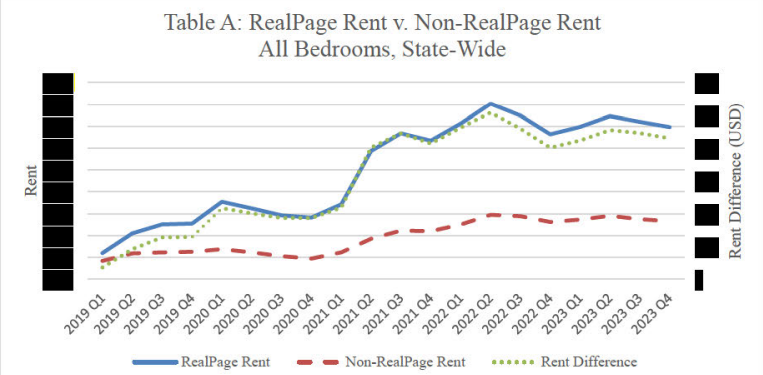
The lawsuit says the way it works is that RealPage provides software tools to landlords that push rental prices beyond what landlords could otherwise achieve while reducing the risk that other landlords will undercut them with more competitive rates. Analysis by the attorney general’s office shows that in numerous markets, pricing is higher and occupancy is lower for properties managed by landlords who use RealPage’s products than for similar properties managed by landlords who don’t use RealPage.

The lawsuit provided a chart showing the differences
The Washington attorney general has filed a new lawsuit against RealPage and nine local landlords claiming they “conspired to harm tenants.”

The investigation found that RealPage’s pricing software provides landlords with a shared logic that tends to raise rents. Two types of RealPage’s pricing software collect nonpublic, competitively sensitive data from landlords to feed the algorithms. Landlords who use RealPage software agree to provide their data, knowing that the software combines their data with data from other landlords. The algorithm then recommends rents — in many cases increasing them. In feedback to RealPage about its software, one potential client said: “I always liked this product because your algorithm uses proprietary data from other subscribers to suggest rents and term. That’s classic price-fixing.”

Washington State was previously part of a multi-state antitrust lawsuit led by the U.S. Department of Justice in federal court, but withdrew to file this challenge in state court under statutes that would cover a greater number of Washingtonians affected by these actions.

This new lawsuit alleges six violations of the state Consumer Protection Act and seeks restitution for a large number of Washington renters. An estimated 800,000 leases in Washington were priced using RealPage software between 2017 and 2024.

The lawsuit lists RealPage and nine local landlords as the defendants, including Greystar; Cushman & Wakefield Inc./Pinnacle Property Management Services; LivCor, LLC; UDR, Inc., Prime Administration, LLC dba Prime Group; Quarterra Multifamily Communities, LLC; LaSalle Properties, LLC; MG Properties, LLC; and Sares Regis Management Company, L.P.

RealPage has said the data fed into its pricing tool is anonymized and aggregated. It said the company “uses aggregated market data from a variety of sources in a legally compliant manner.”

ProPublica is reporting that RealPage, a Texas-based real estate tech company, is facing a new barrage of questions about whether its software is helping landlords coordinate rental pricing in violation of antitrust laws.

ProPublica initially detailed how RealPage’s pricing algorithm uses competitor data to suggest new prices daily for available apartments. ProPublica raised concerns that the software, sold by RealPage, is potentially pushing rent prices above competitive levels, facilitating price fixing or both.


Read the full press release here

Read the full lawsuit here

Sign Up For Our Weekly Newsletter And Get Rental Property And Apartment News And Helpful, Useful Content Each Week.

* indicates required

Georgia: Out-of-State Landlords Must Employ In-State Staff

The Georgia legislature has passed a bill requiring out-of-state landlords to employ at least one in-state staffer to handle tenant complaints

The Georgia legislature has passed a bill requiring out-of-state landlords to employ at least one in-state staffer to handle tenant complaints, according to reports.

The bill, House Bill 399, is headed to Governor Brian Kemp for signature.

The bill says, “Any landlord that is not a resident of this state that owns or operates single-family or duplex rental properties in this state” must employ at least one in-state agent, “who shall be responsible for receiving, coordinating, managing, and responding to” renters’ maintenance concerns.”

Reports say the bipartisan measure to require out-of-state landlords to hire in-state staff materialized in response to a surge of big institutional investors buying up residential housing in Georgia.

That has driven up rent prices, and investors’ habit of camouflaging themselves with shell companies has made it difficult for tenants to get maintenance concerns addressed.

Even so, HB 399 is the only legislation to regulate institutional investor activity

Sign Up For Our Weekly Newsletter And Get Rental Property And Apartment News And Helpful, Useful Content Each Week.

* indicates required

Landlords: What To Do When ICE Arrives At Your Rental

Landlord Ordered to Pay $80,000 Over Threat to Call ICE On Tenants

Fair Housing Month: Compliance, Consequences And Transition

Why Pet-Inclusive Housing is a Win-Win for Everyone

Embracing pet inclusivity is a smart business move as pet-inclusive housing increases retention and improves financial performance.

Embracing pet inclusivity is more than just a kind gesture for rental housing providers—it’s a smart business move as pet-including housing increases retention and improves financial performance.

By Michelson Found Animals

For rental housing providers, embracing pet inclusivity is more than just a kind gesture—it’s a smart business move that fosters community, increases retention, and improves financial performance. Michelson Found Animals’ Pet-Inclusive Housing Initiative (PIHI) offers compelling reasons why property owners should reconsider breed and weight restrictions and implement pet-inclusive policies that benefit both renters and operators alike.

Dispelling Common Myths About Pet Restrictions

Do breed restrictions prevent dangerous pets?

No. Research shows that a dog’s breed does not determine its personality or behavior. Diet, environment, training, and socialization are far more influential factors. In fact, restrictive policies often encourage residents to hide pets or falsely declare them as emotional support animals (ESAs), making it harder to enforce community guidelines.

How can we ensure safety without breed and weight restrictions?

By removing blanket restrictions, rental properties can establish transparency and evaluate each pet as an individual. Utilizing pet personality profiles and pet agreements ensures a clear understanding between property managers and pet-owning residents.

Will allowing all dog breeds affect our liability insurance?

Many property insurance policies do not impose breed restrictions. If your current provider does, there are alternative insurers without such limitations. Additionally, renters can obtain renters insurance policies with no breed restrictions, ensuring liability coverage for any breed.

What if other residents don’t support pet-inclusive policies?

According to the 2024 Grace Hill NMHC Renter Preferences Survey, only 6% of renters say that a property’s pet-friendliness would make them less likely to live there. The biggest concern among non-pet owners is pet waste, which can be easily addressed with proper waste stations and clear community rules.

The Many Benefits of Eliminating Breed and Weight Restrictions

Expand Market Reach

With nearly two-thirds of U.S. households owning a pet, restrictive pet policies severely limit the potential resident pool. Pet-inclusive housing provides a competitive edge, attracting more responsible renters.

Attract Key Demographics

Millennials, Gen Z, and Gen X renters—who make up the largest percentage of pet owners—seek out pet-inclusive housing. With the median renter age being 39, appealing to these pet-loving demographics ensures long-term demand.

Faster Leasing and Higher Occupancy Rates

Properties that welcome pets experience quicker lease signings. Surveys indicate that 83% of rental housing operators report faster lease-ups in pet-inclusive communities, and 79% find vacancies easier to fill.

Financial Benefits

Pet owners are highly motivated renters. Studies show they are willing to compromise on budget and location to find pet-friendly housing. Additionally, pet-owning residents stay 21% longer on average than non-pet owners. Longer resident retention and reduced turnover costs translate to increased net operating income (NOI). Pet-inclusive housing policies support a healthier financial outlook for property managers.

Minimize ESA Fraud and Hidden Pets

Renters sometimes resort to fraudulent ESA claims to bypass breed restrictions, and 11% of renters admit to hiding pets due to restrictive policies. Removing breed and weight restrictions reduces the likelihood of renters hiding or sneaking in unapproved pets. This allows property managers to maintain accurate pet records and enforce community guidelines more effectively.

Make Data-Driven Decisions

There is no scientific evidence linking breed to behavior. The CDC and the American Bar Association are among the organizations that reject breed-specific policies in favor of evaluating individual pet behavior.

Prevent Unnecessary Pet Surrenders

Housing-related issues are a leading cause of pet surrender to shelters. With 98% of pet owners considering their pets family, removing restrictions helps keep families together.

Foster a More Connected Community

Pets naturally foster social connections among residents, creating a more engaged and friendly community. Research shows that pet-inclusive housing operators report increased neighbor interactions and improved resident satisfaction.

Steps to Implement Pet-Inclusive Policies

  • Establish Clear Expectations – Define pet policies and agreements upfront to maintain community harmony.
  • Adopt the Pet Personality Profile (PPP) – Evaluate pets as individuals rather than imposing arbitrary breed and weight restrictions.
  • Improve Pet Amenities – Install dog parks, pet waste stations, and grooming areas to enhance the resident experience.
  • Partner with Pet-Friendly Businesses – Work with local vets, trainers, and pet stores to offer exclusive services to pet-owning residents.
  • Communicate Proactively – Keep both pet owners and non-pet owners informed about policy updates and expectations.

Pet-Inclusive Housing is the Future

Embracing pet-inclusive policies isn’t just about allowing pets—it’s about fostering stronger communities, increasing market lift, and meeting residents’ needs. Michelson Found Animals’ Pet-Inclusive Housing Initiative provides the resources and tools rental housing providers require to make this transition seamless and successful.

Ready to create a pet-inclusive property? Get started at petsandhousing.org for more pet-inclusive information and tools.

About the author:

Michelson Found Animals has continued to identify important problems facing pets and people, and develop real-world, scalable solutions to help them thrive.

Sign Up For Our Weekly Newsletter And Get Rental Property And Apartment News And Helpful, Useful Content Each Week.

* indicates required

Rents Rise Slightly For Second Month In A Row

March saw national rents rise slightly for the second month in a row, according to Apartment List’s April report.

March saw national rents rise slightly for the second month in a row, according to Apartment List’s April report.

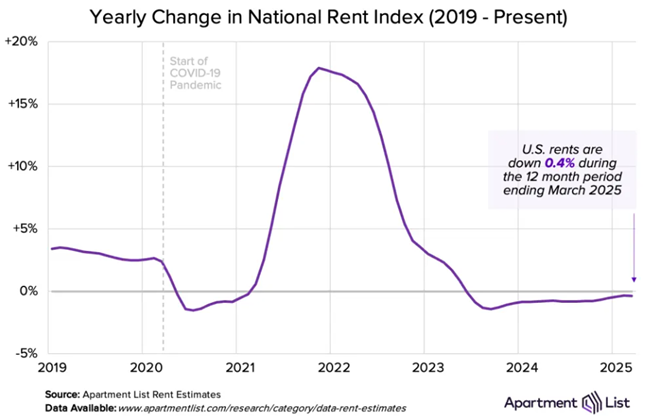
While the last two months have seen some rent increases, overall national year-over-year growth remains negative at -0.4 percent.

But it is slowly inching back toward positive territory the report says.

“Year-over-year rent growth has now been negative since June 2023, but in recent months, there are signs that a return to positive growth is on the horizon.

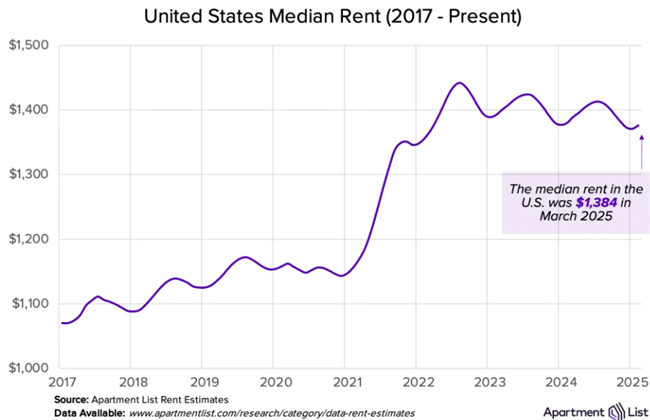
“In dollar terms, the national median monthly rent now stands at $1,384, up $8 per month compared to last month, but down $5 compared to March 2024,” according to the report from the Apartment List Research Team.

March saw national rents rise slightly for the second month in a row, according to Apartment List’s April report.

At the local level, 82 of the nation’s 100 largest cities saw rents rise in March. On a year-over-year basis, rent growth is now positive for a majority of large cities (59 of the top 100).

“Our national index remains negative largely due to steeper declines in a concentrated set of Sun Belt metros that are rapidly expanding their multifamily inventory; these include Austin (-6.3 percent year-over-year), Denver (-5 percent), and Raleigh (-2.9 percent),” Apartment List researchers write.

March saw national rents rise slightly for the second month in a row, according to Apartment List’s April report.

Multifamily vacancy rate hits 6.9%, a new peak

March saw national rents rise slightly for the second month in a row, according to Apartment List’s April report.

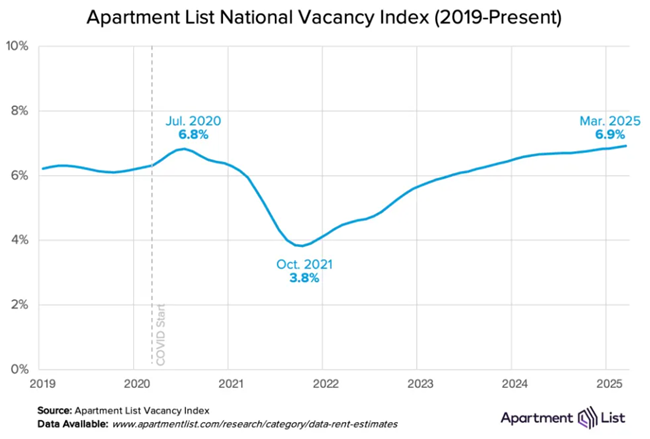
“Our national vacancy index now sits at 6.9 percent, the highest reading in the history of that monthly data series, which goes back to the start of 2017.

“After a historic tightening in 2021, multifamily occupancy has been slowly but consistently easing for over three years amid an influx of new inventory,” the report says.

As new apartment completions decline, the vacancy index could begin to tighten again, “but for now, we’re still seeing vacancies rise, even as rent declines gradually moderate,” the report says.

March saw national rents rise slightly for the second month in a row, according to Apartment List’s April report.

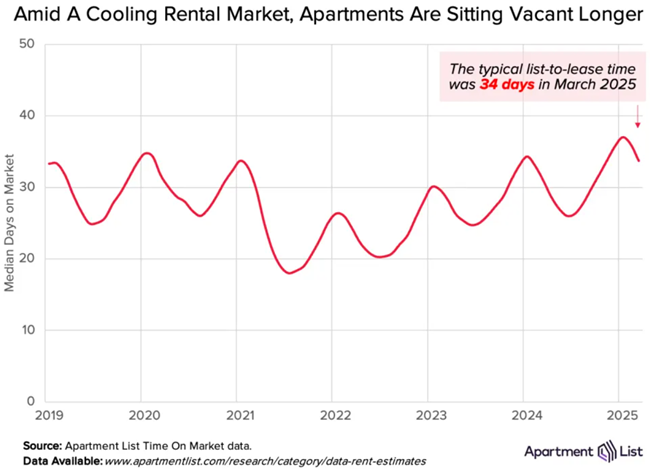
List-to-Lease time comes down from all-time new high

The shortening of list-to-lease time over the past two months is in line with the seasonal return to positive month-over-month rent growth “that we’ve observed in tandem.

“That said, this is still the highest time on market reading that we’ve seen in March of any year going back to the start of 2019, when the data series begins. Units are currently sitting vacant for 3 days longer than they were at this time last year, and for 10 days longer than they were in March 2022 when the market was just beginning to loosen. The influx of new supply is resulting not only in a growing number of vacant units, but also in an increase in the length of time those units remain unoccupied,” according to the report.

Rents rise in March conclusion

The report says demand for rentals going forward “remains a bit more uncertain, and will likely hinge on broader macroeconomic conditions. Currently, it appears likely that 2025 will see a return to positive year-over-year rent growth, but that positive growth is likely to be modest,” according to the Apartment List Research Team.

Read the full April report here.

Sign Up For Our Weekly Newsletter And Get Rental Property And Apartment News And Helpful, Useful Content Each Week.

* indicates required

Oregon Senate Passes Bill To Ban Landlords Asking About Immigration Status

Oregon lawmakers are considering a bill to make it illegal for landlords to inquire about a potential renter’s immigration status.

The Oregon Senate has passed a bill to make it illegal for landlords to inquire about a potential renter’s immigration status, according to the Oregon Capital Chronicle.

Calling it a “moral imperative,” the Oregon Senate voted Monday to ban landlords from asking about or disclosing tenants’ immigration status.

The bill now heads to the Oregon House for approval.

The bill would also prohibit landlords from denying to rent a home or apartment to a tenant based on the landlord’s perception of their immigration status. It would also make it illegal for a landlord to retaliate against a tenant, who might ask for repairs or complain about mold, by threatening to disclose their immigration status to federal immigration enforcement officials.

Under Senate Bill 599, Oregon would join at least four other states — WashingtonCaliforniaIllinois and New York — that have said access to rental housing shouldn’t be contingent on whether a person was born or naturalized into the United States.  The Portland City Council approved a similar law in 2019, backers note.

Oregon’s bill would allow alternative forms of identification in the rental application process — stating that in lieu of a birth certificate or Social Security number that immigrants might not have, alternative forms of identification such as an Individual Taxpayer Identification Number or a driver’s license would suffice.

An amendment to the bill, however, allows for landlords to inquire about a potential renter’s immigration status if required by a federal government program that offers low-income housing.

Rep. Ricki Ruiz, a Gresham Democrat and sponsor of the bill, told Oregonlive.com it is “deeply personal” to him because his parents immigrated to the United States  in search of a better future but also worried about finding a safe and stable home.

The bill has drawn significant opposition from people concerned that it would infringe on landlord rights.

In written testimony, Ruppert Reinstadler of Tigard said further regulating of landlords drives up prices, among other problems.

“Since when do business people (landlords) not have the right to ask questions of their renters?” Reinstadler wrote. “It is a basic tenet of business that you know who your clients are, whether they are trustworthy and whether they are in this country legally.”

Sign Up For Our Weekly Newsletter And Get Rental Property And Apartment News And Helpful, Useful Content Each Week.

* indicates required

Tenants Want Deposit Back After Leaving Damages Now What?

If tenants leave damage in your rental and then want their deposit back what should we do is the question this week for Hank

If tenants leave damage in your rental and then want their deposit back what should we do is the question this week for Ask Landlord Hank. Remember Hank is not an attorney and he is not offering legal advice. If you have a question for him please fill out the form below.

 Dear Landlord Hank,

We have a rental house and the tenants gave 30-day notice. However, we were leaving for a 3-week trip that had been planned for over a year.

They agreed on a date before the end of the month, for a walk-thru. When we arrived at the house, they had already turned the electricity off.

We of course could not check anything.

We turned on the electricity the next day before we left for our trip and found the built-in microwave not working and several gas stove burners not working. Neither of the two heating units were working. We had a repairman out to fix these and found they never changed the filters during the years’ time. The repairman said the issues the unit was having was caused from lack of air flow due to the dirty filters. There were also broken sprinklers that they knew needed replacing; they had been run over with a lawn mower.

-Richelle

Hi Landlady Richelle,

I don’t know what state you are in but be very mindful of the law regarding timing of deposit return.

Hopefully you made a very detailed walk-thru inspection when your tenants first moved in, with photos of the property and the condition of the property and contents.

Then on the exit walk-thru make a detailed list – with photos if possible – of the condition of the property, appliances, etc. If the tenants caused damage to your property, then you are within your right to use the security (damage) deposit for repairs.

I normally send in photos and receipts for work done with the accounting. Even if the tenants are not receiving any refund, make sure you account for how you spent the funds and follow the law to impose a claim on this deposit. Good luck!

Sincerely,

Hank Rossi

Editor’s note: Check your local and state regulations on issues such as this as it varies across the country.

As a child, Hank Rossi sometimes helped his father take care of the family rental-maintenance business.  In the mid-’90s he got into the rental business for himself. After he retired, he started a real-estate brokerage business with his sister that focuses on property management and leasing. Visit his website: https://rentsrq.com.

Ask Landlord Hank Your Question

Ask veteran landlord and property manager Hank Rossi your questions from tenant screening to leases to pets and more! He provides answers each week to landlords.

  • This field is for validation purposes and should be left unchanged.


If tenants leave damage in your rental and then want their deposit back what should we do is the question this week
Landlord Hank Rossi says, “Even if the tenants are not receiving any refund, make sure you account for how you spent the funds.”

Landlords: What To Do When ICE Arrives At Your Rental

How Can I Monitor Tenant Smoking In My No-Smoking Rental?

Do Your “No Smoking” And Odor Policies Stink?

Can I Say “No Pot In My Apartments” When It’s Legal In My State?

Sign Up For Our Newsletter And Get Rental News And Helpful, Useful Content Each Week.

* indicates required


photo credit megaflopp via istockimages

Oregon Considers Rent Control Expansion To Newer Projects

Oregon lawmakers are considering expanding rent control, called rent stabilization, to include some newer buildings

Oregon lawmakers are considering rent control expansion, called rent stabilization, to include some newer buildings, according to reports.

The current law applies only to residential rental units 15 years and older and limits rent increases to 10% a year. The bill would change that to buildings that are seven years or newer.

Also, lawmakers are considering banning the use of AI to set rents.

Adriana Grant, a policy associate with the Eugene Tenant Alliance, told lawmakers that allowing new buildings to remain exempt from rent-increase restrictions and allowing corporate landlords to trade insider information through software undermines the state’s efforts to address the housing crisis.

“Corporate landlords are using these predatory algorithms across the state,” Grant told Oregon Public Broadcasting. “If we don’t act now, Oregonians will continue to be priced out of their homes by software that treats housing as nothing more than a financial asset.”

Landlords would be banned from using AI algorithm software to determine rents.

A few groups representing real estate, as well as  multi-family rental companies, testified in opposition, arguing that reducing the rent cap to seven years might make it harder for developers to attract investment and could make building housing less profitable.

The bill,  Senate Bill 722, provides a ban on algorithm-based pricing software by rental companies and includes a provision to remove the rent cap exemption for buildings older than seven years old. The bill is likely to face amendments going forward.

The Oregon Department of Administrative Services (DAS) will calculate and post the percentage allowable rent increase for the 2026 calendar year by Sept. 30, 2025.

Sign Up For Our Weekly Newsletter And Get Rental Property And Apartment News And Helpful, Useful Content Each Week.

* indicates required

Entrata Expands AI and Platform Innovations to Advance Autonomous Property Management

Entrata has announced major enhancements designed to automate property management and optimize operations across diverse portfolios.

Entrata has announced major enhancements designed to automate property management, optimize operations across diverse portfolios, and elevate the resident experience, according to a release.

With expanded AI capabilities—including new tools for commercial and manufactured housing, as well as enhanced resident rewards through Homebody® Rewards—Entrata is accelerating toward Autonomous Property Management™, where AI-powered workflows anticipate resident needs, streamline operations, and drive efficiency.

AI-Powered Leasing and Invoice Management

Entrata’s ELI+ (Entrata Layered Intelligence®) goes beyond traditional chatbots. Leasing AI offers a seamless blend of chat, voice, email and text to create real-time, personalized interactions, available 24/7. Leveraging the full data layer of the Entrata OS, ELI+ streamlines the leasing process, eliminates guesswork, and improves conversion rates—allowing site teams to focus on higher-value engagement, while helping owners and operators decrease cost. Unlike other systems that depend on third-party integrations that lack comprehensive data availability, Entrata’s AI is natively built into its platform, ensuring seamless, data-driven optimization at every stage of the resident journey.

Similarly, ELI Invoice Entry accelerates invoice processing through AI-driven data extraction, automatically pulling details from uploaded PDFs, eliminating manual entry, and integrating seamlessly into approval workflows to minimize errors and enhance operational efficiency.

“Our ELI+ offerings are transforming how property managers utilize AI within their operations—enabling smarter workflows, automating complex processes, and delivering highly personalized resident experiences,” said Catherine Wong, Chief Operating Officer at Entrata, in a release. “Entrata’s advantage lies in its deep, first-party unified data layer, allowing us to provide proactive, contextualized insights that empower property owners and operators to drive real impact.”

Expanding Support for Commercial and Manufactured Housing

Entrata is elevating its platform for commercial real estate and manufactured housing, unleashing AI-powered efficiencies that streamline operations and breathe new life into property management across diverse asset classes. With this expansion, property owners can now manage their diverse portfolios—residential, commercial, and manufactured housing—all within a single, integrated platform.

  • For commercial properties, Entrata simplifies Triple Net (NNN) leasing with intuitive tools that enhance transparency, streamline workflows, and improve financial accuracy.
  • For manufactured housing, Entrata introduces purpose-built tools to optimize lease management, resident oversight, and operational efficiency.

Homebody Rewards Expands: Travel Portal & Rent Redemption

Entrata is enhancing Homebody Rewards to offer residents even greater flexibility and value. With the new and improved Travel Portal, residents can now redeem their Homebody points for flights and hotel stays, accessing a vast network of hundreds of travel partners worldwide. Additionally, for the first time, residents can apply Homebody points directly toward rent payments via ResidentPortal, providing financial flexibility and meaningful savings.

 “Whether it’s booking a trip home for the holidays or planning a dream vacation, Homebody Rewards allows residents to turn points into real-world experiences,” said Wong. “And with rent redemption, we’re giving residents even more control over how they use their rewards to support their lifestyle and financial well-being.”

Shaping the Future of Autonomous Property Management

Entrata is revolutionizing the property management industry with autonomous solutions, seamlessly integrating ELI+—a suite of interconnected AI modules designed to provide relevant context switching that enhances every stage of the resident journey. Starting with an AI-powered leasing experience that personalizes interactions and converts leads with precision, the platform then streamlines financial operations through intelligent, real-time payments, and culminates in a renewals module that leverages predictive analytics and deep first-party insights to optimize tenant retention. By combining these robust, interlinked workflows with a human-first approach, Entrata empowers property managers to drive operational and cost efficiency while delivering an exceptional, data-driven resident experience.

To learn more about Entrata and its suite of products, visit www.entrata.com.

About Entrata

Entrata is a leading operating system for multifamily communities worldwide. Setting the bar for innovation in property management software since 2003, Entrata offers solutions for every step of the leasing life cycle and empowers owners, property managers, and renters to create stronger communities. Entrata currently serves over three million residents across more than 20,000 multifamily communities around the globe. Learn more at www.entrata.com.

Sign Up For Our Weekly Newsletter And Get Rental Property And Apartment News And Helpful, Useful Content Each Week.

* indicates required

Quartz Countertops: Why Property Owners Are Making the Switch

Quartz countertops are consistent and quick to fabricate, require few components, and manufacturers are keeping large amounts ready to cut and install.
Many management companies are making this change for every one of their properties, just because the expectation for it is becoming so prominent.

Quartz countertops are consistent and quick to fabricate, require few components, and manufacturers are keeping large amounts ready to cut and install.

By Precision Countertops

Countertop industry professionals often speak on the merits of 2cm Quartz material, but what do the actual property owners and management companies have to say about it?

We spoke with several of them to ask why they’re choosing 2cm Quartz over the multitude of other options available to them.

Keeping Up with the Competition

It’s true that the rental property industry is amid a massive shift toward the 2cm Quartz look. It’s striking, elegant, and holds up much better to what renters tend to put them through.

And with the growing consumer demand, no rental property wants to be left in the dust. Many management companies are making this change for every one of their properties, just because the expectation for it is becoming so prominent.

Fast Turn-around

For already established properties that are renovating, every day that a unit goes unrented is money lost. The old standard of Laminate Countertops require many different elements, and lead times can vary greatly due to unpredictable stock. Quartz countertops are consistent and quick to fabricate, require very few components, and manufacturers are keeping large amounts of the material on hand and ready to cut and install. If time is a factor, Quartz is by far the best answer.

An Affordable Upgrade

Money truly talks, and when it comes to making the biggest aesthetic impact for your investment, you can’t do better than replacing old laminate countertops with beautiful new Quartz. The difference in cost between Laminate and 2cm Quartz is getting smaller every day, and the amount of money a property owner can save on future repairs and replacements means they’ll be spending much less over time.

The Choice Is Clear

One thing is certain, property owners and management companies know what’s best for their rentals, and more of them are choosing to take advantage of the benefits of 2cm Quartz Countertops every day because of their beauty, durability, availability and affordability! And with a list of reasons like that, it’s easy to see why!

About the author:

Precision Countertops is the leader in rental housing countertop replacement. With a track record of over 10,000 successful apartment countertop upgrades in the Portland metro area, Precision Countertops specializes in transforming apartments with durable and visually appealing quartz countertop.

Quartz Countertops: The 2cm Revolution

Quartz: The Future of Countertops in Rental Housing

Multifamily Market Set To Be Tested With Challenges

The multifamily market is set to be tested with challenges coming from the current economic volatility and a decline in consumer confidence

The multifamily market is set to be tested with challenges coming from the current economic volatility and a decline in consumer confidence, Yardi Matrix says in a March rent-forecast report.

“While rents traditionally get a bounce during the spring leasing season, the market now faces declining consumer confidence and unsettled financial markets.

“Will economic volatility impact the robust demand for apartments?” asks Andrew Semmes, senior research analyst for Yardi Matrix, writing in the report.

“While the rent and occupancy forecasts remain relatively unchanged, the change in U.S. federal administrations has inserted a degree of volatility, which is, for now, difficult to encapsulate in any of our forecasts,” Semmes says.

The report says it remains unclear how the new policies of the administration will play out and how the multifamily market challenges will be due to:

  • The threat of increased tariffs
  • Impact of government employee reductions under Elon Musk
  • Impact of inflation

“We do not anticipate a recession, but we expect a continued chaotic environment between what is said and what is done.  It is clear that lower-end consumers are under pressure, as credit-card and auto-loan delinquencies increase and layoffs continue in the technology sector.

“At present, it is unclear how the mix of policies will play themselves out, but the timing will have a meaningful impact on the direction of the U.S. economy,” Semmes writes.

Read the full report from Yardi Matrix here.

About Yardi Matrix

Yardi Matrix researches and reports on multifamily, office and self-storage properties across the United States, serving the needs of a variety of industry professionals. Yardi Matrix Multifamily provides accurate data on 18+ million units, covering more than 90 percent of the U.S. population. Contact the company at (480) 663-1149.

Sign Up For Our Weekly Newsletter And Get Rental Property And Apartment News And Helpful, Useful Content Each Week.

* indicates required