Home Blog Page 24

New Portland Renters Coming from Seattle

In 2024, 39% of Apartment List users searched for their next rental in a new metropolitan area with new Portland renters coming from Seattle

Nationwide in 2024, 39% of Apartment List users searched for their next rental in a new metropolitan area, while 25% considered a new state entirely, according to Apartment List’s annual renter migration study.

Researchers say this data highlights strong migration channels out of expensive states, particularly along the coasts, to more affordable ones, particularly in the southeast and Mountain West, a trend that emerged early in the COVID-19 pandemic and has remained steady to this day.

New Portland Renters Coming From Seattle

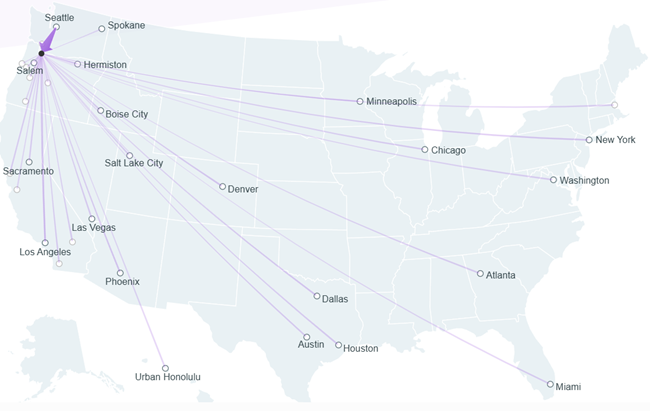
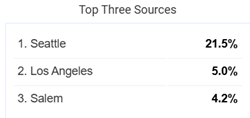
Of renters moving to Portland, the highest percentage, 21.5%, are from Seattle, according to the report. That number is followed by 5% from Los Angeles and 4.2% from Salem, Ore.

On the flip side, renters who are leaving Portland are choosing to move to Eugene (12.1%), Salem (12%), and Seattle (9.6%).

In 2024, 39% of Apartment List users searched for their next rental in a new metropolitan area with new Portland renters coming from Seattle

Renters moving to Seattle from Los Angeles

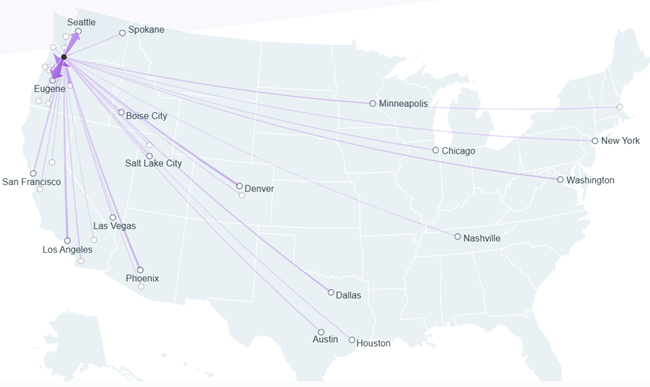
In the case of Seattle, the most renters, 5.4%, are moving from Los Angeles, followed by 4.1% from Portland and 3.9% from New York.

In 2024, 39% of Apartment List users searched for their next rental in a new metropolitan area with new Portland renters coming from Seattle

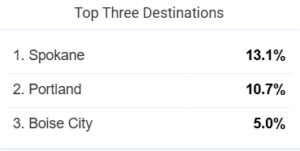
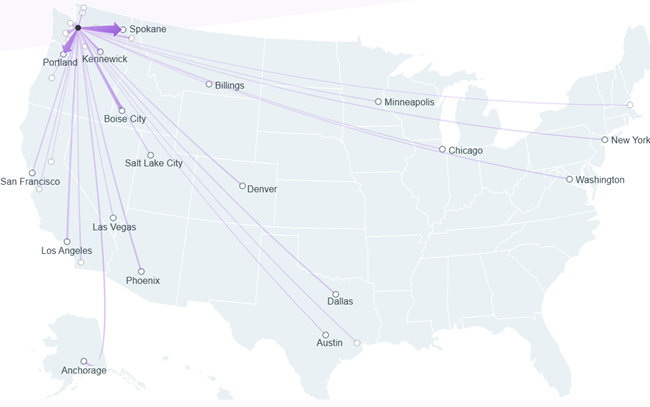
Moving out of Seattle, renters are going to Spokane, Portland and Boise City.

In 2024, 39% of Apartment List users searched for their next rental in a new metropolitan area with new Portland renters coming from Seattle

In 2024, 39% of Apartment List users searched for their next rental in a new metropolitan area with new Portland renters coming from Seattle

Where Are LA Renters Going?

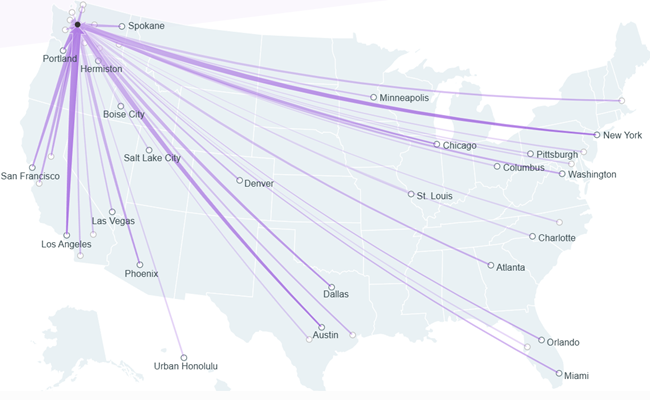
In the case of Los Angeles itself, 15.,6% of renters looking to move to LA are coming from Riverside, with 11.4% from San Diego and 6% from San Francisco.

Those renters moving from Los Angeles are headed to Riverside with 16.1%, San Diego with 12.3% and Phoenix with 5.7%.

Renter-Migration Patterns Settling Down After Covid

The Apartment List report says since the COVID-19 pandemic, developments in remote work, housing affordability, and local economic growth/decline have shifted American migration patterns.

“Most notably, there have been outflows from some of the nation’s largest and most-expensive housing markets to more-affordable and less-densely populated ones. Overall migration has slowed somewhat, as have long-distance moves to a new state or a new metropolitan area,” the company’s researchers write.

Read the full article here and select your location to see results.

Sign Up For Our Weekly Newsletter And Get Rental Property And Apartment News And Helpful, Useful Content Each Week.

* indicates required

A Caution on AI: The Possibility of Fair-Housing Violations in Communication and Payments

AI tools and the possibility of fair-housing violations in communication and payments with tenants and how to navigate the risks

AI tools and the possibility of fair-housing violations in communication and payments with tenants and how to navigate the risks.

By The Fair Housing Institute

Technology has fundamentally reshaped the way property managers and their staff members interact with residents. With new advancements in artificial intelligence (AI), many tools that properties use for payments and resident communication are being upgraded.

These innovations offer efficiency and convenience, but also raise important fair-housing considerations.

Property managers must ensure these tools remain inclusive, accessible, and compliant with fair-housing laws. In this article, we’ll explore how AI is reshaping communication and payments in property management—and how to navigate the risks while leveraging the benefits.

The Evolution of Communication in Property Management

AI-powered chatbots and automated messaging systems are becoming the norm, helping property teams respond to resident inquiries, process maintenance requests, and even screen rental applications. While these tools increase efficiency, property managers must be mindful of accessibility challenges and compliance risks, particularly under the Fair Housing Act.

AI-driven communication must be equitable and accessible for all residents, including those with disabilities.

Over-reliance on automated digital tools could unintentionally exclude residents who require verbal communication due to visual impairments, speak languages not supported by AI systems, or have limited digital literacy or internet access.

Ensuring fair-housing compliance means offering multiple communication channels, regularly auditing AI tools for potential bias, and training staff to override AI responses when necessary.

Remember, you understand that compliance is non-negotiable, whereas AI is continually learning. A balanced approach allows property managers to take advantage of AI’s efficiency while maintaining fairness in resident interactions.

The Shift Toward Digital Payments

Property-management companies are increasingly moving away from cash and check payments, instead encouraging residents to use online portals, digital wallets, and automated bank transfers.

These systems streamline financial operations, reduce late payments, and provide residents with greater flexibility. AI-powered financial tools are now capable of predicting rent-payment trends, sending automated reminders, and even offering customized payment plans based on resident behavior. The ability to automate these processes allows management teams to focus on more pressing concerns while maintaining smooth financial transactions.

Despite the benefits, digital payment systems present challenges that property managers must address. Many residents, particularly those from lower-income households, may not have access to online banking or credit cards. Others may rely on government-issued checks or prefer cash payments for personal reasons. When digital payments become the sole method of rent collection, these individuals may face unnecessary barriers.

To remain inclusive, property managers should ensure that multiple payment options remain available to meet the diverse needs of their residents. Moreover, AI-driven payment reminders and automated late notices must be carefully managed to avoid unintended pressure or harassment, which could lead to compliance concerns.

The Risks of AI in Property Management

As AI becomes more embedded in property management operations, it is essential to recognize the potential risks it introduces.

AI systems are built on data, and if that data contains inherent biases, the AI may unintentionally perpetuate discrimination. This is particularly concerning in areas such as resident screening, maintenance prioritization, and customer-service interactions. When AI is used to assess rental applications, there is a risk that it may favor certain demographic groups based on historical trends rather than making neutral, fair decisions. Similarly, automated maintenance scheduling may inadvertently prioritize certain buildings or residents over others, based on flawed algorithms.

To mitigate these risks, property managers must take proactive steps to ensure that AI-driven processes remain fair and compliant.

AI systems should be regularly audited to identify and correct any biases that may influence decision-making. Transparency is also critical, as residents should have a clear understanding of how AI is used in property operations, particularly when it affects their housing opportunities.

Additionally, human oversight must remain a fundamental part of the process. While AI can enhance efficiency, it should never serve as the sole decision-maker in matters that affect residents’ rights and fair housing compliance.

Implementing AI Responsibly in Property Management

Responsible implementation of AI requires a thoughtful and strategic approach.

Property managers should work closely with technology vendors to ensure that the AI tools they adopt align with fair-housing requirements. This includes understanding how the AI’s algorithms function and verifying that they have been tested for potential biases. Relying on third-party software without reviewing its compliance features can lead to unintended fair-housing violations, making due diligence essential when selecting AI-powered solutions.

Equally important is the need for ongoing training.

Property management staff must be educated on how AI tools operate and how they interact with fair housing laws. Regular training sessions can help teams recognize when an AI-driven decision may be problematic and when human intervention is necessary. AI should function as a support system rather than a replacement for human judgment, and staff members should feel empowered to override AI recommendations when fairness or compliance is at stake.

Continuous monitoring and adaptation are also essential. As AI technology evolves, so do its potential risks and benefits. Regular audits can help property managers assess whether their AI tools are operating as intended or if adjustments are needed to maintain compliance. By staying informed about advancements in AI and fair-housing regulations, property managers can ensure that their use of technology remains both effective and ethical.

The Future of AI and Fair-Housing Compliance

Looking ahead, AI will continue to play a significant role in property management, with advancements in predictive analytics, automated leasing, and personalized resident experiences.

However, as AI becomes more sophisticated, regulatory scrutiny will also increase. Housing authorities and fair-housing advocates are already paying close attention to how AI influences rental decisions, and new guidelines may emerge to address concerns about algorithmic discrimination. Property managers who stay ahead of these changes by proactively refining their AI strategies will be better positioned to navigate the evolving regulatory landscape.

The challenge moving forward will be balancing technological innovation with fair-housing compliance.

AI and digital-payment systems offer undeniable benefits, but they must be designed and implemented in a way that enhances, rather than restricts, resident access and equality. The key to success lies in adopting technology responsibly, ensuring transparency, and maintaining a strong commitment to fair-housing principles and training.

Conclusion

AI-driven communication and digital-payment systems are revolutionizing property management, offering increased efficiency, cost savings, and improved resident experiences.

However, these benefits come with the responsibility to uphold fair-housing standards. Property managers must take an active role in ensuring that AI and digital tools do not create unintended barriers for residents. By maintaining multiple communication and payment options, auditing AI-driven decisions, and providing ongoing staff training, property managers can embrace innovation while fostering an inclusive and compliant housing environment.

As the industry moves forward, the most successful property management companies will be those that integrate AI and digital solutions thoughtfully—enhancing operations while safeguarding the principles of fairness, accessibility, and equal opportunity for all residents.

About the author:

In 2005, The Fair Housing Institute was founded as a company with one goal: to provide educational and entertaining fair-housing compliance training at an affordable price at the click of a button.

Sign Up For Our Weekly Newsletter And Get Rental Property And Apartment News And Helpful, Useful Content Each Week.

* indicates required

Multifamily Rents Were Flat In February But Tests Coming

Multifamily rents were flat in February according to Yardi Matrix, but the company sees tests and challenges coming.

Multifamily rents were flat in February according to Yardi Matrix, but the company sees tests and challenges coming.

The report asks, “Will economic volatility impact the robust demand for apartments?”

Highlights of the monthly report:

  • With economic uncertainty on the rise, U.S. multifamily rents continued in a holding pattern in February. The average U.S. advertised asking rent increased $1 nationally in February to $1,751, while year-over-year rent growth was unchanged at 1.2%.
  • Multifamily rent growth performance continues to be exceptionally regional. The top 10 in the Matrix ranking of major metros comes entirely from the Midwest and Northeast.
  • Single-family build-to-rent advertised rates were unchanged at $2,165, while year-over-year growth remained at 0.2%. There is a wide variance among metros, with Detroit (6.0%), the Inland Empire (5.2%) and Nashville (5.1%) leading the way and Austin (-4.6%) at the bottom.

In typical seasonal pattern, advertised rents “have treaded water of late, which is not a knock given that 2024 recorded its highest number of deliveries in decades,” the report says.

There are questions around the absorption of supply in key markets and whether rents will turn positive in these markets. High-supply markets continue to record some of the largest declines as absorption fails to keep pace with deliveries. In Austin, advertised rents fell 0.4% month-over-month and in Denver, rents fell 0.5% month-over-month

Where the economy goes is a question

“After years of stability and consistent job growth, the country is getting a dose of new policy that has roiled the financial markets. Some estimates put the number of layoffs in February at more than 170,000, the largest number since the global financial crisis,” the report says.

Too, the report says, tariffs and the uncertainty about policy is leading some businesses to wait for clarity before investing.

Read the full report here.

About Yardi Matrix

Yardi Matrix researches and reports on multifamily, office and self-storage properties across the United States, serving the needs of a variety of industry professionals. Yardi Matrix Multifamily provides accurate data on 18+ million units, covering more than 90 percent of the U.S. population. Contact the company at (480) 663-1149.

Diversify Your Approach to Stay Ahead in Multifamily Marketing

What's your 2025 digital marketing strategy for apartments and how to stay ahead in multifamily marketing in the peak leasing season?
What is your 2025 digital strategy for marketing your rental properties?

What is your 2025 digital marketing strategy for apartments and what do you have to do to stay ahead in multifamily marketing heading into the peak leasing season?

By Kevin Juhasz

In a fiercely competitive multifamily market, digital marketing is crucial for attracting qualified leads and increasing occupancy. An effective marketing strategy is equally vital as the industry approaches the 2025 peak leasing season, and success requires a more diverse and sophisticated approach.

Multifamily marketing professionals must continue expanding their digital presence across multiple channels, even though many face flat or decreased marketing budgets.

While 88% of marketing teams use an Internet Listing Service (ILS) and plan to keep investment relatively steady, about three-quarters of them are planning on investing more across digital channels to find their next renters, according to Rent. However, there is a fundamental change in how teams are using marketing channels.

Diversifying the Channel Mix

A community’s marketing mix typically includes such reliable industry standards as ILS, community websites and social media platforms.

However, to maximize reach and engagement, multifamily marketers are starting to incorporate additional strategies that are both cost-effective and proven to attract high-intent prospects.

By integrating geofencing/digital display, paid search and paid social into their marketing strategy, multifamily teams are enhancing visibility, increasing lead quality and improving leasing performance in 2025.

  • Paid search: Paid search remains one of the most efficient lead-generation strategies for multifamily communities. By targeting high-intent searchers who are actively looking, communities can drive qualified traffic to their websites. The key to success is rooted in keyword strategy, bid management and ongoing optimization to maintain high conversion rates while keeping cost-per-lead (CPL) low. Multifamily marketers should activate paid-search campaigns now for maximum impact when peak season begins. By launching early, campaigns can go through the learning phase, allowing the Google Ads algorithm to refine its targeting, optimize bids and improve ad performance before the spring rush.
  • Geofencing: More than 40% of marketers are trying new digital channels like geofencing for the first time in 2025, according to Rent. These tools allow properties to deliver highly targeted ads to potential renters when they are searching for apartments near a community or visiting competitor locations. This hyperlocal approach increases brand awareness, foot traffic and lead quality, making it a cost-effective complement to search-based advertising.
  • Paid social: Social media plays a crucial role in renter decision-making, so paid social media campaigns allow marketers to reach audiences where they spend the most time—on such platforms as Facebook, Instagram and TikTok. Advanced targeting features enable leasing teams to retarget website visitors, engage predictive audiences and reach renters based on demographics, interests and behaviors. Paid social is increasingly effective at generating interest and driving tour sign-ups and applications.

Adding AI to the Mix

AI is revolutionizing the multifamily marketing by enhancing personalization, lead generation and operational efficiency.

AI-powered chatbots and virtual leasing assistants can engage prospects 24/7, answering questions, scheduling tours and collecting valuable data. Predictive analytics help marketers analyze trends, demographics and online behaviors, allowing for more targeted campaigns.

Sentiment analysis helps community managers gauge perception and adjust marketing strategies accordingly. AI also enhances resident retention by analyzing feedback and identifying patterns that influence resident satisfaction. This allows management teams to address concerns and proactively boost reputation management efforts.

Building a Data-Driven Channel Mix

 By striving to base marketing decisions on up-to-the-minute data insights, owners and operators can optimize their marketing budget through practical analytics that identify top-performing channels.

Properties with integrated analytics systems can better track lead sources and calculate the exact cost-per-lease metrics.

Digital marketing for apartments needs constant monitoring of performance indicators. Properties that use data-driven strategies can better predict market trends and adjust their marketing mix accordingly. Marketing teams with complete analytics platforms can show clear value and ROI for their campaigns, measuring channel performance through these key metrics:

  • Lead source tracking and conversion rates
  • Cost per lead and cost per lease
  • Website engagement metrics
  • Social media interaction rates

Up-to-the-minute performance-tracking guides efficient channel diversification. Advanced analytics tools let properties measure the effectiveness of different channels simultaneously and make quick adjustments to maximize budget spending and results. Using proven performance metrics, marketing teams can better allocate resources across channels.

Measuring Multichannel Success

Measuring success across multiple marketing channels requires accurate tracking and analysis of performance indicators. Property managers who track lead quality see 44% higher conversion rates. They achieve this through detailed analytics systems that examine multiple touchpoints at once:

  • Lead-to-tour conversion rates
  • Cost per application
  • Website traffic patterns
  • Brand-visibility indicators
  • Direct traffic volume

Property managers who use advanced analytics tools can better predict occupancy trends and reduce operational costs. Specific metrics help marketing teams identify the strengths and weaknesses of particular strategies. For instance, high website traffic with low conversion rates often indicates the need for targeting adjustments.

Multifamily properties with detailed tracking systems can better measure their marketing spend returns. Properties that focus on improving conversion rates at every touchpoint run more efficient marketing campaigns. Marketing teams can analyze data across channels and make quick campaign adjustments, allowing them to optimize based on actual results instead of guesswork.

Successful digital marketing for apartments through 2025 requires a strategic mix of diverse channels, analytics and accurate measurement systems. Multifamily marketing teams that adapt to this digital world will generate and convert more qualified leads, helping them stay ahead of their competitors. This detailed approach, combined with immediate analytics and performance tracking, builds a resilient growth foundation.

About Rent.

Rent. is a two-sided marketing platform that simplifies the entire renter experience by matching the right property with the right renter, at the right time. Rent. is operated by Rent Group Inc., a subsidiary of Redfin Corporation.

About the author:

Kevin Juhasz is a content manager for LinnellTaylor Marketing.

Sign Up For Our Weekly Newsletter And Get Rental Property And Apartment News And Helpful, Useful Content Each Week.

* indicates required

New Salt Lake City Renters Coming From Provo

New renters in Salt Lake City are coming from Provo according to annual Apartment List renter migration study

Nationwide in 2024, 39% of Apartment List users searched for their next rental in a new metropolitan area, while 25% considered a new state entirely, according to Apartment List’s annual renter migration study.

Researchers say this data highlights strong migration channels out of expensive states, particularly along the coasts, to more affordable ones, particularly in the southeast and Mountain West, a trend that emerged early in the COVID-19 pandemic and has remained steady to this day.

Of renters moving to Salt Lake City, the highest percentage, 14.3%, are coming from Provo, according to the report. That number is followed by 11.8% from Ogden, and 4.8% from Denver.

On the flip side, of the renters who are leaving Salt Lake City, 21.8% are choosing to move to Ogden, 21.3% to Provo, and 9.6% to Boise City.

Renter-Migration Patterns Settling Down After Covid

The Apartment List report says since the COVID-19 pandemic, developments in remote work, housing affordability, and local economic growth/decline have shifted American migration patterns.

“Most notably, there have been outflows from some of the nation’s largest and most-expensive housing markets to more-affordable and less-densely populated ones. Overall migration has slowed somewhat, as have long-distance moves to a new state or a new metropolitan area,” the company’s researchers write.

Read the full article here and select your location to see results.

Salt Lake City Ranks As A Top Place For Landlords In 2025

Why People Moved In The Last Year – Fewest In 25 Years

Is Understanding “ROT” The Key To Being A Better Investor?

Is understanding ROT, or return on time, along with ROI, return on investment, the key to being a better real estate investor?

Is understanding ROT, or return on time, along with ROI, return on investment, the key to being a better real estate investor?

By Scot Aubrey

When you hear the word “rot” in relation to real estate, all sorts of bad visions and horror stories immediately come to mind.

In fact, that word often translates in our minds to money, as in, how much is it going to cost me to repair whatever is rotting.  Allow me to introduce a new way of looking at this word in a much better way, one that when done right, can actually add to your bank account rather than being a drain on it.

While every investor is intimately familiar with ROI, return on investment, which carries a great weight when evaluating a property, many may disregard an equally crucial factor, and that is ROT, or return on time.

For purposes of this article, we will examine return on time to help you become an even more successful and satisfied investor.

Gut Reaction

If you will, please take the next thirty seconds and stop reading.

I want you to think about your portfolio by specific address if you can and think of or say aloud the address of one of your investments.

How do you feel when you hear that address?  Many of you probably have that “perfect” property that houses great tenants who pay on time and even manage some of the most common maintenance items out of their own pocket.  This property brings a smile to your face and good feelings, knowing that it is an asset that provides a great return on both your time and your investment.

Others of you had a physical, maybe even violent reaction when you thought of a property that is less than your ideal.  Tenants that pay late consistently, that call you for even the simplest repairs, which cause friction with their neighbors.  You know the one because it takes up an inordinate amount of your time and more than once you have considered offloading it, and its attendant problems, out of your portfolio and your life.

The Analysis

While return on time is an often-overlooked real estate investor metric, it needs to play a critical role in your decision-making, particularly when time is limited.

After all, time is money and every second you spend managing a property with a low ROT can feel like a total waste because you are sacrificing time that could be spent with family, on a hobby, vacationing or finding your next great property.

While there is no universal formula for ROT, you can begin by evaluating the benefits, satisfaction, or personal wealth derived from the time spent on a specific property.  Time is finite, and therefore, optimizing how time is spent is just as important as financial investments.

ROT focuses on the time and the intangible returns that come from using time effectively.  ROT  is based on the principle that time, like money, is a limited resource.  Time cannot be bought back once spent; therefore, ROT considers the opportunity cost of how time is spent.

Is the time spent working on a project worth the long-term value or the personal satisfaction gained from it?  That is the key question in any analysis you perform with ROT in mind.

A Balanced Approach

Decision making focused solely on ROT could result in the neglect of profitable opportunities if that is the only metric considered.

Every investment you approach has to include a thorough look at the financial AND time aspects required to create a positive return.

For example, let’s say you found an underpriced property in a great neighborhood, but the home needs an extensive remodel to make it appealing to the majority of the market.

You also found a home in the same neighborhood that is turn-key ready but costs 75% more than the fixer upper.  ROI and ROT would be evaluated when deciding between these two projects—one that offers a higher ROI but requires more time, and another that is less lucrative but can be completed more quickly.  Only you can determine how much each factor weighs into your decision-making  process, but both must be a major component of your final determination.

Conclusion

While both ROI and ROT are critical for evaluating decision-making in both personal and professional contexts, they serve different purposes.  A lot of other factors will influence your investment path as well.

Is this a hobby or profession?  What is your age and how many years left do you have to grow your portfolio?  What kind of financial backing do you have if things go sideways?

These questions, and so many others can help you determine how and when to use ROT as a measurement in your present and future investing.  And if you are still feeling heartburn from the earlier exercise where you thought about your portfolio, be bold enough to cut out the rot and move on to an investment that brings you both joy and financial freedom.

About the author:

Scot Aubrey is Vice-President of Rent Perfect, a private investigator, and fellow landlord who manages short-term rentals.  Subscribe to the weekly Rent Perfect Podcast (available on YouTube, Spotify, and Apple Podcasts) to stay up to date on the latest industry news and for expert tips on how to manage your properties.

Here are 6 things to consider if you rent by the room- or want to do so - which can be financially beneficial but with some cautions.

Sign Up For Our Weekly Newsletter And Get Rental Property And Apartment News And Helpful, Useful Content Each Week.

* indicates required

photo credit GaudiLab via istockimages

Landlord Ordered to Pay $80,000 Over Threat to Call ICE On Tenants

An Illinois court has ordered a landlord to pay more than $80,000 for threatening to call immigration authorities (ICE) on a tenant couple

An Illinois court has ordered a landlord to pay more than $80,000 for threatening to call immigration authorities (ICE) on a tenant couple who rented an apartment from him in 2020, according to reports.

The couple sued the landlord, Marco Antonio Contreras, under the Illinois Immigrant Tenant Protection Act (ITPA), which protects tenants from discrimination or harassment based on their immigration status, said the Mexican American Legal Defense and Educational Fund, (MALDEF) which filed the lawsuit on behalf of the couple in 2022.

MALDEF filed the suit because the family’s landlord “threatened to call U.S.  Immigration and Customs Enforcement (ICE) during a rent dispute, solely based on the parents’ perceived immigration status. The suit was the second brought by MALDEF under ITPA, which bans landlords from discriminating against or harassing a tenant based on the tenant’s actual or perceived immigration status,” according to a release.

According to the lawsuit, the tenant family rented a basement apartment from Contreras and his wife beginning in 2017. On June 30, 2020, the landlord went to the family’s apartment and demanded payment of the July rent.  During the discussion, Contreras threatened to report the couple to federal immigration officials, in violation of the law.

“We decided not to stay silent because our landlords threatened us with calling immigration, and we do not believe that anyone has a right to threaten us,” the tenant couple said in a statement. “No one should feel or act superior to others. We are all equals and deserve respect. Just because someone is your landlord does not mean that they get to do whatever they want to you.”

Landlord ordered to pay

On February 19, 2025, Illinois Circuit Court Judge Catherine A. Schneider ordered landlord Contreras to pay more than $80,000 in damages as well as attorneys’ fees and costs for violating the ITPA. The judge also awarded a smaller sum in compensation for denying the tenants access to their belongings.

“Everyone has rights under the rule of law regardless of their actual or perceived immigration status. In Illinois, landlords are prohibited from wielding the threat of immigration enforcement as a weapon against their tenants,” said Susana Sandoval Vargas, MALDEF Midwest Regional counsel, in the release.

“This decision shows that those who choose to disregard these protections will face serious consequences. This is an important victory for all tenants in Illinois, who, like our clients, just want a safe place to call home.”

Illinois was the second state in the United States to enact legislation in 2019 protecting immigrant tenants’ rights. Both New York City and the state protect immigrant tenants’ rights. California passed an immigrant tenant law in 2017. In 2021, a Colorado Tenant Protection Act went in

6 Trigger Words And Questions Every Landlord Should Listen For

6 Trigger Words And Questions Every Landlord Should Listen For

Trigger words and questions from potential tenants and rental applicants that every landlord should listen for and consider.

By David Pickron

You can hardly turn on a television or read a newsfeed where you don’t encounter the term “trigger words.”  While there are some universally accepted trigger words, like racial or ethnic slurs, most people or groups have their own unique lexicon of words that send them immediately into orbit.  Our industry is no different, and over the years the way we identify the players in our game have even fallen victim.  In many circles, “landlords” are now more generically referred to as “housing providers,” while tenants are now more often called “residents.”

As a landlord (I can call myself that because I am one) for more than 20 years, I have encountered thousands of applicants who are looking to rent my property.  In looking at them as a potential “business partner,” I engage several of my senses to get a read on what kind of potential partner they might be.  More important than anything, I listen closely to the questions they ask as we tour the property.  The following is a list of the top trigger words or phrases that every landlord, old and new, should intently listen for to ensure they are getting the best possible read on a person for their property and partnership.

Disclaimer: Being presented these questions doesn’t always mean the applicant is a definite no-go, but it should put you on notice.   Always make decisions from your detailed criteria.

1. Are you going to perform a background check on me?

Has an innocent person with nothing to hide ever asked this question?

The likely answer is no.  Why would they?

If I have no criminal background history, then I have nothing to fear; run all the background checks you want.  As an applicant, if I have something in my past that I am trying to keep from you as my potential landlord, I’d rather know up front, so I don’t waste time or money on trying to qualify for your property.  If this question ever comes up, now is the perfect time to introduce your rental criteria.  Let the applicant know that you have a standard criteria and that these rules are applied evenly and fairly to all applicants.  It’s easier to let the criteria work for you in showing exactly where the standard is for qualifying for your property.  Make sure the criteria are clear in defining exactly what you are looking for when it comes to disqualifying criminal history.  And if you don’t have a criteria, consult with your attorney or local experts to ensure that what you are doing in regard to background checks is legal.   We have a great detailed sample criteria we would love to send to you.  Just email info@rentperfect.com

2. Do you require a deposit up front?

 I can’t tell you how many times I’ve heard this question, or one similar to it.

I’ve been asked to spread out a deposit over a few months, or even the entire term of the lease.  Whatever form it comes in, it puts me on alert.  Why?  Because it usually indicates that money is tight and that I may not be a priority when finances are stretched thin.  When a medical bill or car-repair charge hits a tenant hard, you may be the last person to get paid, if you get paid at all.  Now is the time when you really have to stick to your guns and require that deposit, as it may be the only protection you have moving forward.

3. Can I move in immediately?

 I’ve shown properties where the individuals have arrived at the showing with the moving van packed and ready to unload.

This concerns me, as I have to ask them why they are needing to move so quickly.  Did they just get evicted?  Did they leave their last residence in the middle of the night to avoid being seen by their landlord?  Granted, there are times when an applicant just suffered a devastating loss by flood or fire and needs immediate housing.  Asking follow-up questions on why they need to move so quickly will help you analyze the situation and make the best decision for you and your property.

 4. How many people can stay here?       

 While it might seem harmless, this question could lead to more people living in your property than it can accommodate.

When an applicant sees your listing as a 3-bedroom, 2-bath, it’s pretty safe to expect it can accommodate up to 6 people.  Establishing the maximum occupancy in an applicant’s mind lets them know what you expect and consider as “too many” people in the home.  This question is often accompanied by “how long can someone stay and still be considered a guest?”  Both of these together or individually are cause for you to ask a lot of follow-up questions to determine exactly how your property will be used.  Again, clear criteria can protect you in this area.

5. How many pets can I have in the property?

 Pets are just part of the business and having a firm policy regarding number or type is a great way of protecting your investment.  While you don’t want a zoo moving in, having a no-pet or one-pet policy is pretty standard.  Make sure to require an additional deposit (see point No. a 2) and collect all of it before move-in.  It’s beneficial to define what is considered a pet and to clearly communicate what animals are and are not allowed in or on the property.  I’ve seen tenants who tried raising chickens in the back yard use the excuse that, a) they aren’t pets and b) they never go inside the residence.  Along with violating our lease, they also violated the CCR’S of the Homeowners Association and made me subject to a pretty hefty fine with the city.  Clarity, especially when it comes to pets, will save you a lot of headaches.

6. My current landlord is a jerk

This trigger word lets me know that I just might be the next “jerk”.

Most landlords I meet just want to maintain their property value and make money, and keeping tenants happy is an integral part of that game.  No one wants to discourage a good, paying tenant who is taking care of the property; ask your applicant why they feel that way.  Often, I hear the current landlord will not return their calls.  I see a frustrated landlord when this action starts and, in my mind, it always takes two to tango.

There are countless other things to listen for as you meet with a rental applicant; you likely have stories to tell that top my experiences.  Listen intently, ask as many follow-up questions as you need, and communicate your criteria and policies clearly.  After all, when you are getting ready to turn your keys over to a sizable asset, knowing who you are renting to is critical to your success in this business.

About the Author: 

David Pickron is President of Rent Perfect, a private investigator, and fellow landlord who manages several short- and long-term rentals.  Subscribe to his weekly Rent Perfect Podcast (available on YouTube, Spotify, and Apple Podcasts) to stay up to date on the latest industry news and for expert tips on how to manage your properties.

Using A Code Word Helps You Get the Right Tenant

Sign Up For Our Weekly Newsletter And Get Rental Property And Apartment News And Helpful, Useful Content Each Week.

* indicates required

National Rent Growth Flips Positive In February

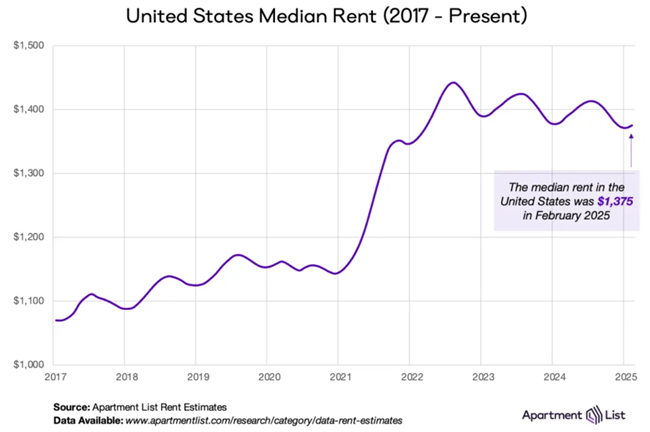
National rent growth flipped back to positive in February for the first time since July 2024, according to the March report by Apartment List.

National rent growth flipped back to positive in February for the first time since July 2024, according to the March report from Apartment List.

National rents fell 0.2% in January, a month that typically marks the bottom of the rental market each year, but then grew by 0.3 percent in February following six straight monthly declines.

Year-over-year national rent growth also remains negative at -0.4 percent, but is slowly inching back toward positive territory. In dollar terms, the national median monthly rent now stands at $1,375, up $4 per month compared to February but down $5 compared to February 2024, the Apartment List research team writes in the report.

At the local level, 75 of the nation’s 100 largest cities saw rents rise in February.

On a year-over-year basis, rent growth is now positive for a majority of large cities (58 of the top 100).

The Apartment List national index remains negative largely due to steeper declines in a concentrated set of Sun Belt metros that are rapidly expanding their multifamily inventory; these include Austin (-6.9 percent year-over-year), Denver (-4.7 percent), and Raleigh (-3.2 percent).

National rent growth flipped back to positive in February for the first time since July 2024, according to the March report by Apartment List.

“Rent growth follows a seasonal pattern – prices tend to go up during the spring and summer and dip during the fall and winter,” the research team writes. “The end of the year, in particular, generally sees the slowest rental market activity as few households move during the holiday season.

“Demand tends to bounce back in the new year, gradually ramping up to peak season activity in the late spring and early summer. In keeping with that pattern, February saw a return to positive rent growth, with prices ticking up for the first time since last July.”

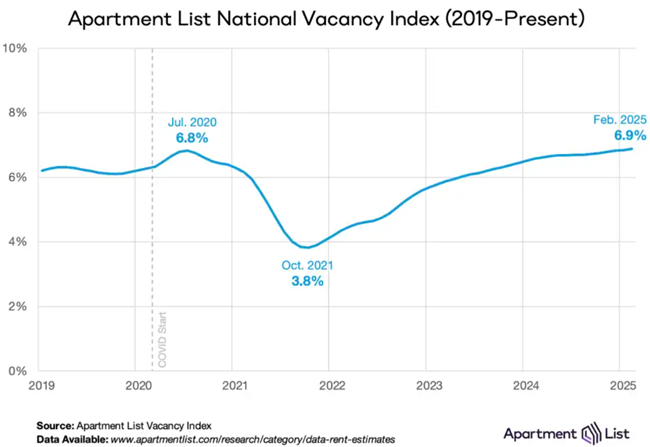
Multifamily vacancy rate hits 6.9%, a new peak

The rising vacancy rate in recent years is largely attributable to an influx of new multifamily inventory hitting the market.

“As new apartment completions decline, the vacancy index could begin to tighten again, but for now, we’re still seeing vacancies rise, even as rent declines gradually moderate,” the research team says.

National rent growth flipped back to positive in February for the first time since July 2024, according to the March report by Apartment List.

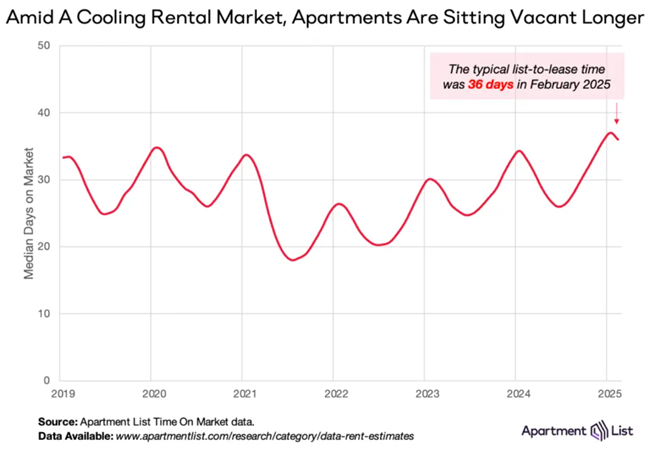
List-to-Lease time retreats from all-time high

The slight decline in time-on-market in February is in line with the seasonal return to positive month-over-month rent growth.

National rent growth flipped back to positive in February for the first time since July 2024, according to the March report by Apartment List.

“That said, this is still the highest time-on-market reading that we’ve seen in February of any year going back to the start of 2019, when the data series begins. Units are currently sitting vacant for three days longer than they were at this time last year, and for 10 days longer than they were in February 2022, when the market was just beginning to loosen. The influx of new supply is resulting not only in a growing number of vacant units, but also in an increase in the length of time those units remain unoccupied,” the research team writes.

Read the full report here.

Sign Up For Our Weekly Newsletter And Get Rental Property And Apartment News And Helpful, Useful Content Each Week.

* indicates required

Multifamily New Supply To Decrease In 2025-2026

Multifamily new supply construction starts are 40% below the peak level recorded in 2022, Yardi Matrix says in a Multifamily Supply Forecast

Multifamily new supply construction starts are now 40% below the peak level recorded in 2022, Yardi Matrix says in a new Multifamily Supply Forecast report.

This decrease, however, comes from a very high starting level, and a still-large inventory of properties remains to be completed.

Overall, the number of units under construction tracked by Yardi Matrix is declining. However, in 2025 the still-large under-construction pipeline will deliver the second-highest amount of annual new supply since the 2008 financial crisis, trailing only 2024’s record volume.

“This slowdown has begun to work its way into the under-construction pipeline, which will result in ​a contraction of new supply from 2025 through 2027. That follows a very high level of development activity and a large inventory of properties still to be completed.

“As a result, forecast completions for 2025 have been increased by 3.3% to roughly 525,000 units, with a 2026 increase of 11.5% to 414,000 units,” writes Ben Bruckner, Senior Research Analyst, for Yardi Matrix.

Multifamily new supply construction starts are 40% below the peak level recorded in 2022, Yardi Matrix says in a Multifamily Supply Forecast
For the Q1 2025 update, the Yardi Matrix Multifamily Supply Forecast was increased for years 2025 through 2027. The forecast for the remaining years is substantially unchanged. Chart courtesy of Yardi Matrix.

The continued elevated construction completion times are a key factor here, the report says, and some amount of the current under-construction inventory will not be completed until 2026. The current forecast update, therefore, anticipates new supply will not fully bottom until 2027.

“For the longer term, the current forecast assumes a higher-for-longer Federal Reserve policy will keep short- and longer-term interest rates elevated. Continued tight new development financing combined with long development lead times will cause construction starts to remain at the same level in 2025 as seen in 2024, resulting in new supply bottoming in 2027,” Bruckner writes.

Read the full report here.

About Yardi Matrix

Yardi Matrix researches and reports on multifamily, office and self-storage properties across the United States, serving the needs of a variety of industry professionals. Yardi Matrix Multifamily provides accurate data on 18+ million units, covering more than 90 percent of the U.S. population. Contact the company at (480) 663-1149.

Sign Up For Our Weekly Newsletter And Get Rental Property And Apartment News And Helpful, Useful Content Each Week.

* indicates required