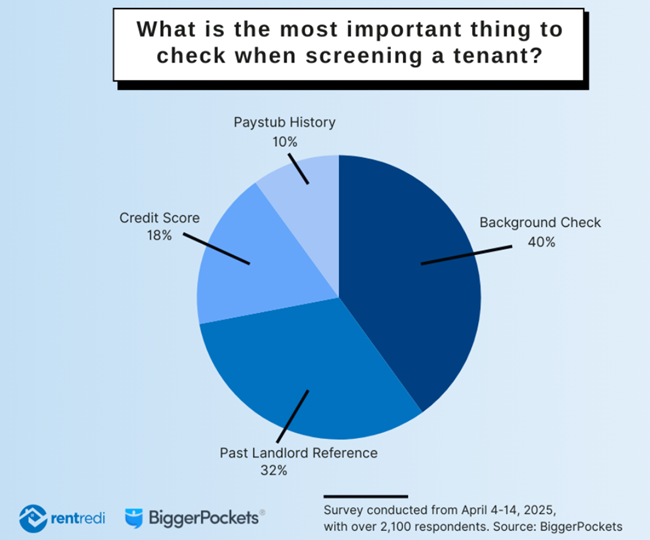
Background checks are the most important tool in a landlord’s screening process, according to a survey of 700 landlords by the property-management software company RentRedi and the real estate investment-strategy company BiggerPockets.
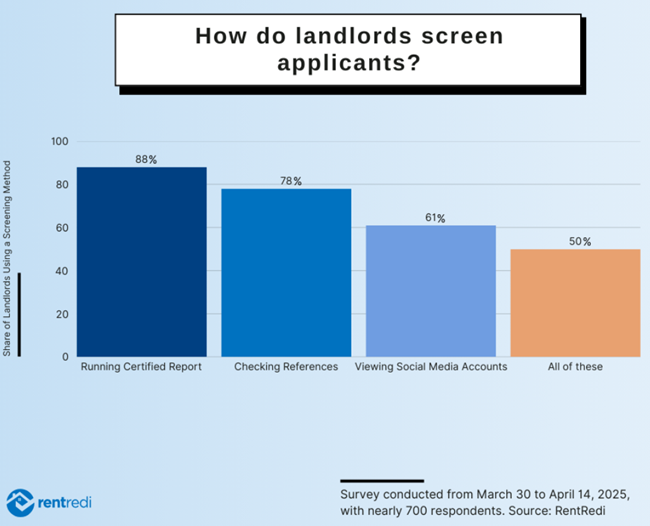
The survey showed that landlords use multiple sources in tenant screening. At the top of the list, 88% of respondents said they run a certified tenant-screening report, while 78% said they reach out to references and 61% said they review applicants’ social media profiles.
Highlights of the report:
Nearly 50% of landlords say background checks are the most important screening factor
References and credit scores rank significantly lower in importance
88% of landlords run certified screening reports; 50% use multiple screening methods
Over 90% of landlords verify employment and income
Landlords increasingly consider lifestyle factors like pets, smoking, and social habits
59% of landlords now prequalify tenants by using software, outpacing manual methods
More than two-thirds of landlords electronically verify tenant documents
8% of landlords still don’t verify any tenant information, highlighting a gap in tools and education
Verifying employment and income is key
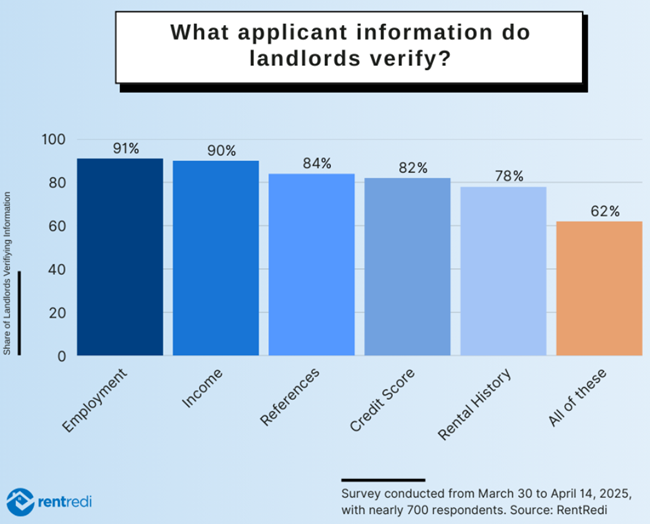
The survey says 91% of landlords verify an applicant’s employment, while 90% confirm income, 84% check references, 82% verify credit scores, and 78% look into rental history.
More than 60% reported verifying all of these details before making a leasing decision, highlighting just how rigorous the screening process has become for many independent landlords.
Pets and smoking are top issues for landlords in tenant verification
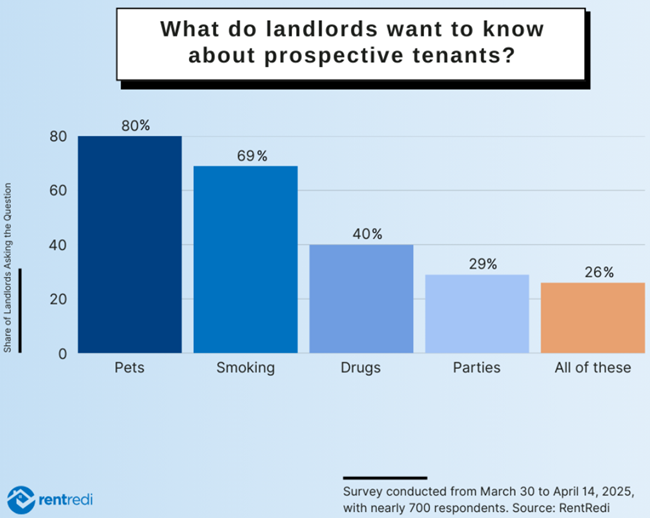
Lifestyle issues are important in rental screening; 80% of landlords said they want to know about a tenant’s pets, while 69% are concerned with smoking habits.
Forty percent said recreational drug use was an important factor to understand, and 29% wanted to know whether tenants planned to host parties—and how often. A quarter of respondents said they try to gather information on all of these lifestyle preferences when screening.
How to get a tenant’s inoperable car towed off a landlord’s rental property is the question this week for Ask Landlord Hank. Remember Hank is not an attorney and he is not offering legal advice. If you have a question for him please fill out the form below.
Dear Landlord Hank:
I have a duplex.
The tenants have an inoperable car in the driveway that they owe a lot of money on and don’t have the money needed to get it fixed.
They’ve asked the dealer to come take it back but the company won’t do it. What are the options to force the dealer to come take it? -Sandi
Dear Sandi,
Check your lease.
In most leases there is a clause concerning vehicles that says something like this: “Vehicles must be currently licensed, owned by tenant, registered, operational and properly parked. Vehicles not meeting the above requirements are unauthorized vehicles subject to being towed at tenant expense.”
This is tenant responsibility.
I would ask your tenants to contact the dealer to tell them to remove the car or that it will be towed, and not only will the dealer not be receiving any more money on this car, he won’t have the car either.
Sincerely,
Hank Rossi
Each week I answer questions from landlords and property managers across the country in my “Dear Landlord Hank” blog in the digital magazine Rental Housing Journal. https://rentalhousingjournal.com/asklandlordhank/
Editor’s note: Check your local and state regulations on issues such as this as it varies across the country.
As a child, Hank Rossi sometimes helped his father take care of the family rental-maintenance business. In the mid-’90s he got into the rental business for himself. After he retired, he started a real-estate brokerage business with his sister that focuses on property management and leasing. Visit his website: https://rentsrq.com.
Ask Landlord Hank Your Question
Ask veteran landlord and property manager Hank Rossi your questions from tenant screening to leases to pets and more! He provides answers each week to landlords.
Landlord Hank Rossi says, “This is tenant responsibility. I would ask your tenants to contact the dealer.”
Colorado Governor Jared Polis signed H.B.25-1207, a pet-inclusive housing bill removing barriers to housing for pet owners, according to a release.
The pet-inclusive housing bill will end insurance-based breed discrimination, expand pet-friendly affordable housing, and support housing stability for vulnerable populations in the state.
“We are laser-focused on saving Coloradans money on housing, and this new law ensures that families will not be forced to decide between beloved furry family members and housing,” Polis said in a release.
“This bill strikes the right balance on making sure Colorado can continue to promote more housing now and keep families together with their pets,” Polis said.
“Our pets are more than just indoor animals. They are family. This new law honors that bond by keeping Colorado families together with their beloved pets when they search for housing,” said Colorado First Gentleman Marlon Reis, an animal rights activist.
“Restrictive rental housing pet policies are not just a nuisance—they are a leading cause of housing insecurity and pet relinquishment,” Ross Barker, Director of the Pet-Inclusive Housing Initiative at MCPP, said in a release.
“This legislation marks a pivotal step toward addressing these issues and will be a game-changer for pet-owning renters. By prioritizing pet-inclusive housing and eliminating outdated breed-based insurance discrimination, Colorado is leading by example and affirming what so many of us already know: pets are family, and no one should have to choose between a roof over their head and a beloved pet,” Barker said.
Polis also signed HB25-1180 – prohibiting pet animal sales in public spaces.
“We want Colorado to be the best state in the country for Coloradans and pets to live and thrive. These bills will help animal shelters and rescues and increase support for enforcing high animal welfare standards across the state. Coloradans love our animals, and through the new income tax check-off, anyone can donate while filing taxes to protect pets and farm animals from cruelty, neglect, and during emergencies like fires and floods,” Polis said in the release.
“The work of protecting animals is, by nature, teamwork. It happens at the community level. It means standing up and speaking out for animals when they’re in trouble and can’t defend themselves. It means looking at every possible avenue by which we can support and uplift animals – and that’s exactly what these bills do,”Reis said in the release.
Renting by the room: David Pickron shares his experience and some of the hard-fought wisdom he came away with trying to maximize rental income.
By David Pickron
I finally did it! After meeting with the experts, recording podcast episodes about it, and talking it over for months, I dipped my toe into the “rent-by-the-room” market.
Since you are reading this, you know I survived, but not without some lessons learned. Like any good person who lives to tale the tale, below I share my experience and some of the hard-fought wisdom I came away with… so buckle up.
Renting by the room
As a curious landlord and one who has tried just about every way to fill a vacancy, I entered the realm of renting out two of my properties by the room in an effort to maximize rental income in a local high-demand area.
By leasing individual bedrooms rather than the entire unit, I hoped to charge a higher combined rent, diversify my income streams, and minimize the financial impact of a single vacancy.
While appearing financially advantageous on the surface, I anticipated a host of challenges and risks that I knew I could not underestimate.
And so I began.
When the listings went live, I immediately had interest. Not having done this before, I was unprepared for exactly what came next.
I was marketing a three-bedroom unit and a two-bedroom unit, both in the same community. I’ll address each property separately.
The three-bedroom unit
Because the rent would be split three ways, the per-room fee was marginally less than that of the two-bedroom unit and immediately drew more interest.
For the sake of anonymity I will reference the applicants as A1, A2, and A3.
A1 came in first and was anxious to see the property. Immediately there were some red flags that went up, and I took notice.
This unit has a two-car garage and A1 wanted complete use and control of the entire space, of course with no additional cost. When I asked why, there was no good reason other than they wanted full control.
I expressed that that wasn’t possible with the parking restrictions in the community and A1 saw this as a deal breaker and withdrew interest.
A2, after seeing the unit, brought their own set of questions. They wanted to ensure that in every storage space, pantry, shelf, etc., that they would be guaranteed a one-third of use. While reasonable to me, I told them I couldn’t guarantee that and that it would need to be managed by the occupants.
A2 withdrew interest in the property at this point. With two strikes against me, I was losing hope.
A3 came along and you guessed it, I struck out. There were questions that could not be answered to A3’s satisfaction and they left the property in search of another option, and I left the property rethinking my strategy.
The two-bedroom unit
As only two occupants would share this space, the per-room rent was a few hundred dollars higher per room.
I had a totally different experience with this unit.
The first individual to come through was excited about the prospects of the property. They were happy with the garage, shared space, and cost. I offered a $200 one-time fee if they could find an individual to take the other room. And much to my surprise, they found a friend through social media to occupy the other room.
This was a successful strategy for me. My search was over almost before it began and I have my first-ever shared-room property occupied by two really satisfied tenants.
Renting by the room requires more management
Communal living adds one more complexity to your management style.
When you rent to one person, they become the “boss” of the property. When you rent to several individuals, you remain the boss and become responsible for helping resolve any issues that arise between the multiple individual tenants. If that doesn’t appeal to you, then this might be something you take a pass on.
In full disclosure, after a few weeks on the market, my three-bedroom unit finally rented out.
I had a single individual come to see it with the potential of sharing with two other tenants. But after considering everything, they decided they wanted the entire property to themselves.
So here I am again, back to the tried-and-true method of renting one property to one tenant.
I’m glad I ventured out, but there is something comfortable about using the model I’ve grown so accustomed to after 30- plus years of investing.
If you are considering renting by the room as an option, you can request my top recommendations to consider adding to your lease at [email protected].
About the author:
David Pickron
David Pickron is president of Rent Perfect, a private investigator, and fellow landlord who manages several short- and long-term rentals. Subscribe to his weekly Rent Perfect Podcast to stay up to date on the latest industry news and for expert tips on how to manage your properties.
A Power of Attorney takes effect on its execution date, remains in effect if you become incompetent and financially incapable, and expires when you pass away. Alternatively, a Power of Attorney document can set forth an earlier date upon which the authority granted therein will terminate.
Your Power of Attorney “Agent”
Your “Agent” is the person designated in your Power of Attorney to manage your estate if you become incompetent or financially incapable. An Agent can be someone close to you, such as a spouse, child, or parent. However, rental property owners may more prudently choose a business partner or another rental industry expert as the Agent. The designated Agent should ultimately acknowledge their duty by signing a certification and acceptance of authority.
Authority Granted in Power of Attorney
Agents have authority to handle matters ranging from business operations, claims and litigation, taxes, and real property transactions. For rental property owners, the Power of Attorney document can describe how your Agent should manage your assets to keep things running smoothly.
Transferring Assets to a Trust through Power of Attorney
A Power of Attorney can simplify the transfer of assets into a trust by enabling your Agent to transfer those assets on your behalf. For example, if you’re unable to finish funding your trust due to an unforeseen severe accident, the Agent can make the necessary transfers for you. If a Power of Attorney is not in place before you become incompetent or pass away, the remaining assets not already in the trust may need to progress through the probate process.
Power of Attorney Compensation
Your Agent is entitled to reimbursement for reasonable costs incurred in exercising their powers outlined in your Power of Attorney. Reimbursement of these costs may come from the assets your Agent is managing while you are incapacitated.
A Power of Attorney is a crucial component in any rental property owner’s estate planning toolbox. While every detail and circumstance surrounding a Power of Attorney cannot be addressed in this article, please feel free to contact John Stromberg by email ([email protected]) or phone (503-255-8795).
About the author:
John Stromberg
John Stromberg assists clients in domestic relations, estate planning, and civil matters. He received his Doctor of Jurisprudence from Willamette University College of Law and attended the University of Oregon for his Bachelor of Arts degree. John Stromberg has experience litigating civil and divorce cases involving estates worth millions, as well as litigation for highly contentious custody, parenting time, and spousal support matters. He is a current member of the Multnomah Bar Association Service to the Public Committee and has appeared at events informing the local community of available domestic relations resources.
A feud between tenants is no fun so how best to handle it is the question this week for Ask Landlord Hank. Remember Hank is not an attorney and he is not offering legal advice. If you have a question for him please fill out the form below.
Dear Landlord Hank:
How do we handle an ongoing, ugly feud between the two sets of tenants in our duplex?
An escalating feud has been brewing for several months, where our tenants argue about everything from when to use the laundry room, how to rake leaves in the yard or how to dispose of waste, etc. Both parties constantly call and text my husband, asking him to take their side and tell the other party that they are in the wrong. They take videos of each other in the yard, supposedly showing their neighbor committing some transgression, and send those to my husband as “proof.”
From our perspective, neither set of tenants has been very courteous or respectful to the other, and we don’t want to concern ourselves with these petty arguments. However, I am worried because both parties have called saying, “I think they are going to kill me!” It seems that both sets of tenants are trying to get us to evict their neighbors, and constantly ask us to “do something.” Last week my husband told the tenant who had just called him, “If you really feel like your neighbor is threatening you, then call the police. Because my hands are tied and I can’t do anything with this situation.” Then the other tenant called and said she had just hired a lawyer.
To my understanding, unless a tenant turns to physical violence or intentionally damages their neighbor’s property, there’s nothing we can do. Or is there? We are just sick and tired of the constant calls, texts and videos, we feel like we’re being harassed! Any advice is appreciated, thank you.
–Victoria
Dear Victoria,
I would outline all the conflicts and issues you are aware of, along with any resolution or lack thereof, and include both tenants with this information via text, email and print a copy and attach to their doors.
If a tenant threatens the other resident, gets aggressive with them or the tenant feels like they may be in danger, then you should call the police and be there when they show up.
You as the landlord are obligated to keep your tenants safe from other residents, and you should consider what is best for both tenants.
It sounds to me that it would be best if both tenants find a new place to live.
Then you could start over with new tenants, making sure that the new tenants are aware they are obliged to live in peace with their neighbors. I would ask the tenants together to find a new place to live and give them a timeline to be out that is reasonable, and ask them to try to ignore their neighbor during this time.
If they refuse to move voluntarily, then I would evict.
Sincerely,
Hank Rossi
Each week I answer questions from landlords and property managers across the country in my “Dear Landlord Hank” blog in the digital magazine Rental Housing Journal. https://rentalhousingjournal.com/asklandlordhank/
Editor’s note: Check your local and state regulations on issues such as this as it varies across the country.
As a child, Hank Rossi sometimes helped his father take care of the family rental-maintenance business. In the mid-’90s he got into the rental business for himself. After he retired, he started a real-estate brokerage business with his sister that focuses on property management and leasing. Visit his website: https://rentsrq.com.
Ask Landlord Hank Your Question
Ask veteran landlord and property manager Hank Rossi your questions from tenant screening to leases to pets and more! He provides answers each week to landlords.
Landlord Hank Rossi says, “I would ask the tenants together to find a new place to live and give them a timeline to be out that is reasonable.”
Fair housing applies to maintenance because while unit repairs may not be mentioned by name in the act, the principle of non-discrimination applies to every service a housing provider offers.
By The Fair Housing Institute
When the Fair Housing Act (FHA) comes up, the conversation typically centers around leasing, advertising, or resident interactions.
But an often-overlooked aspect is how maintenance services, including unit repairs, are handled. While the FHA doesn’t directly reference “repairs” or “maintenance,” it clearly prohibits discrimination in the delivery of housing-related services.
This broader interpretation includes how repair requests are prioritized, addressed, and communicated. Every resident—regardless of their race, national origin, disability, or any other protected category—deserves the same level of service and respect when it comes to their home’s upkeep.
When a Maintenance Delay Becomes a Legal Concern
Delays in repair work are part of property operations.
Supply chain disruptions, vendor availability, and resident scheduling can all slow things down. But when a resident starts to believe these delays are linked to their protected status, it moves into fair housing territory.
Even if a delay is legitimate, a resident’s perception of unequal treatment can lead to a discrimination complaint. That’s why it’s critical to be consistent and transparent about how repair requests are handled. The moment it seems that one resident’s needs are regularly deprioritized compared to another’s, it opens the door to legal scrutiny under fair housing law.
How Property Managers Can Stay Compliant
Maintaining fairness and avoiding even the appearance of discrimination means taking a proactive and thoughtful approach.
It begins with consistent service. All repair requests should be managed with the same urgency and level of professionalism. Communication plays a big role as well. Residents should be kept informed about delays and next steps. A quick call or email updating them on a backordered part or a rescheduled technician can go a long way in preventing frustration and mistrust.
Documentation is also essential.
Keeping clear records of when requests were made, what steps were taken, and any follow-up conversations provide valuable support in the event of a complaint. These records show that decisions were based on operational realities—not on who the resident is. In addition, regular training for office and maintenance staff helps reinforce the importance of equitable treatment and teaches teams how the FHA applies beyond leasing.
When complaints do arise, timely and respectful resolution is key. Addressing concerns quickly and thoughtfully not only resolves the immediate issue but also strengthens your community’s trust in your commitment to fairness and equal treatment.
Building Trust Through Fairness
Although unit repairs may not be mentioned by name in the Fair Housing Act, the principle of non-discrimination applies to every service a housing provider offers—including maintenance.
Property managers who remain vigilant, transparent, and fair in how they respond to repair needs are doing more than just protecting their communities—they’re also protecting their teams and their organizations from legal risk. With consistent communication, thoughtful documentation, and a clear understanding of fair housing responsibilities, property professionals can ensure that every resident feels respected, heard, and equally cared for.
About the author:
In 2005, The Fair Housing Institute was founded as a company with one goal: to provide educational and entertaining fair-housing compliance training at an affordable price at the click of a button.
Here are the 3 best ways to fill vacancies in the market today and how to differentiate your rental property from others.
By Nancy Abrams
A rental vacancy can cut deeply into a property owner’s cash flow. For each month that your unit remains vacant, your carrying costs and utility bills still have to be covered.
In a “normal” market, most landlords need only to put out a “For Rent” sign to get a new tenant. But in 2025, when the market is so unpredictable, how can you beat out the competition and get your space rented quickly? Two words: residential marketing.
Think of your vacancy as a product that needs to be marketed—just as you would any product in the marketplace:
What makes your vacant apartment different than the one down the street?
Why will your tenant be happier in your rental?
Lead with what your prospective tenant cares about the most.
The following amenities are demonstrated ways to differentiate your space from the competition. Adopt them, advertise them and attract more applicants.
3 Best Ways to Fill Vacancies in Today’s Market
Rent reporting: Until recently, money paid out as rent did nothing to benefit a person’s credit rating. Now, you can report rent payments to the credit bureaus to be included in most credit reports. The nominal charge will be far outweighed by the benefits to both you and the tenant.
Upgraded internet and streaming apps: Keyless entry systems, smart thermostats and Netflix are tops among the amenities expected by today’s renters. Newer buildings offer smart technologies, but if you have an older property, upgrade it. Include popular streaming channels. The cost will attract tenants that seek reliable connectivity. It will quickly pay for itself.
Referral program: Encourage existing tenants to refer prospective tenants to your properties. Offer something renters actually want, such as Venmo cash, free rent or gift cards for successful referrals. These programs can significantly reduce turnover, increase occupancy and boost tenant satisfaction.
By knowing what amenities and services renters want, you can adjust your marketing and ensure it meets their needs. The key here is to know your audience to attract and retain renters long term.
About the author:
Nancy Abrams is content editor for AAOA (the American Apartment Owners Association). AAOA assists landlords, property managers, real estate owners and brokers across the country with managing their properties, including tenant credit checks and tenant background screening as well as state-specific landlord forms, such as a rental application or rental agreement. The association also offers resources from educational webinars and landlord tenant law to approved providers for insurance and financing. Contact us today to learn more.
Called rent stabilization, the bill limits rent increases for existing tenants in Washington state to 7% plus inflation or 10%, whichever is lower. Landlords can still adjust rent by higher amounts for new tenants. It also limits rent increases for manufactured homes to 5%.
Ferguson also signed other bills covering everything from property-tax relief for disabled veterans to encouraging construction of so-called “middle housing” options like condominiums.
“Washington needs more affordable housing — a lot more,” Ferguson said in a release. “We must make it easier, faster and less expensive to build housing of all kinds. These bills will address this pressing need.”
New construction is not subject to the cap for its first 12 years. Public-housing authorities, low-income developments, and duplexes, triplexes and fourplexes in which the owner lives in one of the units are also exempt, according to Oregon Public Broadcasting reported from a story in the Washington State Standard.
Rent-hike notices are now required 90 days before they go into effect, up from 60 days under previous law.
Democrats believe the limit will give renters greater predictability in one of the most expensive states for housing, while Republicans think it will chill development and force landlords to sell their properties because they can’t keep up with maintenance costs and property taxes.
Last month, Rep. Sam Low, R-Lake Stevens, argued the policy is “going to be devastating for our housing providers, and we need housing providers to be a part of the solution in the housing crisis that we have.”
Other housing related bills signed by Ferguson
In addition to HB 1217, Ferguson signed nine bills related to affordable housing. These bills covered permitting reform, tax incentives, parking restrictions and more. Those bills are:
House Bill 1106 — Allows more disabled veterans to qualify for property tax relief
House Bill 1403 — Clears up language in state law related to condominium construction
House Bill 1516 — Creates additional insurance options for condominiums
House Bill 1757 — Requires cities to adopt rules for converting existing buildings into housing in commercial and mixed-use zones
Senate Bill 5184 — Limits the number of parking spaces cities and counties require for housing projects
Senate Bill 5298 — Strengthens notification requirements when manufactured- and mobile-home park land is listed for sale
Senate Bill 5313 — Expands the list of provisions that are prohibited in residential rental agreements
Senate Bill 5529 — Expands tax incentives to support affordable housing
Multifamily fundamentals displayed resiliency in April, as the U.S. average national rent increased and occupancy rates remain relatively unaffected by heavy supply growth, Yardi Matrix says in the April report.
However, investors are growing wary as the U.S. economy shows signs of slowing.
Highlights of the report
Multifamily advertised rents continued to grow moderately in April as demand coming from a solid labor market and weak home sale market remained consistent.
The average U.S. advertised rent increased $5 to $1,736, while year-over-year growth fell 10 basis points to 0.9%.
The national occupancy rate declined slightly, reaching its lowest point in more than a decade at 94.4%.
However, a slowdown in supply is anticipated in the coming years, as starts have dropped sharply, which will support absorption.
Single-family build-to-rent advertised rates also increased in April, up $5 to $2,178. Gains were entirely concentrated in the Renter-by-Necessity (RBN) segment, which was up 1.9% year-over year, while the Lifestyle segment was down 0.4%.
“Early data aligns with our forecast of moderate 1.5% rent growth in 2025, but the contraction of the first quarter GDP raises the risk of a potential downturn, which could disrupt otherwise resilient fundamentals,” Yardi Matrix writes in the report.
Rental demand
Rental demand has benefited from high home sale prices and high mortgage interest rates. Home sales have dropped to the lowest level since 2009, according to the National Association of Realtors.
“Home buying and selling remained sluggish in March due to the affordability challenges associated with high mortgage rates,” NAR Chief Economist Lawrence Yun said in a release. “Residential housing mobility, currently at historical lows, signals the troublesome possibility of less economic mobility for society.”
Tariff concerns lead to slow down
“Speaking at a recent Marcus & Millichap webinar, Moody’s Analytics chief economist Mark Zandi said the impacts of tariffs include increased costs for consumers and businesses, a negative wealth effect that affects consumers, and the risk that foreign businesses will divert supply chains to exclude the U.S.”
Yardi Matrix researches and reports on multifamily, office and self-storage properties across the United States, serving the needs of a variety of industry professionals. Yardi Matrix Multifamily provides accurate data on 18+ million units, covering more than 90 percent of the U.S. population. Contact the company at (480) 663-1149.