
Home Blog Page 201

3 Ways Property Managers Can Protect Themselves From Potentially Violent Tenants

What property managers and owners can learn from the shooting last year of two property managers in Portland following the eviction of a tenant.

By John Triplett

The two property managers who were shot by a tenant in their offices in Portland following an eviction late last year, are recovering and doing well according to a spokesman for the company.

The two managers for Guardian Real Estate Services, working at Portland’s Cascadian Terrace Apartments developed by Community Development Partners,were shot and wounded by a tenant during an eviction due to behavioral issues in late December, according to reports.

Both managers, a 45-year-old man and 64-year-old woman, were treated for serious but not life-threatening injuries and are recovering, police said.

The evicted tenant is being held on attempted murder charges.

In terms of how the property managers are doing, Community Development Partners President, Kyle Paine, said, “They are recovering nicely. Out of respect for their privacy, I’m not at liberty to share any information. I can say that we all feel extremely fortunate that the incident was not more severe.” He declined to say if the managers had returned to work.

Rental Housing Journal asked Community Development Partners to share with other owners and property managers what they had learned from the event to help prevent such things in the future at other apartment complexes.  CDP is offering lessons learned and suggestions to other developers. Here are the answers provided by Community Development Partners:

1. What can property managers learn from this experience?

Unfortunately, a violent situation can happen anytime, anywhere.  In light of our experience, we believe it is important for property managers to be educated on the safety plan and procedures for their property, should a crisis happen.  They should also learn ways to alleviate a volatile situation.

2. What can property managers do to better protect themselves?

Education is one key component.  Property managers can partner with local law enforcement and other appropriate community groups to learn ideas and create relationships.  Managers can invite law enforcement to present safety programming to educate both managers and tenants.  Some police departments even offer a safety certification upon completion of a safety program.  These groups are an invaluable asset in providing education and helping create a safe culture in the community.

Communication is also important.  Property managers should play their part in having open communication between, management, ownership and tenants.  The residents need to feel comfortable communicating with property managers if they observe any unsafe individuals or situations.

There are also safety precautions that can be taken when an eviction has escalated.  Property managers should assess the reasons for an eviction, and consider whether there is an anger management component.

    • For example, a tenant not paying rent is often more of a financial problem.
    • However, if a tenant is being evicted for behavioral issues, there may be anger management and an ongoing threat.
    • Management may want to close their office for a time period after the eviction, or reduce hours and access for a period of time for the tenant to cool off.

Also, property managers should take advantage of available resources.  If there is a volatile eviction, it may be wise to use a professional service to help distance management from the situation.

It might also be wise to talk with the police if there is a concern of a threat. The police can escort the manager to the occupant’s unit to help ensure the manager’s safety.   If the tenant fails to vacate upon eviction, management can take advantage of a police lock-out.

3 ways property managers can protect themselves from potentially violent tenants

Photo copyright Kzenon via Canva

The police can escort the person off the property, and set a time for the person to come back and pick up their belongings when management can arrange for more security to be present.  These resources should be used carefully, however, as they can inflame a situation.

3. What can ownership do to help keep property managers safe?

Crisis Plan

One of the most important things that ownership should do is to create and implement a crisis plan for every property, and review with the management company.  The plan should also be reevaluated quarterly to address any new issues or information.

Design

For a newly built or renovated property, ownership should consider safety as part of the design.  “At Community Development Partners, we like to team with our management company in the design phase to take advantage of the safety features that they may desire or require.  We act as one team with our management companies, and together we create better communities that are more pleasurable and livable for our residents,” Paine said.  Ownership can also consider lighting and landscape design as part of environmental safety.  Landscaping can be designed to enhance site lines, and provide a deterrent for illegal activity.  There should also be ample lighting and windows for visibility in all corridors and public spaces, including trash rooms.

Technology

Other safety mechanisms that ownership can install include a fob system that allows tenants to only reach specific floors or areas of the property, and can be turned off in the case of a crisis or threat.  They can also install intercom systems and/or camera systems that can both document a threat and act as a deterrent.  Owners can also install an auto lock system for the main door, which allows management to lock/unlock the door from their desk.  There are also enhanced locking mechanisms which can be installed on windows for added safety.

About Community Development Partners

CDP develops and operates sustainable, life-enhancing affordable housing with a focus on long term community engagement. CDP is a leader of transformative change – responsible for creating life-enhancing affordable development projects that adhere to strict standards of environmentally, socially and economically responsible buildings and communities. Founded in 2012, CDP’s multi-disciplinary team is comprised of real estate development experts who contribute diverse backgrounds in both affordable and market-rate development. Our goal is to weave a sense of community into each of the projects completed. You can find out more about them here.

About Guardian Real Estate Services, LLC

Locally owned and operated out of Portland, Oregon for over 40 years, Guardian Real Estate Services has evolved into a leading management, development and investment firm in the Pacific Northwest. The company says it is defined by a deep commitment to the communities in which they invest. The company’s portfolio is comprised of over 180 communities consisting of 10,000 apartment residences throughout 90 cities in four states.

 

6 Best Lawn Care Practices For Property Managers This Spring

Six top recommendations from lawn care professionals to help property managers, as well as homeowners, grow and maintain healthy lawns include some expert advice and dispel common myths, according to a release.

The National Association of Landscape Professionals put together the top 6 recommendations drawn from the expertise and best practices of experienced lawn care professionals across the U.S.

“Lawns are the foundation of landscapes, but their benefits serve vital functions — capturing pollutants, producing oxygen and cooling homes — that positively impact our communities and the environment at large,” Missy Henriksen, vice president of public affairs, NALP, said in the release.

6 best lawn care practices:

1. Get water-wise. Save water by giving your lawn a deep watering every few days, not daily. Frequent, light watering — as opposed to a deep soak that penetrates the soil — can cause water to evaporate and leads to shallow root growth.

2. Know before you mow. Keep grass at a longer, finished cut height. Never remove more than one-third of a grass blade while mowing. That typically means a finished height of 2 to 3 inches. Mow in the morning, and not right after it rains.

3. Consider grasscycling. Keeping some grass clippings on the lawn after mowing allows nitrogen and nutrients to be returned to the soil for a healthier lawn. It also protects against fungal disease. If the grass is long, you may have to double-cut it to properly mulch clippings. Never leave excess clippings on top of the lawn.

4. Check your balance. Healthy grass starts with the soil. A simple soil test can determine its pH balance, which can help indicate nutrients your lawn may need. Make sure your fertilizer provides the proper nutrients and is appropriate for the season and your lawn type.

5. Think “smart” (lawns). One of the top landscape trends of 2017, cultivars, or cultivated grass varieties, are selectively bred to withstand the elements while still delivering an aesthetically beautiful and healthy lawn. A landscape professional can help you determine if these grass varieties are best for installing or overseeding a lawn.

6. Care about more than color. Don’t worry if your grass isn’t always green. A brown lawn does not mean it is dead. It could be dormant due to factors like extreme heat or drought.

Homeowners and property managers should consult with a professional regarding lawn care guidance for their individual properties. For more tips and to find a qualified landscape professional, visit LoveYourLandscape.org/Find-a-Pro.

lawn care benefits

About NALP

The National Association of Landscape Professionals represents an industry that employs nearly 1 million landscape, lawn care, irrigation and tree care professionals who create and maintain healthy green spaces for the benefit of society and the environment. NALP offers education, networking, training and certification programs that increase the professionalism in the industry and inspire its members to excellence. For more information,

Keep up with lawn care advice with our weekly email newsletter.


Why Are Some Property Managers Not Solving Pet Poop Problems?

By John Triplett

Rental Housing Journal

If you do a search online for apartments and pet poop problems, there is no shortage of negative reviews from tenants about pet waste in apartment communities.

The growing millennial generation is becoming the largest group of renters in the country. And guess what, more than 70 percent of them are pet owners. The trend toward pet ownership in rental housing is only going to grow.

One California apartment owner and his property manager have taken  the problem head-on in their pet-friendly apartment complexes. Not only have they solved their pet poop issues in their complexes with their tenants, but they started a doggie DNA testing program for apartment managers. Now they are working with other property managers to try and help those managers solve their pet poop issues.

However they have run into issues they did not anticipate with some other property managers.

Some property managers deny they have a pet poop problem

Emily Lee, a property manager for Orloff Property Management, Inc. which began the doggie DNA testing program said, “When I went out into the field, a lot of the property managers would say that – just actually deny that they had any issues at all on their property.

“But before I spoke to them I had gone on Google and Yelp to look at some properties in the area that were pet friendly to see what the reviews had to say. Basically I wanted to see if their residents had complained that they had pet poop problems – and they did have pet poop problems,” Lee said.

“But then the property managers – I am unsure of what their reasoning was – they would say, ‘We’re not really interested. We don’t have a pet poop problem.’ And that was pretty much across the board,”  said Lee, a 10-year property management veteran.

“It is our belief that there are not bad dogs, there are bad dog owners,” said Cliff Orloff, owner of Orloff Property Management Inc., which owns approximately 800 units in Sacramento and Berkeley, California, and Indianapolis, Indiana.

 “We have had some bad dogs, but they have been bad dogs because their owners were bad – they didn’t know how to deal with their dogs,” Orloff said.

Why do some property managers not solve the pet poop problem?

Tesla here won "Dog of the Month" in a photo contest at one pet-friendly apartment complex.

Orloff took the pet poop issue to the veterinary school at the University of California-Davis.  The school developed a state-of- the-art program to DNA-sample dogs at a reasonable cost and to DNA-match dog poop to dogs. At one of his complexes, Orloff set up a mandatory registration for dog DNA screening, data management and resident incentive systems to organize this effort efficiently.

“We started a business that is meant to be something like a credit bureau for pet owners,” Orloff said, called NPR4Dogs.com, designed to help pet-friendly apartment complexes.

“The result was dramatic. The dog poop problem went away overnight. Responsible dog owners who lived on the property hailed the new program. Most of the irresponsible dog owners changed their behavior and became responsible dog owners,” Orloff said.

So now Emily Lee and Orloff are trying to help get pet poop problems solved at other apartment complexes.

“As a property manager I am aware of what is going on around me in my community,” Lee said. “We are a little different here and I think in the minority of property managers. We’re not just here to collect rent. We actually enforce all of our policies and we really strive to make our properties a nice place to live.

“So I noticed a lot of larger property management companies have a lot of overhead and they have to jump through hoops to get things approved. So it seems like it was more work for them to implement the DNA program than it was for them to just let the pet poop problem continue.”  She said it seemed there was a lot of bureaucracy and it was just too much trouble to work the issue up the chain of command.

“I only ran into one property manager who did say they do have a problem and she would be interested in the DNA program, but they would have to put it in the budget and get it approved by their regional manager,” Lee said.

“Here Cliff owns and manages these properties so I feel it is just a little different than investors and investment companies who are more about the bottom dollar. We are all concerned about the business, but we want to make sure the properties are a nice place to live too.”

A pet DNA program could help apartment marketing

“I do not think many of these folks think about how this type of program could help their marketing. They do not realize they are blocking out a number of prospects when you do not accept pets. So for them, 10 people come in and eight have pets, so their only prospects are two out of the 10. But if you accept pets, then they are all your prospects.

“So that would actually help their occupancy but then I don’t think people think about that. They just think about ‘Oh it’s going to create a lot of work for us now,’ “Lee said.

“I do believe there are some apartment management companies that are anti-pet and just do not want to deal with it. We do have some properties around here that do not accept pets across the board and it is because it is a lot of work. But like I said, if 10 people walk in to rent an apartment and eight of them have pets we have apartments available for all 10 prospects not just two.

“In the Sacramento region, we are one of two properties that accept all pets and all breeds of dogs. The other property is actually full with a wait list and their rents are significantly higher than ours.

“We changed our policies slightly when we were implementing the DNA program because we were only accepting one pet. And so that actually turned a lot of people away also who had more than one pet.

“I received a phone call from a gal yesterday who was interested in a two-bedroom and she had two pets, and they were larger breeds, so her only option was that one complex and us. And we were not an option because we only take one pet,” Lee said explaining they are now changing to a two-pet option.

Why do some property managers not solve the pet poop problem at their apartments?

Bandit here was another "Dog of the Month" winner at his apartment complex.

Pet friendly can lead to higher rents and income for apartments

“I have been working at Riverfront for six years and in property management for 10 years, and 9 times out of 10 people are not going to give up their pets to move to a place. They are looking for a place that accommodates them and their pets.

“So I do believe you can charge more for rent when you have a pet policy where you are giving something that nobody else is offering.

“We have actually changed our pet policies and now we are accepting two. We made the monthly pet fee higher so that is a little experiment for us to see how much people are willing to pay. It is not an extreme amount but there are some expenses when you have to clean up sometimes in certain areas,” Lee said.

Our current pet policy?

“As of today, two-pet maximum, no weight or breed restrictions, $400 deposit for each pet. Then it is a $25 monthly pet fee for the first pet and then if you have two it is a total of $100 a month. So having that second one will jump that monthly premium up $75,” Lee said.

The Humane Society of the U.S. recommends

  • Your property needs a clear set of rules and consequences for violations. Make rules available at the resident portal and in the office so residents see them frequently. This frees your staff to offer great customer service and answer questions.
  • Be consistent in fining residents who are witnessed not cleaning up after their dog. Strict enforcement supports the community norm that dog waste is picked up by residents. However, false accusations or non-eyewitness accounts should be handled judiciously; consider sending a gentle note that lets people know management cares who scoops their poop.
  • Show residents you’re serious about pet pickup. Many housing companies use services (such as professional poop-scooping or, in the case of ongoing problems, collecting dog DNA so that they can match a sample to its source dog and owner). This is the gold standard for properties with high expectations of their residents, and it’s been shown to work: No one wants to get busted, so people remove the “forensic evidence.” Costs can be absorbed by pet fees you’re already collecting.

About:

You can get in touch with Emily Lee to learn more about NPR4dogs at National Pet Registries Inc.,5953 Riverside Blvd. #330, Sacramento, CA 95831, (916) 529-6072 or email at [email protected].

Download below our free eBook

pet poop is a problem many property managers do not want to deal with

7 Secrets To Keep Tenants Renewing Your Leases

Keeping your tenants happy and renewing their leases is key to keeping your rental housing business and your revenue growing.

Our veteran investor, property manager and blogger shares a few of his secrets here.

By Larry Arth

I learned early on in the landlord business that I had to build a strong relationship with my tenants if I wanted long-term loyal clients for my rentals.

On the other hand, apartment owners and real estate investors who simply look at an investment property as a vehicle where the tenant pays their mortgage and generates them some positive cash flow tend to have tenants who move out annually.

When tenants feel or sense they are nothing more than a revenue stream for their landlord, they tend to move on quickly.

Here is my system:

No. 1-   Let tenants know to expect rent increases in leases

Early on while interviewing, we would inform the prospective tenants that our aim was to retain a long-term rental. We did this by being totally transparent and saying, “Here is what we offer and here is what we expect. “

Within this information was a notation of an annual rental adjustment, letting them know up front that expenses rise each year and rents would also adjust accordingly. The objective here was to set the expectation for this rental increase so they were expecting it instead of defying it.

No. 2 – A discount for on-time payments on leases

For one year of on-time payments we would offer tenants a 25% discount off their renewal amount. If rents were to go up by say $20, they would only be increased to $15. Small rewards go a long way.People like to earn their rewards and it shows that you do care about them. At lease renewal we would identify a renewal rate and the discounted renewal rate. Tenants loved striving for this discount. If they unfortunately were late a month or two, they were still offered an incentive for renewing if we wanted to keep them.

No. 3- A personal follow-up phone call

One month after they moved it, we would call and ask how their move went? Or, if there was anything they needed? Consistently we were met with gratitude and rarely did anyone feel they needed anything. They simply appreciated us reaching out to them. At the same time, it was the perfect opportunity to correct the path of any pending challenges.

No. 4  –  Birthday cards and gift cards kept the bikes put away

Since we learned the birthdates of tenants when they signed a lease, we made it a practice to give the adults a birthday card and the small children a gift card for a free ice cream cone at the local McDonald’s. This one dollar gift is something the kids remembered forever and looked forward to each year. It also created a bond that would allow us to ask the kids to make sure they keep their bikes put away and simple things like keeping proper order to the place.

No. 5 –  Renew your leases and receive handyman for the day

You can do this for a day, or half day, depending on rent value and/or property condition. Renewal time does not have to be scary and leave you wondering if they will re-sign or not.

Their expectation of a rental increase has been identified up front. If they paid their rent on time without any late payments they understand they will receive a reduced rental rate increase and now as a bonus if they renew they will have the opportunity to have some improvements done around the home. With your criteria established, these improvements will only add value and are going to be less expensive than tenant turnover. We did things like add shelves, paint a room, perhaps add a built-in microwave. You set the criteria here and zero in on items that should add value and rentability to the property. This has always been a great win for me.

No. 6  Referral money opportunities for tenants

When a vacancy did appear we would send out letters informing tenants there was going to be a vacancy coming up. It would be a chance for them to help pick out their new  neighbor.

 It would say something like, “We like to have great tenants like you, and as you are a great tenant, your family and friends are likely a match to live in our friendly community as well.  If your referral meets our renting criteria and we rent to them, you will receive $100.”

 This created a source of great prospective tenants and served to let the current tenants know we appreciated them. It also gave us a list of future tenants, as we often received more prospects than we had available rental units. People are now lining up to rent from us. This has helped to keep our vacancy rates very low.

No. 7 The little things make a difference in leases

These little differences in how we manage our properties have people wanting to stay and rent with us. As families outgrew their homes they would ask us if we had any other properties that were bigger, as they wanted to maintain our relationships. Their friends were always inquiring about renting from us. We have great reputations as property owners who care about their tenants. As a result, the only time people moved is if they left the area or if they bought a house.

Summary:

You have all heard of, or personally live, the pride of ownership.  When you can create this same type of pride for your tenants, you have created a great partnership that will have them renewing their lease. A person’s home is their castle. It is theirs independence. Even though they do not actually own the apartment or home, you want them calling it their home. When they feel great about where they live and are happy with it, they will call it their home and they will treat it like their home.

When you show you are genuinely interested in a happy partnership with your tenants, you in turn will find happy tenants who maintain the property and pay on time. Then you have a successful business.

About the Author:

Larry Arth is a landlord and the founder and CEO of Equity Builders Group, a Florida based Real Estate investment Group. As a 36 year veteran to real estate investing, Larry understands that we are now in a global economy and as times have changed, investment strategies must change as well. Larry is an international recognized consultant and speaker and assists hundreds of investors per year, both foreign and domestic to realize their investment potential. He analyzes locations across the country for economic strength and the locations that yield the largest most sustainable return on investment. Within these locations he seeks out and gathers the best teams to deliver sound, high performing and most importantly sustainable turnkey investment. He works with investors to ride the wave of each area-specific market surge. Larry’s primary focus is offering (Non Listed) safe and sustainable turnkey investments to the passive investor.

7 secrets to keep tenants renewing leases. Get up to date information on lease issues and more from our weekly email newsletter


How Much Do You Know About Atypical Evictions?

Atypical evictions can happen when landlords and property managers have to deal with the issue of unmarried co-tenants and roommates, sometimes on the lease and sometimes not on the lease.

When things do not work out with these tenants, a property manager or landlord may face what is known as an “atypical” eviction.

Landlords are now seeing more renters who are Millennials. The trend of unmarried tenants is reflected in Gallup data showing more Millennials are currently single/never married than was true for those in older generations. This means they may have roommates sharing expenses. Plus considerably more Millennials are in domestic partnerships. Specifically, more than half of all Millennials, 59%, have never married, and 9% are in domestic partnerships, according to Gallup.

This week attorney Clint S. Dunaway takes on this topic of atypical evictions.

By Clint S. Dunaway

Our law firm is frequently contacted by landlords and property managers in Arizona looking for help with an “atypical eviction.”

There are a few keys ingredients that make up an atypical eviction:


    • The first ingredient in an atypical eviction is the actual person we are trying to evict. Often we are evicting an ex-girlfriend, ex-boyfriend, ex-friend, roommates, adult children, relatives, etc. For example, if a woman moves into her boyfriend’s house, they breakup, boyfriend asks her to leave, and she won’t leave–then we must move forward with a formal eviction to get her out of the house.
    • The second ingredient that makes these situations unusual is that the person requesting the eviction is often living with the person they are seeking to evict. This must make for some really awkward conversation around the breakfast table.
    • Tensions can become very high in a home where people are living side by side and one of them is trying to evict the other. In these atypical evictions it’s not uncommon for one of the residents to obtain a restraining order against the other person.

It is important to note that whether it is a “traditional” Arizona eviction or an atypical eviction as described above, we must always follow the same formal process.

There are no shortcuts!

So resist the temptation to just lock this person out of your house and throw their belongings into the street.

Trying to take any shortcuts with the eviction process can:

    • Delay the eviction
    • Cost you money
    • Create more stress in your life.

 Do it right the first time and you will be able to get this person out of your life.

 How Long Do Atypical Evictions Take?

The time it takes to evict someone from your house depends on a few important variables, and your state laws.

One of the most important variables is whether or not there was an agreement for this other person to pay rent. If there was an agreement for this person to pay rent and they were not paying rent then we can send them a typical 5-day notice for non-payment of rent.

The entire eviction process for non-payment of rent can take 3 to 4 weeks. So if you have any illusions about your ex-lover/ex-friend/roommate leaving in a day or two you need to re-adjust your thinking.

If there never was agreement for this person to pay rent and there is not a written lease agreement in place then you must send them a 30-day notice to vacate.

If they do not leave after the expiration of the 30 days then we can begin the eviction process thru the courts.

If you are outside Arizona, please check your specific state laws dealing with atypical evictions and seek legal advice on how to handle them.

Also research your state and federal laws on Fair Housing discrimination issues around tenant couples who are unmarried to be sure you as a landlord and property manager are complying with the law.

For instance, Oregon has enacted fair housing laws to protect marital status. One marital status is not more protected than another. In other words, individuals may not be treated differently, denied, or harassed in a housing setting or transaction based on whether or not the residents are married or not.

Photo copyright istock.com/Manuel-F-O

 About the author:

Clint represents landlords and property managers in landlord–tenant disputes in Arizona. He seeks to provide all of his tenants with useful practical advice, not just legal advice to his clients so they can make the best decisions for themselves and their companies. Errors in renting to the wrong people can be astronomically expensive. Clint holds degrees from the University of Dayton School of Law (J.D., 2010) and Brigham Young University (B.A., Political Science). Clint enjoys spending time outdoors and travelling with his family. He also enjoys cheering on the Arizona Cardinals football team. You can reach him at 480-344-4035 and through his website here.


How Well Do You Manage Your Property Manager?

Veteran real estate owner and investor Larry Arth has a great property manager who he has worked with for years. Other owners and  investors struggle at times to find the right management style themselves to work with a property manager. Here are some thoughts on how to make the relationship between owner and investors and property managers work better.

By Larry Arth

I was having a conversation recently with an investor who owned a rental property free and clear and had been happy for years that all things were going well, with tenants paying regularly and checks coming in on time.

For the past five years, this investor was collecting rent checks from the property management company like clockwork. The property management company had been sold to another owner a few years back, but things were still going well. The checks came in right on time every month.

Just what an investor wants from a good property management company, right?

This investor never dreamed a simple change in ownership of a property management company could be a red flag.

However, behind the scenes and unknown to the investor, the property management company handling the property had not been paying – since the ownership change –  the annual property taxes due on her rental.

You all know what happens when you do not pay taxes.

In the case of property taxes, they put a tax lien on your house.

If the taxes are not paid, they can actually sell your house out from under you.

Since the investor owned this rental property free and clear, there was no way to know the taxes were unpaid.

The first time the investor found out there was a problem was when a legal notice was received of years of past due taxes. Now the investor is trying to redeem the rental property after the tax sale.

What is the lesson here for investors and property managers?

For owners and real estate investors: How well do you manage your property manager?

How well do you manage your property manager? Photos copyright DragonImages via Canva

Passive real estate investments are great. But it is really important for real estate investors to properly manage their property managers.

My company helps passive real estate investors, and everyone here at Equity Builders Group believes in watching out for investors and looking forward and seeing all of the possibilities of what could go wrong to keep all the benefits an investment may offer – plus how we can make them better.

This forward vision is like looking through the windshield of your automobile. You will note however that every windshield has a rear view mirror (or now in some vehicles the backup camera in the dash too.)This view is small in comparison to the windshield. But it offers an opportunity for you to look around from time to time so you can get a 360-degree view of where you are going and identify any unforeseen challenges.

Passive real estate investments are of course those with which you have very little to do but sit back and collect checks while your property management companies run your business for you.

That is, until your property management company changes staff and our passive investor, mentioned above, now has to try and redeem the rental property after the tax sale.

This investor of course will look into finding a new, and better property management company going forward.

Based on this investor’s experience, I thought I would offer some thoughts on managing property managers.

7 ways to manage your property manager

  1. Talk with them regularly. Even if checks are coming in, you still want to touch base and make sure the team members you hired are still managing your property and all is good.
  2. Create a checklist of things you want to do throughout the year. Perhaps enter these tasks in your calendar so they get done.
  3. Confirm property taxes are being paid. You should see this expense on an owner’s report. However as this is typically an annual expense, and you are not accustomed to seeing this expense, it is easy to overlook a missing expense like taxes. So log this most important tax expense in your to do list. You can also check the local tax record to ensure it is always paid up.
  4. Review all leases. Know when your units are expected to turn over.
  5. Track your vendors. Like any business, it is turnover of employees or vendors where changes occur. If your property manager switches vendors you want to know why and check on the new ones to avoid unexpected surprises. If your property management company switches ownership you want to vet them as you did when you first hired them. Here is a handy property management questionnaire that I developed over the years that will assist you to hire a great property management company.
  6. Spot check market rents. It is easy to become complacent, but markets are always changing. As an owner you want to know if you are getting fair market rents or whether the market has shifted? If you can raise rents, you want to. On the other hand, if you are charging more than market rents you may risk losing tenants. If you have several units that are overcharging you may find yourself in a sudden escalated vacancy position.
  7. Get pictures of your property at least once a year, and more if possible. Investors love it when you do not have repair expenses. But investors should also be concerned if the property is being properly maintained when they are not seeing some periodic repairs. Keeping a log of pictures as the years go by will allow you to see firsthand the condition of the property.

You can see that there is very little time commitment to help ensure that your property is properly managed and maintained.

As a passive investor you want to let someone take care of the day to day details.

You, however, still want to manage your property managers. Happy investing!

About the Author:

Larry Arth is a landlord and the founder and CEO of Equity Builders Group, a Florida based Real Estate investment Group. As a 36 year veteran to real estate investing, Larry understands that we are now in a global economy and as times have changed, investment strategies must change as well. Larry is an international recognized consultant and speaker and assists hundreds of investors per year, both foreign and domestic to realize their investment potential. He analyzes locations across the country for economic strength and the locations that yield the largest most sustainable return on investment. Within these locations he seeks out and gathers the best teams to deliver sound, high performing and most importantly sustainable turnkey investment. He works with investors to ride the wave of each area-specific market surge. Larry’s primary focus is offering (Non Listed) safe and sustainable turnkey investments to the passive investor.

Employee Evictions And How To Handle The Issue

The issue of employee evictions can come up because many communities require their employees to live on-site, and the often include an apartment as part of their compensation.

As in any business, management must sometimes terminate employees.  This article will examine the acceptable grounds for termination and the procedures to require terminated workers to vacate the premises.

Most employees are “at will.”  This means they work at the pleasure of the employer.

The law presumes every employment contract for an indefinite term to be terminable at will.  As an “at will” employee, his or her employment is for an indefinite term at sufferance.  Either party could terminate employment at will for no cause or any cause.  Another term for this is the employment-at-will doctrine.

Management can fire an employee for good cause or no cause, but not for “bad” cause.

For example, an employer and employee agree that the employee will do the required work and employer will provide the necessary working conditions, as well as pay the employee for the work done.

However, there cannot be a guarantee of continued employment or tenure.  The very nature of the “at-will” precludes any claim for a prospective benefit.  Either employer or employee may terminate the contract at any time.

Good cause for handling employee evictions and termination

Good cause for termination includes lying, fighting, destroying company property, inability to perform the duties of the job, and insubordination.  The employer can terminate the employment if he or she makes a subjective determination that the employee’s work is unsatisfactory.

Often times, multi-housing employees receive housing as part of their compensation.  The Arizona Residential Landlord and Tenant Act does not protect these individuals in employee-termination situations.

A.R.S. § 33-1308 states in part:

Exclusions from application of chapter

Unless created to avoid the application of this chapter, the following arrangements are not covered by this chapter…

5. Occupancy by an employee of a landlord as a manager or custodian whose right to occupancy is conditional upon employment in and about the premises.

Management should draft a written agreement stating that employees are not residents; the agreement is not a lease and the time frame for vacating the unit following termination.  If the employee is a current resident, the landlord should cancel their lease agreement and inform the individual that the employee agreement takes precedence over the lease.

Once management terminates an employee, it should personally deliver to him or her a five-day notice to vacate under the conditions of A.R.S. § 12-1173 (the forcible detainer statute).  However, if, at the time of hiring, the employee signed an agreement specifying the amount of time he or she has to vacate, this takes precedence over the statute.

Additionally, it is a good idea to issue this notice at the time of termination.  Although lockouts are permissible as long as they do not cause a breach of peace, most courts do not look favorably on them.  For example, a judgment has in the past awarded $5,000 in punitive damages to a former employee because of a lockout situation.

At the end of the notice period, management may file a forcible detainer eviction requesting possession of the unit, fair rental value from the termination date, attorney fees and costs.  This procedure is identical to a normal eviction for nonpayment of rent.  Following the hearing and judgment, the constable can evict the employee under a writ of restitution after five days.

Consider the following example on handling employee evictions

Clydesdale Apartments hire Miller Tyme and his girlfriend, Amber Lager, to perform maintenance and housekeeping duties.  Apartment manager Bud Wizer requires that the two sign an employee agreement stating they must move out within 48 hours in the event of their termination.

After a few weeks, Bud Wizer smells alcohol on their breath, frequent absences and poor work performances.  The property owners, Mr. Brew and Mr. Stout, elect to terminate Miller Tyme and Amber Lager.  They verbally request that the two vacate within the 48-hour period stated in their contract.

Miller Tyme and Amber Lager refuse to move and the owners file eviction proceedings against them.  At court, Judge Fosters dismisses the eviction because management did not deliver written notice.  On the way out the courthouse, Miller Tyme tells Amber Lager, “It doesn’t get any better than this.”

About the author:

Andrew M. Hull, Esq., Hull, Holliday & Holliday, PLC, www.doctorevictor.com • 602.230.0088


Two Property Managers Shot During Eviction At Portland Apartments

Two property managers for Community Development Partners, working at the Cascadian Terrace Apartments in Portland, were shot and wounded by a tenant during an eviction “due to behavioral issues” in late December.

Both managers, a 45-year-old man and 64-year-old woman, were treated for serious but not life-threatening injuries and are recovering, police said.

The evicted tenant is being held on attempted murder charges.

“Assault detectives booked 65-year-old Reynaldo Diaz Cabrera, the evicted tenant, into the Multnomah County Jail on two counts of attempted murder,” according to a release from Portland police.

“On Monday December 19, 2016, at 12:36 p.m., North Precinct officers responded to the report of a shooting at the Cascadian Terrace Apartments, located at 5700 North Kerby Avenue. As officers were responding to the scene they learned that two people were shot by a known suspect who fled the scene,” according to the police release.

Photo of Reynaldo Diaz Cabrera charged with attempted murder

Property managers shot

“Officers and medical personnel arrived and located the two victims, a 45-year-old male and a 64-year-old female, suffering from serious but not life-threatening injuries. Both victims were transported by ambulance to a Portland hospital for treatment.

“The suspect was located in a vehicle by police at Northeast Martin Luther King Jr. Boulevard and Winchell Street. The suspect was taken into custody without incident. A firearm has been seized as evidence.  Preliminary information indicates that the suspect was formally evicted … and the victims are both employees of the apartment complex management,” according to the police department release.

Community Development Partners, which owns the apartment complex, released the following statement about the two property managers shot during the incident.

“We’re extremely saddened to hear that two exceptional individuals from the property’s management team were threatened and injured by a resident,” the company said in a release according to KOIN.com.

“The resident was in the process of being legally evicted due to behavioral issues. We are pleased that the suspect is in police custody. We’re cooperating by offering law enforcement any information on the resident they request.”

Man Who Shot Portland Property Managers Sentenced to 13 Years

Resources:

Two people injured in North Portland shooting

Man allegedly shot apartment managers after eviction

Evicted tenant held on attempted murder charges

After eviction, suspect shoots apartment complex employees

Cascadian Terrace Apartments

Community Development Partners


HUD Charges Utah Landlord With Discrimination Over Pet Policy

An owner and manager of a Salt Lake City apartment complex have been charged with discrimination by the U.S. Department of Housing and Urban Development over failing to rent to a tenant who had an emotional support animal.

The potential tenant had inquired about renting an apartment was told the apartments had a strict “no pets” policy because some tenants are atlergic to dogs and other longtime residents simply do not want animals at the property.

The potential tenant told management “she had paperwork from her doctor prescribing the animal as an emotional support animal, and that the animal was a small dog of about ten pounds.,” according to the complaint.  The tenant had a “disability-related need for an assistance animal and the requested accommodation was necessary to allow her the equal opportunity to use and enjoy a dwelling” at the apartment the complaint states.

The HUD charge of discrimination states, “Amy Sloan and BJJ Enterprises, LLC violated the (Fair Housing) Act based on disability by refusing to provide services to persons with disabilities, refusing to make reasonable accommodations for persons with disabilities, and by making housing unavailable to persons with disabilities.”

The apartments are the Pine Cove Apartments, is a 48-unit multifamily apartment building located at 1243 E. Alameda Avenue, Salt Lake City, Utah.

Discrimination involves no-pet policy

“The rental agreement does not contain exceptions to the “no-pet” policy for assistance animals and does not outline any procedures for requesting a reasonable accommodation to the no-pet policy for individuals with disabilities,” according to the complaint.

“For nearly three decades, people with disabilities have had a right to request the reasonable accommodations they need to fully enjoy their homes, but that right is still being denied,” Gustavo Velasquez, HUD’s assistant secretary for Fair Housing and Equal Opportunity said in a release. “HUD will continue to take actions that ensure that property owners and managers understand their rights and responsibilities under the law and take steps to comply with those obligations.”

“The case came to HUD’s attention when the Disability Law Center filed a fair housing complaint with HUD on behalf of a female resident with disabilities at Pine Cove Apartments, in Salt Lake City, who alleged that the owner, BJJ Enterprises, and the manager of the 48-unit complex had denied her request to keep an assistance animal,” the HUD release states. “The Disability Law Center conducted fair housing tests, which revealed evidence that Pine Cove managers discriminated against people with disabilities.  According to HUD’s Charge, Pine Cove strictly adheres to its “no-pets” policy, even when medical documentation attesting to the need for a reasonable accommodation is presented.”

HUD’s charge will be heard by a United States Administrative Law Judge.  If the administrative law judge finds after a hearing that discrimination has occurred, he may award damages to the complainants for their loss as a result of the discrimination. The judge may also order injunctive relief and other equitable relief, as well as payment of attorney fees. In addition, the judge may impose civil penalties in order to vindicate the public interest.

Resources:

HUD charges Utah landlords with discrimination

HUD files charges of discrimination against property owner and manager

Apartment management settles discrimination suit over pets and children

Disability Law Center in Salt Lake City on fair housing issues

7 questions landlords have about pets and pet-friendly apartments

What Should a Landlord Charge for Pets?

Landlord, property managers bullied and harassed over rent increases

Tensions are rising between landlords and property managers, and tenant activists. Landlords and managers have been bullied over rent increases. And they face unpleasant demonstrations from activists as Portland struggles with a shortage of housing and rapidly rising rents.

By John Triplett

Rental Housing Journal

A Portland landlord says he and his property managers have been bullied and intimidated over rent increases after he purchased a small apartment building and had to raise existing rents to afford his new mortgage payments.

He said demonstrators have picketed his personal residence. The have placed notices on the doors of neighbors, camped overnight on his lawn, defecated on his lawn and marched into his property managers’ offices scaring the staff, according to his spokesman, John McIsaac.

The landlord, Landon Marsh, raised rents “only to the lower end of current market rates in Portland,” said McIsaac in a recent interview. Marsh has also written an op-ed style editorial here detailing his opinions on what happened.

McIsaac said the rent increases came after Marsh purchased the small apartment complex, did substantial work to improve the condition of the building and raised rents to cover his costs and mortgage. Unfortunately the rent for one tenant went up by 40 percent and the tenant complained to the Portland Tenants United group.

Telling the landlords’ side of the story

McIsaac said he is speaking out because many in the landlord and property management industry do not feel their side of the story has been told, and that more attention has been focused on what the activists’ demonstrations, and what the tenants say.

“I represent the landlords and property managers who do not want to have exorbitantly high rents, we want more housing stock,” McIsaac said.

“In Portland, 85 percent of the landlords are small operators. They might have their retirement tied up in these properties, but they don’t make a ton of money off of them. So the stereotype is that all of the property owners are huge, out-of-state multimillion-dollar concerns. That is not the case. A lot of these property owners have day jobs,” McIsaac said.

The story of one small landlord


Landlord has been picketed by activists in Portland


Photo ©Multifamily NW

McIsaac said that with the hysteria over rent increases, “the activist group has targeted a couple of landlords in particular. They are not going after the big guys who own thousands of units. They are going after the little guys who own like 20 units.

“And this one guy, Landon Marsh, who is my client, is in the hospital interior-design business. He is a one-man consulting business.  He does not do property development for a living. He has investment properties. They are small ones. All three buildings he owns combined make up 20 units.”

Where this all started with apartment building purchase

“He bought one building around seven or eight months ago out in a semi-blighted part of East Portland, a working-class area,” McIsaac said. “It was built about seven years ago. And it needed some repairs just from wear and tear. The tenants asked him to make these repairs and he said, ‘Yes I will do that.’ “

“So he set to making the repairs. But he had bought the building at market value. And market value right now is a hell of a lot higher than it was seven years ago – it’s a lot higher.

“He said that he was going to have to raise the rent. But he said he would keep the rents – and he stuck to this – at the very low end of market rates. So he’s not a profiteer by any stretch of the imagination,” McIsaac said. He said in his opinion, “This guy is a liberal, progressive classic Portlander. He is a caring, altruistic, sensitive man.”

Group pushing rent control and end to no-cause evictions for Portland

Landlord and property managers face harassment from tenant activitsts

Photo ©Multifamily NW

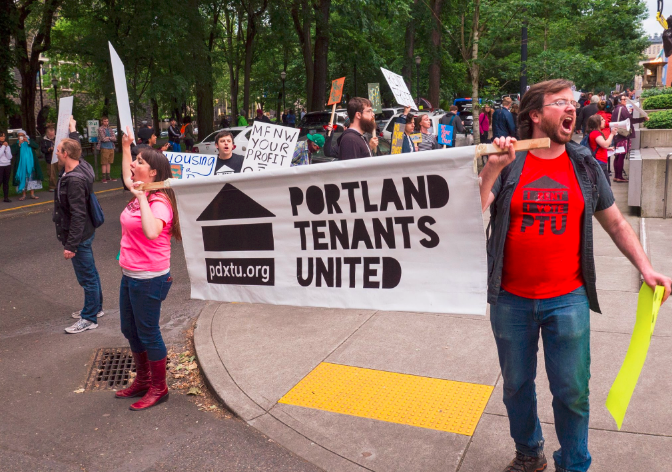
Portland Tenants United is a growing tenants union dedicated to organizing tenants to take action to strengthen and enforce tenants’ rights and protections, according to their Facebook page.

At a recent press conference, Portland Tenants United and City Commissioner-elect Chloe Eudaly, promoting something called “Keep Portland Housed,” called for a freeze on rent and an end to  no-cause evictions in Portland until there is a policy in place to improve conditions for renters.

Leader says group wants municipal disobedience and rent control

“We’ve been in an officially declared housing emergency for over a year. Despite that, tenant protections – the most critical component to preventing homelessness – have not meaningfully improved, and conditions continue to worsen,” Eudaly said in a press release. “My election, and the passage of Portland’s housing bond, present a clear and obvious mandate to City Council to act.”

Eudaly admits state laws prohibit local rent control measures. But she wants city commissioners to commit “municipal disobedience,” do it anyway and fight the resulting lawsuits, she told the Portland Tribune.

Portland Tenants United is focused on lowering the eviction rates in Portland by organizing tenants to vocalize their concerns. Gabriel Erbs, organizer for the group, insists the fight is far from over, according to a report on Portland Patch.  “Tenants can be evicted, for whatever reason or no reason at all, at the landlord’s whim,” he said.

Landlord and tenant activists have clashed

Landlord and property managers face tenant activist protesters in Portland

Tenant activists demonstrate outside Portland Art Museum photo ©Multifamily NW

Tensions escalated late in 2016 at the Portland Art Museum during an awards ceremony. Multifamily NW, an association promoting quality rental housing, was holding its annual ACE awards ceremony for its members when protestors from Portland Tenants United showed up.

Dozens of protesters gathered across the street from the museum. It didn’t take long for tempers to flare, according to koin.com.

The television station reported that, “Tensions were high. Some choice words were exchanged as well as some apparent shoving as protesters came face to face with ceremony attendees. Shouts calling the multifamily association attendees ‘parasite’ and ‘bloodsucker’ rang out from protesters.”

Landlord and property managers have been bullied by tenant activist protesters in Portland

Protesters push past security guards photo ©Multifamily NW

A small group of protesters stormed past security into the museum to disrupt the event. They were soon removed by security, according to katu.com.

Deborah Imse, executive director of Multifamily NW, said in response to the protest, “Over the past few years, rents in Oregon have risen while incomes have lagged behind, creating an urgent housing crisis. In order to thrive, the region needs to work together to create more quality housing options for families of all incomes.

“With demand for housing continuing to increase, we must take action to reduce rental costs by increasing the variety of housing types available to people of all incomes and creating more subsidized affordable and market-rate units,” Imse said in the statement.

Property management groups say more apartment units needed

Any solutions to the Portland housing issue, property management organizations say, should be market-based. A spring 2016 apartment report released by Multifamily NW  says that “Portland’s current development pipeline includes an impressive 21,600 proposed units.”

“More housing is the solution, and our priorities are to help increase supply and educate politicians on the fact that simply adding fees and making business harder has the reverse effect on the problem they want to solve,” Multifamily NW’s  Imse wrote in an email to the Portland Mercury.

Landlord and property managers bullied by tenant activists in Portland

Imse’s image on protester’s poster photo ©Multifamily NW

“As the organization representing property owners and managers, Multifamily NW has adopted a solutions-oriented approach to address the housing shortage. The market data we collect, along with reviews of affordable housing policies across the country and the experience of our members, have shown us the best way to create affordability in the housing market: adopting proven strategies that add to the housing supply,” Imse wrote in an article on Oregonlive.com  in early 2016.

Barrier to constructing new apartments need to be removed

“To increase the overall housing supply, we need to remove barriers to building. This includes updating zoning codes to allow for a wider variety of housing types at a range of price levels.

“At the same time, we should streamline the process for development review and permitting new construction while retaining standards for high-quality buildings. Under the current process, approvals can take a year or more, adding to project costs and delaying the construction of much-needed market-rate and affordable units,” Imse wrote.

Landlords trying to do the right thing caught in the middle

Landlords and property managers bullied by tenant activists over rent increases

Photo ©Multifamily NW

McIsaac said Marsh tried to work with the existing tenants on payment plans and provide plenty of lead time and help moving if they decided not to pay the rent increases. Most tenants decided to stay, he said.

No lawsuits have been filed.

“But they have come up with some non-factual statements about how he has treated tenants and what he has said to them. And he has bent over backwards, and so has the rental company, to make it easier for tenants,” McIsaac said.

“So it is interesting here in Portland the media has not jumped on him, they have been extremely neutral on him. The head of the tenants union has taken it upon herself to negotiate with landlords on behalf of the tenants and she is not a lawyer, not a property owner, she’s just an activist,” McIsaac said.

Property managers bullied as activists marched into property management office

Activists were protesting at one event and then went over to the office of the property management company Marsh had been using to handle his rentals.

“They marched into the A&G Rental Management LLC office and intimidated the people working there. Drove some of them from the main area back into their offices. They had to lock themselves in their offices. And the principals were not in the office at the time, so they basically attacked the support staff – not physically – but screaming, bullhorns, stomping, just marching through this office. It’s not very big,  maybe a grand total of 1,000 square feet. So 30 of them came in there so it was pretty unpleasant,” McIsaac said.

Challenge of buying apartments at market rates

“The bottom line is, if somebody buys a new rental property at market rate from somebody else who owned it for 10 years, the owner is going to sell it at market value. The new owner is going to have to raise the rents to make the monthly mortgage. If you do away with no-cause evictions, then you also do away with the ability to evict bad actors who are drug dealers or domestic abusers, because that is what the law exists for,” McIsaac said.

“His (Marsh’s) other properties have long-term tenants – his other two properties – and so it’s just a crazy, uncomfortable situation. I think the property managers and the landlords are really willing to work with tenants because of the type of city we have here – but the tenants union has refused conversations and any negotiations that are not absolutely in their favor,” he said.

“And they have a couple of politicians on their side,” McIsaac said. “Some politicians support no-cause evictions and rent control. But they don’t know the facts. If they did, they would not do it. The Portland Tenants Union is funded by the national Service Employees International Union (SEIU). No-cause evictions are No. 1 and rental control is No. 2 but I think there are other things lurking underneath if they can get these laws passed.

“If you have rent control you cannot improve your buildings. You have to be an altruistic millionaire to improve a building with rent control because rent is where you derive your income.”

Resources:

Want to lower housing costs? Increase the supply

Portland Tenants United Picket Housing PAC

Multifamily NW The high cost of rent control

East Portland tenants plaster landlord’s neighborhood with flyers

National Multifamily Housing Council

Ash Street Tenants Association letter to landlord Landon Marsh

Portland tenants publicly shame their landlord

Portland Tenants United protest housing awards

John McIsaac Communications and Public Relations

Oregon’s housing crisis too big to ignore – opinion.