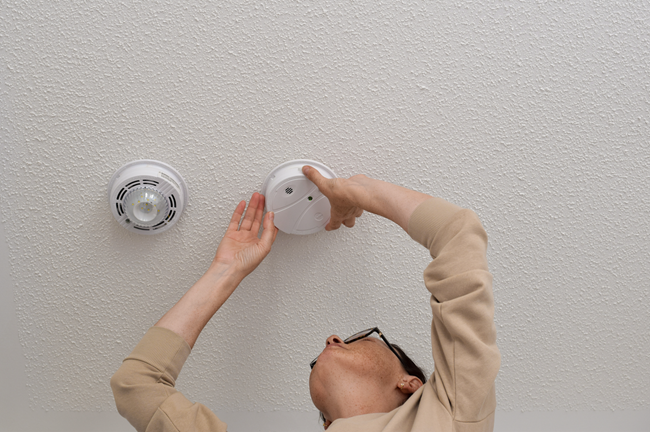
Questions about smoke detectors come up often so this week the question is about a non-functioning smoke detector in a rental and who is responsible for replacing it is the question this week for Ask Landlord Hank. Remember Hank is not an attorney and he is not offering legal advice. If you have a question for him please fill out the form below.
Dear Landlord Hank,
We rent, and the smoke detectors are not working. It looks like entire unit needs new detectors. Who should replace them, us or the landlord?
– Rita
Dear Rita,
Normally the lease will require you to replace smoke-detector batteries when they die, but the owner should be responsible for replacing the actual smoke detector.
I’d try to replace the battery, and then contact the landlord or property manager ASAP.
The owner will also want you and the property to have maximum protection and warning in case of fire.
Sincerely,
Hank Rossi
Editor’s note: Check your local and state regulations on issues such as this as it varies across the country.
As a child, Hank Rossi sometimes helped his father take care of the family rental-maintenance business. In the mid-’90s he got into the rental business for himself. After he retired, he started a real-estate brokerage business with his sister that focuses on property management and leasing. Visit his website: https://rentsrq.com.
Ask Landlord Hank Your Question
Ask veteran landlord and property manager Hank Rossi your questions from tenant screening to leases to pets and more! He provides answers each week to landlords.
Landlord Hank Rossi says, “Normally the lease will require you to replace smoke-detector batteries when they die, but the owner should be responsible for replacing the actual smoke detector.”
It is a landlord’s legal responsibility to keep their properties habitable. If they do not do so, their tenants will not be happy and the property owner can end up in court.
What does the landlord need to do to prevent this? Below are five areas where good maintenance practices will keep tenants satisfied and the property owner out of legal trouble.
Routine maintenance and proactive actions are the first steps to preventing problems before they pop up and create disgruntled tenants so here are 5 best maintenance practices.
1. Prioritize Maintenance Requests
Determine whether the need is urgent or an emergency.
Such issues as a power loss, burst pipe, a fire or HVAC failure are issues of habitability for your tenants and cost potentially thousands of dollars in damage if not immediately rectified.
Take care of high-priority maintenance requests.
If ignored, high-priority issues could pose a significant financial risk or will negatively affect a tenant’s ability to live safely in the unit.
Leaking roofs or pipes, a bedbug infestation, or most broken in-unit appliances qualify as high-priority problems.
Medium-priority requests are preventative maintenance.
Examples of medium-priority issues can include seasonal maintenance tasks such as debris and bush removal for fire prevention, slip prevention in the fall and winter and other issues that could pose a risk to tenants in the near future.
How to assess low-priority maintenance requests
Tasks such as replacing the oven’s light bulb, cosmetic wall repairs, etc. do not pose a safety risk or cause damage to the property. However, they are important to the tenant and must be addressed in a timely manner.
2. Preemptive HVAC Service
Regular HVAC tune-ups and monthly air filter replacements ensure that heating and air-conditioning systems run efficiently, preventing breakdowns and tenant discomfort in extreme weather.
3. Prevent Plumbing Issues
Plumbing problems are some of the most common tenant complaints and must be attended to immediately to prevent further damage. A burst pipe suddenly flooding a kitchen is an issue of habitability for your tenants and will cost thousands of dollars in damage if not immediately repaired. Landlords should respond immediately to plumbing leaks, which could also lead to mold issues.
4, Faulty Electrical Systems Are Fire Hazards
Regularly testing smoke detectors, upgrading outdated systems and ensuring that all electrical outlets are operating properly can prevent emergencies and demonstrate to tenants that they are being protected by management.
5. Outdoor Maintenance
A leaking roof can make plumbing, electrical and HVAC systems vulnerable and tenants unhappy. A certified roofing professional should inspect the roof and make any necessary repairs.
Happy Tenants Equal Renewals
Tenants want to feel secure knowing their landlord takes maintenance seriously. These 5 best maintenance practices and quick responses to repair requests, such as fixing a leaking faucet or a broken heater, show that their comfort and well-being are a priority. A well-maintained home makes tenants more likely to renew their leases, while delayed repairs can create frustration and drive them to look for housing elsewhere.
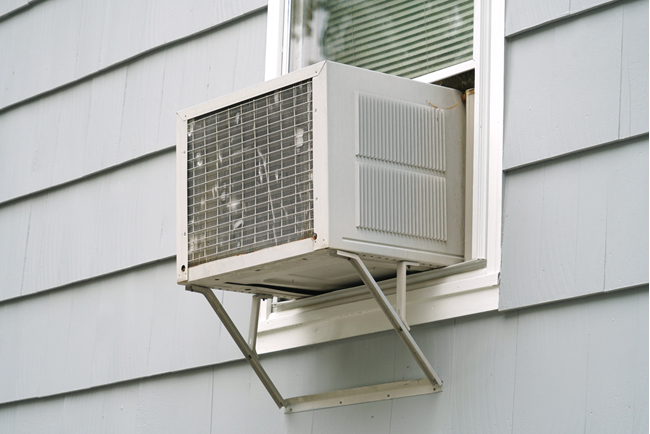
As temperatures rise into the triple digits, Arizona Attorney General Kris Mayes is warning landlords about air conditioning requirements under the state’s landlord-tenant law, according to a release.
Mayes also advised landlord and tenants of the rights tenants have if their air conditioning (AC) needs repair or otherwise fails to provide a habitable living environment.
“Extreme heat poses a serious health risk, and it’s unacceptable for tenants to be without proper air conditioning during summer months,” Mayes said in the release.
“In the case of an outage, landlords and management companies must take swift action to ensure residents have safe and habitable living conditions in accordance with the law. Landlords should be on notice that I will not hesitate to enforce these critical protections for Arizonans, because adequate air conditioning is a matter of life and death in Arizona’s summer heat.”
Tenants have rights that are protected by Arizona law. Failure to provide adequate air conditioning potentially violates the Arizona Landlord Tenant Act (A.R.S. § 33-1301-1381) and any applicable local regulations.
Under Arizona law, landlords must provide a rental unit that has fully operating cooling systems and other appliances that make it safe to occupy. Some municipalities also have more specific standards that may apply.
For example, in the cities of Phoenix and Tucson, rental units that use air conditioning cannot exceed a maximum temperature of 82 degrees in all habitable rooms, including bathrooms. This includes chiller systems, which are air conditioning systems and subject to this requirement. Evaporative coolers are allowed a slightly higher maximum temperature (86 degrees).
It is also important to note that even if renters are not up to date on their rent, landlords are not allowed to cut off air conditioning or other utilities to “punish” tenants (A.R.S. § 33-1374).
Landlords and management agents also have obligations as housing providers under the Arizona Civil Rights Act. Arizona Fair Housing Laws guarantee Arizona citizens equal conditions and access to services, such as functioning cooling systems, while renting.
As such, any remedial measures or repairs cannot be provided to residents on a discriminatory basis. Housing providers must also make reasonable accommodations for individuals with disabilities. Failing to provide an accommodation to an individual whose disability is affected or exacerbated by heat-related conditions can potentially be a violation of Fair Housing Laws.
This may include individuals who are 60 years old and above, as older individuals have greater difficulty regulating core body temperatures and are more susceptible to heat, especially in temperatures exceeding 85 degrees.
AG Mayes offers the following tips to consumers whose AC has gone out:
If your rental unit’s AC is broken, it is important to take steps to ensure your safety. Before you do anything else, notify your landlord. Start with a phone call and then follow up in writing, preferably hand-delivered or by certified mail. If you have a medical condition that will be exacerbated by extreme heat, please include this information in your notification, and request accommodations as necessary.
Your landlord must fix your broken AC within five days of written notice, if temperatures exceed 100 degrees. This timeframe may be shorter if the temperature inside the unit is higher than what is allowed by individual city code. The notice in writing starts the clock. Management has up to five days to fix the issue, which may mean providing a new air conditioning unit, calling in a repair team, or otherwise bringing your indoor temperature down to legally acceptable limits.
If temperatures are below 100 degrees, the landlord has 10 days to repair a broken AC unless the temperature inside the unit exceeds what is allowed by individual city code or the temperature inside the unit poses a threat to health or safety.
For landlords who fail to repair the broken AC, renters may be able to make use of theself-help repair statute. Arizona law allows you to notify your landlord that you will be fixing an issue yourself and deducting the cost from your rent if they have failed to fix your AC after five to 10 days, if you meet the specifications.
If your landlord does not fix your broken AC within five to 10 days, Arizona tenant rights with air conditioning may allow you to terminate your lease or sue for damages (such as for medical bills or paid rent).
If your landlord continues to fail to repair the broken AC, you may file a consumer complaint with the Arizona Attorney General’s Office. If you need a complaint form sent to you, you can contact the Attorney General’s Office in Phoenix at (602) 542-5763, in Tucson at (520) 628-6648, or outside the Phoenix and Tucson metro areas at (800) 352-8431.
Oregon Governor Tina Kotek has signed SB 599 a bill that will ban landlords from asking about the immigration status of tenants, according to her press secretary Roxy Mayer.
The bill takes effect 30 days after signing by the governor which she did on May 28.
“Certainly we want to be sure people have access to housing,” Kotek said about the bill pointing out it had bi-partisan support.
Other states with laws on immigration status of tenants
Washington, California, New York and Illinois have similar laws preventing residents’ legal status from serving as a barrier to housing.
“This bill is about more than documents — it’s about dignity,” said chief bill sponsor Rep. Ricki Ruiz (D-Gresham) in a press release. “No Oregonian should have to live in fear that where they were born could cost them their home. This bill makes it clear: Housing is a human right, and discrimination has no place in Oregon.”
Ruiz said in the release that “under the bill, landlords can verify applicants and run credit checks but cannot limit tenant identification to forms that are presumed to be tied to citizenship or permanent residency.
“The proposed law designates as acceptable Social Security cards, birth certificates, ‘green cards,’ travel and immigration visas, taxpayer ID number cards from the IRS, passports, driver licenses, other government IDs, and reasonably verifiable nongovernment IDs.”
The bill’s language says it “Prohibits landlords from inquiring about or [disclosing] discriminating on the basis of a tenant’s or applicant’s immigration or citizenship status, [or] rejecting an applicant [due to immigration status. Prohibits discrimination based on immigration status for real property transactions.] based on the type of identifying documentation or disclosing or threatening disclosure of an applicant’s or a tenant’s immigration or citizenship status for improper purposes. Authorizes statutory penalties.”
The Oregon Capital Chronicle said Oregon, in 1987, was the first state in the United States to pass a sanctuary law prohibiting state and local law enforcement from helping federal officials enforce immigration law.
As the Trump administration has heightened its immigration enforcement, Gov. Kotek has repeatedly said she supports Oregon’s immigrant community and will uphold Oregon’s sanctuary law.
Washington Governor Bob Ferguson has vetoed a bi-partisan housing study bill aimed at getting to the real problem of rental housing costs.
By Carter Nelson
At the Washington Multifamily Housing Association (WMFHA), we represent property owners, managers and housing professionals who are invested in providing safe, stable, and affordable rental housing across the state.
That’s why we are disheartened by Gov. Bob Ferguson’s recent veto of Engrossed Second Substitute House Bill 1108, a bipartisan bill passed by the Legislature that sought to commission a comprehensive study by the Washington State Institute for Public Policy (WSIPP) to identify the primary cost drivers for rental housing and homeownership in Washington.
The proposed study would have brought together a diverse set of stakeholders from all corners of the housing market: economists, builders, nonprofit and for-profit developers, realtors, mortgage lenders, tenants, landlords, and public agencies. This represented a meaningful opportunity to gather everyone to the table to better understand barriers to rental-housing affordability.
The best way to improve housing affordability is by identifying the most effective ways to increase housing supply. Our members know firsthand the challenges involved in building and maintaining housing, from zoning and permitting delays to the rising costs of labor, materials, and property taxes. This timely study would have helped bring these challenges into focus, providing a guide to smarter policymaking.
Gov. Ferguson’s veto message, citing budgetary constraints and the existence of prior studies, misses the mark. Previous studies have not adequately captured the on-the-ground realities faced by those directly involved in housing development and management. Without a clear, data-driven understanding of what drives costs, well-intentioned policies risk doing more harm than good.
As the housing affordability crisis continues to affect communities statewide, WMFHA urges Washington policymakers to prioritize comprehensive research and stakeholder engagement to inform sustainable solutions.
To learn more about our advocacy and solution-focused work, visit www.wmfha.org.
About the author:
Since joining WMFHA nearly two years ago, Carter Nelson has helped elevate the organization’s advocacy presence—first as Public Affairs Manager and more recently as Director of Government Affairs. In this capacity, she has worked closely with elected officials, industry leaders, and member organizations to strengthen WMFHA’s influence, drive critical policy conversations, and build long-term relationships that support housing development, improve operations for rental housing, and expand housing options across the state. A Washington native, Carter grew up in Seattle and Kirkland.
WASHINGTON, D.C.: Attorney General Brian L. Schwalb said William C. Smith & Co., Inc. (W.C. Smith) has agreed to pay over $1 million and reform its business practices to resolve allegations that it conspired with other district landlords, using rent pricing software from RealPage, Inc., to inflate rents at more than 50,000 apartment units across the district, according to a release.
W.C. Smith owns more than 9,000 of these units. The settlement is the first to result from the Office of the Attorney General’s (OAG) lawsuit, filed in November 2023.
“Rents in D.C. are already sky-high, and amidst this housing affordability crisis, many of the District’s top landlords operated as a housing cartel—illegally colluding to push rents even higher,” Schwalb said in the release.
“I commend W.C. Smith for putting an end to its anticompetitive practices and cooperating with my office to reach this agreement. We will continue working to hold RealPage and the remaining landlords accountable. As the District’s independent attorney general, I will always fight for fair market conditions to protect District residents and ensure a level playing field for law-abiding businesses.”
Background on RealPage
RealPage offers a variety of technology-based services to real estate owners and property managers, including revenue management (RM) products that depend on non-public, competitively sensitive pricing data that RealPage receives from the owners and managers. RealPage uses this confidential data to estimate supply and demand for multifamily housing that is specific to particular geographic areas and unit types and then generates an artificially inflated rental price that maximizes the landlord’s revenue.
In the District, well over 30% of apartments in multifamily buildings (i.e., buildings with five or more units), and approximately 60% of units in large multifamily buildings (with 50+ units), are priced using RealPage’s software. In the Washington-Arlington-Alexandria Metropolitan Area, the overall market share is even higher: Close to 50% of units in multifamily buildings are priced using RealPage’s software.
This leaves many District residents with no choice but to pay RealPage’s inflated rents, according to the release
Schwalb Settlement with W.C. Smith
Schwalb’s office alleged that W.C. Smith used RealPage’s RM Software to set rents for its 9,000+ units in the District. As a part of RealPage’s price-fixing cartel, W.C. Smith and the other defendant landlords illegally coordinated to share sensitive, non-public company data, forgoing competition and delegating rent-setting authority to RealPage.
Under the terms of the settlement, W.C. Smith will:
Pay $1,050,000 to the District in civil penalties, legal fees, and money to affected residents.
Reform its rent-setting practices to prohibit the use of revenue-management software that relies on any non-public or confidential data from other companies.
Refrain from encouraging others to use revenue-management software to accept recommended rent prices and from promoting the use of this type of software to other property owners.
Ross Barker, Director of Michelson Found Animals Foundation’s Pet-Inclusive Housing Initiative.
The winners of the annual pet-inclusive housing initiative awards have been announced by the Michelson Found Animals Foundation’s Pet-Inclusive Housing Initiative. Each year the awards celebrate outstanding leadership in pet-inclusive rental housing policies and practices that drive business success and foster community wellness.
The growing number of pets and their increasingly important role in families’ and individuals’ lives present crucial opportunities for the housing industry, as outlined in the company’s Pets in Rental Housing: 2025 Outlook.
Many housing providers have already recognized this opportunity to meet renters where they are and are leading the way by going beyond pet-friendly to make their communities truly pet-inclusive.
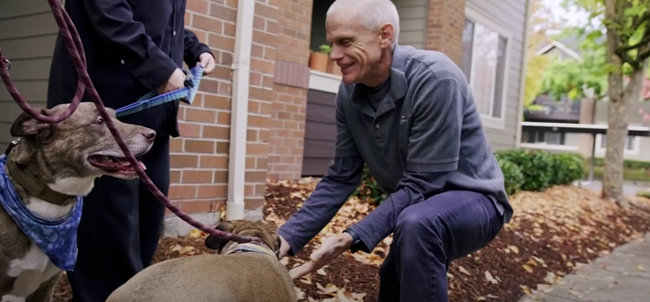
“The winners of this year’s awards are showing what’s possible when housing embraces the full reality of people’s lives—including the pets they love,” Ross Barker, Director of Michelson Found Animals Foundation’s Pet-Inclusive Housing Initiative said in a release. “Their efforts are making communities not just more welcoming, but also more stable, connected, and resilient.”
Watch the awards video
The 2025 Pets and Housing Award Winners are:
Most Impactful Adoption or Foster Event, or Program: Dane Park Communities Recognized for partnering with 97 shelters to help over 200 dogs find loving homes annually through community-driven adoption events and foster programs.
Most Innovative Pet Amenity or Amenity Group: Livano Kemah Awarded for creating an exceptional pet center with structured play, enrichment activities, veterinary services, and themed experiences that strengthen community bonds.
Most Innovative Pet Marketing Campaign: The Management Group, LLC (TMG) Celebrated for a heartwarming, pet-centered marketing campaign showcasing genuine resident-pet relationships, setting a new benchmark for pet-inclusive marketing.
Pets & Housing Policy Advancement Award: DC Councilmember Robert C. White, Jr. Honored for groundbreaking legislation (Pets and Housing Act, “Roscoe’s Law”) eliminating pet-related housing barriers, including burdensome fees and breed restrictions, establishing a national model for pet-inclusive housing policy.
Paws & Progress Nonprofit Award: Found House IHN
Commended for their innovative program supporting families navigating homelessness alongside their pets, including the establishment of Melrose Place, a permanent supportive housing solution.
Best Leap Forward: Avilla Homes by NexMetro
Acknowledged for pioneering single-level rental homes with private yards and no breed restrictions, significantly advancing accessible pet-inclusive housing.
Vanguard Award: Dane Park Communities
Recognized for sustained excellence and leadership in pet-inclusive policies, amenities, and initiatives, making pets integral community members.
Most Pet-Inclusive Property: The Press House, MGMT Residential Awarded for embracing full pet inclusivity with no breed or weight restrictions or pet fees, deposits, or rent, achieving a perfect Pet-Inclusive Score.
Winners were announced virtually at the annual awards event, highlighting the rapidly growing significance of pet-inclusive practices in the housing industry. Please view the award ceremony here. For more information on the Pets and Housing Awards and to learn about pet-inclusive best practices, visit petsandhousing.org.
About Michelson Found Animals
The Michelson Found Animals Foundation(MFA), founded in 2005, directly provides animal welfare services and champions pets at every point they intersect with our society. The foundation operates a range of initiatives, including grants and programs that put resources in the hands of communities in need, research that promotes pet-friendly policies, and more. Learn more at foundanimals.org.
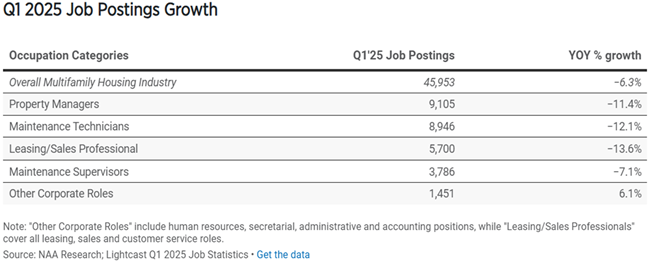
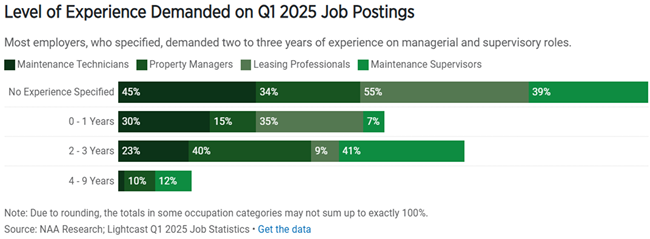
Total job postings in the apartment labor market reached 45,953 by the end of the first quarter of 2025, marking a 6.3% decrease compared to the previous year, according to the Apartment Labor Dynamics report from the National Apartment Association (NAA).
“Among various job categories, corporate roles were the only ones to see an increase in postings year-over-year. On the other hand, roles related to maintenance, property management and leasing experienced a year-over-year decline,” the report says.
What is causing this trend in the apartment labor market?
Broader economic trends and a shift in industry demands
Corporate roles expanding for administrative and strategic operations to navigate market challenges
Decline in maintenance, property management and leasing roles could be attributed to centralization and changing job functions.
Salary Trends in the apartment labor market
Despite a significant decrease in year-over-year job postings in the first quarter of 2025, advertised salaries rose nationally across major job categories.
The exception was the salary category for property managers, where median salary growth remained stable. Maintenance technicians saw a 2.2% salary increase, leasing professionals saw a 3.9% increase and maintenance supervisors experienced a 3.2% increase.
The advertised salary growth for property managers remained stable nationally. However, salaries declined sharply in Atlanta (-12.8%), New York (-5%) and Los Angeles (-1.3%), while they grew in Washington, D.C. (+0.2%) and Seattle (3.3%). This reduction in salaries in certain metro areas was driven by year-over-year declines in job postings across all major categories, indicating less competition for talent among employers.
Leasing professionals saw the highest year-over-year growth in advertised salary, both nationally and in metro areas. Los Angeles (+6%), Washington, D.C. (+10.2%) and New York (+14%) surpassed the national median annual growth.
Employer Activity
There was a 10.6% year-over-year drop in the number of employers actively recruiting.
Top Markets and Skills
The metro regions of Dallas-Fort Worth, Atlanta, Los Angeles, New York, Seattle and Washington, D.C. posted the highest demand for apartment jobs in the first quarter.
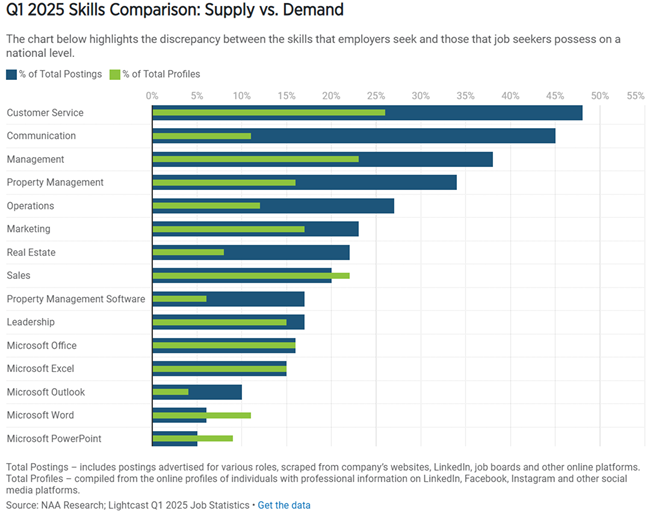
Key skills in demand included customer service, property management, initiative and leadership, and effective communication. The skills reflect the industry’s ongoing focus on resident engagement, leadership skills, management and communication proficiency.
In the first quarter of 2025, the most desired skills in the multifamily housing sector were property management and communication. Property management joined the top three skills from the previous quarter, which include customer service, initiative and leadership, and communication. While employers are increasingly valuing individuals with a customer-focused mindset and abilities that improve the resident experience, expertise in property management is becoming an essential skill.
But beyond the apartment playground swings and slides, the real question every property manager should ask is: Is the playground truly safe?
While play equipment may look sturdy, the surface beneath it is often the most critical and most overlooked factor in preventing injuries. If you’re not confident that your playground surfacing meets today’s safety standards, now is the time to act.
The Season for Outdoor Play Has Arrived
As spring turns to summer, apartment playgrounds come alive with activity. Children rush outside after school, families gather on weekends, and the play area becomes a central hub of community life. This increased traffic means more running, jumping, and the inevitable falls that come with active play. Ensuring your playground surface is ready for this seasonal surge is essential—not only for the well-being of your youngest residents but also for your peace of mind.
Safe Surfacing Makes All the Difference
Most playground injuries happen because of falls, but many of these injuries can be significantly reduced with the right surface in place. That’s why so many apartment complexes turn to FiberPC from Aardvark Bark Blowing. Engineered from 100% virgin cedar, FiberPC offers a natural yet highly effective cushion that absorbs impact and helps protect children from serious harm. It compacts easily to form a stable, reliable surface that holds up over time and stays in place even with daily use.
Compliance You Can Count On
FiberPC isn’t just safe, it’s officially recognized for its performance. It meets the safety standards set by the International Play Equipment Manufacturers Association, and it conforms to multiple ASTM specifications for impact attenuation and engineered wood fiber quality. It is also ADA compliant, which means your playground will be accessible to children and caregivers who use wheelchairs or mobility aids. Independent lab testing by confirms that FiberPC performs as promised under real-world conditions, making it a trusted choice for safety-conscious property owners.
The Hidden Risks of Non-Compliance
Overlooking safety standards doesn’t just put children at risk—it exposes your property to legal and financial consequences. An injury resulting from substandard surfacing can quickly turn into a liability issue, leading to costly claims and a damaged reputation. Staying compliant isn’t just the right thing to do for families, it’s a smart move for your business.
FiberPC Is the Smart, Safe Solution
With FiberPC from Aardvark Bark Blowing, apartment communities can install a playground surface that’s not only safe and accessible but also cost-effective and low maintenance. You’ll be showing your residents, especially families, that their well-being is your priority, all while enhancing the appeal and long-term value of your property.
Now is the perfect time to ensure your playground is ready for the busy seasons ahead. When safety matters, FiberPC is the surface you can trust.
About the author:
Phil Carder is a Certified Playground Safety Inspector (CPSI) with a strong commitment to creating safe, engaging environments for children. As a seasoned real estate developer and investor, he brings over a decade of experience in multifamily apartment housing and property management. Phil is the founder and owner of a successful blower truck service that specializes in manufacturing and installing engineered wood fiber surfacing, prioritizing safety, accessibility, and long-term value. His expertise uniquely bridges the gap between safety standards and real-world application, making him a trusted voice in playground safety and residential development.
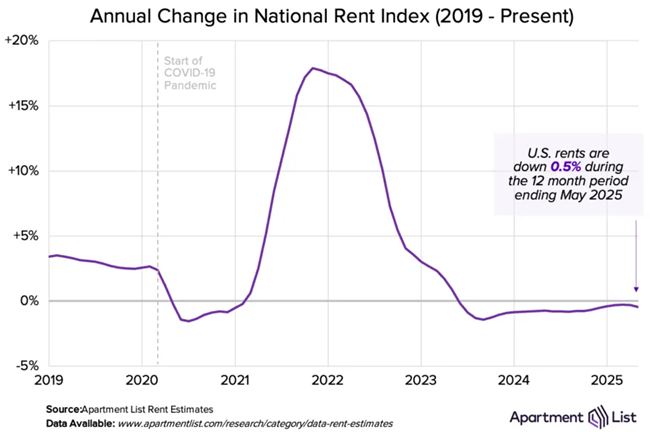
The national rent index increased by 0.4% in May, but despite rents ticking up for the fourth consecutive month, rent growth is currently slowing at the time of year when it typically ramps up and apartment vacancy is growing, Apartment List says in its June report.
“Slow rent growth in May caused year-over-year rent growth dip to further negative, falling to -0.5 percent, after having gradually inched closer to positive territory over the prior six months,” the Apartment List research team writes in the report.
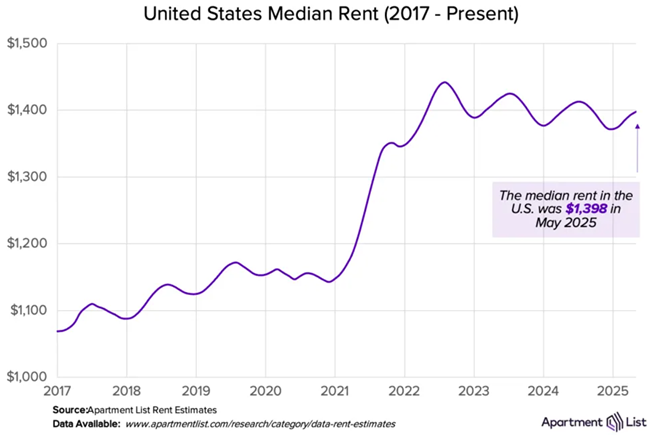
National average rent is now $1,398, up $5 per month compared to last month, but down $6 compared to May 2024.
Following a period of record-setting rent growth through 2021 and the first half of 2022, the national median rent has now fallen below its August 2022 peak by a total of 3.1 percent, or $44 per month.
At the local level, 69 of the nation’s 100 largest cities saw rents rise in May.
“That said, we continue to see fairly steep year-over-year declines in the metros that have most rapidly expanded their multifamily inventory; these include Austin (-6.3 percent year-over-year), Denver (-4.8 percent), and Phoenix (-3.1 percent),” the research team writes.
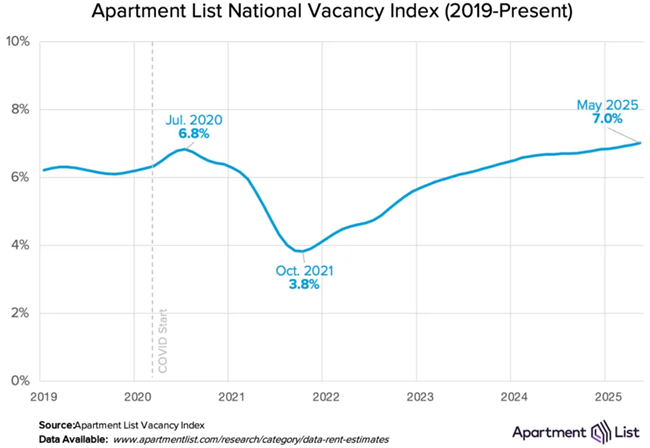
Multifamily vacancy rate hits 7%, a new peak
Vacancies have been opening up steadily for more than three years.
The surge in multifamily construction, which has now started to decline, has led to some of the vacancy increase.
“However, there are still over 700,000 multifamily units under construction, so even as the level of new supply hitting the market falls sharply from last year, it will continue to be robust by historic standards. As new apartment completions decline, the vacancy rate will likely begin to tighten again, but for now, we’re still seeing vacancies rise,” the report says.
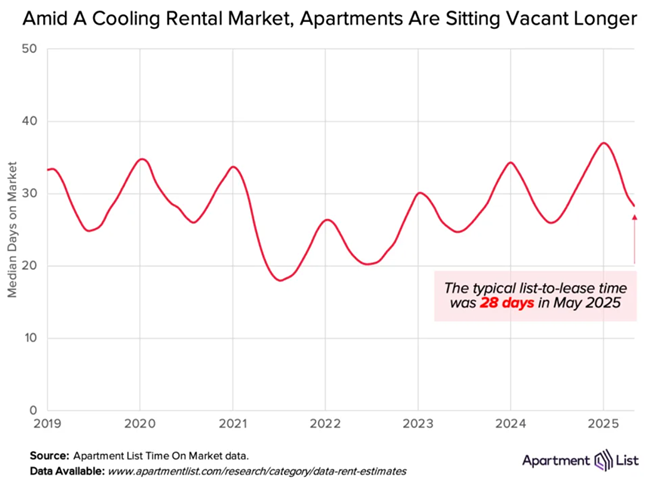
List-to-lease time retreats from all-time high
“The shortening of list-to-lease time that we’ve seen since the start of this year is in line with the seasonal return to positive month-over-month rent growth that we’ve observed in tandem.
“Units are currently sitting vacant just one day longer than they were at this time last year, but are still sitting for eight days longer than they were in mid-2022 when the market was at its tightest,” the report says.
Conclusion
May’s 0.4 percent increase shows rent prices continuing to trend up, but the slowing pace of rent growth is signaling demand weakness heading into peak moving season.
“As the level of new supply coming online continues to abate, we expect to see occupancy tighten and rent growth strengthen in the back half of this year, assuming that demand remains relatively stable. But amid a more uncertain macroeconomic outlook, stable demand is far from certain,” the research team writes.