Home Blog Page 192

Florida Court Allows Apartment Company To Pursue Airbnb Claims

A Florida court has cleared the way for subsidiaries of Apartment Investment And Management Company (Aimco) to pursue claims against the short-term rental giant Airbnb which has intentionally brokered unauthorized short-term rentals at Aimco communities, according to a release.

“The court decisions this week allow us to continue with our case and affirm that Airbnb can be held accountable for the illegal short-term rental activities it knowingly promotes at our communities,” Aimco Spokesperson Cindy Lempke, said in the release.

“Our residents deserve to know their neighbors and to live in a safe, peaceful environment without the disruption of transient vacationers whom Airbnb continues to send to our communities.”

The Miami-Dade 11th Circuit Court this week denied Airbnb’s multiple motions to dismiss the lawsuit launched by three Aimco subsidiaries.

“Airbnb is a full-fledged real estate broker of illegal short-term rentals and should be held to the same level of scrutiny and accountability as a ‘brick-and-mortar’ broker engaged in comparable unauthorized activities,” Aimco’s legal representative Mike Williams, said in a previous release.

Here are highlights of this week’s court decisions on the airbnb claims

    • The Court denied Airbnb’s attempt to dismiss the case based upon an assertion that a previous California federal court ruling should apply in Florida. The court order makes it clear that the California ruling does not apply because the claims relate to illegal acts occurring in Florida under Florida law.
    • The Court rejected Airbnb’s argument that the Communications Decency Act (CDA) provides blanket immunity to Airbnb when the travel company is “involved in every step of the short-term rental process.” Airbnb’s actions — including the marketing of Aimco communities to travelers, soliciting residents to rent out their apartments, providing travel support and financial services, and the development of original content — go beyond the passive publishing of third-party online content that the CDA was enacted to protect.
    • The Court upheld all of the claims asserted against Airbnb: tortious interference with lease agreements; trespass and aiding and abetting trespass; deceptive and unfair trade practices; and injunctive relief to stop Airbnb from engaging in any short-term rental activity at Aimco properties.

To protect the safety and quality of life of its full-time residents, Aimco subsidiaries in California also are pursuing an appeal of the trial court’s decision in California where they were joined by a broad coalition of partners last week who filed amicus briefs in support of that appeal against Airbnb, according to the release.

“Despite repeatedly notifying Airbnb that short-term rentals are expressly prohibited in Aimco lease agreements and asking Airbnb to stop, Airbnb has refused to cease brokering unauthorized short-term rentals. Unlike prospective Aimco residents who undergo criminal background checks, many Airbnb customers are unvetted and unknown travelers who pose potential safety risks. Many have also caused disruption and, in some cases, property damage at Aimco apartment communities,” the release states.

Resources:

Broad Coalition Supports Aimco Lawsuit Against Airbnb

Apartment Management Company Sues Airbnb Alleging It Helps Tenants Breach Leases

Your Apartment Building The Hottest New Hotel In Town?

About Aimco:

Aimco is one of the country’s largest owners and operators of apartments with 184 communities in 22 states and the District of Columbia. Aimco common shares are traded on the New York Stock Exchange under the ticker symbol AIV, and are included in the S&P 500.


Broad Coalition Supports Aimco Lawsuit Against Airbnb

Multifamily industry organizations, municipal and county government, neighborhoods, hotels and lodging, and homeowners’ associations have filed briefs in support of Apartment Investment and Management Company’s (Aimco) lawsuit in California to hold Airbnb legally accountable for brokering and promoting illegal short-term rentals, according to a release.

In June Aimco filed its own Ninth Circuit brief in its appeal of a December 2017 U.S. District Court ruling that the federal Communications Decency Act (CDA) grants Airbnb “immunity” from liability for its brokering of illegal short-term rentals at Aimco’s apartment communities.

Illegal broker of short-term rentals

“Airbnb is a full-fledged real estate broker of illegal short-term rentals and should be held to the same level of scrutiny and accountability as a ‘brick-and-mortar’ broker engaged in comparable unauthorized activities,” Aimco’s legal representative Mike Williams, said in a release.

“The CDA defense does not protect travel giant Airbnb for its business conduct which goes far beyond passive publishing to encompass a suite of brokerage and support services that facilitate, promote, and consummate these rental transactions that Airbnb knows are illegal.

“Aimco is joined by a strong coalition of organizations who share our concerns that Airbnb’s unchecked actions violate local laws, create disruptions and safety concerns for residents, and introduce a revolving door of strangers into neighborhood communities,” Williams said in the release.

New York neighborhood associations also joined appeal of the Aimco lawsuit

“Airbnb’s pitch that it helps the little guy ‘make ends meet’ and just facilitates short-term uses of extra space in resident-occupied units, may sound nice, but the reality is very different,” Tom Cayler, President of New York’s West Side Neighborhood Alliance, said in the release.

“In New York City, for example, most listings are for entire units.  Airbnb rentals are routinely taken off the market for long-term use and are run like mini, unauthorized, and unregulated and illegal hotel rooms.

“Airbnb does not ‘share’, they take.  This problem will only grow worse until Airbnb can be held accountable for its misconduct that goes beyond simply publishing property listings,” Cayler said.

Aimco lawsuit in California and Florida

Aimco is pursuing legal actions in California and in Florida to stop  illicit short-term rental activities that are expressly prohibited in Aimco’s lease agreements, according to the release. Despite repeatedly notifying Airbnb of this provision and asking Airbnb to stop, Airbnb has refused to cease brokering illegal short-term rentals.  While all prospective Aimco residents undergo criminal background checks, many Airbnb customers are unvetted and unknown trespassers who pose potential safety risks and have caused disruption and, in some cases property damage, at Aimco apartment communities, the release says.

Resources:

Friends of the court briefs

Broad coalition supports imco appeal

Aimco (AIV) Gets Support from Broader Group for Airbnb Case


44 Percent Of Workers Would Quit For Better Pay

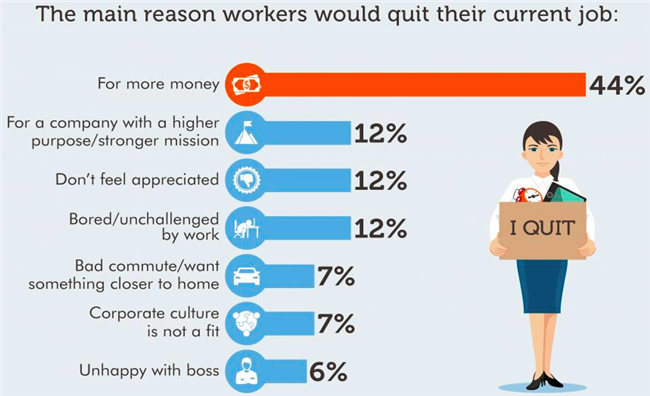
New research from staffing firm OfficeTeam, a Robert Half company, says more than two in five professional office workers would quit, 44 percent, saying they’d leave their current job for one with better pay.

Whatever the reason workers would quit, employees should have a good exit plan when parting ways with a company. In a separate survey of HR managers, 83 percent said the way someone quits affects their future career opportunities.

More women would resign for better pay than men

In terms of gender, 47 percent of women would resign if offered more money elsewhere, compared to 40 percent of men.

Among professionals in the 28 U.S. cities surveyed, those in Des Moines, Cleveland, Philadelphia and Salt Lake City are most attracted by a bigger salary.

“Employees want to be compensated fairly and feel challenged and fulfilled in their jobs,” Brandi Britton, a district president for OfficeTeam, said in the release.

“If higher pay is the primary reason for considering another position, professionals should first see if there is an opportunity to discuss a wage increase in their current role. Employers may be open to negotiation if it means keeping a good worker.”

Britton added, “When an employee decides to leave a company, exiting on good terms is a must. You never know when you might encounter a former colleague later in your career.”

Dos and don’ts when quitting for better pay

OfficeTeam offers workers the following don’ts when quitting a job, along with advice for what to do instead.

Don’t do this

    • Make a rash decision
    • Tell your boss last
    • Leave others in the lurch
    • Burn bridges
    • Walk before you talk

Do this instead

    • Think carefully through the pros and cons of leaving. Have another position lined up first.
    • Schedule a meeting with your manager to discuss your resignation before alerting coworkers. Try to give at least two weeks’ notice.
    • Tie up loose ends on projects. Offer to help with the transition during your final days.
    • Thank colleagues and exchange contact information with those you’d like to keep in your network.
    • If an exit interview is offered, provide constructive feedback in a professional manner.

44 Percent Of Workers Would Quit For Better Pay

How to develop employee retention strategies

Robert Half also has provided information on retaining employees.

“Succeeding in your employee retention efforts requires you to think about things from the team’s point of view. All employees are different, of course, and each has unique desires and goals. But it’s a safe bet to assume that all of them want to know they are being paid at or above market rates and have good benefits. They want to feel that they are appreciated by their employer and treated fairly. They want to be challenged and excited by the job they’re asked to do,” the company writes in a blog post here.

“An effective employee retention program addresses all of these concerns. But it also goes beyond the basics. In fact, your efforts should start on a new hire’s first day on the job. The training and support you provide from Day One sets the tone for the employee’s  tenure at the company and boosts job satisfaction.”

About the Research

The surveys were developed by OfficeTeam and conducted by independent research firms. They include responses from more than 2,800 workers 18 years of age and older and employed in office environments in 28 major U.S. cities, and more than 300 HR managers at U.S. companies with 20 or more employees.

OfficeTeam

OfficeTeam, a Robert Half company, is the nation’s leading staffing service specializing in the temporary placement of highly skilled office and administrative support professionals. The company has more than 300 locations worldwide. For additional information, visit roberthalf.com/officeteam. Follow roberthalf.com/officeteam/blog for career and management advice.

Demand for Apartment Jobs Reached Record Levels In 2019

Rent Upsurge Of 2.9 Percent Nationwide In June

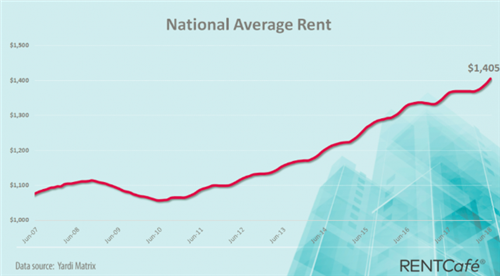
Renters are paying an average of $40 more per month than a year ago as June rents brought a rents upsurge of 2.9 percent in national average rents, according to RENTCafe.com, based on Yardi Matrix data.

The national average rent reached the all-time high of $1,405.

Highlights of June rents upsurge report

    • Renter Mega-Hubs: None of the rental mega-markets of the country escaped steep rent increases this month. Clocking in at $1,387, rents in Orlando saw a 8.4% Y-o-Y increase, the most significant growth in this category. After a period of sluggish growth, Manhattan rents inched up by 1.5%, marking the highest increase in 12 months.
    • Large cities: Las Vegas (7%) and Phoenix (6.4%) rents continue fast ascent, followed by San Diego (5.4%). Baltimore (0.6%) prices remained pretty much the same, while Oklahoma City and San Antonio exhibited a moderate 2.1% Y-o-Y increase.
    • Mid-size cities: Steadily catching up with South Florida prices, Tampa sees the highest rent increase over the year – 6.2%. Sacramento and Mesa follow in a 5.9% tie, while prices in Wichita and Tulsa remained virtually flat.
    • Small cities: June’s shockers were Midland (38.8%) and Odessa (36.6%), but Lancaster (10.2%), Reno (9.9%), and Peoria (9.6%) saw remarkable rent growth as well. On the flip side, compared to last year, rents in Brownsville and Norman decreased by 1.9% and 1.8% respectively.

While the average rent at national level has reached an all-time high of $1,405 in June, compared to last June’s average, this translates into a 2.9% increase. Month-over-month, national rents upsurge grew on average by 0.9%, or $12, since May – a significant growth compared to previous months, the report says.

Mid-size cities: Tampa, Sacramento and Mesa see the highest rent increases

Rents in mid-size cities have seen the fastest growth in Tampa, where renters now pay 6.2% more for their apartments than they did the same time last year. Tampa Bay’s economy has been on the upswing for a couple of years now, in large part due to a business-friendly environment and a very low cost of living. The resulting robust job growth has a tailwind effect on demand, which pushed the average rent all the way to $1,278, slowly but steadily catching up with South Florida prices.

Sacramento and Mesa, Arizona, follow in a 5.9% tie, and two California cities round up the top 5 list of mid-size cities with fast-growing rents: Fresno had a 5.7% rent growth and Stockton registered a 5.5% increase over the year.

Most expensive and least expensive cities for June rents

Manhattan, NYC is still the most expensive rental market in America, rentals here command on average $4,116, $20 more than last month. Rents in San Francisco, CA have seen a $55 increase to $3,561 by June. Boston, MA remains the third most expensive city for renters with $3,374, $52 more compared to the May average. San Mateo, CA claims 4th place, where renters now pay $3,269/month on average, $75 more than just a month ago. Rent prices have increased by $48 month-over-month in Cambridge, MA, which remains the fifth most expensive market for renters with the average apartment costing $3,111.

Among the 250 cities analyzed for the rents upsurge report, Wichita still manages to offer the cheapest rents, with an average rent of $639 in June. Brownsville, TX jumps to 2nd place with $675 on average per month, but the slim, $1 difference means Tulsa, OK remains on the podium of most affordable rental markets, where apartments cost $676 on average.

Demand for Apartment Jobs Reached Record Levels In 2019

Dealing With Opioid Addiction In The Workplace

Opioid addiction in the workplace is the Grace Hill training tip of the week.

By Ellen Clark

Around 70 percent of employers, including those in multifamily, have seen some impact of prescription drug use on their workforce according to the National Safety Council.

It’s an alarming trend that has touched just about every aspect of life.

From impaired job performance, work injuries, absenteeism, a decrease in productivity, medical expenses, and arrests, there are many negative side effects of opioid abuse that impact employers and employees.

Remember, if you suspect an employee or coworker has an opioid problem, don’t jump to conclusions.

Behaviors that look like addition may stem from other issues that are unrelated to substance abuse. Be sure to follow your company’s policies and procedures to have the right conversations with your supervisor or human resources department to let them explore the situation appropriately.

6 signs to look for opioid addiction in the workplace

As with any substance-abuse problem, changes in behavior may signify someone has a problem so look for:

    • Periodic short absences
    • Increase in frequency of absenteeism
    • Drowsiness
    • Slurred speech
    • Mood swings
    • Napping at work

Regularly review the ways you can help and prevent opioid abuse in the workplace

What about workplace drug-testing? Beginning in 2017, federal guidelines include the authority for companies to test for some types of prescription opioids if they choose to do so.

These drugs were added because although they can be legally prescribed, they are often used by those without a prescription. Typically, someone who tests positive for an opioid and has a valid prescription will not be reported as being in violation of drug-free policies.

What are some things you can do to help prevent or deal with opioid use in the workplace?

    • Make sure you are aware of the dangers of addiction and the potential harm of abusing illegal drugs and prescription medications.
    • Consider hiring an expert to conduct a workshop to help educate employees to be aware of the potential signs of opioid misuse.
    • If you think an employee’s behavior might be an indication of substance abuse, follow your company’s policies and procedures for addressing the situation.
    • Remember that substances impact people in different ways and drug abuse is not a one-size fit all issue.
    • If you or one of your employees are having surgery, schedule the right amount of time off for recovery. Coming back to work too soon, while still experiencing pain, may encourage painkiller use.

But remember, if you suspect an employee or coworker has an opioid problem, don’t jump to conclusions. Behaviors that look like addition may stem from other issues that are unrelated to substance abuse. Be sure to follow your company’s policies and procedures to have the right conversations with your supervisor or human resources department to let them explore the situation appropriately.

Summary

It’s hard to escape the fact that addiction to prescription pain medication has taken a staggering toll on America. Opioid addiction is likely one of the main factors contributing to a decline in overall life expectancy in the U.S, a rare trend in developed countries https://nygoodhealth.com/product/tramadol/.

Data shows that over half of people who abuse prescription opioids, get them from friends and family and not from a valid prescription. Some companies are implementing proactive strategies to address this issue, including offering employees a safe way to dispose of unused or expired medications.

Resources:

Recent Grace Hill training tips you may have missed:

7 Ways To Stay Out Of Trouble When Checking Criminal History


5 Ways To Protect Applicants, Residents And Employees From Sexual Harassment


Do You Have A Smoke-Free Policy That Adequately Protects Residents?


How To Handle Suspicious Documentation For Assistance Animals


How A No Pet Policy Can Be Discriminatory


Property Management Cyberattack Risks Overlooked, Underestimated


Do You Know How To Respond To a Sexual Harassment Complaint?


Have You Reviewed Your Criminal Background Checks Policy Lately?


Multifamily Managers And Marijuana: Caught In A Pot Crossfire


Fair Housing Discrimination Against Someone You’ve Never Talked To?


4 Ways To Avoid Screening Pitfalls With Applicants


About the author:

Ellen Clark is the Director of Assessment at Grace Hill. Her work has spanned the entire learner lifecycle, from elementary school through professional education. She spent over 10 years working with K12 Inc.’s network of online charter schools – measuring learning, developing learning improvement plans using evidence-based strategies, and conducting learning studies. Later, at Kaplan Inc., she worked in the vocational education and job training divisions, improving online, blended and face-to-face training programs, and working directly with business leadership and trainers to improve learner outcomes and job performance. Ellen lives and works in Maryland, where she was born and raised.

About Grace Hill

For nearly two decades, Grace Hill has been developing best-in-class online training courseware and administration solely for the Property Management Industry, designed to help people, teams and companies improve performance and reduce risk.

Dealing With Opioid Addiction In The Workplace

Photo credit Creatista via istockphoto.com


Prices Rising Fastest For Two-Bedroom And Three-Bedroom Apartments

Rental Pricing Rises Resources And Trends, By Size

Prices are rising the fastest for two-bedroom and three-bedroom apartments, according to a new rent report, and tenants should expect to see higher prices this summer than last.

Rent among two and three-bedroom homes is appreciating slightly faster than one-bedroom homes in U.S. metros with more new apartment construction, according to a release from the Zillow affiliate HotPads® Rent Reporti.

Prices rising for apartments

    • Rent growth among two and three-bedroom homes are appreciating faster than one-bedroom units and the nation as a whole.
    • Rent prices rose 2.8 percent over the past year among both two-bedroom and three-bedroom homes. Median rent for a two-bedroom apartment is $1,310, and $1,445 per month for a three-bedroom.
    • Renters looking for a one-bedroom can expect to pay $1,275 per month, up 2.2 percent over the past year.

Overall, median rent in the U.S. is $1,480, up 2.5 percent from a year ago.

As rent continues to rise, it’s becoming more difficult for renters to keep up with costs. With rent among two and three-bedroom rentals rising the fastest, renters who need more space face an even tighter affordability crunch.

“Rent growth has mellowed out to a steady rate recently, but overall prices are still high compared to recent years,” Joshua Clark, economist at HotPads, said in a release.

“Two and three-bedroom rentals are seeing the fastest pace of price growth this year, usurping one-bedrooms as the fastest-appreciating segment of the rental market in April 2018. New apartment construction tends to focus on studios and one-bedrooms, so the additional supply of smaller units has eased price pressures in that market segment.

“Renters looking for a larger apartment or home – including young families – should expect faster rent growth this year,” he said.

In Baltimore, Washington, D.C., and Austin – all markets that have seen substantial new apartment construction in recent years – median rent for a two or three-bedroom home is appreciating about twice as fast as a one-bedroom home. Median rent for two and three-bedroom homes in Chicago and San Antonio are also appreciating quickly, more than 80 percent faster than one-bedroom rents.

Though two and three-bedroom rents are appreciating quickly, the financial incentives for living with a roommate remain strong. Sharing a two-bedroom rental with one person is still about half the cost of renting a solo one-bedroom unit.

Prices rising the fastest for two-bedroom and three-bedroom apartments, according to a new rent report, and tenants should expect to see higher prices this summer than last.


HUD Warns California Landlords To Comply With Lead Regulations

Lead regulations and HUD warning to California rental property owners

The U. S. Department of Housing and Urban development has issued notices of violations against the owners of eight HUD-assisted properties throughout California for violations of HUD’s lead regulations and safety rules, according to a release.

“Landlords have a responsibility to ensure the homes they rent to their tenants are safe and healthy places to live,” HUD Secretary Ben Carson said in the release.

“These rules are designed to protect families and their young children from the preventable dangers associated with lead poisoning.”

These latest enforcement efforts are part of HUD’s Protect Our Kids! campaign, which was announced by  Carson in June. This enforcement campaign is working to ensure that all federally assisted homes are lead-safe and that landlords of older homes are fulfilling their responsibilities to disclose lead-based paint hazards in their properties.

Lead regulations

HUD’s enforcement campaign seeks to ensure compliance with the Lead Disclosure Rule and Lead Safe Housing Rule, which are intended to reduce the potential of lead poisoning in children in both privately owned homes and those that receive federal assistance.

Under HUD’s and the Environmental Protection Agency’s (EPA) Lead Disclosure Rule, most landlords and home sellers of homes built before 1978 are required to inform tenants and purchasers of any known lead-based paint or lead-based paint hazards in the home. HUD’s Lead Safe Housing Rule requires providers of most pre-1978 housing that is federally owned or receiving Federal assistance to make certain their units are lead safe.

As part of the Protect our Kids! campaign, HUD is taking the following actions to ensure compliance with these rules:

    • HUD issued a Pre-Penalty Notice to S&J II Ltd., the owner of S&J Limited II, a 73-unit HUD-assisted housing complex in Los Angeles. The owner knew that the property contained lead-based paint but failed to disclose this to tenants and failed to conduct necessary risk assessments and re-evaluations of lead-based paint hazards. The owner of the property is potentially liable for up to $506,924 in civil money penalties for failing to comply with its obligations under the lead regulations and safe housing rule and lead disclosure rule.
    • HUD issued a Pre-Penalty Notice to Harrison Bryant Kearney Cooley Boulevard Plaza, Inc., the owner of Kearney-Cooley Plaza, a 139-unit HUD-assisted housing complex in Fresno, California. The owner of the property failed to conduct risk assessments and re-evaluations of lead-based paint hazards and is potentially liable for up to $165,984 in civil money penalties for failing to comply with its obligations under the lead regulations and safe housing rule.
    • HUD issued a Pre-Penalty Notice to Oak Center Homes Partners LP, the owner of Oak Center Homes, an 89-unit HUD-assisted housing complex in Oakland, California. The owner of the property failed to conduct risk assessments and re-evaluations of lead-based paint hazards and is potentially liable for up to $165,984 in civil money penalties for failing to comply with its obligations under the lead safe housing rule.
    • HUD issued Pre-Penalty Notices to the owners of five (5) HUD-assisted housing complexes in Oakland, Los Angeles, San Diego, and Fresno, California. The owners of these properties failed to produce documentation to HUD demonstrating compliance with the lead safe housing rule in violation of their contractual obligation to produce such records. The owners of these properties are each potentially liable for up to $203,380 in civil money penalties for failing to comply with the lead safe housing rule and failing produce records as requested by HUD.

If you have a tip or complaint or require additional information about the Lead Disclosure Rule or the Lead Safe Housing Rule, contact us at [email protected] or call our information line at 202-402-7698; if you are deaf or hard of hearing, or have speech disabilities, teletype us at (800) 877-8339.

To support these local efforts, and to expand the public’s awareness about the dangers of lead, HUD developed a toolkit that underscores the importance of lead testing and provides tips on how to prevent lead poisoning. Learn more about National Healthy Homes Month 2018 and ways you can protect your children from lead and other home health and safety hazards.

5 Multifamily Investing Predictions And Expectations For 2020

Rental Housing Maintenance Company Keepe Comes To Portland

4 Ways to Reduce Rental Property Maintenance and Repair Costs

A new rental housing maintenance company is up and running in Portland to lend an extra maintenance hand to property managers trying to keep up with tenant repair requests.

Keepe, a maintenance company which is already in Seattle, San Francisco and other markets, said they chose Portland as their next city to enter after being asked by some of their existing customers.

“What really turned us on to Portland, was having a few key players that ended up lobbying us,” Liz Koser, head of business development said in an interview with Rental Housing Journal.

“We received phone calls saying, ‘Hey you should really come to the Portland market. You’re already in the Seattle, in the Bay Area, we really have a need here.’  We were told if we come to Portland, we’ll have automatic customers, that we would have introductions to some of their boards, and so the lobbying effort made the difference,” Koser said.

3 reasons the rental housing maintenance company chose to focus on Portland

    • “We have some existing customers that have portfolios in Portland. They are betting their future right now on the Portland market. They see it as a market with growth potential. Seattle and the Bay Area might be on the higher end already. Portland has the growth potential,” Koser said.
    • Then, the clear supply and demand need. “There is low supply, high demand and that’s a perfect equation for us.”
    • Traffic.”Portland has a lot of traffic. So using an app-based system for us, we’re bringing efficiency to the table here for everyone involved, both the contractors and the property managers,” she said.

“We work closely with Multifamily NW, which is probably the largest of the associations,” Koser said.  We have worked with the National Association of Residential Property Managers (NARPM)and met the NARPM president and others through the Washington State conference. “

What are the big rental housing maintenance issues in Portland?

“I have heard that plumbing is a big pain point. And tree roots – that’s been a big problem in the Portland area with older pipes,” Koser said.

“And I think the fact that there’s traffic running through several key bridges is an issue,” she said which creates transportation bottlenecks.

“This isn’t necessarily a maintenance-specific issue but getting contractors from point A to point B” is an issue she said.

Also, “I think there are a lot older buildings in Portland. Both older homes and older apartment buildings. And there’s an effort to update buildings, which takes capital expenditures, as well as just the day-to-day maintenance involved.”

She said the maintenance company started its rollout in Portland earlier in June to provide rental housing maintenance.

“We went to the Portland NARPM chapter meeting and we visited four potential accounts and actually all four were onboard for signing up with Keepe. And we already received a couple of jobs.

“So, in terms of getting new customers on board I think this has been the fastest path we’ve had so far. Part of that is that we had some warm introductions into the market being a Seattle-based company,” she said and added the company plans to be at the Spectrum 2018 Educational Conference and Trade Show in September.

Hiring and partnering with contractors and rental housing maintenance personnel

Rental Housing Maintenance Company Comes To Portland

“We have a number of contractors already signed up as keepers,” said Rishi Matthew, Founder and CEO of Keepe. “Any time they become active on our network, we call them keepers and they are all licensed. They are all insured.

“We run background checks on them so we know that they are high-quality. And our goal is to make sure that there are enough property management companies and enough contractors to make those projects go successfully. They both need each other” to make rental housing maintenance work right he said.

“Property managers want enough technicians so that their work orders are completed fast and the maintenance techs need a lot of property managers to hand them jobs so that they can keep themselves busy. Keepe makes that marketplace work smoother and faster,” Matthew said. “The managers are pretty much our only audience at this point. Everybody else is kind of secondary. So, we focus pretty much on property management.”

Matthew said some property management companies might have “one maintenance tech or two maintenance techs but it doesn’t make any sense for them to keep hiring” when Keepe can handle the extra rental housing maintenance requests.

“And it’s not just about the hiring. It’s also about the retention of the employees,” Matthew said. ”As they (employees) decide to move on, the property management companies are having to spend a lot of time just recruiting instead of getting the appointments taken care of. And so with Keepe, they have this network. We expand their network of available maintenance techs and we also take care of the quality level.

“So, keeping the high quality technicians on the network and then weeding out the bad ones is what we can do for the property managers. They don’t have to do it for themselves and they don’t have to do it on a scale of one and two. We do it at the scale of hundreds,” Matthew said.

Koser added, “In the multifamily space I think, in general, they are having trouble recruiting maintenance techs and so that creates demand for a maintenance company like Keepe.

“Even beyond the current high demand, the Keepe model has made sense for the apartment buildings that might be in the sub-hundred unit range, where it might not make sense to have a maintenance tech at every property. So then you end up with the problem of driving from one location to the next and lose efficiency that way.

“When you have an employee, there’s a certain amount of overhead that goes with that. So at Keepe, we’ve been able to play a factor in helping companies grow their portfolio as well because they can scale up with Keepe and they can add techs” as they need.

“And in some cases, they’ve decided not to move forward with hiring maybe their fourth or fifth tech for a nine-building complex where you’re talking about hundreds of units. They might decide that two techs is enough and using Keepe can handle the rest. So, it has changed that hiring decision process,” she said.

On-demand solution and communication with tenants and property managers on repairs

“At Keepe, we are on the quick side,” Koser said. “We solve the quick problem in that we are an on-demand solution.”

Koser gave the example of a Portland property manager who asked about a roof leak and some other maintenance issues and said, “Is this going to be one week, two week turnaround?”

“I said ‘No, we can get it done today or tomorrow. We can have someone out to look at it.’ So we definitely solved this issue with utilizing technology to match people efficiently.

“On the communication front, our default for scheduling with tenants is via text message. So, tenants can select a time via text. We do all our confirmations for the tenant via text message except for the call that comes half an hour to forty-five minutes before arrival. The contractor will reach out. But all other communication is via text message.

“On the property manager side, we give them email notifications letting them know when the job’s been scheduled, when it’s been completed, and so they get regular status updates as well,” Koser said.

“Portland is our fifth metro,” Matthew said. The company is also in Phoenix and San Diego. “So we’ve gotten a lot better at going into new cities and being able to successfully on board with contractors and property managers. We are super excited about Portland. We love the city and we’re excited to be here.”

 

Potential Regional Multifamily Supply Overload In Key U.S. Housing Markets

Outsize multifamily deliveries and development activity in some major metros could increase vacancy rates and stagnate rent growth, according to a new report by Yardi® Matrix focusing on regional multifamily supply in some key U.S. housing markets.

Yardi Matrix conducted a study to determine which areas might be at risk of oversupply or undersupply over the next five years.

The research revealed that deliveries in 2016 and 2017 helped compensate for the construction shortage in the wake of the great recession.

Multifamily supply research key points

    • With significant supply expected to be delivered over the next two years, multifamily deliveries may outpace demand in some of the top 30 metros in the U.S. Expect volatility, as some markets and submarkets with outsize development activity experience rising vacancy rates and stagnating rent growth.
    • In the near term, markets at risk of oversupply include Denver, Seattle, Charlotte, Dallas, Phoenix and Miami, where deliveries are expected to outpace demand. Investors and developers can still find attractive deals in those markets, but submarket and sites election will become even more important.
    • The converse holds true in markets where supply and demand appear to be in balance. In many markets, the majority of development is taking place in the urban core, which may create opportunities in growing and urbanizing suburban areas.
    • Over the longer term, the supply picture is more balanced. We expect construction will moderate after the more than 600,000 units currently under construction are completed.
    • Most of the metros that are at short-term risk of oversupply have strong economies and healthy multifamily demand, so units coming online should be absorbed by growing populations. Plus, developers will pull back the throttle if occupancy rates wane much.
    •  Metros with the most deliveries relative to projected demand long term include Seattle, Charlotte, Dallas and St. Louis. Metros with the most favorable demand/supply metrics include Los Angeles, the Inland Empire, San Diego, Houston and Chicago.

      Regional multifamily supply

“Most of the metros that are at short-term risk of oversupply have strong economies and healthy multifamily demand, so units coming online should be absorbed by growing populations,” the report concludes.

Markets and submarkets with outsize development activity, however, “can expect volatility” that will give rise to higher vacancy rates and stagnant rent growth. Achieving market equilibrium going forward will require developers to “intelligently calibrate the amount and location of new projects” to accommodate finite demand.

Read the full report here:  “U.S. Multifamily Supply and Demand Forecasts by Metro” to learn more about homeownership, population shifts, social trends and other factors affecting the multifamily market.

Yardi Matrix offers comprehensive market intelligence tools for investment professionals, equity investors, lenders and property managers who underwrite and manage investments in commercial real estate. Yardi Matrix covers multifamily, industrial, office and self storage property types. Email [email protected], call 480-663-1149 or visit yardimatrix.com to learn more.

About Yardi

Yardi® develops and supports industry-leading investment and property management software for all types and sizes of real estate companies. Established in 1984, Yardi is based in Santa Barbara, Calif., and serves clients worldwide. For more information on how Yardi is Energized for Tomorrow, visit yardi.com.


Portland Multifamily View At Midyear 2018 And Outlook

Here is a look the Portland multifamily activity half way through 2018 and the forecast going forward.

By Greg Frick

HFO Investment Real Estate

We anticipate a lack of on-market product even though significant capital remains available for investment.

With rent growth slowing, potential changes to landlord-tenant laws at the city and state level, and recent federal tax changes—many owners are taking a wait-and-see attitude.

Permits and housing not meeting demand

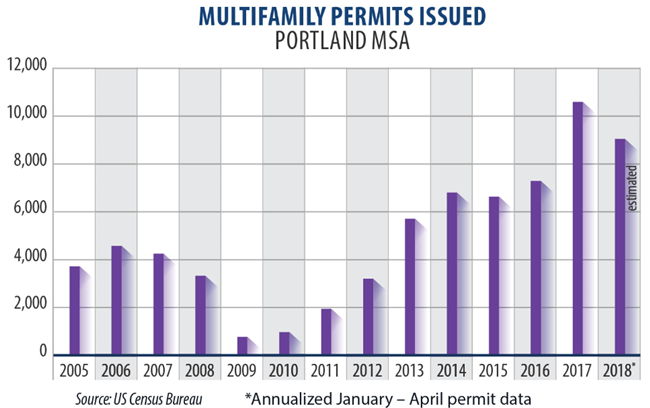
Permits have risen steadily from a low of 1,007 units permitted in 2009 to 10,319 in 2017. Despite this, experts say housing has not accelerated enough to meet anticipated demand.

Meanwhile, amid Greater Portland’s housing and affordability crisis, the Portland City Council implemented inclusionary zoning (IZ) on February 1, 2017. Since then, permit applications in the City of Portland have dropped significantly. Of an estimated 25,000 affordable units needed, only 170 units have been permitted under the IZ guidelines.

Publicly, city leaders appear unconcerned by this drop-off in permitting activity—citing a pipeline of approximately 19,000 market-rate pre-IZ units. It will be interesting to see how many projects that were permitted pre-IZ will be shelved as a result of increased cost of labor and materials.

Vacancies up slightly in Portland multifamily

Since 2015, there has been a significant increase in vacancies—but remains below five percent.

Portland multifamily

Concessions appear largely in Class A close-in projects. Portland has new supply that has yet to be absorbed.

Portland multifamily rents per square foot

For the first time since 2009, rents were basically flat in April over a year earlier according to Multifamily NW.

Meanwhile, the national data firm REIS pegged Portland’s calendar year 2017 rent growth above three percent.

Portland multifamily transactions

Portland saw high transaction volume in 2017, but not as high as in 2016. Much of that has to do with institutional properties above $10 million. There were 51 institutional transactions in 2016 compared to 37 in 2017.


On the private client side—properties valued at less than $10 million—we saw only a slight decrease in transactions from 2016 to 2017. Trends for 2018 appear more or less flat but cannot yet be reliably identified.

Government activity and Portland multifamily

Recently, the City of Portland began requiring all landlords to pay tenant relocation fees ranging from $2,900 to $4,500 based on unit size.

This fall, the city council will vote on adopting a warning notice to be posted on unreinforced masonry (URM) buildings, and next June will vote whether to require seismic retrofits. Portland has budgeted funds for a landlord registry, and Commissioner Chloe Eudaly has proposed adoption of a mandatory—and contentious—tenant screening assessment.

Regional government

Greater Portland’s metro government is under pressure to expand the area’s urban growth boundary and appears more willing to do so than in years past.

State government may take up ending rent control and no-cause evictions

When a new Oregon legislative session begins in early 2019, rental property owners will face a legislature composed of members more inclined than ever to scrap the state ban on rent control and to perhaps end no-cause evictions.

About Greg Frick:


portland multifamily Greg Frick

Greg Frick is a partner with HFO Investment Real Estate, now celebrating its 19th year in business. HFO has brokered over 25,000 units valued at $2.5 billion throughout Oregon and Washington. Greg works with both private market and institutional clients and can be reached directly by phone at (503) 241-5541 or e-mail at [email protected].