Home Blog Page 190

No Fire Sprinklers:13 Dead, Nearly 500 Homeless From 4 Fires In 11 Days

A mother and her five children, ages 2 through 10, were killed in a fire at an extended-stay hotel in Benton Harbor, Michigan, on July 27, 2018

Several others were taken to the hospital with injuries from the fire at the Cosmo Extended Living Hotel, which was reported about 1:45 a.m. The hotel was built as a Howard Johnson in 1962.

    • Five more people died in an off-campus apartment fire in San Marcos, Texas on July 20; four were Texas State University students. At least 200 more residents were affected by the fire, which was reported about 4:30 a.m. at the Iconic Building Apartments. A student who survived is in the hospital with 3rd degree burns over 70 percent of his body. The apartments were built in the 1970s.
    • Two women died in an apartment fire in Westminister, Colo., on July 22. Fourteen more people were injured, some of whom had jumped from two- or three-story windows to escape the fire at the Westbury Apartments, which was reported at 2 a.m.
    • The apartments were built in the 1970s and fire sprinklers were not required.


Fire sprinklers buy time and save lives

Most people don’t realize how quickly fires spread in real life,” Shane Ray, President of the National Fire Sprinkler Association (NFSA), said in a release. “Smoke is so thick that you can’t see, and flames can engulf a room in seconds.  Fires on TV and in movies don’t show the real danger and they create myths about fire sprinklers; they don’t all go off, only the one closest to the fire. Fire sprinklers buy time and time buys life.”

None of the buildings had fire sprinklers, which are required in new construction but not in existing buildings unless they are being extensively renovated. Nor did the River Trails Condominium complex in Prospect Heights, Ill., that left dozens homeless on July 18. Authorities believe that fire would also have caused fatalities if it had occurred at night, like the others did. River Trails was built in the 1970s.

Because of the lack of sprinklers, all the buildings were fully engulfed by the time firefighters arrived.

After a 2017 fire that killed three people in a residential tower in Honolulu, the Associated Press took a look at fire-sprinkler policies in major cities across the United States.

The policies vary widely – New York City requires sprinklers to be installed in older buildings that are 100 feet tall or more; Los Angeles requires sprinklers in residential buildings built before 1943 that are three stories or higher. Some cities require requires sprinklers in high-rise commercial towers, but not in residential buildings; Chicago, Philadelphia and San Francisco are some of these. Dallas does not require sprinklers, though city officials count 89 high-rise residential buildings in the city; 23 have partial sprinkler coverage.

Houston, San Antonio and San Jose are some of the few cities that require retrofitting of all residential buildings. San Diego had such a law but it was later taken out of the municipal code.

As inconsistent as requirements are in major cities, buildings in smaller cities or suburbs are even more unpredictable as to their sprinkler requirements. The safest thing to do, according to the NFSA, is to make sure that any apartment, condominium or hotel room you or your family stays in has a fire sprinkler system.

If you are staying or living in a place without fire sprinklers, the NFSA recommends these precautions:

    • Interconnected smoke alarms in common areas, in all bedrooms and on every level;
    • An escape plan, with two ways out from each bedroom;
    • Portable escape ladders in every bedroom above ground level.

The National Fire Protection Association (NFPA) says that myths about automatic fire sprinklers including thinking that smoke alarms provide enough protection, that they leak or activate accidentally, that when one activates all will activate, ruining items even in rooms that are not burning, or that they aren’t practical in colder climates, where pipes can freeze. None are true.

Resources:

The Associated Press

Detroit Free Press

KXAN, Austin, Texas

9News, Denver

National Fire Protection Association

National Fire Sprinkler Association


Apartment Jobs Account For One Third Of All Real Estate Jobs

A new report from the National Apartment Association says apartment jobs across the country account for one-third of all the real estate jobs in the nation.

In Portland it is even higher.

Apartment jobs in Portland represent 54 percent of all the real estate jobs in the metro area according to the report which ended with the second quarter in June.

Apartments remained a favored asset class for investors and have regularly out-performed other real estate sectors during this cycle.

Continued strong demand for apartment jobs especially property managers

Over 71 percent of apartment industry jobs fell within the property management, leasing and maintenance categories.

Property managers, in particular, were in higher demand this year although all sectors witnessed increases thanks to continued strong demand for apartments.

The jobs report focuses on jobs that are being advertised in the apartment industry as being available, according to Paula Munger, Director, Industry Research and Analysis, for the National Apartment Association’s Education Institute.

“Our education institute is a credentialing body for the apartment industry. They hear often that one of the biggest problems keeping our industry leaders up at night is the difficulty in finding talent, attracting talent and retaining talent,” Munger said.  “Labor-market issues are happening in a lot of industries, certainly with the tight labor market we have.”

So NAA decided to partner with Burning Glass Technologies. “They have a labor-job posting database that is proprietary,” she said, and they can “layer on data from the Bureau of Labor Statistics (BLS). We looked at that and thought we could do something that is really going to help the industry and help benchmark job titles and trends as we go forward.”

Apartment Jobs Account For One Third Of All Real Estate Jobs

Customer services most desired apartment jobs after property management

Other job sectors often compete for candidates with similar skills sets to those apartments need.

Outside of the specialized skill of property management, customer service is the most desired skill in the apartment industry, as it is in retail trade and hospitality.

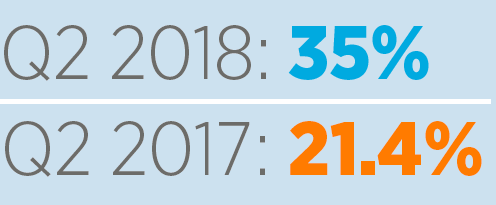
During the second quarter, mean salaries for apartment job postings surpassed both sectors, by 12.8 and 29.4 percent, respectively.

There was also a smaller concentration of lower-paying apartment jobs (under $35,000) which bodes well for the industry in this extremely competitive labor market.

Apartment Jobs Account For One Third Of All Real Estate Jobs

The turnover rate challenge

Ellis Management Solutions has statistics showing the national turnover rate for jobs is 19 percent but in the multifamily industry it is 39 percent.

“I think, I’ll state the obvious, with the high turnover, you are going to have to go out to the market more often to keep your positions filled,” Munger said. “I actually have another report from CEL and Associates a company out of LA, and theirs is more like 32 percent turnover rate for the multifamily industry. But the maintenance job, the on-site maintenance job, is almost consistently the highest turnover year after year.

“Like any other industry, with a lot of turnover, there is that time that has to be taken out to bring the person on board, to do other hiring activities like background checks. So it’s costly and that certainly does not help the bottom line


NAA Study: Barriers To Affordable Apartment Housing In Many Cities

Barriers to affordable apartment housing  mean developers cannot get new units off the ground in many cities according to a new National Apartment Association study.

By John R. Triplett

Rental Housing Journal

The challenges developers face in trying to build affordable housing apartments is the focus of the study by the National Apartment Association (NAA), using four key cities as pilot projects.

While developers know the roadblocks they hit in trying to build affordable apartment housing, local city planning officials and city government officials are also aware of the problem, said Paula Munger, Director of Industry Research and Analysis for the NAA, in an interview.

The pilot cities study came from research showing a need for 4.6 million new apartments by 2030.

A few highlights from the barriers to affordable apartment housing study:

    • The cost of construction, including land costs and fees, are the most common factor affecting new development.
    • Of the four cities in the pilot – San Diego, New York City, Austin and Miami –  San Diego has the greatest number of restrictions, from land availability to community involvement.
    • New York has high construction costs and land availability issues, plus the highest multifamily property tax in the country.
    • Miami has land availability issues due to being on the water.
    • Austin has rising construction, land, labor and impact fees.

“We commissioned a group called Hoyt Advisory Services to look at future demand for apartments,” Munger said.

Munger was referring to a report that “paints a dire picture of apartment availability between now and 2030.”  According to the report, the U.S. housing market will need 4.6 million new apartment homes at all price points by 2030. GlobeSt.com’s Erika Morphy writes that the “apartment industry is quickly exceeding capacity.” Overall, nearly 39 million people live in apartments.

She said “an offshoot of that study was looking at the correlation between affordability and difficulty building new multifamily apartments. The Hoyt group looked at an old (2007) land use index that the University Of Pennsylvania Wharton School Of Business put out and ranked 50 metro areas according to how difficult it was to build. They did a little bit of updating.

“Then we decided to expand upon that, because the Wharton Index was over 10 years old. These four markets are the beginning of that expansive research.

“This is a 70-question survey. It’s pretty intensive, asks about how long it takes to get things approved, how much costs have changed over time, etc., etc. We wanted to dig into it some more because we know its impact. The more difficult it is to build, you can’t meet the demand for apartments. That’s what causes the affordability issues,” Munger said.

Why were these four markets chosen?

“One, we wanted a good geographical dispersion. We have New York, Miami on the East Coast, we have Austin in the middle, and San Diego on the West Coast, different-sized markets.

“We do have these rankings of the 50 metro areas that are mostly based on this 2007 index with some updates. New York, Miami, and San Diego were showing up as difficult to build in with a lot of barriers. Austin was not. Clearly the markets where it was difficult, we wanted to expand upon. We also wanted to look at one, Austin, where it wasn’t so difficult, relatively speaking of course. We chose Austin for that just so the research team could see how the survey performed with both spectrums,” Munger said.

Seattle in top 10 of cities with barriers to affordable apartment housing

In addition to the four cities used in the pilot study, the NAA has the rankings of the top cities where it is most difficult to build affordable apartment housing.

“Certainly Seattle is in the top 10 most difficult to build from the research that hasn’t yet been updated, and Portland is down around 20,” Munger said.

What action can the NAA take?

“We can try to make recommendations to policy leaders and legislators,” Munger said.

“The one-page reports on those four markets are geared towards that, geared to really bringing the problem to light:

    • These are the barriers.
    • This is why we can’t build.
    • This is why we don’t have enough supply to meet the demand.

“We can make policy recommendations. If you go to our website, weareapartments.org, and we have a document. It’s called Vision 2030. There are some policy recommendations in there.

“We do advocate on behalf of the industry, and affordability is part of that in issues such as  outdated zoning laws; we also advocate for “by-right” development, expedited approval for affordable housing, and density bonuses. Those are just a few issues our Government Affairs team is focused on, as well as the other recommendations in Vision 2030.

Construction costs a problem in all markets

“Construction cost showed up as being a problem in all of the markets, rising construction cost in particular. Land cost, and fees, and labor,” Munger said.

She said NAA will be starting the second phase of the project in the next couple of weeks and “we’ll roll out the survey on a national basis.

“Depending on where we get a statistically significant number of responses, those will be the next few markets to be released. I don’t really have a list of what’s upcoming. They’ll self-select themselves based on responses,” Munger said.

Barriers to affordable apartment housing summary

It was important that this study be balanced between apartment developers in the private sector and those in the public sector, Munger said.

“We ended up getting about two-thirds private and a third public. I think when you dig into the public sector responses, there’s certainly a variance between public and private in terms of their perception of the process.

“But I was also surprised that there’s plenty of folks in city planning and city government that know that the approval process is complex. They know that it can take so long. Nimbyism (not in my back yard) showed up in 70 percent of the public responses as being one of their top three problems.

“I guess just the point being that both sides are recognizing that this is an issue, and that’s a very good thing. Hopefully that means we can make some headway going forward,” Munger said.

Munger and the NAA hope that by exploring problems in apartment construction in various cities, more people will understand why costs rise and rents increase – and what has to be done to help ease the situation.

“I’m hoping that (it) helps when people see that these are barriers. Different cities have differing degrees of these barriers, but they’re all common in that they exist and that they impact the supply.

“The other thing to remember too is that it just varies widely state-to-state, jurisdiction- to-jurisdiction, sometimes even within the same metro area,” Munger said.

Here is some more detail from each of the cities in the report

Austin has environmental restrictions plus rising land and construction costs.

NAA Study: Barriers To Affordable Apartment Housing In Many Cities

This high growth market ranks 6 of 50 metro markets for forecasted growth through 2030.

Given the high demand, the market is facing significantly rising construction, land and labor costs. Larger developments can more easily absorb impact fees, creating concern as to the financial feasibility of smaller-scale apartments.

The market is significantly impacted by protective environmental standards which are frequently stated as a costly and time consuming process issue. Building codes are under review with revisions expected later this year. Respondents particularly rank influence of local councils and local residents, namely citizen opposition to growth as strong influencers on residential building activity, which creates a more complicated structure and entitlement process and often requires a real estate advocate and/or community relations specialist to assist the development team.

As one of the fastest growing renter population bases, this market has a relatively new rental stock with only 21% of apartment units built before 1980 and only 17% of rental housing stock in STAR units, the lowest share of older, readily affordable rentals in 50 national metros previously surveyed.

Miami land availability and environmental restrictions

NAA Study: Barriers To Affordable Apartment Housing In Many Cities

As is typical for coastal markets, land in Miami is constrained by natural barriers.

The metro scores high in the number of conservation bonds passed in the past ten years and survey respondents rate the impact of environmental restrictions and their mitigation as important factors in regulating and impacting new apartment development, particularly near the coast.

Land availability ranks the highest barrier, followed by the environments issues above, land and construction costs. Costs are particularly affected by impact fees and waivers are generally not available in lieu of fees. Community involvement remains a significant barrier. Here, survey respondents note that community meetings and engagement are a requirement before the presentation of any zoning or rezoning application.

Local council is rated the strongest in terms of organizations that influence apartment building activity. Miami political structure was ranked the fifth most significant barrier, a nod to the vagaries of metro politics, followed by infrastructure and density and/or growth issues amid a rising demand for more upscale and affordable rental units. Those rental households paying more than 35% of income on rent is the highest share in 50 national metros previously surveyed.

New York City has land availability issues and costs

Not unexpectedly, construction and land costs as well as general land availability were rated as the top factors influencing the new apartment market in New York City.

NAA Study: Barriers To Affordable Apartment Housing In Many Cities

The city also has the highest multifamily property tax rate in the country with complex rent control laws, and can have lengthy submission and appeal processes for housing developers. Respondents then listed affordable housing requirements and the entitlement process as restrictive, followed by community involvement. Community meetings before zoning requests was a particularly significant influence.

The complexity of the NYC urban market is particularly extreme when compared to other metros in the number of submissions and percent of projects that require property tax or other public subsidies. Also, environmental restrictions have significant impact on new apartments. Interestingly, less significant factors include infra-structure and political structure, particularly involvement of county and state level legislative and approval processes versus City actions.

San Diego land availability and environmental restrictions

NAA Study: Barriers To Affordable Apartment Housing In Many Cities

A highly desirable, land-constrained market, San Diego metro has multiple factors ranked high for their impact on apartment development.

Respondents particularly noted that citizen opposition to growth influences the development process through an array of advocacy groups, public votes to circumvent council or planning commissions, repeated lawsuits, and numerous community meetings required before zoning or rezoning. Construction costs are driven up by the high number of impact fees, lack of waivers or processes to mediate fees, and high and increasing land costs.

In addition to coastal restrictions, environmental restrictions and mitigation, the area ranks high in the number of conservation bonds passed at the local and state level in the past ten years including the California Environmental Quality Act (CEQA).

Metro experts also noted process and political structure issues that create uncertainty and delays in the entitlement process. Complex approval structures requiring multiple submissions to approve developments are frequently cited. More than most metro markets, these top issues present formidable barriers to new apartment supply amid strong demand ahead.

Resources:

National Apartment Association

New Report Highlights the Need for 4.6 Million Apartments By 2030

A New Measure of the Local Regulatory Environment for Housing Markets: The Wharton Residential Land Use Regulatory Index

U.S. Apartment Demand – A Forward Look

The Country Needs 4.6 Million New Apartments By 2030. How Many Are Needed Near You?

 

Portland, Seattle Apartment Rents Lag As Other Metros Increase For Sixth Straight Month

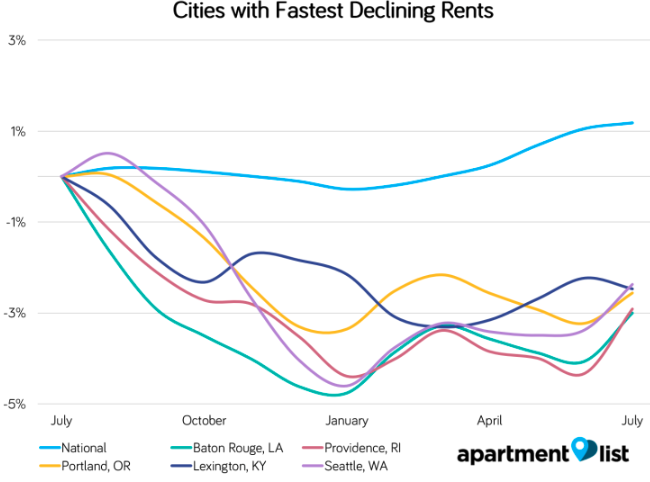
The national apartment rents index is up 0.1 percent month-over-month in the peak of the rental season, marking the sixth straight month of increasing rents, except in Portland and Seattle where rents have declined slightly, according to Apartment List.com.

Year-over-year growth now stands at 1.2 percent, lagging the rates from the two prior years.

“While rents were increasing at a fairly fast clip over in May and June, things cooled off in July with a modest 0.1 percent month-over-month increase,” according to Chris Salviati, housing economist at Apartment List.


“This slowdown is notable, given that we’re still in the midst of the summer months when rental activity is generally at its busiest. For comparison, month-over-month rent growth for July was 0.4 percent in each of the two prior years. This month’s data serves as further evidence of softness in the market, as rent growth over the past year remains sluggish compared to the previous two years.


“Year-over-year growth currently stands at 1.2 percent at the national level, which is well below the 3.1 percent rate we saw this time last year as well as the 2.8 percent rate from July 2016. Rent growth is also pacing well behind the overall rate of inflation, which stands at 2.9 percent as of the latest data release, and is similarly lagging growth in average hourly earnings which have increased by 2.7 percent over the past twelve months. With the homeownership rate continuing to trend upward and more new supply slated to come online throughout the year in many markets, it’s possible that rent growth will continue to be sluggish, a welcome bit of relief as millions of our nation’s renters continue to struggle with housing affordability.


Portland, Seattle show apartment rents declines


Only 23 of the 100 largest cities have seen rents fall over the past year, though an additional 24 saw modest gains of less than 1.0 percent. The chart below shows trends for the five cities where rents declined most:


Portland apartment rent report


Portland, Seattle Apartment Rents Lag As Other Metros Increase For Sixth Straight Month


Portland rents have increased 0.7% over the past month, but are down significantly by 2.6% in comparison to the same time last year. Currently, median rents in Portland stand at $1,130 for a one-bedroom apartment and $1,330 for a two-bedroom. Portland’s year-over-year rent growth lags the state average of -0.9%, as well as the national average of 1.2%.


While rent decreases have been occurring in the city of Portland over the past year, cities in the rest of the metro are seeing the opposite trend. Rents have risen in 8 of the largest 10 cities in the Portland metro for which we have data. Oregon as a whole logged rent growth of -0.9% over the past year. Here’s a look at how rents compare across some of the largest cities in the metro.


    • Looking throughout the metro, Hillsboro is the most expensive of all Portland metro’s major cities, with a median two-bedroom rent of $2,030; of the 10 largest cities in the metro that we have data for, Hillsboro, where a two-bedroom goes for $2,030, is the only other major city besides Portland to see rents fall year-over-year (-0.3%).


    • Springfield, Vancouver, and Corvallis have all experienced year-over-year growth above the state average (3.1%, 2.9%, and 1.9%, respectively).


Portland rents more affordable than many similar cities nationwide


As rents have fallen significantly in Portland, many comparable cities nationwide have seen prices increase, in some cases substantially. Portland is also more affordable than most other large cities across the country.


    • Portland’s median two-bedroom rent of $1,330 is above the national average of $1,180. Nationwide, rents have grown by 1.2% over the past year compared to the 2.6% decline in Portland.


    • While rents in Portland fell significantly over the past year, many cities nationwide saw increases, including Las Vegas (+4.3%), Phoenix (+2.4%), and Charlotte (+1.5%).


    • Renters will find more reasonable prices in Portland than most comparable cities. For example, San Francisco has a median 2BR rent of $3,090, which is more than twice the price in Portland.


Portland, Seattle Apartment Rents Lag As Other Metros Increase For Sixth Straight Month


Seattle apartment rents report


Seattle rents have remained steady over the past month, but have decreased significantly by 2.0% year-over-year. Currently, median rents in Seattle stand at $1,320 for a one-bedroom apartment and $1,650 for a two-bedroom. Seattle’s year-over-year rent growth lags the state average of 0.9%, as well as the national average of 1.4%.


Rents rising in other cities in the Seattle metro


Portland, Seattle Apartment Rents Lag As Other Metros Increase For Sixth Straight Month


While rent prices have decreased in Seattle over the past year, the rest of the metro is seeing the opposite trend. Rents have risen in 9 of the largest 10 cities in the Seattle metro for which we have data. Here’s a look at how rents compare across some of the largest cities in the metro.


    • Federal Way has seen the fastest rent growth in the metro, with a year-over-year increase of 7.0%. The median two-bedroom there costs $1,730, while one-bedrooms go for $1,390.


    • Over the past year, Seattle proper is the only city in the metro that has seen rents fall, with a decline of 2.0%. Median two-bedrooms there cost $1,650, while one-bedrooms go for $1,320.


    • Bellevue has the most expensive rents of the largest cities in the Seattle metro, with a two-bedroom median of $2,330; rents rose 0.5% over the past month but remained flat year-over-year.


    • Lakewood has the least expensive rents in the Seattle metro, with a two-bedroom median of $1,430; rents increased 0.6% over the past month and 5.1% over the past year.


Portland, Seattle Apartment Rents Lag As Other Metros Increase For Sixth Straight Month


Apartment Rents Report Methodology:


Apartment List is committed to making our rent estimates the best and most accurate available. To do this, they start with fully representative median rent statistics for recent movers taken from the Census Bureau American Community Survey. Then, extrapolate this data forward to the current month using a growth rate calculated from the company’s listing data. Growth rates are calculated using a same-unit analysis similar to Case-Shiller’s approach, comparing only units that are available across both time periods in order to provide an accurate picture of rent growth in cities across the country.


The approach corrects for the sample bias inherent in private sources, producing results that are representative of the entire market. The company’s methodology also allows construction of a picture of rent growth over an extended period of time, with estimates that are updated each month. Read more about the methodology here.


3 Types Of Lighting For Your Rentals To Attract Tenants

Lighting for your rentals can be important in attracting and keeping the best tenants, so the maintenance checklist from Keepe this week is on three types of lighting.

These days, the sheer amount of lighting options and seasonal trends available on the Internet’s home design boards and websites alone are endless.

Lighting layouts and lighting fixtures fall among the categories of interior design that can easily get overwhelming as soon as one starts exploring what is available, or “in” lately.

In most cases, choosing over-the-top statement pieces, trendy or poorly planned layouts can lead to wasting hundreds of dollars on items that will quickly become easily damaged, faulty or simply unpractical for tenants.

This week’s post will overview the important bits about lighting – listing the available types and layouts that it’s actually useful to know about and opt for accordingly for your rental property

No. 1 – Ambient or “general” lighting for your rentals

Ambient lighting is the bread and butter of interior illumination because it is responsible for illuminating rooms as a whole.

It is the most basic and fundamental “layer” of indoor lighting, which is why the layout of light sources intended to be the key source of general light should be carefully planned beforehand: ambient lighting should be balanced – not allowing for either awkwardly dark areas or overly bright, glaring ones to form in a space.

The ultimate goal of this first layer of lighting is to produce a natural and comfortable glow that allows residents to enjoy a well-lit space when it’s dark outside.

Our expert electricians find that many different looks and types of light fixtures can create ambient lighting, but ceiling-mounted – or recessed – fixtures are generally most common in rental units as they produce a 360 degree radius of light, which alone easily illuminates square and oblong rooms.

Ambient lighting: a word of advice

The color of a property’s walls plays a huge role in determining the overall luminosity of a room. A less airy, darker look results when the walls are painted with a color that is too dark and does not complement available light sources – both natural and artificial – to ultimately create a well-lit space.

No. 2 – Task lighting for your rentals

3 Types Of Lighting For Your Rentals To Attract Tenants

Task lighting refers to those light sources that purposefully illuminate a certain space to aid daily activities of a property’s residents.

Nightstand lamps, table lamps, pendant kitchen lights, bathroom vanity and kitchen cabinet lighting are all examples of task lighting because they provide light for practical tasks: reading in bed, working at a desk, cooking and getting ready in the bathroom.

Integrated lighting in the kitchen cabinets and bathroom vanities is a type of lighting upgrade that should not be underestimated: most tenants really appreciate having available task lighting.

Task Lighting: a word of advice

When thinking about a rental property’s indoor lighting, it’s important to do so by visualizing layers. While ambient lighting is the first, core layer, it should not be the only focus when planning how to illuminate a space. Task lighting is immensely important because it makes a space more practical and functional.

Our experts find that added lighting in the kitchen and bathroom is almost always a plus for tenants, who really enjoy thoughtful lighting choices.

No. 3 – Accent lighting

3 Types Of Lighting For Your Rentals To Attract Tenants

Also known as “highlighting”, accent lighting works to draw attention to a specific area in the home, typically for aesthetic purposes.

Accent lighting shines a light – pun intended – on a feature or decorative element that one intends to highlight in the home.

Accent Lighting: a word of advice

Unless they are furnished, luxury units, most rental properties do not have a serious necessity for accent lighting.

It’s generally a better idea to give priority to task lighting for your rentals over accent lighting, which actually serves a helpful purpose that tenants enjoy. It can be easy to waste a lot of energy, time and money on choosing and installing accent lighting and other colorful or elaborate “statement” fixtures in a property: while they might look appealing, they rarely keep their value as they usually become outdated in a short span of time.

Other recent rental property maintenance Keepe posts you may have missed:

4 Outdoor Flooring Options For Your Rentals

20 Easy, Affordable Maintenance Projects To Update Your Rentals

7 Tech Gadgets For A Safer And More Efficient Rental Property

5 Maintenance Tips For Long-Lasting Rental Carpet Flooring

Is The Water Heater At Your Rental Property Ready For The Big One?

7 Types Of Kitchen Countertops For Your Apartments

Which Cooktop Is Best For Your Rental Property?

About Keepe:

Keepe is an on-demand maintenance solution for property managers and independent landlords. The company makes hundreds of independent contractors and handymen available for maintenance projects at rental properties. Keepe is available in the Greater Seattle area, Portland, Phoenix, San Francisco Bay and San Diego areas.


Portland Rental Property Database Requires Landlords List Properties

Portland landlords will be required to register the addresses of all rental properties in the new Portland rental property database beginning with the 2018 tax year, the City Council voted.

“A rental registration system will benefit current and potential tenants by giving the city access to real-time data, which will help direct policies to better address Portland’s housing crisis,” said Mayor Ted Wheeler in a press release. The program, called the Residential Rental Registration Program, also allows for routine health and safety inspections of leased properties.

“Quality data in our rental system is something that tenants and landlords have been asking for,” Wheeler told Oregon Public Broadcasting.

The program is the city’s latest effort to combat its ongoing housing crisis. The council declared an official housing emergency in October 2015 due to the low inventory of affordable housing and a corresponding rise in the homeless rate. That declaration waived parts of the city’s zoning codes, which streamlined the building permit process for more than 2,000 new housing units. A month earlier, Portland’s Community Alliance of Tenants had declared a “Renter State of Emergency” after mass evictions became rampant when lower-priced rentals were being upscaled.

Even so, the city has a way to go to even out housing availability. In a June 2018 CNBC ranking of the most expensive places to live in America, Oregon ranked sixth in the nation – and Portland was the most expensive place in Oregon, with the average for a two-bedroom apartment at about $2,500 a month.  The state’s cost-of-living score received only six out of 50 possible points.

Portland rental property database – landlords must register properties by April 2019

For the new database registration, landlords must register their properties by April 2019, when they file their annual business license tax.

All landlords are affected, even those who only lease one property. The city plans to use property tax records to determine the names of residents who own more than one home and notify them of the new requirement. There is no penalty for noncompliance during the first year, but a fine of $500 will be assessed in future years.

“Most jurisdictions, including Gresham, Eugene, Seattle, and San Francisco have data and registration collection systems,” Wheeler said. “It’s time for Portland to catch up.”

No current program keeps track of the number of landlords in Portland, the exact number of units available, or where those units are located. Wheeler said the program will better help the council monitor and enact housing regulations, help low-income tenants and evaluate rent stabilization.

The inclusion of single-unit property owners in the new rental database is an accomplishment for organizations that represent Portland tenants. Single-unit owners were excluded from a temporary Renter Relocation Ordinance passed by the City Council in February 2017 that requires landlords to pay relocation assistance to tenants evicted without cause or whose rent increased 10 percent or more in a year. A study done by Portland researcher Meg Hanson showed that 24,000 landlords were exempt from that ordinance because they owned only one rental property. This accounted for more than 16 percent of the city’s rentals, the report said.

“There’s been this big piece of data that’s been missing from this very important conversation about policy,” Hanson said in an interview with the alternative weekly The Portland Mercury. “This is a huge gap and something that was really important.”

The new database registration will require an estimated 10,000 or more landlords to begin filing business taxes, something that hadn’t previously been required for those who grossed less than $50,000 a year from their rentals.

Resources:

Residential Rental Registration Program Ordinance text, portlandoregon.gov, July 2018

Press release from Mayor Ted Wheeler, July 2018

Portland to Develop Database of Rental Housing Inventory, KUOW, Oregon Public Broadcasting (OPB), July 2018

City of Portland, City Council/Wheeler Press Release, July 2018

Portland City Council Declares a Housing Emergency, OPB, Oct. 2015

A Summer of Evictions: Portland Renters are in a State of Emergency, Portland Mercury, Sept. 2015

The Most Expensive Places to Live in America, CNBC, June 2018

Portland Rental Housing Analytics Summary, Chariot Wheel Research Consultants, Jan. 2018

A New Report Suggests More than 24,000 Rental Units Aren’t Subject to Portland’s Strongest Tenant Protections, The Portland Mercury, Jan. 2018

Portland Will Require All Landlords to Register their Apartments – by Late 2020, The Oregonian/Oregon Live, July 2018

Multifamily Smoke-Free Policy Deadline For Public Housing

Group Says Multifamily Should Ban Smoking Inside and Near Buildings

Implementing a multifamily smoke-free policy is recommended by HUD so the Grace Hill training tip of the week focuses on helpful ways to do this in your property.

By Ellen Clark

All public housing agencies must have a multifamily smoke-free policy in place by July 31, 2018, according to the U.S. Department of Housing and Urban Development (HUD) rule based on a rule passed in late 2016.

HUD had allowed time for implementation of the smoke-free policy and this rule now applies to all public housing except dwelling units in mixed-finance buildings.

While the rule applies to public housing agencies, HUD strongly encourages all multifamily housing owners and agents to implement smoke-free policies in all their properties.

Recap of the HUD multifamily smoke-free policy 

Here’s a recap of the rule and helpful resources about implementing a multifamily smoke-free policy.

    • The rule says that each public housing agency must implement a smoke-free policy banning the use of prohibited tobacco products in all living units, indoor common areas, administrative office buildings, and outdoor areas within 25 feet of any building on public housing grounds.
    • Note that the rule does not prohibit residents of PHAs from smoking.
    • Public housing agencies can establish outdoor designated smoking areas beyond the required 25 feet perimeter to accommodate residents who smoke.
    • Agencies may also establish additional smoke-free locations, or they can even make their entire grounds smoke-free.

While this rule applies to public housing (except dwelling units in mixed-finance buildings), the materials that HUD has assembled to help agencies comply with this rule may be very helpful to any community that is thinking about, or in some stage of implementing, a smoke-free policy.

More rental properties adopting smoke-free policies

More and more rental properties across the country are adopting smoke-free policies with the goal of improving air quality, reducing the risk of fire, and lowering maintenance costs.

If you are one of those properties, here are some great resources HUD has put together to help public housing agencies implement multifamily smoke-free policies that may also be helpful to you:

    • Review all your resources when setting up your smoke-free policy


Implementing HUD’s Smoke-Free Policy in Public Housing includes strategies for communicating with residents, examples of smoke-free policies and enforcement plans, tips for training staff, helpful information for launching a smoke-free policy, and guidance on responding to requests for accommodation.


There is more available on the Healthy Homes section of HUD’s website. Take some time to look around – there’s lots of good stuff out there!

Resources:

Recent Grace Hill training tips you may have missed:

What Do You Do When Assistance Animals Break The Rules?

7 Ways To Stay Out Of Trouble When Checking Criminal History

5 Ways To Protect Applicants, Residents And Employees From Sexual Harassment

Do You Have A Smoke-Free Policy That Adequately Protects Residents?

How To Handle Suspicious Documentation For Assistance Animals

How A No Pet Policy Can Be Discriminatory

Property Management Cyberattack Risks Overlooked, Underestimated

Do You Know How To Respond To a Sexual Harassment Complaint?

Have You Reviewed Your Criminal Background Checks Policy Lately?


Multifamily Managers And Marijuana: Caught In A Pot Crossfire

Fair Housing Discrimination Against Someone You’ve Never Talked To?

4 Ways To Avoid Screening Pitfalls With Applicants


About the author:

Ellen Clark is the Director of Assessment at Grace Hill.  Her work has spanned the entire learner lifecycle, from elementary school through professional education. She spent over 10 years working with K12 Inc.’s network of online charter schools – measuring learning, developing learning improvement plans using evidence-based strategies, and conducting learning studies. Later, at Kaplan Inc., she worked in the vocational education and job training divisions, improving online, blended and face-to-face training programs, and working directly with business leadership and trainers to improve learner outcomes and job performance. Ellen lives and works in Maryland, where she was born and raised.

About Grace Hill

For nearly two decades, Grace Hill has been developing best-in-class online training courseware and administration solely for the Property Management Industry, designed to help people, teams and companies improve performance and reduce risk.


Apartment Amenities: A Mismatch Between Tenants And Management?

A new survey of tenants and apartment amenities shows a mismatch between tenants who want laundry in their units and management which is offering cat friendly apartments, according to Apartmentlist.com.

The report shows most cities apartment amenities fall into three categories:

    • too many amenities
    • not enough amenities
    • the wrong amenities

This apartment amenities mismatch shows up in a new survey that shows most residents want laundry facilities in their apartment, but only 13 percent of apartments offer it. Meanwhile 39 percent of apartments are cat-friendly but many residents do not have cats and are not interested.

How well the amenities available in rental properties align with what renters want and how the supply and demand for amenities varies across the nation’s largest metros was a study done by Apartmentlist.com.

“Analyzing data for ten of the most common amenities, we find that the amenities that renters desire most aren’t the same ones that properties are most likely to offer,” the company says. “We compare the share of properties that have each amenity to the share of users that report a preference for that amenity.”

Apartment amenities most desired? In-unit laundry

In-unit laundry is the most undersupplied of the apartment amenities.

An estimated 53 percent of renters say they’re looking for in-unit laundry, but it’s also the hardest amenity to find, available in only 13 percent of properties. Air conditioning and parking are similarly lacking.

These are the two most desired amenities, with 56 percent of renters citing a preference for air conditioning, and 55 percent saying they want parking. Meanwhile, only 39 percent of properties have air conditioning and only 46 percent have parking.

“It’s also worth noting that even when parking is available, it often costs renters an additional fee. In some dense cities, such as New York and San Francisco, getting a parking spot could add hundreds of dollars to a renter’s monthly expenses,” the report says.

Being cat-friendly is not high on renters’ desires for apartment amenities

At the other end of the spectrum, it seems that there are more pet-friendly apartments than there are renters who have pets.

Cat-friendliness is the most common amenity on the property side, available in 52 percent of properties, but only 12 percent of renters are looking for a cat-friendly apartment, the smallest share of all the amenities we analyzed. Similarly, 48 percent of properties say that they are dog-friendly, but only 27 percent of users select this preference.

Apartment amenities offered often tied to up-front costs

The relative lack or overabundance of particular amenities on the property side is likely related to the upfront costs associated with each amenity.

For example, providing pet-friendliness doesn’t involve any upfront cost, only marginal incremental costs associated with faster wear and tear, which are often recouped by charging “pet rent.”

On the other hand, in-unit laundry takes up valuable additional space within a rental unit, and also requires significant upfront costs, including purchasing the machines and arranging the plumbing, the report says.

Read the full report here.

Apartment amenities vary by city

It is really hot in San Antonio in the summer, so it is no surprise air conditioning tops apartment amenities in that Texas city.

San Antonio dominates the list for highest amenity demand, with the greatest share of renters requesting five of the 10 amenities we analyzed.  San Antonio is also one of the nation’s most affordable large cities, with a median two-bedroom rent of $1,050, which may explain why the area’s renters are more willing to splurge on higher-end amenities, such as hardwoods floors and balconies.

In contrast, the New York City metro has some of the nation’s least choosy renters, with the metro accounting for half of the spots on the low demand list. New York is the nation’s second most expensive rental market — trailing only San Francisco — with a median two-bedroom rent of $2,470. It seems that renters in New York are willing to sacrifice the comfort of additional amenities in an effort to maintain some semblance of affordability.

This relationship between affordability and renter demand holds in other cities as well. In the expensive San Francisco and Boston markets, renter demand is below the national average for nine of the 10 amenities we analyzed, while renter demand exceeds the national average for nine of 10 amenities in the more affordable Tampa and Phoenix markets.

Summary

Amenities are one of the top factors that renters consider when searching for an apartment, and having access to all of one’s preferred amenities can make it a much easier decision to rent a home. That said, some amenities are easier to come by than others.

“Our analysis indicates that in-unit laundry is the holy grail of amenities. Most renters want it, but very few properties have it,” the study says.

The level of emphasis that renters place on finding amenities also varies substantially by location. Renters in more affordable markets tend to have a higher demand for amenities, while renters in the priciest markets are more willing to wash dishes by hand or haul dirty clothes to the laundromat.

“Overall, we find that many markets do a poor job of matching amenity supply and amenity demand,” the report says.

5 Tenant-Friendly Amenities That Increase Your Profits

Seattle Landlords Feel Vilified By Overly Punitive City Ordinances

A new Seattle rental housing study says Seattle landlords feel vilified by overly punitive city ordinances which they believe are actually inadvertently reducing rental housing access.

The study from University of Washington Center for Studies in Demography and Ecology says a large majority of “landlords who responded to the survey reported feeling left out of debates about the development of the City’s housing ordinances and only 10% supported any of the central goals the City has adopted in developing new housing policies.

“Large majorities of landlords believe that ordinances to limit move-in fees, the First-in-Time ordinance, and the ordinance to limit criminal background checks are likely to be ineffective,” the study said.

First-in-Time ordinance a real negative for Seattle landlords

“Attitudes toward the First-in-Time ordinance are especially negative, with large majorities of landlords – and especially those reporting flexible rental standards – reporting that the ordinance places an undue burden on landlords and may reduce housing access for lower-income renters. About 40% of landlords have sold, or plan to sell, property in response to City ordinances governing the housing market,” the study says.

Highlights of the Seattle landlords portion of the survey

    • “Our survey of over four thousand landlords in the Seattle area indicates that the majority of them own or manage a small number of units and/or buildings, and more than half maintain rental property as a way to supplement their main income or support their retirement.
    • “Recent rent increases tended to be more common, and larger, among landlords managing large- (20+ unit) and moderate-sized buildings than among landlords managing smaller buildings, and are also relatively large among landlords who manage multiple buildings. While landlords most often cited increasing taxes and repair costs as the primary motivations for rent increases, landlords managing larger buildings were especially likely to report that recent rent increases have been in response to recent City ordinances.
    • A majority of landlords report that they use a standard set of criteria in deciding to whom to rent their property, but more than half also report that they exercise flexibility in those criteria. Managers of larger buildings are more likely than managers of smaller buildings to employ standard rental criteria and are less likely to relax these criteria in a way that may allow for tenants with imperfect applicant characteristics.

Seattle landlords provide thoughts on city ordinances

Overall, the landlords who responded to the survey appear to see limited value in the city council’s efforts to affect the rental market. Respondents were asked to indicate which of the following goals the council should adopt in establishing housing policies:

    • Increasing the supply of affordable housing
    • Reducing risks to landlords associated with providing affordable housing units
    • Increasing the overall supply of rental units
    • Increasing affordable options for protected classes of renters
    • Making it easier for landlords to terminate leases

“Just over 9% of the respondents indicated an interest in more than one of these goals. However, no individual goal garnered support from more than about 1% of respondents, and the overwhelming majority (89%) of landlords selected none of these options as worthy policy goals for the council,” the study said.

“Landlords’ general dissatisfaction with city ordinances is amplified by the fact that very few landlords feel that the City’s ordinances reflect landlords’ interests,” the study says.

Landlords’ response to ordinances

“We also asked landlords how they have responded to, or plan to respond to, the City’s ordinances.

“About one in five landlords who raised their rent in the past year report that these increases were in response to new city ordinances,” the study said.

Summary of Seattle landlord study

“Overall, the results of the survey highlighted in this report indicate that basic rental practices – from the use of strict tenant requirements to patterns of rent increases – vary sharply by the characteristics of landlords and their properties. These findings point to opportunities to develop housing policies that engage the varied strategies and priorities of a diverse set of landlords.

“However, there appears to be a strong consensus among landlords that the development of city housing ordinance has largely ignored landlords’ perspectives, resulting in a set of ordinances perceived by landlords as highly burdensome and ineffective.

“In addition, responses to open-ended survey questions point to substantial misinformation about City ordinances, suggesting potential value in efforts to engage landlords on the content, intent, and operation of City housing ordinances,” the study says.

Get the full study report here.

Survey methodology:

The survey went live in January, 2018 with invitations via email to 18,477 individuals represented in data from the City’s Rental Registry and Inspection Ordinance (RRIO) program. Representatives from WMFHA and RHAWA also sent email messages to their members, as well as calls in their organization newsletters, requesting that they complete the survey. Between February 9, 2018, and April 2, 2018, four email reminders were sent to all individuals on the RRIO list. Below we provide a description of basic analyses of the data from over four thousand responses received as of April 10, 2018.


5 To-Do’s For Property Managers Before Tenant Vacations Start  

Tenant vacations can mean important vacation to-do’s that landlords and tenants should work together on completing before anyone leaves for their vacation. Here is this week’s maintenance checklist from Keepe.

It’s time to get ready for “vacay” – that is, vacation-related vacancies.

While not all tenants might choose tenant vacations in the summertime, it’s undeniable that the majority of the working population prefers getting away in the warmer weather. Or in the case of Arizona getting out of the hot to the cooler areas.

As numerous tenants prepare to leave for their summer vacations, it’s important to start thinking about the common risks and major issues that vacant (even if only temporarily) apartments are uniquely vulnerable to, and prepare accordingly.

If you property is independent or somewhat isolated it is even more important.

When rental units that are left vacant for considerable lengths of time it is important to take steps to prevent break-ins, maintenance emergencies, resulting damage and other unpleasant “welcome home” surprises. It is a fundamental priority that property owners and managers should make sure to plan for.

No. 1 – Tell us you are going on vacation

The first and most important step is reaching out to tenants to stress the importance of checking in and communicating about tenant vacations and plans

Property managers and owners should keep track of vacancies to then monitor and take care of the property while the tenants are away, and address any issues that would otherwise go unnoticed…..and worsen significantly over time. It’s also fundamental to explain to tenants that this is in their best interest.

No. 2 – 5 burglar-proofing things you can do

Empty apartments and rental homes are preferred by burglars, since breaking in is easier when they are undisturbed. In the summertime, break-in rates soar.

Burglars will stake out entire neighborhoods to identify and target houses that appear vacant. Here are some tips for making a property seem occupied, which keeps it from catching the eye of burglars, and avoiding the resulting loss of thousands of dollars from damage.

    1. Advise tenants to pause or stop any mail or magazine subscriptions, which would otherwise pile up and suggest vacancy. Another option would be to offer picking it up for them.
    2. If vehicles are left at the property, advise tenants to completely empty their interiors, or park inside a garage or protected lot. Vehicles remaining parked on the property and in the same spot for long periods of time can suggest vacancy.
    3. Arrange for landscaping services to be scheduled. An overgrown lawn also suggests that the property has been vacant.
    4. Install bright, motion-activated night lighting. These lighting systems are a great safety feature as they create a spotlight effect that discourages burglars from attempting break-ins.
    5.  Keep in mind that a wide variety of security system types exist. While some are more sophisticated than others, more affordable types are still a great safety tool, which can even sync with your smartphone to relay real-time updates.

No. 3 – Plumbing-related safety

Unexpected breakages are common, and a flooded home can easily become reality if adequate precautions are not taken seriously before tenant vacations.

    1. Locating and shutting off a home’s water valve makes it possible to turn off water supply to appliances and pipes. By doing so, any kind of breaks or issues resulting from faulty appliances won’t ultimately lead to leaks and floods, which can be a costly consequence.
    2. Remind tenants that there is no need to heat the house while it’s vacant: most water heaters come equipped with a “vacation mode” switch that should be activated before leaving for vacation. This energy-saving mode ensures much lower bills.
    3. Bonus tip: A property can easily turn into a off-putting hub of foul odors when the garbage disposal is not properly cleared. It’s important to remind tenants to clear their garbage disposal by turning it on for a few seconds and making sure that all leftover scraps are flushed, which makes it so they don’t remain stuck in the sink’s piping to rot and produce foul smells while everyone is away on vacation.


5 To-Do’s For Property Managers As Tenants Head Out For Vacations

No. 4 – Electrical-related tips for property managers

    1. Remind tenants that unplugging all electrical appliances will allow them to both save money and prevent all the major issues that could arise from short circuiting.
    2. Let tenants know that in the summertime, setting the thermostat in “vacation”/“away” mode or adjusting the indoor temperature to match outside temperatures will allow them to save energy and thus money.

No. 5 – Miscellaneous tips for property managers

    1. It’s always good to touch bases with tenants and verify that even the most obvious precautions and steps have been taken. Was the garbage taken out? The fridge emptied? Are pets going to be taken care of?
    2. Checking smoke detectors and other safety alarms to make sure they’re working is another important step.
    3. Setting up a timer for indoor lights is an optional step that can help with making a home look occupied and less likely to get burglarized.

Other recent rental property maintenance Keepe posts you may have missed:

4 Outdoor Flooring Options For Your Rental

About Keepe:

Keepe is an on-demand maintenance solution for property managers and independent landlords. The company makes hundreds of independent contractors and handymen available for maintenance projects at rental properties. Keepe is available in the Greater Seattle area, Portland, Phoenix, San Francisco Bay and San Diego areas.