
Home Blog Page 18

Keep Pets Safe July 4:Tips, Resources, Importance of Microchipping

Keep pets safe inside July 4 as more pets go missing around the 4th so here are tips, resources and why microchipping is important.

Keep pets safe this July 4 inside your rental housing as unfortunately more pets go missing around the Fourth of July than any other time of the year so here are tips, resources and why microchipping is important.

By Michelson Found Animals

Fireworks season is here, and unfortunately, more pets go missing around the Fourth of July than any other time of the year. That’s why Michelson Found Animals (MFA) is stepping up to help families prepare.

Microchipping is one of the most effective ways to bring lost pets home safely. July is Lost Pet Prevention Month, and we’re proud to have donated more than 2,000 microchips across Los Angeles in anticipation of the Fourth. Now’s the time to check your pet’s chip info, update your contact details, and take a few simple steps to keep them secure.

Let’s make this a safe and joyful Fourth for every family member. Click here to learn more about our efforts, read our full list of tips, and learn how to get involved.

Why So Many Pets Go Missing

The loud noises, flashing lights, and unfamiliar crowds associated with Fourth of July celebrations can cause pets to panic and flee, even those who’ve never shown signs of fear before. Doors are left open during parties, fences are scaled in fear, and pets without ID are quickly lost in the commotion.

That’s why now is the time to prepare, before the fireworks begin.

7 Easy Ways to Protect Your Pet This 4th of July

Here are some simple steps every pet owner can take to help ensure a safe and stress-free holiday:

  • Microchip Your Pet—Microchipping is one of the most effective ways to reunite lost pets with their families. If your pet is already chipped, doublecheck that your contact info is up to date. Make sure to register your microchip for free at https://www.24petwatch.com/.
  • Create a Safe Space Indoors – Set up a quiet room with your pet’s favorite blanket, toys, and a white noise machine or calming music to help drown out the sounds of fireworks.
  • Don’t Leave Pets Outside – Even a fenced yard can’t stop a scared pet from escaping. Always bring them indoors before the festivities begin.
  • Exercise Earlier in the Day – A tired pet is a calmer pet. Take your dog for a long walk or playtime early in the day to help them rest easier that night.
  • Secure ID Tags – Make sure your pet is wearing a collar with a tag that has your current contact information. Tags and microchips work best together.
  • Talk to Your Vet About Anxiety – If your pet has shown stress in the past, ask your vet about calming products or medication to help them through the night.
  • Keep Fireworks Away from Pets – Never light fireworks near your pet or bring them to firework displays. The noise, heat, and smells are distressing and dangerous.

For more details, revisit our guide: 7 Easy Ways to Protect Your Pet on the Fourth of July

About the author:

Dr. Gary Michelson started Found Animals in the aftermath of Hurricane Katrina. By establishing the first free microchip registry for pets, the goal was to allow every lost animal to find their way home. In the 15 years since, Found Animals has continued to identify important problems facing pets and people, and develop real-world, scalable solutions to help them thrive.

Keep pets safe inside July 4 as more pets go missing around the 4th so here are tips, resources and why microchipping is important.

Sign Up For Our Weekly Newsletter And Get Rental Property And Apartment News And Helpful, Useful Content Each Week.

* indicates required

Salt Lake City Rents Up 0.9% In June

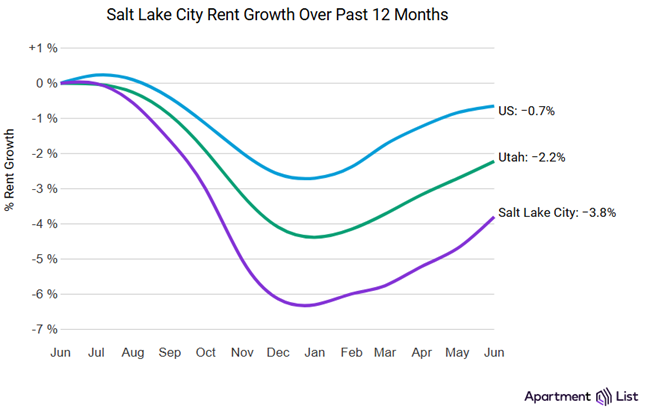
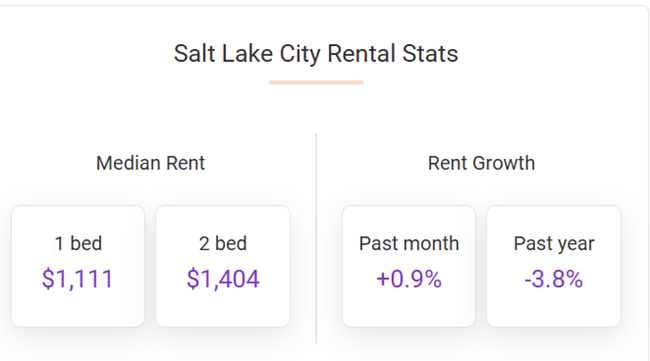
Salt Lake City Rents were up 0.9% in June, according to the July report from Apartment List while down 3.8% year-over-year.

Salt Lake City Rents were up 0.9% in June, according to the July report from Apartment List.

The overall median rent in the city stands at $1,284. Prices remain down 3.8% year-over-year.

Salt Lake City rent growth in 2025 pacing above last year

Six months into the year, rents in Salt Lake City have risen 2.7%.

This is a faster rate of growth compared to what the city was experiencing at this point last year. From January to June 2024 rents had increased 1.4%.

Salt Lake City Rents were up 0.9% in June, according to the July report from Apartment List while down 3.8% year-over-year.

Salt Lake City rents are 12.9% lower than the metro-wide median

Across the metro area, the median rent is $1,474 meaning that the median price in the city proper ($1,284) is 12.9% lower than the price across the metro as a whole. Metro-wide annual rent growth stands at -2.6%, above the rate of rent growth within just the city.

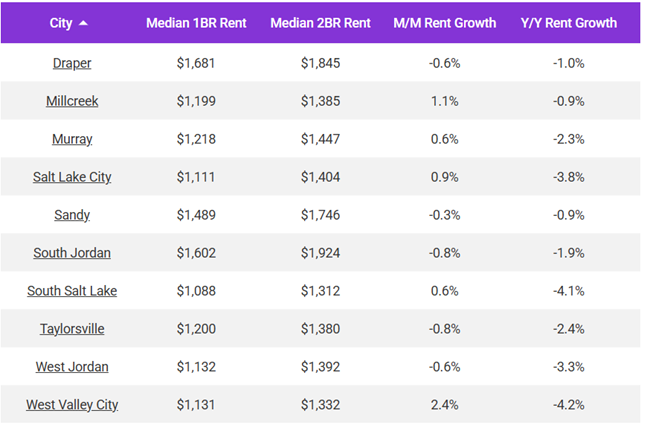
The table below shows the latest rent stats for 10 cities in the Salt Lake City metro area that are included in the Apartment List database. Among them, Draper is currently the most expensive, with a median rent of $1,901. South Salt Lake is the metro’s most affordable city, with a median rent of $1,246. The metro’s fastest annual rent growth is occurring in Millcreek (-0.9%) while the slowest is in West Valley City (-4.2%).

Salt Lake City Rents were up 0.9% in June, according to the July report from Apartment List while down 3.8% year-over-year.

Read the full report here.

Sign Up For Our Weekly Newsletter And Get Rental Property And Apartment News And Helpful, Useful Content Each Week.

* indicates required

Will Robust Supply Be Met With Renter Demand For The Rest Of 2025?

Strong multifamily performance for the second half of 2025 depends on whether robust apartment supply will be met by renter demand,

Whether strong multifamily performance continues for the second half of 2025 depends on a number of competing factors, including whether robust apartment supply will be met by renter demand, says Yardi Matrix in a summer report.

“Questions going forward include whether robust supply will continue to be matched by strong renter demand, how quickly the delivery pipeline will slow in the face of waning starts, and whether interest-rate uncertainty will continue to keep deal flow weak in the face of strong investor demand,” the report says.

Tariffs and negotiation remain a question. However, “metrics such as job growth, inflation and consumer spending have remained steady. Interest rates have stabilized, albeit not falling as the commercial real estate industry hoped going into the year. However, there are signs that the strong growth of recent years is slowing, and uncertainty is creating heightened downside risks going forward.”

Highlights of the report

  • Multifamily performance remained strong in the first half of 2025, with demand nearly keeping pace with the heavy supply pipeline. Deliveries are waning as starts decline, feeding optimism about a new wave of rent growth on the other side of the supply peak.
  • The U.S. economy has held up under the weight of sharp changes in policy, but there are risks from the impact of higher tariffs, volatility in the financial markets and general uncertainty about policy. Interest rates, critical to the multifamily industry, are unlikely to drop given the tug-of-war between weaker economic growth and potentially higher inflation.
  • Multifamily-advertised rent growth remains restrained, about 1% nationally, with gains in most Northeast and Midwest metros and negative growth in many high-supply Sun Belt markets. The supply-demand dynamic is likely to keep growth moderate in the second half.
  • Following a record-setting year for multifamily deliveries in 2024, new supply is slowing, with starts dropping by nearly half. Over 500,000 units are still expected to come online in 2025, but the full impact of declining starts will become more apparent in 2026.
  • Despite investors sitting on plenty of dry powder, transactions continue to dribble at last year’s pace, as many sellers think they can get a better deal waiting for interest rates to drop. The 10-year Treasury remains in the mid-4% range, as the Federal Reserve has a wait-and-see posture toward inflation due to uncertainty over the administration’s tariffs and economic policy.
  • Delinquency is rising, though not to crisis levels, and the plethora of rescue capital is serving to restructure loans that were extended in recent years.

“While a recession is currently not the base forecast, there are heightened risks of both a slowdown and increased volatility,” the report says.

Read the full Yardi report here.

Sign Up For Our Weekly Newsletter And Get Rental Property And Apartment News And Helpful, Useful Content Each Week.

* indicates required

Landlords Must Return Deposit If Tenant Finds Rental Uninhabitable

Oregon Gov. Tina Kotek has signed a bill that requires landlords to return deposits if tenants who haven’t yet signed a lease find the home to be defective.

Oregon Gov. Tina Kotek has signed a bill that requires landlords to return deposits if rental applicants who haven’t yet signed a lease find the home they’ve applied to is defective.

House Bill 3521 would let Oregon renters get their deposits back if the home they’ve applied to has mold, unsafe electrical wiring or other defects making it uninhabitable. The bill passed the Oregon House in a 33-18 vote and passed the Oregon Senate in a 20-8 vote, according to the Oregon Capital Chronicle.

Under the bill, landlords would have five days to return deposits or face a fee equivalent to the deposit they charged or more. Landlords would not face penalties if natural disasters or emergencies keep them from complying, and they could still choose to return deposits at their place of business rather than through mail.

Rep. Annessa Hartman, D-Gladstone, spearheaded the bill after hearing from renters across Oregon who lost hundreds, sometimes thousands, of dollars to hold deposits for homes they couldn’t move into because of mold, broken plumbing or pest infestations.

Renters in Oregon represent 51% of all low-income households, according to Oregon Housing and Community Services. And nearly 37% of all Oregonians rent their homes, according to the U.S. Census. That’s higher than the national average, and renters are in the majority in cities including Eugene, Corvallis, Monmouth, Beaverton and Seaside.

“Landlords can still enter into whole-deposit agreements, collect deposits, and keep them when applicants back out without a good reason,” said Senate sponsor Deb Patterson, D-Salem, on the floor. “That doesn’t change. What does change is that applicants will have the right to walk away if the unit is substantially uninhabitable.”

Read the full bill here.

Sign Up For Our Weekly Newsletter And Get Rental Property And Apartment News And Helpful, Useful Content Each Week.

* indicates required

Landlords Not Enforcing Renters’ Insurance Requirements

Many landlords require renter’s insurance, but other landlords are not enforcing renters insurance requirements or verifying it

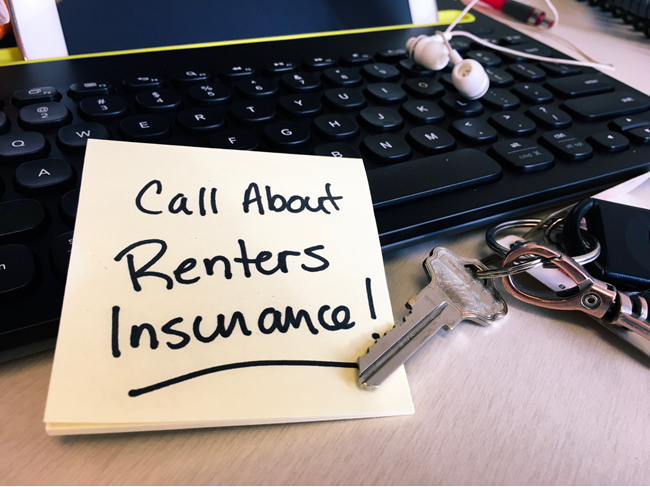
Many landlords require renter’s insurance, but others are still not requiring it or verifying it, according to a new study.

A new joint survey from property-management software company RentRedi and investors website BiggerPockets shows that while most landlords understand the difference between renters’ insurance and landlord insurance, many still don’t require it—and even fewer take steps to verify it.

That gap can leave both landlords and renters exposed to financial risk, especially as rental portfolios grow and things get more complex.

Many landlords require renter’s insurance, but other landlords are not enforcing renters insurance requirements or verifying it

“These results, together with a companion survey conducted by RentRedi alone, highlight that many real estate investors are still exploring the best ways to implement and manage renters’ insurance within their rental process,” the study says, according to a release.

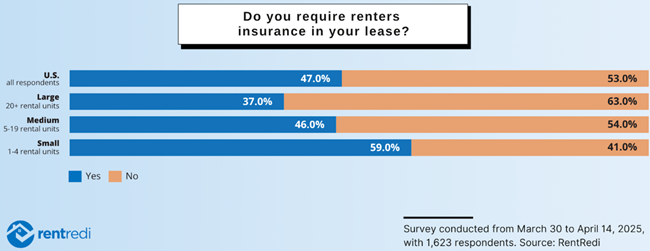
Smaller landlords are 60% more likely to require renters’ insurance than landlords with larger portfolios.

“It’s proof that with the right tools, it’s possible to stay protected without making things harder for you or your tenants,” according to the release.

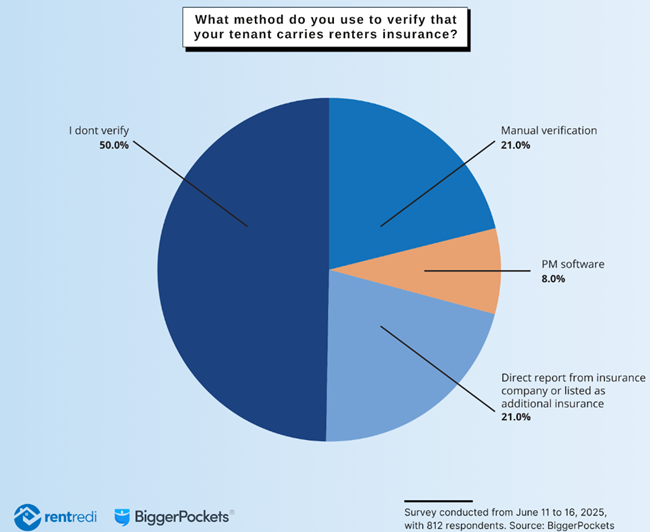
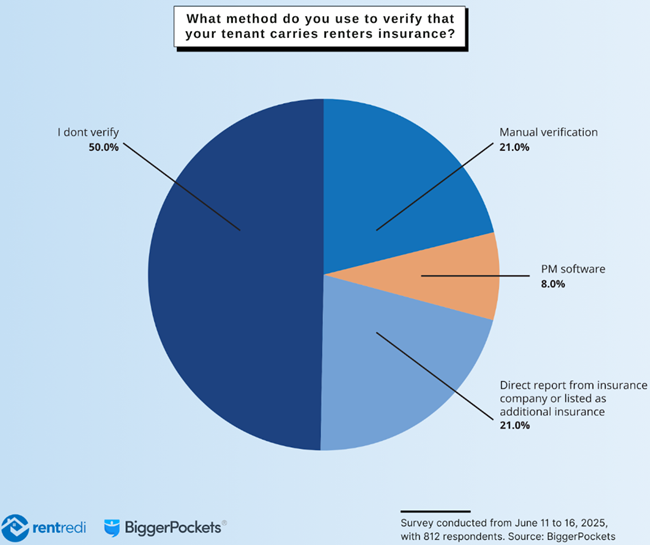
When asked how they verify renters’ insurance coverage, half of respondents reported that they currently do not verify.  The rest rely on a mix of manual checks, insurance-company confirmations, or property-management software, demonstrating that many landlords are still exploring the best ways to integrate renters’ insurance into their rental process.

Many landlords require renter’s insurance, but other landlords are not enforcing renters insurance requirements or verifying it

Key findings about landlords and renters’ insurance

  • Nearly 50% of landlords don’t verify renters’ insurance coverage
  • Fewer than half require renters’ insurance in their leases
  • About 4 in 10 follow up to confirm active coverage
  • Smaller landlords (1–4 units) lead in requiring and enforcing coverage
  • Larger operators trail by double-digit margins but can optimize with automated solutions

Many landlords require renter’s insurance, but other landlords are not enforcing renters insurance requirements or verifying it

Methodology:

The joint survey with BiggerPockets, conducted from June 11–16, 2025, gathered responses from 812 real estate investors and property owners. Separately, RentRedi survey conducted its own survey from March 30 to April 14, 2025 that analyzed landlord behavior across portfolio sizes and received 1,623 responses..

Sign Up For Our Weekly Newsletter And Get Rental Property And Apartment News And Helpful, Useful Content Each Week.

* indicates required

Court Says Landlords Due Compensation For Covid Eviction Ban

A federal court has ruled that landlords have a right to pursue compensation claims for losses suffered during the covid eviction moratorium

A federal court has ruled that landlords are due compensation and have a right to pursue compensation claims for losses suffered during the U.S. Centers for Disease Control and Prevention eviction ban moratorium during the COVID-19 pandemic.

U.S. Court of Appeals for the Federal Circuit denied the federal government’s petition for a rehearing in Darby v. United States, a case claiming the CDC’s eviction moratorium was unconstitutional under the Fifth Amendment.

Landlords Due Compensation

“The decision marks a significant victory for property owners. By upholding the Darby ruling, the court maintains the legal framework that protects housing providers against uncompensated government takings,” according to a release from the National Association of Realtors. “The Federal Circuit’s decision underscores the rights of property owners to pursue compensation claims arising from the CDC eviction moratorium.”

“While the Federal Circuit’s decision is a meaningful win for property owners, the legal battle may not be over. The denial of the government’s rehearing request was not unanimous, and the government may still petition the U.S. Supreme Court to review the case,” the release says.

Covid Eviction Ban Financial Strain

While intended to curb the spread of the virus, the order placed significant financial strain on many mom-and-pop housing providers, who were left without income.

The case was brought by the Georgia and Alabama associations of REALTORS® and other property providers, with legal advocacy support from the National Association of REALTORS®. In July 2021, the Darby plaintiffs sued the U.S. government, claiming the CDC’s eviction moratorium was an unconstitutional taking of property without compensation.

Although the Supreme Court later ruled the CDC had exceeded its authority, the government argued claims couldn’t arise from unauthorized actions. The Federal Circuit disagreed, holding that the moratorium could still be considered authorized for takings analysis, allowing housing providers to pursue compensation.

Read the full release from the National Association of Realtors here.

Sign Up For Our Weekly Newsletter And Get Rental Property And Apartment News And Helpful, Useful Content Each Week.

* indicates required

Photo credit Inna Kot via istockimages.com

Report: U.S. Rent Payments Climb 31% in 5 Years

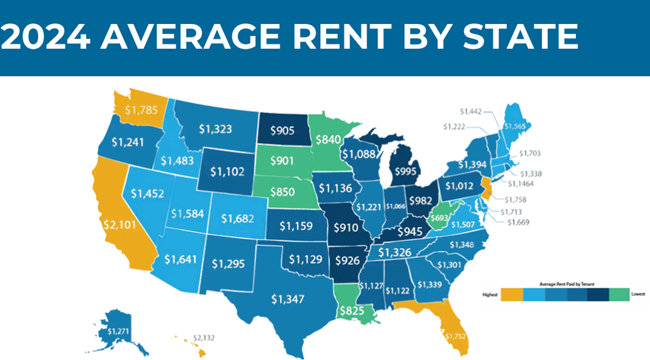
Rent payments climbed as the national average rent paid in 2024 was $1,302, marking a 31% increase over the past five years.

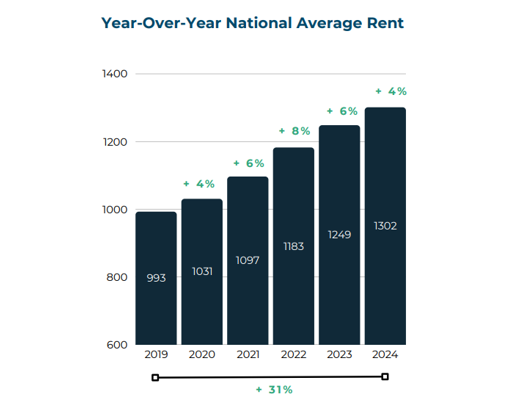
Rent payments have climbed as the national average rent paid in 2024 was $1,302, marking a 31% increase over the past five years, according to a report from Rentec Direct.

Using aggregated actual rent payments from more than 374,000 lease agreements, this report sheds light on affordability challenges and regional fluctuations shaping the housing market in 2025.

Unlike reports that rely on advertised rents, this analysis is based on actual rent paid, offering a more accurate reflection of affordability across markets—especially in rent-controlled areas, the company says in its The State of Rent: Housing Affordability Trends Across the U.S., offering a timely and data-driven look at rent trends from 2019 to 2024.

Key insights from Rentec Direct’s State of Rent Report: 

  • Nationwide rent surge: Average monthly rent reached $1,302 in 2024—up 31% over five years despite a slowing year-over-year growth rate. The steepest spike came between 2021 and 2022 as pandemic-era rent breaks ended.
  • Affordability gaps: Pacific states (Hawaii, California, Washington) top the charts as the most expensive rental markets, while Southern and Midwestern states (West Virginia, Louisiana, Minnesota) offer the most affordable options.
  • Regional extremes: Arizona, Tennessee and New Mexico saw rent hikes exceeding 65%. Minnesota stands out as the only state to see a significant rent decline—a 34% drop, likely tied to land use reform.
  • Supply and demand: States with rapid population growth, limited housing supply and no rent control laws are seeing the largest rent increases.
  • 2025 outlook: The report includes a 2025 market forecast with exclusive intel for renters, landlords and housing advocates navigating shifting trends.

Rent payments climbed as the national average rent paid in 2024 was $1,302, marking a 31% increase over the past five years.

Rent payments climbed

“A 31 percent national rent increase over just five years is a clear indicator that housing affordability remains a pressing concern for millions of renters,” Nathan Miller, President of Rentec Direct, said in a release.

“As we look ahead to the second half of 2025, landlords should focus on long-term strategies for retention and stability. Renters may benefit from exploring more affordable suburban or rural markets or by proactively negotiating lease terms. We encourage our legislators to prioritize smart housing policies that balance supply and demand for both landlords and tenants. Our goal with this report is to give the rental industry the insights it needs to make more informed decisions in an increasingly complex market.”

The report analyzed real rent payment data from Rentec’s network of landlords and property managers from over 300,000 rental properties and over 350,000 tenants in all 50 states to show how rent payments climbed.

To access the State of Rent Report, visit: https://www.rentecdirect.com/learn/research/rent-report-2025.

Sign Up For Our Weekly Newsletter And Get Rental Property And Apartment News And Helpful, Useful Content Each Week.

* indicates required

Rental Parking Can Be a Pain-Some Operators Are Shifting Gears

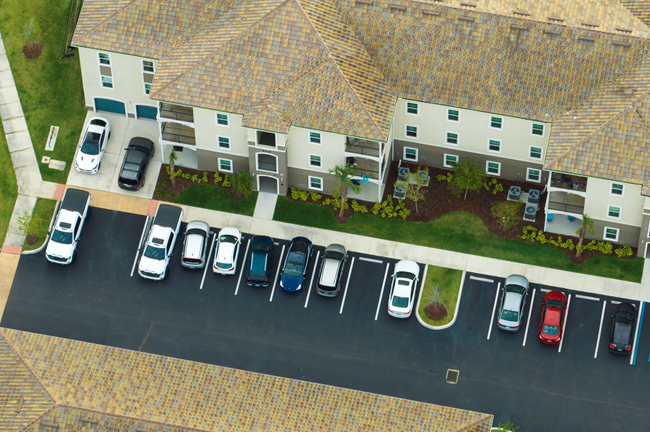
Rental parking is an often overlooked amenity that can play a crucial role in shaping leasing and renewal decisions for renters.

Rental parking is an often overlooked amenity that can play a crucial role in shaping leasing and renewal decisions for renters.

By Todd Katler

Convenience and comfort are paramount to today’s renters, and the often-overlooked element of parking management can make or break resident satisfaction.

While flashy amenities like coworking lounges and smart home integrations capture the spotlight, the reality is that basic infrastructure, such as parking, plays a crucial role in shaping leasing and renewal decisions.

Insufficient spaces and unauthorized parking in multifamily communities can lead to rising tensions among residents and with onsite teams. This can ripple throughout the community, affecting individual satisfaction and the overall atmosphere. There are solutions to help avoid the pitfalls of mismanaged parking.

The Consequences of Common Parking Frustrations

When parking issues persist, they contribute to a negative resident experience, ultimately influencing lease-renewal decisions.

Around 20% of residents report being unsatisfied with their community’s parking overall, according to data from Grace Hill’s Kingsley Surveys, and parking ranks among the most frequently mentioned amenities in both positive and negative reviews, underscoring its significant influence on resident perception.

Surveys asking about community improvements show 6% of all resident comments are related to parking, according to Jen Tindle, vice president of strategic insights at Grace Hill.

That number jumps to 9% in pre-renewal surveys, and climbs again to 10% in move-out feedback, signaling its increasing weight in retention decisions. For comparison, only 5% of prospective residents mentioned parking when evaluating a property, suggesting frustrations grow after move-in, when expectations collide with daily experience.

As communities grow, the demand for parking spaces can quickly outstrip supply, leaving residents feeling neglected and frustrated.

Nobody wants to come home from a long day (probably dealing with heavy traffic) and spend additional time circling the lot looking for a space. If they have a designated space, the sight of a vehicle parked in their space can be infuriating. Now the resident is faced with making a trip to the office to ask the already busy onsite team to summon a tow truck, allowing them to reclaim their rightful space.

These frustrations highlight a significant operational risk for property-management teams. When residents feel unsupported in their parking needs, it creates pressure on management teams to respond effectively and promptly. These frustrations can lead residents to seek a new home, ultimately damaging the community’s reputation. It also increases time constraints on teams, when they could be using the time to build a strong community rather than being focused on trying to keep it together.

To ensure that residents are focused on the enjoyment of their community, it is essential to integrate solutions that empower them and alleviate the burdens on their onsite professionals.

Sensible Rental Parking Solutions: Automated Parking Management

By leveraging automated rental parking solutions, communities can transform their parking strategies and alleviate resident frustrations in several ways.

An automated solution allows residents to reserve spaces for themselves or a guest for up to a full week in many cases. Residents may also have the opportunity to rent a carport space or garage on a long-term basis through their parking app, further alleviating their challenges.

Unauthorized parking is easily addressed by empowering residents to contact a tow truck in less time than making a trip to the office and have their space available to them again. Any worries about dumping off responsibility to residents can be cast aside because the reality is that they prefer to have this control, especially if it adds value.

Automated parking solutions not only enhance the resident experience but also streamline operations for management teams. Leasing professionals are focused on building relationships instead of putting out fires, significantly boosting resident satisfaction and retention. Improving net operating income goes beyond reducing expenses or increasing rent. It’s also about increasing efficiency and reducing avoidable expenses, such as turnover costs.

Gates, sensors and plate readers tend to be more costly and require a significant upfront investment.

On the flip side, the initial cost to set up automated parking is relatively low, making it an optimal choice. Some companies offer free integration of automated parking systems and the use of apps and signs with QR codes makes them more user-friendly, encouraging adoption among residents. Additionally, most suppliers provide customized pricing, enabling communities to set rates that work best for their property and region. A revenue-sharing program means that owners and operators may not only avoid costs for their parking system, but it can also become an additional stream of revenue.

While it may seem mundane, addressing parking frustrations through innovative solutions can lead to happier residents and a more harmonious community. By investing in these highly essential yet often overlooked amenities, multifamily communities can set themselves apart and ensure long-term resident loyalty.

About the author:

Rental parking is an often overlooked amenity that can play a crucial role in shaping leasing and renewal decisions for renters.

Todd Katler is the CEO of Zark Parking Solutions, and is an innovator, founder and investor  in the multifamily industry.

Sign Up For Our Weekly Newsletter And Get Rental Property And Apartment News And Helpful, Useful Content Each Week.

* indicates required

The 10 Worst States To Be A Landlord

In the 10 worst states to be a landlord, it can be tough between taxes, tenants who don’t live up to their lease agreements and more

In the 10 worst states to be a landlord, it can be tough between taxes, tenants who don’t live up to their lease agreements, maintenance woes, and the cost of maintaining a property.

But there are some states where—due to anti-landlord legislation, property tax rates, rent-control laws or congested court systems—there is added pressure on landlords, property owners and property managers. TurboTenant, a property-management software company, compiled the 10 worst states in which to be a landlord based on those factors and more.

Based on these findings, here are 10 states where owning rental property is harder, riskier, and less profitable.

Criteria for Ranking States

  • Anti-landlord legislation: Some states have legislation that favors tenants while presenting hurdles for landlords. A prominent example is the no-fault eviction ban, which prevents landlords from ending leases without cause.
  • Rent-control laws: What landlord wants the state to tell them how much they can charge for rent? Rent-control laws restrict when and how much landlords can increase rent, which limits their ability to adjust to market conditions or rising costs.
  • Eviction timeline and court backlog: States with slow, congested court systems or lengthy eviction-notice requirements can leave landlords stuck with nonpaying tenants for months.
  • Property tax rate: Yearly tax bills that ravage your revenue make it tough to turn a profit.
  • Rental yield: When rent barely covers the mortgage, taxes, and upkeep, landlords are stuck treading water until it’s time to sell. Low rental yields make it tough to turn a profit, let alone save, reinvest, or expand your portfolio.

With those criteria in mind, here are TurboTenant’s:

10 worst states to be a landlord:

No. 10: Connecticut

The state has a 1.92% property tax rate (the third highest in the nation) and evictions that often drag on for months. Also, landlords can’t end a month-to-month lease without just cause. And while no statewide rent-control law exists, several cities still cap rent hikes they consider excessive.

No. 9: Massachusetts

In Massachusetts, landlords can’t charge a late fee until rent is more than 30 days overdue. Adding in the high cost of living and proposed rent caps in Boston complicates matters. And eviction proceedings in Massachusetts can be a nightmare.

No. 8: Minnesota

A Minnesota landlord must issue a 14-day notice (or a 30-day notice in Minneapolis) before initiating the eviction process. Also, late fees are capped at 8%.  While there’s no statewide rent control, St. Paul limits rent increases to 3% a year, and Minneapolis has considered similar restrictions in recent years.

No. 7: Maryland

Maryland’s two most populous counties, Montgomery and Prince George’s, cap rent increases at 3% plus inflation, or 6%, whichever is lower. Maryland lawmakers also are pushing for “good cause” eviction rules that make it harder to terminate leases without a qualifying reason. If passed, the law could force landlords to renew leases with problem tenants.

No. 6: Illinois

Illinois landlords can’t turn down applicants based on how they pay rent, whether through housing vouchers, Social Security, or child support, even if they’ve had trouble collecting those payments in the past. Illinois could move higher up this list if proposed rent-control measures become law. A significant backlog of eviction cases at the court level means that 2-year evictions are a very real possibility, plus this is a high property-tax state.

No. 5: Washington

Rent control, called rent stabilization, limits rent increases for existing tenants in Washington state to 7% plus inflation or 10%, whichever is lower. Landlords can still adjust rent by higher amounts for new tenants. It also limits rent increases for manufactured homes to 5%. Washington has laws that make it hard to remove tenants who stop paying but refuse to leave. Just-cause eviction rules make it hard to move on from tenants, and strict notice requirements add layers of complexity to the eviction process.

No. 4: Oregon

Oregon’s rent-control restriction is 7% plus the annual 12-month change in the Consumer Price Index for all urban customers. During any tenancy, other than week-to-week, the landlord may not increase the rent more than once during any 12-month period. Oregon was the first state in the nation to pass state-wide rent control.

No. 3: New Jersey

Although New Jersey has no statewide rent control, more than 100 local jurisdictions enforce their own ordinances, creating a complex spiderweb of legislation that can baffle even longtime Jersey landlords.  In addition, New Jersey imposes the highest property tax rate in the country (2.49%), strict just-cause eviction laws, and painfully slow court processes.

No. 2: New York

New York’s statewide regulations limit rent increases (even after significant improvements) and prevents landlords from resetting rent between tenants. New York’s 2024 “Good Cause Eviction” law requires landlords to have a legally valid reason to terminate a lease. Additionally, tenants can challenge rent hikes they dislike, leading to drawn-out legal battles and preventing rent from keeping pace with the market.

No. 1: California

California enforces strict rent control, capping increases at 5% plus inflation or 10%, whichever is lower. But what really puts California at the top of the “worst” list is taxes. Rental income can get hit with California’s income tax, up to 13.3%. California is also one of the toughest places to deal with squatters.

Read more here at the TurboTenant blog.

Sign Up For Our Weekly Newsletter And Get Rental Property And Apartment News And Helpful, Useful Content Each Week.

* indicates required

What Are a Trustee’s Duties for Oregon Rental Property?

 There are different trustee duties in Oregon so it is a good idea to ensure that he or she is aware of these obligations.

By John J. Stromberg
Warren Allen LLP

 There are different responsibilities a trustee is required to uphold. If you have a trustee, it is a good idea to ensure that he or she is aware of these obligations.

  • Duty to Administer the Trust:

The trustee must take actions that are in the best interest of the trust beneficiaries. If it becomes necessary to modify the trust due to the acquisition of new property, a trustee can still do so without jeopardizing their duty to adequately administer the original trust.

  • Duty of Loyalty

 A trustee involved in self-dealing or similar transactions that place the trustee’s own interests above those of the trust beneficiaries are prohibited. If your trustee is using income generated from your rental property for their own benefit, the trustee has breached their duty of loyalty.

  • Duty of Impartiality

When multiple beneficiaries have an interest in the trust, the trustee must act impartially in managing the trust assets. If trust beneficiaries have an equal or unequal interest in rental income, the trustee’s duty of impartiality requires the trustee to proportionally distribute that income.

  • Duty to Control and Protect Trust Property

Securely transferring control of rental property can be paramount in maintaining that property’s value and condition. The trustee must confirm the property is adequately insured against loss while in the trustee’s control, and must pay any taxes or liens imposed on trust assets to avoid foreclosure.

  • Duty to Keep Records

Trustees must maintain adequate records that document all receipts and disbursements for the trust. The trustee should document receipts as either income or principal, and disbursements as expenses, capital expenditures, or distributions.

Final Words

This article only addresses a handful of the many duties required of a trustee in Oregon; please feel free to contact John Stromberg by email (stromberg@warrenallen.com) or phone (503-255-8795).

About the author:

There are different trustee duties in Oregon so it is a good idea to ensure that he or she is aware of these obligations.
John J. Stromberg

John Stromberg assists clients in domestic relations, estate planning, and civil matters. He received his Doctor of Jurisprudence from Willamette University College of Law and attended the University of Oregon for his Bachelor of Arts degree. He is a current member of the Multnomah Bar Association Service to the Public Committee and has appeared at events informing the local community of available domestic relations resources.

Sign Up For Our Weekly Newsletter And Get Rental Property And Apartment News And Helpful, Useful Content Each Week.

* indicates required