Home Blog Page 17

Seattle Rents Up 1.3% In June

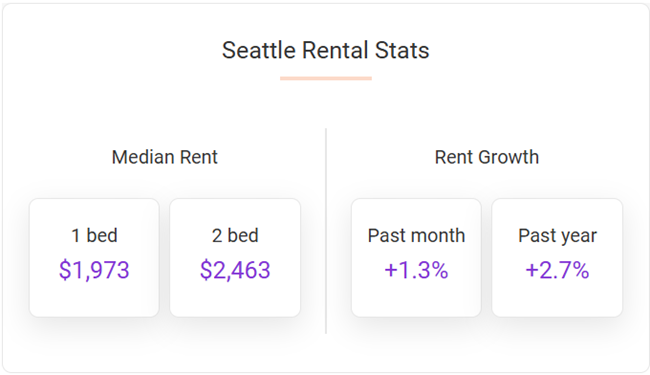
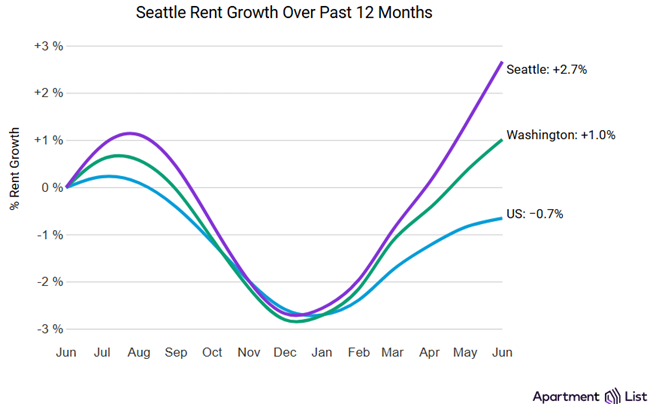
Seattle rents were up 1.3% in June, according to the July report from Apartment List, and up 2.7% year-over-year.

Seattle rents were up 1.3% in June, according to the July report from Apartment List, and up 2.7% year-over-year.

Currently, the overall median rent in the city stands at $2,115.

Seattle rent growth in 2025 pacing above last year

Six months into the year, rents in Seattle have risen 5.4%.

This is a faster rate of growth compared to what the city was experiencing at this point last year: from January to June 2024 rents had increased 4.6%.

Citywide, the median rent currently stands at $1,973 for a 1-bedroom apartment and $2,463 for a 2-bedroom. Across all bedroom sizes for the entire rental market the median rent is $2,115. That ranks #15 in the nation, among the country’s 100 largest cities.

Seattle rents were up 1.3% in June, according to the July report from Apartment List, and up 2.7% year-over-year.

Seattle rents are 4.3% higher than the metro-wide median

Across the wider Seattle metro area, the median rent is $2,027 meaning that the median price in Seattle proper ($2,115) is 4.3% greater than the price across the metro as a whole. Metro-wide annual rent growth stands at 1.0%, below the rate of rent growth within just the city.

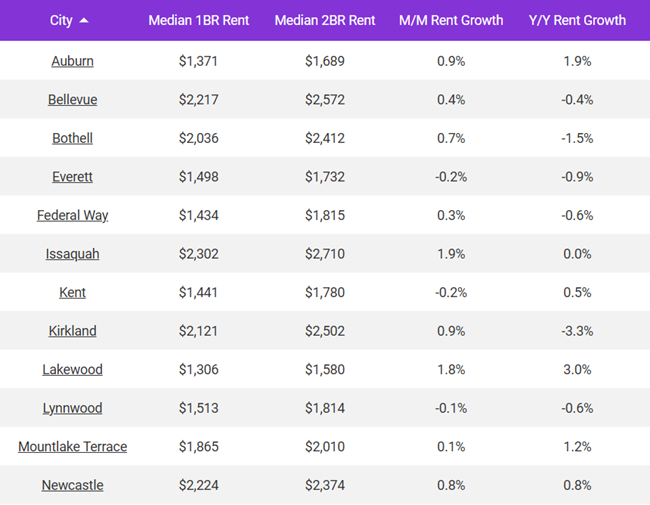
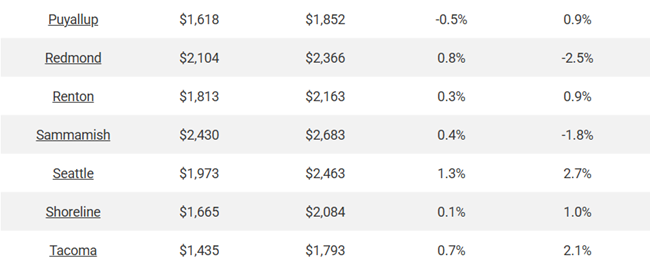
The table below shows the latest rent stats for 19 cities in the Seattle metro area that are included in the Apartment List database.

Among them, Sammamish is currently the most expensive, with a median rent of $3,023. Lakewood is the metro’s most affordable city, with a median rent of $1,487. The metro’s fastest annual rent growth is occurring in Lakewood (3.0%) while the slowest is in Kirkland (-3.3%).

Seattle rents were up 1.3% in June, according to the July report from Apartment List, and up 2.7% year-over-year.

Sign Up For Our Weekly Newsletter And Get Rental Property And Apartment News And Helpful, Useful Content Each Week.

* indicates required

State-City To Build More Multifamily Housing In Portland

The governor of Oregon and the mayor of Portland say they will take action to build more multifamily housing construction in Portland

The governor of Oregon and the mayor of Portland say they will take action to build more multifamily housing construction in Portland, according to a release.

Oregon Gov. Tina Kotek and the Portland Mayor Keith Wilson said the multifamily housing commitments were informed by recommendations made by the Multifamily Housing Development Workgroup, convened by the governor and mayor this spring. They were joined by Portland City Councilor Dan Ryan, Smart Growth Board President Sarah Zahn, Tom Kilbane, managing director at Urban Renaissance Group, and Andrew Colas, CEO at Colas Construction, Inc.

Portland has the worst housing crisis outlook among the largest metro areas in the United States, according to a LendingTree study released Tuesday.

The study analyzed housing markets in 100 of the largest metro areas in the U.S., analyzing vacancy rates, housing unit approvals and home value-to-income ratios.

“In doing so, we found that three of the five metros with the worst outlook are in the Pacific Northwest,” and according to LendingTree, Portland ranks the worst mostly because of a lack of housing and unaffordability.

“I believe in a vision for Oregon and for Portland where everyone can afford a home, where people can live in the places they want and still make ends meet at the end of the month,”  Kotek said in the release.

“Rolling up our sleeves together like this is how we are going to make that happen. Thank you to Mayor Wilson for convening this work group with me and to the developers who shared their experiences to guide these actions.”

“Portland is open for business — for housing, for opportunity, and for a thriving future,” Wilson said in the release. “By expanding self-certification and investing in office-to-housing conversions, we are cutting red tape and accelerating the creation of much-needed homes for Portlanders.”

Build More Multifamily Housing And More Permits Faster

State staff support is being provided to help Portland issue housing construction permits more efficiently and helping builders break ground more quickly, thereby bringing down the cost of construction and eventual cost to Oregonians.

Wilson announced a commitment to reboot the self-certification program and launch a third-party plan review as part of its permit-improvement work.

Self-certification refers to a process wherein a licensed design professional can certify that their submitted plans meet all applicable building codes and regulations, thereby bypassing full building-code plan review for certain types of projects. Together, these two programs will reduce permitting times and spur housing production, Wilson said.

Build More Multifamily Housing For Office-to-Housing Conversion

Kotek directed Business Oregon to designate office-to-housing conversion projects in Portland as essential to the economic well-being of the state, allowing the state Building Codes Division (BCD) to partner with Portland and developers to put together a rapid-approval assessment team to oversee the effort and share the review and inspection responsibilities. The state leaning into these projects will incentivize more projects, help Portland coordinate services, and make projects more predictable, according to the release.

Wilson announced a $15 million notice of funding opportunity to be released later this year for a middle-income office-to-residential housing development in the central city. These office-to-residential conversion projects help revitalize Portland’s urban core and promote the reuse of existing buildings.

Economic Development

Working with local and regional partners, the governor’s office will create a six-month economic development strategy.

The strategy builds on existing economic development plans such as  Prosper Portland’s Advance Portland, and identifies short-, medium-, and long-term tactics to keep existing businesses in Portland and recruit more businesses to set up shop.

Builder’s Remedy: Allowing More Multifamily Affordable Housing

Kotek committed to exploring how a policy called the Builder’s Remedy, modeled after legislation in California, could work to build more multifamily housing in Oregon. The California Legislature passed the Builder’s Remedy, which limits denials of projects with affordable housing when local jurisdictions are out of compliance with state production laws.

The plan announced is to “kick-start the building of 5,000 multifamily housing units over the next three years by waiving system development charges during that time,” according to the release. They also jointly committed to continue reviewing the work group’s recommendations, to meet with investors in partnership with the City of Portland and multifamily housing developers.

Read the full release here.

Sign Up For Our Weekly Newsletter And Get Rental Property And Apartment News And Helpful, Useful Content Each Week.

* indicates required

Demand, Supply and Uncertainty Weaken June Rent Growth

Multifamily rents saw tepid growth in June, with strong demand counterbalanced by high deliveries in the Sun Belt and ongoing uncertainty

Multifamily rents maintained a tepid growth rate in June, with strong demand counterbalanced by high deliveries in the Sun Belt and ongoing uncertainty about the economy, according to Yardi Matrix in its June report.

Multifamily performance remained solid through mid-year 2025, with rents rising by $20, or 1.2%, over the first two quarters.

Highlights of the report:

  • Multifamily rents rose in June, but growth remains tepid as the market balances between robust demand and supply while economic uncertainty is high. The average U.S. advertised rent increased by $3 to $1,749 during the month, while year-over-year growth was 0.9%.
  • Advertised rents rose 0.7% during the second quarter and 1.2% during the first half of 2025, both well shy of pre-pandemic growth rates. In the seven years between 2013 and 2019, advertised rents grew on average by 1.8% during the second quarter and 2.4% during the first half of the year.
  • National single-family build-to-rent advertised rates rose by $4 to $2,201 in June, representing a 0.7% annual increase and 0.8% growth in the first half of the year. As with multifamily, rent growth is positive but subdued compared to recent years.

Yardi Matrix says more than 250,000 apartment units were absorbed through May, per Matrix, putting the market on track for another year of robust demand. Austin led with 22,000 units absorbed, followed by Sun Belt markets including Charlotte, Nashville, Raleigh-Durham and Orlando.

While there is some positive news, there are also areas of concern

“The economy and job market remain strong, but growth has slowed, and the impact of tariff and immigration policies in the second half remains uncertain.

“Unemployment is low, but job switching has declined, reducing labor-market dynamism. Policy uncertainty continues to challenge business planning, with the new tariff implementation date pushed again to August,” the report says.

Read the full Yardi Matrix report here.

About Yardi Matrix

Yardi Matrix researches and reports on multifamily, office and self-storage properties across the United States, serving the needs of a variety of industry professionals. Yardi Matrix Multifamily provides accurate data on 18+ million units, covering more than 90 percent of the U.S. population. Contact the company at (480) 663-1149.

Sign Up For Our Weekly Newsletter And Get Rental Property And Apartment News And Helpful, Useful Content Each Week.

* indicates required

Immigration Authorities Demand Landlords Turn Over Tenant Info

Immigration authorities issued subpoenas demanding landlords turn over leases, rental applications, plus other information on tenants

Immigration authorities have issued subpoenas demanding that landlords turn over leases, rental applications, forwarding addresses, identification cards and other information on their tenants, according to the Associated Press.

Eric Teusink, an Atlanta-area real estate attorney, told the Associated Press that several of his clients recently received subpoenas asking for entire files on tenants. A rental application can include work history, marital status and family relationships.

The two-page “information enforcement subpoena,” which Teusink shared exclusively with The Associated Press, also asks for information on other people who live with a tenant. One of these documents, dated May 1, is signed by an officer with the U.S. Citizenship and Immigration Services anti-fraud unit. However, it is not signed by a judge.

Teusink told the AP many of his clients oversee multifamily properties and are used to getting subpoenas for other reasons, such as requests to hand over surveillance footage or give local police access to a property as part of an investigation. But those requests are each signed by a judge, he said.

Teusink said his clients were confused by the latest subpoenas. After consulting with immigration attorneys, he concluded that compliance is optional. Unless signed by a judge, the letters are essentially just an officer making a request.

“It seemed like they were on a fishing expedition,” Teusink said, according to wabe.org.

ICE officers have long used subpoenas signed by an agency supervisor to try to enter homes. Advocacy groups have mounted a “Know Your Rights” campaign urging people to refuse entry if the documents are not signed by a judge.

Landlords: Know the difference between administrative and court ordered subpoenas

Denise Holliday, an Arizona attorney, noted that ICE commonly issues administrative subpoenas that can feel a bit intimidating but she encourages all business owners to learn the difference between a court ordered subpoena and an administrative subpoena and create a policy under which you will response to ICE subpoenas and related communications.

“It is legal to safely ignore administrative subpoena absent a court order but you may prefer to provide a written response that explains your grounds for objecting to what is requested in the subpoena. ICE may seek a court order for your company to comply with their request to produce information and if you fail to comply with that court order there may be serious legal consequences,” Holliday said.

The subpoena reviewed by the AP is from USCIS’ fraud detection and national security directorate, which, like ICE, is part of The Department of Homeland Security. Although it isn’t signed by a judge, it threatens that a judge may hold a landlord in contempt of court for failure to comply.

Tricia McLaughlin, a Homeland Security spokeswoman, defended the use of subpoenas against landlords without confirming whether they are being issued.

“We are not going to comment on law enforcement’s tactics surrounding ongoing investigations,” McLaughlin said. “However, it is false to say that subpoenas from ICE can simply be ignored. ICE is authorized to obtain records or testimony through specific administrative subpoena authorities. Failure to comply with an ICE-issued administrative subpoena may result in serious legal penalties. The media needs to stop spreading these lies.”

ICE Subpoenas New to Many Landlords

Boston real estate attorney Jordana Roubicek Greenman said a landlord client of hers received a vague voicemail from an ICE official last month requesting information about a tenant. Other local attorneys told her that their clients had received similar messages. She told her client not to call back.

Anthony Luna, the CEO of Coastline Equity, a commercial and multifamily property management company that oversees about 1,000 units in the Los Angeles area, said property managers started contacting him a few weeks ago about concerns from tenants who heard rumors about the ICE subpoenas. Most do not plan to comply if they receive them.

“If they’re going after criminals, why aren’t they going through court documents?” Luna said. “Why do they need housing-provider files?”

Lindsay Nash, a law professor at Yeshiva University’s Cardozo School of Law in New York, said ICE can enforce the subpoenas, but it would first have to file a lawsuit in federal court and get a judge to sign off on its enforcement — a step that would allow the subpoena’s recipient to push back, Nash said. She said recipients often comply without telling the person whose records are being divulged.

“Many people see these subpoenas, think that they look official, think that some of the language in them sounds threatening, and therefore respond, even when, from what I can tell, it looks like some of these subpoenas have been overbroad,” she said.

Sign Up For Our Weekly Newsletter And Get Rental Property And Apartment News And Helpful, Useful Content Each Week.

* indicates required

5 Ways Property Managers Can Maintain Margins

As the rental market begins to normalize and return to pre-pandemic levels, here are 5 ways property managers can maintain margins.

As the rental market begins to normalize and return to pre-pandemic levels, here is how property managers can maintain margins.

By Vanessa Anderson
C0O, at ShowMojo, part of PropertyTek

After years of markets that were unusually favorable to landlords and property managers, we’re shifting into more of a tenants’ market: Time on market is trending up, leads per rental are down, and concessions are increasing.

But we’re not seeing a truly “soft” market by historical standards. Think of this as more of a return to pre-pandemic norms. For property managers, the name of the game is adapting business practices to maintain margins.

This piece will highlight five ways to do that, based on the specific changes we’re seeing in our user data.

1. Set Your Asking Price Right the First Time

First, the good news: Average rents continue to climb. As of April, median rents nationwide were as high as they’ve ever been (right around $1,650). Lower-priced units (between $500 and $999) are decreasing as a share of total available units, and units above $1,500 are leasing faster than lower-priced units did in previous quarters.

The most likely reason: constrained supply. Housing supply still hasn’t recovered from the 2008 downturn, and the limited number of units on the market is helping keep prices elevated.

Still, this doesn’t mean you can increase unit prices willy-nilly.

In fact, setting an asking price that’s too high will cost you 30 or more days on the market. In our data, we found that units with no price reductions stayed on the market around 31 days, while those with at least one price reduction took closer to 68 days to rent.

Pricing is as much an art as a science. If you’ve had to reduce rents to lease units lately, it may be time to review your strategy.

2. Include These 6 Elements in Listings

Another sign of the softening market: leads per listing are near historic lows. In 2022, we were seeing about 30; today, it’s closer to 22.

Boost efficiency by making your listings stand out from the noise. Our data shows an advantage (i.e., fewer days to rent) for listings that have the following:

  1. A descriptive title. No title costs one to two days.
  2. A property description (400+ words). Longer descriptions offer some advantage. If you struggle to get words out, use tools like ChatGPT. You can upload a few photos and ask it to generate a description.
  3. Listing details (two to 10). Include differentiators (stainless steel appliances, a pool, hardwood floors, etc.) rather than expectations.
  4. Clear policies for pets, security deposits, and the application process. Tenants can now afford to skip listings with unclear or confusing policies – and they do! We’re now seeing penalties for unclear or missing policies about pets (one day), security deposits (three to four days), and the application process itself.
  5. High-quality photos with watermarks. The number doesn’t affect time to lease, but high-quality photos are a must. Watermarks don’t affect the number of days on market, but “aggressively” watermarking your photos (so they can’t easily be copied) reduces fraud by 40 percent.
  6. Video or 3D tours. Only about eight percent of units offer this right now, which means we don’t have enough data to assess the impact on time on market. However, for higher-end units, video and 3D tours can clarify what you’re offering.

3. Let Prospects Self-Schedule Showings

The more you can do to maintain your prospects’ flow while they’re apartment hunting, the better your results will be. One option available to you is using tech that lets prospects self-schedule showings.

Instead of asking an interested prospect to click over to their email, compose a message asking for a showing, wait for a response from your team, and then schedule a showing when the property in question is no longer top of mind, let them click a few buttons on the listing itself to set up a showing.

This will mirror the experience prospects are having on other online channels (Google, social media, AI chatbots), where the trend is increasingly to stay on one platform rather than “surf” from site to site via links (search “zero-click marketing” if the concept is new to you.).

When you set up self-scheduling, always offer near-term availability:

  • 65 percent of showings booked less than a day out actually do happen.
  • Only 11 percent of showings booked more than two weeks out happen.

This is a simple way to weave automation into your leasing workflow that significantly eases the admin burden for your team. That’s a big win for efficiency.

4. Automate Everything You Can on the Admin Side

Not only are we seeing fewer leads per listing, listings are staying on the market longer (41 days on average, up from about 36 this time last year).

The easiest way to reduce unnecessary drag time: automate everything you can.

I mentioned self-scheduling, but today’s leasing automation software makes it possible to automate much more, including…

  • Showing reminder messages (via email and text) to reduce no-shows.
  • Post-tour summary messages with next steps.
  • Real-time lead response (via answering service, chatbot, etc.).

If you’re not yet using purpose-built software to automate workflows, now’s the time to consider it. The more you automate, the less administrative work your team has to do. This helps you keep headcount low without sacrificing the quality of your service. In some cases, automation will actually augment quality (as with allowing self-scheduling).

5. Embrace Self-Guided Tours

Deep breath. If you’re not yet doing self-guided tours, I know it can feel intimidating. But the data is clear: If you let prospects handle tours themselves, you’ll book 20 percent more showings.

The logistics are fairly straightforward. You need a smart lock or lockbox connected to software that lets you manage showings. When prospects self-show, they get a dedicated time slot and code that only works during that time.

As with anything, the decision of whether to allow self-showings is largely one of personal risk tolerance: Are you more comfortable with the risks associated with fewer leads or the risks associated with prospects being unattended in your units?

One way to mitigate some risk is to use self-showing in conjunction with pre-screening questions and only make it available to those who qualify.

I personally wouldn’t be comfortable offering self-showings for occupied units. But I love the prospect of having the option available to me because it makes me more adaptable to shifting market conditions.

And the potential upside is significant: One customer of ours that switched to self-showings increased their tour capacity from 40 per week to more than 100. They avoided growing headcount and now have their team focus on improving their “field position,” ensuring that units are secure, trash is removed, and operations run smoothly.

A More Efficient Business Serves You Better in Any Market

Today, we’re talking about how to adjust your business practices to suit the softening market. But adapting to make your business more efficient will serve you in any market.

And while market conditions will ebb and flow over the years, there’s an undeniable trend toward tenants expecting more digitization, more automation, and more real-time communication. Property managers who recognize that and adapt their businesses accordingly will be well-positioned to meet these tenants where they are in the years to come.

About the author:

Vanessa Anderson is the chief operating officer at ShowMojo, a leasing automation platform and part of PropertyTek. ShowMojo helps property managers reduce vacancy times, cut down on repetitive tasks, and deliver a smoother experience for both renters and leasing teams.

Sign Up For Our Weekly Newsletter And Get Rental Property And Apartment News And Helpful, Useful Content Each Week.

* indicates required

Phoenix Feels Growing Pains as Strong Supply Dominates

Strong supply continues to pressure Phoenix’s multifamily market, restraining rent growth and having an impact on occupancy

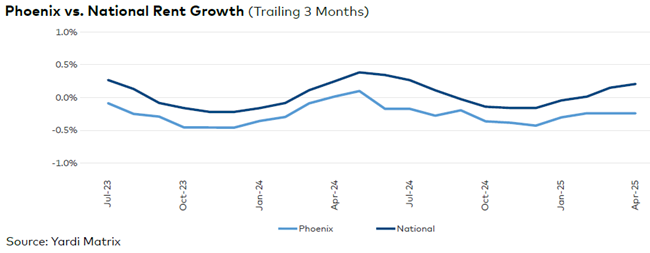
Strong supply continues to pressure Phoenix’s multifamily market, restraining rent growth and having an impact on occupancy, writes Yardi Matrix in its recent Phoenix Multifamily Market report.

Rents have fallen 3.1%  over the past year, to $1,550, posting the third-lowest performance among Yardi Matrix’s top 30 metros.

Employment is slowing down, the continuing available supply is slowing down rent movement and developers are scaling down big projects, the report says.

Pipeline is cooling off

Following a two-year wall of deliveries, the pipeline is steadily cooling off.

Still, figures remain fairly robust, with 3,763 units completed this year through April and an additional 34,937 units underway.

Strong supply continues to pressure Phoenix’s multifamily market, restraining rent growth and having an impact on occupancy

Rents contract

The high influx of new high-end Lifestyle units contributed to steady contractions across asset classes. Declines were, of course, steeper in the Lifestyle segment, where advertised asking rents slid 0.4%, on a T3 basis through April, to $1,740.

Year-over-year through April, the average advertised asking rent increased in just one submarket: Scottsdale–North (1.0% to $2,003), which is the metro’s the second-most expensive area.

The priciest submarket, Phoenix–Paradise Valley Village, saw its average drop 0.4%, to $2,025. In downtown Phoenix, which had the largest pipeline as of April, rents inched down just 0.1%, to $1,970.

Employment

While Phoenix saw some softening in employment, a lot is still happening in and around in the Phoenix metro.

“This includes the start of operations for the first phase of TSMC’s (Taiwan Semiconductor) Fab 21 chip fabrication facility. The second phase is in equipping mode, while the third fab broke ground in April. The entire project is expected to employ 6,000 workers.”

Meanwhile, Intel made slight cuts to its workforce in the area. However, the $32 billion expansion of the Ocotillo campus in Chandler is still slated for a 2025 delivery and projected to generate 3,000 manufacturing jobs.

Read the full report here.

About Yardi Matrix

Yardi Matrix researches and reports on multifamily, office and self-storage properties across the United States, serving the needs of a variety of industry professionals. Yardi Matrix Multifamily provides accurate data on 18+ million units, covering more than 90 percent of the U.S. population. Contact the company at (480) 663-1149.

Sign Up For Our Weekly Newsletter And Get Rental Property And Apartment News And Helpful, Useful Content Each Week.

* indicates required

Landlords: What To Do When ICE Arrives At Your Rental

Landlords and ICE: 4 things landlords to do to protect property and tenants when Immigration and Customs Enforcement arrives at your property

Here are 4 things landlords should consider when ICE (Immigration and Customers Enforcement) comes to your rental property from an Arizona landlord-tenant attorney.

By Denise Holliday

What are landlords supposed to do if and when ICE (Immigrations and Customs Enforcement) arrives at your rental property?

According to ICE, their agents are tasked with “finding and deporting specific individuals based on existing deportation orders and criminal convictions.”  Contrary to the hyperbole in the news, ICE says it “does not conduct raids or sweeps and does not target noncitizens indiscriminately.”

Some of the targeted individuals will undoubtedly live in rental communities, and ICE will seek to find and remove them from those communities.  While landlords are not required to cooperate with ICE, they cannot block or prevent ICE from pursuing lawful action.

Landlords and ICE: 4 things landlords to consider if agents come to your rental property

No. 1 – First and foremost, maintain a professional demeanor.  Engaging with law enforcement can be scary and intimidating.  Keep in mind these agents are looking for a targeted individual they deem to be dangerous.  Harsh or abrasive behavior will only serve to escalate the matter.

No. 2 – ICE cannot enter private areas without consent, or a warrant.  If you are presented a warrant, make a copy and contact your legal counsel immediately.

No. 3 – If a housing provider is asked if a specific targeted individual lives on the property, there is no obligation to provide that information, but there is also no prohibition in providing that information.  If you are asked for rent rolls, resident logs or tenant files, you must be given a warrant allowing them to obtain that information.  The landlord’s records belong to the landlord.

No. 4 – Politely refusing to assist law enforcement is quite different than providing aid and comfort to a targeted individual.  Do not provide false or misleading information or make any attempt to hide an individual.  Obstructing a federal investigation carries harsh penalties.  Tipping off a targeted individual to avoid arrest puts the ICE agent’s life in danger, increases the likelihood of a violent confrontation on your property, and is a federal felony that carries substantial prison time.

What if ICE asks for list of all tenants?

Recently, one of our clients was approached by federal agents and requested a list of all current tenants, including vehicle information.

They did not present a warrant.

Following the guidelines above, the manager explained, in a professional manner, that she would provide that information for any targeted individual they were looking for, but a complete list of all tenants, with the details they asked for, was too broad and would require a warrant.

A few days later, they were given a warrant for specific information regarding a targeted individual.  Management complied with the warrant and the individual was removed from the property.

Protect your property and other tenants

In dealing with these situations, protecting the property and the other residents in the community is a serious consideration.

If ICE presents a warrant, they will complete their task with or without management’s cooperation.

That may include a hard takedown of an individual or individuals in your community.  ICE will give no regard to any damage to the property if they have to kick in doors, use tear gas or use other tactics.

Also you cannot recover from ICE for any damage they do. The landlord can charge the resident for property damages caused by law enforcement activities. Good luck collecting if they are in jail or fled the state.

This also increases the risk to other members of the community.  Dangerous targeted individuals often don’t go quietly. Not cooperating with the arresting agency will not prevent the arrest, but it may lead to serious property damage and put your other residents in harm’s way.

Landlords must recognize their duty to their tenants, their duty to obey the law, and their duty to protect the other residents in their community.  This can be a tightrope balancing act from a precarious height.

When things get serious, call your attorney.

About the author:

Denise Holliday is the managing partner of Hull, Holliday &  Holliday, PLC and has been engaged in landlord/tenant law practice since 1996. She is a certified instructor for the Arizona Department of Real Estate, Arizona Association of Realtors, Property Management Institute, and National Association of Real Property Managers.

Sign Up For Our Weekly Newsletter And Get Rental Property And Apartment News And Helpful, Useful Content Each Week.

* indicates required

Half Of Americans Want Short-Term Neighborhood Rentals Banned

A research study shows that 49% of Americans think short-term rentals such as Airbnb should be banned completely in residential areas.

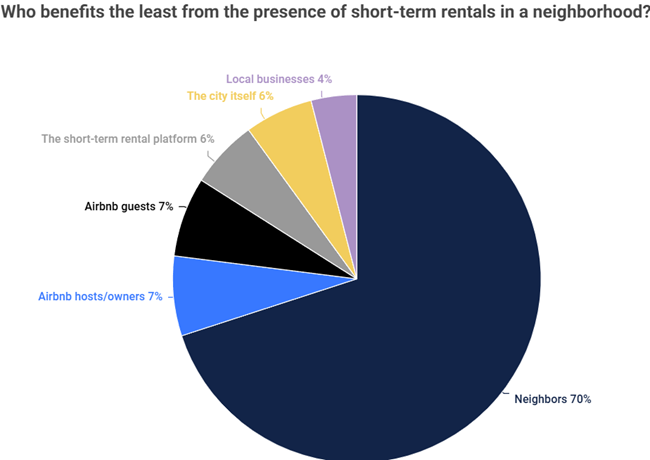
A May 2025 research study shows that 49% of Americans think short-term rentals such as Airbnb and Vrbo should be banned completely in residential areas. The study surveyed 1,000 people and received 489 responses; some respondents live in neighborhoods where such rentals exist and some have stayed in them.

When Airbnb first went online more than 15 years ago, it represented a dramatic change in the way people traveled, not to mention the opportunities it presented to homeowners with extra space and real estate investors in tourist-friendly markets, writes  Nick Pisano for Anytime Estimate.

“The proliferation of Airbnbs in some communities has dramatically transformed the experience of those living there full time, who often face the negative impacts of short-term rentals with little direct benefit beyond the hope of added tourist dollars for local businesses.

“It’s a distinction that has many asking: Do Airbnbs really make good neighbors, and how should residential communities handle those who want to operate one there?”

Anytime Estimate surveyed 1,000 Americans, including 33% who have stayed in an Airbnb and 24% who have or had one in their community, about their views on Airbnbs and other short-term rentals such as Vrbo, their potential impact on their neighborhoods, and more.

A research study shows that 49% of Americans think short-term rentals such as Airbnb should be banned completely in residential areas.

Support for regulations on short-term rentals is strong: 

  • 83% say short-term rentals hould be held to hotel tax and safety standards.
  • 82% believe hosts should need a business license.
  • 78% want background checks for renters.
  • 71% think hosts should have to notify neighbors of every booking.

Highlights of the report

  • Roughly 40% of Americans believe a neighbor converting their home into a short-term rental would decrease the quality of life for local residents, more than four times the number who say it would improve it (9%).
  • About 60% consider the presence of a nearby short-term rental as a negative when buying a home; 28% would offer less on the home, and 32% wouldn’t make an offer at all.
  • About half (49%) think short-term rentals should be banned outright in residential areas.
  • Over half of Americans (52%) say they’d be less comfortable letting their children play outside with a short-term rental next door.

Some of the specific concerns were listed by the survey participants, in order from highest concern to least concern:
1. Loud parties/events
2. Increased crime or safety issues
3. Strangers staying in the neighborhood
4. More trash or litter
5. Loss of privacy
6. Decreased property values
7. Increased difficulty finding street parking
8. Decreased sense of community

However, when asked “In general, do you have positive or negative feelings about Airbnb and other short-term rental companies?”, 43% of respondents said they had “neutral” feelings, while 36% had positive feelings and 21% had negative feelings.

Summary

The survey shows clear evidence that, despite more than a decade of existence in many markets, most people still haven’t firmly made up their minds about whether short-term rentals  are a good or bad thing for their general area — even if they’re certain they don’t want one on their block.

Read the full research report here.

Sign Up For Our Weekly Newsletter And Get Rental Property And Apartment News And Helpful, Useful Content Each Week.

* indicates required

Would Your Portfolio Benefit From A Property Manager?

Like any other investment, properties need to be carefully managed and looked after so would your portfolio benefit from a property manager?

Like any other investment you make, properties need to be carefully managed and looked after so would your portfolio benefit from a property manager?

By Johana Williams
Utopia Management

If you own property for rent, then you will already be aware of the challenges involved.

Rental properties often need us to be very attentive; the idea that this is simply “passive income” that requires minimal input is an outdated concept. To get the most out of a real estate investment, you need to be willing to do one of two things:

  1.     Commit your time to managing the property as you would any other business, or
  2.     Hire a professional property-management company that can do this for you.

Like any other investment you make, properties need to be carefully managed and looked after.

They require constant supervision and analysis, as well as continual connections with the people renting from you. Think about how much goes into managing your property: You need to first invest in the building, maintain its condition and amenities, market the property, prepare the legal documentation for tenancy, and then find a tenant you can trust. Then, you need to maintain contact with maintenance vendors, such as trade professionals.

It’s a lot, right? You are not alone if you feel like your “passive” investment isn’t very passive at all!

With that in mind, many property owners – especially those in major real estate locations – benefit from hiring a property-management company. Would your property portfolio benefit from the same?

Time Versus Money: The Owner’s Dilemma

The first reason many people avoid hiring property managers  is the cost. Property-management companies take a percentage of the property’s income in return for managing the property. However, given the time-sensitive nature of modern life, many property owners are happy to give up that little bit of profit to reclaim personal time or more easily make time for future business endeavors!

When you hire a property manager, you no longer need to stay within the local area of your property, giving you more time to do other things. You could move to a new country or head off on holiday without worrying that your tenant(s) will run into issues. A property manager takes on so many of the mundane yet vital tasks involved in property management that you cannot help but feel the benefits of having your time back.

There is also the fact that, with a property manager being the first responder to any tenant troubles, you do not have to be on-call at all times. Worried about having to miss out on a fun evening with friends in case of a storm brewing? Leave it to your property manager.

Benefiting From Manager Expertise and Experience

However, while the cost mentioned above is a valid concern, there are always costs necessary for a successful business model, and they are often worth paying. A property-management company is involved, and they deal with everything. They market the property and manage its maintenance using quality contractors and even tenants. Property-management firms have specialists who handle just about everything involved, meaning you carry far less personal burden.

That can be a good thing because all you need to do is wait for your payments to arrive. When inspections need to be carried out, your property manager does them for you. The best property-management companies use licensed professionals, from real estate agents and marketers to licensed contractors and trade professionals with all the right connections and certifications. As such, they can often secure better rates for supplies and professionals.

You benefit from their experience of dealing with surprise situations, too. While you might be blindsided by an overnight flooding or a shock legal dispute with a tenant, property-management companies have seen it all.

Consistent Performance

Another nice benefit, is that tenants tend to stick around longer when a property manager is involved. This is simply because things get done on a more routine basis, mistakes are more easily avoided, and response times are better. The best property managers have staff on-call 24/7, so any issues receive near-immediate responses.

Performance comes down to tenant selection and retention, as well. The best property-management companies find quality tenants and keep them around longer. This means fewer gaps in rent payments, because quality tenants pay on time and stay in the building longer. Not only do you get better tenants, but they stick around, and you don’t have to get involved in messy evictions because your property manager will handle that for you. The efficacy and overall experience of the propert- renting process becomes much better when you have dedicated managers.

As you can see, a property-management company could be the time-saving solution you need. They can also boost property performance and provide the answers you want. If you are sick of having to solve every problem that pops up with your rental property portfolio, involve an expert. Hire a property manager, and see how much time you can claw back each year. After all, time is money.

Investing in property is supposed to give you a lease on life and personal freedom, right? Well, with a property manager, that becomes a realistic goal instead of a pipe dream. Suppose you want to make sure that your property investment pays off; like anything else in life, it pays to leave matters in the hands of experts you can trust. Learning on the job as a property owner can become very expensive.

About the author:

Johana Williams has lived in San Diego for more than 25 years and a property manager for 20. She has been an asset to the growth of Utopia Management (as well as client portfolios) due to her comprehensive knowledge of property management, maintenance, and the accounting associated with managed properties. As regional manager, Johana supervises 27 branches in California, Washington, Nevada, and Oregon.

Sign Up For Our Weekly Newsletter And Get Rental Property And Apartment News And Helpful, Useful Content Each Week.

* indicates required

Multifamily Investors Ask: Best Markets for Long-Term Investments?

Multifamily investors recently asked which challenged multifamily markets are best markets for long-term investments?

Multifamily investors recently asked John Burns Real Estate Consulting which challenged multifamily markets are best markets for long-term investments?

“To answer the question at hand, we tailored the model to spotlight multifamily markets facing short-term stress—characterized by modest or even negative rent growth, below-average occupancy levels, and cap-rate expansion since early 2022—but strong long-term fundamentals,” write John Burns consultants in their newsletter.

Markets to watch

Among the top 10 markets. there are some special ones to watch. John Burns consultants say the top markets “have been challenged lately with soft rents, falling occupancies, and rising cap rates.”

However, many show long-term demographic growth with new supply now declining.

No. 1 – Austin

“Despite current headwinds from elevated supply, the fundamentals—demographics, job growth rates more than twice the national average, and long-term appeal—make Austin a strong bet for future rent growth,” writes Michael Kenney, senior consultant.

No. 6 – Nashville

“Nashville has faced heavy supply pressure for longer than many other markets, but strong in-migration continues to support demand. We’re already seeing signs of improvement. Supply being absorbed and fewer new projects in the pipeline signal a strong long-term outlook,” writes James Penner, vice president.

No. 9- Charlotte

All top 10 “challenged” markets have seen rents fall in recent years, but Charlotte’s fell just 0.3% despite having the highest share of units under construction (8.5% of inventory). With a solid economic base and relative affordability, Charlotte should keep attracting new residents and remain a strong long-term opportunity.

About the author:

For more information, visit John Burns Real Estate Consulting. “We help clients address strategic decisions like this with our proprietary JBREC Market Ranking Model, a tool we customize for clients across all housing sectors to help strategize investment decisions.”

Sign Up For Our Weekly Newsletter And Get Rental Property And Apartment News And Helpful, Useful Content Each Week.

* indicates required