Home Blog Page 16

Ethics in Property Management: The Decisions No One Sees

Ethics in property management influence how fair, consistent, and transparent your housing practices look to residents, staff, and regulators

Ethics in property management influence how fair, consistent, and transparent your housing practices appear to residents, staff, and regulators.

By The Fair Housing Institute

In property management, some of the most important decisions are the ones made quietly, without fanfare, applause, or even acknowledgment. They’re the individual choices that take place in leasing offices, during maintenance calls, or while responding to a resident’s email. These moments might not make headlines, but they shape the culture of a community, influence team morale, and protect housing providers from costly legal risks.

The Small Choices That Matter Most

Ethical dilemmas in property management often show up in subtle, everyday interactions: A resident offers a thoughtful gift during the holidays. A prospective resident shares a personal hardship and asks for flexibility. An established resident wants a policy exception “just this once.” None of these are unusual. In fact, they’re common.

But the impact of how they’re handled is significant. Accepting a gift might seem harmless—until another resident notices and wonders about favoritism. Granting a one-time exception can lead to frustration when someone else is denied the same exception. And saying “yes” to one request might make it harder to justify a “no” later.

These aren’t just customer-service decisions. They’re ethical ones, and they influence how fair, consistent, and transparent your housing practices appear to residents, staff, and regulators.

Fairness Is More Than Following the Law

At its core, ethical property management is about doing the right thing, especially when it’s hard, inconvenient, or unpopular. It’s about recognizing that fairness isn’t just about avoiding discrimination; it’s about creating an environment where everyone feels respected and valued.

When housing professionals respond to resident concerns, make judgment calls, or interpret policies, they’re making micro-decisions that either reinforce or erode trust. That’s why consistency is key. It protects both the provider and the community by reducing misunderstandings, maintaining professionalism, and minimizing the risk of violating fair-housing laws.

Policies As Anchors, Not Barriers

Policies exist for a reason, but that doesn’t mean they’re inflexible. Rather than seeing them as limitations, think of them as anchors—frameworks designed to guide decision-making and promote equity. When applied thoughtfully and consistently, policies help remove personal bias and ensure every individual is treated fairly.

This is especially important when handling accommodation requests or other sensitive issues. A well-trained team understands not only the letter of the law but also the importance of empathy and professionalism. This balance is what turns policy into practice and compliance into care.

Creating a Culture of Integrity

Ethical decisions don’t happen in isolation. They’re influenced by leadership, reinforced through training, and modeled by example. Housing providers who foster a culture of integrity—where team members are encouraged to ask questions, seek guidance, and prioritize fairness—are better equipped to handle tough calls.

Investing in ethical leadership and ongoing education isn’t just good practice—it’s a strategic advantage. It reduces liability, increases resident satisfaction, and builds a stronger, more cohesive team.

Professionalism is a Daily Practice

Ultimately, ethical property management is a commitment. It’s showing up with integrity, even when no one is watching. It’s treating policies not as checklists, but as tools for fairness. And it’s understanding that while not every decision will be easy, every decision is an opportunity to lead with values.

By embracing the unseen moments with thoughtfulness and professionalism, housing providers can build communities that are not only compliant, but truly fair—and that’s a legacy worth protecting.

About the author:

In 2005, The Fair Housing Institute was founded as a company with one goal: to provide educational and entertaining fair-housing compliance training at an affordable price at the click of a button.
Sign Up For Our Weekly Newsletter And Get Rental Property And Apartment News And Helpful, Useful Content Each Week.

* indicates required

On-Time Rent Payments Continue to Decline

The national on-time rent payments rate continues to show signs of strain for independent landlords, according to Chandan Economics

The national on-time rent payments rate continues to show signs of strain for independent landlords, according to the June 2025 Chandan Economics & RentRedi report.

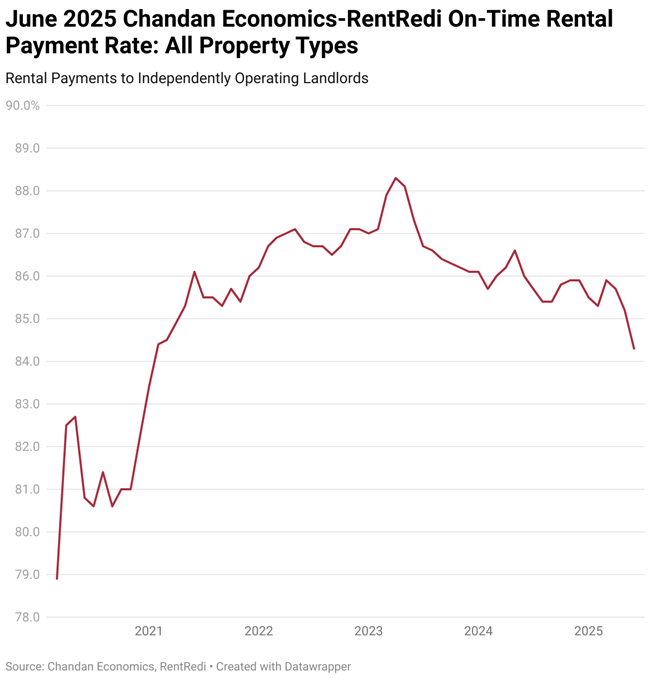
The report documented three consecutive months of decline, adding to a gradual but steady erosion in on-time payment performance.

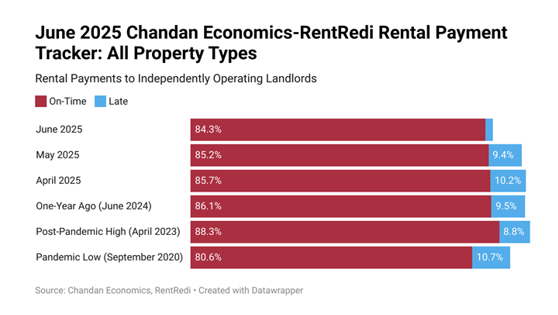
“On-time rent payments in independently operated units dropped meaningfully in June 2025 — offering a stark warning about the financial health of renter households in a high-uncertainty economic environment. According to this month’s first estimate, 84.3% of units paid their full rent on time — a decline of 85 basis points (bps) from May.

“Additionally, May’s on-time payment rate, initially reported at 85.5%, has been revised down to 85.2%. In total, the on-time rate has declined by 154 bps over the past three months.

https://rentalhousingjournal.com/report-u-s-rent-payments-climb-31-in-5-years/

Year-over-Year Decline Of On-Time Rent Payments

Compared to a year earlier, the rate is down a sizable 171 bps — the steepest annual drop since April 2024.

Most notably, year-over-year on-time rent payment rates have now declined for 23 consecutive months.

Key takeaways from the on-time rent payments report

  •  In June 2025, the on-time payment rate in independently operated rental units fell by 85 basis points (bps), dropping to 84.3%.
  • On-time payment rates have fallen year-over-year for 23 consecutive months.
  • The forecast full-payment rate fell to 94.0%, marking a new post-2021 low.
  • Western states continue to hold the highest on-time payment rates in the country, led by Montana, Utah, Hawaii, Alaska, and Idaho.
  • Two- to four-family rental properties held the highest on-time payment rates in June, coming in at 84.6%.

Why the report is important

The Independent Landlord Rental Performance report provides valuable insights into how well non-institutional landlords are managing rental payments. It uses data from property management software RentRedi, showcasing results from 73,502 units.

Information is collected and reported monthly by Chandan Economics. The trends highlighted here can serve as a benchmark for investors, brokers, and policymakers to understand the health of independent landlords in the rental market.

About the report:

Chandan Economics is a leading economic advisory firm that caters to the commercial real estate industry. Their services include economic research, data science, and litigation consulting.

RentRedi provides a comprehensive property management platform that enhances the renting experience for both landlords and tenants.

Read the full report here.

Sign Up For Our Weekly Newsletter And Get Rental Property And Apartment News And Helpful, Useful Content Each Week.

* indicates required

Secure Mailrooms Among Today’s Most Coveted Rental Amenities

Secure mailrooms are becoming a coveted rental property amenity as tenants receive multiple packages, sometimes daily

Secure mailrooms are becoming a coveted rental property amenity as tenants receive multiple packages, sometimes daily, and porch pirates are a major concern. Here is a question and answer on the issue.

By Austin Maddox

  • The mailroom has traditionally been a behind-the-scenes feature. What’s changed to elevate it into a coveted amenity for renters in today’s housing market?

Mailrooms have evolved out of necessity. We’re seeing tremendous growth in package volume, and residents are now receiving deliveries multiple times a day. With that, porch piracy has become a major concern, especially in multifamily communities. Lockers and centralized delivery systems not only provide 24/7 access but also help protect residents’ packages from theft.

Efficient package management and security are not the only drivers; the mailroom has become part of the amenity conversation. Communities want to offer residents convenience and peace of mind, and they’re also thinking about aesthetics. Some high-end communities have incorporated premium lockers that match the building’s design, making the mailroom feel like a thoughtful extension of the overall resident experience.

  • How are smart lockers or automated mailroom solutions helping property managers differentiate themselves in an increasingly competitive real-estate environment?

In a crowded rental market, property managers are constantly seeking ways to stand out, and smart lockers have emerged as a powerful differentiator. They check multiple boxes: security, convenience, and operational efficiency.

Our company has worked with a number of apartment communities and multifamily properties where lockers become a key selling point. When residents see a community prioritizing a convenient solution to a daily challenge, it makes an impression.

Communities are increasingly appreciating the expectations of Generation Z, which will reshape the multifamily housing landscape. This generation’s blend of digital fluency, budget consciousness, and commitment to authenticity and sustainability creates a powerful market force. Gen Z renters see  lockers as an amenity they will use regularly, unlike other big-ticket community investments such as gyms, swimming pools or clubhouses. Automated lockers also fit with this generation’s preference for on-demand, 24/7 access.

From an operational perspective, lockers free up staff time by automating package management. That means leasing agents and community managers can focus on higher-touch services and creating a great experience for current and prospective renters. It’s a win-win, since at the same time lockers provide tangible value to residents.

  • As mail and parcel locker rooms are evolving into multipurpose communal spaces, can you speak to some of the creative ways buildings are designing and using these spaces today?

In new builds, lockers are being integrated from the start, often in lobbies, amenity centers, or near coworking spaces. These placements increase convenience and visibility, which in turn boosts resident adoption.

For older buildings, where space is limited, we’re seeing a lot of creative repurposing. Some properties are transforming laundry rooms, especially in units where in-apartment laundry has become standard, into secure package hubs. Others are making use of space in garages or next to existing mailbox clusters. We’ve even seen clients repurpose other areas, such as shuffleboard courts that weren’t being used.

Part of this creative wave is the boost in the community identity. Communities are wrapping lockers with branded graphics, incorporating signage, and turning the locker area into a polished, welcoming extension of the lobby. With remote work still prevalent, some properties are placing lockers near business centers or waiting areas so residents can pick up packages during breaks. It’s all about increasing utility while creating spaces that fit how people live today.

  • Package theft and delivery failures remain top concerns for residents. What role do smart lockers play in improving security and trust in last-mile delivery?

Smart lockers are one of the most effective tools we have for securing last-mile delivery. They provide 24/7 self-service access, so residents can retrieve packages on their own schedule without worrying about someone snatching their deliveries. Each delivery to an automated locker is tracked and only accessible by the recipient using a unique code or barcode, which means a full chain of custody from the carrier to the recipient.

This system eliminates the all-too-common scenario of packages being left in a leasing office or unsecured hallway or storage room. This also benefits staff, who don’t need to oversee every delivery. In addition to this, residents get peace of mind, and carriers appreciate the streamlined drop-off experience.

  • There’s a growing emphasis on the “experience economy.” How do you see delivery and locker automation enhancing the overall resident experience in multifamily living?

Today’s residents expect the same kind of instant gratification from their homes that they get from the rest of their lives. We know convenience is king, and lockers help bring that level of service to multifamily living.

For residents, it’s about more than just getting a package. It’s about getting it securely, quickly, and without any hassle. Lockers provide that seamless experience. They also open the door to new interactions—community managers are using them to distribute welcome kits, keys, documents, and even items like pool towels or promotional giveaways.

It’s a seemingly small detail with a big impact. Locker systems are one of the ways communities are turning routine interactions into elevated experiences that enhance resident satisfaction and retention.

  • How have building codes, city regulations, or insurance policies influenced the rise in demand for locker systems in recent years?

We’ve seen these factors play a growing role in locker adoption. As package theft becomes more frequent and reimbursement from vendors and carriers becomes more limited, residents are increasingly looking for ways to safeguard their deliveries. Lockers have become a form of “package insurance.”

Sustainability initiatives are also coming into play. City codes are evolving to prioritize eco-friendly practices, and smart lockers can help properties reduce the environmental impact of multiple delivery trips. By consolidating deliveries into one drop-off, lockers cut down on emissions and vehicle traffic. For younger renters, those sustainability credentials matter.

While lockers weren’t originally designed to solve regulatory challenges, they’ve become a smart, proactive solution that helps communities meet some resident expectations on multiple fronts.

  • What changes or improvements can residents expect to see moving forward in how mail and parcel rooms are integrated into their living spaces?

Looking ahead, we expect to see lockers integrated even more deeply in the daily lives of residents, not just as a delivery solution, but as part of the broader amenity ecosystem. We’re already seeing properties use lockers for more than packages. They’re storing documents, managing key handoffs, distributing welcome letters, information on building events and more.

Locker systems can reflect the unique needs and personality of each community. Some buildings are using modular locker designs to retrofit tight urban spaces, while new developments are designing locker areas as high-traffic touchpoints that enhance the resident experience.

These systems are also being connected with mobile apps and community platforms, enabling residents to receive notifications, access features, and even schedule services all from one place. Automated lockers have become more than a mailroom add-on.

About the author:

Austin Maddox is executive vice president of sales and operations for North America, Lockers Automation, Quadient.

Photo credit zhudifengvia istockimages

Sign Up For Our Weekly Newsletter And Get Rental Property And Apartment News And Helpful, Useful Content Each Week.

* indicates required

Portland Rents Up 0.9% In June

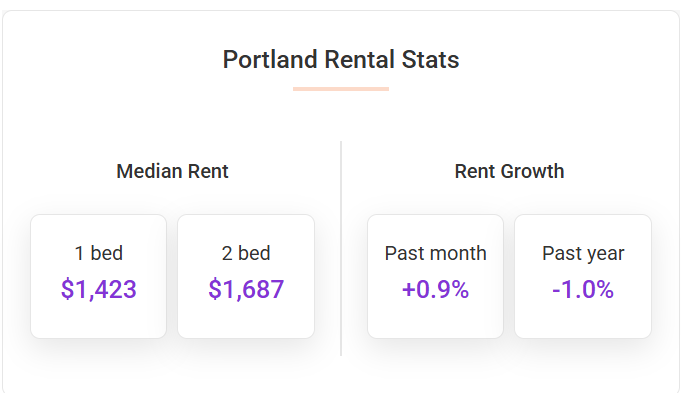
Portland rents were up 0.9% in June however, prices remain down 1.0% year-over-year and now the median rent in the city stands at $1,566.

Portland rents were up 0.9% in June according to the July report from Apartment List.

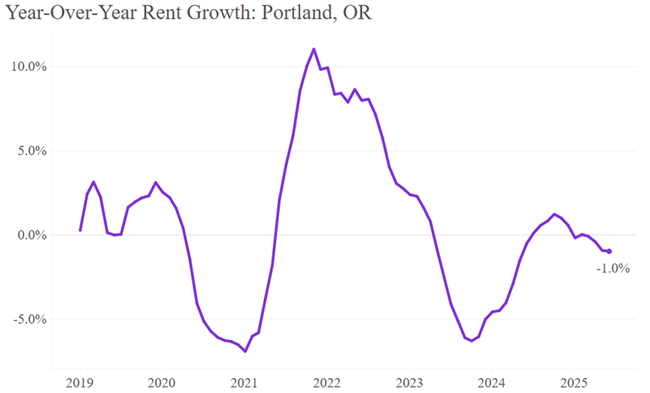
However, prices remain down 1.0% year-over-year.

Currently, the overall median rent in the city stands at $1,566.

Portland rent growth in 2025 pacing below last year

Six months into the year, rents in Portland have risen 3.0%. This is a slower rate of growth compared to what the city was experiencing at this point last year. From January to June 2024 rents had increased 3.9%.

Citywide, the median rent currently stands at $1,423 for a 1-bedroom apartment and $1,687 for a 2-bedroom. Across all bedroom sizes in the entire rental market, the median rent is $1,566. That ranks #40 in the nation, among the country’s 100 largest cities.

Portland rents were up 0.9% in June however, prices remain down 1.0% year-over-year and now the median rent in the city stands at $1,566.

Portland rents are 6.6% lower than the metro-wide median

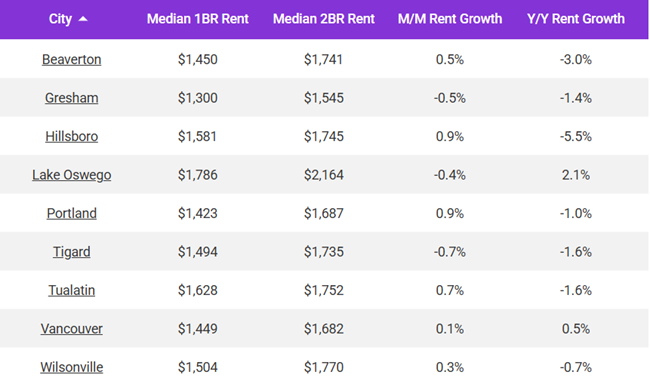
Across the Portland metro area, the median rent is $1,678 meaning that the median price in Portland proper ($1,566) is 6.6% lower than the price across the metro as a whole. Metro-wide annual rent growth stands at -0.7%, above the rate of rent growth within just the city.

The table below shows the latest rent stats for 9 cities in the Portland metro area that are included in the Apartment List database.

Among them, Lake Oswego is currently the most expensive, with a median rent of $2,040. Gresham is the metro’s most affordable city, with a median rent of $1,524. The metro’s fastest annual rent growth is occurring in Lake Oswego (2.1%) while the slowest is in Hillsboro (-5.5%).

Portland rents were up 0.9% in June however, prices remain down 1.0% year-over-year and now the median rent in the city stands at $1,566.

Sign Up For Our Weekly Newsletter And Get Rental Property And Apartment News And Helpful, Useful Content Each Week.

* indicates required

Seattle Rents Up 1.3% In June

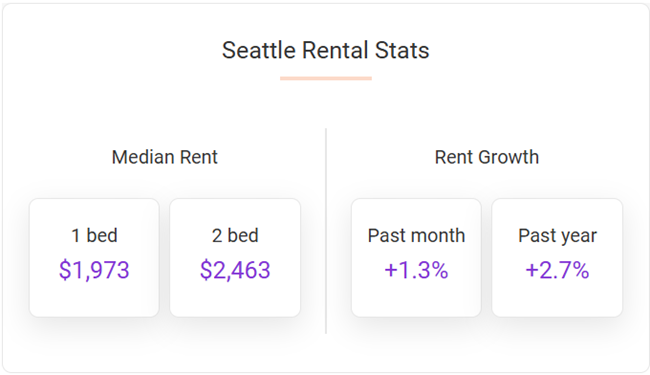
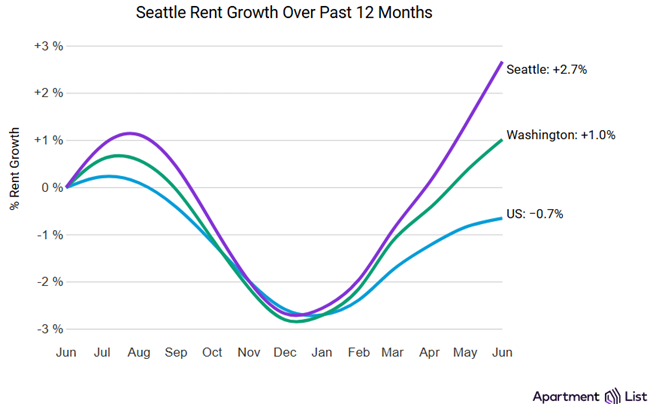
Seattle rents were up 1.3% in June, according to the July report from Apartment List, and up 2.7% year-over-year.

Seattle rents were up 1.3% in June, according to the July report from Apartment List, and up 2.7% year-over-year.

Currently, the overall median rent in the city stands at $2,115.

Seattle rent growth in 2025 pacing above last year

Six months into the year, rents in Seattle have risen 5.4%.

This is a faster rate of growth compared to what the city was experiencing at this point last year: from January to June 2024 rents had increased 4.6%.

Citywide, the median rent currently stands at $1,973 for a 1-bedroom apartment and $2,463 for a 2-bedroom. Across all bedroom sizes for the entire rental market the median rent is $2,115. That ranks #15 in the nation, among the country’s 100 largest cities.

Seattle rents were up 1.3% in June, according to the July report from Apartment List, and up 2.7% year-over-year.

Seattle rents are 4.3% higher than the metro-wide median

Across the wider Seattle metro area, the median rent is $2,027 meaning that the median price in Seattle proper ($2,115) is 4.3% greater than the price across the metro as a whole. Metro-wide annual rent growth stands at 1.0%, below the rate of rent growth within just the city.

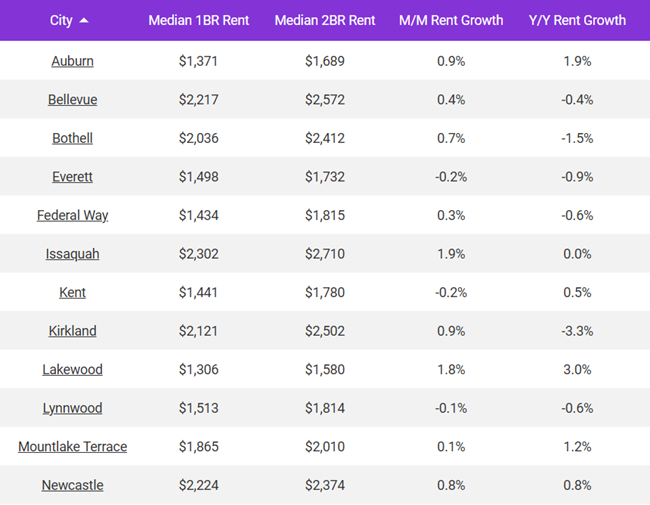
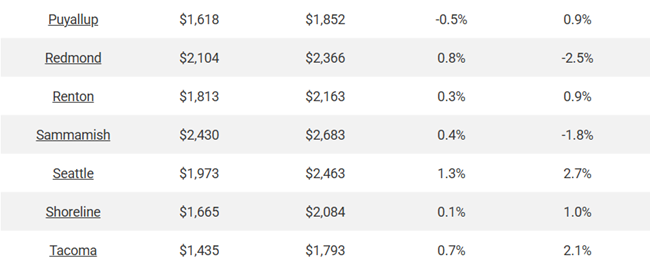
The table below shows the latest rent stats for 19 cities in the Seattle metro area that are included in the Apartment List database.

Among them, Sammamish is currently the most expensive, with a median rent of $3,023. Lakewood is the metro’s most affordable city, with a median rent of $1,487. The metro’s fastest annual rent growth is occurring in Lakewood (3.0%) while the slowest is in Kirkland (-3.3%).

Seattle rents were up 1.3% in June, according to the July report from Apartment List, and up 2.7% year-over-year.

Sign Up For Our Weekly Newsletter And Get Rental Property And Apartment News And Helpful, Useful Content Each Week.

* indicates required

State-City To Build More Multifamily Housing In Portland

The governor of Oregon and the mayor of Portland say they will take action to build more multifamily housing construction in Portland

The governor of Oregon and the mayor of Portland say they will take action to build more multifamily housing construction in Portland, according to a release.

Oregon Gov. Tina Kotek and the Portland Mayor Keith Wilson said the multifamily housing commitments were informed by recommendations made by the Multifamily Housing Development Workgroup, convened by the governor and mayor this spring. They were joined by Portland City Councilor Dan Ryan, Smart Growth Board President Sarah Zahn, Tom Kilbane, managing director at Urban Renaissance Group, and Andrew Colas, CEO at Colas Construction, Inc.

Portland has the worst housing crisis outlook among the largest metro areas in the United States, according to a LendingTree study released Tuesday.

The study analyzed housing markets in 100 of the largest metro areas in the U.S., analyzing vacancy rates, housing unit approvals and home value-to-income ratios.

“In doing so, we found that three of the five metros with the worst outlook are in the Pacific Northwest,” and according to LendingTree, Portland ranks the worst mostly because of a lack of housing and unaffordability.

“I believe in a vision for Oregon and for Portland where everyone can afford a home, where people can live in the places they want and still make ends meet at the end of the month,”  Kotek said in the release.

“Rolling up our sleeves together like this is how we are going to make that happen. Thank you to Mayor Wilson for convening this work group with me and to the developers who shared their experiences to guide these actions.”

“Portland is open for business — for housing, for opportunity, and for a thriving future,” Wilson said in the release. “By expanding self-certification and investing in office-to-housing conversions, we are cutting red tape and accelerating the creation of much-needed homes for Portlanders.”

Build More Multifamily Housing And More Permits Faster

State staff support is being provided to help Portland issue housing construction permits more efficiently and helping builders break ground more quickly, thereby bringing down the cost of construction and eventual cost to Oregonians.

Wilson announced a commitment to reboot the self-certification program and launch a third-party plan review as part of its permit-improvement work.

Self-certification refers to a process wherein a licensed design professional can certify that their submitted plans meet all applicable building codes and regulations, thereby bypassing full building-code plan review for certain types of projects. Together, these two programs will reduce permitting times and spur housing production, Wilson said.

Build More Multifamily Housing For Office-to-Housing Conversion

Kotek directed Business Oregon to designate office-to-housing conversion projects in Portland as essential to the economic well-being of the state, allowing the state Building Codes Division (BCD) to partner with Portland and developers to put together a rapid-approval assessment team to oversee the effort and share the review and inspection responsibilities. The state leaning into these projects will incentivize more projects, help Portland coordinate services, and make projects more predictable, according to the release.

Wilson announced a $15 million notice of funding opportunity to be released later this year for a middle-income office-to-residential housing development in the central city. These office-to-residential conversion projects help revitalize Portland’s urban core and promote the reuse of existing buildings.

Economic Development

Working with local and regional partners, the governor’s office will create a six-month economic development strategy.

The strategy builds on existing economic development plans such as  Prosper Portland’s Advance Portland, and identifies short-, medium-, and long-term tactics to keep existing businesses in Portland and recruit more businesses to set up shop.

Builder’s Remedy: Allowing More Multifamily Affordable Housing

Kotek committed to exploring how a policy called the Builder’s Remedy, modeled after legislation in California, could work to build more multifamily housing in Oregon. The California Legislature passed the Builder’s Remedy, which limits denials of projects with affordable housing when local jurisdictions are out of compliance with state production laws.

The plan announced is to “kick-start the building of 5,000 multifamily housing units over the next three years by waiving system development charges during that time,” according to the release. They also jointly committed to continue reviewing the work group’s recommendations, to meet with investors in partnership with the City of Portland and multifamily housing developers.

Read the full release here.

Sign Up For Our Weekly Newsletter And Get Rental Property And Apartment News And Helpful, Useful Content Each Week.

* indicates required

Demand, Supply and Uncertainty Weaken June Rent Growth

Multifamily rents saw tepid growth in June, with strong demand counterbalanced by high deliveries in the Sun Belt and ongoing uncertainty

Multifamily rents maintained a tepid growth rate in June, with strong demand counterbalanced by high deliveries in the Sun Belt and ongoing uncertainty about the economy, according to Yardi Matrix in its June report.

Multifamily performance remained solid through mid-year 2025, with rents rising by $20, or 1.2%, over the first two quarters.

Highlights of the report:

  • Multifamily rents rose in June, but growth remains tepid as the market balances between robust demand and supply while economic uncertainty is high. The average U.S. advertised rent increased by $3 to $1,749 during the month, while year-over-year growth was 0.9%.
  • Advertised rents rose 0.7% during the second quarter and 1.2% during the first half of 2025, both well shy of pre-pandemic growth rates. In the seven years between 2013 and 2019, advertised rents grew on average by 1.8% during the second quarter and 2.4% during the first half of the year.
  • National single-family build-to-rent advertised rates rose by $4 to $2,201 in June, representing a 0.7% annual increase and 0.8% growth in the first half of the year. As with multifamily, rent growth is positive but subdued compared to recent years.

Yardi Matrix says more than 250,000 apartment units were absorbed through May, per Matrix, putting the market on track for another year of robust demand. Austin led with 22,000 units absorbed, followed by Sun Belt markets including Charlotte, Nashville, Raleigh-Durham and Orlando.

While there is some positive news, there are also areas of concern

“The economy and job market remain strong, but growth has slowed, and the impact of tariff and immigration policies in the second half remains uncertain.

“Unemployment is low, but job switching has declined, reducing labor-market dynamism. Policy uncertainty continues to challenge business planning, with the new tariff implementation date pushed again to August,” the report says.

Read the full Yardi Matrix report here.

About Yardi Matrix

Yardi Matrix researches and reports on multifamily, office and self-storage properties across the United States, serving the needs of a variety of industry professionals. Yardi Matrix Multifamily provides accurate data on 18+ million units, covering more than 90 percent of the U.S. population. Contact the company at (480) 663-1149.

Sign Up For Our Weekly Newsletter And Get Rental Property And Apartment News And Helpful, Useful Content Each Week.

* indicates required

Immigration Authorities Demand Landlords Turn Over Tenant Info

Immigration authorities issued subpoenas demanding landlords turn over leases, rental applications, plus other information on tenants

Immigration authorities have issued subpoenas demanding that landlords turn over leases, rental applications, forwarding addresses, identification cards and other information on their tenants, according to the Associated Press.

Eric Teusink, an Atlanta-area real estate attorney, told the Associated Press that several of his clients recently received subpoenas asking for entire files on tenants. A rental application can include work history, marital status and family relationships.

The two-page “information enforcement subpoena,” which Teusink shared exclusively with The Associated Press, also asks for information on other people who live with a tenant. One of these documents, dated May 1, is signed by an officer with the U.S. Citizenship and Immigration Services anti-fraud unit. However, it is not signed by a judge.

Teusink told the AP many of his clients oversee multifamily properties and are used to getting subpoenas for other reasons, such as requests to hand over surveillance footage or give local police access to a property as part of an investigation. But those requests are each signed by a judge, he said.

Teusink said his clients were confused by the latest subpoenas. After consulting with immigration attorneys, he concluded that compliance is optional. Unless signed by a judge, the letters are essentially just an officer making a request.

“It seemed like they were on a fishing expedition,” Teusink said, according to wabe.org.

ICE officers have long used subpoenas signed by an agency supervisor to try to enter homes. Advocacy groups have mounted a “Know Your Rights” campaign urging people to refuse entry if the documents are not signed by a judge.

Landlords: Know the difference between administrative and court ordered subpoenas

Denise Holliday, an Arizona attorney, noted that ICE commonly issues administrative subpoenas that can feel a bit intimidating but she encourages all business owners to learn the difference between a court ordered subpoena and an administrative subpoena and create a policy under which you will response to ICE subpoenas and related communications.

“It is legal to safely ignore administrative subpoena absent a court order but you may prefer to provide a written response that explains your grounds for objecting to what is requested in the subpoena. ICE may seek a court order for your company to comply with their request to produce information and if you fail to comply with that court order there may be serious legal consequences,” Holliday said.

The subpoena reviewed by the AP is from USCIS’ fraud detection and national security directorate, which, like ICE, is part of The Department of Homeland Security. Although it isn’t signed by a judge, it threatens that a judge may hold a landlord in contempt of court for failure to comply.

Tricia McLaughlin, a Homeland Security spokeswoman, defended the use of subpoenas against landlords without confirming whether they are being issued.

“We are not going to comment on law enforcement’s tactics surrounding ongoing investigations,” McLaughlin said. “However, it is false to say that subpoenas from ICE can simply be ignored. ICE is authorized to obtain records or testimony through specific administrative subpoena authorities. Failure to comply with an ICE-issued administrative subpoena may result in serious legal penalties. The media needs to stop spreading these lies.”

ICE Subpoenas New to Many Landlords

Boston real estate attorney Jordana Roubicek Greenman said a landlord client of hers received a vague voicemail from an ICE official last month requesting information about a tenant. Other local attorneys told her that their clients had received similar messages. She told her client not to call back.

Anthony Luna, the CEO of Coastline Equity, a commercial and multifamily property management company that oversees about 1,000 units in the Los Angeles area, said property managers started contacting him a few weeks ago about concerns from tenants who heard rumors about the ICE subpoenas. Most do not plan to comply if they receive them.

“If they’re going after criminals, why aren’t they going through court documents?” Luna said. “Why do they need housing-provider files?”

Lindsay Nash, a law professor at Yeshiva University’s Cardozo School of Law in New York, said ICE can enforce the subpoenas, but it would first have to file a lawsuit in federal court and get a judge to sign off on its enforcement — a step that would allow the subpoena’s recipient to push back, Nash said. She said recipients often comply without telling the person whose records are being divulged.

“Many people see these subpoenas, think that they look official, think that some of the language in them sounds threatening, and therefore respond, even when, from what I can tell, it looks like some of these subpoenas have been overbroad,” she said.

Sign Up For Our Weekly Newsletter And Get Rental Property And Apartment News And Helpful, Useful Content Each Week.

* indicates required

5 Ways Property Managers Can Maintain Margins

As the rental market begins to normalize and return to pre-pandemic levels, here are 5 ways property managers can maintain margins.

As the rental market begins to normalize and return to pre-pandemic levels, here is how property managers can maintain margins.

By Vanessa Anderson
C0O, at ShowMojo, part of PropertyTek

After years of markets that were unusually favorable to landlords and property managers, we’re shifting into more of a tenants’ market: Time on market is trending up, leads per rental are down, and concessions are increasing.

But we’re not seeing a truly “soft” market by historical standards. Think of this as more of a return to pre-pandemic norms. For property managers, the name of the game is adapting business practices to maintain margins.

This piece will highlight five ways to do that, based on the specific changes we’re seeing in our user data.

1. Set Your Asking Price Right the First Time

First, the good news: Average rents continue to climb. As of April, median rents nationwide were as high as they’ve ever been (right around $1,650). Lower-priced units (between $500 and $999) are decreasing as a share of total available units, and units above $1,500 are leasing faster than lower-priced units did in previous quarters.

The most likely reason: constrained supply. Housing supply still hasn’t recovered from the 2008 downturn, and the limited number of units on the market is helping keep prices elevated.

Still, this doesn’t mean you can increase unit prices willy-nilly.

In fact, setting an asking price that’s too high will cost you 30 or more days on the market. In our data, we found that units with no price reductions stayed on the market around 31 days, while those with at least one price reduction took closer to 68 days to rent.

Pricing is as much an art as a science. If you’ve had to reduce rents to lease units lately, it may be time to review your strategy.

2. Include These 6 Elements in Listings

Another sign of the softening market: leads per listing are near historic lows. In 2022, we were seeing about 30; today, it’s closer to 22.

Boost efficiency by making your listings stand out from the noise. Our data shows an advantage (i.e., fewer days to rent) for listings that have the following:

  1. A descriptive title. No title costs one to two days.
  2. A property description (400+ words). Longer descriptions offer some advantage. If you struggle to get words out, use tools like ChatGPT. You can upload a few photos and ask it to generate a description.
  3. Listing details (two to 10). Include differentiators (stainless steel appliances, a pool, hardwood floors, etc.) rather than expectations.
  4. Clear policies for pets, security deposits, and the application process. Tenants can now afford to skip listings with unclear or confusing policies – and they do! We’re now seeing penalties for unclear or missing policies about pets (one day), security deposits (three to four days), and the application process itself.
  5. High-quality photos with watermarks. The number doesn’t affect time to lease, but high-quality photos are a must. Watermarks don’t affect the number of days on market, but “aggressively” watermarking your photos (so they can’t easily be copied) reduces fraud by 40 percent.
  6. Video or 3D tours. Only about eight percent of units offer this right now, which means we don’t have enough data to assess the impact on time on market. However, for higher-end units, video and 3D tours can clarify what you’re offering.

3. Let Prospects Self-Schedule Showings

The more you can do to maintain your prospects’ flow while they’re apartment hunting, the better your results will be. One option available to you is using tech that lets prospects self-schedule showings.

Instead of asking an interested prospect to click over to their email, compose a message asking for a showing, wait for a response from your team, and then schedule a showing when the property in question is no longer top of mind, let them click a few buttons on the listing itself to set up a showing.

This will mirror the experience prospects are having on other online channels (Google, social media, AI chatbots), where the trend is increasingly to stay on one platform rather than “surf” from site to site via links (search “zero-click marketing” if the concept is new to you.).

When you set up self-scheduling, always offer near-term availability:

  • 65 percent of showings booked less than a day out actually do happen.
  • Only 11 percent of showings booked more than two weeks out happen.

This is a simple way to weave automation into your leasing workflow that significantly eases the admin burden for your team. That’s a big win for efficiency.

4. Automate Everything You Can on the Admin Side

Not only are we seeing fewer leads per listing, listings are staying on the market longer (41 days on average, up from about 36 this time last year).

The easiest way to reduce unnecessary drag time: automate everything you can.

I mentioned self-scheduling, but today’s leasing automation software makes it possible to automate much more, including…

  • Showing reminder messages (via email and text) to reduce no-shows.
  • Post-tour summary messages with next steps.
  • Real-time lead response (via answering service, chatbot, etc.).

If you’re not yet using purpose-built software to automate workflows, now’s the time to consider it. The more you automate, the less administrative work your team has to do. This helps you keep headcount low without sacrificing the quality of your service. In some cases, automation will actually augment quality (as with allowing self-scheduling).

5. Embrace Self-Guided Tours

Deep breath. If you’re not yet doing self-guided tours, I know it can feel intimidating. But the data is clear: If you let prospects handle tours themselves, you’ll book 20 percent more showings.

The logistics are fairly straightforward. You need a smart lock or lockbox connected to software that lets you manage showings. When prospects self-show, they get a dedicated time slot and code that only works during that time.

As with anything, the decision of whether to allow self-showings is largely one of personal risk tolerance: Are you more comfortable with the risks associated with fewer leads or the risks associated with prospects being unattended in your units?

One way to mitigate some risk is to use self-showing in conjunction with pre-screening questions and only make it available to those who qualify.

I personally wouldn’t be comfortable offering self-showings for occupied units. But I love the prospect of having the option available to me because it makes me more adaptable to shifting market conditions.

And the potential upside is significant: One customer of ours that switched to self-showings increased their tour capacity from 40 per week to more than 100. They avoided growing headcount and now have their team focus on improving their “field position,” ensuring that units are secure, trash is removed, and operations run smoothly.

A More Efficient Business Serves You Better in Any Market

Today, we’re talking about how to adjust your business practices to suit the softening market. But adapting to make your business more efficient will serve you in any market.

And while market conditions will ebb and flow over the years, there’s an undeniable trend toward tenants expecting more digitization, more automation, and more real-time communication. Property managers who recognize that and adapt their businesses accordingly will be well-positioned to meet these tenants where they are in the years to come.

About the author:

Vanessa Anderson is the chief operating officer at ShowMojo, a leasing automation platform and part of PropertyTek. ShowMojo helps property managers reduce vacancy times, cut down on repetitive tasks, and deliver a smoother experience for both renters and leasing teams.

Sign Up For Our Weekly Newsletter And Get Rental Property And Apartment News And Helpful, Useful Content Each Week.

* indicates required

Phoenix Feels Growing Pains as Strong Supply Dominates

Strong supply continues to pressure Phoenix’s multifamily market, restraining rent growth and having an impact on occupancy

Strong supply continues to pressure Phoenix’s multifamily market, restraining rent growth and having an impact on occupancy, writes Yardi Matrix in its recent Phoenix Multifamily Market report.

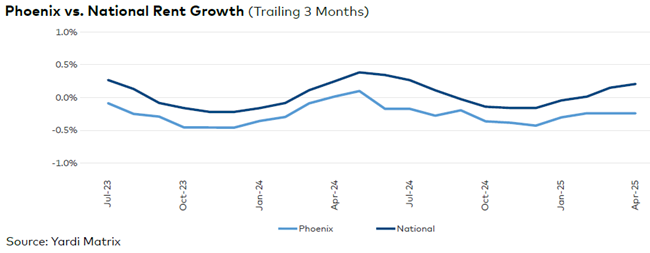
Rents have fallen 3.1%  over the past year, to $1,550, posting the third-lowest performance among Yardi Matrix’s top 30 metros.

Employment is slowing down, the continuing available supply is slowing down rent movement and developers are scaling down big projects, the report says.

Pipeline is cooling off

Following a two-year wall of deliveries, the pipeline is steadily cooling off.

Still, figures remain fairly robust, with 3,763 units completed this year through April and an additional 34,937 units underway.

Strong supply continues to pressure Phoenix’s multifamily market, restraining rent growth and having an impact on occupancy

Rents contract

The high influx of new high-end Lifestyle units contributed to steady contractions across asset classes. Declines were, of course, steeper in the Lifestyle segment, where advertised asking rents slid 0.4%, on a T3 basis through April, to $1,740.

Year-over-year through April, the average advertised asking rent increased in just one submarket: Scottsdale–North (1.0% to $2,003), which is the metro’s the second-most expensive area.

The priciest submarket, Phoenix–Paradise Valley Village, saw its average drop 0.4%, to $2,025. In downtown Phoenix, which had the largest pipeline as of April, rents inched down just 0.1%, to $1,970.

Employment

While Phoenix saw some softening in employment, a lot is still happening in and around in the Phoenix metro.

“This includes the start of operations for the first phase of TSMC’s (Taiwan Semiconductor) Fab 21 chip fabrication facility. The second phase is in equipping mode, while the third fab broke ground in April. The entire project is expected to employ 6,000 workers.”

Meanwhile, Intel made slight cuts to its workforce in the area. However, the $32 billion expansion of the Ocotillo campus in Chandler is still slated for a 2025 delivery and projected to generate 3,000 manufacturing jobs.

Read the full report here.

About Yardi Matrix

Yardi Matrix researches and reports on multifamily, office and self-storage properties across the United States, serving the needs of a variety of industry professionals. Yardi Matrix Multifamily provides accurate data on 18+ million units, covering more than 90 percent of the U.S. population. Contact the company at (480) 663-1149.

Sign Up For Our Weekly Newsletter And Get Rental Property And Apartment News And Helpful, Useful Content Each Week.

* indicates required