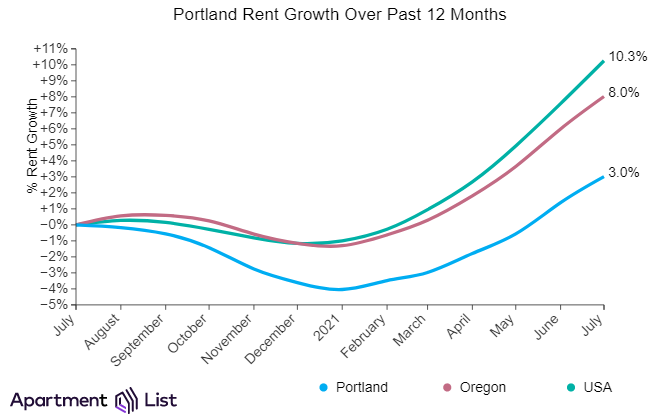
Rents continue to increase in Portland and were up by 1.6 percent in July, the sixth straight month that the city has seen rent increases, according to the latest report from Apartment List.
The Portland rents rise shows rents are up 3 percent year-over-year. Median rents in Portland are $1,199 for a one-bedroom apartment and $1,398 for a two-bedroom.
Across the Portland metro, of the largest 10 cities that Apartment List has data for, all have seen prices rise. Oregon as a whole logged rent growth of 8.0 percent over the past year.
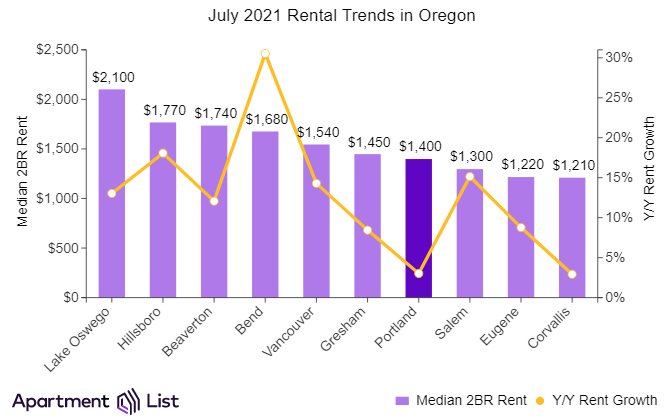
As Portland rents rise, here’s a look at how rents compare across some of the largest cities in the metro:
Lake Oswego is the most expensive of all Portland metro’s major cities, with a median two-bedroom rent of $2,101.
Bend experienced the fastest growth, up 30.5 percent.
Hillsboro, Salem, and Vancouver have all experienced year-over-year growth above the state average (18.1 percent, 15.1 percent, and 14.3 percent, respectively).
Rent Growth Continues Upward Across the Country
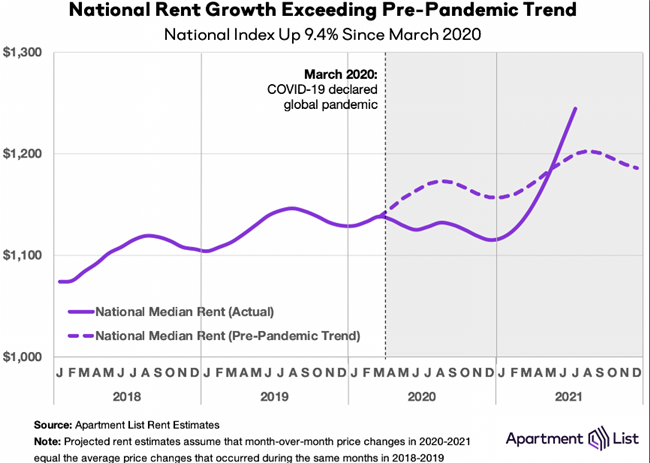
The national rent index increased by 2.5 percent from June to July, continuing a months-long trend of rapidly accelerating rent growth, according to the August Apartment List National Rent Report.
So far in 2021, the national median rent has increased by a staggering 11.4 percent.
“To put that in context, in the pre-pandemic years from 2017-2019, rent growth from January to July averaged just 3.3 percent. This month’s spike continues to push rents well above where they would be if growth had remained on its pre-pandemic trend,” the report says.
While rent growth continues to see some regional variations, “overall rent growth in 2021 so far is outpacing pre-pandemic averages in 98 of the nation’s 100 largest cities.”
The Apartment List report says the rent spikes have now put actual rents well ahead of the trend they were on prior to the pandemic.
“The national median rent currently stands at $1,244, which is $44 greater than where we project it would be if rent growth over the past year and a half had been in line with the growth rates we saw in 2018 and 2019,” the report says.
Coastal cities rents also on the rebound
San Francisco consistently made headlines throughout the pandemic for the 26.6 percent drop in rents from March 2020 through January 2021, but since January, San Francisco rents have increased by over 17 percent.
Even sharper rebounds have been observed in Boston (+23 percent since January), Seattle (+22 percent), and New York (+21 percent).
“These COVID-era price fluctuations – down quickly at the start of the pandemic, up quickly since the start of 2021 –- are significantly more volatile than the seasonal price fluctuations we normally see in these markets.”
Conclusion
The report said while the pandemic created some softness in the rental market last year, 2021 “has brought the fastest rent growth we have on record in our data.
“Nationally, and in nearly all individual cities across the country, rent growth in 2021 has exceeded average growth rates from pre-pandemic years. Rents remain below pre-pandemic levels in just a handful of cities. And even in markets like San Francisco and New York where ‘pandemic pricing’ is still in effect, prices are quickly rebounding.
“At the same time, booming markets like Boise continue to see prices climb. More broadly, rental inventory across the nation remains tight, and as economic recovery continues to gain momentum, we may be seeing the release of pent-up demand from renters who had been delaying moves due to the pandemic. Whereas last year’s peak moving season was halted by the pandemic, this year’s seasonal spike is more than making up for lost time.”
The California Rental Housing Association has sued the state of California in federal court arguing the third extension of the state’s eviction moratorium is unconstitutional and violates rental-property owners’ rights, according to a release.
“We tried working with our legislators and the governor to reach an agreement that would recognize the financial burdens faced by both rental-housing providers and renters,” said Christine Kevane LaMarca, president of the association, in a release. “They chose to ignore the financial burdens of small and medium rental-property providers.
“The courts are our last resort. Rental-housing providers across the state are suffering severe economic distress and losses directly caused by the state of California’s ongoing overreaching eviction moratorium,” she said.
The lawsuit was filed in the Eastern District of California (Sacramento) and joined by two individual rental-housing owners. It challenges the constitutionality of AB832, the state’s third extension of the statewide moratorium on evictions for nonpayment of rent.
The suit alleges that the moratorium unconstitutionally violates rental housing owners’ basic property rights, and substantially—and retroactively—impairs existing rental agreements and leases, which give owners the contract right to repossess their units for nonpayment of rent.
The lawsuit, filed under the federal civil rights act, seeks a declaration that AB 832 is unconstitutional and an injunction prohibiting its enforcement.
Rental-housing providers suffering
“The state continues to extend the eviction moratorium with no distinction between residents who cannot afford to pay due to the pandemic and residents who can afford to pay their rent but are using the moratorium to violate their rental agreements,” LaMarca said.
“Rental-housing providers continue to provide housing, and in some cases, for no compensation, which leaves us with no recourse. Small and medium rental-housing providers rely on rental income to pay their mortgages and maintenance expenses, while supporting their own families. We wake up every day thinking about how to house people – that is what we want to do – and government action is interfering with our ability to effectively do so.
“This lawsuit is intended to restore our rights and allow us to enforce rental contracts that have been unnecessarily expropriated for the past 16-plus months,” she said.
About the California Rental Housing Association
The California Rental Housing Association represents 19,000+ members who provide nearly 537,000 rental units. CalRHA’s members are primarily small- and medium-sized rental-housing providers throughout the state of California. Our purpose is to advocate in the best interest of the rental-housing industry and collectively address industry needs.
When you get reliable tenants, you naturally want them to stick around as long as possible so here are 7 lease renewal incentives landlords can use with the unpredictable housing market right now.
By Justin Becker
As a landlord, having good tenants gives you great peace of mind. Having decent people on your property gives the assurance that they won’t be causing any intentional damage. Plus, getting rent on time means that you have a steady income stream.
It’s not even about the money you earn, it’s also about the money you don’t lose. A vacant apartment or house is costing you in terms of maintenance, upkeep, taxes, and trying to find new tenants. At the same time, you’re not getting any income from your real estate investment.
So, when you get reliable tenants, you naturally want them to stick around as long as possible. The lease renewal can be a tricky business, especially with the housing market being so unpredictable right now, so here are some lease renewal incentives to consider.
Ultimately, you want to re-sign those quality renters; for that, the following lease incentives could be the best ways to start!
Lease Renewal Incentives
1. Cash Incentives
For many tenants, the temptation of a cash bonus might seal their decision to renew their lease. This might be especially true of couples or single individuals who are still living in a 1 bedroom unit and probably want to save what they can.
For most tenants, you can decide whether a discount on their rent might be possible.
After that, you can consider actual cash, security-deposit rebates, etc. At times, it might be enough to just offer some tenants direct incentives such as gift cards from Target or Amazon. The incentive equality and likelihood of success will vary according to the tenants’ age groups, family size, socioeconomic status, and several other factors.
Another example of an attractive cash incentive is to have desirable renewal terms. For instance, a landlord might offer a two-year lease renewal at little to no increase in the rental rates.
This way, the tenant is happy at having at least one major cost unaffected by inflation rates. At the same time, the landlord gets to have their quality tenants firmly in place for two years instead of one (or however long the deal is for).
2. Gift Incentives that Aren’t Monetary
When we use the word “gift” here, we mean something that’s non-monetary. For instance, you can offer tenants certain upgrades, such as a ceiling fan or a newer model of an appliance. Appliances that they don’t already have, such as an air fryer or toaster oven, might also get a lot of appreciation. Since the kitchen is among the most essential rooms in rentals, start thinking from there.
You can offer tenants certain upgrades, such as a ceiling fan or a newer model of an appliance.
Other items you can consider are televisions, tablets, a new bed, etc. Perhaps it would help to take a tour of the place or just keep your eyes and mind open when you’re talking to your tenants. They might need a certain item and let it slip mid-conversation.
Another convenient non-monetary incentive could be the option of covered parking near the rental property. If you already provide parking in exchange for a fee, consider waiving it for the next year or at least give a discount. You can also offer free parking to residents who have been renting from you for a certain number of years.
Covered parking will be especially attractive for those who live in a very cold region. With snow and other weather elements, people are always looking for places to park their car safely. Having a nice spot near your tenant’s home will certainly make them think twice about moving out (if ever!).
3. Unit Upgrades or Enhancements
Getting a washer/dryer could also be a great incentive here. The main aim here is to make changes that positively affect the whole rental.
When you’re offering homes for rent, be ready to upgrade the place a bit as time goes by. Remember, if those quality tenants end up leaving, you might have to spend a lot on upgrades to attract new parties. You can probably save money and hassle by working on a unit upgrade now without paying for a whole rehaul.
If most of the rental place is carpeted, you might want to offer free carpet cleaning to start with. A better incentive is to get new carpeting, a coat of fresh paint on every wall, or new flooring, according to the tenants’ wishes. However, keep in mind that such major upgrades should only be offered to tenants who have been with you for at least five years.
Getting a washer/dryer could also be a great incentive here. The main aim here is to make changes that positively affect the whole rental. Don’t think of it as spending money to make other people happy; everything you do in this regard will ultimately increase your property value.
5. Going Off-Site for Activities and Entertainment
Not every lease-renewal incentive needs to be about the property. Many renters might like something else that makes their lives better in their current space. A membership to a nearby gym, for instance, is both a nice gift and an added incentive to stay in the area. If this doesn’t seem viable (some people might be offended if you hint that they need to hit the gym!), consider a subscription to a book-box service or a grocery-delivery service.
6. Getting Services to Lower Expenses
You can also consider giving certain services as lease renewal incentives. These may include media services, which means an internet connection and free cable.
Landlords who own huge apartment buildings often qualify for rewards or referral discounts from cable and internet companies. Consult your provider and find out if these discounts can trickle down to benefit certain residents as well. The same goes for any upgrade you might get for free or at a lower price than usual.
If your tenants are in an older age group, they might not want upgraded internet or cable services. What they might appreciate more are laundry and housecleaning services. Even those who live in luxury 3 bedroom apartments for rent will appreciate such services at a reasonable rate.
7. Put Together a Menu of What You Can Afford
A new upgraded kitchen faucet or even a new range or range hood can go a long way to making tenants happy.
If your tenants are worth keeping around, then why not go the extra mile? If you can afford several minor upgrades, or a major one, put all the choices together and present them to the family or individuals. The menu items might include cleaning services, touch-ups, wallpapering, installing a swing, and so on.
This way, you can offer choices that are in your budget and also give tenants the freedom to choose. They just might appreciate this freedom even more than the incentive itself.
Lease Renewal Incentives – The Takeaway
So, how do you decide which could be the right lease renewal incentives to keep your valued tenants around? By offering varied incentives; we are all individuals, after all. Remember, the implementation also counts for a lot; you don’t want to foist a major renovation on their living space until they’ve agreed to it.
Before you make any decisions, be sure to stay respectful, within boundaries, and aware of what your tenants need. Look at your budget as well; weigh the pros and cons, and then go for what seems best. In the meantime, stay courteous and give good customer service to your quality tenants. Let them know how much you appreciate them throughout the year instead of just at lease renewal time!
About the author:
Justin Becker is a property owner in the state of Michigan and has a passion for managing communities. He owns apartment complexes and mobile home communities, and has been writing his own blogs for his properties for several years.
CDC Director Dr. Rochelle Walensky has signed an order to extend the CDC eviction moratorium saying the evictions of tenants for failure to make rent or housing payments could be detrimental to public health-control measures to slow the spread of the virus that causes COVID-19.
“This order will expire on October 3, 2021 and applies in United States counties experiencing substantial and high levels of community transmission levels of SARS-CoV-2,” Walensky said in a release.
“The eviction moratorium allows additional time for rent relief to reach renters and to further increase vaccination rates. In the context of a pandemic, eviction moratoria—like quarantine, isolation, and social distancing—can be an effective public health measure utilized to prevent the spread of communicable disease. Eviction moratoria facilitate self-isolation and self-quarantine by people who become ill or who are at risk of transmitting COVID-19 by keeping people out of congregate settings and in their own homes,” the release said.
The National Multifamily Housing Council (NMHC) issued a release saying that it “strongly opposes the CDC’s latest announcement to reimpose a federal eviction moratorium. This action is a complete reversal of the administration’s stated course announced just last week, including the perceived constitutional barriers to a CDC moratorium.
“This move does nothing to speed the delivery of real solutions for America’s renters and ignores the unsustainable and unfair economic burden placed on millions of housing providers— jeopardizing their financial stability and threatening the loss of affordable housing stock nationwide,” the NMHC said in the release.
The National Real Estate Investors Association issued the following statement regarding the Biden Administration’s recent reimposition of the CDC’s eviction moratorium:
“Recently, the U.S. Supreme Court said in a 5-4 decision that the CDC does not have the authority to put in place an eviction moratorium under Section 264. However, the Biden Administration chose to do it anyway. We are calling on the Supreme Court to immediately strike down this blatant act of unconstitutionality,” the organization said in a release.
Charles Tassell, COO of National REIA, said “The executive branch is acting as if it were the legislative branch, meanwhile the judicial branch is asleep at the wheel. Justice Kavanaugh deferred from striking down the eviction moratorium only because the administration stated it would expire in July. Turns out, this was nothing but a hollow promise and a ruse. How many more small business owners will go belly-up before this never-ending moratorium actually expires?”
In addition, Tassell stated that “this convoluted order will only muddy the waters with daily and weekly changes, inducing confusion and leaving many harmed along the way – not least of which are the 50 percent of property owners who own one to four units that will now be at risk of massive fines and jail time should their legal due process fall on the wrong date.”
Rent relief money still slow in coming
“At the onset of the pandemic, NMHC urged Congress to create a federal rental assistance program. Congress finally heard our calls and late last year enacted the Emergency Rental Assistance Program (ERAP). Seven months after states received the first tranche (portion) of $25 billion of the nearly $46 billion appropriated, only $3 billion has been distributed as of June 30, according to Treasury data.
“It is unacceptable that some localities continue to delay distribution of benefits, and it is unacceptable to continue to ask housing providers to carry the financial burden of this pandemic.
“For nearly 18 months, apartment firms have stepped up to help their residents facing financial struggles through payment plans, deferred payments or other solutions. They continue to do so now, redirecting staff, and hiring new staff, to reach out to residents and to help them apply for assistance,” the NMHC said in the release.
Which type of rental property flooring is best for you and your tenants to both help with maintenance costs and still be attractive to get new tenants?
The maintenance checkup this week provided by Keepe focuses on flooring to be sure you are your protecting your investment and income as well as keeping your tenants happy..
Flooring is the first thing that rental applicants see during a showing of a rental property so which rental property flooring is right?
Rental property flooring choice is the equivalent of curbside appeal for homeowners.
Renters are motivated by different attributes than homeowners, so luxury or cost are not the only attributes to consider when making a choice of flooring. It is also important to consider which segment of the rental market the property at hand is targeting.
For example, it may not make sense to install low-cost vinyl flooring if the location and finish of the property is more attuned to the high-end renter. That said, when it comes to rental property flooring options, there are a few technical attributes that are important to consider.
Rental property flooring basics
There are four basic types when you are selecting flooring:
Hardwood
Laminate
Carpet
Vinyl
Also, you can take into consideration various criteria when comparing the available flooring options:
Variety
Ease of installation
Maintenance
Softness
Durability
Resale or releasing value
Eco-friendliness
Affordability.
Here are some pros and cons for different rental property flooring options
Hardwood is not as easy to install as the other options, so a professional is needed to do the job and it is an expensive installation because it includes laying the floor, sanding, staining and finishing.
Rental Property Hardwood Flooring Pros
Variety: You can find hardwood flooring in a variety of colors, patterns (strip flooring, plank flooring, parquet flooring), width and thickness.
Maintenance: Hardwood is easy to maintain and it can be re-sanded and refinished several times to remove stains and scratches. With a new refinish you can change the color of your hardwood using a different stain.
Durability: Hardwood floors are durable, so it cannot be damaged easily. You can also place heavy furniture on it without any damage. Contribution to the resale value of your rental: Hardwood floors increase the sale value of your rental a lot, so if you think that you will sell the rental in a few years, it’s worth installing hardwood floors.
Hardwood flooring cons
Ease of installation: Hardwood is not as easy to install as the other options, so a professional is needed to do the job and it is an expensive installation because it includes laying the floor, sanding, staining and finishing.
Softness: Hardwood floors are not soft so it might not be the first option if you have kids and/or older people in the house.
Eco-friendliness: Cutting forests is not an eco-friendly activity, so if you are green and love nature hardwood floors are not a choice.
Affordability: Hardwood is an expensive choice for rental property flooring and the right fit for more upscale rentals.
Laminate flooring pros
Variety: Since laminate flooring mimics hardwood, you can also find it in a variety of colors, patterns types, width and thickness for your rental property flooring.
Ease of installation: Laminate floors (especially the snap-on ones) are easy to install so this can be an excellent DIY project.
Maintenance: Laminate floors are easy to clean and require low maintenance.
Affordability: Laminate flooring is an inexpensive choice. Prices may vary with quality but all in all it is a more affordable choice
Laminate flooring cons
Softness: Laminate floor is not a soft surface.
Eco-friendliness: Laminate is not an eco-friendly option being manufactured with toxins and resins. So, you can have off-gassing with laminate flooring not recommended for people with allergies and respiratory problems.
Durability: Laminate floors can scratch easily, and damaged by heavy furniture. The only way to repair it is by changing the affected area.
Contribution to the resale value: Laminate flooring can be neutral and somewhat detrimental to value when reselling it.
Professional installation is required for carpet installation, but the cost of installation is cheaper than hardwood floors.
Rental Property Carpet Flooring Pros
Variety: you can find a large variety of carpeting for your rental property flooring, in terms of colors, materials, etc.
Softness: carpeted floors are soft and suitable for children and the elderly. Some people prefer them at least for the bedroom areas due to this quality.
Eco-friendliness: depending on the materials used they can be eco-friendly.
Affordability: the price of carpeting can vary a lot but you can find nice options that are not very expensive.
Carpet flooring cons
Ease of installation: Professional installation is required for carpet installation, but the cost of installation is cheaper than hardwood floors.
Maintenance: Carpets get very dirty and it is not easy to clean and maintain, especially if your renter has pets. On move-out, professional carpet cleaning is a must.
Durability: Carpeted floors are durable because they are soft.
Contribution to the resale value of your rental property or releasing of your rental property: Carpeted rental property flooring can be neutral to your house value.
Rental Property Vinyl Flooring Pros
Variety: you can find a large variety of vinyl for your house, in terms of colors, materials, etc.
Maintenance: Vinyl is easy to clean and maintain.
Softness: Vinyl floors are softer than other types of hard flooring.
Durability: Vinyl floors are durable because they are soft.
Affordability: Vinyl is by far the cheapest option.
Vinyl flooring cons
Ease of installation: It is better to ask a professional to install it.
Eco-friendliness: As a plastic surface it does not qualify as eco-friendly.
Contribution to the resale value of your house: Vinyl floors can decrease the resale value of the house
These are the numerous rental property flooring options available and their pros and cons. Besides these attributes, the ultimate choice also depends on the type of renter that the property is targeting, the duration to an expected sale of the property, the expected frequency of renter turnover, etc. This post is meant to aid you in making the exercise of choosing rental property flooring somewhat easier.
Keepe is an on-demand maintenance solution for property managers and independent landlords. The company makes a network of hundreds of independent contractors and handymen available for maintenance projects at rental properties.
Keepe is available in the Greater Seattle area, Greater Phoenix area, San Francisco Bay area, Portland, San Diego and is coming soon to an area near you. Learn more about Keepe at https://www.keepe.com.
When COVID-19 began to take hold in the spring of 2020, many rights that landlords had were put on hold by way of executive orders. The legislature took its time to craft laws which would shape the landlord/tenant relationship. Before that occurred, many local jurisdictions acted swiftly, enacting their own COVID-related local rules and prohibitions. Having multiple layers of rules and laws posed significant challenges. As we come out of COVID-19-related moratoriums, these challenges continue to exist.
Analyzing how to comply with both local rules and state rules can be challenging. Many lay people understand somewhat the concept of federal supremacy—i.e., how federal law can have supremacy over state laws that conflict with same. Thinking that a similar rule would hold true from a state/local law relationship makes sense, but it is unfortunately much more complicated. While this article won’t dive into the legal issues there, there are a couple common landlord/tenant that can differ from a local perspective and should receive your attention.
First, some localities have differing requirements regarding their leases. Portland is the obvious example, as their FAIR Ordinance imposes a variety of rules and obligations that are not found in state law. Others, like Gresham, have obligations snuck into their city codes regarding forms that should be included with the rental agreement executed by the tenant. The above examples are a reminder that the laws can and do change, so updating your landlord/tenant documents from time to time is important.
Next, it’s important to remember that prerequisites for utilizing your rights may differ from jurisdiction to jurisdiction. For example, while Oregon law requires landlords to pay relocation assistance to tenants for utilizing a Qualifying Landlord Exemption only if the landlords own more than four rental properties, local rules in Portland differ. The Portland jurisdiction has no safe-harbor number for small landlords. Portland does provide the ability to avoid paying Portland-specific relocation if the landlord obtains the required Relocation Assistance Exemption form prior to entering into a fixed-term tenancy with their tenant. Further, the landlord must provide that document to the tenant prior to entering into a fixed-term rental agreement with that tenant. The failure to take these steps can result in a required relocation payment to your tenant, which could have potentially been avoided.
Timelines can also differ depending on local jurisdictions. For example, under state law, landlords with tenants in their first year of occupancy are allowed to serve 30-day no-cause notices. Some local laws, as in Portland and Milwaukie, have extended these to 90 days. While the state legislature extended the first year of occupancy under Senate Bill 282 through August 31, 2021, landlords exploring their no-cause/non-renewal rights should seek counsel to ensure compliance.
The foregoing examples are a few of many. However, they illuminate the importance of both staying up to date on the laws that govern your landlord/tenant relationship and seeking counsel from someone knowledgeable in this area. With the flurry of legal changes recently, missteps can prove expensive.
About the Author:
Bradley Kraus, Portland attorney
Brad Kraus is a partner at Warren Allen LLP. His primary practice area is landlord/tenant law, but he also assists clients with various litigation matters, probate matters, real estate disputes, and family-law matters. A native of New Ulm, Minnesota, he continues to root for Minnesota sports teams in his free time. You can reach him via email [email protected] or 503-255-8795.
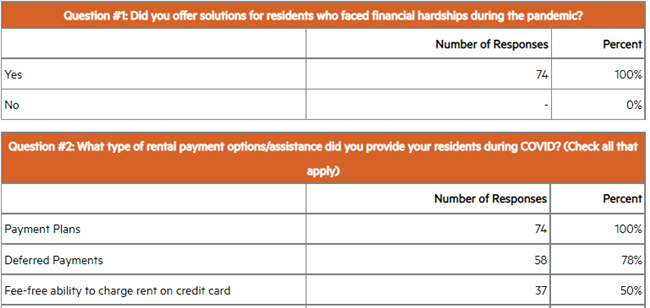
Property owners and landlords helped renters with eviction-mitigation efforts and offered solutions for residents facing financial hardships during the COVID-19 pandemic, according to a new survey from the National Multifamily Housing Council (NMHC).
Extended, shortened or other changes to lease terms – 58 percent
Cash for keys – 54 percent
Fee-free ability to charge rent on credit card – 50 percent
The survey also asked what additional steps firms took to support residents during the pandemic:
Increased cleaning and sanitation – 95 percent
Connecting residents with food banks, charities, and other local support resources – 86 percent
Informing residents of healthcare protocols and best practices – 86 percent
Hosting virtual social or exercise events – 57 percent
Creating on-site services at communities to support residents – 50 percent
Made it easier to work from home – 49 percent
“At the onset of the pandemic we issued a call to our industry to halt evictions, create payment plans and work with residents as they faced this unprecedented hardship. The new data demonstrate how both the multifamily industry and residents alike made monumental sacrifices to meet their obligations during this crisis,” said NMHC President Doug Bibby in a release.
“As we transition away from these emergency pandemic orders, we ask apartment firms to continue their efforts to work with residents during this wind-down period,” Bibby said.
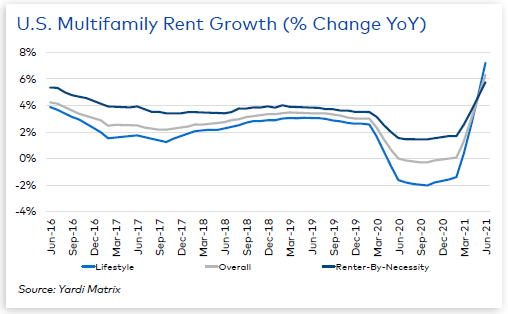
The first half of this year saw outstanding rent growth in multifamily rental properties and while that is probably not going to be sustained, strong multifamily performance will continue in the second half of 2021, according to Yardi Matrix.
In their summer report for 2021 entitled “Multifamily Emerges Strong from the Pandemic,” the company says that while rent growth seen in the first half of 2021 cannot continue indefinitely, “conditions for above-average growth in these metros (southwest and southeast) are likely to persist for months. With rents increasing by almost double digits in many markets on a year-over-year basis, the cost-of-living gap between what have been considered “lower-cost cities and gateway markets is starting to narrow.”
The rapidly growing tech hubs of Phoenix, Las Vegas, Atlanta and Tampa show that, “People migrating into these cities can afford the large price increases. But longtime residents are deeply affected by the accelerated rent growth,” Yardi Matrix says in the report.
Chart courtesy of Yardi Matrix.
Why conditions for continued growth are strong
Pent-up demand and the recovering economy have produced robust rent growth this spring.
The U.S. economy is growing at its fastest rate in decades, as progress with the COVID-19 vaccine has allowed people to resume normal activities.
Potential headwinds include rising inflation and whether employees can find enough workers.
Many secondary markets continued to post dazzling increases, and gateway markets such as New York and San Francisco are rapidly rebounding from the pandemic.
New apartment supply, which dipped only moderately during the pandemic, is expected to bounce back to about 334,000 units in 2021.
Capital markets remain one of the strongest aspects of the multifamily business.
While the economy is coming back, employment and labor participation are still lagging, especially in the service sectors that were hit hard by the pandemic, the report says.
New apartment construction is particularly affected by supply-chain issues and challenged with dramatically rising steel, lumber and copper prices; copper and lumber prices have more than doubled from this time last year. “Not only is demand for building materials coming back in full force but pandemic restrictions are making it more difficult to obtain them,” the report says.
New apartment construction is impacted by rising lumber prices and supply chain issues.
“Volatility is likely to continue for a few years as the world fights to contain the virus, until global vaccine implementation allows economies to fully recover and return to pre-pandemic stability. However, that does not mean there won’t be strong economic growth in certain sectors and geographies in the short term,” Yardi Matrix says in the report.
Yardi Matrix researches and reports on multifamily, office and self-storage properties across the United States, serving the needs of a variety of industry professionals. Yardi Matrix Multifamily provides accurate data on 18+ million units, covering more than 90 percent of the U.S. population. Contact the company at (480) 663-1149
There are various strategies when using DSTs (Delaware Statutory Trusts) in a 1031 exchange. Some investments are as easy as a simple exchange from one property into a single DST. Other times DST’s are used to invest leftover equity from an exchange so the investor is not taxed on leftover funds, called “boot”. Investors will routinely use DSTs as a backup ID in case their target replacement property doesn’t work out. And occasionally, Kay Properties will assist an exchanger to utilize all said strategies in one sophisticated effort to mitigate risk and defer as much tax as possible. Read on for the experience of a highly skilled 1031 DST specialist.
A real estate investor sold an investment property for approximately $2M. Roughly 25% of his property was leveraged. Therefore, $1.5M was sitting in his qualified intermediary account. He then contacted Kay Properties to pursue a partial 1031 DST exchange. The exchanger wanted to purchase a property on his own, but something smaller and easier to manage than the property he recently sold. He wanted to put part of his exchange into a completely passive DST option that would require no management on his part. The DST part was relatively easy. However, he was having a hard time finding a replacement property to own outright, and the 45-day clock was ticking. Kay Properties created a multifaceted strategy that supported the investor from a variety of angles.
First, the exchanger used the debt built into the DST to replace his mortgage. The Kay Properties representative created a DST portfolio for the investor with a loan-to-value of approximately 50% to match the exact debt required to satisfy the 1031 exchange regulation. The debt was non-recourse, meaning the investor did not need to apply or sign for the loan, nor did it show up on his personal balance sheet. This freed him up to purchase a smaller property to own outright without taking out a mortgage, which increased his probability of closing.
Next, the exchanger used a DST as a backup ID in case the target property did not work out. The due diligence period on the replacement property extended past the 45-day period. If inspections exposed an issue that compromised the deal, the exchanger would be vulnerable to over hundreds of thousands of dollars in taxes. However, since the Kay Properties representative advised the client to use a DST as a backup ID, the exchangers risk of a failed exchange was significantly mitigated.
Finally, Kay Properties assisted the investor to ensure there was no leftover equity by using the DST to invest the leftover boot. After the exchanger and the seller agreed on a price, he realized there was approximately $50,300 of exchange funds left over. Kay Properties found a DST to invest that exact amount to finish up the exchange.
When one has the knowledge and the assistance of a skilled DST 1031 specialist, an investor can mitigate risk and protect themselves from a failed exchange in a variety of ways. Through the assistance and guidance of Kay Properties, the exchanger in this case split funds into both DSTs and his own property, replaced his debt with a non-recourse loan, protected his exchange with a backup ID, and took care of the leftover boot. These high level DST skills often are not available to investors who choose to work with unaware financial planners with little-to-no understanding of real estate, 1031 exchange strategies and DST investments. Fortunately, the client was working with Kay Properties. If you are interested in learning more on how to use a DST to mitigate risk and defer taxes in your 1031 exchange, contact Kay Properties by registering at www.kpi1031.com.
Kay Properties is a national Delaware Statutory Trust (DST) investment
firm. The www.kpi1031.com platform provides access to the marketplace of DSTs from over 25 different sponsor companies, custom DSTs only available to Kay clients, independent advice on DST sponsor companies, full due diligence and vetting on each DST (typically 20-40 DSTs) and a DST secondary market. Kay Properties team members collectively have over 115 years of real estate experience, are licensed in all 50 states, and have participated in over $21 Billion of DST 1031 investments.
This material does not constitute an offer to sell nor a solicitation of an offer to buy any security. Such offers can be made only by the confidential Private Placement Memorandum (the “Memorandum”). Please read the entire Memorandum paying special attention to the risk section prior investing. IRC Section 1031, IRC Section 1033 and IRC Section 721 are complex tax codes therefore you should consult your tax or legal professional for details regarding your situation. There are material risks associated with investing in real estate securities including illiquidity, vacancies, general market conditions and competition, lack of operating history, interest rate risks, general risks of owning/operating commercial and multifamily properties, financing risks, potential adverse tax consequences, general economic risks, development risks and long hold periods. There is a risk of loss of the entire investment principal. Past performance is not a guarantee of future results. Potential cash flow, potential returns and potential appreciation are not guaranteed.
Securities offered through Growth Capital Services, member FINRA, SIPC, Office of Supervisory Jurisdiction located at 582 Market Street, Suite 300, San Francisco, CA 94104.
The National Apartment Association has filed suit in U.S. Court of Federal Claims to recover damages on behalf of landlords and rental housing providers who have suffered severe economic losses under the U.S. Centers for Disease Control and Prevention’s (CDC) federal eviction moratorium, according to a release.
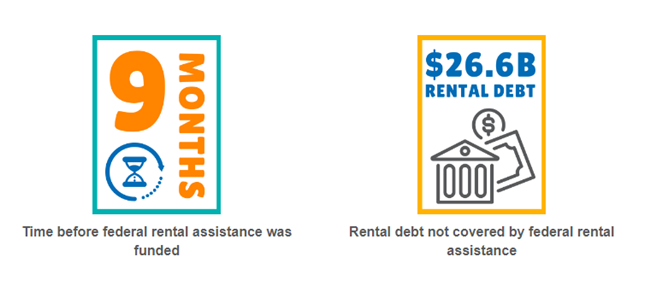
Though the federal government has allocated roughly $47 billion in federal rent relief in combined December 2020 and March 2021 legislation, “it took more than nine months for Congress to do it. This prolonged inaction, paired with a sluggish rollout and the CDC eviction moratorium, has allowed rent debt to continue to balloon – devastating the industry in the short-term and fueling the housing affordability crisis, to the detriment of the broader economy, in the long-term.”
Saying the eviction moratorium has “saddled renters with crippling debt,” Bob Pinnegar, NAA President and CEO, said in the release that the eviction ban “has jeopardized not only the availability, but also the future cost of rental housing. NAA is standing up for an industry – and its residents – that are left holding the bag on $26.6 billion in rental debt after operating under extreme conditions for 16 months.
“The government has intruded into private property and constitutional freedoms, and we are proudly fighting to make owners whole and ensure residents’ debt is wiped from their record,” Pinnegar said.
Apartment owners and operators “have continued good-faith operations throughout the COVID-19 pandemic and are now left to shoulder $26.6 billion* in debt not covered by federal rental assistance.”
The suit, NAA et al. v. The United States of America, argues that the CDC order has curbed several rights under the U.S. Constitution, including: the right to access the courts, the freedom to contract with others absent government interference, the right to demand compensation when property is taken by government action, and the limits of federal government power.
“With little hope of receiving additional federal assistance, NAA is seeking to limit the loss borne by rental housing providers and, ultimately, clear the debt records of their residents. Doing so will help secure the long-term health of the rental housing industry and ensures households across the income spectrum have continued access to rental housing,” the release says.
NAA is represented by two firms, Dorsey & Whitney and the law office of John McDermott.
This lawsuit is open to all rental housing providers who operated under the federal moratorium and who have been damaged by the CDC eviction moratorium. For more information about the lawsuit, please visit here.
*$57.3 billion in rent debt at the end of 2020 (Urban Institute) + $8 billion in Q1 2021 (Mortgage Bankers Association) + estimated $8 billion in Q2 2021 (MBA, Q2 numbers expected soon) – just under $47 billion in allocated rental assistance = $26.6 billion in unfunded rent debt (and climbing).