
Coworking has replaced the traditional apartment business center as 75% say access to coworking spaces directly influences their decision to renew their lease.
By Becky McLaughlin
For years, the business center was treated as a baseline amenity in multifamily communities. It represented productivity, access and modern living. Today, many of those spaces sit unused, built around assumptions about work that no longer hold true.
Zillow’s 2024 analysis of 5.6 million U.S. rental listings highlights just how much expectations have changed. Apartments that continue to promote business centers receive 24% fewer saves and 27% fewer shares per day. Properties that highlight coworking spaces, on the other hand, see a markedly different response, with 16% more saves and 23% more shares.
That contrast reflects more than a naming preference. It points to a structural change in how residents integrate work into their daily lives and how shared spaces either align with that reality or fall behind it.
In a market where vacancy is elevated and rent growth is tightening, amenity decisions carry more weight than they did just a few years ago. Owners and operators are increasingly evaluating not just whether a space exists, but whether it actively contributes to renewals, occupancy, and long-term perceived value.
Why the business center lost relevance
Well before remote and hybrid work became mainstream, residents were already carrying their offices with them. Laptops, smartphones and tablets became everyday essentials, untethering work from a single room or piece of equipment.
As work became portable, fixed locations lost relevance. With 75% of employed adults now working remotely at least some of the time, and hybrid job postings up 60% over the past two years, demand for traditional workrooms has rapidly declined.
Work now happens wherever it makes sense. At a kitchen table. In a bedroom. Outdoors. For property owners, that reality changes the equation. A static business center no longer influences satisfaction or retention, because it was never designed to support this kind of flexibility. As a result, residents rarely factor it into leasing decisions.
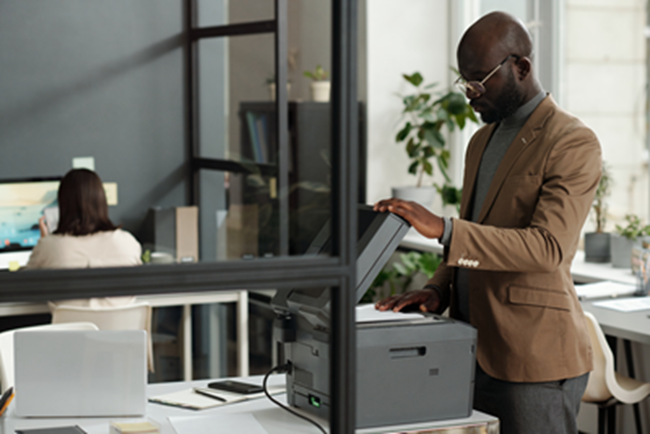
Security concerns further limit usage. Shared printers and copiers, a core feature of business centers, have developed a reputation for storing and selling data. And when personally identifiable information has to flow through shared desktop computers, it’s not just an IT headache, it’s a liability, especially as data-privacy legislation continues to become more stringent.
Residents concerned about security will obviously avoid these spaces entirely, and in a competitive market where every square inch matters, that hesitation can be detrimental to a property’s appeal. As of October 2025, U.S. multifamily vacancy sits at 7.2%, the highest level in Apartment List’s index since 2017.
Rent growth is only projected to reach 2.6% by year’s end. In this environment, underperforming spaces do more than sit unused. They weaken perceived value and put pressure on revenue.
How residents approach work today
Residents no longer work in one place for eight hours straight. They move through a property depending on the task. Video calls happen in private soundproof pods. Deep focus shifts to quiet lounges. Short check-ins happen near a coffee bar.
The expectations are not excessive, but they are precise. Comfortable seating near natural light. Soundproof areas for important calls. Power outlets within easy reach. When those fundamentals are in place, people stay longer and return more often.
WithMe, Inc.’s recent resident survey found that 28% of residents use shared spaces for work either exclusively or alongside their apartment, while another 22% divide their time evenly between the two. More importantly, 75% say access to coworking spaces directly influences their decision to renew their lease.
Supporting a mobile workforce
If residents move throughout the property while working, the infrastructure must support that movement.
Wi-Fi coverage can’t stop at the leasing office. It needs to extend across coworking areas, common spaces and outdoor zones. When connectivity is inconsistent, residents will simply go elsewhere.
Daily use amenities matter more than ever. Technology-powered office essentials, like self-serve printing and on-demand premium coffee, can create consistent engagement without increasing operational strain. These features become part of daily routines because they solve real, recurring needs.
Variety in the space matters as well. Small collaboration spaces for two to four people consistently see stronger usage than oversized conference rooms. Individual focus areas need privacy, soundproofing and seating that supports full workdays. Conference rooms still serve a purpose, but they are no longer the focal point. Adaptability now carries more weight than scale.
When evaluating whether a coworking space is actually performing, owners should be asking a few simple questions. Does it support multiple work modes throughout the day? Is it easy for residents to move in and out without disruption? And does it rely on amenities people genuinely use, not just ones that photograph well?
In tight markets, properties that perform best are the ones designed around how residents work today, not how workspaces were imagined in 2010.
Moving beyond the business center
Business centers made sense when shared equipment was unavoidable and high-speed internet was not guaranteed. That era has passed.
Today’s residents value flexibility, mobility and spaces they actually use. Removing a business center is not about eliminating work support. It is about aligning amenities with modern lifestyles.
Every square foot must justify its presence. When it no longer does, it is time to rethink how that space is used. The most resilient properties treat shared space as an evolving asset, not a fixed line item.
About the author:
Becky McLaughlin is the senior vice president of revenue at WithMe, Inc. She has more than 20 years of experience and has led marketing teams in healthcare, technology, and insurance. Becky earned her Bachelor of Science from Syracuse University’s Newhouse School of Communications.