

Apartment landlords and property investors borrowed record sums at historically low rates. As the bill comes due and interest rates rise, ‘the chickens are coming home to roost,’ the Wall Street Journal reported.
Few investors are feeling more pain from rising interest rates than America’s apartment landlords.
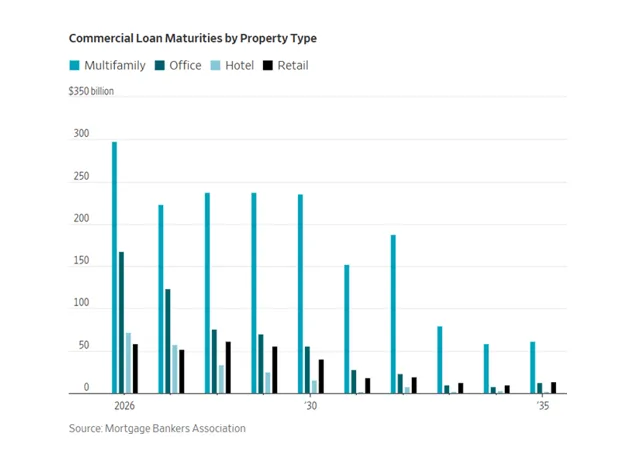
These property owners face a bill of more than $1.8 trillion in debt over the next decade. From this year to 2028, about $757 billion of those loans are coming due, according to the Mortgage Bankers Association. That is the most of any commercial real-estate sector.
Nearly $300 billion of those loans are maturing in 2026 alone. This follows a record-setting 2025, when $310 billion in loans came due, the highest the sector had seen in a single year since the Mortgage Bankers Association started tracking. Another $223 billion is due next year.
Now, after the Federal Reserve raised rates a quarter point and with bond yields rising, that debt is about to become a much bigger burden. Landlords are having to refinance when borrowing rates are roughly twice the level of five years ago, when many of these loans were made.
When apartment-mortgage rates tumbled to historic lows of around 3% in 2020 and 2021, multifamily buildings were the hottest investment in commercial real estate.
Apartment rents, meanwhile, were surging at double digits nationwide. Multifamily became a refuge for real-estate investors amid the doom spiral in other sectors.
“There was a sense of relative euphoria,” said Mike Wolfson, Newmark’s managing director for multifamily capital-markets research. “But things turned very quickly.”
New apartment construction flooded the market, mostly concentrated in the Sunbelt region. Cities such as Phoenix, Denver, Atlanta and Austin, Texas, were inundated with new luxury apartments and not enough people to fill them.
Fast forward, many of the same apartment landlords riding high are now preparing to sell at a loss, hand back the keys to their lenders or reconfigure their balance sheets to shoulder millions more in mortgage payments after refinancing.
The financial strain is already causing developers to pare back on new construction and instead buy distressed properties at a sharp discount.
“The chickens are coming home to roost for a lot of people,” said Sean Burton, chief executive of the multifamily firm Cityview.
AI Tools Allow Renters To Falsify Pay Stubs In Income Verification
What Seattle’s Rental Fee Ban Means For Pets And The Rest Of The State