
The September rent growth national median rent dipped down by 0.1 percent in September, marking the first monthly decline since January, according to the October report from Apartment List.
The transition from increasing to decreasing rent prices is expected at this time of year as this is consistent with the market’s usual seasonality.
Fewer renters tend to move in the fall in winter months, and so property owners offer modest discounts to attract demand and fill vacant units at this time of year.
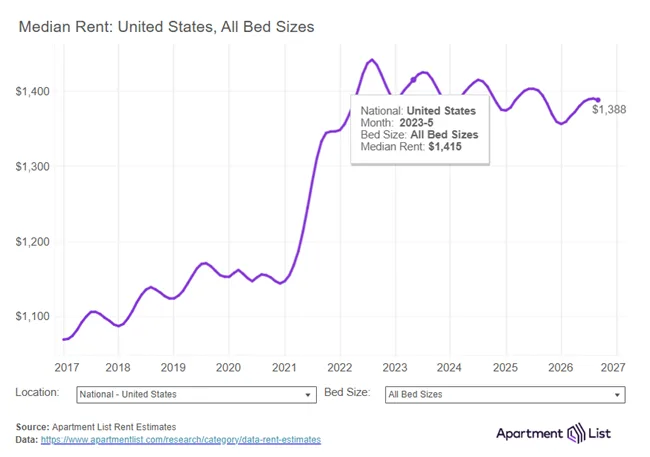
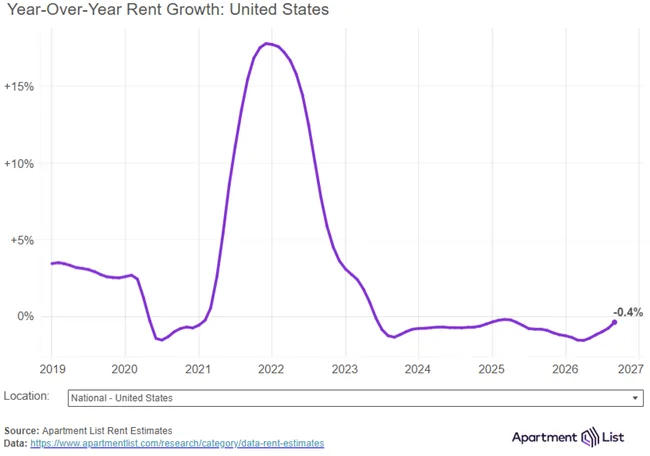
The national median rent now stands at $1,388. Rents are still down 0.4% compared to one year ago, but year-over-year rent growth has been steadily inching up and the vacancy rate is moving down, signaling a gradual tightening of rental market conditions.
What the fall rent dip trend actually shows
Apartment List economist and researcher Chris Salviati and Rob Warnock write that, “even though rents have now dipped in September, that decline was notably more subdued than what we have seen not just in recent years, but also than what we saw in the pre-pandemic years when the market was well-balanced.
From 2022 to 2025, the average rent decline in September was -0.5 percent; from 2017 to 2019 it was -0.3 percent; this year it was just -0.1 percent. This is the first month in years that rent growth has outpaced the pre-pandemic average, offering the clearest signal yet of the rental market’s rebound.”
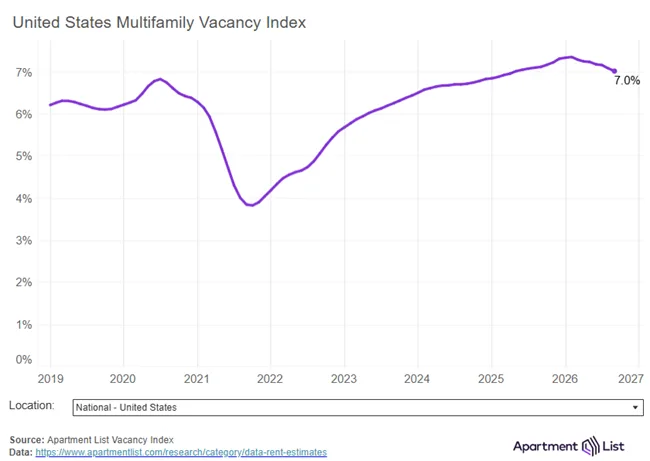
Multifamily vacancy rate ticks down to 7%, continuing its decline
The vacancy rate has been slowly creeping down, and fell to 7 percent in September. This recent inflection comes after four-plus years during which the vacancy rate gradually loosened from record lows to record highs.
The vacancy rate remains elevated above its long-run average, but it has now moved past its peak and is slowly returning to levels more in line with balanced market conditions. That said, if the current pace of tightening continues, it will still be over a year before the vacancy rate falls back to the 2017 to 2019 average of 6.4 percent.
List-to-Lease time remains elevated at 34 days
Salviati and Warnock write, “This month’s reading is the longest that we’ve seen in any September going back to 2019 when our tracking begins (January’s 41 days set the overall record).
Units are taking two days longer to turn over than at this time last year, and more than two weeks longer than they were in September 2021 when the market was at its hottest. This lengthened list-to-lease time is a reminder that despite the recent inflection points in pricing and occupancy, rental market conditions remain fairly cool overall.
Conclusion
It appears that the rental market is poised for continued strengthening in pricing and occupancy. “If the year closes out on a similar trajectory to the one it’s been on, 2026 will be the first year since 2022 with positive full-year rent growth.”