Home Blog Page 36

Justice Department Preparing Rental Price Collusion Civil Suit

The Justice Department is looking into rental price collusion and considering a civil lawsuit over rent-settling algorithms

The U.S. Department of Justice (DOJ), which has been looking into rent-settling algorithms, is now considering a civil lawsuit against a software company that it believes allows rental price collusion among large landlords to fix prices, according to ProPublica.

The DOJ staff has recommended a lawsuit against RealPage Inc., a software company used by landlords across the country, according to two people with knowledge of the matter, ProPublica reported.

The civil lawsuit against RealPage “would accuse the company of selling software that enables landlords to illegally share confidential pricing information in order to collude on setting rents,” the report says.

“The recommendation escalates the investigation to the antitrust division’s leadership, including Assistant Attorney General Jonathan Kanter. Also on the table for a complaint is the landlords’ ability to use the software to match vacancy rates, essentially restricting supply, at competing buildings in the same rental market, said the people, who were granted anonymity to discuss a confidential investigation,” ProPublica said in the report.

RealPage and the property companies have argued in court that the allegations do not support any agreement to fix prices. Among their arguments, the property owners and managers say there is no evidence of any conspiracy of rental price collusion, beyond that they are all clients of RealPage.

Multiple tenants across the country have sued RealPage claiming the tech company’s apartment software led to rental price collusion by landlords to inflate rents. The lawsuits from around the country were consolidated in federal court in Nashville.

RealPage and dozens of property owners and managers are already the targets of a class-action lawsuit brought by renters. There are also suits filed by attorneys general in Washington, D.C., and Arizona. The North Carolina attorney general recently announced that his office is also investigating.

In Arizona, Attorney General Kris Mayes has filed a lawsuit against RealPage, Inc. and nine major residential apartment landlords operating in Arizona for price-fixing and conspiring to illegally raise rents for hundreds of thousands of Arizona renters in the Phoenix and Tucson metro areas, according to a release.

Read the full report from ProPublica here.

Sign Up For Our Weekly Newsletter And Get Rental Property And Apartment News And Helpful, Useful Information Each Week.

* indicates required

How To Enhance Leasing Efficiency With Automation Tools

Leasing efficiency means finding ways to avoid missing leads that come in to busy property managers by leveraging automation tools.
Busy property managers can miss leasing leads without the help of automation tools.

Leasing efficiency means finding ways to avoid missing leads that come in to busy property managers by leveraging automation tools.

By Kevin Juhasz

The multifamily housing industry has witnessed a significant shift in consumer behavior, one in which potential residents almost always rely on online platforms to research, compare and make informed decisions about their next apartment.

When a prospect reaches out, follow-up times of one or two days are increasingly unacceptable in today’s competitive market.

In an era where savvy renters inquire at all hours, timely responses are crucial. Onsite teams, despite their best efforts, often miss nearly 20% of leads while attending to current residents and other prospects. This issue has highlighted the importance of having a robust digital presence and leveraging automation to convert prospects into tenants.

Challenges in follow-up

Onsite teams face numerous challenges in their daily operations, from managing resident requests and interactions to responding to inquiries.

While 84% of leasing teams have a standard process for managing leads, ranging from manual solutions to automated solutions, 75% of leasing teams still report that they are missing some quality leads, according to a 2024 report by Rent.

With a myriad of responsibilities, it can be challenging for these teams to dedicate the necessary time and resources to follow up on every inquiry promptly and effectively.

Missed leads can have a detrimental impact on occupancy rates and overall success. In highly competitive markets, prospects will quickly move on to other options if their inquiries are not addressed in a timely and professional manner.

These missed opportunities can significantly affect the bottom line of owners and operators, including lost revenue and dropping occupancy rates.

Tools For Supporting Lead Generation and Nurturing

Leveraging technology can significantly enhance the ability to nurture leads more effectively.

According to the Rent.com study, 82% of multifamily professionals use automated communication; but among those, only about half of these communications are automated. The challenge in today’s marketplace is to use an effective combination of tools and strategies to streamline the process for both teams and prospective residents.

Whether automation results in getting leases to the finish line, helps narrow the right prospects or enables effective person-to-person interaction, the goal should be to ensure that no lead goes unaddressed. Teams can start by making sure the following are in place:

  • Automated capture – Integrating lead-capture solutions on a property’s website and social media platforms can ensure that every inquiry is promptly recorded and tracked.
  • Management systems – CRM platforms allow onsite teams to organize and prioritize leads, assign follow-up tasks and track interactions.
  • Automated communication – Utilizing automation tools can enable personalized and timely communication with prospects through email, text messaging and chatbots, providing a seamless and engaging experience.

Automation tools in the rental journey

Initial inquiries, tour scheduling, and re-engagement efforts for lapsed inquiries are key touchpoints where automation can make sure things don’t slip through the cracks.

Regardless of staffing fluctuations, office hours, or number of inquiries, automation can quickly and easily address these crucial opportunities, allowing teams to engage with more serious prospects.

Automation tools to improve conversion rates

Automation doesn’t have to stop at booking a tour.

More sophisticated platforms can not only streamline processes and enhance efficiency for teams, but also provide a superior experience for future residents.

  • Lead-scoring and prioritization – Automated lead-scoring algorithms can prioritize leads based on their likelihood to convert, directing focus to the most promising opportunities.
  • Task automation and reminders – By automating follow-up tasks and setting reminders, teams stay on top of lead-management responsibilities after inquiries and tours, ensuring timely and consistent communication.
  • Reporting and analytics – Automated reporting and analytics tools offer valuable insights into lead sources, conversion rates and marketing campaign performance, enabling data-driven decision-making for continued performance.

While it can feel intimidating, technology can significantly enhance lead-management efforts to improve leasing efficiency.

The biggest roadblocks in lead nurturing— including no follow-up, inconsistent follow-up, and incorrect/inauthentic follow-up— can be virtually eliminated by implementing cutting-edge solutions and implementing a tech-driven marketing strategy.

Multifamily communities can effectively capture and nurture leads, streamline operations and provide a superior experience for potential residents. By adopting best practices, multifamily properties can unlock the full potential of technology and drive occupancy rates, net operating income and overall success.

About the author:

Kevin Juhasz is a content manager for LinnellTaylor Marketing and a writer, editor, and storyteller.

Sign Up For Our Weekly Newsletter And Get Rental Property And Apartment News And Helpful, Useful Content Each Week.

* indicates required

Photo credit otortion via istockimages

Top Apartment Operators Figure Out AI’s Best Daily Uses

A webinar panel discusses applying artificial intelligence's (AI) best daily uses for top apartment operators and for solving “pain points.”
Companies in all asset classes are discovering and building upon the technology, helping their teams save time, be more productive, and solve pain points

A webinar panel discusses applying artificial intelligence’s (AI) best daily uses for top apartment operators and decision-making for solving “pain points.”

By Richard Berger

Commercial real estate is not trailing the business world when it comes to applying artificial intelligence (AI) to its operations and decision-making.

Companies in all asset classes are discovering and building upon the technology, helping their teams save time, be more productive, and solve pain points. In some cases, AI-driven virtual-leasing assistants and website chatbots have been humanized; Companies are giving these tools actual names, such as Veris Residential’s “Quinn” and “Taylor.”

AI’s growth and implementation were discussed recently during a webinar hosted by executive search firm Jackson Lucas, featuring Nicole Jones, senior vice president for marketing and communications for Veris Residential; Lisa Tully-Lavian, senior vice president for customer experience at Bell Partners, and Chris Urwin, strategic advisor for VARi Knowledge Partners.

Jones mentioned many ways AI helps on a day-to-day basis, including driving qualified leads to her leasing team and being leaned on in a pinch to help craft formal executive letters or marketing copy.

“Early on, many were afraid or nervous about using AI, but now you hear about it at every conference,” Jones said. “As a person so focused on our clearly defined brand and style, I wondered how an AI tool could come into play.

“But we’re using it to solve pain points and it’s helping to modernize the process, and in a branded way,” she said.

Her company started by training the tool, Jones said, giving it two personas. One is “Quinn,” a friendly version used when addressing residents and prospects on basic apartment living. The other is “Taylor,” one that takes on a more executive, authoritative persona, such as when residents are delinquent on their rent.

As for the qualified traffic to the on-site teams, “Before, we had these leads but might not have had time to address them, much less with personalized responses,” Jones said. “Now that we’re using this [product from EliseAI], the results have been astonishing. It took the ‘paper cuts’ off our staff members’ plates and let them focus more on giving better customer service.”

Whereas Veris Residential previously managed its leads through email and Microsoft Outlook, Quinn is helping the teams see and analyze all conversations with the customers.

“Our goal was to deal with our customers in a customizable way and then convert them,” Jones said. “When we launched Quinn, we could address leads that weren’t responded to. Our goal wasn’t to reduce our staff. AI is a member of our team. We integrate Quinn into everything to make sure he serves a purpose. Quinn is a person to us. We humanized him. We give Quinn information multiple times every day.”

Tully-Lavian noted that AI is adept at responding to questions about lease terms and conditions. “It also can more efficiently alert onsite teams about a resident’s lease expiration so that they can address renewals in a timely way,” she added.

Jones said, “It provides us with information about our residents and prospects that would’ve previously been a huge heavy lift for our on-site teams to get done.”

Jones said customers don’t care if they’re interacting with AI if it seems like a human interaction.

Even better, Jones said Veris Residential’s upfront spend on marketing is much more efficient.

‘Nervous Concerns’ about AI are ‘Overblown’

The panel said that implementing AI for apartment operators can be daunting. Urwin acknowledged that real estate people and technology people tend to speak different languages.

“The nervous concerns that you hear about AI, though, are overblown,” Urwin said.

However, gaining trust in each other about using AI and what it’s capable of comes with small wins that can lead to bigger ones, he said. Those small wins will make things “less scary,” he said.

AI processes are fed data that “has to have a single source of truth” on a daily basis, he said. As the AI industry likes to say, “The best AI comes from the best data.”

Solving issues through AI for apartment operators relies on well-crafted prompts (or commands asked of the AI software). Urwin said the best way to write prompts is to provide context about what is needed.

“Give the background,” he said. “Be specific. Don’t be afraid to iterate. You can’t offend these tools – they don’t have emotions – so you can tell them they’re wrong. You can revise their prompt to get a better answer.”

Urwin said companies wanting to delve into AI should identify their questions or problems and proceed from there, tooling their systems to provide answers through a combination of large language models and proprietary data.

“New tools bring new capabilities,” Urwin said. “You can use AI as an end-to-end tool, working with it continuously and teaching it things from the real estate companies’ perspectives.”

Jones said her company is not “big enough” to build an in-house AI tool.

She said, “Find a partner to work with who will communicate with you and figure out how to address your issues. This benefits them, too, because they have other clients who have the same points.”

Urwin said all commercial real estate asset classes could benefit because “they all have pain points they want to solve,” and that, today, AI is being used more on an operations basis rather than for strategy. Having AI involved in strategy is the next frontier.”

The quality of the data is key, as machine learning is only as good as the data being inputted. Tully-Lavian went on to emphasize that data gathering requires a thoughtful process that is not too intrusive, and that cybersecurity should be of paramount importance.

“You have to remember people aren’t numbers, and they aren’t algorithms,” she said.

Specific AI Tools For Apartment Operators 

Urwin said certain generative AI tools (such as OpenAI, Copilot, Claude, and Perplexity) are more skilled than others at doing particular tasks.

He said he finds ChatGPT best for data analytics. Claude is better at creative content—it can read and remember PDFs. Perplexity is good for compiling topical research.

Jones is finding other uses for AI, such as using it as a shortcut to draft an executive letter. “I can then clean it up,” she said. “It gives me a good place to start.”

She also uses it to write a SWOT analysis (strengths, weaknesses, opportunities, threats) on her competitive set or write marketing copy in seconds.

AI can analyze and summarize a collection of anecdotal comments from residents, reviews, etc., and categorize them to find the most common words or phrases that indicate what the community needs to improve and what it’s doing well.

“It’s one thing for an on-site staff person to say, ‘Well, everybody has a dog.’ But is that true?” Jones said. “We can look at the comments to either verify or correct that.”

Tully-Lavian summarily said AI is creating a paradigm shift in every industry.

“Companies need to look at it and not be left flat-footed,” she said. “AI does what technology is supposed to do, which is to make it easier for people to do the things that they want to do. We look at our data to help predict behaviors and empower our associates with this information so they may provide quality and personalized service for our residents.”

About the author:

Richard Berger is a freelance journalist who has 20+ years of experience covering commercial real estate for various media sites and CRE-related associations. He lives in Northern Virginia.

Sign Up For Our Weekly Newsletter And Get Rental Property And Apartment News And Helpful, Useful Content Each Week.

* indicates required

Rent Prices Continue Up For Sixth Month In A Row

Rent prices continued up in July for the sixth month in a row, Apartment List says in its August report while vacancies climb

Rent prices continued up in July for the sixth month in a row, Apartment List says in its August report.

However, the Apartment List research team warns that rent growth is modest.

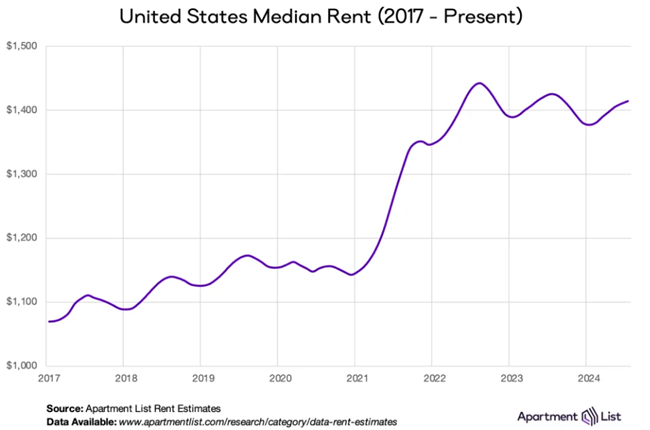
“While month-over-month rent growth remains positive, it is decelerating. Prices increased just 0.2% in July and today the nationwide median rent stands at $1,414. It is very possible that rent growth will turn flat or negative in August, and stay there for the remainder of the year,” researchers write.

Busy Rental Season Coming To An End

“The busy rental season – which turned out not to be that busy – is coming to an end. July posted a 0.2% increase in rents nationwide, but it’s likely that rent growth will fall below zero next month, and stay there for the rest of the calendar year.
“In July, nationwide rents rose $4 (0.2%) but remain $11 (0.8%) cheaper than one year ago. This is the second year in a row where supply growth has kept rent growth in check, despite improvements on the demand side of the market. Geographic patterns have held steady: rent growth remains faster in the Midwest and Northeast, while markets in the South and West are seeing the sharpest declines,” writes Igor Popov, Chief Economist

for Apartment List.

Rents are up 0.2% month-over-month, down 0.8% year-over-year

“Rent growth follows a seasonal pattern – prices tend to go up during the spring and summer and dip during the fall and winter. Today we are nearing the end of that busy summer season, but this year’s trend is not bringing elevated rent growth. The nationwide median rent has increased for six straight months; however, the pace of that positive rent growth is slowing, with rents up 0.2 percent in July, compared to 0.4 in June and 0.6 percent in May,” the report says.

Rent prices continued up in July for the sixth month in a row, Apartment List says in its August report while vacancies climb

While 71 of the nation’s 100 largest cities saw rents go up in May, on a year-over-year basis, rent growth is positive for only 52 of these cities.

The report says seasonality has shifted slightly in the past two years. In both 2023 and 2024, peak monthly rent growth occurred in March, two months earlier than in pre-pandemic years. Since March, rent growth has slowly decelerated, reflecting the sluggish, supply-rich rental market that has persisted since late-2022.

Vacancies continue to increase

Rent prices continued up in July for the sixth month in a row, Apartment List says in its August report while vacancies climb

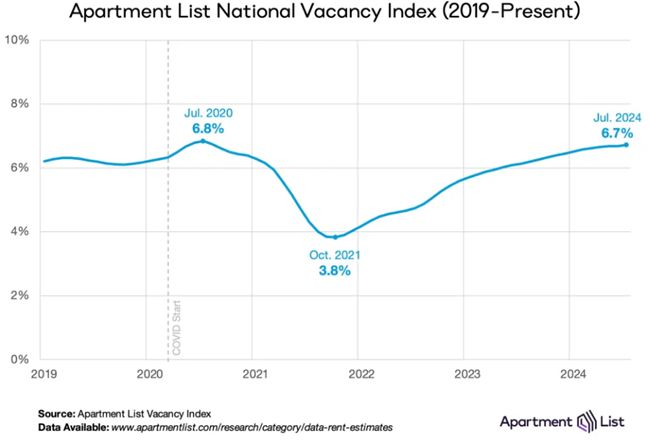
The research staff writes that through July, “our vacancy index sits at 6.7 percent, the highest reading since August 2020. And there’s good reason to expect that it could rise even further during the remainder of the year.

Despite a recent slowdown in new permits being issued and new construction projects breaking ground, the number of multifamily units under construction remains near record levels. 2023 saw the most new apartments complete construction in more than 30 years, and an even greater number of new units are expected to come on the market this year. This means that renters should have more available options than they have in some time, especially in the Sun Belt markets where construction activity has been strongest.”

Read the full report here

Sign Up For Our Weekly Newsletter And Get Rental Property And Apartment News And Helpful, Useful Content Each Week.

* indicates required

Entrata Announces New Collaboration with Freddie Mac Multifamily

Entrata has announced recently acquired Rent Dynamics is now working with Freddie Mac Multifamily as part of its credit-building initiative.

Entrata has announced that recently acquired Rent Dynamics is now working with Freddie Mac Multifamily as part of its credit-building initiative.

The collaboration will help renters build credit by reporting on-time rent payments to the top three credit bureaus.

Multifamily residents living in eligible properties backed by Freddie Mac financing can receive 24 months of credit-building services from one of Freddie Mac’s participating rent-reporting vendors.

“Entrata is honored to collaborate with Freddie Mac Multifamily in this potentially life-changing initiative as we continue to build and expand our industry-leading products and ecosystem to help multifamily community residents across the U.S.,” said Adam Edmunds, Chief Executive Officer of Entrata. “In collaboration with Freddie Mac, Entrata’s resident services program will continue to empower residents and property managers alike as they make the most of our platform.”

Entrata’s rent-reporting program, a part of their larger resident services program, has already seen significant results with an average increase in credit scores across residents who have participated in the program. Data from Entrata also shows that rent reporting allows a significant number of residents to go from having no credit to being scored.

“Freddie Mac Multifamily is working to expand best practices in resident-centered housing across the multifamily industry, and that includes helping families establish or improve their credit scores,” said Corey Aber, Vice President of Mission, Policy and Strategy at Freddie Mac Multifamily. “We are confident that this collaboration with Entrata and Rent Dynamics will further our mission to make the multifamily industry more equitable and to strengthen the economic mobility of renters.”

Entrata has announced recently acquired Rent Dynamics is now working with Freddie Mac Multifamily as part of its credit-building initiative.

In addition to its work with Freddie Mac, Entrata recently announced a similar continuation with Fannie Mae’s Multifamily Positive Rent Payment program. As Entrata continues to expand its resident services, it will continue to address the issues that residents face and add significant value to the millions of apartment units that Entrata services nationwide.

About Entrata

Entrata is a leading operating system for multifamily communities worldwide.

Entrata Acquires Colleen AI to Usher in New Era of Autonomous Property Management

Photo credit designer491 via istockimages

San Francisco Adopts Ordinance To Ban AI Rent Pricing Tools

San Francisco has become the first city to adopt an ordinance banning the use of artificial intelligence software to set rental rates

San Francisco has become the first city in the nation to adopt an ordinance to ban the use of artificial intelligence software to set rental rates, according to reports.

The Board of Supervisors has unanimously adopted an ordinance blocking the use and sale of artificial intelligence tools that allegedly enable price fixing by large corporate landlords.

“Banning algorithmic price gouging is pro-housing policy,” Supervisor Aaron Peskin said at a recent board meeting. “Let’s build housing for renters, not for real estate investors,” according to NBCbayarea.com.

The rent pricing tools legislation will go before the board for final approval on Sept. 3.

Peskin said he hopes the legislation will be a model for other local governments around the country, comparing the urgency around the ordinance to the city’s early regulation of Airbnb.

The city’s ordinance comes as the U.S. Department of Justice is investigating RealPage, a revenue management company whose software is used by landlords to maximize rents. Attorney generals across the country have filed lawsuits alleging RealPage’s tools empower collusion and price-gouging among large corporate property owners, KQED reported.

Peskin, who introduced the legislation, said. “Wall Street has gotten into the housing business, and it’s a phenomenon we have seen here locally.” He said banning the software is “entirely consistent with our shared goal of a functioning housing market that meets our real housing needs.”

Tens of thousands of units in San Francisco are estimated to be owned by companies that use artificial intelligence software technology, according to Lee Hepner, senior legal counsel at the American Economic Liberties Project.

“Landlords, who should be ordinarily competing against each other, are instead adopting the price recommendations of this third-party revenue management software. And the effect of that is an old-fashioned price-fixing scheme,” Hepner told KQED. “It is not unlike the kind of price fixing that antitrust laws have addressed for well over a century.”

RealPage says the claims about the artificial intelligence software are false and housing affordability should be the focus.

“The time is now to address a number of false claims about RealPage’s revenue management software, and how rental housing providers operate when setting rent prices,” Dana Jones, RealPage CEO and President said in a statement. “Housing affordability should be the real focus. RealPage is proud of the role our customers play in providing safe and affordable housing to millions of people. Despite the noise, we will continue to innovate with confidence and make sure our solutions continue to benefit residents and housing providers, alike.”

The Budgeting Benefits of Reputation Management

Multifamily online reputation management is crucial to protecting reviews and distinguishing a rental property in the competitive space.

Multifamily online reputation management is crucial to protecting multifamily reviews and distinguishing a rental property in the competitive space.

By Kendall Pretzer

Reputation management has emerged as a crucial aspect of multifamily operations, encompassing strategies and techniques to monitor, enhance and protect a brand’s online presence.

Reputation management should not be reactionary, but instead an integral part of marketing for a property’s long-term financial health. By proactively managing their reputation, owners and operators can mitigate potential crises, build trust with customers and ultimately drive revenue growth.

Understanding the Importance of Online Reputation Management

According to the 2024 NMHC and Grace Hill Renter Preferences Survey, 71% of residents who referenced property ratings and reviews (e.g. Google, Yelp, ApartmentRatings.com) report that the content of the ratings and reviews has stopped them from visiting properties. Actively monitoring these platforms and promptly addressing customer feedback, both positive and negative, can feel daunting, but it is crucial for maintaining a community’s brand.

Negative reviews can deter prospects— 84% of renters report that reviews influenced their leasing decision— leading to a direct impact on overall property performance. Conversely, positive reviews, and how companies respond to them, can serve as powerful endorsements.

Reputation in multifamily goes beyond Google business profiles and Internet Listing Services. Engaging with customers and groups on social media platforms builds trust and fosters positive relationships as part of Online Reputation Management (ORM). Crisis management is also a part of ORM and having a well-defined plan in place can help mitigate the impact of negative publicity or poor reviews on a brand’s reputation.

Managing reputation to improve the resident experience

The most obvious benefit of effectively addressing concerns across all digital platforms is the opportunity to improve the resident experience. By actively managing online reputation and addressing concerns quickly, consistently and authentically, onsite teams can improve resident satisfaction. What’s better than a five-star experience? Sometimes it is converting a one-star into a five-star.

Consistency in communication and responsiveness has a trickle-down effect. As multifamily is also starting to see the long-term value of building a strong brand reputation, fostering customer loyalty and mitigating the potential impact of negative publicity has become crucial.

The bottom line is that no single property stands alone for today’s savvy residents, and it doesn’t matter how new or beautiful the apartments are. When prospects read reviews, they’re taking in all facets of those critiques — the community, customer service and resident experience — along with the quality.

 Reducing turnover reduces expenses

In the crowded market multifamily, a strong reputation can distinguish a community from its competitors, enabling it to attract more prospects and stabilize financial growth.

Monitoring online reviews and feedback allows owners to identify areas for improvement and streamline operations. Moving is usually no fun, and residents want to avoid it when they can. Increased responsiveness has a direct impact on resident retention, leading to cost savings and reduced turnover.

While the exact calculations for ROI will vary based on the specific location of a property and the type, there are key factors to consider across an entire portfolio. Owners and operators must examine the potential revenue increases resulting from higher occupancy rates and optimizing rental rates.

This goes hand in hand with thousands of dollars per unit in turnover costs when a resident leaves, which includes the time spent on attracting new residents. The financial impact of improved efficiency and reduced marketing expenses can be realized quickly.

 Reduced operational costs also benefit teams

While not always considered a line item in the marketing budget, ORM may need to be reframed as a necessary component in marketing goals and considerations.

 Prioritizing ORM is one of the most cost-effective ways to help the bottom line. The financial benefits are often realized by operational and marketing savings that are greater than the investment. Utilizing automated tools and software solutions to streamline monitoring, reporting and response processes will reduce manual labor and improve efficiency. This is also helped by investing in employee training and education programs to maximize the use of ORM solutions.

Companies will need to ensure that the solutions they implement will offer ORM management across all review channels and platforms, as well as  analytics and reporting tools that show the results of their teams’ efforts. This information should be both easily accessible and customizable, providing insights about overall property performance.

In today’s landscape, effective multifamily online reputation management is a critical component of a successful budget. By allocating the necessary resources and implementing effective reputation management strategies, businesses can build trust, enhance their online presence and ultimately drive revenue growth.

About the Author

Kendall Pretzer brings more than 30 years of experience in property management and supplier solutions to her role as the Chief Executive Officer at Grace Hill.

About Grace Hill

Grace Hill provides technology-enabled performance solutions that help owners and operators of real estate properties increase property performance, reduce operating risk and grow top talent. Its industry-leading solutions covering policy, training, assessment, survey and data-driven insights are bolstered by years of real estate experience, in-depth service-level expertise and outstanding customer support. Today, more than 500,000 real estate professionals from more than 2,300 companies rely on talent performance solutions from Grace Hill. Visit us at gracehill.com or on LinkedIn.

Sign Up For Our Weekly Newsletter And Get Rental Property And Apartment News And Helpful, Useful Content Each Week.

* indicates required

More Young Adults Living With Parents

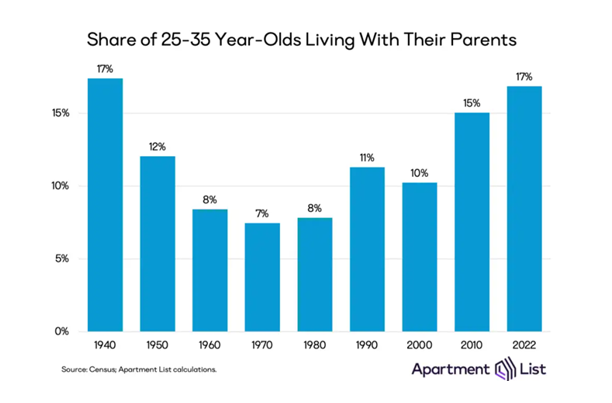
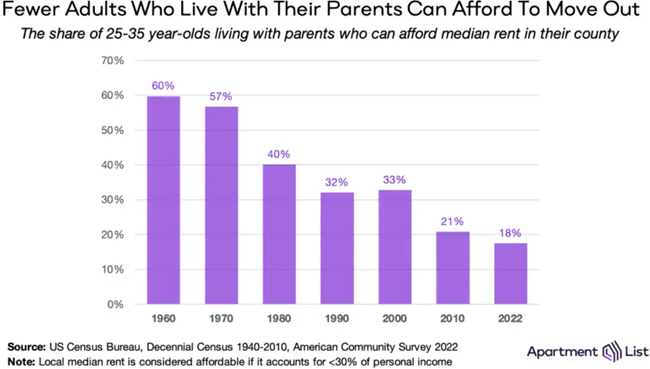
There are more young adults living with parents than at any point since the 1940s, says a new report from Apartment List economists.

There are more young adults living with parents than at any point since the 1940s, says a new report from Apartment List economists.

Housing affordability is forcing young adults between 25 and 35 to live with parents out of necessity and not out of choice.

“Fewer than one-in-five are earning incomes that would allow them to comfortably afford local rent prices, a far lower share than in the past. The prevalence of young adults living with parents is increasing in all parts of the country, and for both those with and without college degrees,” Apartment List Senior Housing Economist Chris Salviati writes.

Less than one in five earn enough to move out on their own

For the 25-to-35 age group incomes have gradually declined over the past few years.

For example, the median annual income of employed 25- to 35-year-olds who lived with their parents was $32,000. After adjusting for inflation, this was down by 10 percent compared to 2000.

“Among young adults who live at home, the share who could comfortably afford to live independently has fallen dramatically.

“For the purpose of this analysis, we assume that an individual was in a financial position to move out of their parents’ home if they could have paid the median rent for studio and 1-bedroom apartments in the county where they lived without spending more than 30 percent of their individual income on rent,” Salviati writes.

As of 2022, just 18 percent of young adults living at home were earning incomes that would have allowed them to comfortably strike out on their own.

There are more young adults living with parents than at any point since the 1940s, says a new report from Apartment List economists.

College degrees make a difference

Those with college degrees are less likely to live with parents, even though some do.

However, “Young-adults without college degrees are far more likely to live with their parents; one-in-five of them live at home, a rate that has more than doubled from just 8 percent in 1980. The non-college-educated make up 71 percent of all 25- to 35-year-olds who live with their parents,” the report says.

Summary 

The report concludes that living at home is more prevalent among those without degrees, but the number of college-educated young adults who live with their parents is also higher than it’s ever been, as growing student debt exacerbates the pressure of high housing costs.

“This trend speaks to the way in which today’s economic realities are forcing many of America’s younger generations to delay major milestones on the path to adulthood,” Salviati writes.

Read the full report here.

Sign Up For Our Weekly Newsletter And Get Rental Property And Apartment News And Helpful, Useful Content Each Week.

* indicates required

Broad Coalition of Housing Providers Oppose Rent Cap

The Use Of Marijuana – A Fair Housing Challenge

Use of marijuana and fair housing laws and property managers

Marijuana use in rental housing presents a fair housing challenge for property managers who need to navigate the legal complexities in federal and state laws.

By The Fair Housing Institute

Navigating the legalities of marijuana use within property management is an ongoing challenge as states increasingly adopt diverse regulations.

This variance between state and federal laws places property managers in a complex position, tasked with adhering to legal requirements while addressing the needs and rights of residents.

This article provides a comprehensive overview for property management professionals to manage these legal complexities efficiently, fostering a compliant and supportive community environment.

State Law versus Federal Law

Navigating the complexities of marijuana laws can be perplexing for property management professionals.

Despite marijuana being legal for medical or recreational use in numerous states, it remains prohibited under federal law. This discord between state and federal regulations often confuses housing policies. It’s crucial for property managers first to understand these legal distinctions as they develop guidelines for their properties, particularly when dealing with federal funding constraints.

How Your Property’s Funding Can Affect Policies

The source of your property’s funding plays a pivotal role in the policies you can enforce regarding marijuana use.

Properties that receive federal funding must adhere to federal laws that do not recognize the legality of marijuana. This means that regardless of state laws, properties with federal ties must prohibit marijuana use to remain compliant. Conversely, privately funded properties in states where marijuana is legal might have more flexibility in setting their policies.

No-smoking policies in residential properties play a crucial role in decisions regarding marijuana use.

Initially aimed at preserving air quality and minimizing fire risks, these policies naturally extend to prohibit all forms of smoking, including marijuana. This comprehensive approach prevents confusion and ensures uniform enforcement across all residents. In regions where marijuana is legally permitted, property managers must balance these no-smoking policies with potential medical accommodations, possibly suggesting non-smoking alternatives like edibles or vaporizers to comply with both health standards and legal requirements.

Reasonable Accommodations and Their Verifications

When a resident requests a reasonable accommodation for the medical use of marijuana, property managers face a complex and sensitive task.

Verifying the legitimacy of such medical claims is not only legally necessary but also a meticulous process, often involving the review of medical marijuana cards or prescriptions.

Due to the intricate and varying nature of state and federal laws and the detailed attention required to ensure authenticity, these decisions should be reserved for senior management within the property management company.

Furthermore, consulting with a fair-housing attorney is crucial to establishing a robust, consistent verification process that meets legal standards. This approach ensures compliance and maintains a uniform policy across all resident requests, safeguarding the property management against potential legal challenges.

Other Resident Complaints

Handling resident complaints related to marijuana use, such as the odor from smoking, requires a balanced approach.

While it’s essential to accommodate medical needs, the comfort and well-being of other residents cannot be overlooked. If your property permits smoking and marijuana use aligns with state law, consider practical solutions to mitigate the impact and be prepared to discuss alternatives. For properties with a no-smoking policy, this rule would extend to marijuana as well, thereby simplifying policy enforcement.

As the legal landscape around marijuana continues to evolve, property-management professionals must stay informed to ensure their policies comply with both state and federal laws. Regular training and updates on fair-housing laws are crucial in navigating these complex scenarios and ensuring compliance and high resident service standards. By understanding the intricacies of marijuana legislation and its implications for property management, you can better serve your community while upholding the law.

About the author:

In 2005, The Fair Housing Institute was founded as a company with one goal: to provide educational and entertaining fair-housing compliance training at an affordable price at the click of a button.

Portland Apartment Market Stabilizing Or Improving

Here is a Portland apartment market mid-year summary for 2024 that shows the Portland apartment market stabilizing or improving.

Here is a Portland apartment market mid-year summary for 2024 that shows the Portland apartment market stabilizing or improving.

By Patrick Barry

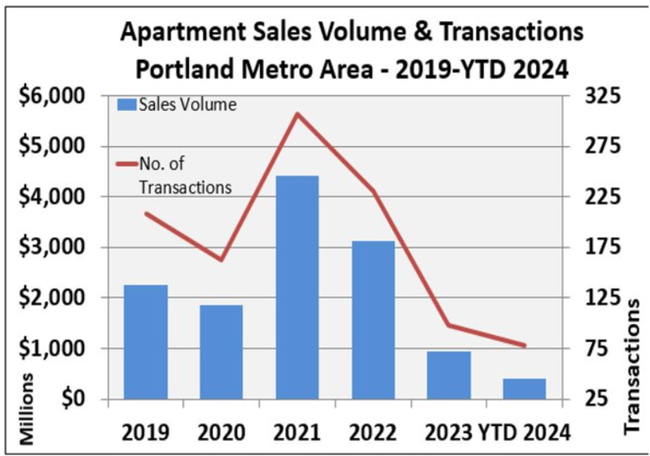
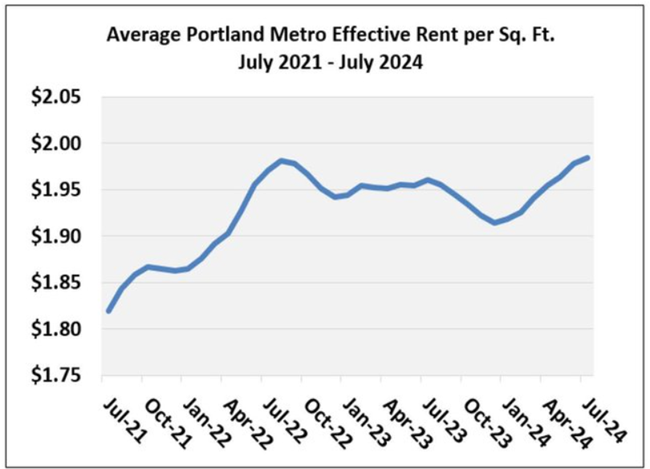
There was a general sense of optimism that the apartment market would show improvement in 2024. However, at the halfway point of the year, apartment market fundamentals (rents/vacancies) are stabilizing or improving, though the sales market remains extremely sluggish, Barry & Associates write in a report.

“We have created a one-page report summarizing how the Portland apartment [market] is faring in YTD 2024,” the report says. “While the sales market remains depressed, apartment fundamentals will likely see continued improvement based on very little proposed construction.

“Apartment sales picked up in the second quarter of 2024 and buyers/sellers appear to have accepted that lower prices seen recently are not transitory. Keep in mind that not all submarkets are equal, with certain areas faring better than others.”

Portland Apartment Market Snapshot Mid-Year 2024

  • Rents up 1.2% year-over-year and close to the peak in mid-2022.
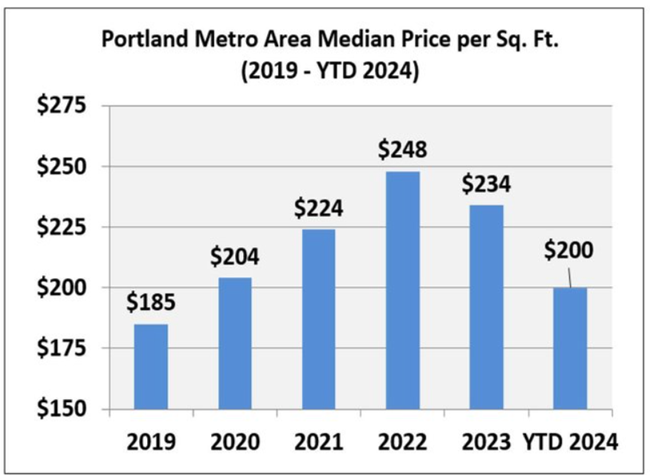
  • Median price per square foot down 14.5% year-over-year.
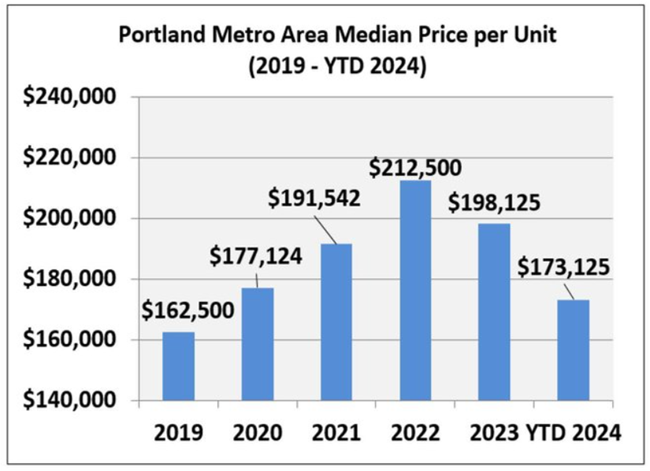
  • Median price per unit down 12.6% year-over-year.
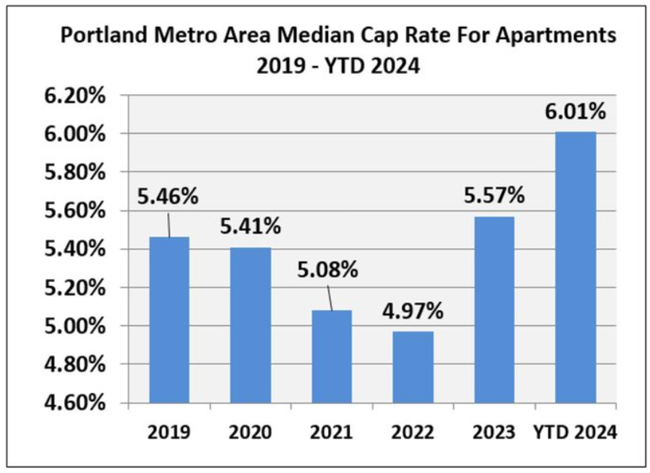
  • Cap rates up 40+ basis points.
  • Number of transactions trending below 2023, which was a 30+ year low. Through June, only 39 sales or 78 when annualized. The average number of sales from 1990-2022 was 201.
  • Numerous distressed sales year-to-date in 2024- Source CoStar.

Here is a Portland apartment market mid-year summary for 2024 that shows the Portland apartment market stabilizing or improving.

Here is a Portland apartment market mid-year summary for 2024 that shows the Portland apartment market stabilizing or improving.

Portland prices

Portland cap rates

About the author:

Patrick O. Barry is a certified general appraiser with Barry & Associates – Apartment Appraisal Specialists, 1535 SW Clifton St, 2nd Fl, Portland, OR 97201. Phone: 971-275-5345. pb@barryapartmentreport.com – www.barryapartmentreport.com

Sign Up For Our Weekly Newsletter And Get Rental Property And Apartment News And Helpful, Useful Content Each Week.

* indicates required