
Home Blog Page 27

Strengthening Policies, Procedures, and Written Communication in Property Management

Property management and the essential role of policies, written communication and procedures for the year ahead.

Property management and the essential role of policies, written communication and procedures for the year ahead.

By The Fair Housing Institute

As the new year begins, property management professionals have the opportunity to reflect on foundational practices that ensure both compliance and operational excellence.

Among these, few aspects are as critical as robust fair housing policies, well-defined procedures, and professional written communication.

These elements not only safeguard against legal risks but also foster trust and professionalism in interactions with residents, prospects, and team members. This article explores the essential role of policies and written responses, offering a timely reminder to recalibrate for the year ahead.

The Importance of Fair Housing Policies and Procedures

Fair housing policies and procedures serve as the backbone of any property management operation, regardless of the size of the portfolio.

They provide a clear framework for staff to understand their responsibilities and adhere to fair housing laws, ensuring consistent application of these principles across the board. Moreover, well-documented policies act as a vital defense mechanism during fair housing investigations, demonstrating that actions taken were in line with established guidelines.

For property management companies of all sizes, the creation of a basic fair housing policy is non-negotiable.

However, it is not enough to simply draft a policy and let it sit idle. These documents must be living resources, regularly reviewed and updated to reflect changes in legislation or operational needs.

In addition to a general fair housing policy, companies should implement specific procedures addressing reasonable accommodations and modifications. These procedures must clearly outline the steps for processing requests and define the roles of staff members responsible for decision-making.

To ensure these policies are accessible and actionable, many companies utilize a centralized policy manual.

This resource serves as a go-to reference for staff, housing key documents such as fair housing policies, reasonable accommodation procedures, and supporting forms. Regular training sessions are critical to reinforce the importance of these policies and ensure all employees understand their role in maintaining compliance.

The Role of Written Communication in Fair Housing Compliance

In the property management industry, written communication is not merely transactional; it is a direct representation of your company’s brand and commitment to professionalism.

Emails, letters, and even social media responses all fall under the umbrella of marketing and must align with fair housing principles. As such, every written response must be crafted carefully to avoid potential issues of discrimination or misrepresentation.

One area where this is particularly critical is in responding to inquiries about unit availability.

Consistency in responses is essential to prevent any appearance of favoritism or bias. For example, if two prospects inquire about the same unit, the responses they receive should not differ in ways that could be perceived as discriminatory.

All leasing professionals should be equipped with standardized language to address these situations, ensuring a uniform and compliant approach.

Another consideration is the tone and content of written communication with residents.

Professionalism must be maintained at all times, even when dealing with difficult or hostile situations. Emails represent an official form of communication, and as such, they should be approached with the understanding that their contents may later be scrutinized in legal or regulatory contexts.

It is critical to remain composed, clear, and respectful, avoiding language that could escalate tensions or be misinterpreted.

Balancing Efficiency and Personalization in Written Responses

While templates and canned responses can improve efficiency, their use must be approached with care.

Generic responses may be suitable for common inquiries, but personalized communication is necessary for more nuanced or unique situations.

A failure to adapt responses to the context can leave residents or prospects feeling dismissed, potentially damaging the relationship and raising questions about the company’s commitment to fair housing principles.

This is where training becomes invaluable.

Staff must be equipped with the knowledge and judgment to discern when a situation requires a tailored response. Ongoing training programs should address not only the technical aspects of fair housing compliance but also the soft skills necessary to bring a human element to written communication.

This balance between professionalism and empathy is what distinguishes truly effective property management operations.

Preparing for Success in the Year Ahead

The start of a new year offers the perfect opportunity to review and strengthen your company’s policies and communication practices.

Begin by conducting a thorough audit of your fair housing policies and written communication guidelines. Identify any gaps or areas in need of refinement, and make it a priority to address them.

It is equally important to engage your team in this process. Gather feedback from staff on the challenges they face when applying policies or crafting responses, and use this input to inform updates and training programs.

Establish a schedule for regular policy reviews and training sessions to ensure these foundational practices remain top of mind throughout the year.

Finally, remember the power of written communication as a tool to build trust and foster positive relationships.

By prioritizing consistency, professionalism, and a human touch, your team can set the tone for a successful year while reinforcing the company’s commitment to fair housing compliance and exceptional service.

Conclusion

In the property management industry, success is built on a foundation of strong policies, clear procedures, and professional communication.

As the new year begins, take this opportunity to reaffirm your commitment to these principles. By investing time and effort into refining your fair housing policies and enhancing written communication practices, you can navigate the complexities of property management with confidence, fostering trust and compliance in every interaction.

Let this year be one of growth, consistency, and renewed dedication to excellence.

About the author:

In 2005, The Fair Housing Institute was founded as a company with one goal: to provide educational and entertaining fair-housing compliance training at an affordable price at the click of a button.

FTC, Colorado Sue Greystar For Deceiving Tenants On Rent Prices

The FTC and state of Colorado has sued Greystar for deceiving tenants over rent prices and mandatory fees and monthly rent costs

The Federal Trade Commission and the state of Colorado have sued Greystar, the largest multifamily operator in the United States, for deceiving tenants ”about monthly rent costs by tacking on numerous mandatory hidden fees on top of advertised prices,” according to a release.

Since at least 2019 Greystar has “used deceptive advertising to entice consumers into applying for rental housing, and then bilked those consumers out of hundreds of millions of dollars by charging “hidden fees” (mandatory, fixed fees that are not included in the advertised price) for itself and its landlord clients,” according to the complaint filed in federal court in Colorado.

“Greystar is responsible for advertising available units at the properties it manages. Greystar is also responsible for finding qualified tenants to apply for available units. After a unit is filled, Greystar communicates with and collects the rent and hidden fees from the tenant on behalf of the owner.

“Greystar advertises its available apartments widely. Greystar knows that price is the most important factor for the majority of consumers searching for an apartment, and the rental price is a key aspect of Greystar’s apartment listings. Despite this, Greystar consistently omits various mandatory fees from the advertised price. Simply put, consumers cannot lease a Greystar-managed apartment by paying only the advertised price,” the complaint says.

“The FTC is suing Greystar for deceptively advertising low monthly rents only to later saddle tenants with hundreds of dollars of hidden junk fees,” said FTC Chair Lina M. Khan in the release.

“The FTC should continue its work taking on corporate landlords that use illegal tactics to jack up rent, exploit tenants, and deprive Americans of safe and affordable housing.”

Colorado Attorney General Phil Weiser said, “Because of Greystar’s deceptive advertising and hidden fees, tenants are on the hook in their lease for hundreds, if not thousands, of dollars more than they anticipated that their apartment would cost.

“Through their actions, Greystar is thwarting apartment hunters from comparison shopping and choosing a home that fits within their budget. To the extent that other corporate landlords are not advertising their all-in pricing and are engaging in similar tactics, they are on notice that such conduct is illegal and will not be tolerated in Colorado,” Weiser said in the release.

Greystar says on their website they have more than a million multifamily units and student beds under their management.  For example, in Portland, Ore., Greystar manages more than 18,000 units, according to the Portland Business Journal.

How the fees work in the leasing process

Greystar’s hidden fees allegedly range from tens to hundreds of dollars a month, which add up substantially over the course of a tenant’s lease. Among the fees noted in the complaint are “valet trash” fees, package-handling fees, utility fees, fees to distribute utility bills, “verification fees” when consumers use non-Greystar-provided renters’ insurance, and media/smart home packages, among numerous others. The FTC and Colorado say in the release that tenants cannot opt out of these fees even if they do not want or use the related services.

In many instances, tenants who saw an advertisement for a Greystar apartment had no way to learn about these hidden fees until after they filled out inquiry forms with their personal information or clicked through small-print hyperlinks, according to the complaint.

The complaint also explains that Greystar, in some cases, waited to reveal fees until after consumers had paid a substantial application fee or holding deposit, and then only deep in a 40- to 60-page lease agreement. The complaint further charges that if consumers discover the existence of the fees after their application is approved and choose not to sign the lease, Greystar does not refund the application fees or holding deposits they paid, which can be hundreds of dollars.

The complaint cites multiple examples of Greystar-managed properties where its advertisements on third-party real-estate listing sites, like Zillow, failed to list the company’s mandatory fees, despite those sites having a specific “fees” section where the company does list optional fees like those for parking or pets. According to the complaint, even on websites Greystar operated, apartment listings did not include information about mandatory fees, even where optional fees were listed.

The complaint charges that Greystar and a number of its subsidiaries violated the FTC Act, the Gramm-Leach-Bliley Act, and the Colorado Consumer Protection Act.

The commission vote authorizing the staff to file the complaint was 5-0. The complaint was filed in the U.S. District Court for the District of Colorado

The commission files a complaint when it has “reason to believe” that the named defendants are violating or are about to violate the law and it appears to the commission that a proceeding is in the public interest. The case will be decided by the court.

Read the full press release here.

Read the complaint filed in federal district court here.

Sign Up For Our Weekly Newsletter And Get Rental Property And Apartment News And Helpful, Useful Content Each Week.

* indicates required

Frank Roessler On How The Multifamily Industry Could Perform in 2025

How the multifamily industry could perform in 2025 with a Q&A from Ashcroft Capital's Frank Roessler who has cautious optimism for 2025.

How the multifamily industry could perform in 2025 with a Q&A from Ashcroft Capital’s Frank Roessler who has cautious optimism for 2025.

Editor’s note: As the founder and CEO of New York-based Ashcroft Capital, Frank Roessler leads a fully integrated multifamily investment firm that owns and operates approximately 14,000 apartment homes across the Sun Belt states of Georgia, Florida, North Carolina and Texas. In this Q&A with Rental Housing Journal, Roessler offers his take on how the apartment industry could perform in 2025, reviews Ashcroft’s 2024, outlines the company’s goals for 2025 and details the multiple benefits of his firm’s centralized procurement department.

As you look ahead to 2025, what do you think is in store for the apartment industry in the coming year? What do you expect in terms of operating fundamentals and the pace of investment sales?

Roessler: I would describe my outlook as one of cautious optimism. The past couple of years have certainly been challenging for the apartment industry, as a big increase in the delivery of new units has caused an uptick in vacancy rates and softened rent growth. Also, high interest rates have dramatically slowed the pace of investment sales.

But various data points indicate that 2025 could represent an improvement in both operating fundamentals and investment sales volume. We’re seeing a slowdown in the delivery of new apartment communities, and the existing supply is being absorbed, although more slowly than one would hope. This dynamic combined with the ongoing resilience of the U.S. economy could set the stage for more significant rent growth.

At the same time, an uptick in Treasuries may create headwinds as this will adversely impact values and create a further bid-ask spread. This piece of the puzzle will play out as the year rolls on. If inflation continues to come down and the economy cools moderately, we will likely see transactional volume increase. If this happens, 2025 could mark a return to a fairly normal year when it comes to investment sales. Not a historic year, but a normal one.

How would you summarize Ashcroft’s 2024, and what are your company’s goals and plans for the next 12 months?

Roessler: Ashcroft had a strong 2024. We were laser-focused on strengthening our platform of vertical integration, our staffing and our onsite operations.

And given the overall climate, we’re satisfied with our activity in the investment sales market. We completed two acquisitions in the latter part of the year. We recapitalized The Avery, a 20-year-old garden-style community in the Dallas-Fort Worth metroplex. The recapitalization took place when the previous owner—a joint venture between a private equity limited partner and us—sold the property to a joint venture between Ashcroft and Virtus Real Estate Capital. In August, we also acquired Halston Waterleigh, which is a garden-style community just outside of Orlando, in Winter Garden, Florida.

Looking ahead to this year, we are currently under contract to acquire three apartment communities in the first quarter, and we’re also slated to sell two properties as well. Our goal is to acquire a total of five to eight properties this year while remaining disciplined, strategic and conservative in our underwriting.

Ashcroft touts its centralized procurement department as one of the company’s unique characteristics. Describe how that program works.

Roessler: One of our goals is to improve the resident experience at our communities after we acquire the properties. We strive to achieve that by optimizing onsite operations and undertaking thoughtful, strategic renovations of the homes and common-area amenities.

Through our in-house procurement department, we are able to source and acquire renovation materials directly from overseas manufacturers, which provides roughly a 30% discount when compared to buying in bulk from U.S. retailers. All things being equal, this enables us to pass along higher returns to our investors, and it also allows our company to navigate international supply chain disruptions, as well as domestic disruptions like hurricanes and other severe weather events.

Looking beyond 2025, do you see any particular challenges in store for the apartment industry? What is your assessment of the sector’s long-term health?

Roessler: I certainly can’t predict the future. I don’t have a crystal-clear crystal ball. But the available information would indicate that multifamily investment fundamentals remain strong compared with other asset classes. New supply appears set to fall in the coming years, which would help operations, and the cost of buying a home, in an era of still relatively high interest rates, would seem likely to support strong renter demand.

As far as challenges, the Treasury market continues to serve as a headwind for our industry.

About the author:

How the multifamily industry could perform in 2025 with a Q&A from Ashcroft Capital's Frank Roessler who has cautious optimism for 2025.

Frank Roessler is the founder and CEO of New York-based Ashcroft Capital.

Sign Up For Our Weekly Newsletter And Get Rental Property And Apartment News And Helpful, Useful Content Each Week.

* indicates required

LA’s Wildfires Have Left Families in Turmoil. Here are 4 Things Rental Property Owners Can Do Now to Help

Here are 4 things rental property owners can do now to help keep people, pets and families together after LA's historic wildfires.

Here are 4 things rental property owners can do now to help keep people, pets and families together after LA’s historic wildfires.

By The Pet-Inclusive Housing Initiative

In the aftermath of Los Angeles’ extraordinary wildfires that have left thousands of families without homes, one thing is clear: The city’s tight housing market will be strained further. For families with pets, this strain is compounded by breed and weight restrictions and additional fees and deposits for pets in rental housing. According to the Pets in Rental Housing 2025 Outlook from Michelson Found Animals Foundation’s Pet-Inclusive Housing Initiative, 80% of rental properties that allow pets still enforce breed restrictions, and 64% impose weight limits. Renters with pets cite additional hurdles, such as refundable pet deposits, monthly pet rent, and nonrefundable pet fees, making housing accessibility even more challenging.

Families with pets seeking rental housing in the aftermath of LA’s wildfires will need true inclusivity for their furry family members, regardless of breed or size. Housing providers who respond to this demand can expect stronger resident loyalty, reduced vacancies, and goodwill in the community. Here’s how housing providers can help meet this need and support families as they recover:

1. Reduce or eliminate breed restrictions

Research shows that an individual dog’s breed is not a reliable indicator of behavior. Factors such as diet, environment, health, training, breeding, genetics, management, and socialization all influence behavior. More importantly, when prospective residents encounter breed and weight restrictions, they may be more likely to hide their pet or falsely declare it an emotional support animal (ESA). This makes it harder to hold all pet owners accountable to community guidelines.

2. Increase pet weight limits or remove them altogether

There is no evidence that larger pets cause more damage to rental units. Instead of relying on outdated stereotypes for pet policies, properties can assess each pet individually by eliminating restrictions and fostering transparency with residents.

3. Reconsider pet fees

Generally, the industry believes pet fees are necessary to cover potential damages and support pet amenities. However, average pet damages occur in less than 10% of pet-occupied units, and some properties lack even basic pet amenities, making multiple fees—like a pet deposit, nonrefundable pet fee, and monthly pet rent—challenging to justify. Specifically in California, the California Apartment Association strongly recommends against charging “pet rent” or similar fees because they are not plainly permitted by law. Finally, considering that 92% of renters consider pets important members of the family, it is no surprise that renters, when faced with pet fees they cannot afford, may be tempted to hide their pets or have them declared ESAs to avoid having to choose between keeping their pets or remaining housed.

4. Welcome more families with pets while prioritizing safety

Properties can adopt a set of pet personality questions and a comprehensive pet agreement to establish clear expectations for all residents with pets. These steps create a safer and more supportive environment for everyone.

By implementing these changes, housing providers can meet the needs of renters with pets and foster a pet-inclusive community. Supporting families during such a critical time helps build trust and long-term resident relationships, creating lasting benefits for everyone involved.

In this time of devastation, families need the safety and security of a place they can call home—with their pets. Pets are family, and with simple and immediate changes to pet policies, housing providers can help keep families together while still addressing their business needs.

For more pet-inclusive housing information and resources, visit petsandhousing.org.

Read the article here.

Sign Up For Our Weekly Newsletter And Get Rental Property And Apartment News And Helpful, Useful Content Each Week.

* indicates required

2025 To See Decline in Rent Concessions, More Pet-Friendly

Zillow predicts in 2025 that rent concessions will decline and more rental properties will become pet-friendly.
Nearly half of potential renters said they passed on a particular property because it was not pet-friendly.

Zillow predicts in 2025 that rent concessions will decline and more rental properties will become pet-friendly.

“Apartment renters enjoyed a relatively friendly market in 2024, at least compared to the record rent growth seen in 2022,” Zillow said in the report.

While landlords in parts of the country have seen rents decline slightly in 2024, the report says “the share of rental listings on Zillow offering a concession — such as free weeks of rent or free parking — is at a record high.” However, the company “expects renters will not have as much opportunity to negotiate for that free month of rent by the end of 2025.”

The multifamily-construction boom is the primary reason for the rise in concessions. More multifamily units are hitting the market than at any time in the past 50 years, pushing property managers to compete for renters. “Those fireworks are predicted to fizzle in 2025, especially in the second half of the year,” the report says.

Zillow predicts in 2025 that rent concessions will decline and more rental properties will become pet-friendly.

Pet-friendliness will become nonnegotiable for property managers

The report notes that renters are getting older, and they are not putting off “adulting” milestones such as moving in together or getting a pet before they buy a home.

The median age of a renter has risen to 42, and they are settling into the renter lifestyle. Fewer renters considered buying this year, as renting is more affordable in some markets.

With 58% of renters having a pet — up from 46% before the pandemic — “it is no wonder that nearly half said they passed on a particular property because it was not pet-friendly. In today’s more competitive rental landscape, not allowing pets may put property managers behind the eight ball,” the report says.

Other highlights from the report:

  • Here is where we get to the report’s bold predictions for 2025Zillow sees Americans increasingly embracing small homes and attached options. Affordability may be the cause, but a trend toward higher densities is undeniable.
  • The report projects a 2.6% home price change for 2025. That is a solid and manageable number. And there will be at least some shift in favor of buyer negotiating power, though that will be regional, such as in the southwest.
  • The company highlights its “BuyAbility” feature as one way buyers can navigate the often-tricky interplay of prices and mortgage rates to help them figure out precisely what they can afford.

See the full list of 2025 Zillow predictions here

Sign Up For Our Weekly Newsletter And Get Rental Property And Apartment News And Helpful, Useful Content Each Week.

* indicates required

Justice Department Sues 6 Large Landlords

Justice Department Sues Six Large Landlords over RealPage algorithmic pricing schemes

The Justice Department, together with 10 state co-plaintiffs, has filed an amended complaint in its antitrust lawsuit against RealPage to sue six of the nation’s largest landlords for participating in algorithmic pricing schemes that harmed renters, according to a release.

The amended complaint alleges the landlords — Greystar Real Estate Partners LLC (Greystar); Blackstone’s LivCor LLC (LivCor); Camden Property Trust (Camden); Cushman & Wakefield Inc and Pinnacle Property Management Services LLC (Cushman); Willow Bridge Property Company LLC (Willow Bridge) and Cortland Management LLC (Cortland) — participated in an unlawful scheme to decrease competition among landlords in apartment pricing, harming millions of American renters.

At the same time one of the landlords, Courtland Management, agreed to cooperate with the justice department and enter into a settlement to end the use of common rental-pricing algorithms and competitively sensitive data to set rents.

Atlanta-based Cortland manages more than 80,000 rentals in 13 states. A related federal criminal investigation that led to a May 2024 search of its headquarters has been closed, a spokesperson told ProPublica, which started the investigation into the pricing schemes.

The spokesperson said the company is “pleased” to announce the settlement. “We believe we were only able to achieve this result because Cortland has invested years and significant internal resources into developing a proprietary revenue-management software tool that does not rely on data from external, nonpublic sources,” the spokesperson said.

Acting Assistant Attorney General Doha Mekki of the Justice Department’s Antitrust Division said in the release, “While Americans across the country struggled to afford housing, the landlords named in the lawsuit shared sensitive information about rental prices and used algorithms to coordinate to keep the price of rent high.” The “action against RealPage and six major landlords seeks to end their practice of putting profits over people and make housing more affordable for millions of people across the country.”

Justice Department Sues 6 Large Landlords

The amended complaint alleges that the six landlords actively participated in a scheme to set their rents using each other’s competitively sensitive information through common pricing algorithms.  Along with using RealPage’s anticompetitive pricing algorithms, these landlords coordinated through a variety of means, including:

  • Directly communicating with competitors’ senior managers about rents, occupancy, and other competitively sensitive topics.
  • Regularly conducting “call-arounds.”
  • Participating in “user groups” hosted by RealPage.
  • Sharing information with competitors about parameters in RealPage’s software.

Co-plaintiffs in the case are the attorneys general of California, Colorado, Connecticut, Illinois, Massachusetts, Minnesota, North Carolina, Oregon, Tennessee and Washington.

RealPage Senior Vice President Jennifer Bowcock called the federal case “flawed” and said the company is “committed to vigorously defending ourselves and our customers against the DOJ’s accusations.” RealPage has already changed its software to remove nonpublic data, despite its view that its technology was legal and “pro-competitive,” she told ProPublica.

A White House report released in December estimates the nation’s renters overpaid by $3.8 billion in 2023.  The White House cited RealPage as the primary provider of rental-pricing algorithms. Companies like RealPage use their tools to suggest optimal rent for landlords to charge.

Read the full news release here.

Sign Up For Our Weekly Newsletter And Get Rental Property And Apartment News And Helpful, Useful Content Each Week.

* indicates required

2025 Promises Change as Supply Growth Declines

The year 2024 ended on a down note for rents, but the new year promises change as the supply growth declines, Yardi Matrix says

The year 2024 ended on a down note for rents, but 2025 promises change as the supply growth declines, Yardi Matrix says in its yearend report.

The report says the rental market has been stuck on a treadmill because:

“Metro-level performance has been mixed—high-supply growth metros have seen advertised rents turn negative, while metros with low supply have recorded moderate growth—but national year-over-year growth has been stuck between 0% and 1.0% for 16 straight months,” the report says.

Why 2025 promises change

Change is coming in 2025 for several reasons.

  • Starts have dropped
  • Completions will wane soon
  • Job growth will help absorb completed new apartments
  • Demographics will also help

But there are concerns in 2025 as well

Donald Trump’s plan to reduce immigration could slow demand.

“Multifamily also is bracing for less favorable interest rate conditions than expected,” the report says. The Fed forecast has indicated there may not be the expected rate cuts in 2025. The threat of tariffs also looms.

“The upshot is that investors’ higher inflation expectations have pushed the 10-year Treasury rate up to 4.6%, creating ongoing pricing uncertainty that could keep deal flow muted,” the report says.

 Highlights of the report:

  • Multifamily finished 2024 on the downswing, with the average U.S. advertised rent falling $4 nationally in December to $1,742. Year-over-year rent growth, which remains positive albeit weak, was down 10 basis points to 0.6%.
  • The trends that shaped 2024 remained in place to the end. Demand stayed robust throughout the year in most regions, so regional and market-level rent change was determined by the amount of local supply growth.
  • After outperforming multifamily through most of the year, single-family rental rates also ended the year poorly. Advertised rents dropped $7 month-over-month in December to $2,141, with year-over-year growth dropping 40 basis points to -0.8%.

Read the full Yardi Matrix report here.

About Yardi Matrix

Yardi Matrix researches and reports on multifamily, office and self-storage properties across the United States, serving the needs of a variety of industry professionals. Yardi Matrix Multifamily provides accurate data on 18+ million units, covering more than 90 percent of the U.S. population. Contact the company at (480) 663-1149.

Sign Up For Our Weekly Newsletter And Get Rental Property And Apartment News And Helpful, Useful Content Each Week.

* indicates required

The Insurance Secret Every Property Owner Needs to Know

The insurance secret every rental property owners needs to know and what Zillow cannot tell you is the replacement cost for your investment

By Andres Dominguez III

When determining the true value of your rental property, Zillow’s Zestimate might come to mind. However, in insurance, the most crucial valuation is the Replacement Cost.

This article will explore the significance of Replacement Cost and its implications for insurance. Before delving into Replacement Cost, we will first clarify two commonly used valuation methods.

 1- Market Value:

 Market value is a valuation method that varies because it is determined by larger market forces.

Macroeconomic influences such as local market conditions, supply and demand, interest rates, and inflation impact market value. Ultimately, market value is determined by what the market is willing to bear. Buyers decide how much the property is really worth based on what they are willing to pay to purchase the property. As a general rule, the more competitive the market, you might expect to see a higher market value of a property.

2- Appraised Value:

The appraised value is an estimated value of a property at a specific point in time, determined by a licensed real estate appraiser.

A formal appraisal is usually required when obtaining financing from a traditional lender. Appraisals are objective assessments that focus on factors that are difficult to change, such as the property’s location, total square footage, architectural style, basement condition, and number of bedrooms and bathrooms. The appraised value also takes into consideration the land on which the property sits. For example, a 2000-square-foot home in one neighborhood may appraise for more than a similar 2000-square-foot home on the other side of town. The appraised value is important because it can impact how much financing a lender will offer you and is a requirement for most lending institutions.

3- Replacement Cost:

Replacement Cost is the estimated amount it will cost an insurance company to rebuild your property from scratch, excluding the cost or value of the land.

This valuation method focuses on factors such as square footage, materials, bathrooms, kitchens, and finishes of the property. Most insurance carriers use company-specific software that takes these inputs to estimate the Replacement Cost.

It’s important to note that you should insure your home for at least 80%-90% of the Replacement Cost to avoid penalties. If you insure the property for less than the Replacement Cost, the insurance company can and will penalize you at the time of a claim. This is known as the Coinsurance Penalty. Different insurance companies have various ways of assessing this penalty, so it’s essential to consult with your agent to ensure that your current building limit satisfies the Coinsurance Requirement on your policy. You can also read our article HERE that goes in-depth on the topic of Coinsurance | How Does Coinsurance Work?

Conclusion

 The three valuation methods each have their own significance based on the situation.

As far as insurance is concerned, the Replacement Cost is of utmost importance. Ultimately, insurance companies will cover the expenses for materials, labor, and construction needed to reconstruct your property. Therefore, it is crucial to insure your property for the correct amount to prevent any penalties for underinsuring.

If all this insurance and valuation terminology is making you dizzy, please contact our team HERE. We would be happy to explain Replacement Cost in more detail and we can even provide you with a free Replacement Cost Report of your property for your reading pleasure.

www.anderson.insure 

Call: 801-262-1551 Text: 801-758-9046
Call us for more information on renters insurance and any questions you have about land lording, we love helping our customers be successful Utah landlords. Call our office at 801-262-1551 or Click Here for a for a consultation with our experienced team. Find out more about renter’s insurance.

Avoid Costly Coinsurance Penalties with Proper Insurance Coverage for Your Investment Properties

For a full review of your apartment or rental property insurance, contact a knowledgeable Anderson Insurance Group agent today.

Complete Guide to Apartment Building Insurance

A guide to the most important things to know about finding and buying apartment building insurance to protect your investment?

What are the most important things to know about finding and buying apartment building insurance to protect your investment?

By Andres Dominguez III

As an owner of a multi-family apartment complex, you are exposed to different risks than a traditional single-family homeowner.

Events such as loss of rents and bodily injury lawsuits are more likely to impact your bottom line. Finding insurance to protect you from these risks is easy with an insurance agent you can trust. Whether your building is a triplex, fourplex, or hundreds of units, our team at Anderson Insurance Group has the knowledge, skills, and carriers to ensure you have the right coverage.

Here’s the most important things you should know about finding and buying insurance for your apartment.

What Type of Insurance Do Apartment Buildings Need?

 A standard “Landlord” policy will not suffice for an apartment building.

You will need a true Commercial Property Policy because your apartment building is also a business. Due to the nature of this business, you have more liability and will want to ensure your policy has these essential coverages:

  • General Liability
  • Commercial Property
  • Business Income (Loss of Rents)
  • Ordinance & Law

General Liability Insurance

 General Liability Insurance is a must-have for any business, especially an apartment complex.

It covers a wide range of incidents, such as negligence, and customer slip-and-fall accidents, and it can also cover you if a tenant or prospective tenant sues you for discrimination. This coverage will help cover your legal defense costs and any damages awarded. Failure to obtain adequate coverage could leave you with hundreds of thousands of dollars in lawsuits and medical bills.

Commercial Property

 Property insurance covers the cost of repairing or replacing your building’s physical property if it is damaged or destroyed due to a covered event.

This can include fires, wind, hail, vandalism, and theft. As an apartment building owner, you may have several structures on your property such as garages, storage buildings, swimming pools, clubhouses, etc. These are also covered in addition to the main apartment building(s).

Business Income (Loss of Rents)

 This coverage provides reimbursement for lost income and expenses for some or all of the time it takes to repair unit damages.

If your apartments are unrentable due to a covered event (such as smoke, fire, or burst pipes) that makes your unit(s) unrentable.  This coverage can help you stay afloat during the recovery period and cover ongoing expenses such as debt service, utilities, tax payments, and payroll.

Ordinance & Law

 The best way to describe an Ordinance & Law loss is that it’s a consequence of a covered loss.

A few years ago an apartment owner insured with our agency had a fire in his apartment building that was built in 1911 in a historic area of Salt Lake. The fire was started by a candle and caused damage to three units. The Salt Lake City building inspector would not give a permit to the building owner to repair the apartments directly damaged by the fire without bringing an undamaged part of the building to current electrical codes. This part of the building had been added to the original structure many years ago but the quality of construction was not to current codes and represented a fire hazard.

The insurance company paid $150,000 for direct damage to the three apartments and an additional $100,000 in Ordinance & Law coverage to bring the building to current electrical and building codes. Our customer even had to pay a small amount over the $100,000 to bring the building 100% up to code but regardless called to thank us for this coverage, his prior policy did not have any coverage for Ordinance and Law.

**Not all policies offer or include Ordinance & law and not all properties are eligible. Call our agency to have an experienced and knowledgeable agent review your current coverage to check for gaps in coverage such as these.

For more information on Ordinance & Law coverage, check out our article HERE.

If all this insurance and coverage terminology is making you dizzy, please contact our team HERE. We would be happy to explain Apartment Insurance in more detail and we would be happy to review your current coverage and offer you a new quote.

About the Author:

Andres has been consulting Utah Rental Owners and Entrepreneurs for over 8 years. He is a graduate of Salt Lake Community College and the University of Utah, where he studied Marketing. He is driven by his mission to render the highest level of service, provide the best coverage available, and build meaningful relationships. When not serving his clients, Andres enjoys running marathons, practicing martial arts, and snowboarding.

Call: 801-262-1551 Text: 801-758-9046
Call us for more information on renters insurance and any questions you have about land lording, we love helping our customers be successful Utah landlords. Call our office at 801-262-1551 or Click Here for a for a consultation with our experienced team. Find out more about renter’s insurance.

Avoid Costly Coinsurance Penalties with Proper Insurance Coverage for Your Investment Properties

For a full review of your apartment or rental property insurance, contact a knowledgeable Anderson Insurance Group agent today.

The Insurance Secret Every Property Owner Needs to Know

The Utah Landlord’s Playbook: Strategies for Full Bookings

3 Must-Have Coverages for Landlords

National Median Monthly Rent Ended Year Lower Than It Started

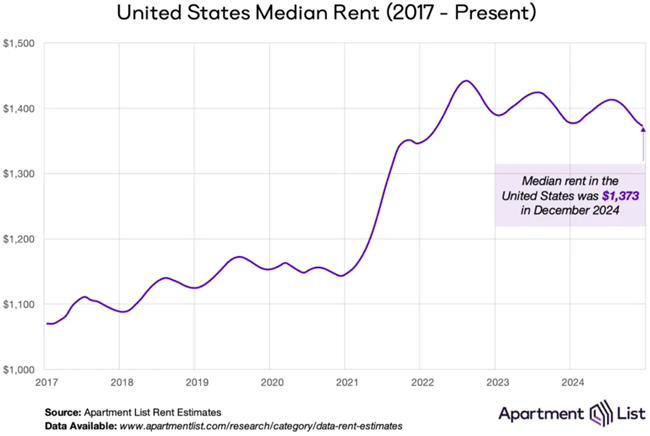
The national median monthly rent closed out 2024 at $1,373 in December, after declining by 0.6 percent, or $8, from the prior month.

The national median monthly rent closed out 2024 at $1,373 in December, after declining by 0.6 percent, or $8, from the prior month, Apartment List says in their January report, ending the year lower than it started.

Year-over-year rent growth nationally also currently stands at -0.6 percent, meaning that the typical apartment is currently renting for slightly less than it was one year ago.

In dollar terms, the national median rent today is $8 per month cheaper than it was one year ago and $50 per month less than in August 2022, but still remains $225 per month higher than the January 2021 level.

“The end of the year, in particular, generally sees the slowest rental market activity, as few households move during the holiday season. That lack of demand tends to result in modest discounts from property owners with vacancies to fill. In keeping with that pattern, 2024 ended with a fifth consecutive monthly dip in December.

“As moving activity picks back up in the new year, we are likely to see these monthly declines moderate and then flip back to positive growth in the coming months,” Apartment List economists write in the report.

The national median monthly rent closed out 2024 at $1,373 in December, after declining by 0.6 percent, or $8, from the prior month

Apartment vacancies remain elevated

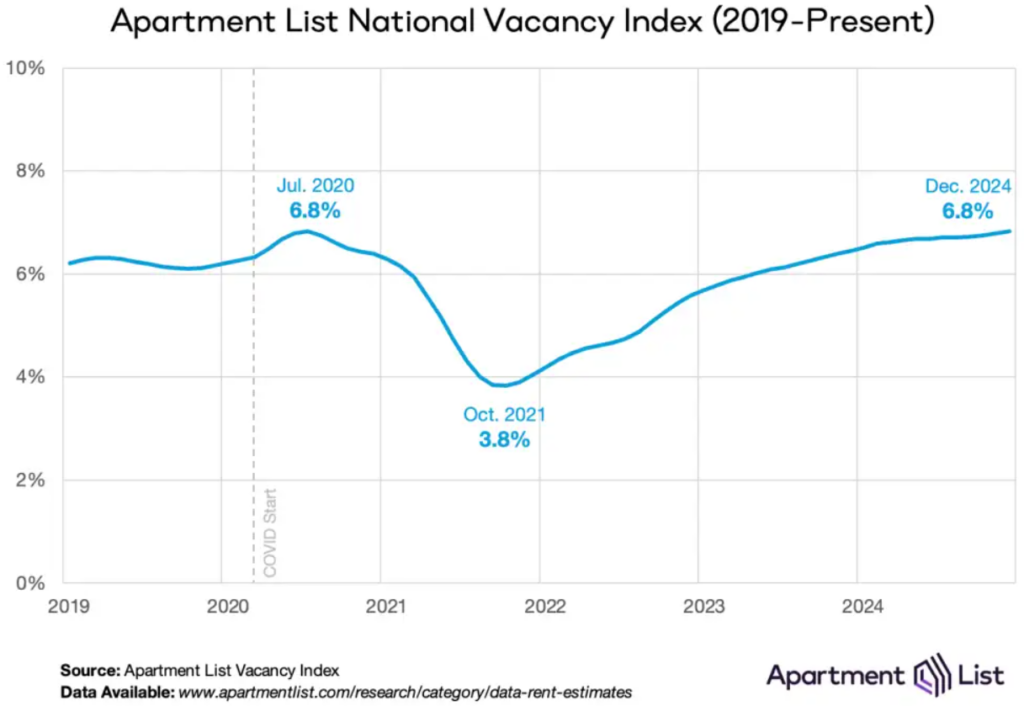
On the supply side of the rental market, “our national vacancy index continues trending up slowly and currently sits at 6.8 percent, the highest reading since the onset of the pandemic. After a historic tightening in 2021, multifamily occupancy has been slowly but consistently easing for over two years amid an influx of new inventory. 2024 saw the most new apartment completions since the mid-1980s, and with nearly 800 thousand units still in the construction pipeline, the supply boom has runway to continue into 2025.”

However, vacancy trends can be highly localized, Apartment List points out.

The national median monthly rent closed out 2024 at $1,373 in December, after declining by 0.6 percent, or $8, from the prior month

List-to-Lease time hits a new high

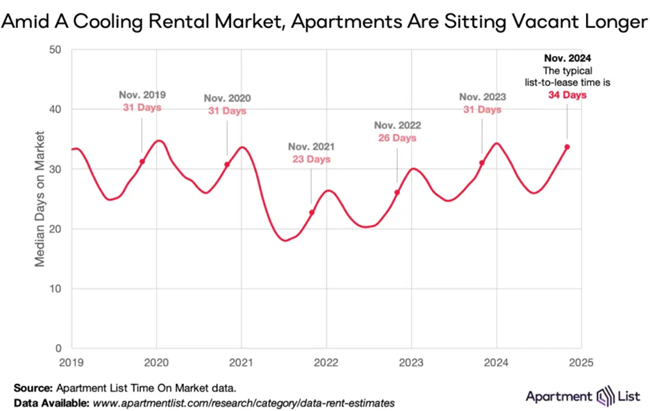
The median time on market of 36 days in December “is the highest reading that we’ve seen for this metric in any month going back to the start of 2019, when the data series begins.

“It seems that the influx of new supply is resulting not only in a growing number of vacant units, but also in an increase in the length of time those units remain unoccupied,” the report says.

The national median monthly rent closed out 2024 at $1,373 in December, after declining by 0.6 percent, or $8, from the prior month

The national median monthly rent closed out 2024 at $1,373 in December, after declining by 0.6 percent, or $8, from the prior month

Conclusion

Rent increases are currently being moderated by a robust construction pipeline that delivered a decades-high number of new apartment units in 2024.

“While rental demand has bounced back a bit this year, recent signs of labor market softness could dampen demand going forward. With this in mind, we expect that new supply will continue to outstrip demand into 2025,” Apartment List says in the report.

Read the full report here.

Sign Up For Our Weekly Newsletter And Get Rental Property And Apartment News And Helpful, Useful Content Each Week.

* indicates required