Home Blog Page 21

Why Fair Housing Applies to Maintenance Too

Fair housing applies to maintenance because the principle of non-discrimination applies to every service a housing provider offers.

Fair housing applies to maintenance because while unit repairs may not be mentioned by name in the act, the principle of non-discrimination applies to every service a housing provider offers.

By The Fair Housing Institute

When the Fair Housing Act (FHA) comes up, the conversation typically centers around leasing, advertising, or resident interactions.

But an often-overlooked aspect is how maintenance services, including unit repairs, are handled. While the FHA doesn’t directly reference “repairs” or “maintenance,” it clearly prohibits discrimination in the delivery of housing-related services.

This broader interpretation includes how repair requests are prioritized, addressed, and communicated. Every resident—regardless of their race, national origin, disability, or any other protected category—deserves the same level of service and respect when it comes to their home’s upkeep.

When a Maintenance Delay Becomes a Legal Concern

Delays in repair work are part of property operations.

Supply chain disruptions, vendor availability, and resident scheduling can all slow things down. But when a resident starts to believe these delays are linked to their protected status, it moves into fair housing territory.

Even if a delay is legitimate, a resident’s perception of unequal treatment can lead to a discrimination complaint. That’s why it’s critical to be consistent and transparent about how repair requests are handled. The moment it seems that one resident’s needs are regularly deprioritized compared to another’s, it opens the door to legal scrutiny under fair housing law.

How Property Managers Can Stay Compliant

Maintaining fairness and avoiding even the appearance of discrimination means taking a proactive and thoughtful approach.

It begins with consistent service. All repair requests should be managed with the same urgency and level of professionalism. Communication plays a big role as well. Residents should be kept informed about delays and next steps. A quick call or email updating them on a backordered part or a rescheduled technician can go a long way in preventing frustration and mistrust.

Documentation is also essential.

Keeping clear records of when requests were made, what steps were taken, and any follow-up conversations provide valuable support in the event of a complaint. These records show that decisions were based on operational realities—not on who the resident is. In addition, regular training for office and maintenance staff helps reinforce the importance of equitable treatment and teaches teams how the FHA applies beyond leasing.

When complaints do arise, timely and respectful resolution is key. Addressing concerns quickly and thoughtfully not only resolves the immediate issue but also strengthens your community’s trust in your commitment to fairness and equal treatment.

Building Trust Through Fairness

Although unit repairs may not be mentioned by name in the Fair Housing Act, the principle of non-discrimination applies to every service a housing provider offers—including maintenance.

Property managers who remain vigilant, transparent, and fair in how they respond to repair needs are doing more than just protecting their communities—they’re also protecting their teams and their organizations from legal risk. With consistent communication, thoughtful documentation, and a clear understanding of fair housing responsibilities, property professionals can ensure that every resident feels respected, heard, and equally cared for.

About the author:

In 2005, The Fair Housing Institute was founded as a company with one goal: to provide educational and entertaining fair-housing compliance training at an affordable price at the click of a button.
Sign Up For Our Weekly Newsletter And Get Rental Property And Apartment News And Helpful, Useful Content Each Week.

* indicates required

3 Best Ways to Fill Vacancies in Today’s Market

3 Best Ways to Fill Vacancies in Today’s Market

Here are the 3 best ways to fill vacancies in the market today and how to differentiate your rental property from others.

By Nancy Abrams

A rental vacancy can cut deeply into a property owner’s cash flow. For each month that your unit remains vacant, your carrying costs and utility bills still have to be covered.

In a “normal” market, most landlords need only to put out a “For Rent” sign to get a new tenant. But in 2025, when the market is so unpredictable, how can you beat out the competition and get your space rented quickly? Two words: residential marketing.

Think of your vacancy as a product that needs to be marketed—just as you would any product in the marketplace:

  • What makes your vacant apartment different than the one down the street?
  • Why will your tenant be happier in your rental?
  • Lead with what your prospective tenant cares about the most.

The following amenities are demonstrated ways to differentiate your space from the competition. Adopt them, advertise them and attract more applicants.

3 Best Ways to Fill Vacancies in Today’s Market

  1. Rent reporting: Until recently, money paid out as rent did nothing to benefit a person’s credit rating. Now, you can report rent payments to the credit bureaus to be included in most credit reports. The nominal charge will be far outweighed by the benefits to both you and the tenant.
  2. Upgraded internet and streaming apps: Keyless entry systems, smart thermostats and Netflix are tops among the amenities expected by today’s renters. Newer buildings offer smart technologies, but if you have an older property, upgrade it. Include popular streaming channels. The cost will attract tenants that seek reliable connectivity. It will quickly pay for itself.
  3. Referral program: Encourage existing tenants to refer prospective tenants to your properties. Offer something renters actually want, such as Venmo cash, free rent or gift cards for successful referrals. These programs can significantly reduce turnover, increase occupancy and boost tenant satisfaction.

By knowing what amenities and services renters want, you can adjust your marketing and ensure it meets their needs. The key here is to know your audience to attract and retain renters long term.

About the author:

Nancy Abrams is content editor for AAOA (the American Apartment Owners Association). AAOA assists landlords, property managers, real estate owners and brokers across the country with managing their properties, including tenant credit checks and tenant background screening as well as state-specific landlord forms, such as a rental application or rental agreement. The association also offers resources from educational webinars and landlord tenant law to approved providers for insurance and financing. Contact us today to learn more.

Sign Up For Our Weekly Newsletter And Get Rental Property And Apartment News And Helpful, Useful Content Each Week.

* indicates required

Washington Governor Signs Rent-Control Bill

Washington Governor Bob Ferguson signed a rent-control bill, House Bill 1217, also called rent stabilization which takes effect immediately

Washington Gov. Bob Ferguson has signed a rent-control bill, House Bill 1217, which takes effect immediately, according to a release.

Called rent stabilization, the bill limits rent increases for existing tenants in Washington state to 7% plus inflation or 10%, whichever is lower. Landlords can still adjust rent by higher amounts for new tenants. It also limits rent increases for manufactured homes to 5%.

Ferguson also signed other bills covering everything from property-tax relief for disabled veterans to encouraging construction of so-called “middle housing” options like condominiums.

“Washington needs more affordable housing — a lot more,” Ferguson said in a release. “We must make it easier, faster and less expensive to build housing of all kinds. These bills will address this pressing need.”

New construction is not subject to the cap for its first 12 years. Public-housing authorities, low-income developments, and duplexes, triplexes and fourplexes in which the owner lives in one of the units are also exempt, according to Oregon Public Broadcasting reported from a story in the Washington State Standard.

Rent-hike notices are now required 90 days before they go into effect, up from 60 days under previous law.

Democrats believe the limit will give renters greater predictability in one of the most expensive states for housing, while Republicans think it will chill development and force landlords to sell their properties because they can’t keep up with maintenance costs and property taxes.

Last month, Rep. Sam Low, R-Lake Stevens, argued the policy is “going to be devastating for our housing providers, and we need housing providers to be a part of the solution in the housing crisis that we have.”

Other housing related bills signed by Ferguson

In addition to HB 1217, Ferguson signed nine bills related to affordable housing. These bills covered permitting reform, tax incentives, parking restrictions and more. Those bills are:

  • House Bill 1106 — Allows more disabled veterans to qualify for property tax relief
  • House Bill 1403 — Clears up language in state law related to condominium construction
  • House Bill 1516 — Creates additional insurance options for condominiums
  • House Bill 1757 — Requires cities to adopt rules for converting existing buildings into housing in commercial and mixed-use zones
  • Senate Bill 5184 — Limits the number of parking spaces cities and counties require for housing projects
  • Senate Bill 5298 — Strengthens notification requirements when manufactured- and mobile-home park land is listed for sale
  • Senate Bill 5313 — Expands the list of provisions that are prohibited in residential rental agreements
  • Senate Bill 5529 — Expands tax incentives to support affordable housing
  • Senate Bill 5611 — Reduces housing-permit timelines

More information on Governor Ferguson’s bill actions can be found here.

Sign Up For Our Weekly Newsletter And Get Rental Property And Apartment News And Helpful, Useful Content Each Week.

* indicates required

Multifamily Rents Rise As Economy Begins To Slow

Multifamily rents rise in April was due to the occupancy rates remaining relatively unaffected by continued heavy supply growth

Multifamily fundamentals displayed resiliency in April, as the U.S. average national rent increased and occupancy rates remain relatively unaffected by heavy supply growth, Yardi Matrix says in the April report.

However, investors are growing wary as the U.S. economy shows signs of slowing.

Highlights of the report

  • Multifamily advertised rents continued to grow moderately in April as demand coming from a solid labor market and weak home sale market remained consistent.
  • The average U.S. advertised rent increased $5 to $1,736, while year-over-year growth fell 10 basis points to 0.9%.
  • The national occupancy rate declined slightly, reaching its lowest point in more than a decade at 94.4%.
  • However, a slowdown in supply is anticipated in the coming years, as starts have dropped sharply, which will support absorption.
  • Single-family build-to-rent advertised rates also increased in April, up $5 to $2,178. Gains were entirely concentrated in the Renter-by-Necessity (RBN) segment, which was up 1.9% year-over year, while the Lifestyle segment was down 0.4%.

“Early data aligns with our forecast of moderate 1.5% rent growth in 2025, but the contraction of the first quarter GDP raises the risk of a potential downturn, which could disrupt otherwise resilient fundamentals,” Yardi Matrix writes in the report.

Rental demand

Rental demand has benefited from high home sale prices and high mortgage interest rates. Home sales have dropped to the lowest level since 2009, according to the National Association of Realtors.

“Home buying and selling remained sluggish in March due to the affordability challenges associated with high mortgage rates,” NAR Chief Economist Lawrence Yun said in a release. “Residential housing mobility, currently at historical lows, signals the troublesome possibility of less economic mobility for society.”

Tariff concerns lead to slow down

“Speaking at a recent Marcus & Millichap webinar, Moody’s Analytics chief economist Mark Zandi said the impacts of tariffs include increased costs for consumers and businesses, a  negative wealth effect that affects consumers, and the risk that foreign businesses will divert supply chains to exclude the U.S.”

Read the full report here.

About Yardi Matrix

Yardi Matrix researches and reports on multifamily, office and self-storage properties across the United States, serving the needs of a variety of industry professionals. Yardi Matrix Multifamily provides accurate data on 18+ million units, covering more than 90 percent of the U.S. population. Contact the company at (480) 663-1149.

Sign Up For Our Weekly Newsletter And Get Rental Property And Apartment News And Helpful, Useful Content Each Week.

* indicates required

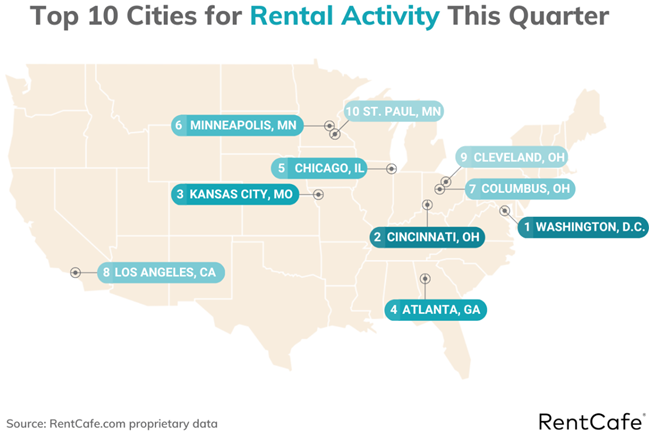
Top 5 Cities For Rental Activity First Quarter 2025

Here are the top 5 cities in the first quarter of 2025 that are getting the most  online engagement on RentCafe.com, according to data.

Here are the top 5 cities in the first quarter of 2025 that are getting the most  online engagement on RentCafe.com, according to available data for the full first quarter of 2025.

The report tracks renters’ engagement with listings on RentCafe.com in the top 150 U.S. cities, to provide fresh insights into renter preferences and market dynamics.

Here are the top 5 cities for rental activity

No. 1 – Washington, D.C.

This is the top spot for renter engagement. Even with a 7% drop in page views, the city’s popularity is fueled by an 18% increase in favorited listings. With saved searches down 13%, renters interested in apartments in The Nation’s Capital are clearly making quicker choices.

No. 2 – Cincinnati

The Queen City climbs to No. 2 this quarter, up nine spots from last year. With a 37% boost in favorited listings and a 36% increase in available rentalsrenters have more options to choose from, allowing them to take their time in finding the right place in the city.

No. 3 – Kansas City

Kansas City surged 12 spots to earn the third place in the rankings. This rise is mostly due to a 5% increase in online traffic, amid a 4% drop in availability and a 9% decrease in saved searches. This suggests that apartment seekers may be making faster decisions on apartments they like.

No. 4 – Atlanta

While apartment listings in Atlanta continue to have strong online engagement, renters are spending more time weighing their options before committing to a lease. This slower decision-making likely explains the drop in favorited listings and saved searches.

No. 5 – Chicago

In the Windy City, the combination of a 23% drop in saved searches and a 3% decrease in available listings points to a trend where renters are moving increasingly quickly to secure apartments in the city to avoid losing out.

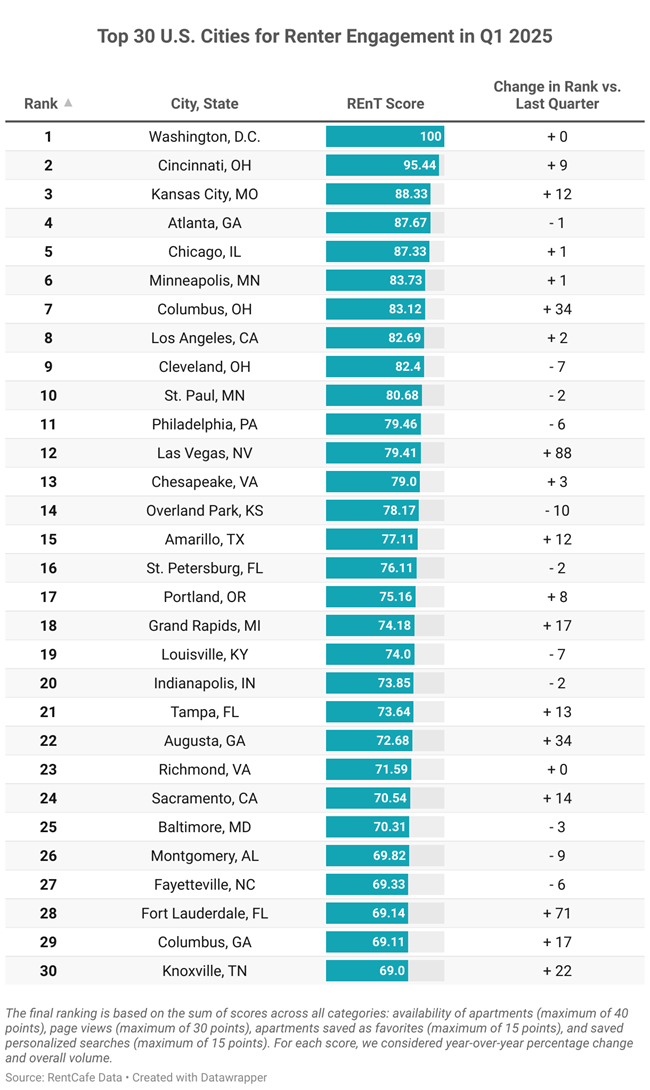
Looking farther down the list the South is most in-demand region, claiming half of the top 30.

Here are the top 5 cities in the first quarter of 2025 that are getting the most  online engagement on RentCafe.com, according to data.

The South dominates the rankings this quarter, boasting 15 entries in the elite top 30 most sought-after cities. The Midwest is next with 10 entries, followed by the West with four. The Northeast lags noticeably behind with only one city represented in the rankings.

Interestingly, though, the picture shifts within the top 10, where the Midwest leads with seven cities compared to three from the South.

Read the full report from RentCafe here.

Sign Up For Our Weekly Newsletter And Get Rental Property And Apartment News And Helpful, Useful Content Each Week.

* indicates required

Tenants Pouring Grease Down Sink And Flushing Paper Towels

Tenants pouring grease down the sink and flushing paper towels down the toilet and damage to the septic system is the question this week

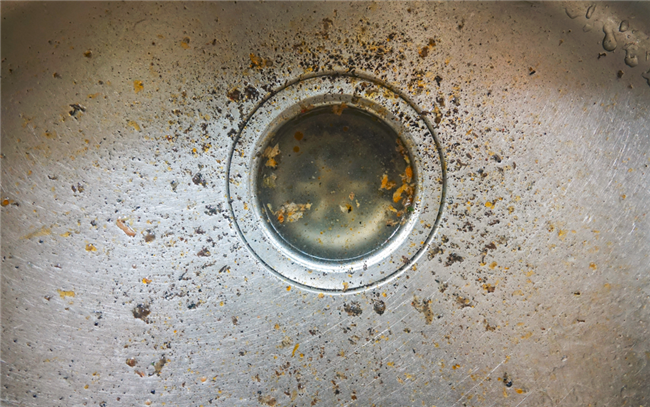
Tenants pouring grease down the sink and flushing paper towels down the toilet into the septic system is the issue this week week for Ask Landlord Hank. Remember Hank is not an attorney and he is not offering legal advice. If you have a question for him please fill out the form below.

Dear Landlord Hank:

I am acting as power of attorney for my son and my daughter-in-law.

So, I have found out in the last four months or so that the tenants have been pouring grease down the sink. In an exorbitant amount.

And they also admitted to me that they have been putting paper towels and everything down the toilet. But the grease is the worst.

So, there are several large bills from the septic guy, you know one for $701 for $800 and one for $500 one for $300. It’s just crazy.

We asked him to stop doing it. And now it has ruined the plumbing and septic tank – and it needs a new pump and the whole thing has to be cleaned out by a specialist. Now he’s trying to tell me that the water is turning into grease. You got the picture. What are my options please? And, thank you very much.

-Fay

Dear Fay,

I would make sure the plumber indicates on his invoices that the cause of the problem is the grease, and paper towels, etc. that that tenants are flushing.

Check your lease-it may say something like, ” If any plumbing issues result from tenant and or guests flushing anything into the toilet other than human waste and toilet paper, the tenant will be responsible for any costs or charges incurred. You will have proof from your interview with tenants and plumber that tenants are damaging your property.

I would immediately put a 3-day notice on the tenant’s door and then file for eviction. Best of luck!

Sincerely,

Hank Rossi

www.rentsrq.com

Each week I answer questions from landlords and property managers across the country in my “Dear Landlord Hank” blog in the digital magazine Rental Housing Journal.    https://rentalhousingjournal.com/asklandlordhank/

Editor’s note: Check your local and state regulations on issues such as this as it varies across the country.

Ask Landlord Hank Your Question

Ask veteran landlord and property manager Hank Rossi your questions from tenant screening to leases to pets and more! He provides answers each week to landlords.

  • This field is for validation purposes and should be left unchanged.

Tenants pouring grease down the sink and flushing paper towels down the toilet and damage to the septic system is the question this week
Landlord Hank Rossi says, “I would make sure the plumber indicates on his invoices that the cause of the problem is the grease, and paper towels, etc. that that tenants are flushing.”

How Can I Monitor Tenant Smoking In My No-Smoking Rental?

Do Your “No Smoking” And Odor Policies Stink?

Can I Say “No Pot In My Apartments” When It’s Legal In My State?

Sign Up For Our Newsletter And Get Apartment News And Helpful, Useful Content Each Week.

* indicates required

National Rent Growth Continues to Inch Up in April

National rent growth continued to inch up in April by 0.5%, as 83 of the nation’s 100 largest cities saw rents rise in April.

National rent growth continued to inch up in April by 0.5%, according to the May report from Apartment List, as 83 of the nation’s 100 largest cities saw rents rise in April.

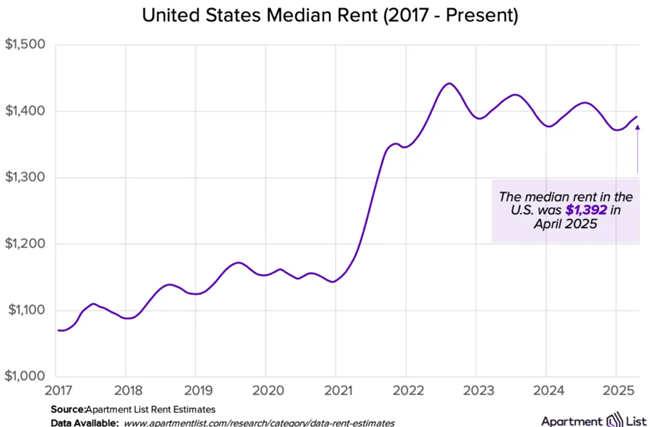
In dollar terms, the national median monthly rent now stands at $1,392, up $7 per month compared to last month, but down $4 compared to April 2024.

The national median rent has now fallen below its August 2022 peak by a total of 3.5%, or $50 per month. But despite the cooldown, the typical rent price remains 21 percent higher than its January 2021 level.

April’s small rent increase was less than the March increase, and the March decline in itself was concerning at the beginning of the usual seasonal pattern of rent increases.  Thus, “This month’s reading may be the first indication of demand slowing due to declining consumer confidence amid a more uncertain macroeconomic outlook,” writes the Apartment List Research Team writes.

National rent growth continued to inch up in April by 0.5%, as 83 of the nation’s 100 largest cities saw rents rise in April.

Multifamily vacancy rate hits 7%, a new peak

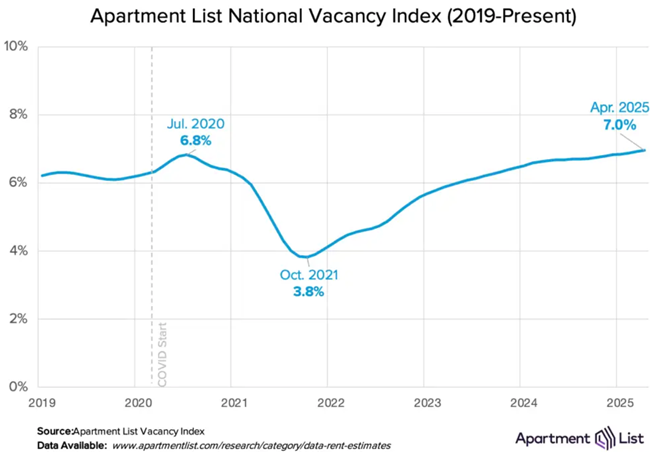
Apartment List says its measure of the national multifamily vacancy rate increased again and now sits at 7 percent, “representing a new all-time high for this data series, which goes back to the start of 2017.”

The rising vacancy rate has been largely tied to the increase in new apartment construction. As new apartment completions decline, the vacancy rate will likely begin to tighten again, but “for now, we’re still seeing vacancies rise, even as rent declines gradually moderate,” the report says.

Vacancy rate increases as national rent growth continued to inch up in April by 0.5%, as 83 of the nation’s 100 largest cities saw rents rise in April.

List-to-Lease time comes down from all-time high

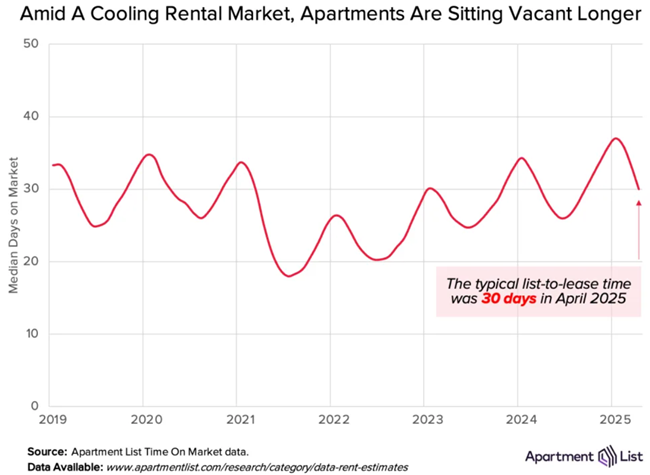
Among units that were leased in April, the median time on market was 30 days, down from 33 days in March.

Units are currently sitting vacant for 1 day longer than they were at this time in 2024, but are still sitting for 10 days longer than they were in mid-2022, when the market was at its tightest.

The influx of new supply has resulted not only in a growing number of vacant units, but also in an increase in the length of time those units remain unoccupied.

List to lease time increased as national rent growth continued to inch up in April by 0.5%, as 83 of the nation’s 100 largest cities saw rents rise in April.

Conclusion

April’s 0.5 percent increase shows rent prices continuing to trend up, but with some signs of potential demand weakness heading into peak moving season.

“As the level of new supply coming online continues to abate, we expect to see occupancy tighten and rent growth strengthen in the back half of this year, assuming that demand remains relatively stable. But amid a more uncertain macroeconomic outlook, stable demand is far from certain,” writes the Apartment List research team.

Read the full report here.

Join Us for the 2025 Pets and Housing Awards!

Join us for the 2025 pets and housing awards online and meet this year's winners by registering and joining us virtually on June 4, 2025.

Join us for the 2025 pets and housing awards online and you can meet this year’s winners by registering and joining us virtually on June 4, 2025.

Get ready to celebrate the best in pet-inclusive housing!

Michelson Found Animals’ Pet-Inclusive Housing Initiative invites you to join us virtually on June 4, 2025, for the fourth annual Pets and Housing Awards. We’ll be honoring the individuals, properties, and programs leading the way in pet-inclusive housing nationwide.

Join us for the 2025 pets and housing awards online and meet this year's winners by registering and joining us virtually on June 4, 2025.

Awards to be presented include:

Best Leap Forward
Most Impactful Adoption or Foster Event or Program
Most Innovative Pet Amenity or Amenity Group
Most Innovative Pet Marketing Campaign
Most Pet-Inclusive Property
Vanguard Award

NEW THIS YEAR!

Paws & Progress Nonprofit Award
Pets & Housing Policy Advancement Award

Join us in celebrating the champions who are creating a future where pets and their people thrive together.

Register now to join us virtually on June 4.

Click Here to Register for the Big Event


About the pet-inclusive housing initiative:

Dr. Gary Michelson started Found Animals in the aftermath of Hurricane Katrina. Found Animals established the first free microchip registry to help lost pets find their way home. With a commitment to continue keeping people and pets together, he turned to the next scalable solution: increasing the availability of truly pet-inclusive housing.

Teaming up with the Human Animal Bond Research Institute (HABRI), the Michelson Found Animals Foundation commissions research to better understand pet-related housing issues and find the right solutions to help keep people and pets together.

From this research, the Pet-Inclusive Housing Initiative develops resources, partnerships, and actionable tools to increase the availability of truly pet-inclusive housing. We are working hard to increase pet-inclusive housing because everyone should have access to the joy of pets. After all, pets help communities grow stronger.

Why Pet-Inclusive Housing is a Win-Win for Everyone

Sign Up For Our Weekly Newsletter And Get Rental Property And Apartment News And Helpful, Useful Content Each Week.

* indicates required

Tariff Uncertainty Affects Multifamily Construction Starts

Current tariff policy is causing multifamily uncertainty about future years as multifamily construction starts have plummeted from 2022 peak

Current tariff policy is causing multifamily uncertainty about future years as construction starts have plummeted from the 2022 peak, Yardi Matrix says in a supply forecast.

The current under-construction pipeline is set to deliver 536,000 units in 2025 and 422,000 in 2026.

The report says construction starts moderated significantly in 2024.

“The large decline will drive a slowdown in new supply in 2026. However, elevated completion times and a still-large under-construction inventory imply that supply will not completely bottom until 2027,” writes Ben Bruckner, senior research analyst for Yardi Matrix, in the report.

The report says tariff policy has added a great deal of uncertainty to how multifamily construction starts will unfold in the remainder of 2025. The forecast assumes starts will be at a similar-to-slightly-lower pace than what was recorded in 2024.

Yardi Matrix continues to forecast that new supply will bottom in 2027, with a gradual recovery taking hold in 2028 through 2030.

“As always, Yardi Matrix is extremely focused on accurately maintaining our development-pipeline data and identifying any changes in its evolution that will have a meaningful impact on future new supply,” Bruckner writes.

Read the full report here.

National Rent Growth Continues to Inch Up in April

Sign Up For Our Weekly Newsletter And Get Rental Property And Apartment News And Helpful, Useful Content Each Week.

* indicates required

Rent Control Passes in Washington Goes To Governor

A rent control bill limiting rent increases across Washington State has passed the Senate and House but with different amounts and conditions

A rent-control bill limiting rent increases throughout Washington State has now passed both the Senate and House and goes to the governor for signature, according to reports.

The final version was a compromise after moderate Democrats in the Senate wouldn’t go along with the initial 7% cap, without inflation, the House had approved.

Landlords also couldn’t raise rents in the first year of a tenancy under the proposed law. If a landlord violates the provisions, tenants or the state attorney general could bring litigation.

Buildings owned by nonprofits or public housing authorities would be exempt from the limits. The same goes for duplexes, triplexes or fourplexes if the owner lives in one of the units, as well as new construction for its first dozen years.

Supporters say the rent legislation would give predictability to tenants who could be forced out of their homes by steep hikes, while still giving room for landlords to impose increases.

“As everyone knows, housing is the single greatest cost in a household budget,” said Sen. Emily Alvarado, D-Seattle, to the  Washington State Standard. “This bill is a simple guardrail for the many, many people in this state who just want to make sure that they can have a little bit of control in that household budget and plan and save.”

Opponents say the bill would drive developers out of Washington, hurting the state’s push to increase housing supply. And current landlords wouldn’t be able to keep up with inflationary costs for maintenance, they believe.

Sen. Chris Gildon, R-Puyallup, pointed to another proposal from Senate Democrats to allow an increase in annual property tax from the current 1% cap. “I have a real fear for our housing market at large over time should both of those policies come to fruition,” Gildon told the Washington State Standard.

The bill contains an emergency clause. If enacted, the provisions will take effect immediately.

Sign Up For Our Weekly Newsletter And Get Rental Property And Apartment News And Helpful, Useful Content Each Week.

* indicates required