Home Blog Page 2

Trends and Data Illustrate 2026 State Of Pets in Rentals

Trends and data in the 2026 state of pet rentals report shows pet ownership and rental cooperation are rising but challenges exist.

Trends and data in the 2026 state of pet rentals report shows pet ownership and rental cooperation are rising but challenges exist.

A new survey released by PetScreening reports that 81% of rental housing operators report growth in pet ownership, and 68% now consider themselves “pet-friendly,” which means a variety of things ranging from more pets being allowed to more pet-focused amenities onsite.

The 2026 State of Pets in Rental Housing Report, based on feedback from 673 property managers and leasing professionals primarily within the multifamily and single-family sectors, details the effects of pet-inclusivity in the modern rental-housing world.

While 71% of U.S. households own a pet, according to the American Pet Products Association, PetScreening data shows that only 43% of renters report owning one. This figure is nearly 30 percentage points lower than the pet ownership rate reported by housing operators, suggesting that many pets in rentals may be unauthorized or underreported. The report aims to assess reasons for the disparity and ways operators can resolve related challenges.

Trends and data in the 2026 state of pet rentals report shows pet ownership and rental cooperation are rising but challenges exist.

While the rates of pet ownership in rentals continues to rise, operational challenges persist, as operators report pet damage and unauthorized pets are among the primary issues they face at their properties.

“Despite any operational challenges, the survey underscores the clear benefits of welcoming pets at rental communities,” said John Bradford, founder and CEO of PetScreening. “When pet strategies are optimized to embrace pet-inclusivity and reflect the desires of the modern renter, the advantages become more pronounced in the form of a wider resident pool, stronger retention and increased revenue. While the industry still can make significant headway, property managers are doing a commendable job of bridging the gap.”

Some of the gap between the overall U.S. pet ownership rate and the percentage of renters who say they own pets may be attributable to unauthorized and underreported pets onsite. This highlights the importance of accurate tracking, which can help operators collect their rightful pet-related revenue and avoid potential risks associated with unauthorized pets.

Digging into the Data: Popular Amenities, Common Restrictions

The survey also noted that pets are an increasingly key driver in renter decision-making, as renter search data from Apartments.com showed that more than half of renters utilizing pet filters search for dog-friendly communities. The most cited pet amenities offered by survey respondents included pet waste stations (45%) and pet parks (35%)—functional offerings that were significantly more prevalent than experiential features such as dog-walking services (24.9%) or pet-focused events (11.2%).

While some of the industry has shed blanket restrictions in favor of evaluating pets and their owners on an individual basis, most properties continue to have significant restrictions in place. Pet limits per household was the most cited by respondents (78.4%), while other traditional restrictions such as breed (66.7%) and weight limits (59.8%) continue to be prevalent as well.

Metrics specific to PetScreening included that the company’s clients experienced a 30.7% increase in revenue after implementing the platform, which underscored the impact of pet-friendly policies paired with formal tracking and screening tools. Additionally, PetScreening says its customers saved approximately 1.3 million administrative and legal hours reviewing assistance-animal accommodation requests, instead relying on the platform’s expertise, which also helped to reduce risk of regulatory violations and potential litigation.

The entire report can be accessed here.

About PetScreening:

PetScreening is a leading platform for managing pets and assistance animals. Offered at no cost to housing providers, the platform standardizes pet-risk assessment with digital pet profiles and FIDO Scores®, streamlines assistanc- animal reviews in compliance with HUD and Fair Housing guidelines, and helps identify unauthorized pets, all while supporting more pet-inclusive communities. Learn more at petscreening.com.

Pet Owning Renters Face Barriers Despite “Pet-Friendly” Ads

2026 Pets and Housing Awards Are Open For Nominations

Pets Are Family, Not an Apartment Amenity

Sign Up For Our Weekly Newsletter And Get Rental Property And Apartment News And Helpful, Useful Content Each Week.

* indicates required

Oregon Tenant Confidentiality Bill Goes To Governor For Signature

Oregon's 2026 tenant confidentiality bill restricts landlords from disclosing tenant information such as SSNs, immigration status, or medical

Oregon’s 2026 tenant confidentiality bill (HB 4123) restricts landlords from disclosing sensitive tenant information—such as SSNs, immigration status, or medical records—without written consent.

It now goes to the governor for signature and It imposes penalties of up to twice the monthly rent for “knowingly” violating these privacy protections.

The law covers personal details including Social Security numbers, contact information, income details, immigration/citizenship status, and medical or disability records.

The bill includes exceptions for situations involving legal or administrative proceedings, such as court orders, mandatory background checks, insurance claims, or necessary maintenance services.

Clackamas Women’s Services  told kgw.com  the “tenant confidentiality” bill would help protect women trying to escape their abusers.

CWS supports survivors of domestic and sexual violence, stalking, trafficking and other crimes. All too often, a woman’s whereabouts get back to her abuser, she said.

“We know how important it is for survivors when they are finally able to leave a violent situation and get into a safe and secure housing situation — that they’re able to keep that,” Erlbaum said.

When that information gets out, survivors may have to start the process of finding safe housing all over again. Because often, “victims’ information is shared and their abuser shows up at their place of employment or sometimes even at that housing unit itself,” she explained.

“It’s actually fairly common, and I think it’s because information is just shared in the course of conversation,” Erlbaum said. “Again, maybe very well-meaning, but that can create a really high-risk situation for survivors.”

Accidental Landlords Rise To Three-Year High

A near-record number of homeowners are becoming rental property owners as the number of accidental landlords rise

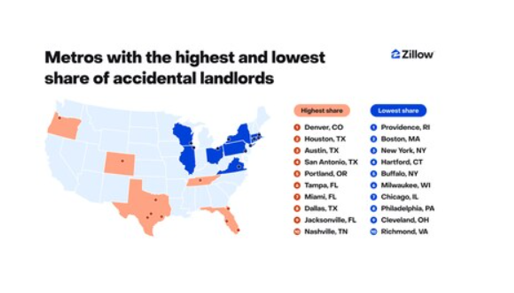
A near-record number of homeowners are becoming rental property owners as accidental landlords rise when they turn their unsold properties into rentals, according to Zillow.

Properties owned by these accidental landlords account for more of the listed rental stock than at any time since 2022 — and the trend may not have peaked yet.

  • 2.3% of homes listed for rent on Zillow were recently listed for sale, according to a new Zillow analysis. Only once in Zillow’s nearly six-year record has the share of “accidental landlords” been higher nationwide.
  • Texas and Florida markets, along with Denver, Portland and Nashville, have the largest share of these accidental-landlord properties.
  • Would-be sellers resorting to renting instead of accepting a serious price cut indicates these homeowners don’t need to liquidate distressed properties.

“Sellers are facing a different reality than they did a few years ago,” said Kara Ng, senior economist at Zillow. “Bargaining power is tilting toward buyers and homes are taking longer to sell, making renting out a property one way to buy time rather than compete aggressively on price.”

An accidental landlord is a property owner who becomes a landlord unintentionally, often by inheriting a home, moving for work without selling their previous house, or due to a slow housing market. Unlike intentional investors, they typically rent out of necessity rather than a planned business strategy

Because Zillow is a destination for both for-sale and rental listings, the platform offers a view into how unsold homes are increasingly reentering the market as rentals.

Detached single-family homes are the most common property type owned by an accidental landlord — 3.4% of single-family homes listed for rent on Zillow are owned by accidental landlords. That’s compared to 2.2% for townhomes and 1.1% for condos.

The rise of would-be sellers turning into accidental landlords rather than selling for a loss — or at least a lower price than they are willing to accept — is a good indication that homeowners aren’t selling out of necessity or because they are at risk of foreclosure.

Oregon Tenant Confidentiality Bill Goes To Governor For Signature

Sign Up For Our Weekly Newsletter And Get Rental Property And Apartment News And Helpful, Useful Content Each Week.

* indicates required

Report Outlines Steps for Multifamily Growth in 2026

Steps operators can take to ensure multifamily growth in 2026 rather than remaining stuck in neutral in 2026

Steps operators can take to ensure they’re moving the needle in the right direction rather than remaining stuck in neutral in 2026 as prospects want transparency, control and consistent touchpoints.

By Paul Willis

For many rental-housing operators, the goal in 2026 is to remain steady. It is a reasonable objective considering the hints of uncertainty surrounding the sector. Occupancy rates are a bit soft in some markets, and overall investor activity hasn’t returned to its peak form.

But for those a bit more ambitious, the intention is to grow in ‘26.

According to the recently released Entrata report The 2026 Playbook for Multifamily Growth, potential for advancement remains prevalent despite some mild headwinds facing the industry.

The report outlines steps operators can take to ensure they’re moving the needle in the right direction rather than remaining stuck in neutral.

 Control, clarity and consistency

 According to the report, the three factors most important to renters are equally crucial for operators: control, clarity and consistency. Control refers to renters’ ability to move at their own pace by using self-serve options when they desire and talking to a live agent when it matters—without having to repeat steps. The report shows a hefty 58% of Gen Z renters—the fastest emerging contingent of renters in the industry—completed the application process nearly exclusively online, and 35% of the generation’s renters indicated they’d prefer a fully self-service leasing process.

Clarity refers to advertised pricing that reflects the true monthly cost, an all-in price including rent, fees and other services that contains no surprises. A convincing 82% of renters indicated that they want more fee transparency within the rental process (put another way, only 18% of respondents believe operators are currently doing enough when disclosing fees and all-in costs).

Consistency refers to the notion that every touchpoint shares the same context, so prospects never have to repeat steps or start the process over. Whether the touchpoint is generated online, by text, by phone or in-person, the messaging should never waver.

Automated leasing journey

 Much like putting together an amazing workplace culture or a perfect game plan in football, there is much talk of a fully automated leasing journey—but what does it look like in actual practice?

According to the report, the ideal automated journey consists of these steps:

  • A prospect searches for a rental home online and clicks a property listing.
  • An AI assistant greets them on the website, answers questions about pricing, availability and amenities, and then recommends floor plans based on their preferences.
  • The prospect takes a virtual tour, selects a home and schedules a visit for an in-person tour through the assistant, which automatically confirms and sends reminders.
  • The prospect then completes an online application after the tour process is complete. The system verifies their information, runs instant screenings, generates a digital lease and collects signatures and payments—all entirely digital and bereft of human involvement, unless the prospect requests the support of a live agent.

This enables prospects to have a seamless online experience with high-touch support when needed. Property teams, meanwhile, have full visibility into the journey and can pinpoint the progress of the prospect in real time. This enables teams to identify which leads might need a direct follow-up, a nudge forward or continued nurturing.

A personalized offer

In the age of convenience, a personalized offer that incorporates a prospect’s preferences serves as an ultra-modern way to secure a lease.

An example of this, according to the report, is a prospect who views a property online and receives a follow-up message with a home tailored to their interests. This includes a floor plan similar to the one they toured and additional preferences, such as a home near the amenity spaces, with a mountain view or in proximity to the parking area. The personalized offer can include a limited-time incentive, such as a discounted first month’s rent or waived application fee, if the prospect applies within a certain time period.

The offer can be delivered automatically through email or text, personalized with the prospect’s preferred move-in date and home type, which creates a sense of urgency and an efficient way to move forward with the process. Offering multiple home choices within the personalized offer is another way operators can provide control for renters, who might not be fully enamored with the initial choice provided.

Entrata research shows that Gen Z renters are more focused on satisfaction and convenience than cost when deciding whether to renew a lease, meaning the same “personalized offer” concept can be equally beneficial in the renewal process.

Primary takeaways

The report’s overriding message is that, while growing in 2026 is certainly plausible, it will take more than a singular action. The heart of the effort should include a mix of message clarity, features designed for prospects and residents to take control, and the right amount of assistance from AI and automation.

While the initiative must be multitiered, the report recommended four immediate steps operators can take to ignite the process:

  • Enhance fee transparency by publishing all-in pricing across your website and listings, with a simple cost estimator.
  • Enable 24/7 coverage through AI and chatbots for web, text and voice, with seamless human handoffs. Little is more frustrating to a prospect than talking to an agent who doesn’t have knowledge of the steps they have already completed.
  • Offer flexible choices—tour types, lease terms, deposit options and payment cadence—and track how often they are utilized.
  • Launch or refine a resident-rewards program linked to on-time payments, renewals, referrals, reviews and compliance.

While taking these steps, operators should constantly monitor how they are performing in actual practice, the report says. Tracking metrics such as time to first reply, percentage of listings with all-in pricing, rewards enrollment and hours saved for onsite teams can provide a snapshot of the effectiveness of the initiative.

Operators that constantly measure and adjust accordingly, the report says, will generate a competitive edge and reap the results in the form of increased demand. They might surpass the ambition of simply remaining steady in 2026, as well.

About the author:

Paul Willis is a content director for LinnellTaylor Marketing.


Oregon Tenant Confidentiality Bill Goes To Governor For Signature

Washington Passes Rental Housing Flood-Risk Disclosure Law

Sign Up For Our Weekly Newsletter And Get Rental Property And Apartment News And Helpful, Useful Content Each Week.

* indicates required

Washington Passes Rental Housing Flood-Risk Disclosure Law

Washington lawmakers approved legislation requiring rental flood risk disclosure by landlords and to inform tenants about insurance

Landlords must inform tenants about the Washington State law requiring flood-risk disclosure and to inform tenants most rental insurance policies do not cover floods.

By Aaron Kirk Douglas

Washington lawmakers approved legislation requiring landlords to disclose when rental units are in areas at risk of flooding and to inform tenants that standard renters’ insurance does not cover flood damage.

The bill, prompted by flooding in Western Washington that displaced renters, would apply to leases signed after Dec. 31, 2026, and recommends tenants consider purchasing flood insurance, according to the Seattle Timess.

Why it matters to rental property owners

Disclosure requirements for rental housing continue to expand nationwide.

While the new Washington rule is relatively narrow, it reflects a broader regulatory trend toward increasing landlord disclosure obligations related to climate risks, insurance coverage, and property conditions.

Unlike some states, including Oregon, California and Texas, Washington only required flood risk disclosures in home sales — not in rental leases.

The bill passed with bipartisan support — and no strong opposition from major landlord groups. But some say there’s still work to be done.

Sean Flynn, president of the Rental Housing Association of Washington, was initially concerned that a disclosure requirement would cause unnecessary fear and ostracism of certain properties. But with the requirement only applying to leases, and not rental advertisements, he’s changed his tune according to the Seattle Times.

“What ended up getting passed, I think, meets everyone’s goals and is a good bill,” he said. “It’s pretty reasonable.”

About the author:

Aaron Kirk Douglas is a multifaceted storyteller and market analyst. His career spans journalism, creative nonfiction, filmmaking, and real estate research. He serves as Director of Market Intelligence at HFO Investment Real Estate/GREA, the Pacific Northwest’s leading multifamily brokerage.

What the Next Generation of Developers Is Learning And Why It Matters for Multifamily

Sign Up For Our Weekly Newsletter And Get Rental Property And Apartment News And Helpful, Useful Content Each Week.

* indicates required

Tennessee Trying To Stop Landlords From Banning Guns

A Tennessee bill would prevent landlords from banning guns and prohibit adding a clause to a lease to ban firearms in rentals

A Tennessee bill, HB 496, would prevent landlords from banning guns and prohibit adding a clause to a lease that would ban tenants from “lawfully possessing, carrying, transporting, or storing a firearm, firearm components, or ammunition on leased premises.”

The bill to stop landlords from banning guns has passed the legislature and heads to the governor for signature.

The protection also extends to firearms kept in vehicles parked in tenant parking areas and in locations controlled by the landlord that tenants must use to enter or exit their residence or parking areas.

If passed, the new law would only apply to residential lease agreements and landlord rules that are entered into, amended, extended or renewed on or after Jan. 1, 2027.

Under the bill, landlords can require tenants to transport a firearm between a vehicle and the tenant’s residence only if the firearm is concealed, holstered or stored in a carrying container. Landlords can also require firearms to remain concealed, holstered or in a container when tenants are in common areas such as hallways or elevators, according to the bill.

Some properties are excluded from the proposal, including premises leased to state agencies or departments, facilities licensed or contracted with the Department of Mental Health and Substance Abuse Services, school properties, or facilities connected to the Department of Children’s Services.

Health care and elder care facilities are also exempt, including hospitals, nursing homes, homes for the aged, assisted care living facilities, memory care facilities and certain independent living facilities connected to those operations.

No Guns In My Apartments: Can A Landlord Say That And Put It In A Lease?

Return To Positive Rent Growth With Small Increase In February

Sign Up For Our Weekly Newsletter And Get Rental Property And Apartment News And Helpful, Useful Content Each Week.

* indicates required

2026 Pets and Housing Awards Are Open For Nominations

Raise the woof- the 2026 pets and housing awards are open for the fifth year for nominations from the Pet-Inclusive Housing Initiative.

Raise the woof- the 2026 pets and housing awards are open for the fifth year for nominations from the Pet-Inclusive Housing Initiative.

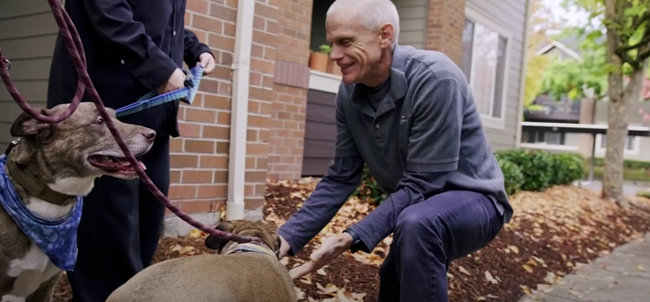
The connections between people and their pets have never been stronger, and the multifamily housing industry is leading the charge in celebrating this bond. With more renters seeking pet-inclusive communities, forward-thinking operators are redefining what it means to be a “pet-friendly” property—and now it’s time to recognize their groundbreaking work.

Michelson Found Animals Foundation says nominations are now open for the Fifth Annual Pets and Housing Awards, presented by the Pet-Inclusive Housing Initiative. These awards honor the trailblazers, innovators, and community champions who are making housing more welcoming for pets and their people.

Ross Barker, Director of the Pet-Inclusive Housing Initiative, describes the event as a highly anticipated opportunity to highlight outstanding efforts in pet-inclusive housing. “We eagerly anticipate this event every year because it lets us shine a spotlight on the outstanding organizations leading the pack with their pet-inclusive housing solutions,” Barker said. “This fifth annual event will be our best yet, and we’re excited to see the great work organizations nominate!”

Raise the woof- the 2026 pets and housing awards are open for the fifth year for nominations from the Pet-Inclusive Housing Initiative.
Ross Barker, Director of Michelson Found Animals Foundation’s Pet-Inclusive Housing Initiative.

Why Nominate For Pets And Housing Awards In 2026?

This is your chance to showcase your achievements and gain industry-wide recognition as a leader in pet inclusivity. Whether you’ve launched an innovative amenity, hosted successful pet-focused      events, or reimagined pet policies by easing or eliminating size and breed restrictions, we want to celebrate your dedication to improving the lives of pets and residents alike. Whether you’re part of a large company spanning multiple states, an independent rental operator serving a local community, an advocate for pet policy change or a nonprofit champion for pets in housing, we want to hear from you! Or you may know some great work in one of these categories you would like to nominate on behalf of someone else – go for it!

2026 Pets And Housing Awards Categories

With nine categories, there’s a spotlight for every kind of innovation:

  • Best Leap Forward: Recognizing significant progress in pet inclusivity.
  • Vanguard Award: Honoring a company with a sustained, long-term commitment to pet-inclusive housing.
  • Most Impactful Pet & Community Engagement Event or Program: Recognizing a rental housing property or company for its adoption or foster initiatives, partnerships, education, or other pet-focused programs.
  • Most Innovative Pet Amenity or Amenity Group: Shining a light on creative spaces and services for pets.
  • Most Innovative Pet Marketing Campaign: Showcasing campaigns that engage and attract pet-loving residents.
  • Most Pet-Inclusive Property: Celebrating a property that goes above and beyond for pets and their people, setting the pet-inclusive standard.
  • Paws & Progress Nonprofit Award: Celebrating nonprofits driving positive change in pet-inclusive housing.
  • Pets & Housing Policy Advancement Award: Recognizing advocacy and policy advancements that benefit pets and housing.

Key Details For 2026 Pets And Housing Awards

  • Nomination Deadline: March 27, 2026
  • Winners Announced: Virtually (details to follow)

How to Nominate

Submitting a nomination is simple and unlimited! Highlight the achievements in any—or all—categories. Share your (or another’s) story, inspire your peers, and claim your place as an industry leader. Simply click here to get started.

Let’s Celebrate Together

The 2026 Pets and Housing Awards are more than just accolades—they’re a celebration of the innovative and heartwarming ways the multifamily housing industry improves lives. Let’s honor the creativity, compassion, and commitment that make pet-inclusive housing a reality.

Don’t wait! Start your nominations today, and join us in setting the standard for pet-inclusive communities. Together, we’ll keep raising the woof!

Return To Positive Rent Growth With Small Increase In February

National rents returned to positive rent growth and inched up in February after falling for six straight months as the season is changing

National rents returned to positive rent growth and inched up in February after falling for six straight months, according to the March report from Apartment List.

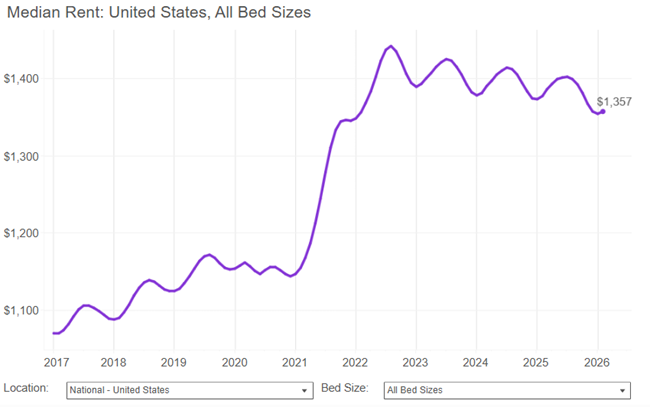
The national median rent ticked up by 0.2 percent in February, flipping positive after six straight monthly rent declines.

National rents returned to positive rent growth and inched up in February after falling for six straight months as the season is changing

This officially marks the start of the market creeping out of the off-season, and we’ll likely see continued increases in the months ahead as moving activity ramps up, Apartment List researchers say.

The timing of this month’s return to positive rent growth is in line with typical seasonal patterns – prices soften as fewer renters move during the fall and winter, and then gradually begin to increase as we get closer to the peak moving summer season. February has marked the return to positive rent growth in each of the last four years.

National rents returned to positive rent growth and inched up in February after falling for six straight months as the season is changing

Highlights of the return to positive rent growth report:

  • The national median rent increased by 0.2% in February, and now stands at $1,357. This marks the first monthly increase since last July, as the market begins to pull out of its off-season pricing dip.
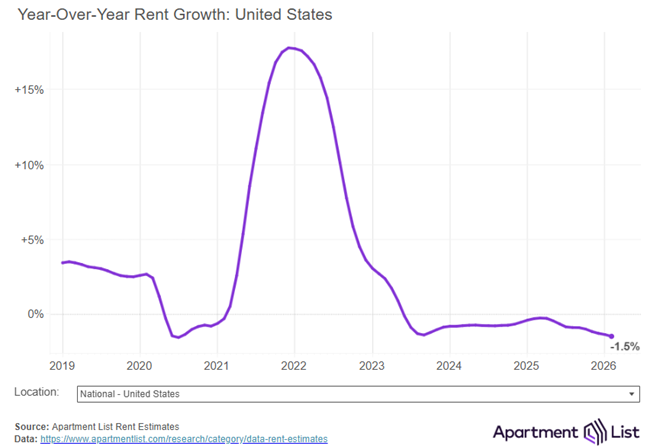
  • Rent prices nationally are down 1.5% compared to one year ago. Year-over-year rent growth has been slightly negative for well over two years, and the national median rent has now fallen from its 2022 peak by a total of 5.9%.
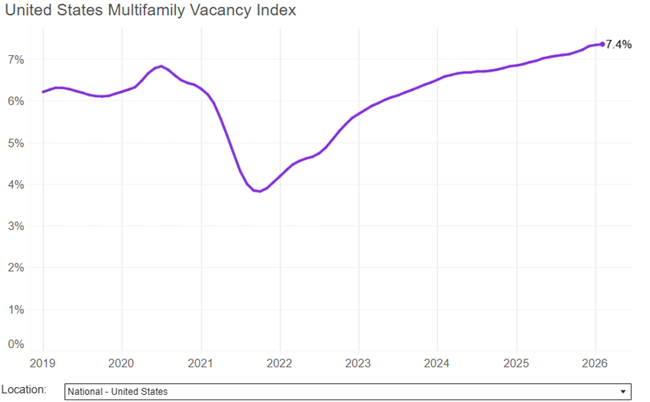
  • The national multifamily vacancy rate ticked up to 7.4% this month.  We’re past the peak of a multifamily construction surge, but a healthy supply of new units is still hitting the market and colliding with sluggish demand, causing vacancies to continue trending up.
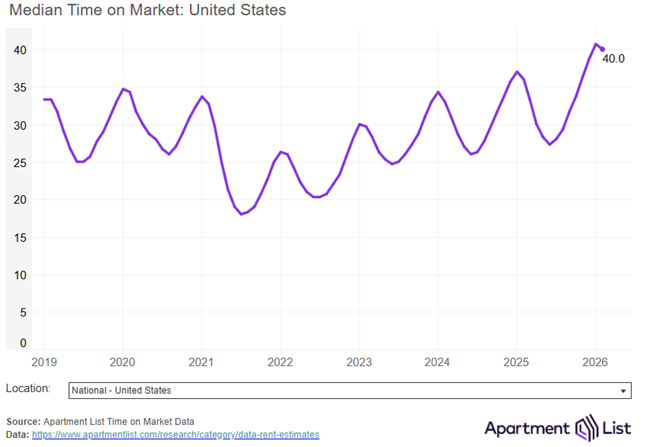
  • Units are taking an average of 40 days to get leased after being listed, which is four days longer than one year ago, and more than twice as long as it took units to turn over when the market was at its hottest in mid-2021.

Vacancy index continues to climb

The Apartment List national vacancy index – which measures the average vacancy rate of stabilized properties in our marketplace – increased to 7.4 percent in February. This represents the highest level since at least 2017, which is when we started tracking occupancy.

National rents returned to positive rent growth and inched up in February after falling for six straight months as the season is changing

Eventually, the market will absorb the swell of new units, and occupancy and pricing trends should begin to gradually tighten. But for now, conditions remain soft, and the runway for these sluggish conditions seems to have lengthened as a shaky labor market has put a damper on housing demand.

List-to-Lease time remains elevated at 40 days

As more vacant units have come onto the market, those units have also been sitting vacant for somewhat longer. The Apartment List “time on market” index tells us how long it takes for units to get leased after they are first listed on our platform.

Median time on the market it takes to lease

This “list-to-lease” time is a highly-seasonal measure, and ticked down slightly this month, in line with month-over-month rent growth flipping positive. Units leased in February had been sitting on the market for an average of 40 days, down from 41 days last month.

Read the full report here.

Oregon Landlords Could Face Financial Penalty If Leaking Tenant Immigration Status

Oregon landlords who leak confidential information about tenants such as immigration status or medical records could face financial penalties.

Oregon landlords who leak confidential information about tenants such as their immigration status or medical records could soon face financial penalties.

Under House Bill 4123, passed by the Oregon Senate on Monday by a 24-3 vote, lawmakers on both sides of the aisle moved to strengthen existing protections for immigrants without permanent legal status that the Legislature enacted last year. The bill now heads to Gov. Tina Kotek’s desk for final consideration.

The Oregon Capital Chronicle reported that a 2025 Oregon law already ensures that landlords may not discriminate against tenants due to their immigration status while prohibiting release of information about their citizenship with the intent to harass, retaliate against or intimidate. That also includes when a landlord threatens to release such information.

But that law didn’t establish explicit monetary compensation for individuals who are victims of discrimination, instead empowering them to sue in court or challenge discriminatory decisions such as an eviction based on immigration status. Affordable housing, civil rights and domestic-violence survivor advocates have urged lawmakers to support HB 4123 on the grounds that renting in Oregon shouldn’t further expose vulnerable communities.

If a landlord “knowingly violates” the bill’s protections, tenants whose confidential information has been disclosed could recover compensation that equals twice the amount of their monthly rent. Protected information would also include Social Security numbers and medical or disability records.

Sign Up For Our Weekly Newsletter And Get Rental Property And Apartment News And Helpful, Useful Content Each Week.

* indicates required

Portland’s Rent Growth Slows With Soft Fundamentals

Portland’s average advertised asking rent dropped 0.6% on a trailing three-month basis as Portland's rent growth slowed with soft fundamentals

Portland’s average advertised asking rent dropped 0.6% on a trailing three-month basis as of December 2025, reaching $1,727, as Portland’s rent growth slowed with soft fundamentals, according to the most recent Yardi Matrix Multifamily Report.

Meanwhile, the national rate declined by only half that amount, sliding to $1,737. Metro Portland’s occupancy rate for stabilized assets was 95.0% in November, or 40 basis points above the U.S. average.

As of November, Portland unemployment stood at 4.8%, according to preliminary data from the Bureau of Labor Statistics. Job growth was limited to just four sectors, and those increases were not enough to offset wider employment declines, leading to a net loss of 7,200 positions.  Despite economic uncertainty, several developments were underway in Portland. Among these projects was the I-205 Abernethy Bridge improvement, which includes making the bridge earthquake-ready and adding walking and biking paths.

The $672 million project is scheduled for completion at the end of the year.

In 2025, developers added more than 5,800 units to the metro’s inventory and had close to 4,400 units underway as of December. The majority of recent deliveries and projects underway target the lifestyle segment. Transaction activity remained steady, as the metro recorded $1.2 billion in deals in the past year. That was a little short of the $1.4 billion recorded in 2024.

Read the full report here.

Return To Positive Rent Growth With Small Increase In February