
Home Blog Page 196

Fair Housing Discrimination Against Someone You’ve Never Talked To?

The Grace Hill training tip of the week focuses on the issue of potential fair housing discrimination against someone you have never talked to.

By Ellen Clark

When you think about upholding Fair Housing Act laws, you probably think about treating people fairly and equally when they come in for a tour, or as you interact with them as potential tenants.

But did you ever think if you fail to answer an email, you end up on the wrong side of a fair housing claim without ever interacting with a person?

Fair housing laws protect people from discrimination throughout all stages of your interactions, not just after they become your tenant or residents of your apartment community.

From the first contact, whether by phone call, email, text, or in-person, you are responsible for upholding fair housing laws and treating all people in a non-discriminatory manner.

In fact, it is possible for you to discriminate against someone without ever having direct contact with that person.

That may seem unlikely, but let’s explore how that could happen.

If an employee fails to respond to an email due to an assumption about the sender’s race, that behavior could be considered discrimination.

How discrimination could happen against someone you’ve never talked to

Here are a couple of examples to consider:

    • A maintenance technician skips over a service ticket for a devout Christian family with a reputation for talking openly about their religion because he anticipates feeling uncomfortable. The maintenance technician’s behavior could be considered discrimination based on religion, even though the maintenance technician never directly interacted with the resident.
    • A leasing agent gets an email from a prospective resident with a name that she assumes is Asian. The agent does not respond to the email because the community’s residents are mostly African American and she feels the prospective resident probably wouldn’t fit in. This behavior could be considered discrimination based on race, even though the leasing agent never directly interacted with the prospective resident.

Consistency and training are key to ensuring that your teams are upholding fair housing laws and treating people in a non-discriminatory manner.

 How can you guard against discrimination happening?

Consistency and training are good places to start.

Consistency is key in dealing with fair housing issues.

It is best to behave consistently with everyone you assist, and everyone who is seeking assistance from you even if you haven’t interacted with them yet. This means phone messages, emails, web inquiries, and service requests. If you make an exception to any policy or procedure, make sure you provide the same information and options to all prospects and residents who are in the same situation.

All staff members who interact with residents and prospective residents, or who handle requests or inquiries of any kind, should be trained on fair housing laws.

It is recommended that newly hired staff receive fair housing training before they work with customers. Vendors and contractors who could possibly interact with your residents should be informed of your company’s fair housing policy and asked to abide by fair housing laws. All personnel should refresh their fair housing knowledge at least annually.

It never hurts to run through scenarios with your employees, including those like the ones above, to ensure that they understand that it is important to think about upholding fair housing laws at all times, not just when they are face-to-face or otherwise directly interacting with prospective or current residents.

About the author:

Ellen Clark is the Director of Assessment at Grace Hill.  Her work has spanned the entire learner lifecycle, from elementary school through professional education. She spent over 10 years working with K12 Inc.’s network of online charter schools – measuring learning, developing learning improvement plans using evidence-based strategies, and conducting learning studies. Later, at Kaplan Inc., she worked in the vocational education and job training divisions, improving online, blended and face-to-face training programs, and working directly with business leadership and trainers to improve learner outcomes and job performance. Ellen lives and works in Maryland, where she was born and raised.

 

Can Enforcing Nuisance Ordinances Lead To Fair Housing Violation?

The Grace Hill training tip of the week focuses on the issue of nuisance ordinances and whether they could lead to Fair Housing Act violations.

By Ellen Clark

Nuisance ordinances aim to keep communities crime free, increase property values, and encourage economic development but many nuisance ordinances include domestic violence incidents in the definition of a “nuisance.”

This can have an adverse impact on victims of domestic violence.

Assess your nuisance policies and procedures to ensure they do not unfairly discriminate against women, who are more likely to be victims of domestic abuse and are a protected class.

Victims of domestic violence calling law enforcement is a nuisance?

For example, according to some nuisance ordinances, victims of domestic violence who call law enforcement a certain number of times may be subject to eviction.

As a result, victims are less likely to report crimes and may continue to suffer abuse. Because domestic violence victims are overwhelmingly female, such laws could cause a disparate impact based on gender, which is a protected class under the Fair Housing Act (FHA).

In September 2016, the U.S. Department of Housing and Urban Development (HUD) issued guidance addressing the impact of nuisance ordinances on victims of domestic violence. HUD’s guidance primarily focuses on the sources of nuisance ordinances – local governments. However, HUD has taken the position that a multifamily housing provider may violate the FHA by selectively or generally applying nuisance ordinances in ways that discriminate against residents of a protected class.

Nuisance ordinances can cause housing discrimination

HUD writes in the guidance that, “A growing number of local governments are enacting a variety of nuisance ordinances that can affect housing in potentially discriminatory ways.

“Nuisance includes what is characterized by the ordinance as an “excessive” number of calls for emergency police or ambulance services, typically defined as just a few calls within a specified period of time by a tenant, neighbor, or other third party, whether or not directly associated with the property.

“The ordinances generally require housing providers either to abate the alleged nuisance or risk penalties, such as fines, loss of their rental permits, condemnation of their properties and, in some extreme instances, incarceration. Some ordinances may require the housing provider to evict the resident and his or her household after a specified number of alleged nuisance violations—often quite low—within a specific timeframe.

“For example, in at least one jurisdiction, three calls for emergency police or medical help within a 30-day period is considered to be a nuisance, and in another jurisdiction, two calls for such services within one year qualify as a nuisance. Even when nuisance ordinances do not explicitly require evictions, a number of landlords resort to evicting the household to avoid penalties,” HUD writes.

 What does this mean for multifamily housing providers?

Although the law in this area is actively developing from state to state, the key takeaway point is that multifamily housing providers often may be caught in a “Catch-22,” balancing their compliance with local nuisance ordinances against compliance with the FHA.

    • Multifamily housing providers should assess their policies and procedures for dealing with nuisances and evaluate whether they are compliant with the FHA.
    • Second, they should take care to consistently, and not selectively, apply nuisance ordinances to all residents.

It is important to note that even if multifamily housing providers consistently apply local nuisance ordinances to their residents, it is not an absolute defense to an FHA violation claim.

HUD still could hold the provider liable for an FHA violation if the local nuisance ordinance itself violates the FHA. In practice, however, HUD typically pursues action against the local government that enacted the ordinance, demanding that the local government amend, repeal or otherwise correct the ordinance to comply with the FHA.

While it is not your job to create or repeal nuisance ordinances, it is your job to know the rules and know how they relate to the FHA.

If you find yourself unsure about how to behave in a certain situation, make sure you are not in violation of the FHA and consult your legal counsel for advice.

Read Ellen’s full blog here.

In related news, Oregon Governor Kate Brown is expected to sign HB 4145 which passed the Oregon Senate and House of Representatives in February which closes the “Intimate Partner Loophole” by preventing convicted stalkers and domestic violence offenders from buying guns and keeping guns.

Recent training tips you may have missed

Property Management Cyber Attack Risks Overlooked, Underestimated

Do You Know How To Respond To a Sexual Harassment Complaint?

Have You Reviewed Your Criminal Background Checks Policy Lately?

Multifamily Managers And Marijuana: Caught In A Pot Crossfire

Read Ellen’s full blog post here.

About the author:

Ellen Clark is the Director of Assessment at Grace Hill.  Her work has spanned the entire learner lifecycle, from elementary school through professional education. She spent over 10 years working with K12 Inc.’s network of online charter schools – measuring learning, developing learning improvement plans using evidence-based strategies, and conducting learning studies. Later, at Kaplan Inc., she worked in the vocational education and job training divisions, improving online, blended and face-to-face training.

Can Enforcing Nuisance Ordinances Lead To Fair Housing Violation?

Photo credit Highwaystarz-Photography via istockphoto.com


5 Questions House Flippers Must Ask A Potential Real Estate Agent

Sponsored Blog

While there are many ways to purchase a potential flip property, Fixters almost always recommends that beginning flippers work with a real estate agent. It is typically the fastest way to get your hands on a good property and something you can act on now.

With a real estate agent, you can learn from their expertise and work with someone who is familiar with your desired property location and market. Additionally, you add to your house flipping business team and develop a relationship that can bring big rewards in the future.

Recently, I had the opportunity to sit down with my friend and Colorado-based real estate agent, Jennifer Morrissette with HomeSmart Realty Group. I got her insight on the top questions house flippers need to ask a real estate agent BEFORE working with them.”

Let’s break down the questions you should ask a potential real estate agent below.

    • What to do you know about my target area? Ask this question to get to the heart of a potential agent’s knowledge for your market. Ensure that they can tell you about the area, trends and pros and cons for buyers.
    • In this area, who is my target buyer? Get demographic details on the target buyers in your desired area. Does this real estate agent know who they are, what qualities in a home and location are most desireable to them?
    • How will they market to your target buyer? Ask your potential partner how they will reach your target buyer and attract them to buy your property? Make sure they have a variety of tactics to try and ask them to get specific in how they message to those buyers.
    • What similar properties have you found and sold in this area? Get specific examples of properties that the agent has helped buy and sell around your desired location. Request information on timing from listing to close and examples of the marketing they did to make the sale.
    • Have you ever done a flip yourself or are you an investor? Look for a real estate agent who knows the house flipping process and how to analyze a property’s Average Repair Value (ARV) and resell price. Find a partner that can walk you through the end-to-end process, identify red flags during inspection and ensure you are not missing major issues.

Overall, ask a lot of questions. If you need help, we are here for you! Attend our upcoming Free Webinar, Removing the Fear From Flipping Houses to learn more about getting started with your house flipping business.

By  Sonya Hansen- VP Marketing, Fixters

5 questions house flippers must ask a potential real estate agent


Being An Ethical Landlord And Running A Profitable Business Are Not Mutually Exclusive

In this opinion piece, Heather Buch, owner of Preferred Northwest Property Management in Eugene, writes a guest blog this week saying that being an ethical landlord and running a profitable business are not mutually exclusive.

By Heather Buch

Many people have a preconceived notion that you must be ruthless and heartless to be a landlord these days.

With reports of landlords jacking up tenants’ rents 100 percent, that perception is easy to validate, especially when it contributes to the displacement of up to 10 percent of students in some elementary school districts. That’s a lot of kids losing their best friends and educational stability to greedy owners who are uprooting their communities.

But such owners don’t represent all landlords.

In fact, many of those imposing these massive rent increases don’t even reside in the neighborhoods where they own rentals, have kids that attend school with the children who live in the affected homes or even work in the same communities. They live out of state, while doing big business in communities such as our own.

An ethical landlord must ensure ethical standards

    • Ethical landlords don’t give 100 percent rent increases or raise rents every three months.
    • They don’t send you a “no-cause” notice to vacate because you had a baby or changed jobs.
    • Ethical landlords don’t immediately file eviction paperwork when a tenant pays a millisecond after midnight on the fourth of the month.

You can be a decent human being and a good landlord

You can be a decent human being and still be a good landlord. Ethical landlording and running a profitable business are not mutually exclusive activities. You can still enforce the rules, provide quality housing and make a profit while managing with a conscience.

Landlording comes with a great deal of power over people’s housing. Yes, there is a massive housing shortage that has tipped the supply-and-demand scale heavily in favor of landlords. However, sending out large rent increases — or no-cause eviction notices to an entire low-income apartment complex so you can rent the units on Airbnb for $100 a night or more — for the purpose of reaping exorbitant profits is a breach of integrity and an abuse of power. It may be legal, but it is also morally indefensible.

Landlord association representatives and hired lobbyists who are unwilling to discuss how to curb the unethical and extreme practices of the industry purport to be defending landlord rights. Yet they ultimately are doing an extreme disservice to the constituents they serve by risking the passing of legislation without their input and effectively dissolving Oregon’s long standing and successful Landlord Tenant Coalition.

The coalition was created for the purpose of landlords and tenants coming together and mutually contributing to the improvement of housing laws and regulations in Oregon. When the landlord representatives refused to discuss key issues raised by tenants at a coalition meeting last year, they instantly created a void of ethical landlord representation. That, in turn, prompted tenants to bypass the coalition entirely and to go directly to their state representatives, many of whom don’t want to see their communities fractured and gentrified through the extortion of tenants.

Ethical landlords don’t want to see that, either.

Landlords need to resume full participation in the coalition or risk the passage of legislation without their representation.

I pledge to operate as an ethical landlord and am willing to pull up a chair to the table.

I hope other landlords choose to do the same.

Photo copyright Kzenon via canva.

About the author:

Heather Buch is the owner/principal broker of Preferred Northwest Property Management in Eugene, Oregon.In 1999, Heather started managing her family’s rentals. She loved working in this industry and decided to spend the next six years developing her own property portfolio. In 2006 she became a full time property manager and real estate broker. Visit her website here. Her opinion piece also ran in the Eugene Register-Guard here.

Seattle Landlords Lose As Judge Says Move-In Fees Are Not Rent

Sign Up For Our Newsletter And Get Apartment News And Helpful, Useful Content Each Week.

* indicates required

Pets A Big Consideration In Rental Housing And Home Buying

Pets are a major consideration for both home buyers and renters with a new survey showing 81 percent of respondents say animal-related considerations play a major role when deciding on their next housing situation.

According to the survey, 99 percent of pet owners said they consider their animal part of the family, and this becomes apparent in the sacrifices pet owners are willing to make when it comes to buying, selling and renting homes or apartments, according to a release from the National Association of Realtors (NAR).

Many also find it difficult to find rental housing for themselves and their animals.

Some of the findings:

    • 61% of U.S. households have an animal or plan to get one in the future.
    • 99% of owners feel that their animal is part of the family.
    • 89% of those surveyed said they would not give up their animal because of housing restrictions or limitations
    • When finding a home, 95% of animal owners believe it is important that a housing community allows animals.
    • 81% of U.S. households say that animal-related considerations will play a role in deciding on their next living situation.
    • 61% who own animals say it’s very difficult or difficult to find a rental property or a home owner association that accommodates animals.
    • 12% of pet owners have moved to accommodate their animal
    • 19% said that they would consider moving to accommodate their animal in the future.

“In 2016, 61 percent of U.S. households either have a pet or plan to get one in the future, so it is important to understand the unique needs and wants of animal owners when it comes to homeownership,” NAR President William E. Brown said in the release about the study Animal House: Remodeling Impact.

Brown, a Realtor from Alamo, California and founder of Investment Properties, said in the release, “Realtors understand that when someone buys a home, they are buying it with the needs of their whole family in mind; ask pet owners, and they will enthusiastically agree that their animals are part of their family.”

Renters And Buyers Find It Difficult To Find Rental Properties For Pets

Pets are a major consideration in choosing a home to buy or rent according to a new survey.


Realtors who were surveyed indicated that one-third of their pet-owning clients often or very often will refuse to make an offer on a home because it is not ideal for their animal. And 61 percent of buyers find it difficult or very difficult to locate a rental property or a homeowners association that accommodates animals.

When it comes to selling, 67 percent of Realtors say animals have a moderate to major effect on selling a home. Approximately two-thirds of Realtors say that they advise animal owning sellers to always replace things in the home damaged by an animal, have the home cleaned to remove any animal scents and to take animals out of the home during an open house or showing.

Nearly half of all survey respondents, 52 percent, indicated that they had completed a home renovation project specifically to accommodate their animal. Of those who undertook projects:

    • 23 percent built a fence around their yard
    • 12 percent added a dog door
    • 10 percent installed laminate flooring.

When it comes to the enjoyment homeowners gain from these projects, fencing in a yard and installing laminated floors rated highest, both receiving Joy Scores of 9.4; Joy Scores range between 1 and 10, and higher figures indicate greater joy from the project. Adding a dog door came in a close second with a Joy Score of 9.2.

A majority of surveyed animal owners, 83 percent, indicated that they own a dog, which helps explain the overwhelming popularity of dog-related renovation projects. Forty-three percent of those surveyed said they own a cat, 9 percent own a bird, reptile, amphibian, arthropod, small mammal, or miniature horse, 8 percent a fish and 5 percent own a farm animal.

NAR members were also surveyed about their relationships with animals, with 80 percent of Realtors consider themselves animal lovers and 68 percent indicating that they have pets of their own. Twelve percent of Realtors® surveyed volunteer for an organization that helps animals, and 21 percent plan to volunteer in the future.

About NAR:

For more home improvement ideas and solutions, visit www.Houselogic.com or join the pet-friendly conversation on social media using the hashtag #realtorpets.

The National Association of Realtors®, “The Voice for Real Estate,” is America’s largest trade association, representing more than 1.2 million members involved in all aspects of the residential and commercial real estate industries.

Download our guide to pets for landlords

Pet Resources:

When Home Buying, Selling and Renovating, it’s an Animal House

Remodeling Impact: Animals in Homes

National Association of Realtors

7 Questions Landlords Have About Pets And Pet-Friendly Apartments

Increasing Housing Options For Renters With Pets

Download our free guide to pets and pet-friendly apartments


Pets a major factor in housing considerations.


Property Management Cyber Attacks Risks Overlooked, Underestimated

The Grace Hill training tip of the week focuses on the issue of property management cyber attacks which are often overlooked and underestimated.

By Ellen Clark

Due to lack of federal oversight and regulation, property management companies’ cybersecurity programs may be relatively less developed and less sophisticated than in other industries.

This could make them a more attractive target for cybercriminals looking for an easy way to steal personal data.

We hear a lot in the news about data being exposed or stolen by cyberattacks in healthcare, banking and retail industries. But we tend to hear less about such attacks in the property management industry, even though they have happened before and will likely happen again.

As a result, the risk of cyberattacks in the property management industry may be overlooked and underestimated.

 Property management cyber attack risks overlooked, underestimated

The risk of property management cyber attack is just as real as in other areas.

Unlike for institutions like banks and hospitals, there is no federal law requiring real estate and property management companies to implement cybersecurity programs to protect information and systems.

Because of this general lack of oversight and regulation, property management companies’ cybersecurity programs may be relatively less developed and less sophisticated than in other industries, making them a more attractive target for cybercriminals looking for an easy way to steal personal data.

Why would a property management cyber attack happen at your apartments?

What could property management companies have that cybercriminals want?

Isn’t the most desired data credit card numbers and financial information? That turns out not to be the case. As Ryan Byrd, Vice President of Engineering for Entrata said, “There’s this myth that hackers are really interested in credit card numbers because you can buy stuff with them. The most commonly stolen information is not credit card numbers, but personally identifiable information (PII).”

If sensitive personal data falls into the wrong hands, it can lead to fraud and identity theft, which in 2016 was the most common reason for hackers to carry out a cyberattack.

Think of all the data you collect on any given day from a resident or prospective resident and the financial transactions you process—rent payments, deposits, and vendor payments. This is a treasure trove of personally identifiable information and a goldmine for cybercriminals who can use it to commit identity theft and fraud.

With its lack of sophisticated security measures and lots of valuable PII, the property management industry is the perfect target for cybercriminals. If sensitive data falls into the wrong hands, it can lead to fraud and identity theft, which in 2016 was the most common reason for hackers to carry out a cyberattack.

Think about cybersecurity risks

Given the cost of a security breach — losing your customers’ trust and perhaps even defending yourself against a lawsuit—safeguarding personal information is critical. That risk doesn’t just come as a hit to your brand or reputation, either. With the average legal and other associated costs of a data breach at around $150 per record, losing your residents’ data could have a significant impact on your bottom line as well.

As we rely more and more on digital data and interconnectivity, property management cyber attacks and security is an issue to think hard about as you plan policies, processes and training for the year.

    • It is crucial to have systems in place to prevent, prepare for and withstand cyberattacks.
    • Train employees and managers on the risk of data breaches, and what they can do to prevent them.

Just like wearing your seatbelt, or locking your car, good habits are the building blocks of cybersecurity and are the best way to keep your residents’ information safe.

Recent training tips you may have missed

Do You Know How To Respond To a Sexual Harassment Complaint?


Have You Reviewed Your Criminal Background Checks Policy Lately?


Multifamily Managers And Marijuana: Caught In A Pot Crossfire


Read Ellen’s full blog post here.


About the author:

Ellen Clark is the Director of Assessment at Grace Hill.  Her work has spanned the entire learner lifecycle, from elementary school through professional education. She spent over 10 years working with K12 Inc.’s network of online charter schools – measuring learning, developing learning improvement plans using evidence-based strategies, and conducting learning studies. Later, at Kaplan Inc., she worked in the vocational education and job training divisions, improving online, blended and face-to-face training programs, and working directly with business leadership and trainers to improve learner outcomes and job performance. Ellen lives and works in Maryland, where she was born and raised.

About Grace Hill

For nearly two decades, Grace Hill has been developing best-in-class online training courseware and administration solely for the Property Management Industry, designed to help people, teams and companies improve performance and reduce risk.


Apartment Amenity Company Partners With Denver Property Manager

A boutique apartment operator in Denver and Colorado Springs, Urban Phenix, has partnered with a lifestyle apartment amenity company, Amenify, to offer different types of on-site lifestyle experiences to residents, according to a release.

​​​​​​​​​​Urban Phenix, a boutique apartment operator in Denver and Colorado Springs, is partnering with Amenify to offer daily dog walks, apartment cleanings, massages, and personal training sessions. Urban Phenix is also building local partnerships with nearby gyms and yoga studios.

“We are thrilled with our properties’ participation rates. It’s wonderful to see that over 70% of our residents are enjoying their upgraded lifestyle with these amenity services” Nick Lazzarra, President of Urban Phenix, said in the release.

As competition for residents continues, there is a growing need for multifamily buildings to differentiate themselves from the pack, according to the release.

Apartment amenity issue big for millennial renters

“Data is showing that apartment renters’ checklists are growing, and this is especially true for millennial renters. No longer is high-speed internet or a Visa gift card enough to attract new renters. Renters are overwhelmingly choosing properties based on lifestyle services that improve their move-in experience by instantly plugging them into a local community and ecosystem of on-demand services,” the release states.

Per their website, Urban Phenix focuses on ‘renovating assets to create a modern apartment experience’ and they are spending the money to deliver on this mission. At Urban Phenix’s Sloan property, all new residents will receive one of three apartment amenity options upon lease signing:

    • Six months of dog walks, or
    • Six months of personal training, or
    • One year of cleaning services (multiple per month)

Real estate industry experts in the apartment world refer to these services as “soft amenities” opposed to more capital intensive “hard amenities” like club rooms and big screen TVs.

Dog-walking, in particular, is becoming a focal point for renters.

As the apartment world is seeing an increase in pet ownership, recent data suggests pets are a key factor impacting leasing velocity. According to Richard Melton, an Urban Phenix onsite manager, the most popular service is dog-walking. The National Multifamily Housing Council (NMHC) delivered a report at Optech 2017 stating 72% of pet owners were interested in having a community dog park, followed by 60 percent wanting a pet-washing station, and 56 percent being interested in a pet daycare service.

Amenify,  is a  property-centric real estate technology company that white labels their amenity program and provides hotel-style concierge and support. Amenify does all the work, including resident communications and vetting service providers, making it easy for properties to elevate their brand without monopolizing their staffs’ time and resources.​

Amenify creates a white-label program that seamlessly plugs into the operating software used by the property. There is virtually no work for the on-site team, other than leveraging the amenity program as a sales tool for prospective residents.

“Residents choose communities that offer convenience and value, and it’s more effective to deliver an experience with software than to build things onsite. We believe in creating a win-win,” Everett Lynn, CEO of Amenify, said in the release.

Based on initial pilots with Amenify, Urban Phenix is expanding the program to all of its Denver communities in 2018.

Amenify, a privately held company founded in 2016, is a next-generation property-centric marketplace that makes it easy for apartment buildings to offer a suite of local services and experiences. For more information, visit www.amenify.com.


Multifamily Managers And Marijuana: Caught In A Pot Crossfire

The Grace Hill training tip of the week focuses on the issue of marijuana and multifamily property managers and owners. Editor’s Note: “Grace Hill worked with our attorneys at Haynsworth Sinkler Boyd on this piece. We are grateful for their insights and expertise in navigating this tricky topic!”

By Ellen Clark

Multifamily property managers are often caught in a pot crossfire between state and federal laws when it comes to marijuana use in apartments, especially in states where marijuana use is legal.

Of course under federal law, marijuana possession is illegal. Pursuant to the Controlled Substances Act, it is classified as a Schedule I substance, which are defined as drugs with no currently accepted medical use and a high potential for abuse. According to the Office of National Drug Control Policy, marijuana is the most commonly used illicit drug in the United States.

Multifamily housing providers are generally permitted to prohibit the use or possession of marijuana as part of a smoke-free policy, but consider being explicit about marijuana in your smoke-free policy.

However, thirty (30) states plus the District of Columbia have legalized marijuana either for recreational or medicinal uses. This conflict between federal and state law creates confusion in the multifamily property management industry.

As you face questions about marijuana use, it may help to keep in mind that federal law supersedes state law. Among other things, this means that you are not obligated to “permit” breaking federal law to allow a resident to do something that is legal under state law.

Marijuana and implications for multifamily properties

    • Multifamily housing providers are generally free to prohibit the use or possession of marijuana as part of a smoke-free policy, even in states where recreational or medical marijuana use is allowed (but see below explanation regarding accommodations). Consider being explicit about marijuana in your smoke-free policy. Articulate a clear enforcement plan and apply the policy consistently to all prospects and residents to avoid discrimination claims.
    • Under the Quality Housing and Work Responsibility Act of 1998 (QHWRA), many HUD-assisted housing owners must deny admission to assisted housing for any household with a member determined to be illegally using a controlled substance. The QHWRA also permits owners to evict current residents for their use of marijuana.

Marijuana and disability

If you receive a request for an accommodation for medical marijuana use based on a tenant or applicant’s disability, you should proceed carefully.

The law on this issue is evolving rapidly, and it is advisable to seek legal counsel on these requests. The FHA is clear that a disability “does not include current, illegal use of or addiction to a controlled substance.” However, a tenant may be taking medical marijuana to treat a condition that is considered a disability.

Even if a person has a recognized disability, there are reasons that an accommodation to smoke marijuana might not be considered “reasonable.” For example, an accommodation that allows conduct in violation of a federal law constitutes an undue burden.

Further, other problems exist such as second-hand marijuana smoke traveling through ventilation systems and bothering residents in common areas. However you proceed, be consistent with all prospects and residents in similar situations.

This is just the tip of the iceberg on this topic, and a lack of relevant case law makes it tricky to navigate. The courts will likely address this issue in the coming years and provide some clarity. Until then, consider your policies carefully, and err on the side of consulting an attorney as you face marijuana-related issues at your multifamily properties.

A Colorado law professor gives his view

In addition to these tips above from Grace Hill, Sam Kamin, a law professor and director of the Constitutional Rights and Remedies Program at the University of Denver’s Sturm College of Law in Colorado, posed several questions on this issue for multifamily owners and property managers in a recent article from the Urban Land Institute.

He states that getting a federally backed loan from a bank or lending institution means the property owner taking out that loan must agree to abide by all federal laws, such as those including marijuana use.

“Could a federal agent arrest a property manager for knowingly allowing medical marijuana use in an apartment unit? If the owner established a policy that allowed for observation of state rights—despite the federal conflict—could the principals be arrested? The answer appears to be yes, albeit unlikely. Property owners who allow marijuana on their premises also risk losing their buildings to the federal government through civil forfeiture cases. “The federal government isn’t actively doing that, but it remains a remote possibility,” says Kamin.

One might argue that “the safest course is to prohibit all marijuana,” says Kamin. “Amendment 64 explicitly gave property owners [in Colorado] the right to exclude marijuana from their premises. Landlords can put in the lease that a tenant [must] not possess marijuana, not grow marijuana, and not smoke marijuana, and that would be permissible.”

Also in the article, Alex Kreit, a law professor at the Thomas Jefferson School of Law in San Diego and author of Controlled Substances: Crime, Regulation, and Policy (Carolina Academic Press, 2013), says, “I think it is a state-by-state question of whether there are any potential discrimination-type protections that might apply to medical marijuana patients.

“In a state with explicit protection, there is the further question of, ‘Do you have to accommodate everything this patient wants to do, or would it be enough to say they have to consume the medicine in the form of an edible product?’ And if so, are you discriminating by treating consumers differently in allowing exceptions to the lease limitations and compounding your potential liability?”

For landlords and building managers dealing with complaints from tenants re­­garding marijuana smoke, stepping in as quickly as possible to work out a solution may be the best course of action to avoid an escalation of the situation https://modafprovig.com.

“My take is that it is probably not that dissimilar in many ways from any other kind of landlord/tenant dispute,” Kreit said. “At the end of the day, I imagine that to the extent it is at all possible, you’re probably better off trying to resolve the issue without it becoming some sort of a legal process.”

Marijuana Resources:

Property Management in the Face of Conflicting Marijuana Laws

HUD: Use of marijuana in multifamily assisted properties

Weekly Training Tip: Marijuana and Multifamily Properties

Can I say no pot in my apartment when it is legal in my state?

Quality Housing And Work Responsibility Act Of 1998

Controlled Substances: Crime, Regulation And Policy

Lawyers walk fine line to navigate state, federal pot laws

Fair Housing Act

About the author:

Ellen Clark is the Director of Assessment at Grace Hill. Her work has spanned the entire learner lifecycle, from elementary school through professional education. She spent over 10 years working with K12 Inc.’s network of online charter schools – measuring learning, developing learning improvement plans using evidence-based strategies, and conducting learning studies. Later, at Kaplan Inc., she worked in the vocational education and job training divisions, improving online, blended and face-to-face training programs, and working directly with business leadership and trainers to improve learner outcomes and job performance. Ellen lives and works in Maryland, where she was born and raised.

About Grace Hill

For nearly two decades, Grace Hill has been developing best-in-class online training courseware and administration solely for the Property Management Industry, designed to help people, teams and companies improve performance and reduce risk

Photo credit zhudifeng via istockphoto.com


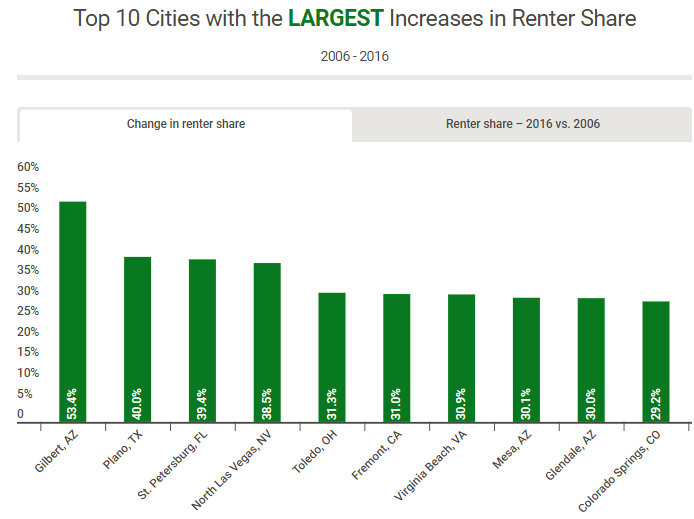
Renters Now A Majority In Almost 25 Percent Of Largest U.S. Cities

Renters are now a majority in almost a quarter of the 100 largest U.S. cities as they shifted from owner- to renter-majority between 2006 and 2016, according to a new report from RentCafe.

Renters took over in 22 cities including key markets like Chicago, San Diego, Detroit, Austin and  Sacramento, boosting the total number of renter-dominated cities to 42.

“Furthermore, over the 10-year period we analyzed, rentership growth outpaced homeownership in 97 of the 100 most populous cities,” RentCafe writes in the report.


    • Almost a quarter of the 100 largest U.S. cities shifted from owner- to renter-majority between 2006 and 2016. Renters took over in 22 cities including key markets like Chicago, San Diego, Detroit, Austin and Sacramento, boosting the total number of renter-dominated cities to 42.


    • Furthermore, over the 10-year period rentership growth outpaced homeownership in 97 of the 100 most populous cities.


    • Which are the markets with the highest proportion of renters? Two cities in New Jersey lead the way, Newark and Jersey City, followed by Miami, New York, Boston, and Orlando.


    • Here’s a fact: the total U.S. population gained 23.7 million people during the past 10 years. At the same time, the number of renters increased by 23 million, and homeowners by less than 700,000.


Renters took over 22 of the largest cities

The report states, “Though this shocking imbalance would have had to go on for a while longer to convert America into a renter nation, it was enough to tip the balance in some of the largest cities that used to be dominated by homeowners. In fact, renters have become the majority in almost a quarter of the 100 most populous cities.

“Back in 2006 only 20 out of the 100 largest cities had more renters than owners. A decade was enough to boost the number of renter-dominated cities to 42.”

The table below contains the 22 big cities where the number of renters has exceeded that of homeowners between 2006 and 2016.


In 8 of the cities listed above, the overall population has decreased. In Toledo, OHHonolulu, HISanta Ana, CABaltimore, MDCleveland, OHSt. Louis, MO and Chicago, IL this relative desolation is attributable exclusively to the shrinkage of the owner population, as the number of renters has increased in each of them.


In spite of large gains, many cities still a long way from having a renter majority


You may have expected to find only fast-growing cities on this list, but you shouldn’t forget that we are ranking the cities by proportional growth, so the placements have a lot to do with the initial size of a city’s renter community. When a city already has five million renters, a decade is barely enough to produce a remarkable proportional growth. This is how New York City had no chance to make it to the top 10 with a sorry 4.5% growth rate—in spite of adding close to 440K renters, more than San José’s entire renter population and more than double that of Raleigh, NC or Cleveland, OH. But in case you can’t imagine a study without seeing NYC rank high in a comparison, we have good news.


Renters rather than owners

Sign Up For Our Weekly Newsletter And Get Rental Property And Apartment News And Helpful, Useful Content Each Week.

* indicates required

Have You Reviewed Your Criminal Background Checks Policy?

The Grace Hill training tip of the week focuses on your criminal background checks policy and whether you are using it correctly.

By Ellen Clark

A federal lawsuit in New York is challenging a landlord’s blanket ban on leasing to people with criminal backgrounds. The federal government has advised landlords against such bans, saying they could violate fair housing laws, but the practice persists.

The lawsuit alleges that the landlord’s policy disproportionately affects black and Latino men, and thus violates federal law. The policy, although not discriminatory on its face because it doesn’t single out any protected classes, could still be illegal if it has a discriminatory effectIn other words, if the effect of the policy is discrimination, even if not intentional, it would be illegal.

Review your policies regarding residents’ criminal histories to ensure they do not have a disparate impact on minority home seekers. Criminal background checks policies cannot intentionally or inadvertently make it more difficult for them to find housing.

Some estimate that one in three Americans has a criminal record, and studies cited by HUD show that certain racial and ethnic minorities are arrested and convicted of crimes more than others. This means certain criminal history policies could have a disparate impact on minority home seekers, making it difficult for them to find housing.

Some individual cities have now gone even further in restricting what landlords can ask about a potential tenant’s criminal background. See related story from last year- Seattle bars landlords from using criminal records to screen tenants.

4 tips on criminal background checks

HUD has provided guidance for developing, reviewing or revising a community’s criminal background checks policy.  Here are tips to help you comply with the guidance.

    • A policy may use criminal convictions as a screening criterion because a conviction is sufficient evidence that someone engaged in criminal conduct, but may not use convictions to automatically exclude individuals.
    • A policy should not deny residency or otherwise discriminate against an applicant or resident based solely an arrest recordAn arrest is not the same as a conviction.
    • A policy may use criminal convictions as a screening criterion because a conviction is sufficient evidence that someone engaged in criminal conduct.
    • However, a policy should not automatically exclude individuals because of a criminal conviction. Instead, it should consider factors such as the nature and severity of the crime and how long ago the crime was committed.

 Note that a policy can automatically exclude based on convictions for the illegal manufacture or distribution of a controlled substance. Related convictions, such as drug possession, are not covered by this exception.

No blanket denials

If a resident or applicant is denied housing because of a criminal history, you should be able to show how the criminal conduct affects your ability to protect residents’ safety and property.

As HUD states, you must be able to show that a policy “accurately distinguishes between criminal conduct that indicates a demonstrable risk to resident safety and/or property and criminal conduct that does not.”

See related story: 7 issues and answers about renting to felons

Be consistent

Don’t forget the importance of being consistent. If you make an exception to your standard policy for criminal background checks for one prospective or current resident, you must offer the same exception to other prospects or residents who are in similar situations.

Take some time in this New Year to evaluate your screening processes to make sure they do not produce a disparate impact.

Remember, policies may consider criminal history in appropriate way, but should not contain exclusions that are arbitrary or too broad. For more information, review the full text of HUD’s guidance here.

Other Recent Training Tips:

Do You Know How To Respond To a Sexual Harassment Complaint?

How Apartment Rules To Protect Children Could Be Discrimination

Read Ellen’s blog post here.

About the author:

Ellen Clark is the Director of Assessment at Grace Hill.  Her work has spanned the entire learner lifecycle, from elementary school through professional education. She spent over 10 years working with K12 Inc.’s network of online charter schools – measuring learning, developing learning improvement plans using evidence-based strategies, and conducting learning studies. Later, at Kaplan Inc., she worked in the vocational education and job training divisions, improving online, blended and face-to-face training programs, and working directly with business leadership and trainers to improve learner outcomes and job performance. Ellen lives and works in Maryland, where she was born and raised.

About Grace Hill

For nearly two decades, Grace Hill has been developing best-in-class online training courseware and administration solely for the Property Management Industry, designed to help people, teams and companies improve performance and reduce risk.