Home Blog Page 195

Tacoma Votes To Make Landlords Give 90-Day Notice Before Evictions

The Tacoma City Council has adopted a temporary ordinance that requires property owners to give 90 days notice to tenants who are being evicted due to building demolition, renovation or change of use.

That ordinance will expire at the end of September, but the city council said it’s working on something more permanent.

The new temporary ordinance came after council members  voted to look into tenants’ rights issues and landlord-tenant laws after a hearing involving residents at the Tiki Apartments who had been facing evictions after a 20-day notice, according to reports.

The temporary ordinance is intended to provide interim enhanced protections as the city develops further recommendations to address housing and tenant protections for City Council consideration.

“Having experienced homelessness in my life I understand the hardship caused by the affordable housing crisis and the need for enhanced tenant protections,” Councilmember Keith Blocker said in a release.“To address the immediate needs of the residents at the Tiki Apartments, we have been in contact with the new property owner, who has agreed to provide additional time for tenants to relocate and extended the notice of eviction to June 30, 2018. The city is committed to continued coordination of service delivery with our community partners to ease residents’ transition as we begin to work toward long-term solutions for our community.”

The ordinance will not address the emergent need of residents who have already received notification of termination of tenancy, yet city leaders recognize the urgency for assistance according to the release.

“The rising cost of housing in Tacoma impacts us all, but being displaced in this climate creates a particular hardship for our most vulnerable neighbors,”  Mayor Victoria Woodards said in the release.

“While the landlord in this case offered to go beyond the minimum requirements of the law, we as leaders need to ensure that other tenants in the city have sufficient time to relocate and to access the services they need to keep a roof over their heads,” she said.

Evicted residents given until end of June

With the passing of the temporary ordinance, the residents now have until the end of June to relocate.

Initially, the council voted unanimously to direct City Manager Elizabeth Pauli “to look into options for expanding tenant rights, while working with tenant and landlord groups to build a consensus, and to bring possible recommendations to be discussed at an upcoming Community Vitality and Safety Committee meeting,” according to the Tacoma News Tribune.

On April 5, the Tiki Apartments on South Highland Avenue were purchased by CWD Investments, a Seattle-based company, according to KIRO-TV. Residents in all 58 units received a notice from Allied Residential, the third-party company that now manages the property. The notices indicated that residents in half of the units have until April 30 to vacate. Residents in the other half have until the end of May.

The tenants have been renting month-to-month and Washington law only requires a 20-day notice to move, according to reports.

The notice said that the property will be “going through a major renovation in the next few months” and offered “a one-time relocation benefit of $900 … exchanged for your apartment keys on the prearranged move out date,” according to the newspaper.

Chad Duncan is the lone registered member of CWD Investments LLC, according to the newspaper, and he said in a statement, ““We intend to work with those in hardship that communicate such. We are not heartless.”

Ordinance deals with evictions

Mayor Woodards  initially called the emergency public meeting which resulted in the temporary ordinance and an extension of time to the end of June for the Tiki Apartments residents, many of whom have nowhere to go and don’t have the means to pay first and last month’s rent as well as a deposit for a new place on such short notice.

Woodards also directed Pauli to look into any possible violations of landlord-tenant law that may have occurred at the Tiki Apartments and other Allied Residential properties as alleged by some speakers at a recent council meeting.

Roger Valdez with Seattle for Growth told the television station that what happened at the Tiki Apartments may become more common in places like Tacoma. Tenants say the building has been run down for years. Housing experts think that leaves developers with few options.

“You see people who are benefiting from years and years of deferred maintenance in lower rent and then it all catches up,” he told KIRO-TV. “It’s an unfortunate situation but we’ve seen it a lot in Seattle.”

Resources:

Tacoma examining rental laws after evictions

Emergency Tacoma council meeting planned to discuss evicted Tiki Apartment residents

New Tacoma landlord to desperate tenants he’s evicting: ‘Moving will be an improvement’

Families told to leave Tacoma apartments: ‘It’s so scary it brings tears to my eyes’


Do You Have A Smoke-Free Policy That Adequately Protects Residents?

Landlord Hank what do i do about second-hand smoke in my apartment?

Have you thought about your smoke-free policy or no-smoking policy and whether it adequately protects residents who need a smoke-free environment? The Grace Hill training tip of the week focuses on this issue and new HUD rules for smoke-free policies in public housing.

By Ellen Clark

More and more rental properties across the country are adopting smoke-free policies with the goal of improving air quality, reducing the fire risk, and lowering maintenance costs.

Even with no-smoking policies in place in many apartment complexes, research indicates that many of the nearly 80 million Americans who live in multiunit housing experience secondhand smoke infiltration in their living unit that originated from elsewhere in or around their building.

For tenant in apartment buildings and condominiums, secondhand smoke can be a major concern. It can migrate from other units and common areas and travel through doorways, cracks in walls, electrical lines, plumbing, and ventilation systems.

The U.S. Centers for Disease Control and Prevention (CDC) has recommended that all multi-unit housing in the United States adopt smoke free policies in order to protect residents from the very serious health hazards caused by drifting tobacco smoke.

“There is no risk-free level of secondhand smoke, and even brief exposure can cause immediate harm,” the CDC says.

What the CDC says about multifamily housing

“Multi-unit housing residents are particularly susceptible to involuntary secondhand smoke exposure in the home. Environmental studies indicate that secondhand smoke constituents can infiltrate units where no smoking occurs (eg, units whose residents have adopted smoke-free home rules) from units and shared areas where smoking is permitted,” the CDC says.

“Nearly 7 million U.S. multiunit housing residents live in government subsidized housing, including approximately 2 million in public housing either owned or operated by a government housing authority. The potential for secondhand smoke exposure in public or subsidized housing is of particular concern because a large proportion of these units are occupied by people who are particularly sensitive to secondhand smoke, including children (45%), the elderly (41%), and the disabled (25%).

All Public Housing Agencies (PHAs) administering low-income, conventional public housing were required to have a smoke-free policy in place by July 31, 2018.

In December of 2016, HUD published a final rule requiring Public Housing Agencies (PHAs) administering low-income, conventional public housing to implement policies.

The rule went into effect in February of 2017, but there is an 18-month implementation period, meaning that all PHAs must have a smoke-free policy in place by July 31, 2018. This rule applies to all public housing except dwelling units in mixed-finance buildings.

The rule says that each PHA must implement a smoke-free policy banning the use of prohibited tobacco products in all living units, indoor common areas, PHA administrative office buildings, and outdoor areas within 25 feet of any building on public housing grounds.

Note that the rule does not prohibit residents of PHAs from smoking. In fact, PHAs can establish outdoor designated smoking areas beyond the required 25 feet perimeter to accommodate residents who smoke. PHAs may also establish additional smoke-free locations, or they can even make their entire grounds smoke-free.

HUD rules on smoking could help any apartment community

While this rule applies to public housing (except dwelling units in mixed-finance buildings), the materials that HUD has assembled to help PHAs comply with this rule may be very helpful to any community that is thinking about, or in some stage of implementing, a smoke-free policy.

More rental properties across the country are adopting smoke-free policies. If you are one of those properties, here are some great resources HUD has put together to help PHAs implement smoke-free policies that may also be helpful to you.

    • Implementing HUD’s Smoke-Free Policy in Public Housing includes strategies for communicating with residents, examples of smoke-free policies and enforcement plans, tips for training staff, helpful information for launching a smoke-free policy, and guidance on responding to requests for accommodation.

There is more available on the Healthy Homes section of HUD’s website. Take some time to look around – you might find just what you are looking for!

Also, the American Lung Association worked with experts around the United States to develop an online curriculum on how to implement a smoke free policy in multifamily housing properties like apartments and condominiums.

    • Communicate the health and economic impact of secondhand smoke in multi-unit housing.
    • Engage with building managers, property owners, policymakers, residents and other stakeholders to adopt smoke-free multi-unit housing policies.
    • Plan and implement a successful smoke-free multi-unit housing policy.
    • Identify resident rights and responsibilities, as well as options for providing services to help smokers quit.

Group Says Multifamily Should Ban Smoking Inside and Near Buildings


About the author:

Ellen Clark is the Director of Assessment at Grace Hill.  Her work has spanned the entire learner lifecycle, from elementary school through professional education. She spent over 10 years working with K12 Inc.’s network of online charter schools – measuring learning, developing learning improvement plans using evidence-based strategies, and conducting learning studies. Later, at Kaplan Inc., she worked in the vocational education and job training divisions, improving online, blended and face-to-face training programs, and working directly with business leadership and trainers to improve learner outcomes and job performance. Ellen lives and works in Maryland, where she was born and raised.

About Grace Hill

For nearly two decades, Grace Hill has been developing best-in-class online training courseware and administration solely for the Property Management Industry, designed to help people, teams and companies improve performance and reduce risk.

Do You Have A Smoke-Free Policy That Adequately Protects Residents?


Photo credit idil toffolo via istockphoto.com

Sign Up For Our Newsletter And Get Apartment News And Helpful, Useful Content Each Week.

* indicates required

Are LED Light Bulbs The Best Option For Your Rental Property?

LED light bulbs, whether replaced by the landlord or the tenant in your rental property, is the maintenance checkup from Keepe this week as we look at the pros and cons.

Going green is also important for some properties and something to consider for LED light bulbs.

LED light bulbs have become popular with industry professionals. So we asked our electricians to give us some tips as we explore what is best for our rentals.

How LED light bulbs work

LED light bulbs produce light by conducting electrical currents through a microchip that powers a small, light-emitting diode.

Their popular counterpart – incandescent light bulbs – rely on electrically-produced heat instead: electrical currents heat the metallic filament found inside the glass bulb, which becomes luminous after being brought up to a high, incandescent temperature

Pros of LED light bulbs

    • Efficient: LED light bulbs have been found to be up to 90% more efficient than incandescent light bulbs. This is because LEDs require much less energy to power up and produce light than it takes for an incandescent light bulb to reach the temperature necessary to emit light. Consuming less energy to illuminate a space will translate in lower utility bills.
    • Long-lasting: While incandescent light bulbs will stop working when their filaments wear out, the microchips and diodes in LED light bulbs last much, much longer. Some LED bulbs can last up to 10 years and produce over 40,000 hours of light before needing to be replaced. Additionally, instead of suddenly “going out” like incandescent light bulbs, LED nearing the time of replacement will visibly becoming dimmer, which makes it more practical to be prepared for their replacement and not experience a sudden loss of light.
    • Stylish: Since their introduction in 1995 and especially during the early 2000’s, compact fluorescent lights (or CFLs) became the best available alternative to incandescent light bulbs; while they certainly allowed for reduced energy consumption – fluorescent technology requires from a third to a fifth of what an incandescent light bulb would need to work – they came in a one-of-a-kind, rather impractical design: a curly or long twisted tube. Most people find the tubular design to be unappealing and difficult to incorporate in most light fixtures, especially decorative ones, like chandeliers and pendant-type pieces. While General Electric announced that it would stop producing curly CFLs altogether back in 2016, they can still be easily found and purchased: today, LED offer a much more practical and aesthetically pleasing alternative. Not only are LEDs widely available in the “classic” round and bulbous design – which is easy to incorporate in light fixtures – but manufacturers have been able to develop different shape variations to satisfy a wide range of design preferences.
    • Safe: LEDs surpass both incandescent and CFL light bulbs when it comes to safety. The main flaws of incandescent light bulbs are their frail glass exterior that can shatter easily and the way they heat up; in fact, they can generate enough heat to get the entire light fixture to reach dangerously high temperatures that can damage heat-sensitive surroundings and in some cases even cause injury when touched. Their fluorescent technology requires CFL light bulbs to incorporate mercury, which is a toxic material that cannot be disposed of alongside “regular” trash and needs to be handled with care. LED light bulbs resolve both issues as they do not generate heat when turned on nor utilize toxic materials.
    • Increasingly affordable: when LED light bulbs were first released, they were quite pricier than other available light bulbs. Their price has dropped ever since and today is considered to be rather accessible. It is possible to easily find LED light bulbs at most hardware stores at a variety of price points.
    • Directionality: LED light bulbs are versatile; they now can produce a diffused glow for a large room or can also create a spotlight effect in a certain space, such as below a bathroom vanity.


Are LED Light Bulbs The Best Option For Your Rental Property?

Cons of LED light bulbs

Are LED Light Bulbs The Best Option For Your Rental Property?


    • Light spectrum: LED light bulbs produce a white light, which is rather “bright” and cold. Some people find this light spectrum to be unappealing in spaces that they prefer to be dimmer. While investing in a light dimmer would solve this issue, it nonetheless requires an added step and expense.
    • Temperature-sensitivity: While LED bulbs don’t generate heat or temperature variations themselves, they are sensitive to the temperature of the space they are found in. LED bulbs have been found to fail when placed in an environment presenting a higher temperature. In some spaces, LED bulbs will need a heat sink to be added so that they can be kept cool.

The Best Appliances In Rental Property

About Keepe:

Keepe is an on-demand maintenance solution for property managers and independent landlords. The company makes a network of hundreds of independent contractors and handymen available for maintenance projects at rental properties. Keepe is available in the Greater Seattle area, Greater Phoenix area, San Francisco Bay area, Portland, San Diego and is coming soon to an area near you. Learn more about Keepe at https://www.keepe.com

Sign Up For Our Newsletter And Get Apartment News And Helpful, Useful Content Each Week.

* indicates required


Social Media Tenant Screening Risks And Fair Housing

social media and tenant screening

Have you thought about using social media tenant screening as a way to checkout potential tenants on social media or checking on current residents on social media? The Grace Hill training tip of the week focuses on this issue and the Fair Housing Act.

By Ellen  Clark

Social media can be a tempting tool to find more information about tenants and prospective tenants, but the information you find can leave you vulnerable to discrimination claims.

But what about looking up applicants or residents on social media? Can that be problematic from a fair housing perspective? Let’s take a look.

First some background as the topic of social media and fair housing is back in the headlines.

In March, fair housing organizations filed a lawsuit against Facebook, accusing the company of allowing real estate companies and landlords to exclude women and families with children from seeing certain housing ads.  The lawsuit, filed by the National Fair Housing Alliance in U.S. District Court in the Southern District of New York, alleges that the world’s largest social network still allows advertisers to discriminate against legally protected groups, including mothers, the disabled and Spanish-language speakers.

Diane Houk, lead counsel for the alliance, told ProPublica this type of discrimination is especially difficult to uncover and combat. “The person who is being discriminated against has no way to know” it, because the technology “keeps the discrimination hidden in hopes that it will not be caught,” she said.

Facebook disputes the housing groups’ allegations. “There is absolutely no place for discrimination on Facebook. We believe this lawsuit is without merit, and we will defend ourselves vigorously,” said Facebook spokesman Joe Osborne told ProPublica.

A few weeks ago we talked about how social media communications are often considered advertisements, and discrimination in advertising is prohibited by the Fair Housing Act. It is illegal to create, publish or distribute housing ads that discriminate, limit or deny equal access to housing because of membership in any federally protected class.

Using social media tenant screening 

It may be tempting to use social media to learn more about prospective residents during the screening process.

However, on social media you are likely to find out information that defines someone as protected class, such as their religion, that they have children, or that they have a disability.

This could make you more likely to deny someone housing based on those characteristics, which could make you more vulnerable to discrimination claims.

If you think what you find on social media could influence, or even appear to influence, your decision about leasing to someone, then steer clear of investigating on social media. The best thing to do is follow your standard application and qualification procedures consistently for all prospects.

If you connect with residents on social media, think carefully before acting on information you find.

 Using social media to check on current tenants

Imagine you have a couple living in a one-bedroom apartment home.

Your occupancy limits specify two people per bedroom.

On social media, you learn that the couple is in the process of adopting twins. What should you do?

In this case, it is best to not take any action.

Even making a note of this in the residents’ file could be problematic if you face a fair housing claim. It could appear as though you used the couple’s familial status in making decisions, which could violate fair housing law.

What if you come across something concerning about residents on social media, such an indication that they lied on their application or weren’t honest in an accommodation request?

Consult with your supervisor and legal counsel before taking any action. If you act on information and are wrong about what you found, you may put yourself at risk for a fair housing complaint.

Summary on social media tenant screening and fair housing

In this age of social media, it is important to understand that you are responsible for acting in a non-discriminatory way, no matter what form of communication you are using.

You must be just as mindful of fair housing laws when sharing information and interacting with customers online as you are when sharing information and interacting in print and in person.

The same rules apply.

Read Ellen’s full blog post here.

Successful Landlords Know All Tenant Screening Companies Are Not The Same

About the author:

Ellen Clark is the Director of Assessment at Grace Hill.  Her work has spanned the entire learner lifecycle, from elementary school through professional education. She spent over 10 years working with K12 Inc.’s network of online charter schools – measuring learning, developing learning improvement plans using evidence-based strategies, and conducting learning studies. Later, at Kaplan Inc., she worked in the vocational education and job training divisions, improving online, blended and face-to-face training programs, and working directly with business leadership and trainers to improve learner outcomes and job performance. Ellen lives and works in Maryland, where she was born and raised.

About Grace Hill

For nearly two decades, Grace Hill has been developing best-in-class online training courseware and administration solely for the Property Management Industry, designed to help people, teams and companies improve performance and reduce risk.

Sign Up For Our Newsletter And Get Apartment News And Helpful, Useful Content Each Week.

* indicates required

10 Ways To Make Small Bathrooms In Your Rentals Look Bigger and Better

small bathrooms in your rentals - 10 ways to make them look bigger

Small bathrooms in your rental properties can be made to look bigger and keep tenants happier with small, affordable changes in this maintenance checkup from Keepe

Being able to enjoy a spacious bathroom is on the wish list of many tenants,.

However many properties – especially rental unit clusters – are designed to optimize space. That means that the sheer size of a property’s rooms might have to be reduced to squeeze in extra storage space or living areas.

While an extra small bathroom or powder room is certainly better than having one less bathroom in the property, it can be a hard point to sell, especially when a small bathroom is a property’s only bathroom.

A room expansion or remodel is expensive, labor intensive and time-consuming. It is also unlikely to be feasible for units that have been purposely designed to host certain numbers and types of rooms of specific dimensions.

10 ways to make small bathrooms in your rentals look bigger and better

No. 1 – Opt for white on white

Avoiding dark, overly bright or coordinated color schemes is a must. Avoid contrasts and colors from emphasizing how small a space is by highlighting where the walls and/or ceiling end. White creates a spacious and airy feel. White also allows natural and/or artificial light to illuminate the space as opposed to being absorbed by dark colored paints or wallpapers.

No. 2 – Match tiles, walls and ceiling

Matching the color of painted walls, tiling and ceiling erases the visible contrast that would result if they were of different colors. Uniformity and continuity of color makes the space look significantly larger, thus making more elaborate tiling patterns or color schemes an element to avoid.

No 3 – Extend tiling

If showers and other areas are surrounded by tiled walls, it’s ideal to extend tiling all the way up to the ceiling to avoid trims to “mark” a clear point on the walls and “shorten” them as a result.

10 Ways To Make Small Bathrooms In Your Rentals Look Bigger and Better

No. 4 – Lengthen the space with vertical tiling

Instead of opting for regular or square-like tiles and laying them horizontally, choosing longer tiles and laying them vertically tricks the onlooker to perceive the space as being taller or wider than it really is.

No. 5 – Save space with a new door

Regular doors demand a certain radius of space available at all times to adequately swing open. This forces the layout of all elements within the space to accommodate the clearance. Sliding doors give back this space as they slide open without taking up space from the room.

No 6 – Use bright lighting in small bathrooms

Poor illumination can make a small bathroom look dark and claustrophobic. The combination of bright lighting with the white color scheme of its surroundings creates an airy, fresh look.

No 7 – Use mirrors to your advantage

Large mirrors can create an optical illusion that makes the room look larger. You can almost double the perceived space with them. Larger mirrors can be pricey, but generally still cost less than a tiled wall. This makes them an advantageous substitute.

No. 8 –  Invest in sleek fixtures and furnishings

10 Ways To Make Small Bathrooms In Your Rentals Look Bigger and Better

Elaborate design elements are distracting and overwhelming is a small space.  Modern bathroom fixtures and furnishings showcase sleek and harmonious lines, which work well with the minimalist look of uniform white paints and tiling to create an elegant space.

No. 9 – Go with glass

Instead of boring and cheap-looking shower curtains, opt for a glass panel for your shower. It modernizes and opens up the space by allowing for greater visibility past the “visual wall” that a shower curtain would create. For added privacy – if preferred – glass paneling can be tinted or frosted.

No 10 – Be smart about storage

In small bathrooms, any extra room made available by eliminating “bulky” furnishings goes a long way. Adding floating vanities, shelving and wall cabinets maxmizes storage space while still maintaining a neat and polished look.
About Keepe:

Keepe is an on-demand maintenance solution for property managers and independent landlords. The company makes a network of hundreds of independent contractors and handymen available for maintenance projects at rental properties.

Keepe is available in the Greater Seattle area, Greater Phoenix area, San Francisco Bay area, Portland, San Diego and is coming soon to an area near you. Learn more about Keepe at https://www.keepe.com.

5 Maintenance Tips For Long-Lasting Carpet In Your Rentals

Kitchen Range Hood Options for Your Rentals

Sign Up For Our Newsletter And Get Apartment News And Helpful, Useful Content Each Week.

* indicates required

Apartment Owner Ordered To Pay $1.6 Million In Bed Bug Lawsuit

A jury has awarded a California family $1.6 million in one of the largest single bed bug lawsuit case awards ever reported against an apartment owner, according to a release.

Liliana Martinez told NBC in Los Angles her family suffered for months with bed bugs at the Kahala Islander Apartments in Inglewood, California in 2010. She said her child, a baby at the time, was covered in bites.

“Just seeing how he would scratch all the time and nothing would heal because it would start bleeding again. It was very emotional, very stressful,” she told the television station.

The family says they complained to apartment management and were told to throw out all of their furniture and sleep on the floor. But it took months to eradicate the bugs. The lawyer who represents the apartment building declined to comment on the case.

The defendant in the case, Amusement Six Apartments LLC owns an apartment complex in Inglewood and simply didn’t respond appropriately to the Plaintiffs complaints about bedbugs, according to Yahoo news.  According to the suit, it took management 9 days to initially schedule bedbug treatment, and when they did, the pest control operator left handfuls of chemical all over their belongings and carpet.  When the plaintiffs complained about the chemical, the management told them there was nothing they could do, and they should vacuum a square area in their living room to sleep on with their 2 young children.  Although they then agreed to change the carpet, it took them 3 months to do so, and all the while, the bed bugs were feeding and breeding in the carpet until it was changed.  The family continued to receive bedbug bites the entire time.

Bed bug lawsuit verdict the largest in U.S.

Brian Virag, attorney from the law firm of mybedbuglawyer.com, obtained the $1.6 million verdict for the family and said in a release it was the largest verdict for a single family for bed bugs in the U.S.  He represented the family of four including a 3-year old boy and a 3-month old baby girl who were all bitten by bed bugs.  His clients were all exposed to bedbugs between July and October of 2012.

The case was Liliana Martinez Et. Al. v. Amusement Six Apartments LLC.

The young boy, Jorge Maravilla Jr., who was 3 years old at the time of the bedbug exposure was covered in bed bug bites.  He has significant residual scarring to the day.  The jury awarded Jorge Jr. $880,000.

This is the fifth landmark verdict obtained by Virag in the last 12 months that included a 3.5-million-dollar verdict against PLB Management, and a $546,000 verdict in October against the Hilton Garden Inn in Rancho Cucamonga, CA, whose clients were exposed to bed bugs for a one-night hotel stay.

Sixteen former and current residents of one of Los Angeles’ largest apartment complexes  won a $3.5-million verdict over an infestation of bed bugs in their units last year, Virag told the Los Angeles Times.

Park La Brea Apartments, a sprawling complex with more than 4,000 units in the Miracle Mile District, was found liable by a jury in Los Angeles Superior Court late Friday afternoon, said attorney Brian Virag, who represented the plaintiffs.

Colorado Governor Signs New Bed Bug Law For Landlords And Tenants

Sign Up For Our Newsletter And Get Apartment News And Helpful, Useful Content Each Week.

* indicates required

Seattle City Council Halts Online Rent Bidding Apps

The Seattle City Council in an 8-0 vote has put a moratorium on the use of rent bidding apps such as Rentberry for rental housing in Seattle until the council can study the impact of the technology, according to a release.

Startups like Rentberry allow landlords to list rental units so that would-be tenants can offer higher or lower prices, based on what they would be willing to pay. The sites take a percentage of the difference. Operators of these rental auction sites claim supply and demand already affect rent prices and that their services just make the process more transparent, according to reports.

“Innovation in technology has been a key component of what makes Seattle such a great city, adding to our economic diversity. At the same time, we must have the opportunity to learn about new platforms, such as these ‘rent bidding’ platforms, and ensure that they live up to the equity and housing access values of our city,” Councilmember Teresa Mosqueda said in the release.

The Rentberry site says, “Rentberry is a transparent home rental service and a price negotiation platform uniting tenants and landlords. It automates all the standard rental tasks from submitting your personal information, credit reports and custom offers, to e-signing rental agreements and online rental payments.”

Rentberry lists a number of major cities, with the exception of Seattle, on its site including New York, Miami, Chicago, Los Angeles, Boston, Houston, Philadelphia, Phoenix and Atlanta.

Rent bidding apps will be studied

Mosqueda’s legislation puts a one-year moratorium on the technology’s operation in Seattle while the City’s Office of Housing, in conjunction with Office of Civil Rights and Department of Construction and Inspections, evaluates the potential impacts of the rent auctioning applications, specifically how they abide by equitable access to housing laws.

During the moratorium, the city will evaluate how the bidding platforms comply with the city’s fair access housing laws, including the “First in Time” law, which requires that landlords accept the first qualified applicant.

Mosqueda developed the legislation after the Associated Students of the University of Washington (ASUW) approached her with concerns about access and equity, and asked that the City evaluate the potential impacts of rent bidding apps, and compliance with city laws.

Sorana Nance, ASUW Senate Speaker, said in a release, “I’m glad that students have had an impact on the Seattle that we will be living in, especially at a time when our city is experiencing rapid change. My hope is that this legislation will help ensure equitable housing practices for Seattle residents now and in the future.”

Councilmember Mosqueda added, “I’m thankful to the ASUW students for approaching me, and appreciate Puget Sound Sage for illustrating the importance of pausing and evaluating the technology before we have unintended consequences.”

Rentberry said in a release that, “One of the revolutionary blockchain technologies the team is working on this year is the Rentberry Auctioning Technology. The Auctioning Technology’s core purpose is to ensure that landlords price their properties optimally in both hot and slow markets, while potential tenants are afforded complete visibility on competing offers and offered the ability to seamlessly negotiate rental terms online. It acts as a pricing oracle that allows tenants to bid, sign legal rental documents, and settle payments using BERRY tokens, all in one place,” according to investinblockchain.com.

Tenants can also crowdsource their rent deposits in the community.

Resources:

Seattle bans rent bidding in latest attempt to keep disruptive tech from compounding housing crisis

Seattle bans apartment auction apps to avoid online bidding wars

Why rent bidding apps will make the rental market even more unaffordable

Rentberry Roadmap: Will 2018 Be the Year of the Rental Market Revolution?


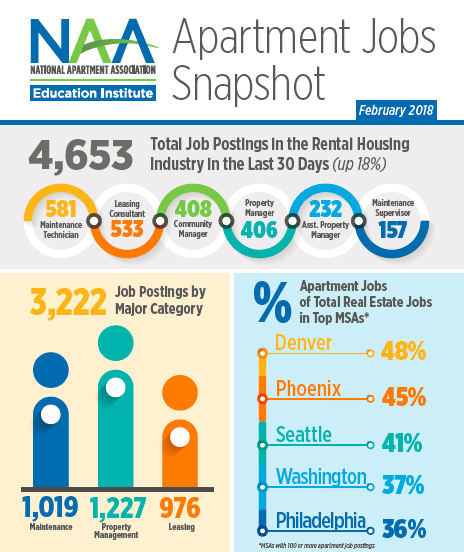
Seattle, Phoenix, Denver Top Hot Spots For Apartment Jobs

Apartment jobs listings jumped up 18 percent in February over January, according to the apartment jobs report from the National Apartment Association Education Institute.

The increase in the number of apartment job listings in February certainly involves some seasonality factors as 2018 hiring plans took firmer hold, according to Paula Munger, Director, Industry Research and Analysis, for the National Apartment Association (NAA).

Denver, Phoenix and Seattle maintained spots in the top three metro areas for apartment jobs as a percent of the entire real estate sector, signaling increasingly competitive job markets where qualified candidates have plenty of choices, she said.

Construction manager positions took the longest to fill, at 44 days, as the construction sector overall has experienced a long-term labor shortage. By contrast, owners and operators looking for administrative positions can typically fill these jobs in less than a month.

 Leasing consultant apartment jobs pay mean of $39,235

Seattle, Phoenix, Denver Top Hot Spots For Apartment Jobs

This month’s snapshot focused on the leasing consultant position, with job postings across the country showing a mean salary of $39,235.

In addition to leasing experience, these positions require strong communication and writing skills, as well as customer service skills.

Experience in property management was also a strongly desired. Markets with the highest concentration of demand for leasing consultants are unsurprisingly in areas which have had a spate of new apartment construction: Detroit, Raleigh and Washington, DC. Although all types of apartment jobs will be needed for new communities, these markets are currently experiencing a shortage of qualified leasing professionals, Munger reported.

Jobs in property management, maintenance and leasing will continue to grow and “we’re not seeing that change any time soon,” Munger said last month. ”Construction has leveled off a bit and I’m sure you’ve heard that starts are down. But I see that as more of a normalizing thing than anything. More and more people are making a choice to live in apartments,” she said in an interview with Rental Housing Journal.

“Our education institute is a credentialing body for the apartment industry. They hear often that one of the biggest problems keeping our industry leaders up at night is the difficulty in finding talent, attracting talent and retaining talent,” Munger said last month at the time the first report was released.  “Labor-market issues are happening in a lot of industries, certainly with the tight labor market we have.”

For the monthly on-going reports, the NAA decided to partner with Burning Glass Technologies. “They have a labor-job posting database that is proprietary,” she said, and they can “layer on data from the Bureau of Labor Statistics (BLS). We looked at that and thought we could do something that is really going to help the industry and help benchmark job titles and trends as we go forward.”

About the National Apartment Association Education Institute

The NAA Education Institute provides broad-based education, training and recruitment programs that attract, nurture and retain high-quality professionals and develop tomorrow’s Residential Property Management industry leaders.

About The National Apartment Association

The National Apartment Association is the leading voice for the apartment housing industry. As a trusted partner, a valued connector and a powerful advocate, the NAA is committed to serving 160 affiliates, more than 75,000 members and the 9.25 million apartment units operate globally.


Portland Landlords Will Have To Pay Tenant Moving As City Makes Policy Permanent

Portland landlords now face a permanent policy that forces them to pay tenant moving costs if they want to increase rent by 10 percent or do no-cause evictions to move tenants out to rehab old apartment buildings to upgrade them, according to reports.

Landlords see the ordinance as disguised rent control.

The permanent renter protection policy requires landlords to pay tenant moving costs ranging from $2,900 to $4,500 to tenants subject to no-cause evictions or who choose to move if their rents are raised more than 10 percent a year.

The council revoked an exemption for landlords who own just one rental unit, except in limited circumstances. The revised policy is effective immediately, according to reports.

“I’m pleased that we’ve been able to work through some complex issues and arrive at a consensus policy that will, after today, become permanent City law,” Commissioner Nick Fish said in a release.

“There’s no shortage of anxiety and uncertainty in the world and in our community right now. Portland tenants shouldn’t have to worry whether they’re going to come home to notice of a 20 percent rent increase. Or whether their child is going to have to change schools and start over somewhere new mid-year. Whether they’ll have to choose between groceries or medicine. Or whether they’ll be able to keep a roof over their family’s head. The market forces at work here are too big for any local government to contain, but we have an obligation to step up and lead in ways that we can,” Fish said in the release.

Mayor Ted Wheeler who had earlier said he wanted more study on the issue, changed his mind and voted to remove the exemption for small landlords who own only one property and require them to comply with the moving ordinance.

Removing the small landlord exemption came after a research study

Chariot Wheel Research Consultants authored the study which says, “This single-unit exemption not only undermines the spirit of the law, it leaves nearly 20% of renter households vulnerable to the same double-digit rent increases and no-cause evictions which precipitated the housing state of emergency to begin with, thus perpetuating and exacerbating the very hardships the RELO ordinance seeks to mitigate.”

Landlords continue fight against the relocation ordinance

Last year, John DiLorenzo, attorney for two landlords challenging the ordinance in court said, “Though we appreciate the time and effort the court expended on this case, we still strongly believe the ordinance will only aggravate Portland’s housing crisis. The court failed to see it for what it is – disguised rent control, which violates state statutes and the Oregon Constitution,” DiLorenzo said.

Summary of changes to Portland tenant moving ordinance

Attorney Leah Sykes with Greenspoon Marder LP wrote that in addition to making the ordinance permanent, the City made numerous other changes. The exemption for owners of a single rental dwelling within the City was removed and the following 12 highly specific exemptions from the relocation fee requirements were implemented:


  • Rental Agreements for week-to-week tenancies;
  • Tenants that occupy the same Dwelling Unit as the Landlord;
  • Tenants that occupy one Dwelling Unit in a Duplex where the Landlord’s principal residence is the second Dwelling Unit in the same Duplex;
  • Tenants that occupy an Accessory Dwelling Unit that is subject to the Act in the City of Portland so long as the owner of the Accessory Dwelling Unit lives on the site;
  • A Landlord that temporarily rents out the Landlord’s principal residence during the Landlord’s absence of not more than 3 years;
  • A Landlord that temporarily rents out the Landlord’s principal residence during the Landlord’s absence due to active duty military service;
  • A Dwelling Unit where the Landlord is terminating the Rental Agreement in order for an immediate family member to occupy the Dwelling Unit;
  • A Dwelling Unit regulated as affordable housing by a federal, state or local government for a period of at least 60 years.
  • A Dwelling Unit that is subject to and in compliance with the federal Uniform Relocation Assistance and Real Property Acquisition Policies Act of 1970;
  • A Dwelling Unit rendered uninhabitable not due to the action or inaction of a Landlord orTenant;
  • A Dwelling Unit rented for less than 6 months with appropriate verification of the submission of a demolition permit prior to the Tenant renting the Dwelling Unit;
  • A Dwelling Unit where the Landlord has provided a fixed term tenancy and notified the Tenant prior to occupancy, of the Landlord’s intent to sell or permanently convert the Dwelling Unit to a use other than as a Dwelling Unit subject to the Act.

In addition Sykes wrote, “It is extremely important to note that these exemptions are only available to landlords AFTER the landlord completes and submits the required exemption reporting forms to the Portland Housing Bureau. As revised, these narrow exemptions appear to extend to companies managing such properties on behalf of an exempt owner.”

Divided Oregon Supreme Court Upholds Portland Relocation Payment Ordinance

Fair Housing Discrimination Against Someone You’ve Never Talked To?

The Grace Hill training tip of the week focuses on the issue of potential fair housing discrimination against someone you have never talked to.

By Ellen Clark

When you think about upholding Fair Housing Act laws, you probably think about treating people fairly and equally when they come in for a tour, or as you interact with them as potential tenants.

But did you ever think if you fail to answer an email, you end up on the wrong side of a fair housing claim without ever interacting with a person?

Fair housing laws protect people from discrimination throughout all stages of your interactions, not just after they become your tenant or residents of your apartment community.

From the first contact, whether by phone call, email, text, or in-person, you are responsible for upholding fair housing laws and treating all people in a non-discriminatory manner.

In fact, it is possible for you to discriminate against someone without ever having direct contact with that person.

That may seem unlikely, but let’s explore how that could happen.

If an employee fails to respond to an email due to an assumption about the sender’s race, that behavior could be considered discrimination.

How discrimination could happen against someone you’ve never talked to

Here are a couple of examples to consider:

    • A maintenance technician skips over a service ticket for a devout Christian family with a reputation for talking openly about their religion because he anticipates feeling uncomfortable. The maintenance technician’s behavior could be considered discrimination based on religion, even though the maintenance technician never directly interacted with the resident.
    • A leasing agent gets an email from a prospective resident with a name that she assumes is Asian. The agent does not respond to the email because the community’s residents are mostly African American and she feels the prospective resident probably wouldn’t fit in. This behavior could be considered discrimination based on race, even though the leasing agent never directly interacted with the prospective resident.

Consistency and training are key to ensuring that your teams are upholding fair housing laws and treating people in a non-discriminatory manner.

 How can you guard against discrimination happening?

Consistency and training are good places to start.

Consistency is key in dealing with fair housing issues.

It is best to behave consistently with everyone you assist, and everyone who is seeking assistance from you even if you haven’t interacted with them yet. This means phone messages, emails, web inquiries, and service requests. If you make an exception to any policy or procedure, make sure you provide the same information and options to all prospects and residents who are in the same situation.

All staff members who interact with residents and prospective residents, or who handle requests or inquiries of any kind, should be trained on fair housing laws.

It is recommended that newly hired staff receive fair housing training before they work with customers. Vendors and contractors who could possibly interact with your residents should be informed of your company’s fair housing policy and asked to abide by fair housing laws. All personnel should refresh their fair housing knowledge at least annually.

It never hurts to run through scenarios with your employees, including those like the ones above, to ensure that they understand that it is important to think about upholding fair housing laws at all times, not just when they are face-to-face or otherwise directly interacting with prospective or current residents.

About the author:

Ellen Clark is the Director of Assessment at Grace Hill.  Her work has spanned the entire learner lifecycle, from elementary school through professional education. She spent over 10 years working with K12 Inc.’s network of online charter schools – measuring learning, developing learning improvement plans using evidence-based strategies, and conducting learning studies. Later, at Kaplan Inc., she worked in the vocational education and job training divisions, improving online, blended and face-to-face training programs, and working directly with business leadership and trainers to improve learner outcomes and job performance. Ellen lives and works in Maryland, where she was born and raised.