Home Blog Page 15

Portland Rents Rose Slightly in July

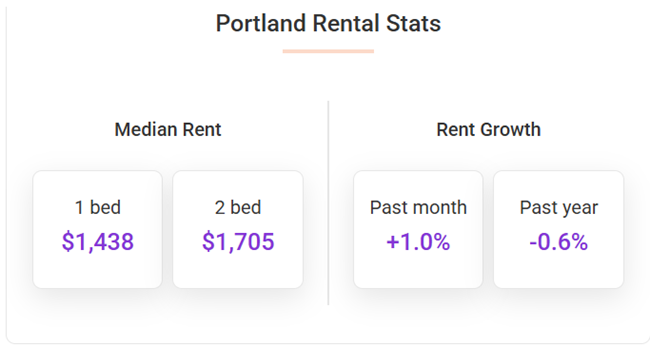
Portland rents were up 1% in July, according to the August report from Apartment List while the overall median rent in Portland is $1,583.

Portland Oregon rents were up 1% in July, according to the August report from Apartment List.

The overall median rent in Portland is $1,583. As far as Portland rents in July the median rent for a one-bedroom apartment is $1,438, and $1,705 for a 2-bedroom. Rent prices remain down 0.6% year-over-year.

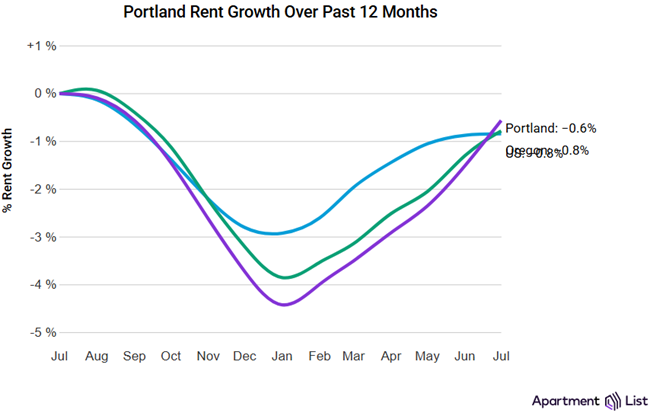
Portland’s rent growth over the past year is similar to both the state (-0.8%) and national averages (-0.8%).

Portland rent growth in 2025 pacing similar last year

Seven months into the year, rents in Portland have risen 4.0%.

This is a similar rate of growth compared to what the city was experiencing at this point last year; from January to July 2024, rents had increased 4.4%.

Portland rents were up 1% in July, according to the August report from Apartment List while the overall median rent in Portland is $1,583.

For comparison to Portland rents in July, the median rent across the nation as a whole is $1,231 for a 1-bedroom, $1,387 for a 2-bedroom, and $1,402 overall. The median rent in Portland is 12.9% higher than the national, and is similar to the prices you would find in Aurora, CO ($1,603) and Madison, WI ($1,582).

Portland rents are 6.0% lower than the metro-wide median

Across the Portland metro area, the median rent is $1,685, meaning that the median price in Portland proper ($1,583) is 6.0% lower than the price across the metro as a whole. Metro-wide annual rent growth stands at -0.8%, below the rate of rent growth within just the city.

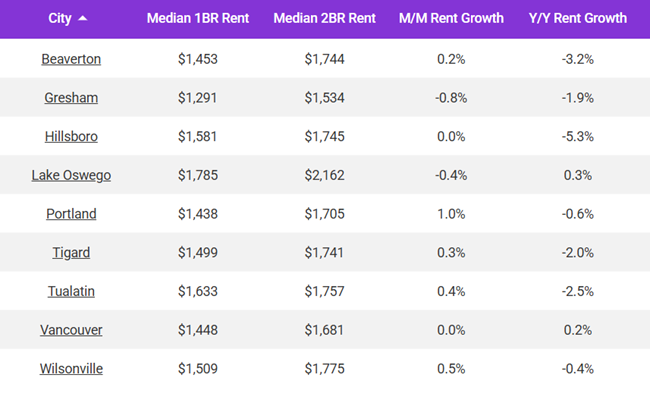
The table shows the latest rent stats for 9 cities in the Portland metro area that are included in the Apartment List database.

Among them, Lake Oswego is currently the most expensive, with a median rent of $2,039. Gresham is the metro’s most affordable city, with a median rent of $1,513. The metro’s fastest annual rent growth is occurring in Lake Oswego (0.3%), while the slowest is in Hillsboro (-5.3%).

Portland rents were up 1% in July, according to the August report from Apartment List while the overall median rent in Portland is $1,583.

Sign Up For Our Weekly Newsletter And Get Rental Property And Apartment News And Helpful, Useful Content Each Week.

* indicates required

Rents Hold Steady In July: Vacancies Tick Up

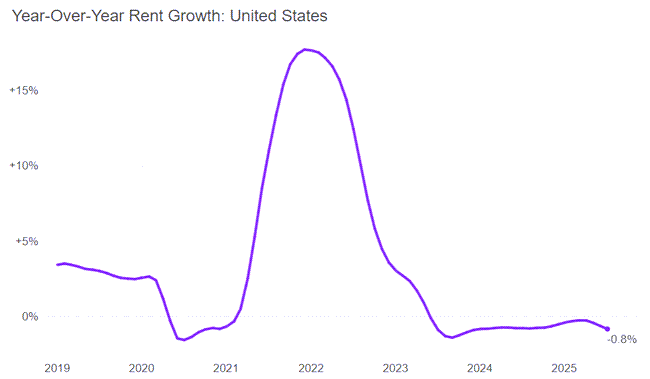
National rents in July held steady as the vacancy rate hit a new peak and have now been flat during the peak moving season.

National rents held steady in July as the vacancy rate hit a new peak, according to the August report from Apartment List. Rents grew month-over-month early in the year, but have now been flat during the peak moving season.

“After increasing by 0.6 in March, our national rent index has seen its growth rate trending down over the past four months, at odds with the typical seasonal trend,” the Apartment List Research Team writes in the report.

“The late spring and summer months are normally the peak season for moving activity, and rent growth tends to ramp up at this time of year in tandem with demand. The fact that we’ve instead seen rent growth get increasingly sluggish indicates softness in the market, possibly reflecting declining consumer confidence amid a more uncertain macroeconomic outlook,” the report says.

National rents in July held steady as the vacancy rate hit a new peak and have now been flat during the peak moving season.

In dollar terms, the national median monthly rent now stands at $1,402, down $11 compared to July 2024. With the overall trajectory of rents trending modestly downward in recent years, the national median rent has now fallen below its August 2022 peak by a total of 2.8 percent, or $40 per month.


But that cooldown came following a period of record-setting rent growth, and the typical rent price remains 22 percent higher than its January 2021 level.

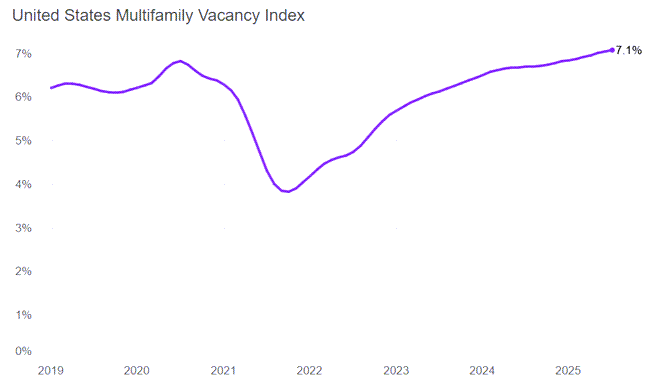
Multifamily vacancy rate hits 7.1%, a new peak

“Our national vacancy index – which measures the average vacancy rate of stabilized properties in our marketplace – ticked up this month and now stands at 7.1 percent.

“This represents an all-time high for this data series, which goes back to the start of 2017. We are now past the peak of the apartment construction wave, but even as the level of new supply hitting the market falls sharply compared to last year, it remains robust by historic standards. The vacancy rate will begin to tighten eventually, but for now it continues to rise as the market is still absorbing a swell of new units,” the report says.

National rents in July held steady as the vacancy rate hit a new peak and have now been flat during the peak moving season.

List-to-Lease time ticks up for first time this year

July saw time on market tick up from the first time this year, increasing from 27 days in June to 28 days in July.

As more vacant units have come onto the market, those units have also been sitting vacant for somewhat longer.

Report Summary

The research team writes, “All of our key indicators are pointing toward ongoing sluggishness in the multifamily rental market – rent growth is slipping and the vacancy rate is at an all-time high. The outlook has been complicated by macroeconomic whiplash being caused by tariffs and other policies being pursued by the Trump administration.

“That uncertainty appears to have modestly dampened demand during this moving season. And although the supply wave is receding, the number of units that hit the market in the first half of this year was still above the long-run average. With construction expected to slow further in the second half of this year and into 2026, conditions are likely to shift.”

Read the full report here.

Seattle Rents Ramp Up 1.2% In July

Seattle rents rose 1.2% in July with median rent now $2,140 as rent growth over the past year has outpaced both state and national averages.

Seattle rents rose 1.2% in July and the median rent in the city is now $2,140, according to the August report from Apartment List.

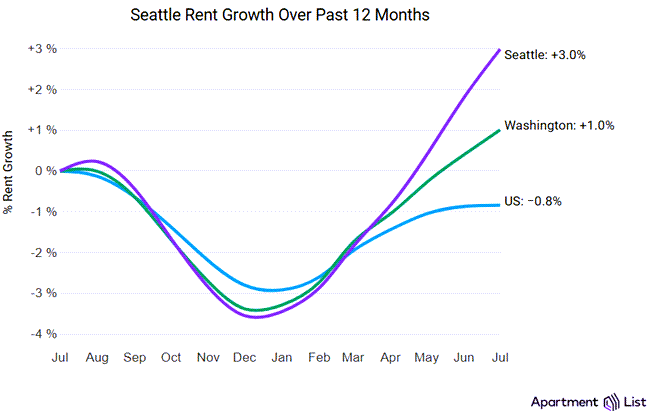
Seattle’s rent growth over the past year has outpaced both state (1.0%) and national (-0.8%) averages.

Seattle rent growth in 2025 pacing above last year

Seven months into the year, rents in Seattle have risen 6.7%. This is a faster rate of growth compared to what the city was experiencing at this point last year: from January to July 2024 rents had increased 5.5%.

Seattle rents rose 1.2% in July with median rent now $2,140 as rent growth over the past year has outpaced both state and national averages.

July rent growth in Seattle ranked #4 among large U.S. cities

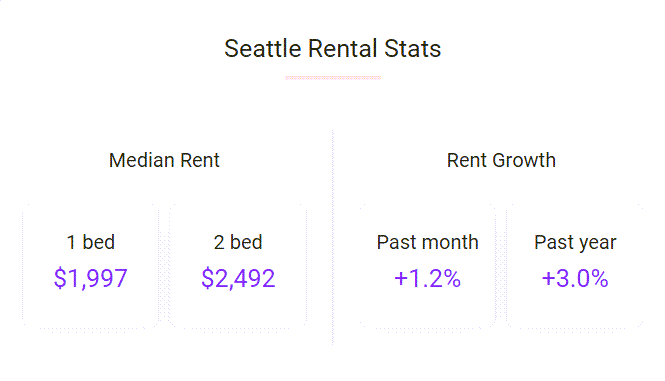
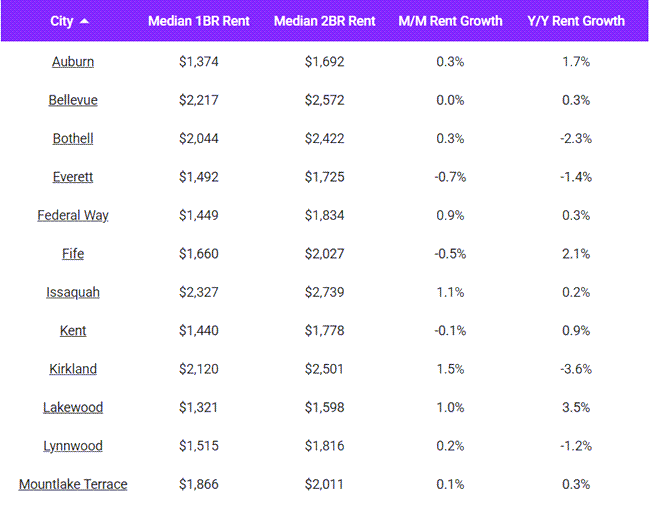
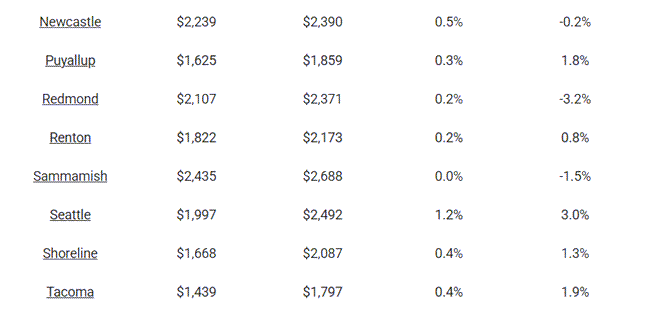
Seattle rents went up 1.2% in the past month, compared to the national rate of 0.0%. Among the nation’s 100 largest cities, this ranks #4. Citywide, the median rent ist $1,997 for a 1-bedroom apartment and $2,492 for a 2-bedroom. Across all bedroom sizes  the median rent is $2,140.

Seattle rents are 4.9% higher than the metro-wide median

Across the Seattle metro area, the median rent is $2,040 meaning that the median price in Seattle proper ($2,140) is 4.9% greater than the price across the metro as a whole. Metro-wide annual rent growth stands at 1.1%, below the rate of rent growth within just the city.

The table below shows the latest rent stats for 20 cities in the Seattle metro area that are included in the Apartment List database. Among them, Sammamish is currently the most expensive, with a median rent of $3,028. Lakewood is the metro’s most affordable city, with a median rent of $1,504. The metro’s fastest annual rent growth is occurring in Lakewood (3.5%) while the slowest is in Kirkland (-3.6%).

Seattle rents rose 1.2% in July with median rent now $2,140 as rent growth over the past year has outpaced both state and national averages.

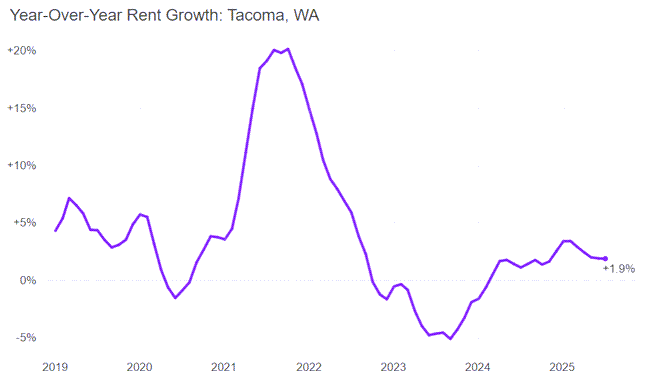
Tacoma year over year rent growth

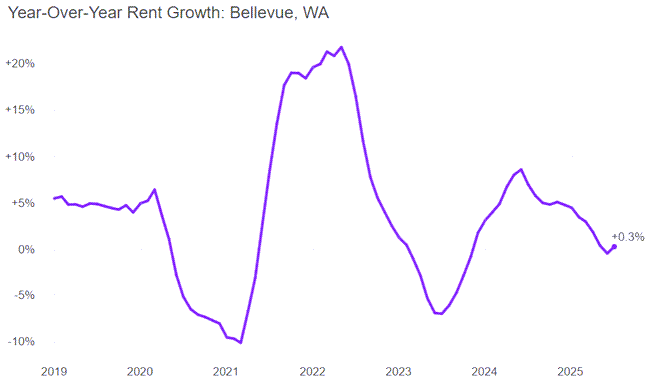
year over year rent growth in Bellevue

Read the full report here.


Sign Up For Our Weekly Newsletter And Get Rental Property And Apartment News And Helpful, Useful Content Each Week.

* indicates required

Pet Owning Renters Face Barriers Despite “Pet-Friendly” Ads

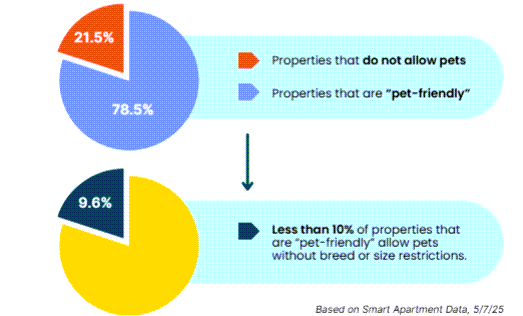
While 79% of rental properties are labeled “pet-friendly,” less than 10% actually allow pets without breed restrictions or size restrictions.

A new national report from the Pet-Inclusive Housing Initiative (PIHI), a Michelson Found Animals Foundation program, reveals a critical gap between perception and reality in the U.S. rental housing market. While 79% of rental properties are labeled as “pet-friendly,” less than 10% actually allow pets without breed or size restrictions.

While 79% of rental properties are labeled “pet-friendly,” less than 10% actually allow pets without breed restrictions or size restrictions.

The 2025 Pet-Inclusive Housing Report analyzes current housing policies and renter experiences across all 50 states, uncovering the financial and emotional toll restrictive pet policies place on millions of families. With updated data from Smart Apartment Data and original research conducted by PIHI, the report paints a detailed and urgent picture of the need for policy reform.

Pet-Friendly: Key Findings from the 2025 Report Include:

  • Less than 10% of “pet-friendly” properties allow pets without breed or size restrictions nationally.
  • Monthly pet rent is the most burdensome cost for renters across all income levels.
  • LA ranks among the worst major cities for pet-friendly housing access, with just 64% of properties allowing pets—and only 5% without restrictions.
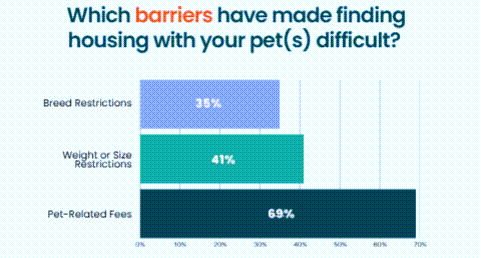
  • Breed and size restrictions are among the top three barriers renters face when searching for housing with pets.
  • Nearly 1 in 4 renters have declared a pet an emotional support animal (ESA) primarily to overcome housing barriers.
  • Over 70% of renters report no pet-related damage to their units, debunking common myths about property risk.
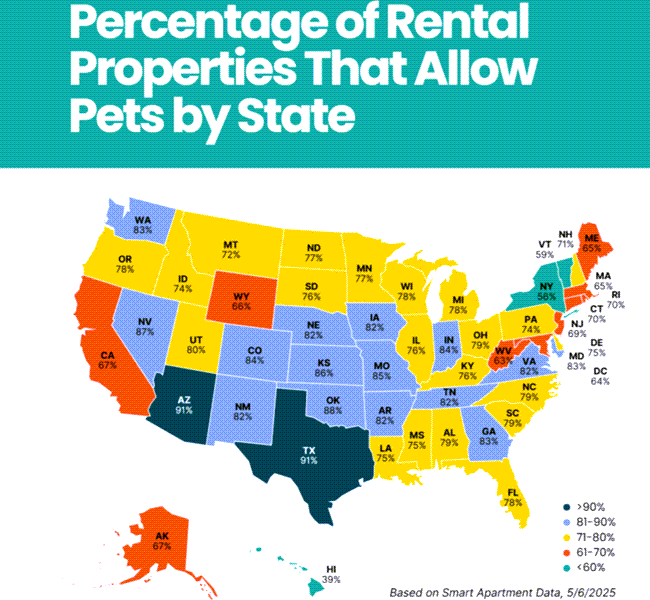
  • Access to pet-friendly housing varies dramatically by state, from 91% in Arizona and Texas to just 39% in Hawaii and 56% in New York.

While 79% of rental properties are labeled “pet-friendly,” less than 10% actually allow pets without breed restrictions or size restrictions.

“This report confirms what too many pet owners already know: ‘pet-friendly’ often doesn’t mean accessible,” said Ross Barker, Director of the Pet Inclusive Housing Initiative.

“Breed and size restrictions, added fees, and inconsistent policies keep families in a constant state of housing insecurity. Our hope is that these findings will galvanize policymakers, housing providers, and advocates to align on common-sense reforms that recognize pets as part of the family and housing as a stabilizing force.”

While 79% of rental properties are labeled “pet-friendly,” less than 10% actually allow pets without breed restrictions or size restrictions.

To access the full report and learn more about pet-inclusive housing reform, visit: Pet-Inclusive Housing Reports.

Michelson Found Animals Foundation, founded in 2005, directly provides animal welfare services and champions pets at every point they intersect with our society. The foundation operates a range of initiatives, including grants and programs that put resources in the hands of communities in need, research that promotes pet-friendly policies, and more. Learn more at foundanimals.org.

The report also includes survey responses from over 500 U.S. pet-owning renters, with more than 80% of dog owners reporting difficulty finding rental housing with their pets. The consequences of these restrictions are profound: families are forced to rehome beloved pets, misrepresent them as ESAs, or hide them altogether, driving up shelter populations and deepening housing instability.

“At MFA, we know that one of the most impactful ways to drive change is by removing barriers to housing for pet owners, increasing access to housing, and preventing pets from unnecessarily entering shelters,” said Dr. Gary K. Michelson, Founder & Co-Chair of Michelson Found Animals. “This report shines a light on where those barriers continue to exist and how we can work together to remove them.”

https://heyzine.com/flip-book/2025petsandhousingdata.html

Sign Up For Our Weekly Newsletter And Get Rental Property And Apartment News And Helpful, Useful Content Each Week.

* indicates required

6 Ways to Arm Yourself Against Deadbeat Tenants

Here are 6 ways to arm yourself against deadbeat tenants to safeguard your property and financial interests.

Here are 6 ways to arm yourself against deadbeat tenants to safeguard your property and financial interests.

By Nancy Abrams

Finding reliable tenants is the key to successful property management. But how can you be confident that tenants will pay their rent on time and will not do damage to your rental property?

You can’t trust your intuition or cross your fingers when you sign a lease with a tenant. Without careful screening, you may have to eventually contend with tenants who don’t uphold their lease obligations.

Here’s how to safeguard your property and financial interests from deadbeat tenants:

1. Thorough tenant screening

  • Implement a robust screening process: An immediate, comprehensive landlord credit check will help shield your real estate assets against deadbeat tenants, expensive eviction costs and loss of rental income in addition to avoiding a great deal of aggravation.
  • Run background checks and confirm the applicant’s financial stability with employment and income verifications to ensure they can comfortably afford the rent.
  • Verify references: Contact previous landlords to gain insight into a potential tenant’s past behavior.
  • Be consistent and fair: Apply the same screening criteria to all applicants to comply with fair housing laws and avoid discrimination claims.

2. Strong lease agreement

Draft a comprehensive lease agreement. Clearly outline payment terms, due dates, late fee policies, property maintenance responsibilities and behavior expectations, such as noise levels, guest limits, etc.

Include clauses for lease violations and eviction procedures. Ensure the lease covers subletting restrictions, rules for breaking the lease and the legal process for resolving disputes.

Ensure that your lease complies with local landlord-tenant laws and is legally enforceable.

3. Financial safeguards

  • Cover potential damages or unpaid rent by requiring a security deposit.
  • Protect yourself from property damage, lost rent and legal expenses by investing in landlord insurance.

4. Effective communication and documentation

Maintain professional communication: To develop a positive relationship and prevent disputes from escalating, address tenant concerns promptly and respond to maintenance requests quickly.

Document everything: Keep detailed records of all interactions, including rent payments, repair requests and rule violations. These records can be crucial evidence if legal action becomes necessary.

Conduct regular inspections: Schedule inspections at least twice a year to check the property’s condition and address potential issues early.

5. Proactive measures for non-payment

  • Some state or local laws require a grace period before late fees can be charged.
  • Keep a legal record of non-payment and send late-rent notices as soon as the rent is overdue.
  • Communicate with the tenant and offer potential solutions, such as payment plans, if appropriate.

6. Taking legal action when necessary

  • Understand your rights by familiarizing yourself with landlord-tenant laws and eviction procedures in your area.
  • If rent remains unpaid, serve a “Pay or Quit” notice. This formal notice gives the tenant a specific timeframe (e.g., three to seven days, depending on local laws) to pay the overdue rent or vacate the property.
  • Consider “Cash for Keys” as a last resort. In some situations, offering a financial incentive to vacate can be more cost-effective than a lengthy eviction process.
  • If the tenant fails to comply with the “Pay or Quit” notice, you may need to file an unlawful detainer lawsuit and follow the formal eviction process to regain possession of your property.
  • Hire an attorney specializing in landlord-tenant law to navigate complex cases and ensure compliance with all regulations.

By implementing these preventative measures and taking appropriate action when issues arise, you can minimize the risk associated with renting to deadbeat tenants and protect your investment.

About the author:

Nancy Abrams currently serves as Content Editor for AAOA (the American Apartment Owners Association). AAOA assists landlords, property managers, real estate owners and brokers across the country with managing their properties, including tenant credit checks and tenant background screening as well as state-specific landlord forms, such as a rental application or rental agreement.  The association also offers resources from educational webinars and landlord tenant law to approved providers for insurance and financing. Contact us today to learn more.

Sign Up For Our Weekly Newsletter And Get Rental Property And Apartment News And Helpful, Useful Content Each Week.

* indicates required

7 Summer Rental Property Maintenance To-Do’s

Here are 7 summer rental property maintenance to-do's for summer to keep your investment looking good for your tenants.

Here are 7 summer rental property maintenance to-do’s for summer to keep your investment looking good for your tenants.

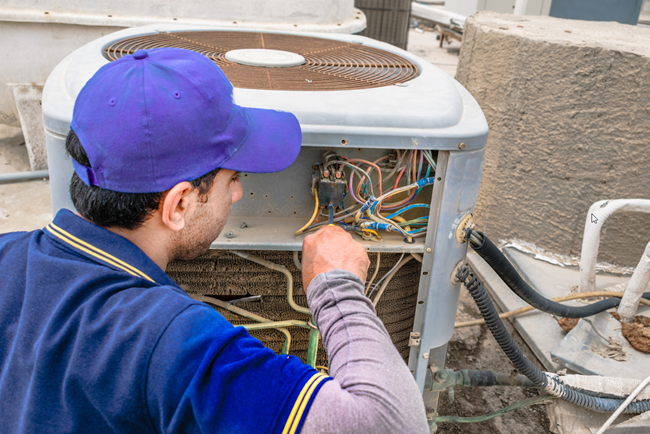
No. 1 – Air Conditioning System. Ensure your tenants will be able to enjoy a functional air conditioning system in the summer, so check now instead of waiting for them to call later. An HVAC specialist can check whether the air conditioning system is in optimal shape and clean condensers and evaporators from debris that naturally accumulate after the air conditioning is not being utilized regularly.

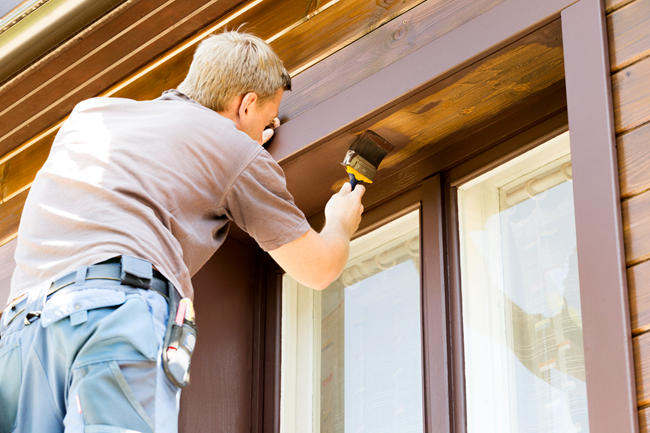
No. 2 – Painting. Good rental property maintenance includes tending to worn and discolored walls, doors, windows, fences and porches is a perfect activity for the spring. A professional can get your exteriors back to like-new condition with a fresh coat of paint.

Here are 7 summer rental property maintenance to-do's for summer to keep your investment looking good for your tenants.

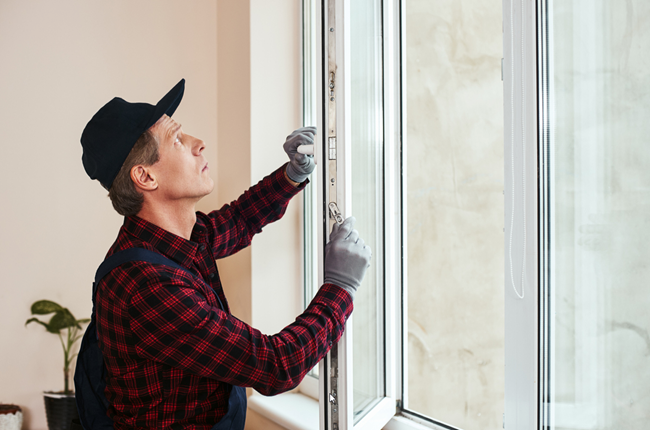
No. 3 – Window and Door Screens. All screens should be thoroughly checked for tears, as they represent an easy point of entry for those bugs and critters that start showing up as the weather gets hotter. Older, loose and worn screens or frames should be promptly replaced to avoid the annoyances of bugs’ activities within the home.

maintenance to-do's for summer to keep your investment looking good for your tenants.

No. 4 – Porches and Fences. Wooden fences and porches should be treated with protective sealant every four to six years. A professional can assess the condition of porches and fences to recommend necessary treatments, which protect wood from the cracks, warping, rotting and discoloration that can happen as a result of wet weather and/or direct sunshine exposure.

No. 5 – Decks. Especially in older properties, exterior decks can begin to wear down, rot and become unstable and unsafe. A specialist can check the conditions of a deck’s structure and recommend necessary repairs to ensure that tenants can safely enjoy spending time outside as the weather gets warmer.

Here are 7 to-do's for summer to keep your investment looking good for your tenants.

No. 6 – Landscaping. If your property is surrounded by greenery, a professional should be hired to trim overgrown vegetation, remove debris and leaves, and inspect plants that are actively growing on the property’s structure or fencing. This allows for vegetation to grow neatly around the property, which is both aesthetically pleasant and safe, since overgrown surroundings make for perfect living spaces for pests and other wildlife.

No. 7 – Garden Sprinklers: If you rely on a sprinkler system to maintain your property’s lawn check it after it was unused for several months and before it starts beings used often. A professional can check for leaky valves, inefficient lines, water pressure levels and faulty sprinkler heads.

These items for your summer rental property maintenance will keep tenants and property managers happy.

Sign Up For Our Newsletter And Get Apartment News And Helpful, Useful Content Each Week.

* indicates required

Rental Property Maintenance Checklist, Part One: Plumbing

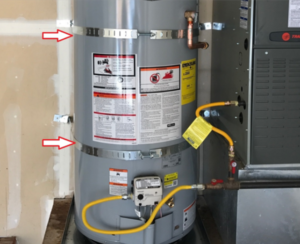
rental property maintenance plumbing and water heater secured with straps in earthquake prone areas of the country

3 Common Plumbing Emergencies In Rental Properties And What To Do

Rental Property Maintenance: 6 Items to Troubleshoot in Your Crawl Spaces

How to Waterproof Your Basement</

Part 2 – Rental Property Maintenance: Security, Pest Control, & Exteriors


Landlords: The Power of Knowing Your Property Neighbors

One often-overlooked but crucial aspect of property management for landlords is the power of knowing the neighbors of the properties you own.

One often-overlooked but crucial aspect of property management for landlords is the power of knowing the neighbors of the properties you own. Here are 4 steps you can take.

By Scot Aubrey

For many, the fear of the unknown is devastating. For landlords, it can be paralyzing.  However, getting rid of that fear might be as easy as walking next door.

As a landlord, managing properties isn’t just about collecting rent and maintaining the structure; it’s also about fostering a sense of community.

One often-overlooked but crucial aspect of property management is knowing the neighbors of the properties you own.  This practice not only enhances safety and security for your tenants and your investment but also helps create a more cohesive and harmonious environment for everyone involved, including the neighbors.

An Extra Set of Eyes

Knowing your neighbors can significantly improve the safety and security of your rental properties.

Neighbors, especially the nosy ones, keep an eye out for unusual activities or suspicious individuals, acting as an additional layer of vigilance for your investment.

By building relationships with neighbors, landlords can establish a network of trust and communication that helps prevent crime and creates an easy line of communication should an incident occur.  Neighbors are also valuable sources of information about the condition of your rental properties.

They can alert you to maintenance issues that might otherwise go unnoticed, such as leaking pipes, overgrown yards, or unauthorized occupants.

This can save you time and money by alerting you to problems before they escalate into more significant issues that could potentially affect property value or the ability to rent the property.

Positive Tenant and Community Relations

Every action you take tells the tenant how much you value them.

When you are familiar with the neighbors and community, your tenants see that you care about more than just the monthly rent payment, and that their well-being is a priority.

Increased tenant satisfaction leads to longer lease periods where they are more likely to renew their leases.

Additionally, knowing the neighbors allows landlords to address any concerns or complaints more effectively, demonstrating proactive management and a commitment to resolving issues promptly.

A strong sense of community, where residents take pride in their surroundings, benefits everyone involved, from landlords and tenants to neighbors themselves.

Practical Steps for Landlords

To effectively get to know the neighbors of your rental properties, consider the following practical steps:

  1. Introduce yourself: Take the initiative to introduce yourself to neighboring residents.  A friendly conversation can go a long way in establishing rapport and building trust.  Leave behind your contact information.  Neighbors are a great source for referrals as well, and just might help you find your next tenant.
  2. Attend community events: Participate in neighborhood events or meetings to connect with residents and stay informed about local issues and developments.
  3. Establish communication channels: Provide neighbors with contact information and encourage them to reach out if they notice any concerns related to your properties.
  4. Encourage open dialogue: Foster an environment where neighbors feel comfortable sharing feedback or reporting incidents, ensuring prompt and respectful responses from you or your team.

One Good Investment Deserves Another

Knowing the neighbors of the properties you own is more than just a good practice, it’s an investment in creating safer, more vibrant communities.

By building relationships with neighbors, landlords can enhance security, monitor property conditions, foster positive tenant relations, and mitigate potential risks.

These efforts not only benefit your investment but also contribute to a sense of belonging and mutual support among residents.

Ultimately, landlords who prioritize neighborly engagement are likely to see greater tenant satisfaction, reduced turnover, and increased long-term value in their rental properties.

About the author:

Scot Aubrey is vice-president of Rent Perfect, a private investigator, fellow landlord and cohost of the weekly Rent Perfect Podcast.  Subscribe to his podcast to stay up to date on the latest industry news, and for expert tips on how to manage your properties.

Sign Up For Our Weekly Newsletter And Get Rental Property And Apartment News And Helpful, Useful Content Each Week.

* indicates required

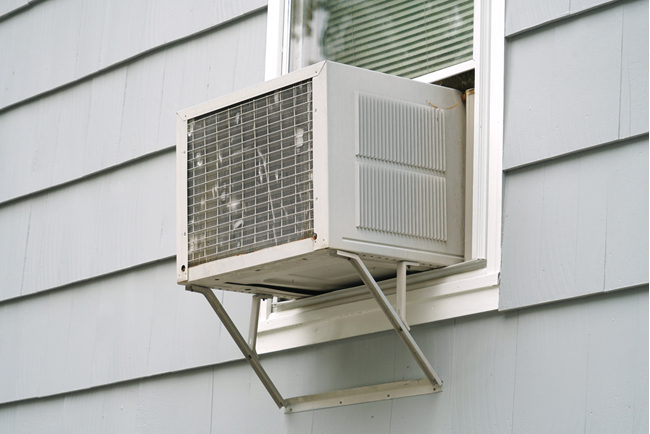
AC Requirements for Portland Landlords May Be Coming

Portland landlords may soon have air conditioning requirements for their rental properties, according to reports.

Portland landlords may soon have air conditioning requirements for their rental properties, according to reports.

The Portland Permitting and Development Bureau is exploring a code amendment to create a maximum indoor-temperature standard for rental units.

In Portland, there are more than 153,000 rental units. About 75 percent of renters already have some form of air conditioning in their homes, according to a city-commissioned analysis by economic consulting firm ECOnorthwest.

“A maximum temperature standard may be one path to mitigating the effect of heat waves and extreme heat events in Portland,” wrote ECOnorthwest in a cost analysis of cooling temperature standard in Portland.

“A local code amendment that requires landlords to provide cooling options can not only save lives but also improve the health and comfort of renters who often lack control over improvements to their living spaces.

“Based on other jurisdictions’ experience with maximum temperature standards ranging from 78 to 88 degrees Fahrenheit, this analysis assumed a maximum temperature standard of 80 or 82 degrees Fahrenheit to estimate compliance costs,” the ECOnorthwest analysis said.

“We are in a climate crisis, and setting a maximum indoor-temperature standard for rental units can help ensure that populations more likely to be renters in Portland, such as communities of color or those with lower incomes, are prioritized in our climate actions,” said interim Portland permitting and Development Director David Kuhnhausen in an interview with  The Oregonian/OregonLive.

Costs to landlords?

Two potential options to comply with such a requirement are installing window air conditioning or hiring a contractor to install ductless mini-split heat pumps along with necessary upgrades to electrical panels.

An Energy Star-certified window air conditioner costs about $330, though it can cost up to three times higher with professional installation.

On the other hand, a professionally installed mini-split heat pump could cost about $6,100, and, if needed, upgrading the electrical panel could increase the costs by about $3,900, according to ECOnorthwest.

Cost could be the biggest challenge, according to Multifamily NW, an association representing residential property managers and owners.

“We support the goal of protecting residents from extreme heat, especially in light of recent heat waves that have disproportionately impacted seniors and low-income households.

“However, mandating air conditioning or heat pumps in every unit without financial support would place a substantial burden on housing providers, particularly for older buildings not originally designed for these systems,” said Andie Smith, a housing provider in Oregon and the group’s current board president, to the Oregonian.

Accidental Landlords Growing as Home Sellers Delist Properties

Accidental landlord numbers are growing with high interest rates and frustrated sellers delisting properties and offering them as rentals

The number of accidental landlords is expected to grow as interest rates remain high and frustrated sellers are deciding to delist their properties and instead offer them on the rental market, according to reports.

Delistings jumped 47% nationally in May from a year earlier, according to the Realtor.com® economic research team’s latest monthly housing trends report. Year to date, delistings are up 35% from the same period in 2024.

“This year’s market is a study in contrasts,” says Danielle Hale, chief economist of Realtor.com. “Buyers are seeing more choices than they’ve had in years. But many sellers, anchored by peak price expectations and upheld by strong equity positions, are deciding to step back if they don’t get their number.”

With the rising supply of homes for sale, plus high mortgage rates and waning consumer confidence, more potential buyers are staying on the sidelines, writes Diana Orick in the CNBC Property Play newsletter. Some frustrated sellers are deciding to delist their properties and instead offer them on the rental market.

“When these home sellers cannot find buyers, they face three choices: delist and wait, cut price to find market-clearing level, or convert to rental. The last option creates what Parcl Labs terms ‘accidental landlords’: Owners who enter the single-family rental market not by design, but by necessity,” wrote Jesus Leal Trujillo, principal data scientist at Parcl Labs.

The inventory of homes for sale has already been growing steadily over the past year, especially in formerly hot pandemic-migration markets like the Sun Belt.

Homes are sitting on the market longer as sellers, used to the heady price hikes of the last five years, are reluctant to lower their prices. As more for-sale supply enters the rental pool, that could limit landlord pricing power.

“You’re not going to see big reductions in rent, but maybe you won’t be able to get 4% or 5% increases on your rent. Maybe it’s just 1% to 2% in some cases,” said Haendel St. Juste, a senior equity research analyst at Mizuho Securities, in an interview with CNBC. “But the professional big guys have been getting 4% to 5% renewal rates and 75% retention in their portfolio. So, keeping people in the homes at 4% to 5% rent is a key part of their business model.”

What The Big Institutional Landlords Are Doing

“We saw something like this in 2022 after mortgage rates doubled: A huge uptick in the number of people who owned one property besides their primary residence,” said Rick Sharga, CEO of CJ Patrick Co., a real estate advisory firm.

“They are deploying more funds into build-to-rent projects, rather than competing with smaller investors and traditional homebuyers for resale properties,” he said, suggesting that doing so limits the threat from those so-called accidental landlords.

That minimizes some of the risk, but St. Juste said the biggest landlords will have to incur some occupancy decline in order to optimize their revenue, as opposed to just slashing rents.

“The incremental risk from this slow selling season is that there could be more supply, you know, come this fall, come next spring, that could limit some of the rental growth upside for next year,” he said.

Sign Up For Our Weekly Newsletter And Get Rental Property And Apartment News And Helpful, Useful Content Each Week.

* indicates required

California AG Warns Landlords On Immigrant Tenant Discrimination

California Attorney General Rob Bonta issued a warning to landlords against immigrant tenant discrimination and immigration authorities

California Attorney General Rob Bonta issued a stark warning to landlords across the state: Housing discrimination against immigrant tenants is illegal and will not be tolerated, according to a release.

Bonta said in the release that it is illegal for landlords to, “retaliate against tenants, or influence tenants to move out by threatening to disclose a tenant’s immigration status to Immigration and Customs Enforcement (ICE) or law enforcement.

“Especially as the federal administration carries out an inhumane campaign of mass deportation and creates a culture of fear and mistrust, it is crucial that landlords and tenants understand their obligations and rights under California law.”

Landlords cannot threaten to disclose a tenant’s immigration status in order to pressure a tenant to move out. (Civil Code § 1940.2.)  In most cases, landlords are not allowed to ask a tenant or potential tenant their immigration or citizenship status in California.

“Landlords who violate these laws may be required to pay tenants for damages, penalties, and attorney’s fees. For example, a landlord who discloses a tenant’s immigration status to any immigration authority may be ordered to pay the tenant statutory damages equal to 6 to 12 times the monthly rent (Civil Code § 1940.35(b).) Tenants have an array of other rights and protections under California law,” Bonta said in the release.

Landlords and Immigration Authorities  

If immigration authorities like ICE demand tenant information from a landlord, such as a tenant’s rental application or other documents, the landlord may ask to see a warrant or other authority, Bonta said in the release. Landlords should immediately seek legal advice to determine whether they must comply and to ensure that they do not violate California’s anti-discrimination and privacy laws. There are different types of documents that ICE may present:

  • An ICE administrative warrant or a notice to appear for an immigration hearing does not give ICE special powers to search a landlord’s records. Landlords should seek legal advice about how to respond.
  • If ICE presents a warrant issued by a federal court or other court order signed by a judge, landlords should comply promptly and, where feasible, seek legal advice before responding.
  • Landlords presented with a subpoena for documents or evidence should seek legal advice on how to respond.
  • Landlords should not physically interfere with ICE officers in the performance of their duties.

Sign Up For Our Weekly Newsletter And Get Rental Property And Apartment News And Helpful, Useful Content Each Week.

* indicates required