Home Blog Page 13

Landlord Says Agents Broke Into Her Building, Took 6 Tenants

Landlord Says Agents Broke Into Her Building, Took 6 Tenants

A Chicago landlord says U.S. Immigrations and Customs Enforcement (ICE) agents wearing vests that said “Police” broke into her building late at night and took six of her tenants, according to news reports.

Landlord and property owner Arminda Castelin told CBS, “My tenant called me very scared. He said that, ‘Police are trying to break into our house.’ ”

Castelin said when she came in on Monday, the doors were broken and the tenants were gone.

Castelin said six people — mostly fathers and husbands — were detained. She said some of her doors were broken, and her building is almost completely empty after the rest of the tenants fled in fear. She said a mother and a baby remained in one apartment, trying to figure out the next steps after the father was taken.

Castelin said she thought the agents were police officers, since that is what their vests said.

ICE Agents Seek Tenant Info, Calling It ‘Welfare Check’

“They (tenants) say police, but they don’t even know what kind of people it is,” she said. “They are just terrorized right now.”

Castelin said she looked at her tenants’ IDs and documents before they signed leases to make sure they were legal residents.

“It’s just so sad, you know?” she said. “They keep calling me, and I’m just trying to help them.”

CBS News Chicago reached out to legal analyst Irv Miller to see if ICE agents can wear police vests. Miller said there is no law or regulation saying they cannot.

Sign Up For Our Weekly Newsletter And Get Rental Property And Apartment News And Helpful, Useful Content Each Week.

* indicates required

August Rent Growth Flat in Summer Slowdown

Accidental Landlords Growing as Home Sellers Delist Properties

The Consumer Review Fairness Act and Its Marketplace Impact

Photo credit via istockimages

Unraveling The Mystery Of 1031 Exchanges

Unraveling the mystery of 1031 exchanges and some exceptions for the taxpayer and rules on the same taxpayer.

Unraveling the mystery of 1031 exchanges and some exceptions for the taxpayer and rules on the same taxpayer.

By William L. Exeter
Exeter Trust Company

In a 1031 exchange transaction, it is often said that legal title to the real estate being sold (i.e., the relinquished property) and the real estate being purchased (i.e., the replacement property) must be held under the exact same legal title.

This is a common misconception.  Although it is generally recommended to hold legal title to properties in a 1031 exchange under the exact same legal title, there are exceptions where legal title is not required to be identical.

Same Taxpayer Requirement

The actual requirement is that the ownership (i.e., the taxpayer) of the relinquished and replacement properties in a 1031 exchange must be held by the “same taxpayer” regardless of how legal title is held. The same taxpayer must sell the relinquished properties and buy the replacement properties.

This same taxpayer requirement is an implicit requirement that is not specifically mentioned in the Internal Revenue Code or Treasury Regulations.  Legal title may vary from the sale of the relinquished property to the purchase of the replacement property if the property ownership continues to be held by the exact same taxpayer.

This is one of many reasons why investors should discuss their proposed 1031 exchange with their legal, tax and financial advisors before proceeding with their transaction.

Exceptions – Disregarded Entities

There are several ways an investor can acquire and hold legal title to real estate while still meeting the same taxpayer requirement.  Generally, this is achieved by using a disregarded entity.  Disregarded entities are entities that are ignored for Federal tax purposes (i.e., they do not file a Federal Tax Return) and are treated as if the underlying investor is the actual taxpayer.

The following are individuals or disregarded entities that will be treated as if the properties were owned or held by the same taxpayer:

  • Individual name
  • Single-member limited liability company (LLC) that has not elected partnership or corporation treatment for Federal tax purposes (i.e., it is a disregarded entity)
  • Fully revocable grantor trust (e.g., living trust)
  • Title holding trust (land trust) [Revenue Ruling 92-105]
  • Tenant-in-common (TIC) ownership structure [Revenue Procedure 2002-22]
  • Delaware statutory trust (DST) [Revenue Ruling 2004-86]

Examples Using Disregarded Entities

Lenders often require legal title of the replacement property to be held in a specific way for them to complete the financing.  Many lenders do not allow legal title to be held in a trust or a LLC, while other lenders may require legal title to be held in an LLC.

For instance, an investor may hold legal title to his or her relinquished property in an LLC, but the lender may insist legal title to the replacement property be held in the investor’s individual name to complete the financing. This will meet the same taxpayer requirement if the LLC is a single-member LLC and disregarded entity for Federal tax purposes. The LLC is ignored and treated as if the underlying individual is the owner for Federal tax purposes and therefore considered to be the same taxpayer.

Similarly, an investor may hold legal title to his or her relinquished property in a fully revocable grantor trust (i.e., living trust, title holding trust or land trust), but the lender may require legal title to the replacement property be held in the investor’s individual name to complete the financing. This will also meet the same taxpayer requirement if the trust is a disregarded entity for Federal tax purposes.  These trusts are ignored and treated as if the underlying individual is the owner for Federal tax purposes and therefore considered to be the same taxpayer.

Death of Taxpayer During 1031 Exchange

If the taxpayer dies during a 1031 exchange, the Treasury Regulations require the taxpayer’s estate to complete the 1031 exchange transaction to receive tax-deferred exchange treatment. In fact, the taxpayer’s estate must complete the 1031 exchange to receive a step-up in the cost basis.

Non-Disregarded Entities

Entities that are not classified as disregarded entities for Federal income tax purposes (i.e., they are regarded entities), include, but are not limited to:

  • Limited liability companies (LLCs) treated as partnerships or corporations
  • General partnerships
  • Limited partnerships
  • Corporations (both sub-chapter “C” and “S” corporations)
  • Irrevocable trusts

Legal title to the relinquished and replacement properties must generally be held in the exact same legal title (i.e., in the regarded entity name) when the entity is not disregarded for Federal tax purposes.

Legal, Tax and Financial Advisor Review

The requirement to have the same taxpayer vs. the way legal title is held is very complex. It is crucial for investors to have their legal, tax, and financial advisors examine their proposed 1031 exchange to ensure the same taxpayer requirement is met. If the taxpayer is not deemed to be the same, the 1031 exchange could be disallowed.

Ask Bill Exeter

Ask Bill Exeter and his team your questions about 1031 exchanges and he and his team will get back to you.

Name

About the author:

Unraveling the mystery of 1031 exchanges and some exceptions for the taxpayer and rules on the same taxpayer.

William L. Exeter is Chief Executive Officer Exeter 1031 Exchange Services, LLC Exeter Trust Company. Mr. Exeter is one of the founders of The Exeter Group of Companies and has been with the company since its inception in 2004. He is based in The Exeter Group of Companies’ national corporate headquarters office in San Diego, California. He also serves as an industry consultant, advisor, trainer, instructor, and expert witness.

Sign Up For Our Weekly Newsletter And Get Rental Property And Apartment News And Helpful, Useful Content Each Week.

* indicates required

Landlords To Pay $20,000 In Emotional Support Animal Case

Two Wisconsin landlords will pay $20,000 to settle an emotional support animal case that that accused them of discriminating against tenants

Two Wisconsin landlords will pay $20,000 to settle an emotional support animal case involving cats and rats, that that accused them of discriminating against tenants who have emotional support animals, according to the Milwaukee Journal Sentinel.

A federal complaint filed in November 2024 accused landlords Tammy Estrada and Ramiro Estrada of violating the Fair Housing Act after denying tenant Ashlee Crosno’s request to keep two cats and three rats obtained after her psychiatrist recommended emotional support animals.

The complaint alleged that the Estradas denied the request and retaliated against Ashlee Crosno and her husband, Michael, when they attempted to exercise their rights under the Fair Housing Act, among other violations.

Under the law, landlords generally must allow tenants to keep an emotional support animal if they provide documentation of a disability from a licensed health professional.

The psychiatrist recommended the emotional support animals on April 4, 2022, after which the Crosnos acquired the animals. On Jun 29, 2022, Ms. Crosno wrote to Tammy Estrada requesting the accommodation.

According to the complaint, the Estradas rejected Crosno’s request, saying that only one emotional support animal was allowed, imposing additional pet fees and fines, and later threatening eviction, even though Crosno twice provided supporting documentation from her psychiatrist. Crosno’s lease did not impose a limit on the number of animals a tenant could have, nor did it distinguish between pets and emotional support animals.

In generally, emotional support animals are not legally seen as pets, rules for pets generally do not apply, and reasonable accommodation requests can be made before or after acquiring emotional support animals.

The complaint also said Tammy Estrada called Crosno’s psychiatrist and threatened to report him for supporting her request.

The Estradas did not admit liability as part of the settlement, and the claims in the complaint remain allegations only.

The U.S. Department of Housing and Urban Development initially investigated Crosno’s complaint and issued a charge of discrimination before referring the case to the U.S. Department of Justice.

Crosno told the Milwaukee Journal Sentinel her animals help her cope with sleepless nights, panic attacks and depression. She said her rats’ playfulness motivates her and eases feelings of loneliness, while her cats’ soothing weight on her chest calms her anxiety.

As part of the settlement the Estradas must complete fair-housing training to settle the federal lawsuit that accused them of discriminating against tenants with emotional support animals.

Read the original complaint here.

Sign Up For Our Weekly Newsletter And Get Rental Property And Apartment News And Helpful, Useful Content Each Week.

* indicates required

National Rents Dip Again In August

Rents dipped again 0.2% in August, the first month-over-month rent decline nationally, according to the September report from Apartment List.

Rents dipped 0.2% in August, the first month-over-month rent decline nationally, according to the September report from Apartment List.

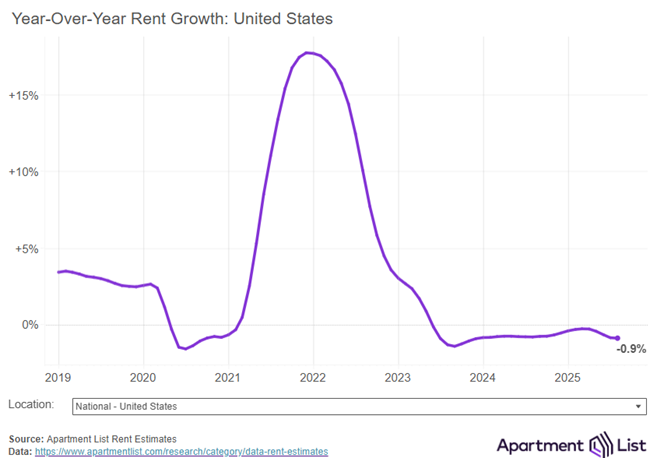
Rents are now down 0.9% year-over-year.

This marks the end of the busy season for moving activity, and it’s likely that rent prices nationally will continue to decline through the fall and winter, when fewer renters are typically looking for apartments, according to the report’s research team.

Rents dipped again 0.2% in August, the first month-over-month rent decline nationally, according to the September report from Apartment List.

“Monthly rent growth peaked at +0.6 percent in March this year, and then began to gradually trend down during the peak moving months, when rent growth is normally fastest.

“The flip to negative month-over-month growth has also come a bit earlier than what we saw in pre-pandemic years, although this is now the third straight year that prices have begun to dip in August,” the report says.

Highlights of the rent report:

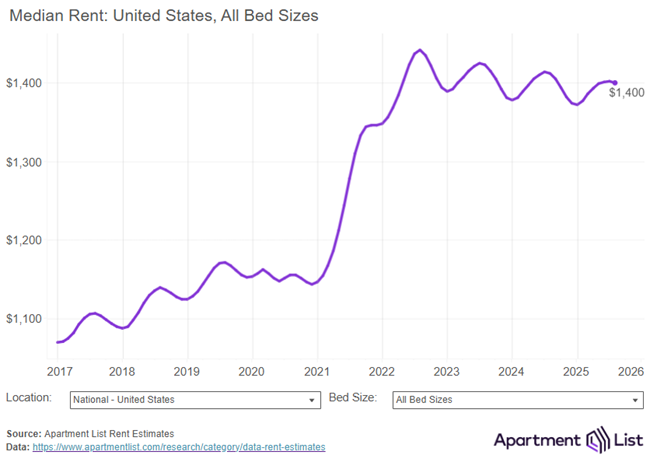
  • After the August decline, national median rent stands at $1,400.
  • Year-over-year rent growth has ticked further negative for four consecutive months and is now at its lowest level since December 2023.
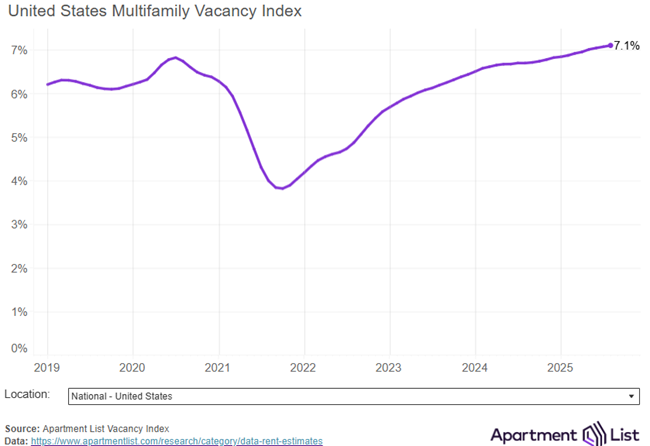
  • The national multifamily vacancy rate sits at 7.1%, a record high. We’re past the peak of a multifamily construction surge, but a healthy supply of new units is still hitting the market, and vacancies are still trending up.
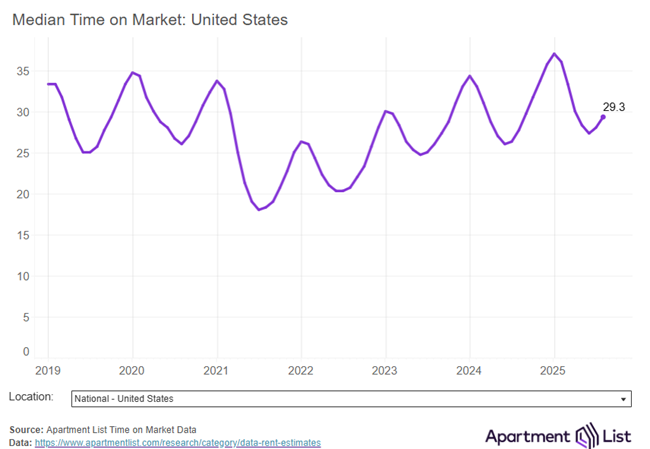
  • Units are taking an average of 29 days to get leased after being listed, up one day from last month’s reading, and down from a high of 37 days in January.

Rents dipped again 0.2% in August, the first month-over-month rent decline nationally, according to the September report from Apartment List.

Multifamily vacancy rate hits 7.1%, a new peak

The most important driver behind the soft rent growth of recent years has been a historic surge of multifamily construction.

However, while the peak of the multifamily construction surge has now passed, a healthy supply of new units is still hitting the market, and vacancies are still trending up.

Conditions are expected to tighten later this year and into next as the supply wave continues to recede, but for now the market is still absorbing a swell of new units.

Rents dipped again 0.2% in August, the first month-over-month rent decline nationally, according to the September report from Apartment List.

New supply driving falling rents in Sun Belt markets; the Bay Area heats up

The Austin metro currently has the softest conditions among the nation’s large rental markets, with the median rent there down by 6.6% over the past year.

At the other end of the spectrum, the San Francisco metro has seen the fastest year-over-year rent growth (+4.7%).

List-to-Lease time ticks up for first time this year

As more vacant units have come onto the market, those units have also been sitting vacant for somewhat longer.

The typical “list-to-lease” time peaked at 37 days nationally in January, an all-time high going back to the start of the data series in 2019.

“We have since come down from that peak, but August saw time on market tick up for the second consecutive month, increasing from 28 days in June to 29 days this month,” the report says.

Rents dipped again 0.2% in August, the first month-over-month rent decline nationally, according to the September report from Apartment List.

August Rents Conclusion

As the report saw national rents dip again, all key indicators are pointing toward ongoing sluggishness in the multifamily rental market, as rent growth is slipping and the vacancy rate is at an all-time high.

A return to tighter market conditions remains on the horizon, but the outlook has been complicated by a continued influx of new units to the market and macroeconomic whiplash being caused by tariffs and other policies being pursued by the Trump administration.

“With construction expected to slow further in the second half of this year and into 2026, conditions are likely to shift, but it will still take time for the market to metabolize the recent growth in the rental stock,” the Apartment List research team writes.

Read the full report here.

Sign Up For Our Weekly Newsletter And Get Rental Property And Apartment News And Helpful, Useful Content Each Week.

* indicates required

Personal Outreach Crucial for Apartment Prospect Follow-Up

Personal outreach is key for multifamily communities as a survey shows 6 out 7 properties don’t combine call, text, and email in follow-up.

Personal outreach is crucial as a survey of 1,100 multifamily communities found six out of seven properties don’t combine call, text, and email in their prospect follow-up.

By Richard Berger

Property management companies and software technology providers continue to emphasize the importance of striking the right balance between digital and personal interactions.

What they can agree on is that responding to leads through email, voice, text, or other means is crucial in their efforts to maintain or build occupancy.

However, a recent survey of 1,100 multifamily communities by Flair, tracking each for 30 days, found that six out of seven properties don’t combine call, text, and email in their follow-up.

Some sent instant email confirmations that read, “Thanks for your interest, we’ll be in touch soon.” But when researchers stripped out autoresponders, they found that properties took an average of 36 hours to truly follow up.

Prospects reached out for specific information: Can my dog live here? What fees are included? Is my credit high enough? The survey registered this response performance based on outreach types:

  • Email Only: 23%
  • Email + Phone: 26%
  • Email + Text: 15%
  • Email + Text + Phone: 15%
  • Zero response: 14%

Properties that incorporate texting for the first time outperform those that don’t by 600%, and texting is six times more effective at scheduling tours than via email, according to the lead- and resident-nurturing platform, Nurture Boss an AI-powered platform for multifamily.

Communities that used all three channels averaged 10.89 touchpoints over 30 days—using email-only netted just 5.58 attempts. The median across all properties was seven touchpoints, even when including auto-responders.

Nurture Boss data reveals that it takes an average of eight touchpoints to generate a tour and 10 or more to generate a lease application. Nonetheless, 47.6% of properties stopped all follow-up after 15 days.

Natalina Rettew, head of asset management at Trion Properties, utilizes a “dialer-up” feature that generates a contact card and automatically initiates a phone call from the apartment community to the prospect.

“This creates significant conversion because when the contact card is created, it is usually the time when the prospect is most engaged,” Rettew told GlobeSt.com.

“It’s beneficial that the first contact the prospect has is from a live person, and they can invite them to schedule a tour.”

Trion Properties operates 6,000 units nationwide, mainly in California, Oregon, Colorado, and Florida. Its California portfolio is mostly in Sacramento and the East Bay.

“We have done lead nurturing through bots, but we felt like in those cases, the conversations took longer to occur,” she said. “It wasn’t immediate like it is with Flair.” “The immediate connection we get with prospects through Flair has been very effective for our properties.”

Rettew is seeing a 60% answer rate and an uptick in tour scheduling.

Windell Mollenido, vice president of marketing and technology for the California-based apartment management firm The REMM Group, told GlobeSt.com that “society today yearns for authenticity and they’re even willing to pay for it. “

AI is not replacing humans, he said. “It’s enhancing a person’s ability to connect with prospects. Following up on renter prospect leads is not simply about looking at numbers on a spreadsheet.”

About the author:

Richard Berger is a freelance reporter who covers real estate.

Photo credit Diamond Dogs via istockimages.

Sign Up For Our Weekly Newsletter And Get Rental Property And Apartment News And Helpful, Useful Content Each Week.

* indicates required

Landlord Wins Ruling in Emotional Support Animal Fee Case

A federal judge has ruled a landlord did not have to automatically waive its animal fee for a tenant with an emotional support animal

A federal judge has ruled that a landlord did not have to automatically waive its emotional support animal fee for a tenant with an emotional support animal (ESA) under the Fair Housing Act (FHA), according to a report in jdsupra.com.

Judge Sarah Vance of the U.S. Eastern District of Louisiana held that a tenant with an ESA seeking to have her landlord waive a generally applicable animal fee was required to prove that the waiver was both necessary for her to use and enjoy her home and reasonable.

In reaching her ruling, Judge Vance rejected the notion that guidance issued by the U.S. Department of Housing and Urban Development (HUD) always requires housing providers to waive pet fees for people with ESAs.

She found the HUD Notice stating that a housing provider may not charge a fee or deposit for a service animal or other assistance animal “unpersuasive.”

Judge Vance rejected the argument that landlords always must waive fees for tenants with ESAs. Instead, she concluded that whether such accommodation is required is a fact-specific, case-by-case determination.

The judge said in the ruling it is the job of the courts, not agencies like HUD, to determine laws and the Constitution.

“Agency interpretations are only entitled to respect if they have the power to persuade. Ultimately, she found the HUD notice stating that a housing provider may not charge a fee or deposit for a service animal or other assistance animal ‘unpersuasive’.”

This case involved the plaintiff’s request for a reasonable accommodation under the FHA and Louisiana Equal Housing Opportunity Act (LEHOA), specifically seeking a waiver of a $400 animal fee for her dog, which she claimed was an ESA.

The defendants’ apartment complex allows animals, so there was no issue with the dog living there. The only dispute was whether the defendants had to waive the animal fee they charged all tenants for the plaintiff just because she had an ESA.

Adams & Reese attorneys representing the landlord argued that the FHA does not say housing providers must waive animal fees for ESAs.

It only says they must make reasonable accommodations that are necessary for disabled people to use and enjoy their homes equally.

The plaintiff, represented by the Louisiana Fair Housing Action Center, argued that it is always necessary to waive animal fees for people with ESAs to afford them an equal housing opportunity.

“Ultimately, Judge Vance found the plaintiff failed to prove she needed a fee waiver because she did not put forward any evidence to demonstrate that waiving the fee would alleviate the effects of her disability and the record showed the plaintiff could afford the fee, particularly if given the option to pay in installments,” judsupra.com reported.

Why This Decision Matters for Landlords

For years, HUD, the DOJ, and others have maintained that housing providers must waive fees whenever someone claims they are disabled and need a service or assistance animal, period.

Though not actually the law, this idea was perpetuated through Internet websites that have profited by promoting the sale of ESA prescriptions by advertising that purchasers may save money by avoiding animal fees. Judge Vance’s ruling clarifies that the analysis does not begin and end with the delivery of an ESA letter from a tenant to a landlord.

Instead, tenants seeking fee waivers must prove they need them and that their request is reasonable under the circumstances.

Judge Vance’s ruling provides guidance to landlords about how to assess both the need for and the reasonableness of fee-waiver requests. It also confirms that alternative accommodations, such as allowing tenants to pay over time, can be effective.

Read the full report from jdsupra.com here.

Sign Up For Our Weekly Newsletter And Get Rental Property And Apartment News And Helpful, Useful Content Each Week.

* indicates required

Plenty of Women at the Table – Until the Table Gets Smaller

Women in multifamily: The vibrant, female-driven workforce at the property and regional levels seemed to disappear in the upper leadership.

Careers for women in multifamily housing: The vibrant, female-driven workforce I knew at the property and regional levels seemed to disappear in the upper tiers of leadership.

By Judy Bellack

When I began my career in multifamily housing nearly 40 years ago, women were already a strong presence in the leasing offices, property-management teams, and regional leadership roles.

From my earliest days, I called on and worked alongside smart, capable women who could fill a building, solve a crisis, lead a team, and manage a budget with the same ease they brought to welcoming new residents.

Yet as I advanced in my own career, moving from my first entry-level role into mid-management and then executive levels, I noticed something troubling: The higher I climbed, the fewer women I saw beside me (and as a supplier, across the table from me).

The vibrant, female-driven workforce I knew at the property and regional levels seemed to disappear in the upper tiers of leadership. In its place was a far more male-dominated landscape—one that didn’t reflect the talent I knew was out there.

While I’ve seen progress in the decades since—more women at the table, more companies embracing the business case for diversity—the reality is that our industry still has a long way to go. And this isn’t just about women.

True equity and inclusion must extend to people of color, the LGBTQ+ community, and anyone historically shut out of decision-making spaces. It’s time we name this inversion gap for what it is and commit to closing it—not someday, but now.

The Pipeline Is Robust. The Promotions Aren’t

The numbers tell a story many of us already sense from lived experience.

At the property level, women are not just present—they are the majority. Across the United States, roughly 60–62% of property managers are women, and in many markets, regional managers and directors are also predominantly female. On paper, this should mean the industry has a robust leadership pipeline.

But something happens as you climb the ladder. While women represent about 36–37% of the broader commercial real estate workforce, they make up only 9% of C-suite roles.

Some analyses report an even starker picture—just 1.3% of women in the C-suite, with over one-third of firms having no women in any senior executive positions at all. And for women who do make it to the top, the pay gap widens dramatically—from 9% less than men in entry-level roles to 33% less at the executive level.

In multifamily development leadership, the picture varies by market: In major metro areas, the share of women in top roles can be as low as 6% or as high as 23%—a sign that geography and local culture still heavily influence who gets the keys to leadership.

Clarifying the Concepts: Inequality, Equality, Equity, and Justice

When we talk about this dynamic, it’s important to be precise with our language.

Inequality is the imbalance itself—when one group, in this case women, is underrepresented in leadership or paid less for the same work.

Equality means everyone gets the same access, resources, and opportunities—important, but insufficient if starting points are wildly different.

Equity goes further, ensuring that resources and support are tailored to close gaps and remove disadvantages. Equity recognizes that the same opportunity offered to everyone doesn’t always yield the same outcome.

Justice is the ultimate goal: dismantling the systemic barriers—bias, exclusionary networks, inflexible work cultures—that created the inequity in the first place.

In multifamily, we’ve made strides toward equality—there are more women in leadership programs, on panels, and in professional networks than there were 20 years ago. But true equity is uneven, and justice is still aspirational. Until systemic barriers are addressed, progress will remain fragile.

Personal Reflection & Industry Trends

In nearly four decades in this business, I’ve seen real change worth celebrating.

I’ve watched women become business-line leaders, presidents of management companies, and CEOs of supplier partners. I’ve seen companies embrace family-friendly policies and, in some cases, actively recruit diverse talent for senior roles.

Yet, I’ve also seen how slow and uneven this progress is.

I personally hit the glass ceiling–hard. I ultimately left the industry for a brief period to accept my first C-suite role.

Industry data shows that while female candidate placements in top roles ticked up in recent years, the overall percentage of women in the C-suite has barely moved.

Too often, I still hear from women who are the “only” in the boardroom—or who’ve had to fight twice as hard for the same title or pay as their male peers. The persistence of this pattern is not just frustrating; it’s a business problem, because diverse leadership teams outperform homogenous ones in innovation, employee engagement, and profitability.

Why This Matters

When women’s advancement stalls, the industry loses more than fairness—it loses talent, perspective, and competitive advantage.

Studies show that diverse leadership teams make better decisions and deliver stronger financial results. Conversely, every time a qualified woman leaves because the path ahead is blocked, we weaken the leadership pipeline for the entire sector.

This is not a “nice-to-have” problem. Multifamily companies are in a war for talent. We cannot afford to overlook the very people who are driving operational success on the ground—people who, given the opportunity, could shape the industry’s future from the top.

Actionable Suggestions for Industry Leaders

If you’re serious about changing this dynamic, it requires intention—not just aspiration.

  • Measure and publish the data: Track gender representation and pay at every level, and make those numbers visible. Transparency forces accountability.
  • Invest in mentorship and sponsorship: Mentors offer guidance; sponsors open doors. Pair high-potential women with leaders who can advocate for their advancement.
  • Design policies that work for everyone: Flexible schedules, equitable parental leave, and remote options aren’t perks—they’re retention strategies.
  • Examine your culture: From the language in job postings to who gets invited to networking dinners, culture signals who belongs and who doesn’t.
  • Be intentional in promotions and hiring: Require diverse candidate slates, and hold leaders accountable for developing talent inclusively.
  • Tie DEI to performance goals: If leadership compensation is linked to operational metrics, it should also reflect progress on diversity, equity, and inclusion.

A special note here given the unavoidable politics of our current administration: Have the leadership courage to pursue DEI initiatives rather than ditch them to the detriment of your companies and our industry.

Advice to Women in the Industry

For women navigating this space, my advice is simple but not always easy:

  • Don’t accept being the “only” quietly. Seek out allies—both male and female—and build networks that lift you up and keep you connected.
  • Ask for what you deserve—whether it’s a promotion, a raise, or a seat at the table. Your work is valuable, and your compensation should reflect it.
  • Choose your culture wisely. No role is worth staying in a place where your voice is muted or your growth is limited.
  • Push for change where you are. If your company’s panels, leadership teams, or recruitment pools are homogenous, say so. Offer solutions.
  • Support others. When you reach a milestone, extend your hand to the next woman coming up behind you.

The road to equity and justice is long, but it’s easier to travel when we refuse to walk it alone.

Wrapping Up

The multifamily industry has the people, the talent, and the will to lead the way in building truly equitable leadership pipelines.

But good intentions without measurable action will only keep us moving at the same slow pace we’ve seen for decades. Equality—offering the same opportunity to everyone—is a starting point, but equity and justice require deeper, structural changes that remove barriers and make advancement a realistic outcome for all.

For industry leaders, this means making equity a business priority with the same seriousness as revenue or NOI. It means holding ourselves accountable for who sits in leadership chairs and who’s still waiting outside the door.

For women—and for all underrepresented voices—it means refusing to accept a career ceiling that’s invisible only to those not standing beneath it. It means speaking up, negotiating fiercely, and advocating for one another, because no one should have to navigate this path alone.

If we do this right, the next generation of women in multifamily won’t have to tell the same story I’m telling today. They’ll have a different one—a story not of the gaps we tolerated, but of the progress we made together.

About the author:

Women in multifamily: The vibrant, female-driven workforce at the property and regional levels seemed to disappear in the upper leadership.

Judy Bellack is a seasoned business executive and consultant with 30 years’ experience leading sales/operations/marketing teams for suppliers to the multifamily industry. Former NAA Supplier’s Council Chair, NMHC Supplier Partner Alliance Chair and NAA Paragon Award Winner. Industry Principal for Michelson Found Animals.

Sign Up For Our Weekly Newsletter And Get Rental Property And Apartment News And Helpful, Useful Content Each Week.

* indicates required

7 Ways Landlords Can Keep Rental Properties Bed Bug-Free

Here are 7 smart measures for landlords to take that can keep rental properties bed bug free and avoid costly remediation.

Here are 7 smart measures for landlords to take that can keep rental properties bed bug free and avoid costly remediation.

By Daniel Clark

Maintaining a rental property comes with numerous responsibilities, and one of the most critical is ensuring a safe, clean, and pest-free environment for tenants.

Bed bugs are a persistent problem in rental properties, capable of causing distress, health issues, and costly remediation. For landlords, understanding preventive measures and incorporating a business such as Pest Control Naperville into property-management routines is essential to protect tenants and maintain property value.

Understanding Bed Bugs

Bed bugs are small, reddish-brown insects that feed on human blood, typically at night. They are not known to transmit diseases, but their bites can cause itching, allergic reactions and sleep disturbances. These pests are highly resilient and can survive in furniture seams, mattresses, wall crevices, and even behind picture frames.

Because bed bugs reproduce quickly and spread easily, early detection and preventive strategies are crucial for landlords. Once an infestation takes hold, treatment can become time-consuming, expensive, and disruptive to tenants.

How Bed Bugs Enter Rental Properties

Preventing bed-bug infestations begins with understanding how they spread. Bed bugs typically enter properties through:

  1. Tenants’ belongings – Luggage, clothing, or second-hand furniture can carry bed bugs from hotels, public transportation, or other infested spaces.
  2. Adjacent units – In multi-unit buildings, bed bugs can migrate through walls, electrical outlets, or ventilation ducts.
  3. Shared spaces – Common areas like laundry rooms or storage units can serve as points of entry if not properly maintained.

Understanding these entry points allows landlords to take proactive measures to reduce the likelihood of an infestation.

Preventive Measures for Landlords

1. Regular Property Inspections

Frequent inspections are one of the most effective ways to detect early signs of bed bugs. Landlords should check beds, mattresses, upholstered furniture, and wall crevices. Early signs include:

  • Small reddish or brown spots on bedding or mattresses
  • Shed bed-bug skins
  • Tiny eggs or eggshells in seams or cracks

By identifying infestations early, landlords can address the problem before it spreads throughout the property.

2. Educating Tenants

Tenant awareness is key in preventing bed bugs. Providing educational materials on how to spot bed bugs, report bites, and minimize risk can significantly reduce the chances of an infestation. Encourage tenants to:

  • Inspect second-hand furniture before bringing it into the property
  • Wash and dry clothing on high heat after returning from travel
  • Report any suspicious bites or sightings promptly

3. Investing in Protective Covers

Using bed bug-proof mattress and box-spring encasements is a practical preventive measure. These covers eliminate hiding spots for bed bugs, making inspection easier and reducing the potential for infestations.

4. Reducing Clutter

Clutter provides hiding places for bed bugs, making detection and treatment more difficult. Encouraging tenants to keep spaces organized and minimize excess items, particularly in bedrooms and storage areas, can limit potential infestation zones.

5. Regular Cleaning and Maintenance

Maintaining a clean environment reduces the likelihood of bed bugs establishing themselves. Regular vacuuming of carpets, rugs, and upholstered furniture helps remove eggs and insects. Additionally, steam-cleaning mattresses and furniture can kill bed bugs on contact.

6. Prompt, Professional Pest Control

Even with preventive measures, bed bugs can still infiltrate rental properties. Partnering with a professional business like Pest Control Naperville ensures that any signs of infestation are addressed quickly and effectively. Regular scheduled treatments, particularly in high-risk areas, can significantly reduce the likelihood of widespread infestations.

7. Isolating and Treating Infested Units

If a bed-bug problem is detected, isolating the affected unit is critical to prevent spread. Furniture, bedding, and clothing should be treated according to recommended pest-control guidelines. Early intervention limits the need for large-scale treatments and reduces disruption to tenants.

Legal and Financial Considerations

Landlords are responsible for maintaining habitable rental properties, and in many regions, this includes ensuring the property is pest-free. Failing to manage bed-bug infestations can result in:

  • Tenant complaints and potential legal disputes
  • Property damage from untreated infestations
  • Loss of rental income during remediation

Investing in preventive measures is not just a matter of tenant comfort—it protects landlords from financial and legal risks associated with infestations.

Benefits of Proactive Bed Bug Prevention

Implementing preventive strategies offers multiple advantages:

  • Tenant satisfaction – Tenants are more likely to renew leases in properties free from pests.
  • Reduced costs – Early detection and treatment are far less expensive than addressing widespread infestations.
  • Property preservation – Preventing infestations protects flooring, furniture, and walls from damage.
  • Peace of mind – Both landlords and tenants benefit from a safe, healthy living environment.

Conclusion

Bed bugs are a serious concern for rental-property owners, but with diligence and preventive strategies, infestations can be minimized. By incorporating regular inspections, tenant education, protective measures, and professional pest control companies, landlords can keep their properties safe, clean, and comfortable for tenants.

Taking proactive steps not only protects your investment but also enhances tenant satisfaction and long-term rental stability.

About the author:

Daniel Clark is a professional blogger who writes on numerous topics such as home, pest control, property issues and more.

Sign Up For Our Weekly Newsletter And Get Rental Property And Apartment News And Helpful, Useful Content Each Week.

* indicates required

Government Interference On Landlords Can Be Profound

The impact of government interference on landlords can be profound as governments aim to regulate the rental housing market.

The impact of government interference on landlords can be profound as governments aim to regulate the rental housing market. These interventions often spark debates about fairness, economic impact, and the rights of property owners.

By Scot Aubrey

If you’ve been a housing provider for any period of time, you’ve likely been rattled by some restriction imposed by a governmental body.

And usually that frustration is followed up by the statement uttered under your breath (or maybe at the top of your lungs), “But it’s my property!”

Government interference with landlords is often a contentious issue, drawing both criticism and support from various parties.  As governments aim to regulate the rental-housing market, their interventions often spark debates about fairness, economic impact, and the rights of property owners.

Rent control

A rapidly expanding area where governments extend their control over your rights can be seen in communities where rent-control policies are being introduced and enforced.

These regulations typically limit how much landlords can increase rents annually, aiming to protect tenants from steep hikes that could lead to housing instability.

Proponents argue that rent control ensures affordable housing, prevents the wealthy from overtaking, and stabilizes communities.

However, critics contend that it discourages new construction, decreases housing quality, reduces tenant mobility, and increases administrative costs.  Simply put, it helps people who are in trouble right now but it has the potential to harm everyone else involved in the business relationship.

Eviction policies

Another area where the government can interfere is in the creation of eviction policies.

Legislatures often set strict guidelines on when and how landlords can evict tenants, aiming to prevent unfair evictions and homelessness.

Depending on where you have investments, these regulations vary widely, with some jurisdictions requiring just cause for eviction, such as non-payment of rent or lease violations, while others impose longer notice periods.  If you have properties in multiple markets, make sure you are familiar with the particular nuances of each area and adhere to those policies with accuracy.

Property taxes and government subsidies

Taxation is also a significant area of government involvement.

Property taxes, in particular, can substantially affect landlords’ profitability.

Governments use property taxes to fund public services, and rates can vary widely depending on local budgets and assessments.

We have seen some areas in the country penalize property owners with significantly higher tax rates for rental properties.  Deductions and incentives for landlords may exist to mitigate these costs, but navigating tax codes adds complexity and cost to property management.

Government subsidies and incentives also play a role in landlord-tenant dynamics.  Programs that subsidize low-income tenants or incentivize landlords through tax breaks when they  provide affordable housing aim to bridge the gap between market forces and social needs.

The challenge often lies in the bureaucratic administration of these programs that generate outcomes that vary in effectiveness.

The legal side

Lastly, the legal frameworks that affect landlord-tenant relationships are another critical area of government interference.

Lease agreements, security deposits, tenant-screening limitations and repair responsibilities are often regulated to protect both parties’ rights.

These laws seek to balance the power dynamic between landlords and tenants, ensuring fair treatment and resolving disputes through judicial processes; although it often feels like landlords are always made out to be the villains in the media.

The impact of government interference on landlords can be profound.

Well-intended regulations aim to create stable housing markets and protect vulnerable tenants, but they can also impose financial burdens and limits on property rights for the beleaguered landlord.

Compliance costs, reduced flexibility in managing investments, and potential for legal disputes create a complex landscape that landlords have to navigate with extreme care.

So next time you want to shout to the rooftops, “But it’s my property,” realize there is more at play here than just you trying to effectively manage your investment.

About the author:

Scot Aubrey is vice-president of Rent Perfect, a private investigator, and a fellow landlord who manages short-term rentals.  Subscribe to the weekly Rent Perfect podcast (available on YouTube, Spotify, and Apple) to stay up to date on the latest industry news and for expert tips on how to manage your properties.

Sign Up For Our Weekly Newsletter And Get Rental Property And Apartment News And Helpful, Useful Content Each Week.

* indicates required

Top 4 Uncertainties Facing the Rental Housing Industry

The top four uncertainties facing the rental housing industry are set out in a new in-depth study by the National Apartment Association

The top four uncertainties facing the rental housing industry are set out in a new in-depth study by the National Apartment Association (NAA) that shows how operators across the country are navigating them.

The apartment industry is facing a complex landscape marked by economic uncertainties, technological disruptions, and evolving regulatory environments across the country.

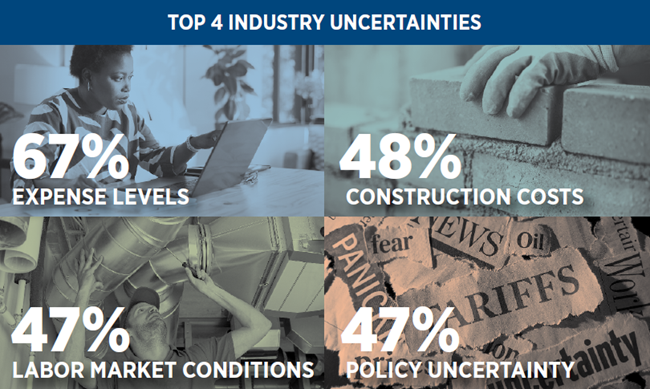
The findings reveal these key insights about the top four industry uncertainties facing rental housing.

The top four uncertainties facing the rental housing industry are set out in a new in-depth study by the National Apartment Association

No. 1 – Expense levels

During the past 12 months, expense levels emerged as the most pressing operational challenge, outpacing interest rates and labor issues, with 67% of survey respondents rating rising expenses as a highly significant issue that has affected business operations.

These findings underscore the broad inflationary pressures on line-item costs such as materials, repairs, ongoing maintenance and vendor contracts. Companies are facing increased difficulty in maintaining profitability amid rising baseline operational costs.

No. 2 – Construction costs

Due to consistent labor shortages, supply-chain disruptions, extended project timelines and inflationary pressures, 48% of respondents believe that construction costs are second in severity of the challenges currently facing the industry.

The impact reflects the deep interconnectedness between macroeconomic trends and development feasibility.

No. 3 – Labor-market conditions

In the survey, 47% of respondents believe that labor-market conditions are highly significant, as operators have faced challenges finding skilled talent despite increased employment growth. Interest rates are a key concern, with 45% of respondents rating them as highly significant.

This indicates that while interest rates remain a central pressure point, staffing constraints and regulatory ambiguity are weighing more heavily on business operators.

No. 4 – Policy uncertainty

Policy uncertainties, including active and proposed tariffs, federal funding volatility, and shifting regulatory reforms at the state and local levels, continue to weigh heavily on operator decisions.

Here are more survey details from the respondents in the NAA study:

Interest rate shifts

The impact of higher rates is felt nationwide and across the property-value spectrum, affecting both large corporate entities and individual rental owners and operators. Interview participants highlighted several headwinds stemming from higher interest rates, including delayed acquisitions and a pause on new development projects.

The top four uncertainties facing the rental housing industry are set out in a new in-depth study by the National Apartment Association

Construction costs

There is a clear divide between those actively adapting to construction-cost pressures and those deferring action because of uncertainty or strategic misalignment.

Among active respondents, strategies span from contract renegotiation and value engineering to delayed execution and internal planning.

Those who remain inactive often do so intentionally, with valid operational or investment priorities elsewhere. As cost pressures persist, more firms may shift from passive observation to active preparation.

Labor-market challenges

Changes in the labor market over the past year have affected apartment owners and operators. Despite continued employment growth, companies emphasize that finding skilled talent remains both a priority and a challenge.

The survey results indicated that labor-supply challenges pose a greater threat to multifamily housing operations than wage increases. Sixty percent of survey respondents identified labor shortages as more disruptive than rising compensation costs. The inability to secure reliable, skilled labor – particularly in maintenance, repairs and other front-line roles – is straining operational capacity and elevating turnover risks.

Centralization

Centralization was not broadly perceived as a major disruptive force to operations in the current market environment. Only 11% of respondents rated it as a highly significant challenge. This suggests that while many firms are pursuing centralization for strategic efficiency or experimenting with centralized models, it has not created widespread operational friction in the rental housing industry.

Single-family versus multifamily

The responses revealed a varied and shifting landscape. Some industry professionals focus only on multifamily buildings, while others manage only single-family properties. And some larger firms own and manage a combination of both. The interviews highlighted a growing demand for both types of rentals with a renewed focus on affordability.

The top four uncertainties facing the rental housing industry are set out in a new in-depth study by the National Apartment Association

Revenue impact

For many professionals, rent growth has been moderate over the past year. In some cases, companies are resorting to concessions or rent reductions to either retain or attract renters. Respondents emphasized the importance of having strong rent-collection systems in place, including automation strategies.

Looking ahead, operators identified regulatory changes and pricing limitations as the biggest looming threats to their revenue strategy. Sixty-eight percent saw regulatory uncertainty as a moderate to severe risk, while 73% identified pricing limitations (e.g. rent control, market caps) as a major threat.

Fraud and bad debt in the rental housing industry

Fraud and bad debt have become more than routine nuisances; they are now recognized as persistent operational threats. Industry participants in NAA’s interview panel stated that fraud and bad debt are both rising concerns and challenges, especially with the technological advances of artificial intelligence.

On the fraud side, concerns are focused on the application process, where fake income documents, identification forms, credit history and other documents are much easier to create with AI.

About the survey:

The NAA study and survey about uncertainties facing rental housing, sponsored by MRI Software and conducted by the NAA, approached the research study with a two-pronged methodology. One prong involved fielding a survey of senior-level real estate professionals, collecting insights and information from more than 350 respondents across the industry.  The other prong consisted of a series of in-depth interviews with C-suite and Independent Rental Owners (IRO) to uncover deeper concerns and provide more detail about the ways in which the industry is responding to current challenges.

The top four uncertainties facing the rental housing industry are set out in a new in-depth study by the National Apartment Association (NAA)

Read the full in-depth report here

Sign Up For Our Weekly Newsletter And Get Rental Property And Apartment News And Helpful, Useful Content Each Week.

* indicates required