Home Blog Page 12

Multifamily Pet Management Technology Solution

Multifamily Pet Management Technology Solution

As property operators confront rising costs and mounting pressure to increase revenue, addressing the gaps in pet management and pet policies has become critical, according to a release from Foxen.

With pet ownership among renters climbing to 58% and pet-friendly properties in high demand, property managers are strained by fragmented systems that disrupt the rental application process and increase liability risks.

Foxen’s multifamily pet-management tool centralizes pet and animal data, giving staff an frictionless way to process pet applications and animal-related reasonable-accommodation requests while maximizing profit recovery, the company’s release says.

Foxen has launched PetClear, a technology-based solution to streamline pet management for property owners and operators.

Industry data reveals that renters with pets generate 10–15% more property damage on average than do tenants without pets, while inconsistent pet-policy enforcement costs operators millions in unreported pet fees and increased liability exposure. However, other research disputes the statement that pets cause more property damage.

“Our recent industry research shows that more than 70% of property-management professionals struggle to enforce pet policies. At the same time, 90% of property-management professionals report an increase in the frequency of emotional-support animals, with misrepresentation issues in some cases,” said Kevin Jacobson, CEO of Foxen, in the release. The company hopes to be the go-to platform for today’s competitive rental market.

The platform collects and organizes all documents for accommodation requests, making the process simple for residents and efficient for staff. It also helps properties recapture lost pet rent and fees; for example, 100 reported pets in a portfolio charging $25/month adds $30,000 in annual revenue, showing how better compliance delivers real financial gains.

Developed through extensive collaboration with property-management teams, PetClear addresses both sides of the pet management equation.

Key platform benefits include:

  • Improved leasing performance: Automated applicant reminders and property-management software integration means complete pet data is centralized in one place, eliminating time spent on manual follow-ups while consistently enforcing policies through required resident acknowledgments.
  • Strengthened NOI and reduced risk: Recover missed income from unreported pets, create new verification fee streams, and prevent property damage through systematic verification.
  • Superior user experience: Provide residents a pet-friendly and safe community with a convenient resident-management portal that protects private data while reducing vendor bloat.

“Customers asked for a solution that integrates seamlessly with existing operations and removes the guesswork from pet management,” Jacobsen said in the release. He said the product “helps properties increase revenue while also improving resident experience for owners of pets and assistance animals alike.”

About the author:
Foxen is a provider of solutions that mitigate risk and build financial wellness for multifamily property owners, operators and their residents.

Sign Up For Our Weekly Newsletter And Get Rental Property And Apartment News And Helpful, Useful Content Each Week.

* indicates required

Pets and Housing: Pet Owning Renters Face Barriers Despite “Pet-Friendly” Ads

Late Rent Payments Climb as Finances Weigh on Renters

On-time rent payments have declined and late rent payments have climbed as finances weigh on renters and U.S. economic growth slows

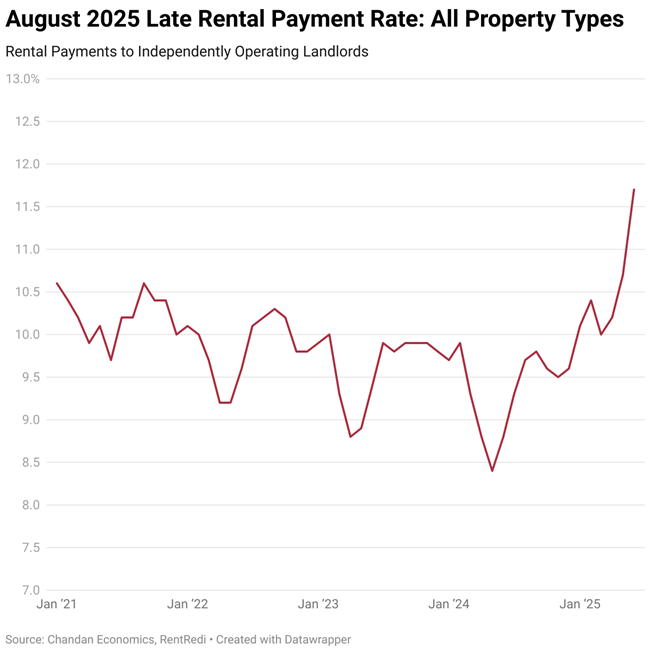
On-time rent payments by apartment renters have been on the decline since April 2023, illustrating the financial strains facing many renter households as late rent payments climb and U.S. economic growth slows, according to a new report from  Chandan Economics powered by RentRedi data.

While August 2025 payments showed some improvement, on-time rent payments are down substantially from a year ago.

Highlights of the late-rent-payments report:

  • On-time rent payments have declined steadily since April 2023, reflecting mounting financial stress on renters.
  • Full rent collections remain steadier, but more renters are paying late—late payments in independently owned rentals rose from 8.8% in mid-2024 to 11.7% in June 2025.
  • Seasonal patterns are shifting: Typically, late payments ease in spring tax-refund season, but not this year—suggesting deeper cash flow misalignment.
  • Slower wage growth and rising debt burdens are pressuring renters, though stable employment has helped many eventually catch up.
  • Looking ahead, household debt and interest payments pose the biggest risks to renters’ ability to stay current.

“The growing share of apartment renters playing catch-up on their monthly bills may speak to a broader undercurrent of distress,” the report says.

“The seasonality of late rent payments in recent years suggests that renters in mom-and-pop properties are sensitive to modest changes in monthly cashflow.

“Late-rent-payments have tended to drop off in the spring, lining up with when most households receive their tax refunds. However, a sustained recent surge in late rent payments this year without the normal springtime improvement may indicate a structural misalignment of household cash flows, with a growing share of tenants relying on mid-month income to pay off overdue rent,” the report says.

Compared to the early pandemic years, the income constraints felt by renters today are not as acute — nor are they as destabilizing to landlord incomes. Although wages have slowed, layoffs are not accelerating significantly, helping explain why many renters are eventually meeting their rent obligations even if it’s taking longer to get there.

“Looking ahead, rising household debt and interest payments pose the most obvious risk to renters’ ability to keep up,” the report says.

Read the full report here.

Sign Up For Our Weekly Newsletter And Get Rental Property And Apartment News And Helpful, Useful Content Each Week.

* indicates required

Weather Tracker Mobile Maintenance App Helps Property Management

How a weather tracker mobile maintenance app can help property management present greater details when responding to residents

How a weather tracker mobile maintenance app can help property management present greater details when responding to residents, filing insurance claims, or any other risk management situations.

By Paul Bergeron

Apartment residents often blame a management company for damage or injuries caused by inclement weather, which can lead to lawsuits and accusatory conflict.

American Landmark, which manages 35,000 apartment homes, is better prepared for such incidents, including complaints about HVAC issues or flooding, because it is now tracking precise weather conditions through its mobile maintenance app.

This enables the maintenance technician, property management, and the corporate office to present greater details when responding to residents, filing insurance claims, or any other risk management situations.

Rachel Palmer, chief administrative officer of American Landmark, noted that the field for capturing weather conditions using the AppWork maintenance platform represents a breakthrough in capabilities.

“Having precise weather data tied to a specific location and time provides tremendous value in risk management,” Palmer said. “For example, when evaluating property damage, it allows us to clearly distinguish between losses caused by natural events—such as heavy rain or high winds—and those resulting from maintenance issues.

“This level of detail is also important to insurers, as it creates an objective record. Without it, residents may assume damage stems from negligence, when in fact it can often be traced back to documented weather conditions.”

The app records the weather conditions and temperature as the maintenance technicians move through the work-order and incident-reporting process.

“It’s not the weather in a city or a neighborhood, but the exact location that is recorded with latitude and longitude coordinates,” Palmer said.

“Detailed weather records also provide important context in liability cases. For instance, if a resident were to slip on stairs, accurate data showing that it was raining at the time helps clarify the role of environmental conditions. This allows us to present an objective picture, rather than relying solely on assumptions about property conditions or footwear.”

The app also allows her on-site team to send alerts about the current conditions or when bad weather is on the way.

“It’s important to encourage personal accountability while also providing residents with clear, timely information. Tools like this allow us to document notifications and demonstrate that we’ve communicated relevant conditions. If a dispute arises, we can show that residents were informed, creating transparency and fairness for everyone involved.”

Paul Rhodes, founder of Directional Maintenance, told GlobeSt.com that a correlation between providing maintenance service and the environmental conditions outside could have an impact of varying sizes.

“On the smaller size, impacting one resident, it could standardize emergency response to the ‘my HVAC system is broken,’ during comfortable outdoor temperatures,” Rhodes said.

“A larger impact could trigger roof or outdoor inspections after a hurricane, and parking area drain and gutter inspections after a certain quantity of rain,” he said. “Automations could be set to create service requests based on forecasting.”

He gave the example of being able to remove pool furniture, adjust irrigation timers, and make other appropriate preparations before a storm. More precisely, a system can automatically alert the team to perform coil-cleaning service requests after sandstorms and foundation inspections after earthquakes.

“Additionally, documenting the outside humidity would be helpful during the remediation process in aiding the proper response to liability concerns.”

American Landmark’s 48-hour guarantee

Landmark offers a Landmark 360 promise to its residents that states it will respond to their work orders within 48 hours – guaranteed.

Last year, it did 242,000 work orders across 110 properties, among the 35,000 apartment homes it manages. Work orders, on average, were completed in 1.4 days.

The property=management company also uses these performance metrics as part of its maintenance teams’ incentive program. By linking measurable outcomes—such as timely repairs and effective issue resolution—to bonuses, the system encourages accountability and helps ensure residents receive a higher standard of service.

The AppWork maintenance system includes a unique feature that can automatically “stop the clock” on work orders when outside vendors or additional parts are needed. This ensures that response times are measured fairly and that maintenance teams’ key performance indicators reflect only the work within their direct control.

For example, if a technician begins a repair but needs to pause to request a part, the system stops the timer. This provides a more accurate picture of the actual labor time required, promoting both fairness and accountability.

“The tool’s advanced search function also makes it easy to track specific issues—such as rain-related incidents, stairway concerns, or other types of damage. This allows us to quickly monitor work-order progress and confirm when repairs have been completed, improving both efficiency and accountability,” Palmer said.

About the author:

Paul Bergeron is a freelance writer and reporter.

Sign Up For Our Weekly Newsletter And Get Rental Property And Apartment News And Helpful, Useful Content Each Week.

* indicates required

Two Years of Declining Rents Have Renters Ready to Move

Two years of declining rents have renters ready to move for many renters to gain space, save money or explore a new area,

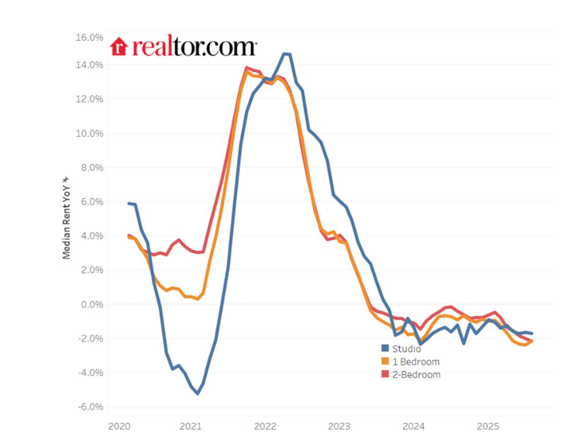
More than two years of declining rents are sparking moving plans for many renters to gain space, save money or explore a new area, according to a new report from Realtor.com.

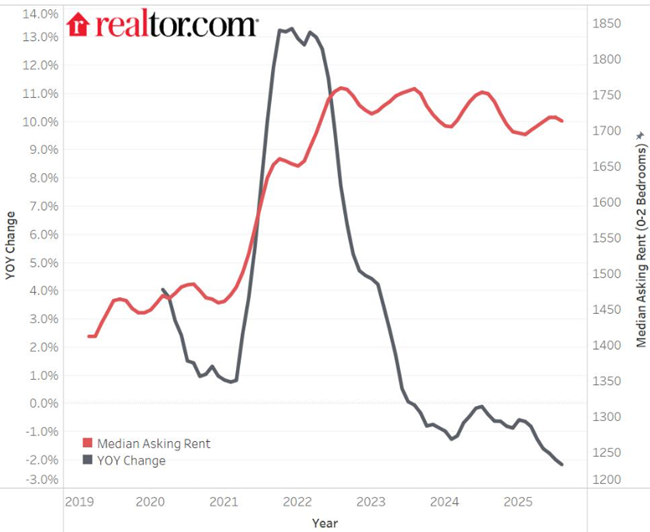
Rent prices fell year over year for the 25th consecutive month in August, while also registering the first month-over-month drop since March 2025, signaling the expected seasonal slowdown heading into the fall.

“Rental declines across the majority of markets in various-sized homes are providing new options for renters, who have been squeezed by significant increases since the pandemic,” said Danielle Hale, chief economist at realtor.com, in a release.

“As rents remain significantly higher than pre-pandemic levels, our Site Visitor Survey shows that the search for a more affordable home remains one of the top reasons to move across all age groups. This is likely a reason why we’re starting to see a modest uptick in renter mobility.”

Rents Decline Again, but Nationwide Rent Is 2.6% Below 2022 Peak

Rents Decline Again, but Nationwide Rent Is 2.6% Below 2022 Peak

Rent Prices Dropping Across All Unit Sizes

Median rent declined across units in all size categories examined by realtor.com. Studio rents dropped to $1,430 per month, down $25 (-1.7%) year over year; 1-bedrooms fell to $1,593, down $35 (-2.1%) year over year; and 2-bedrooms, which experienced the highest growth rate over the past six years, registered the largest declines, landing at $1,897, down $42 (-2.2%) year over year.

Why Renters Are Ready to Move

With rents easing, more renters are exploring a move.

When rents rose in 2021–2022, nearly 80% of renters stayed put, with mobility around 20.8%. Census data shows renter mobility edged up in 2023 (21.5%) and continued to rise in 2024 (21.6%).

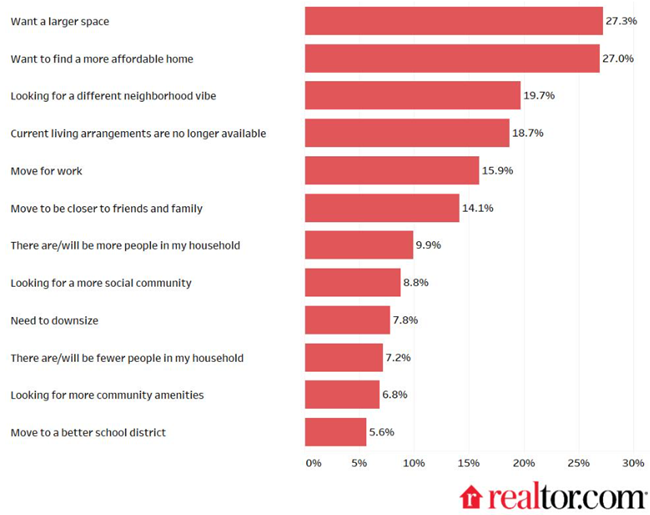
Data from the realtor.com Site Visitor Survey reveals renters are most often considering a move to gain more space, find a more affordable home, or try out a new neighborhood.

Markets with the largest rental price declines from their peaks, including Las Vegas (-13.6%), Atlanta (-13.6%), and Austin, Texas (-13.4%) in particular, are creating pockets of opportunity for renters looking to make a move.

Reasons for mobility vary by age, with younger and older renters more likely to move for affordability reasons, while middle-aged renters may be looking for more space to accommodate a growing family.

“Renters focused on affordability are often willing to make compromises, like choosing a longer commute, fewer amenities or fewer on-site services,” said Jiayi Xu, economist at realtor.com, in the release.

“It shows that many households are carefully weighing costs against lifestyle, making tradeoffs to find a home that better fits their budget.”

Why are you moving into a new rental home? 

Why are you moving into a new rental home?

Renters Remain Hopeful About Ownership, But Barriers Persist


Even as the average age of home buyers reached an all-time high of 38 in 2024 and many renters remain priced out of buying, optimism about ownership is strong.

Nearly 60% of renters surveyed said they plan to buy a home, and of those, more than half expect to do so within the next one to two years. At the same time, barriers such as saving for a down payment, limited affordable inventory, and credit constraints remain the top reasons people continue to rent.

Read the full report here.

Sign Up For Our Weekly Newsletter And Get Rental Property And Apartment News And Helpful, Useful Content Each Week.

* indicates required

Fair-Housing Mythbusters: ESA Denial, from Apartments to Dorms

An ESA myth housing providers have that in certain situations they can deny an emotional support -most scenarios are rooted in myth not law.

A misconception many housing providers face is the belief that certain situations justify denying an emotional support animal (ESA) request and most of these scenarios are rooted in myth rather than law.

By the Fair Housing Institute

Emotional support animals (ESAs) remain one of the most misunderstood areas of fair-housing compliance.

While property managers and housing providers often encounter resident concerns about animals, the Fair Housing Act sets clear boundaries. When a resident or student has a verified disability and a legitimate need for an ESA, housing providers must make reasonable accommodations.

This applies across the board, whether the setting is a college dormitory or a multifamily apartment complex.

The biggest misconception many housing providers face is the belief that certain situations justify denying an ESA request. In reality, most of these scenarios are rooted in myth rather than law.

Myth 1: Certain Breeds Can Be Banned

One of the most common concerns surrounds specific dog breeds, particularly pit bulls. Community fears often lead housing providers to believe they can deny an ESA based on breed restrictions.

However, the Fair Housing Act does not allow this.

What providers can and should do is ensure they carry adequate liability insurance that covers any potential incident involving animals on their property. What they cannot do is shift that responsibility onto the resident or deny an ESA solely because of breed.

Myth 2: College Housing Is Exempt

Another frequent misconception is that ESAs do not apply to college or university housing. Because dormitories operate differently from standard rental housing, some providers assume they are exempt from ESA requirements.

In truth, student housing falls under the same legal framework as other housing providers. If a student presents proper documentation verifying a disability and the need for an ESA, the institution must accommodate them. Denial based on housing type is a clear violation of the Fair Housing Act.

Myth 3: ESAs Must Be Hypoallergenic

Concerns about allergies often surface when an ESA request is made. Some housing providers may think they can deny an animal because it is not hypoallergenic.

Generally, this is not a valid reason for denial. Only in rare cases, such as communal living arrangements where another resident’s medical needs are directly at stake, might this factor be considered. Even then, careful evaluation is required to ensure compliance with fair-housing standards.

Myth 4: Multiple ESAs Are Not Allowed

Another area of confusion is the number of ESAs a resident is allowed to have. Some providers believe there is a limit, or that multiple animals are automatically unreasonable.

The truth is that each request must be evaluated on an individual basis.

If a resident can demonstrate medical documentation supporting the need for more than one animal, the request should be processed accordingly. Past acceptance of the animals or long-term residency also plays a role in evaluating the request fairly.

Myth 5: Late Disclosure Justifies Denial

A final misconception arises when residents disclose their ESA needs after moving in or after being approved for housing. Providers sometimes view this as dishonest and believe they can deny the request.

While late disclosure is not ideal, it does not invalidate the resident’s rights.

Housing providers must still process the request through the reasonable-accommodation process. Maintaining professionalism and consistency is essential in these situations to avoid the appearance of retaliation or discrimination.

Building Confidence Through Compliance

The key to addressing ESA-related concerns is not to rely on assumptions but to return to the principles of fair-housing law.

Denials based on myths or misunderstandings can quickly escalate into complaints or legal action.

For example, some residents may purchase ESA letters online to back up requests tied to these myths, such as breed restrictions, hypoallergenic requirements, or multiple animals. These letters can be misleading, and they often complicate the verification process for housing providers.

The best way forward is through training, consistency, and careful evaluation of each request.

By separating fact from fiction and staying alert to new challenges like online ESA letters, housing providers can protect themselves from costly mistakes while fostering trust and fairness in their communities.

Compliance is not just about following the law; it’s about creating housing environments where residents feel supported and respected.

About the author:

In 2005, The Fair Housing Institute was founded as a company with one goal: to provide educational and entertaining fair-housing compliance training at an affordable price at the click of a button.

Sign Up For Our Weekly Newsletter And Get Rental Property And Apartment News And Helpful, Useful Content Each Week.

* indicates required

August Rent Growth Flat in Summer Slowdown

Multifamily rent growth was flat nationally in August as demand kept up with supply, according to Yardi Matrix August report

Multifamily rent growth was flat nationally in August as demand kept up with supply, according to market research company Yardi Matrix.

“Rent growth is expected to remain lackluster through year-end. Momentum is slowing across most metros, as only a few markets recorded more than 3% year-over-year growth,” according to the monthly report.

The slowdown in rents is primarily driven by too much supply rather than demand for rentals.

“However, supply pressures are beginning to ease, with most metros past their peak supply and new starts declining sharply due to the cost of construction and tighter financing,” the report says.

Highlights of the report:

  • Multifamily rents changed little in August due to seasonality and rising uncertainty about consumers’ financial health. The average U.S. advertised rent fell $1 to $1,755 in August while year-over-year growth fell 10 basis points to 0.7%.
  • After two years of extraordinary gains following the pandemic, rents nationally have settled into a slow-growth pattern over the last three years in which increases are moderate and mostly limited to the spring. If the pattern holds, rents will change little in coming months.
  • Single-family build-to-rent advertised rates were unchanged in August, but stood at a record high of $2,208. Rent growth is at least 5% year-over-year in Chicago, Kansas City, Twin Cities and Columbus and negative in high-supply markets including Austin, Tampa, Raleigh and Denver.
  • Consumer budgets are tightening due to rising costs and the softening job market.

Interest rates and labor market

Possible interest rate cuts by the Federal Reserve are not likely to be enough to turn around the home-sale market.

“As a result, many prospective buyers will remain renters, supporting multifamily demand,” the report says.

Price increases may happen in coming months as they are filtered through supply chains and distribution networks. While layoffs remain muted, the labor market remains delicate.

Governments Are Trying to Help

  • The growth in housing costs in recent years has spurred legislators at all levels of government to act to create more housing supply.
  • Hundreds of pro-housing bills have been introduced in states this year, dozens of which are now law in states such as California, Texas and Michigan.
  • While the legislative efforts are a positive start, they come at a time when apartment starts are dropping and the impact could be years away.

Read the full report from Yardi Matrix here.

Sign Up For Our Weekly Newsletter And Get Rental Property And Apartment News And Helpful, Useful Content Each Week.

* indicates required

Trouble Finding Tenants Who Can Pass HOA Screening

How to find tenants who can pass the HOA Screening and requirements is the question this week for a condo owner with a lease up

How to find tenants who can pass the HOA Screening and requirements is the question this week for Ask Landlord Hank. Remember Hank is not an attorney and he is not offering legal advice. If you have a question for him please fill out the form below.

Hi Hank,

Our condo will be going up for lease probably on November 1st or December 1st.

We have managed the leasing ourselves for the past couple of tenants and are now considering using an agency.

One concern for us has been that the pool of people responding to our ads for the condo have been people who could not pass the screening in our HOA.

Can you tell me where you advertise properties and how you screen potential tenants?

-Camela

Dear Landlady Camela,

The most important part of the landlord/property-management business plan is to find a good quality tenant.

It sounds like you are doing an excellent job of screening tenants for your place if you know they wouldn’t pass the HOA requirements.

My requirements for a good quality tenant are someone with good credit, who makes at least three times the rent, has a clean background, has good rental history for the last 5 years, is not a sex offender/predator and not on any terror watch list.

This is strictly business, so I don’t mind turning folks down that don’t fit minimum requirements.

We advertise on MLS, our website, Zillow, Trulia, Realtor.com, Hotpads, Facebook, and about 40 other websites you never heard of like Padmapper, Apartments.com and Rental Beast, etc.

The market is very slow now in this area of Florida due to all the inventory in apartments and decreased migration to this area. Be selective; it may take time, but it’s worth it for the right tenant.

Sincerely,

Hank Rossi
Each week I answer questions from landlords and property managers across the country in my “Dear Landlord Hank” blog in the digital magazine Rental Housing Journal. www.rentsrq.com   https://rentalhousingjournal.com/asklandlordhank/

Ask Landlord Hank Your Question

Ask veteran landlord and property manager Hank Rossi your questions from tenant screening to leases to pets and more! He provides answers each week to landlords.

  • This field is for validation purposes and should be left unchanged.

How to find tenants who can pass the HOA Screening and requirements is the question this week for a condo owner with a lease up.
Landlord Hank Rossi says, “My requirements for a good quality tenant are someone with good credit, who makes at least three times the rent, has a clean background, has good rental history for the last 5 years, is not a sex offender/predator and not on any terror watch list.”

Can I Get Tenant’s Inoperable Car Towed Off My Rental Property?

How To Handle Ugly Feud Between Two Sets of Tenants?

Tenants Pouring Grease Down Sink And Flushing Paper Towels

Do You Know The 5 Questions Landlord Hank Asks Tenants When They Call?

Sign Up For Our Newsletter And Get Rental Property News And Helpful, Useful Content Each Week.

* indicates required

Photo credit AndreyPopov via istockimages

Rentana, Orion Partnership Shows Operators How To Outperform Market Downturns

Rentana, Orion partnership shows multifamily operators how to outperform market downturns and off-peak seasons to protect revenue

With seasonal leasing lulls approaching, multifamily leaders are seeking smarter ways to outperform market downturns and protect revenue while keeping teams lean, according to a release from Rentana.

Rentana, an AI-powered revenue intelligence platform that helps owners and operators turn slowdowns into growth opportunities, has announced a partnership with Orion Real Estate Partners, a tech-forward investment firm.

“Orion worked through a manual, time-consuming pricing process that was seeing rent decline by 3.5%. Digging through multiple systems and reports to assess pricing was inefficient and proving unsuccessful. Orion needed a way to boost efficiency and portfolio performance without adding headcount,” according to a release.

After evaluating the revenue management landscape, Orion chose Rentana for its real-time, personalized insights delivered through an intuitive, privacy-first platform. Within just five months, Orion achieved measurable results:

  • Return on Investment: 350% within 5 months
  • Faster Pricing Reviews: slashed 6x – from 1 hour to 10 minutes per property per day, leaving more time to find other operational opportunities
  • Accelerating Occupancy: increased by 2% enabling greater pricing power

“With Rentana, we’ve elevated our decision-making to a new level,” Mark Limpert, Principal at Orion Real Estate Partners, said in the release.

“The platform delivers intelligence and efficiency that allows us to stay ahead of market shifts and focus on driving results across our portfolio.”

Rentana combines public market data with proprietary portfolio insights to deliver real-time, actionable recommendations. Its AI-powered intelligence allows teams to anticipate market shifts, streamline renewals, and proactively set pricing before seasonal slowdown hits.

“Leasing lulls don’t have to mean lost revenue,” Julie Blanc, CEO and Co-Founder of Rentana said in the release. “Rentana gives teams personalized and immediate intelligence to move faster, scale smarter, and outperform peers, even in challenging markets.”

Earlier this year, Rentana helped 29th Street Capital drive a $4.6 million valuation boost in just 90 days, outperforming a competing system from an established industry veteran.

About Rentana:

Rentana is an AI-powered revenue intelligence platform purpose-built for multifamily owners and operators. Founded by alumni of Stripe, Airtable, and Airbnb, Rentana helps institutional real estate teams optimize revenue with real-time insights, smart pricing recommendations, and operational tools designed for modern markets. Book a demo at rentana.io/demo

Sign Up For Our Weekly Newsletter And Get Rental Property And Apartment News And Helpful, Useful Content Each Week.

* indicates required

Landlord Says Agents Broke Into Her Building, Took 6 Tenants

Landlord Says Agents Broke Into Her Building, Took 6 Tenants

A Chicago landlord says U.S. Immigrations and Customs Enforcement (ICE) agents wearing vests that said “Police” broke into her building late at night and took six of her tenants, according to news reports.

Landlord and property owner Arminda Castelin told CBS, “My tenant called me very scared. He said that, ‘Police are trying to break into our house.’ ”

Castelin said when she came in on Monday, the doors were broken and the tenants were gone.

Castelin said six people — mostly fathers and husbands — were detained. She said some of her doors were broken, and her building is almost completely empty after the rest of the tenants fled in fear. She said a mother and a baby remained in one apartment, trying to figure out the next steps after the father was taken.

Castelin said she thought the agents were police officers, since that is what their vests said.

ICE Agents Seek Tenant Info, Calling It ‘Welfare Check’

“They (tenants) say police, but they don’t even know what kind of people it is,” she said. “They are just terrorized right now.”

Castelin said she looked at her tenants’ IDs and documents before they signed leases to make sure they were legal residents.

“It’s just so sad, you know?” she said. “They keep calling me, and I’m just trying to help them.”

CBS News Chicago reached out to legal analyst Irv Miller to see if ICE agents can wear police vests. Miller said there is no law or regulation saying they cannot.

Sign Up For Our Weekly Newsletter And Get Rental Property And Apartment News And Helpful, Useful Content Each Week.

* indicates required

August Rent Growth Flat in Summer Slowdown

Accidental Landlords Growing as Home Sellers Delist Properties

The Consumer Review Fairness Act and Its Marketplace Impact

Photo credit via istockimages

Unraveling The Mystery Of 1031 Exchanges

Unraveling the mystery of 1031 exchanges and some exceptions for the taxpayer and rules on the same taxpayer.

Unraveling the mystery of 1031 exchanges and some exceptions for the taxpayer and rules on the same taxpayer.

By William L. Exeter
Exeter Trust Company

In a 1031 exchange transaction, it is often said that legal title to the real estate being sold (i.e., the relinquished property) and the real estate being purchased (i.e., the replacement property) must be held under the exact same legal title.

This is a common misconception.  Although it is generally recommended to hold legal title to properties in a 1031 exchange under the exact same legal title, there are exceptions where legal title is not required to be identical.

Same Taxpayer Requirement

The actual requirement is that the ownership (i.e., the taxpayer) of the relinquished and replacement properties in a 1031 exchange must be held by the “same taxpayer” regardless of how legal title is held. The same taxpayer must sell the relinquished properties and buy the replacement properties.

This same taxpayer requirement is an implicit requirement that is not specifically mentioned in the Internal Revenue Code or Treasury Regulations.  Legal title may vary from the sale of the relinquished property to the purchase of the replacement property if the property ownership continues to be held by the exact same taxpayer.

This is one of many reasons why investors should discuss their proposed 1031 exchange with their legal, tax and financial advisors before proceeding with their transaction.

Exceptions – Disregarded Entities

There are several ways an investor can acquire and hold legal title to real estate while still meeting the same taxpayer requirement.  Generally, this is achieved by using a disregarded entity.  Disregarded entities are entities that are ignored for Federal tax purposes (i.e., they do not file a Federal Tax Return) and are treated as if the underlying investor is the actual taxpayer.

The following are individuals or disregarded entities that will be treated as if the properties were owned or held by the same taxpayer:

  • Individual name
  • Single-member limited liability company (LLC) that has not elected partnership or corporation treatment for Federal tax purposes (i.e., it is a disregarded entity)
  • Fully revocable grantor trust (e.g., living trust)
  • Title holding trust (land trust) [Revenue Ruling 92-105]
  • Tenant-in-common (TIC) ownership structure [Revenue Procedure 2002-22]
  • Delaware statutory trust (DST) [Revenue Ruling 2004-86]

Examples Using Disregarded Entities

Lenders often require legal title of the replacement property to be held in a specific way for them to complete the financing.  Many lenders do not allow legal title to be held in a trust or a LLC, while other lenders may require legal title to be held in an LLC.

For instance, an investor may hold legal title to his or her relinquished property in an LLC, but the lender may insist legal title to the replacement property be held in the investor’s individual name to complete the financing. This will meet the same taxpayer requirement if the LLC is a single-member LLC and disregarded entity for Federal tax purposes. The LLC is ignored and treated as if the underlying individual is the owner for Federal tax purposes and therefore considered to be the same taxpayer.

Similarly, an investor may hold legal title to his or her relinquished property in a fully revocable grantor trust (i.e., living trust, title holding trust or land trust), but the lender may require legal title to the replacement property be held in the investor’s individual name to complete the financing. This will also meet the same taxpayer requirement if the trust is a disregarded entity for Federal tax purposes.  These trusts are ignored and treated as if the underlying individual is the owner for Federal tax purposes and therefore considered to be the same taxpayer.

Death of Taxpayer During 1031 Exchange

If the taxpayer dies during a 1031 exchange, the Treasury Regulations require the taxpayer’s estate to complete the 1031 exchange transaction to receive tax-deferred exchange treatment. In fact, the taxpayer’s estate must complete the 1031 exchange to receive a step-up in the cost basis.

Non-Disregarded Entities

Entities that are not classified as disregarded entities for Federal income tax purposes (i.e., they are regarded entities), include, but are not limited to:

  • Limited liability companies (LLCs) treated as partnerships or corporations
  • General partnerships
  • Limited partnerships
  • Corporations (both sub-chapter “C” and “S” corporations)
  • Irrevocable trusts

Legal title to the relinquished and replacement properties must generally be held in the exact same legal title (i.e., in the regarded entity name) when the entity is not disregarded for Federal tax purposes.

Legal, Tax and Financial Advisor Review

The requirement to have the same taxpayer vs. the way legal title is held is very complex. It is crucial for investors to have their legal, tax, and financial advisors examine their proposed 1031 exchange to ensure the same taxpayer requirement is met. If the taxpayer is not deemed to be the same, the 1031 exchange could be disallowed.

Ask Bill Exeter

Ask Bill Exeter and his team your questions about 1031 exchanges and he and his team will get back to you.

Name

About the author:

Unraveling the mystery of 1031 exchanges and some exceptions for the taxpayer and rules on the same taxpayer.

William L. Exeter is Chief Executive Officer Exeter 1031 Exchange Services, LLC Exeter Trust Company. Mr. Exeter is one of the founders of The Exeter Group of Companies and has been with the company since its inception in 2004. He is based in The Exeter Group of Companies’ national corporate headquarters office in San Diego, California. He also serves as an industry consultant, advisor, trainer, instructor, and expert witness.

Sign Up For Our Weekly Newsletter And Get Rental Property And Apartment News And Helpful, Useful Content Each Week.

* indicates required