Home Blog Page 11

Salt Lake City Rents Up In September

September Rents in Salt Lake City

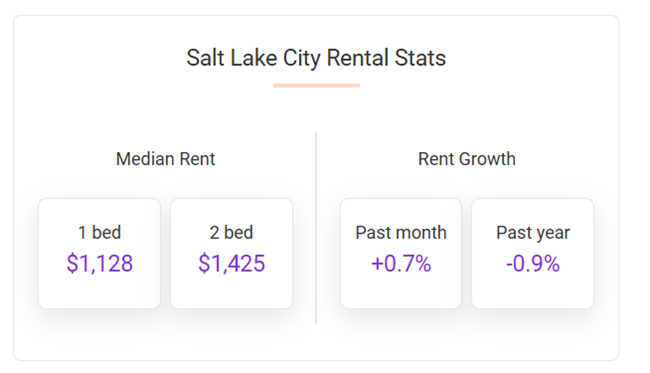
Salt Lake City rents rose 0.7% in September according to the October report from Apartment List.

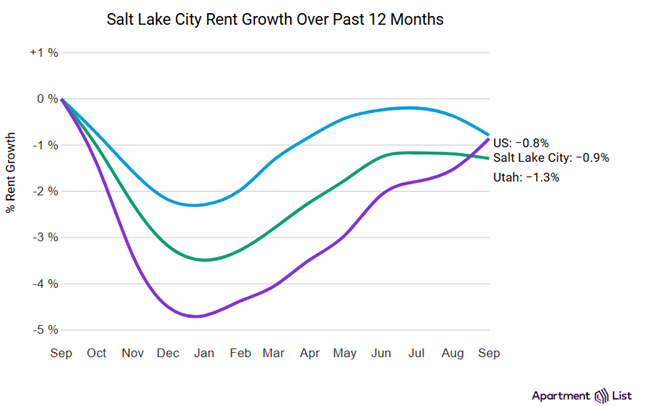
However, prices remain down 0.9% year-over-year. Salt Lake City’s rent growth over the past year has is similar to both the state (-1.3%) and national averages (-0.8%).

Currently the overall median rent in the city stands at $1,303.

Salt Lake City rent growth in 2025 pacing above last year

Nine months into the year, rents in Salt Lake City have risen 4.0%.

This is a faster rate of growth compared to what the city was experiencing at this point last year: from January to September 2024 rents had decreased 0.1%.

Utah rents over past 12 months

Salt Lake City rents are 11.8% lower than the metro-wide median

Across the Salt Lake City metro area, the median rent is $1,477 meaning that the median price in Salt Lake City proper ($1,303) is 11.8% lower than the price across the metro as a whole. Metro-wide annual rent growth stands at -1.2%, below the rate of rent growth within just the city.

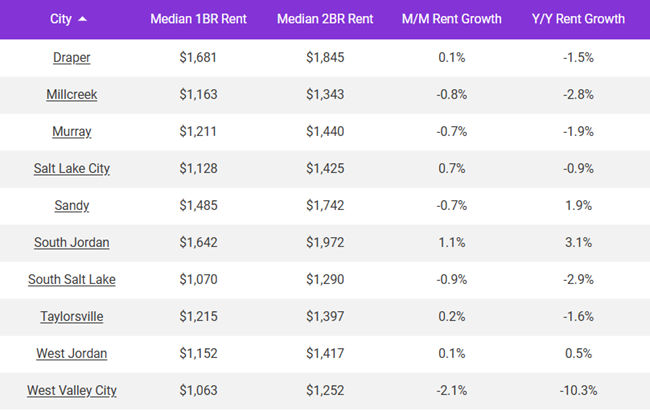
The table below shows the latest rent stats for 10 cities in the Salt Lake City metro area that are included in the Apartment List database.

Among them, Draper is currently the most expensive, with a median rent of $1,901. South Salt Lake is the metro’s most affordable city, with a median rent of $1,225. The metro’s fastest annual rent growth is occurring in South Jordan (3.1%) while the slowest is in West Valley City (-10.3%).

September rents in the suburbs

New Salt Lake City Renters Coming From Provo

Rethinking Pet Fees: Finding Fairness for Renters And Housing Providers

Landlords Not Enforcing Renters’ Insurance Requirements

National Rent Dip Continues In September

The national median rent dipped by 0.4 percent in September, marking the second straight monthly decline as rental market enters slow season

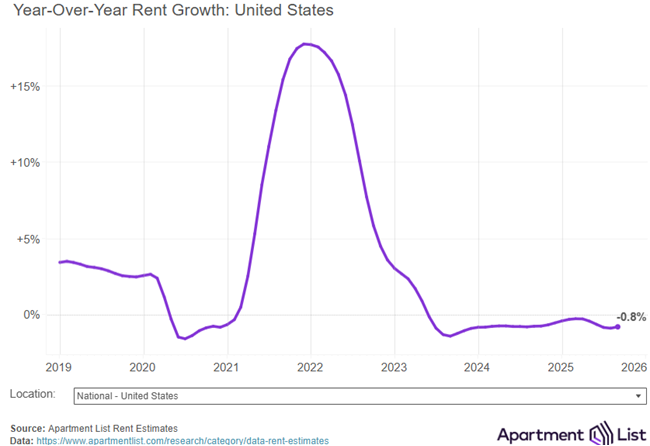
The national median rent dipped by 0.4 percent in September, marking the second straight monthly decline, according to the October report from Apartment List.

In addition to the September drop, the rental market has now entered the slow season and rent prices are expected to continue to drop through the end of the year.

Fewer renters looking to move as temperatures turn cooler and the holiday season approaches the Apartment List Research Team says.

The national median rent dipped by 0.4 percent in September, marking the second straight monthly decline as rental market enters slow season

Highlights of the October report:

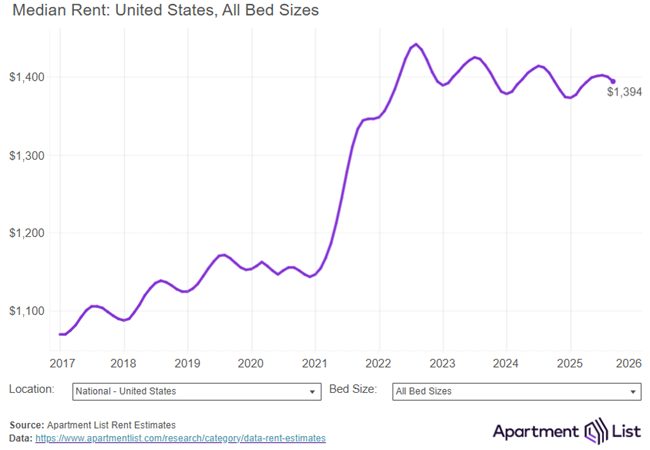
  • The national median rent now stands at $1,394.
  • Rent prices nationally are down 0.8% compared to one year ago.
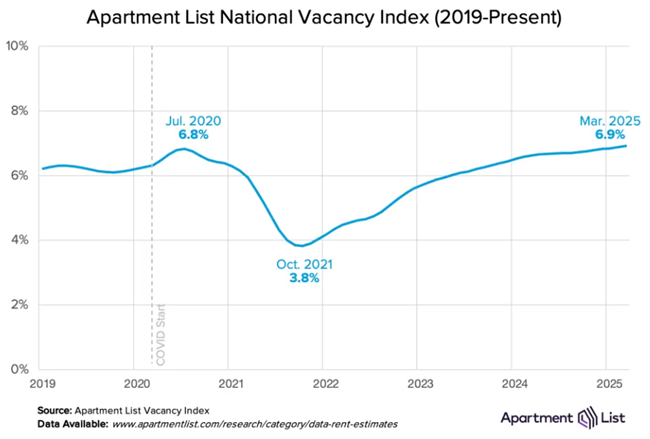
  • The national multifamily vacancy rate now sits at 7.1%, a record high.
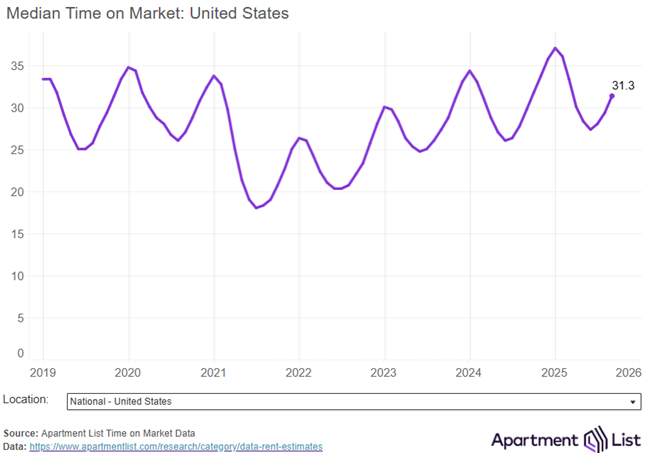
  • Units are taking an average of 31 days to get leased after being listed.

“Monthly rent growth peaked at +0.6 percent in March this year, but it then began to gradually trend down during the peak moving months, when rent growth is normally fastest.

“The flip to negative month-over-month growth also came a bit earlier than what we saw in pre-pandemic years, although this is now the third straight year that prices have begun to dip in August,” the research team writes.

The national median rent dipped by 0.4 percent in September, marking the second straight monthly decline as rental market enters slow season

Multifamily vacancy rate hits 7.1%, a new peak

As more new construction apartment continue to hit the market, more vacant units are sitting on the market, meaning that property owners face more competition for renters and have less pricing leverage.

The Austin metro currently has the softest conditions among the nation’s large rental markets, with the median rent there down by 6.5% over the past year.

The national median rent dipped by 0.4 percent in September, marking the second straight monthly decline as rental market enters slow season

List-to-Lease time ticks up for third straight month

“The increasing list-to-lease time that we’ve seen recently is in line with the transition to negative rent growth as we enter the market’s off-season.

“But in addition to that seasonal trend, units are also sitting a bit longer than they typically do at this time of year, a signal of market softness in line with our rent growth and vacancy estimates,” the Apartment List Research Team writes.

The national median rent dipped by 0.4 percent in September, marking the second straight monthly decline as rental market enters slow season

Conclusion

“All of our key indicators are pointing toward ongoing sluggishness in the multifamily rental market – rent prices are down and the vacancy rate is at an all-time high.

“The outlook has been complicated by a continued influx of new units to the market and a weakening macroeconomic outlook, which could lengthen the time that it takes for the market to metabolize the recent growth in the rental stock,” the research team writes.

Read the full monthly report here.

Sign Up For Our Weekly Newsletter And Get Rental Property And Apartment News And Helpful, Useful Content Each Week.

* indicates required

Where Are Homeowners Who Cannot Sell Becoming Accidental Landlords?

Many homeowners who cannot sell are becoming accidental landlords in areas dominated by institutional investors,

Many homeowners who cannot sell are becoming accidental landlords in areas dominated by institutional investors, according to Parcl Labs, a real estate research company.

The New York Times reports the accidental- landlord trend is accelerating, the researchers found, particularly in markets where large institutional investors — businesses that own more than 1,000 single-family homes — hold a substantial chunk of available properties.

“Since the end of the pandemic, those large investors have flocked to the states lining the bottom of the United States from coast to coast, chasing job and population growth,” the Times writes. “But surging inventory and a declining number of buyers have given rise to a competitive crop of former sellers who are now ‘accidental landlords’.”

Most are individual owners competing with those large institutional investors in the rental market. Six Sun Belt markets — Houston, Dallas, Phoenix, Tampa, Atlanta and Charlotte, N.C. — contain 37 percent of large institutional real estate nationwide, according to Parcl Labs.

Highlights of the Parcl Labs report:

  • Parcl Labs’ data reveals increasing numbers of failed home-sellers shifting into rentals and becoming accidental landlords is up year-over-year in five of six institutional markets, led by Houston (+41.4%) and Dallas (+32.3%).
  • Institutional markets face weakening fundamentals. Surging inventory and declining buyer activity have intensified supply-demand imbalances, led by Charlotte (38.2% YoY inventory growth), Dallas (37.7%), and Atlanta (34.1%).
  • Institutions are responding by reducing exposure and capitalizing on home appreciation gains. Over the past year, large institutions became net sellers nationwide, with 76.7% of their net selling concentrated in those six core markets, led by Atlanta, Dallas, and Houston.

The trend of accidental landlords is one of several signs that the real estate market is becoming increasingly unfriendly to sellers. De-listings increased by 57 percent in July compared with last year, according to an August Realtor.com report, which called 2025 “the least seller-friendly summer since Realtor.com began tracking data in 2016.”

Sign Up For Our Weekly Newsletter And Get Rental Property And Apartment News And Helpful, Useful Content Each Week.

* indicates required

Renter Has Sent Notice of Lease Termination – Now What?

What happens when a renter sends a notice of lease termination is the question this week from a landlord who is wondering what to do now

What happens when a renter sends a notice of lease termination is the question this week for Ask Landlord Hank. Remember Hank is not an attorney and he is not offering legal advice. If you have a question for him please fill out the form below.

Dear Landlord Hank,

My tenants have sent email to formally terminate their lease. As part of the email, they told us that they want reimbursement in an amount of $7,000 for their refrigerator, washer, dryer and televisions, which they said were damaged by the electricity in the house.

They have never notified us of these problems; they replaced the appliances without our knowledge or permission.

Are we legally supposed to reimburse them when they never notified us of these problems? There also deep scratches on the hardwood floor that were not there before. The tenants said  the scratches were normal wear and tear. How do we prove it is not normal wear and tear?

-Cora

Dear Cora,

I hope you have a good lease and an adequate security deposit with these tenants, and that you did a detailed walk-through  inspection of the property before the tenants took occupancy, with lots of photos.

The lease will normally spell out the law in your state for security-deposit refunds and timing.

The deposit is not meant to cover normal wear and tear, which is a normal deterioration of the property over time. It’s the difference between leaving small nail holes in the wall where they hung pictures, but not a big hole from a doorknob hitting a wall or someone hanging a TV from the wall.

Normal wear patterns in a carpet are from walking a path, not from rips, snags, burns or non-cleanable stains. Cabinet doors can be squeaking or loose but not damaged or missing, drains can be slow but not completely plugged up with hair, appliances can be dirty but not damaged due to misuse.

In the case of wood flooring, fading or a worn finish – especially in high-traffic areas – is acceptable, but not scratches, gouges, warping or water-damage from tenant abuse or negligence.

The walk-through inspections at the beginning and end of a lease will document in writing and photos the initial and final condition of the property and is a critical step in this business so you have proof of the condition of the property and the contents.

Per most leases there is a maintenance/inspection clause detailing that tenant shall maintain the premises in good, clean and tenantable condition throughout the tenancy AND shall notify the landlord immediately of any maintenance need or repair in writing.

I would find a good attorney in your area that specializes in landlord/tenant law and have a consultation.

These are the kinds of tenants that make this business challenging at times, but possibly could have been avoided with careful and deep screening up front, before leasing to them.

In the future, try to obtain at least five years of residential history so you know your applicants have taken care of prior properties, paid their rents on time, gave notice, didn’t cause any property damage, and that other owners would re-rent to them. Good luck!

Sincerely,

Hank Rossi

Each week I answer questions from landlords and property managers across the country in my “Dear Landlord Hank” blog in the digital magazine Rental Housing Journal. www.rentsrq.com   https://rentalhousingjournal.com/asklandlordhank/

Ask Landlord Hank Your Question

Ask veteran landlord and property manager Hank Rossi your questions from tenant screening to leases to pets and more! He provides answers each week to landlords.

  • This field is for validation purposes and should be left unchanged.

What happens when a renter sends a notice of lease termination is the question this week from a landlord who is wondering what to do now
Landlord Hank Rossi says, “try to obtain at least five years of residential history so you know your applicants have taken care of prior properties, paid their rents on time, gave notice, didn’t cause any property damage, and that other owners would re-rent to them.”

Editor’s note: Be sure to check the laws and regulations in your city or state on this issue as rules vary across the United States.

Can I Get Tenant’s Inoperable Car Towed Off My Rental Property?

How To Handle Ugly Feud Between Two Sets of Tenants?

Tenants Pouring Grease Down Sink And Flushing Paper Towels

Do You Know The 5 Questions Landlord Hank Asks Tenants When They Call?

Sign Up For Our Newsletter And Get Rental Property News And Helpful, Useful Content Each Week.

* indicates required

Photo credit Andrii Dodonov via istockimages

How Focusing on Client Satisfaction Pays Off

Why a focus on client satisfaction - keeping clients happy- in multifamily can be a key to successful and profitable management.

Why a focus on client satisfaction – keeping clients happy – especially when it comes to maintenance in multifamily can be a key to successful and profitable management.

By Paul Bergeron

The wake-up call came when his property-management company lost two big clients, comprising about 20% of its revenue.

It was an unsteady time at Howzer Property Management. The company, which manages about 1,000 doors, was transitioning its property-management software, and its CEO, Casey Howe, said it lost a sense of purpose.

“Our staff didn’t look forward to coming to work,” Howe told an audience during a session at the MXSummit by Property Meld this month in Rapid City, S.D.

The session, “Customer-Obsessed: The Key to Thriving Property-Maintenance Operations,” spoke to why keeping clients happy is a key to successful and profitable management.

“As an industry, we are good at process, but our focus on making clients happy can be lacking,” Howe said.

Howzer received complaints, including poor communication on maintenance, clients’ inability to understand the financial statements, excessively long draws, clients’ prior notice of issues that the management company did not address, and insufficient explanation of pricing.

The company refocused, and the results were astounding. It improved its 33% CSAT (Customer Satisfaction) rating to 72% in about six months.

“We started talking directly with our clients and that immediately helped us to identify and begin resolving issues,” Howe said.

Having that open line helped to put both parties at ease.

“There aren’t many ways we can differentiate our businesses in this industry, other than price and service,” Howe said.

His company’s priorities shifted away from innovation and being an early adopter.

“For that, you can let other people fail for you, so you don’t have to,” Howe said. “We needed to have an outward focus: What are our clients asking for, and can we deliver it?”

The key to client satisfaction is to hire a client-success manager, Howe said, a position he was familiar with having previously worked in SaaS (software as a service) technology.

“There aren’t many in our industry who have them because the responsibilities are often wrapped in the property-manager position,” he said.

Another step that led to revenue-per-door increases was conducting customer success surveys. They focused on client onboarding, legal issues, client strategy and financial acumen, and tenant problem resolutions.

He also advised taking a hard look at an existing process. Howzer chose maintenance coordination.

“Look at your processes and ask yourself, ‘If I were a client, what would I do differently?’ ” Howe said, which leads to new approaches.

He shared maintenance timelines with clients, made them aware of costs up front, offered proactive updates, clarified notations on the financial statements, and involved the lead technician and supervisor when needed.

Howzer’s clients varied in the number of units they owned, which influenced some of the efforts.

“An owner who has 50 units probably doesn’t want to hear about every maintenance work-order that is conducted,” Howe said. “But one who has just three units probably does.”

Management companies have their processes, and they tend to stick to them. However, by making his clients more aware through information sharing, Howe and Howzer achieved success.

About the author:

Paul Bergeron is a freelance writer.

Sign Up For Our Weekly Newsletter And Get Rental Property And Apartment News And Helpful, Useful Content Each Week.

* indicates required

Driving Performance Through Multifamily Technology

With multifamily technology (proptech) increasingly integrating into the sector, owners, and property managers have training challenges.

With new multifamily technology (proptech) increasingly integrating into the sector, owners, operators and property managers are encountering a variety of challenges.

By Julia Crawford

In multifamily training and development, there is an unprecedented and widening gap between the possibilities new property technology (proptech), brings and the actual implementation or adoption happening on the ground.

While traditional training techniques and methodologies sufficed in simpler, less complex times, the current landscape demands a new approach to training and professional development. These new methods need to be more flexible, accessible and tailored to diverse learning needs, ensuring that teams can stay up-to-date and effectively harness the latest innovations regardless of the situation in their individual communities.

It’s no longer good enough to have training “complete” as a measure of success. Modern training requires a new mindset to achieve optimal success, placing an emphasis on performance-based enablement rather than compliance-only training. This approach focuses on driving specific key performance indicators (KPIs), competence and confidence through training.

8 Workforce Development Challenges

With new technology increasingly integrating into the multifamily sector, owners, operators and property managers are encountering a variety of challenges that can complicate effective training:

  • High Turnover Rates: The turnover rate for the multifamily sector is consistently higher than average and still higher at the property level. This requires communities to implement an onboarding and training program that brings new employees up to speed quickly so service levels don’t suffer.
  • App Fatigue: Tech stacks are rapidly becoming more difficult as property teams are faced with switching between apps and keeping track of dozens of passwords.
  • Shifting Training Needs: As digital tools have become routine, technical training alone is no longer enough. Communities now face the challenge of balancing efficiency and empathy.  Training priorities are shifting toward interpersonal skills such as communication, conflict resolution, and customer services, while also ensuring teams can use technology in ways that strengthen, not weaken, human connection.
  • Generational Differences: As the workforce becomes more multi-generational, a one-size-fits-all approach to training is no longer optimal. Training needs to become more personalized to meet the varying levels of technical knowledge among employees.
  • Technology-Adoption Gaps: Some employees excel with new technology while others struggle due to role-specific skill gaps. These differences lead to inconsistent operations and can ultimately affect resident satisfaction and retention.
  • Compliance Blind Spots and Regulatory Fatigue: Constantly changing requirements and the burden of manual regulatory monitoring create compliance risks and lead to fatigue for those responsible for keeping up.
  • Low Engagement: Generic, one-size-fits-all training formats often fail to capture interest or motivate employees. This leads to reduced participation, fewer opportunities for employees to build new skills, and slower career growth.
  • Language Barriers: In a diverse workforce, language barriers can hinder productivity, especially for deskless employees like maintenance staff who rely on real-time support and clear communication to do their jobs effectively. When language prevents learning, everyone suffers.

Transforming Multifamily Training

Training today needs to bring overall workflow and performance-based methods to the forefront, providing adaptive, accessible and measurable multifamily training.

Owners and operators should strive for a system that is on-demand and available with shorter, more accessible content to meet the diverse needs of those participating in training. Easy-to-use chatbots enhance training by allowing users to ask questions in real-time during a session or while on the property.

Multifamily employees are looking for training that meets their community’s needs quickly, while helping them tackle the daily tasks they face with property management, as well as resident interaction and retention. It’s equally critical to ensure that teams have a system that keeps them up-to-date on frequently changing policies and regulations.

The AI and Mobile Revolution: A Competitive Edge for Every Employee

Artificial intelligence has transformed training from reactive to predictive.

AI-powered systems can assess training needs before gaps become problems, recommend personalized content based on individual performance patterns, and identify potential issues through advanced analytics.

Mobile accessibility has become essential in training. Cross-device functionality generates seamless experiences, whether your team uses smartphones, tablets or desktop computers. Providing offline capabilities keeps learning continuous even if there’s limited connectivity, while push notifications are helpful for delivering timely reminders and updates to teams.

In the past, teams were faced with making decisions based on outdated information. AI, paired with real-time dashboard analytics, provides more current performance metrics, individual progress tracking, and compliance status visualization, turning data into actionable insights for more immediate improvement.

ROI That Clearly Communicates

KPIs today go far beyond simply verifying that training modules are completed.

Monitoring how performance improves over time is more critical with a shift in training approach. Additionally, compliance metrics ensure employees are meeting regulatory standards, which helps reduce risks for owners and operators. Regulatory standards are changing quickly and ensuring an onsite team has a clear understanding is crucial for compliance.

Adoption metrics also play a crucial role. These include platform-utilization rates, which indicate how frequently employees access training materials; engagement statistics, showing how well training is integrated into daily routines; and user-satisfaction scores, reflecting participants’ views on the training experience.

Collectively, these metrics provide a richer, more detailed picture of training success and demonstrate clear ROI by showing actual effects on employee performance and organizational goals. Additionally, companies can use this to evaluate training modules or programs to make needed adjustments to more effectively engage their workforce.

Future-Proofing Training Strategy

Future-proofing isn’t about chasing every new gadget or trend — it’s about building a training strategy that adapts as quickly as the business changes.

That means creating systems that scale with growth, evolve with regulatory demands, and adjust to workforce shifts. Operators who connect training directly to property performance will ensure their teams are not only compliant, but also confident, capable, and competitive.

The multifamily industry is at an inflection point. Multifamily technology is everywhere, but real performance gains only come when people are equipped to use it well. Training must move from “checked boxes” to “changed behaviors,” embedding knowledge into daily workflows and tying learning directly to the KPIs that matter most.

Operators who embrace this shift will not just adapt to tighter margins and rising expectations — they’ll set the standard. By aligning multifamily technology, people, and performance, they can build stronger teams, deliver better resident experiences, and position their portfolios to thrive in a more competitive market.

About the author:

With multifamily technology (proptech) increasingly integrating into the sector, owners, and property managers have a variety of challenges.

Julia Crawford serves is senior vice president of product management at Grace Hill. With over two decades of experience, she is known for transforming complex product portfolios into innovative, market-leading solutions. Julia is passionate about execution that delivers value, with a focus on helping customers achieve stronger business outcomes.

Sign Up For Our Weekly Newsletter And Get Rental Property And Apartment News And Helpful, Useful Content Each Week.

* indicates required

The Hidden Risk of Renter Defaults And Industry Perception

A new survey reveals persistent multifamily renter defaults driven by economic instability placing increasing pressure on operations.

A new survey reveals persistent multifamily renter defaults driven largely by economic instability that are placing increasing pressure on operations.

A national survey of over 400 multifamily professionals, conducted by TheGuarantors in partnership with J Turner Research, highlights differing views on renter default, recovery, and risk mitigation.

Executives and onsite staff are experiencing different realities, and that gap could be preventing operators from implementing effective risk mitigation strategies or tools.

“While nearly half of operators surveyed perceive default trends as stable, this perception obscures a concerning reality: more than a third report increases. Pessimism around renters’ financial recovery is also notable, and perceptions differ significantly between leadership and frontline staff,” the report says.

4 Key findings in the report

No. 1 – Economic backdrop driving default

Economic pressures remain the primary perceived driver of renter default, with little optimism that these conditions will improve in the short term.

Top concerns were cash flow, employment, and rent affordability.

The top three cited causes of delinquency were:

  • Cash constraints (29%)
  • Job loss (24%)
  • Rent affordability (23%)

Executives prioritized cash flow issues (35%), while onsite staff—closer to resident interactions—pointed more often to job loss (28%).

No. 2 – Outlook: No relief in sight

A strong majority (80%) of respondents believe these cores issues will persist over the next year. Among the 20% who do anticipate change, most still expect the next wave of defaults to be driven by job loss, affordability, or cash-related stress, further reinforcing expectations of prolonged financial strain.

No. 3 – Secondary factors differ by role

When asked about additional contributing factors:

  • Executives cited government policy fallout (e.g., CARES Act)
  • Corporate and onsite teams emphasized resident money management and broader economic pressures

These role-specific insights suggest both structural (macro policy) and behavioral (spending habits) lenses are influencing the way different teams interpret default risk.

No. 4 – Fraud: Underestimated and overlooked

Only 8% of respondents named fraud as a primary cause. However, this perception diverges sharply from broader industry data. According to a recent NMHC report:

  • 3% of operators experienced fraud in the past year
  • 7% saw a rise in fraudulent applications or documents

This mismatch indicates that while economic hardship dominates daily discussions, the financial toll of fraud—especially sophisticated, undetected types—may be under-recognized in current decision-making and strategy.

Report conclusion and summary

“This research paints a picture of an industry facing sustained pressure from renter default. While perceptions of stability persist at the surface, one in three operators is seeing increases. Executives are increasingly wary of recovery rates.

“And frontline staff report worsening conditions. Operationally, the cost is real: bad debt, eviction expenses, strained cash flow, and overextended property teams.

“Yet, traditional tools—while widely used—are delivering only moderate results, especially in the eyes of leadership. A significant gap remains between the complexity of today’s risks and the tools being deployed to manage them.

“And with fewer than one in four operators exploring new solutions, most teams may be unprepared for continued disruption,” the report says.

Read the full report here.

Sign Up For Our Weekly Newsletter And Get Rental Property And Apartment News And Helpful, Useful Content Each Week.

* indicates required

HUD Moves to Gut Fair Housing Act Enforcement

HUD and the Trump administration are making efforts to limit Fair Housing Act enforcement, the law that prohibits discrimination in housing

The U.S. Department of Housing and Urban Development (HUD) and the Trump administration are making efforts to limit Fair Housing Act enforcement, the landmark civil rights law that prohibits discrimination in housing, according to reporting in the New York Times.

Sen. Elizabeth Warren, the ranking Democrat on the Senate committee responsible for HUD,, sent a letter to the HUD inspector general saying, “The documents obtained by my office allege that HUD leadership informed (the) existing office of fair-housing staff that “fair housing was ‘not a priority’ of the administration, that less civil rights work would be performed under this administration.”

According to the Times, half a dozen current and former employees of HUD’s fair housing office said that Trump political appointees had made it nearly impossible for them to do their jobs, which involve investigating and prosecuting landlords, real estate agents, lenders and others who discriminate based on race, religion, gender, family status or disability.

“Several lawyers said they had been blocked from communicating with clients without approval from a Trump appointee, and had been barred from citing some past housing civil rights cases when researching legal precedent for possible new prosecutions,” the article says.

HUD staff members said much of the office’s fair-housing work is being characterized as an offshoot of D.E.I.

Documents reviewed by The Times show that the work was repeatedly referred to as “not a priority of the administration.”

Trump administration officials have drastically reduced Fair Housing Act enforcement at HUD. Settlements dropped from $4-8 million annually to less than $200,000, while discrimination charges fell from 35 per year to just 4 since Donald Trump took office. Staff cuts of 65% have reportedly left the fair housing office with only 11 employees, according to the Times reporting.

Kasey Lovett, a spokeswoman for HUD, said in a statement that it was “patently false” to suggest the department was looking to blunt enforcement of the Fair Housing Act. The Office of Fair Housing and Equal Opportunity, she said, “is using its authority to uphold the law, protect the vulnerable, and ensure meaningful access to housing.”

Fair housing cases have historically covered a broad range of civil rights violations.

They have involved landlords refusing to rent to single mothers with children, or people of a certain religion. They have combated discrimination against disabled veterans who needed to live with a service animal. They have targeted real estate agents who did not want to show Black buyers homes in white neighborhoods. And in recent years, they have protected survivors of domestic violence from being denied housing assistance when attempting to escape a stalker or abuser.

Five lawyers have filed a federal lawsuit alleging that they had been “unlawfully targeted by HUD leadership and forced to leave” their roles in the fair-housing office “against their will.” They asked for an injunction ordering HUD to cancel their reassignments.

A spokesman for Senator Elizabeth Warren said the senator sent a request to Brian Harrison, HUD’s acting inspector general, to open an investigation into the office. The allegations, she wrote, “suggest that HUD is no longer enforcing Fair Housing and Civil Rights Laws — with dire consequences.”

Read the full New York Times article here.

Read Senator Elizabeth Warren’s letter here.

Sign Up For Our Weekly Newsletter And Get Rental Property And Apartment News And Helpful, Useful Content Each Week.

* indicates required

4 Tenant-Screening Mistakes that Could Cost You Thousands

4 Tenant-Screening Mistakes that Could Cost You Thousands

Tenant screening is one of the most important steps you can take to protect your investment so here are four tenant screening mistakes that could cost you.

By Nancy Abrams

Many landlords still fall into common traps that leave them vulnerable, so let’s look at four tenant-screening mistakes you want to avoid.

Mistake #1: Skipping Screening Because “It Takes Too Long”

Some landlords believe they can judge a tenant’s reliability just by looking at their application.

But modern online screening tools make it easy to get a full picture within minutes. With only basic applicant details, such as date of birth and Social Security number, you can instantly access reports covering credit history, eviction records, criminal background checks, and identity verification. Bypassing this step might feel like a time-saver now, but it can create major headaches later if your tenant turns out to be unreliable.

Mistake #2: Relying Only on Credit Score and Income

A high credit score and a solid job may suggest financial stability, but they don’t tell the full story.

A tenant who pays bills on time could still neglect your property, clash with neighbors, or break lease terms. On the flip side, someone with a modest credit score may be a responsible and respectful renter. Screening should look beyond income and credit to include rental history, landlord references, and eviction records to truly gauge tenant reliability.

Mistake #3: Skipping Background Checks to Save Money

Some landlords hesitate to pay for tenant background checks, assuming they’re too expensive.

But the truth is, the cost is minimal compared to the potential losses. Evictions alone can cost an average of $3,500, not to mention property damage or months of unpaid rent. Many landlords charge applicants an application fee, eliminating the need to pay for the screening themselves. Whether you cover the cost or not, skipping a background check can leave you exposed to significant financial risk.

Mistake #4: Believing Credit Checks Will Hurt an Applicant’s Score

It’s a common misconception that running a credit check will damage a tenant’s credit score.

In reality, AAOA landlord credit checks are considered “soft pulls,” which don’t affect scores at all. Only “hard pulls,” such as applying for a mortgage or credit card, temporarily lower credit scores by a few points. Reassuring tenants about this distinction can help ease concerns and streamline your application process.

The Bottom Line

Approving a tenant based on gut feeling or incomplete information is a gamble that can quickly turn costly. By avoiding these common mistakes and running thorough background and credit checks, you’ll protect your property, minimize turnover risks, and improve your chances of finding tenants who pay on time and respect your investment.

About the author:

Nancy Abrams currently serves as content editor for the American Apartment Owners Association (AAOA). AAOA assists landlords, property managers, real estate owners and brokers across the country with managing their properties, including tenant credit checks and tenant background screening as well as state-specific landlord forms, such as a rental application or rental agreement.

The association also offers resources from educational webinars and landlord tenant law to approved providers for insurance, rent collection and financing. Contact the organization today to learn more.

Sign Up For Our Weekly Newsletter And Get Rental Property And Apartment News And Helpful, Useful Content Each Week.

* indicates required

Proper Processes for Vendor Relationships Strengthen Business

Setting up a process for vendor relationships in multifamily such as a preferred vendor program can strengthen business relationships.

Setting up a process for vendor relationships in multifamily, such as a preferred vendor program ,can strengthen business relationships.

By Paul Bergeron

When entering the world of real estate investment and property management, having a ton of motivation is not enough. There must be processes in place, especially when it comes to working with vendors.

Samuel Beutler, co-owner of Apex Property Management, explained why during his session, “Collaborative Partnerships: Elevating Your Property Maintenance Operations Through Vendor Relationships,” at the MX Summit by Property Meld in September in Rapid City, S.D.

“Stop keeping the vendors who are just ‘good enough’,” he said. “It’s OK to let them go.”

On the other hand, “Vendors will sense early on if you are not dialed in (regarding) the way you manage your business,” Beutler said.

Beutler said it’s important to choose vendors that match the property-management company’s portfolio size.

“A company that manages 600 units doesn’t want to use the biggest firm in town,” he said. “You don’t want companies that are too big or too small, you want your visions to align, otherwise it won’t work.”

He suggested either hiring a vendor relations coordinator or assigning those duties to one of your employees to improve vendor coordination.

Beutler said he insists that every vendor he chooses is certified by Property Meld, a maintenance-management software. He said, once on board, to give the vendors precise directions on everything that needs to be done, from work orders to priorities to invoicing.

He avoids any vendors that require deposits, such as “putting half down” on the payment before they begin the work, or advancing them the costs of materials.

Beutler uses a “preferred vendor” program and gives himself a 10% discount on their invoices, capped at a $500 discount.

“We do this, and the vendors like it, because we can guarantee that we’re going to give them a lot of work,” he said. “If they don’t understand why we do this, we show them our QuickBooks account and let them see how much work these preferred vendors receive.”

Preferred vendors also realize that, due to their status, they don’t have to pay nearly as much to advertise their services to generate more business.

The vetting process is key. Beutler insists that any vendor interested in doing business with Apex must apply through the Apex website. This creates consistency in the process.

“Management companies can learn a lot about these interested vendors, including what it’s going to be like to work with them, based on how they fill out their applications,” he said.

“It’s a chance for them to demonstrate their professionalism and ability to communicate clearly by providing details.”

Once they have applied, it’s essential to respond to them and let them know that they are now in the candidate system.

“When selected with care, vendors can be an extension of your brand,” Beutler said. “And always use the praise and feedback loop between residents, the management company, and vendors to maintain strong communication.”

About the author:

Paul Bergeron is a freelance writer.

Sign Up For Our Weekly Newsletter And Get Rental Property And Apartment News And Helpful, Useful Content Each Week.

* indicates required