
Home Blog

How Cost And Geography Are Defining America’s Renters

Cost and geography are defining America's renters as young renters, family renters, and long-term renters facing being priced out, locked in.

Cost and geography are defining America’s renters as young renters, family renters, and long-term renters who face different challenges of being priced out or locked in – its the affordability gap.

The United States rental market is often discussed as if it were a single, uniform experience. It is not. A new report, which includes an analysis of 2024 American Community Survey data across the 100 largest metropolitan areas by Realtor.com, finds the U.S. rental market is splitting into three distinct but overlapping groups. For most tenants, the decision of where and how to live is increasingly a calculation of financial survival rather than a lifestyle choice:

  • Young renters are being priced out of the markets they once defined
  • Family renters — which are disproportionately minority households — find homeownership structurally out of reach
  • Long-term renters remain largely locked in place, many unable to afford the market they already live in.

Together, these trends reveal a rental landscape shaped less by individual preference than by cost, geography, and unequal access.

“We often hear that today’s renters are choosing to rent because they don’t want to be homeowners or are choosing to be ‘forever renters,’ but in order to understand what’s holding renters back, we need to know who they are, where they are, and why they’re renting,” said Danielle Hale, chief economist at Realtor.com.

“America’s rental landscape is being shaped by cost and geography in ways that limit flexibility for almost every type of tenant, whether it’s young professionals moving inland for breathing room or families in high-cost markets stuck behind an affordability wall. Despite the fact that 75% of Americans believe homeownership is part of the American dream, we found that in nearly every category of renter, achieving homeownership is a challenge.”
Cost and geography are defining America's renters as young renters, family renters, and long-term renters facing being priced out, locked in.

The New Geography of Young Renters

  • Young renters represent 31.9% of all renter households nationally.
  • A typical young-renter household in the U.S. is headed by a 28-year-old adult, with a household size of two people living in a two-bedroom unit, earning $65,000 annually.
  • Young renters are concentrated in mid-size, affordable inland metros that offer job opportunity— not expensive coastal cities.
  • Markets with high young-renter shares show significantly lower affordability stress, higher shares of single-person households, and lower rates of doubling-up.

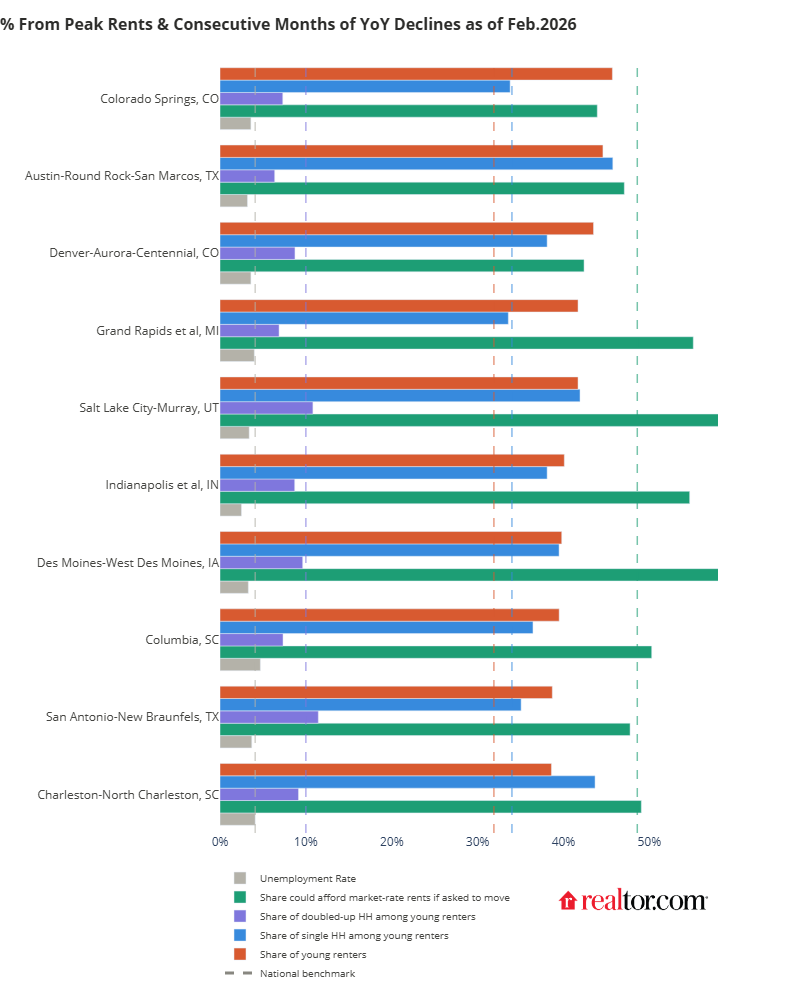
The top metros for young renters include Colorado Springs (45.7%), Austin (44.6%), and Denver (43.5%). The shift is driven by a massive affordability gap: In the top 10 young-renter markets, an average of 52.6% of renters can afford a fair market rent, compared to just 32.0% in Miami and 33.6% in Los Angeles. Yet, affordability alone does not explain why young renters choose these specific markets over other affordable alternatives.

The top markets also offer something equally important — jobs. In December 2025, the average unemployment rate across the top 10 young renter markets was 3.6%, compared to a national rate of 4.1%, suggesting these are not just cheap markets but genuinely tight labor markets where early-career opportunities are abundant. Austin — named twice as a top destination for recent college graduates — has emerged as one of the country’s most dynamic labor markets, drawing technology companies, financial services firms, and corporate relocations that have created a deep well of early-career opportunity.

Where renting is affordable, these households have the financial room to live independently, with higher shares of single-person households. Where it is not, they are forced to double up. In Los Angeles, for example, 16.3% of young-rental households live in “doubled-up” arrangements, nearly twice the 8.6% average in the top 10 young-renter markets.

The Homeownership Barrier for Family Renters

  • Represent 44.3% of all renter households nationally
  • A typical family-renter household in the U.S. is headed by a 42-year-old adult, with a family size of three people living in a three-bedroom unit, earning $68,000 annually.
  • Family renters are concentrated in majority-minority markets across California, Texas, Florida, and Hawaii.
  • These renters face a double barrier: high home prices that put buying out of reach, compounded by a long-documented homeownership gap that disproportionately affects minority households.
  • Markets where family renters concentrate most heavily are among the most burdened and most crowded in the country.

Family renters represent the largest share of the market at 44.3% nationally. The geography of family renting is, to a significant degree, the geography of minority America. The highest concentrations are found in majority-minority markets across California, Texas, Florida, and Hawaii, led by Stockton (63.3%), Riverside (61.7%), and McAllen (61.0%).

This concentration reflects two forces working in the same direction. First, minority groups tend to have higher family-formation rates. For example, among all Hispanic households, 67.9% are family households, compared to 60.1% among white-alone households. Second, and more fundamentally, minority families in these markets face a double barrier to homeownership.

Home prices have climbed far beyond the reach of median-income households — every one of these markets scores below the national affordability benchmark, according to Realtor.com data. This affordability wall is compounded by structural barriers that persist regardless of market conditions — unequal access to credit and limited intergenerational wealth have produced a homeownership gap that remains wide and well-documented.

The Lock-In Effect for Long-Term Renters

  • Long-term renters represent 36.1% of all renter households nationally.
  • They are concentrated in rent-regulated anchor cities (New York, Los Angeles) and their spillover markets across California and the Northeast.
  • A majority of long-term renters cannot afford current market rents. An average of just 39.2% of renting households in the top 10 metros would face severe affordability stress if forced to move at fair market rent within the same metro, assuming the same household incomes and bedroom sizes.
  • A typical long-term renting household is headed by a 55-year-old adult, living in a household of two people and two bedrooms with a median household income of $48,500.

Long-term renters, those in the same unit for five or more years, are increasingly concentrated in the country’s most expensive anchor cities. In New York (53.3%) and Los Angeles (49.6%), decades of rent stabilization have kept millions of tenants in below-market units they cannot afford to leave.

This “lock-in” effect extends to overflow markets as well. Renters priced out of Boston have moved to Providence (44.4%) and Worcester (44.0%), but may find themselves stuck again as rents rise in these secondary cities. On average, 39.2% of renter households in the top 10 long-term renter metros would face severe affordability challenges if they were forced to move within their current metro at fair market rent. The burden is most acute in Providence (45.8%) and Bridgeport (43.9%), where renters have simply run out of affordable places to go.

Not all long-term renters are the same. Some stay by choice — drawn by community ties, neighborhood familiarity, or simply a preference for stability, especially for senior renters. But for many others, staying put is not a preference.

“When you look beneath the national averages, you see a market that is failing to provide mobility,” said Jiayi Xu, economist at Realtor.com. “The lack of new, affordable inventory means that for many, the ‘American dream’ of choosing where you live has been replaced by the necessity of staying exactly where you are.”

Read the full report here.

Methodology

This analysis draws on 2024 American Community Survey (ACS) one-year estimates across the 100 largest metropolitan areas. The sample is restricted to renter households headed by an adult over 18 who is not currently enrolled in school, focusing on households actively participating in the housing market.

Photo credit Mary Long via istockimages.
Renters Migrating To Sunbelt And Mountain West Report Says

Sign Up For Our Weekly Newsletter And Get Rental Property And Apartment News And Helpful, Useful Content Each Week.

* indicates required

FTC Plans To Set Rules And Regulation On Rental Housing Fees

Apartment Leaders Pull Back From Rent-Controlled Markets

Renters Migrating To Sunbelt And Mountain West Report Says

Americans are continuing to migrate to the Sunbelt and Mountain West, according to the 2026 Apartment List Renter Migration Report.

Americans are continuing to migrate to the Sunbelt and Mountain West, according to the 2026 Apartment List Renter Migration Report.

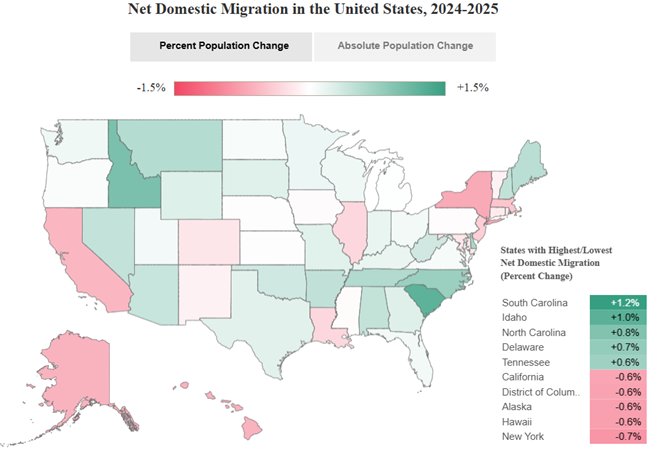
One enduring feature of the post-pandemic housing market is migration out of dense, expensive markets and into more affordable ones. Census data shows this clearly; from 2024 to 2025, states like California, New York, and Massachusetts experienced domestic migration outflows to the Sun Belt and Mountain West regions.

California and New York Export Renters To Texas And Florida

In absolute terms, California, New York, Illinois, New Jersey, and Massachusetts had the largest net domestic migration outflows between 2024 and 2025. In California specifically, 229,000 more people moved out of the state than moved into it.

California’s total population was essentially flat year-over-year, but only because net negative domestic migration was offset by net positive international migration (+109,000) and net positive natural growth (110,000 more births than deaths). So the state remains a major importer of new residents from across the globe, and also a major exporter of residents to other parts of the country. In percentage terms, the state lost 0.6% of its population to domestic migration.

At the other end of the spectrum, North Carolina, Texas, South Carolina, Tennessee, and Arizona have gained the most new residents through domestic migration. In North Carolina, net domestic migration totaled +84,000, a +0.8 percent population increase. Meanwhile, the neighbor to the south has cemented itself as the nation’s fastest growing state, at least in percentage terms. For the fourth straight year, South Carolina has topped the rankings, with +1.2 percent population growth (net +66,000 residents).

Conclusion

The geographic flexibility offered by remote work, coupled with worsening affordability, have swayed America’s migration patterns in recent years. Despite migration rates slowing, data from the Census Bureau as well as the Apartment List platform signal sustained interest in lower-density, lower-cost regions of the country, namely the Southeast and Mountain West. But as remote work appears to be losing some momentum, popularity in these regions may also wane, at least for markets that do not offer competitive wages.

Read the full report here.

Sign Up For Our Weekly Newsletter And Get Rental Property And Apartment News And Helpful, Useful Content Each Week.

* indicates required

FTC Plans To Set Rules And Regulation On Rental Housing Fees

Apartment Leaders Pull Back From Rent-Controlled Markets

Washington Removes Certified Mail Requirement For Eviction Notices

Washington State has removed the certified mail requirement for eviction notices while Vancouver moves forward with rental registration.

By Aaron Kirk Douglas

While Washington has removed the certified mail requirement for eviction notices, local jurisdictions like Vancouver are moving forward with new compliance programs that owners need to act on immediately.

House Bill 2664, passed unanimously by the Legislature, eliminates the requirement that unlawful detainer notices be sent via certified mail. Instead, notices may be served through standard mail, simplifying a process that had created delays, returned mail, and administrative backlogs for housing providers.

The law is expected to take effect in early summer 2026, widely understood across the industry as June 11, 2026, providing near-term operational relief for property managers and owners.

At the same time, Vancouver’s new rental registration program is now live—and carries a near-term deadline with real financial implications.

All rental housing units within Vancouver city limits—including apartments, duplexes, and single-family rentals—must be registered annually beginning in 2026.

However, the city has created a 90-day grace period to encourage compliance:

Register by March 30–31, 2026 → $0 cost (fee waived for the first year)

Register after that date → $30 per unit annual fee applies immediately

This is not a minor administrative detail. For larger portfolios, missing the deadline could translate into a meaningful, recurring operating expense across hundreds of units.

The city has been explicit that fees are waived only through March, with the $30 per-unit charge beginning April 1.

Early registration is one of the simplest, immediate cost-saving moves available to housing providers in Clark County.

Beyond registration, Washington continues to offer a more predictable legal framework than Oregon in several key areas. Clark County courts have generally maintained consistent statutory interpretation, avoiding the procedural variability seen elsewhere.

In addition, Washington’s approach to nonpayment cases still requires tenants to pay the full amount owed—including rent, costs, and fees—to cure a default, rather than allowing partial payments to restart the process.

About the author:

Washington State has removed the certified mail requirement for eviction notices while Vancouver moves forward with rental registration.
Aaron Kirk Douglas

Aaron Kirk Douglas is a multifaceted storyteller and market analyst. His career spans journalism, creative nonfiction, filmmaking, and real estate research. He serves as Director of Market Intelligence at HFO Investment Real Estate/GREA, the Pacific Northwest’s leading multifamily brokerage.

Home Flippers Getting Squeezed As Profits Drop

Real estate investors flipping homes are seeing their profits drop considerably as mortgage rates, high prices and supply squeeze profits

Real estate investors flipping homes are seeing their profits drop considerably as higher mortgage rates, high home prices and tight supply squeeze profit margins.

Diana Olick, senior real estate correspondent at CNBC Property Play, says home flippers are seeing their smallest profits since the since the 2007-2009 recession.

“In all of 2025, roughly 297,000 single-family homes and condos were flipped nationwide, according to ATTOM, a real estate data provider, which defines a flip as a home purchased and sold in the same 12-month period. That was a decrease of 3.9% from 2024 and the lowest number of flips in any year since 2020. Investor flips accounted for 7.4% of all 2025 home sales, down from 7.6% in 2024,” Olick reports.

With the backdrop of the highest median home prices on record, the typical home flip netted investors just $65,981 in gross profit, or a 25.5% return on investment, according to ATTOM. That is down from 32% the prior year and the lowest rate since the Great Recession in 2008.

“Competition for homes remains strong in many markets due to constrained supply,” said Rob Barber, CEO of ATTOM, in a release. “With prices staying elevated, investors are finding it harder to secure deals that deliver strong returns.”

For comparison, in the boom decade following the financial crisis, profit margins were higher than 50%, peaking at 61% in 2012, which is around when home prices bottomed.

Net profits, or investor returns that factor in the cost of fixing up the property, can vary widely depending on local labor, material and financing costs. Across the U.S., however, the cost of fixing properties before flipping remains elevated due to ongoing supply chain pressures and tariff-related increases in material prices, which continue to compress investor margins, according to ATTOM.

Sign Up For Our Weekly Newsletter And Get Rental Property And Apartment News And Helpful, Useful Content Each Week.

* indicates required

Renters Migrating To Sunbelt And Mountain West Report Says

Washington Removes Certified Mail Requirement For Eviction Notices

The Consistency Trap: When “Fair” Policies Create Unfair Risk

Managers may apply the same strict rules to all - the consistency trap- and think they’re protected but the legal landscape is shifting.

Many managers assume that as long as they apply the same strict rules to everyone – the consistency trap-  they’re protected from fair housing trouble but the legal landscape is shifting.

By The Fair Housing Institute

In property management, it’s tempting to lean on zero-tolerance screening policies. They’re fast, efficient, and feel like a safe bet against discrimination claims.

But relying solely on an algorithm creates a real problem. When we prioritize a rigid “yes or no” over an actual conversation, we aren’t just being efficient—we’re often creating a legal liability and missing the human context that defines real risk. The challenge today isn’t just about who we let in, but how sophisticated and fair our process is for those we initially turn away.

The Illusion of Objective Safety

A common mistake in the industry is thinking that a blanket ban is a safe harbor.

Many managers assume that as long as they apply the same strict rules to everyone, they’re protected from fair housing trouble. However, the legal landscape is shifting. Regulators now look closely at the disparate impact of these neutral-sounding rules. For example, a policy that automatically rejects anyone with a criminal record might unintentionally hit certain protected groups much harder than others. By sticking to an inflexible standard, you might actually be turning a risk-management tool into a legal target.

Being a pro in this field means moving past the “set it and forget it” mindset of automated screening. We have to acknowledge that data has limits. A low credit score might come from a one-time medical emergency rather than a habit of not paying bills. A conviction from a decade ago might have zero bearing on how someone will behave as a neighbor today. When we refuse to look behind the numbers, we aren’t really protecting the property; we’re just ignoring the nuances that help us understand who a person actually is.

The Strategic Value of the Appeal

Moving from a simple “Yes/No” system to a real appeals process might feel like more paperwork, but it’s actually a smart business move. An individualized assessment shows that you’re making a good-faith effort to follow fair housing laws. By giving applicants a clear way to share their side—whether it’s evidence of rehabilitation or an explanation for a financial dip—you change the story from one of “rejection” to one of “due process.” If a decision is ever challenged, having a documented, person-centered rationale is your best defense.

Handling this well usually means tweaking how your team works. Instead of leaving it all to an algorithm, you might need a small review group or a compliance lead who knows how to look at the “whole person.” This human-in-the-loop model keeps the community safe while making sure the company isn’t wide open to biased claims. The goal is a process that is as rigorous in its empathy as in its standards, ensuring every denial is backed by a solid, defensible reason.

Fair Housing Month Special on YouTube

Also, we are happy to announce that, in honor of Fair Housing Month, The Fair Housing Institute will host a live event on YouTube focusing on HUD updates, emotional support animals, and the impact of AI in fair housing. It will be on April 1st at 2 p.m. e.s.t. Here is a link to register for the event and ask any questions you would like answered during the event. Please feel free to share with your organization!

Building Trust Through a Fair Process

At the end of the day, how you handle appeals is about procedural justice. When people feel they’ve been heard and their situation was actually considered, they are far less likely to walk away angry or file a formal complaint. Being transparent about why a decision was made and how someone can contest it builds massive professional credibility. It tells the market and the regulators that your company operates with integrity and actually understands its social and legal responsibilities.

The long-term value of ditching the “consistency trap” is a more resilient business. A management firm that gets the appeals process right can handle new laws and social changes without breaking a sweat. You stop being reactive to every new mandate and start leading the industry toward a smarter, more legally sound approach. That trust, built through a fair and human process, is the strongest protection your property can have.

About the author:

In 2005, The Fair Housing Institute was founded as a company with one goal: to provide educational and entertaining fair-housing compliance training at an affordable price at the click of a button.

Multifamily Rents Maintain Slow Pace

Multifamily rents maintained a slow pace as advertised rents remained flat in February, with multifamily expecting a year of slow growth

Multifamily rents have maintained a slow pace as advertised rents remained flat in February, with the multifamily market anticipating another year of slow growth, according to the latest report from Yardi Matrix.

“The market faces headwinds in economic conditions that include weak job growth and consumer confidence as well as in demand drivers such as immigration and migration,” the report says.

“While February is typically a slower month, there are longer-term issues of concern. Rents have been essentially unchanged over the past 18 months, while absorption slowed starting in the second half of last year. Domestic migration has slowed and immigration outflows have weighed on household formation. Occupancy rates are negative year-over-year in 28 of the top 30 Matrix markets.

Highlights of the multifamily rents report:

  • Multifamily rents remained stagnant in February as the average U.S. advertised rent was unchanged at $1,740, with year-over-year growth dropping 10 basis points to 0.1%.
  • February is usually a slow month, but the signals do not point to a strong bump in rents in the spring. Drivers of demand such as population growth, immigration and the job market are not robust, while the occupancy rate and absorption have been weak in recent months.
  • As the future of the industry is debated in Washington, rents for single-family build-to-rent properties were unchanged in February at $2,191, while occupancy rates softened slightly. Year-over-year rent growth improved modestly to -0.4%

Lease renewals are strong and renewals positive

Multifamily conditions are by no means dire. Lease renewals are strong and renewal rates continue to be positive, Yardi Matrix says in the report.

“Core markets such as San Francisco and Chicago have bounced back, while Sun Belt markets retain healthy long-term growth characteristics. Equity and debt capital is plentiful, and opportunities exist for core properties and value-add assets with 2020-2022 vintage mortgages that need to be restructured.

“But economic trends signal softness heading into the spring leasing season and raise the possibility that 2026 could shape up to be a weak year for rent growth,” the report says.

Read the full Yardi Matrix report here.

Sign Up For Our Weekly Newsletter And Get Rental Property And Apartment News And Helpful, Useful Content Each Week.

* indicates required

FTC Plans To Set Rules And Regulation On Rental Housing Fees

Apartment Leaders Pull Back From Rent-Controlled Markets

Seattle Landlords Hit By High, Rising Insurance Costs

Seattle landlords are facing rising insurance costs as average monthly insurance costs in the metro area rose 84.61% between 2019 and 2024

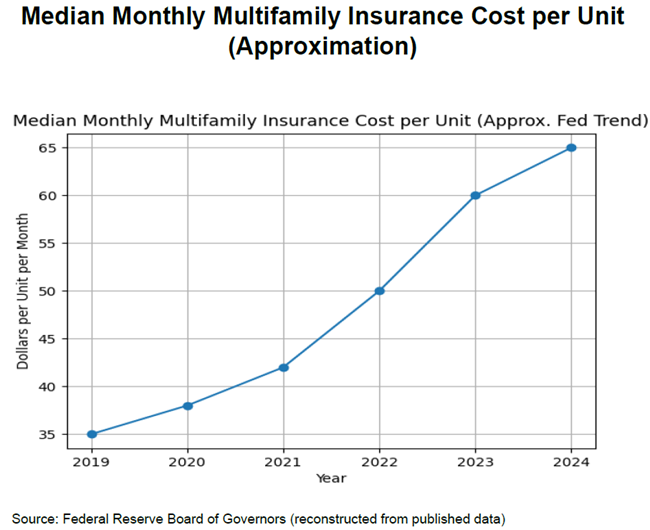
Seattle landlords are leading the nation in facing rising insurance costs as average monthly insurance costs in the Seattle metro area rose 84.61% between 2019 and 2024 to $62.02 per multifamily unit, according to a study published by the Federal Reserve.

National landlords also faced rising insurance costs as nationally the average insurance cost increased 76.5% over the same period.

The study analyzed financial records of thousands of multifamily properties across the U.S. with commercial mortgage-backed securities loans. The data was compiled by analytics company Trepp.

Jake Mayson, director of government affairs at the Washington Multi-Family Housing Association, told the Business Journal that he attributed the sharp jump in insurance costs to the overall economic uncertainties and “increased risk out there in the environment. So every dollar that’s going to pay for property damage and higher insurance premiums, that’s a dollar not going into making the next renovation feasible, that’s not going into creating a new unit of housing to address our supply problems in Washington state.”

“There are larger per-dollar increases in insurance premiums in cities that are experiencing high amounts of property damage and property crime,” he said. The Fed study found that each additional dollar spent on property insurance reduced an owner’s net profit by roughly 75 cents. Insurance costs shaved off 3.83% of revenue for a typical landlord in 2024, up from 2.3% in 2019.

“It’s not like housing providers can raise the rent if their premium goes up,” WMFHA executive director Nick Marin told the Business Journal. “There’s a competitiveness in the market.”

Sign Up For Our Weekly Newsletter And Get Rental Property And Apartment News And Helpful, Useful Content Each Week.

* indicates required

FTC Plans To Set Rules And Regulation On Rental Housing Fees

Apartment Leaders Pull Back From Rent-Controlled Markets

FTC Seeks Comment On Potentially Unfair Rental Housing-Fees

The Federal Trade Commission is seeking written public comment on proposed rules involving potentially unfair rental housing fees

The Federal Trade Commission has announced it is seeking written public comment on a notice of proposed rulemaking to address nationwide potentially unfair rental housing fees or deceptive fee practices in connection with rental housing.

As detailed in a Federal Register notice announcing an Advance Notice of Proposed Rulemaking, the FTC is seeking written comments, including data, evidence, analyses and arguments, regarding rental housing fees and charges throughout a lease lifecycle, from application to moveout.

“Rental-pricing practices that are neither clear nor transparent undermine competition and harm consumers,” said Christopher Mufarrige, director of the FTC’s Bureau of Consumer Protection. “The Trump-Vance FTC is focused on addressing unlawful business conduct that obscures the actual cost of housing and undermines price competition.”

The failure to advertise the true total rent can limit consumers’ ability to make informed financial decisions, increasing their search costs and exposing them to other negative monetary consequences when they take on more rent than they can afford. These practices also may undermine competition by weakening the incentives of rental-housing providers who do advertise the true total rent.

The notice seeks comments on such topics as:

  • Total rent: Do rental housing providers fail to clearly disclose or misrepresent the true total rent for a property, including all mandatory fees or charges?
  • Fees and Charges: Do rental housing providers fail to clearly disclose or misrepresent the nature, purpose, amount, refundability, optionality and recurrence of fees or charges?
  • Application Fees: What practices do rental housing providers engage in relating to application fees that harm consumers?
  • Security Deposits: What practices do rental housing providers engage in relating to security deposits that harm consumers?
  • Billing Issues: What practices do rental housing providers engage in relating to billing that harm consumers?
  • Consumer Choice: What practices do rental housing providers engage in that harm consumers by impeding consumer choice?

Unfair and deceptive rental housing fee practices violate federal law. In the past two years, the FTC has filed two cases challenging these fee practices by nationwide housing providers. Invitation Homes, the largest single-family home rental housing provider in the country, agreed to pay $48 million to settle FTC allegations that the company violated the FTC Act by, among other things, excluding mandatory monthly fees from the advertised rent.

Greystar Real Estate Partners, the largest residential rental property owner and manager in the nation, was ordered to change its fee disclosure practices and pay $23 million in consumer redress to settle a lawsuit by the FTC and the state of Colorado that alleged the company misrepresented the true cost of renting a property and excluded mandatory fees from the advertised rent.

Case-by-case enforcement, while essential, addresses only some aspects of the harmful fee practices in the rental housing industry. The notice announced this week explores whether a rule is needed to address hidden and misleading fees that inflate rent well beyond what is advertised and other problematic fee practices imposed throughout a lease lifecycle. It also would serve as a deterrent against those practices because it would allow the agency to seek civil penalties against violators and more easily obtain redress for harmed consumers.

Consumers can submit comments electronically for 30 days, ending April 11. Consumers also may submit comments in writing by following the instructions in the “Supplementary Information” section of the Federal Register notice.

Sign Up For Our Weekly Newsletter And Get Rental Property And Apartment News And Helpful, Useful Content Each Week.

* indicates required

Trends and Data Illustrate 2026 State Of Pets in Rentals

Trends and data in the 2026 state of pet rentals report shows pet ownership and rental cooperation are rising but challenges exist.

Trends and data in the 2026 state of pet rentals report shows pet ownership and rental cooperation are rising but challenges exist.

A new survey released by PetScreening reports that 81% of rental housing operators report growth in pet ownership, and 68% now consider themselves “pet-friendly,” which means a variety of things ranging from more pets being allowed to more pet-focused amenities onsite.

The 2026 State of Pets in Rental Housing Report, based on feedback from 673 property managers and leasing professionals primarily within the multifamily and single-family sectors, details the effects of pet-inclusivity in the modern rental-housing world.

While 71% of U.S. households own a pet, according to the American Pet Products Association, PetScreening data shows that only 43% of renters report owning one. This figure is nearly 30 percentage points lower than the pet ownership rate reported by housing operators, suggesting that many pets in rentals may be unauthorized or underreported. The report aims to assess reasons for the disparity and ways operators can resolve related challenges.

Trends and data in the 2026 state of pet rentals report shows pet ownership and rental cooperation are rising but challenges exist.

While the rates of pet ownership in rentals continues to rise, operational challenges persist, as operators report pet damage and unauthorized pets are among the primary issues they face at their properties.

“Despite any operational challenges, the survey underscores the clear benefits of welcoming pets at rental communities,” said John Bradford, founder and CEO of PetScreening. “When pet strategies are optimized to embrace pet-inclusivity and reflect the desires of the modern renter, the advantages become more pronounced in the form of a wider resident pool, stronger retention and increased revenue. While the industry still can make significant headway, property managers are doing a commendable job of bridging the gap.”

Some of the gap between the overall U.S. pet ownership rate and the percentage of renters who say they own pets may be attributable to unauthorized and underreported pets onsite. This highlights the importance of accurate tracking, which can help operators collect their rightful pet-related revenue and avoid potential risks associated with unauthorized pets.

Digging into the Data: Popular Amenities, Common Restrictions

The survey also noted that pets are an increasingly key driver in renter decision-making, as renter search data from Apartments.com showed that more than half of renters utilizing pet filters search for dog-friendly communities. The most cited pet amenities offered by survey respondents included pet waste stations (45%) and pet parks (35%)—functional offerings that were significantly more prevalent than experiential features such as dog-walking services (24.9%) or pet-focused events (11.2%).

While some of the industry has shed blanket restrictions in favor of evaluating pets and their owners on an individual basis, most properties continue to have significant restrictions in place. Pet limits per household was the most cited by respondents (78.4%), while other traditional restrictions such as breed (66.7%) and weight limits (59.8%) continue to be prevalent as well.

Metrics specific to PetScreening included that the company’s clients experienced a 30.7% increase in revenue after implementing the platform, which underscored the impact of pet-friendly policies paired with formal tracking and screening tools. Additionally, PetScreening says its customers saved approximately 1.3 million administrative and legal hours reviewing assistance-animal accommodation requests, instead relying on the platform’s expertise, which also helped to reduce risk of regulatory violations and potential litigation.

The entire report can be accessed here.

About PetScreening:

PetScreening is a leading platform for managing pets and assistance animals. Offered at no cost to housing providers, the platform standardizes pet-risk assessment with digital pet profiles and FIDO Scores®, streamlines assistanc- animal reviews in compliance with HUD and Fair Housing guidelines, and helps identify unauthorized pets, all while supporting more pet-inclusive communities. Learn more at petscreening.com.

Pet Owning Renters Face Barriers Despite “Pet-Friendly” Ads

2026 Pets and Housing Awards Are Open For Nominations

Pets Are Family, Not an Apartment Amenity

Sign Up For Our Weekly Newsletter And Get Rental Property And Apartment News And Helpful, Useful Content Each Week.

* indicates required

Oregon Tenant Confidentiality Bill Goes To Governor For Signature

Oregon's 2026 tenant confidentiality bill restricts landlords from disclosing tenant information such as SSNs, immigration status, or medical

Oregon’s 2026 tenant confidentiality bill (HB 4123) restricts landlords from disclosing sensitive tenant information—such as SSNs, immigration status, or medical records—without written consent.

It now goes to the governor for signature and It imposes penalties of up to twice the monthly rent for “knowingly” violating these privacy protections.

The law covers personal details including Social Security numbers, contact information, income details, immigration/citizenship status, and medical or disability records.

The bill includes exceptions for situations involving legal or administrative proceedings, such as court orders, mandatory background checks, insurance claims, or necessary maintenance services.

Clackamas Women’s Services  told kgw.com  the “tenant confidentiality” bill would help protect women trying to escape their abusers.

CWS supports survivors of domestic and sexual violence, stalking, trafficking and other crimes. All too often, a woman’s whereabouts get back to her abuser, she said.

“We know how important it is for survivors when they are finally able to leave a violent situation and get into a safe and secure housing situation — that they’re able to keep that,” Erlbaum said.

When that information gets out, survivors may have to start the process of finding safe housing all over again. Because often, “victims’ information is shared and their abuser shows up at their place of employment or sometimes even at that housing unit itself,” she explained.

“It’s actually fairly common, and I think it’s because information is just shared in the course of conversation,” Erlbaum said. “Again, maybe very well-meaning, but that can create a really high-risk situation for survivors.”