
Development adviser says public-private partnerships are gaining traction and drawing interest as developers look for a workable paths.
By Aaron Kirk Douglas
With market-rate projects struggling to pencil, public-private partnerships are drawing new interest from developers looking for a workable path, according to Brian Vanneman, who advises public agencies on catalytic mixed-use projects across Oregon and Washington.
Vanneman has spent about 20 years in the field. He holds a master’s in urban planning from Portland State University and spent 15 years at Leland Consulting Group before starting his own firm, Forum Placemaking, three years ago. His work centers on sites where a city, port or other public agency already owns the land.
He keeps his definition of a public-private partnership simple. “You’ve got to have at least two entities, you’ve got to have a public agency and a private developer,” he said, along with a legally binding development agreement rather than a handshake. His focus is real estate development and placemaking, not toll roads or single-facility contracts.
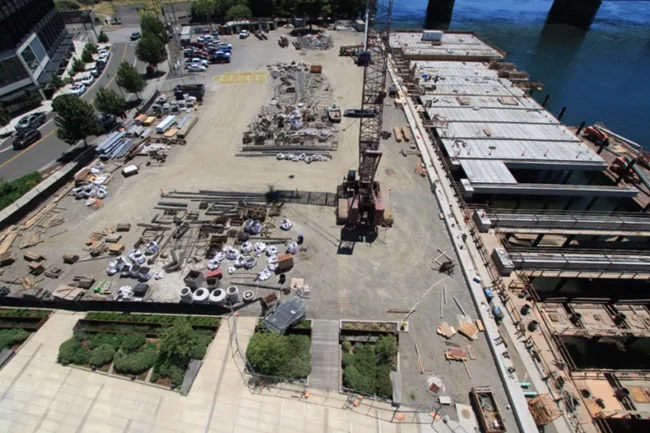
Much of his recent work sits in Clark County. He has advised the Port of Vancouver on its waterfront, the Port of Camas-Washougal on the project now called Highest Point, and the Port of Ridgefield on a 40-acre site along Lake River. His footprint runs from north of Seattle down to Eugene.
Vanneman said the biggest difference between working in the two states comes down to Oregon’s prevailing wage law. In Oregon, more than $750,000 in public funds can trigger prevailing wage rates on the private vertical construction, not just the public roads or parks. Estimates for the added cost run from 15% to 30%. It is “very easy to trigger that” in Oregon, he said, while Washington generally applies prevailing wage only when a project is at least 50% public.
He called Oregon’s trigger a real concern as more cities and states discuss revolving loan funds and public capital for housing. The risk, he said, is that a program meant to incentivize building ends up doing the opposite. He pointed to the Eugene Waterfront, where developer Atkinson Dame has said future phases totaling well over 1,000 housing units are hard to pencil with prevailing wage costs attached.
Even so, Vanneman sees openings. Market-rate deals are stuck with high interest rates, high costs and rising operating expenses. “There’s nothing getting built right now,” he said. Public-private partnerships give developers other avenues, including workforce and middle-income housing supported by mission-driven capital. He cited the Oregon Community Foundation’s recent $100 million commitment to middle-income housing and said a project at 100% of area median income often matches where the market sits.
The structure carries a timing advantage in a slow market. Partnerships move slower and add process, but a developer often does not have to close on land right away or break ground for many months. “That used to be a bad thing,” Vanneman said. Today it lets a developer hold a position without carrying land costs.
He was candid about the risk. Forecasting feasibility is hard, and interest rates and rents remain uncertain. His worry is that all parties can talk themselves into a project that still will not pencil in 12 months.
Bottom line: For patient capital, public-private partnerships offer a way to control strong sites without paying for land up front, which improves returns and buys time in a market where little else works. For developers built around a three- to five-year hold, the longer timeline may be a poor fit. Owners and investors watching Oregon policy should track how prevailing wage rules interact with new public housing programs, since the details can decide whether a project moves.
About the author:

HFO Research (Aaron Kirk Douglas) from HFO Investment Real Estate’s Multifamily Marketwatch YouTube podcast, hosted by partner Greg Frick. Aaron Kirk Douglas is director of market intelligence for HFO Investment Real Estate In Portland.