Home Blog Page 38

Rent Prices Rise in June, But Rentals Slow

Rent prices continued to rise in June but rent increases remain modest as the pace of growth slowed in what is typically the busy season.

Rent prices continued to rise in June but overall rent increases remain modest, Apartment List says in its July report.

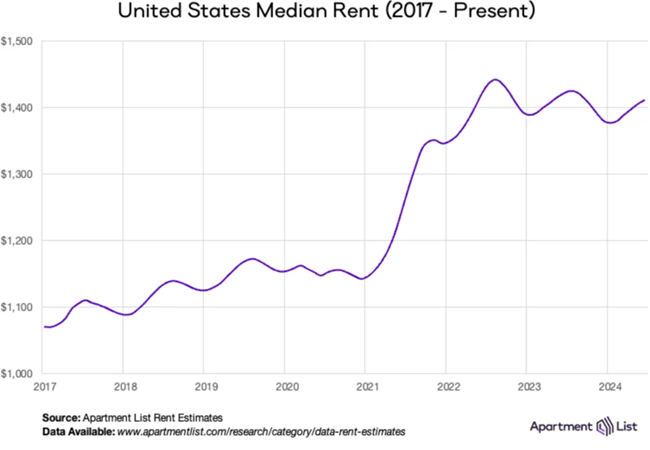
While there have been five straight months now of rent increases, the national median rent increased by 0.4% in June and now stands at $1,411 as the pace of growth has slowed in what is typically the busy season.

“We are currently in the midst of what is typically the busy season for the rental market, but this year’s peak season is not bringing elevated rent growth,” the report says.

While rent growth has slowed, the national median rent is still more than $200 per month higher than it was just a few years ago.

Rental market headed for a slow summer

“This is typically the time of year when rent growth is accelerating amid the busy moving season, so sluggish growth this month indicates that the market is headed for another slow summer,” the report says.

The report says 80 of the nation’s 100 largest cities saw rents go up in May. But on a year-over-year basis, rent growth is positive for only 46 of these cities. Many of the steepest year-over-year declines remain concentrated in Sun Belt cities that are rapidly expanding their multifamily inventory, such as Austin (-7.4 percent year-over-year), Raleigh (-5.2 percent), and Jacksonville (-4.1 percent).

Rent prices continued to rise in June but rent increases remain modest as the pace of growth slowed in what is typically the busy season.

Apartment vacancies remain elevated

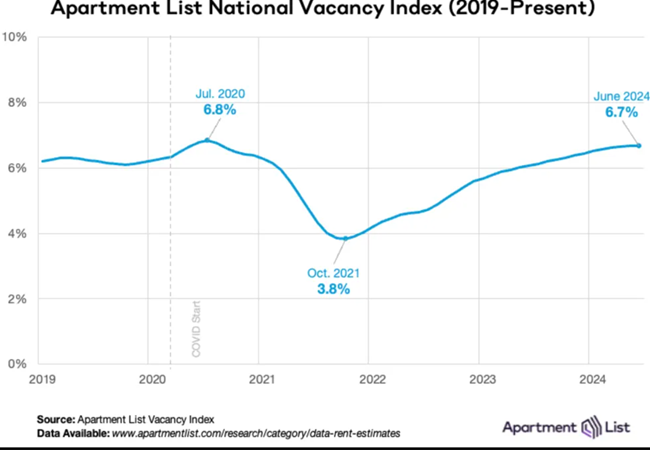
Apartment vacancies have been opening up steadily for more than two years.

“As of June, our vacancy index sits at 6.7 percent, the highest reading since August 2020. And there’s good reason to expect that it could rise even further during the remainder of the year,” the report says.

The report says that despite a recent slowdown in new permits being issued and new construction projects breaking ground, the number of multifamily units under construction remains near record levels. In 2023 the most new apartments were completed in more than 30 years, and an even greater number of new units are expected to come on the market this year.

Rent prices continued to rise in June but rent increases remain modest as the pace of growth slowed in what is typically the busy season.

Conclusion

The report’s summary says despite a small June increase, rent growth is slowing down at the time of year when the rental market activity is normally approaching its apex.

“Year-over-year rent growth is also indicative of a sluggish market, remaining negative at -0.7 percent. Rent increases are currently being moderated by a robust construction pipeline expected to deliver a decades-high number of new apartment units in 2024. Improving consumer sentiment about broader macroeconomic conditions may be driving a modest rebound in rental demand, but that bounce back has so far been outweighed by the impact of incoming supply.”

Read the full report here.

Rent Prices Up Slightly For 4th Month, but Vacancies High

Sign Up For Our Weekly Newsletter And Get Rental Property And Apartment News And Helpful, Useful Content Each Week.

* indicates required

Do New Luxury Apartments Bring Lower Rents for All?

new “luxury apartments” influence rental costs for all prices of apartments, including the lower-cost Class C apartments NMHC says

In a new research bulletin, the National Multifamily Housing Council (NMHC) says new “luxury apartments” influence rental costs for all prices of apartments, including the lower-cost Class C apartments.

But many Americans remain skeptical as to whether these new apartments – which tend to be more expensive than existing units and are often marketed as “luxury” – will aid affordability for households at the lower end of the income spectrum, says Chris Bruen, senior director of research for the NMHC.

Apartments classified as Class A tend to be both higher quality and more expensive than their Class B and Class C counterparts.

Class A apartments recorded an effective asking rent of $2,213 per month in the first quarter of 2024, according to data from CoStar.  Class B apartments rented for $1,671 and Class C apartments for $1,347.

“Even though nearly all apartment units built in 2023 were classified by CoStar as either Class A (41.3%) or Class B (56.8%), both economic theory and empirical literature suggest that this new supply should have a downward effect on rent growth for all apartments, including Class C. For instance, Myers and Park (2020) found that new apartment construction, even at higher price points, enabled older units to “filter” and house an increasing share of low-income households over time,” Bruen says.

He says there is evidence that this recent wave of Class A and B construction has led to lower rent increases among Class C units. Markets with higher rates of Class A and B deliveries tended to record lower rent increases among Class C units, providing some evidence that construction at the high end promotes affordability among all unit types.

The Takeaway

Apartment deliveries have increased to their highest level since the late 1980s, which has resulted in a significant moderation in rent growth. According to the NMHC analysis, this surge in construction – which consists almost entirely of more expensive, Class A and B units – translated to lower rates of rent increases for Class C apartment units as well, providing further evidence of apartment “filtering.”

The bottom line, according to these figures: Increased supply (of all kinds) equals improved affordability.

However, this higher level of deliveries and moderating rent growth is likely to be short-lived, since a combination of moderating rent growth, rising operating costs and a rising cost of capital have already led to a sharp pull back in new apartment construction.

Read the full report and detail here.

Sign Up For Our Weekly Newsletter And Get Rental Property And Apartment News And Helpful, Useful Content Each Week.

* indicates required

Insurance Leads Rising Rental Property Expenses

Multifamily rental property expenses continue to grow at above-trend levels, led by insurance increases, according to a special bulletin.

Multifamily rental property expenses continue to grow at above-trend levels, led by insurance increases, according to a special bulletin by Yardi Matrix.

The report cautions that rental property owners should not expect even robust income growth to outstrip the rapid increase in expense growth.

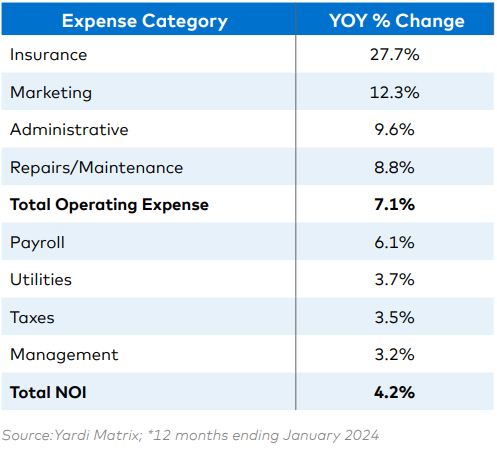
Property insurance alone was up by more than 27%, Yardi Matrix says in the study.

Using an examination of more than 20,000 properties that use Yardi operating software, Yardi says overall multifamily expenses rose 7.1% year-over-year to an average of $8,950 as of January. Here is how the expenses broke down in the study:

  • 7% insurance
  • 3% marketing
  • 6% administrative
  • 8% repairs and maintenance

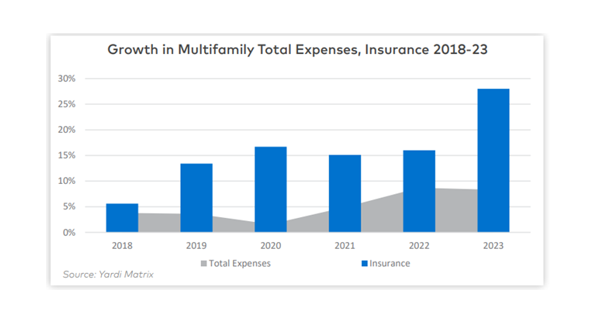
“Driven by inflationary pressures, total expenses at multifamily properties have increased rapidly in the past two years, peaking at 8.7% in 2022. Before that, the average annual expense growth rates were 4.9% in 2021, 1.6% in 2020, 3.6% in 2019 and 3.8% in 2018,” the report says.

Multifamily rental property expenses continue to grow at above-trend levels, led by insurance increases, according to a special bulletin.

Multifamily property insurance costs driving expense issues

The most recent 27.7% jump in property insurance is only the latest hit for multifamily expenses.

Property insurance costs have risen 129% nationally since 2018, to an average of $636 per unit. Property insurance premium growth rates were 16.0% in 2022, 15.1% in 2021, 16.7% in 2020, 13.4% in 2019 and 5.6% in 2018, the report says.

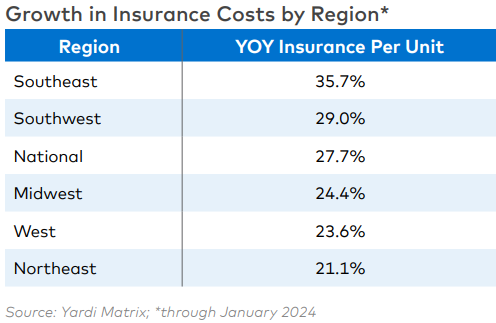
Weather-related insurance events in the Southeast have been a major driver of the property-insurance increases.

Multifamily rental property expenses continue to grow at above-trend levels, led by insurance increases, according to a special bulletin.

“Although property insurance is only 7% of total expenses, its share of overall costs is growing. Plus, it is becoming more difficult to obtain in areas with severe hurricanes, floods and fires,” said Paul Fiorilla, director of research, in the report.

Rental income growth is also now slowing, while multifamily expenses grow. One of the areas is the Individual inflation components.

“Service inflation is still high, a sign that the labor market continues to be tight, which feeds into high administrative and payroll costs for apartments.

“Likewise, supply chains have repaired to a great degree from the height of the pandemic, but repair and maintenance costs are stubbornly high due to increasing costs of labor and materials that are impacted by forces including energy and delays in global shipping lanes,” Fiorilla said.

Summary

Streamlining processes plus implementing new technology can help, however, “the upshot is that property owners can’t expect robust income growth to continue to outstrip rapid growth in expenses.

“Profitability will be at risk if expense increases do not moderate during a period when rent growth is forecast to remain weak,” Fiorilla says.

Read the full report here.

About Yardi Matrix

Yardi Matrix researches and reports on multifamily, office and self-storage properties across the United States, serving the needs of a variety of industry professionals. Yardi Matrix Multifamily provides accurate data on 18+ million units, covering more than 90 percent of the U.S. population. Contact the company at (480) 663-1149.

My Tenant Wants To Repaint His Unit – What Should I Do?

My Tenant Wants To Repaint His Unit – What Should I Do Landlord Hank??

When a tenant wants to repaint his unit, a question that often comes up, should we let the a new tenant repaint his unit? On his page,  Ask Landlord Hank answers questions from other landlords and property managers around the country about their rentals so fill out the form below if you have a question for him. Remember Hank is not an attorney and is not offering legal advice.

Dear Landlord Hank,

A new tenant has moved into one of my units and the tenant wants to repaint and  has asked if he could repaint. I just paid to have the unit painted white so it would go with everything. What do you think?

Dear Landlord Mike,

I would tell the tenant that he cannot make any changes to the paint.

In the past, tenants have sworn they would repaint to original color and it has never happened.

The tenants often paint some color that is difficult to cover -very bright or very dark- so when they move out it will cost you two times as much to repaint for next family.

I give tenants a nice neutral paint color

I like to give tenants a nicely painted, neutral color, normally bright white to make the units feel even larger.

But, occasionally someone asks if they can repaint. Now the answer is ‘NO.’

If you don’t like the color, I’m sorry but repainting is not an option.

In my experience, either tenants don’t repaint, as promised, or they do a poor job and get paint on carpet, or use the wrong color, etc., therefore costing even more money to fix and repair.

Tenant was a painter and it still did not work out

I even had a tenant that worked as a painter (not for me on my rentals), but promised he’d repaint.

That promise went out the window when his divorce occurred and he couldn’t find the time.

I have over 20 years of learning from my mistakes

I’ve had prospects say they will take an unpainted unit after viewing the unit prior to the current tenant leaving. I thought that I couldn’t really lose, since I would not be supplying the paint or labor.

Wrong.

These tenants added accent walls in bold colors and designs which made repaint far more work when they moved out.

Ask Landlord Hank Your Question

Ask veteran landlord and property manager Hank Rossi your questions from tenant screening to leases to pets and more! He provides answers each week to landlords.

  • This field is for validation purposes and should be left unchanged.

About the author Landlord Hank:

My tenant wants to repair his unit and this question is something that often comes up Landlord Hank, so what should we do?

“I started in real estate as a child watching my father take care of our family rentals- maintenance, tenant relations, etc , in small town Ohio. As I grew, I was occasionally Dad’s assistant. In the mid-90s I decided to get into the rental business on my own, as a sideline. In 2001, I retired from my profession and only managed my own investments, for the next 10 years. Six years ago, my sister, working as a rental agent/property manager in Sarasota, Florida convinced me to try the Florida lifestyle. I gave it a try and never looked back. A few years ago we started our own real estate brokerage. We focus on property management and leasing. I continue to manage my real estate portfolio here in Florida and Atlanta. “ Visit Hank’s website here.

Dear Landlord Hank: I Have A Tenant Couple Who Fight On A Regular Basis – What Do I Do?

Sign Up For Our Newsletter And Get Apartment News And Helpful, Useful Content Each Week.

* indicates required

Who’s Responsible For Smoke Detector Batteries In Rentals?

3 Steps For Dealing With Tenants And Frozen Pipes

Super-Commuting Grows As Bosses Pull Back On Remote Work

A growing number of Americans are spending at least 90 minutes each way traveling to and from work, a practice known as “super-commuting

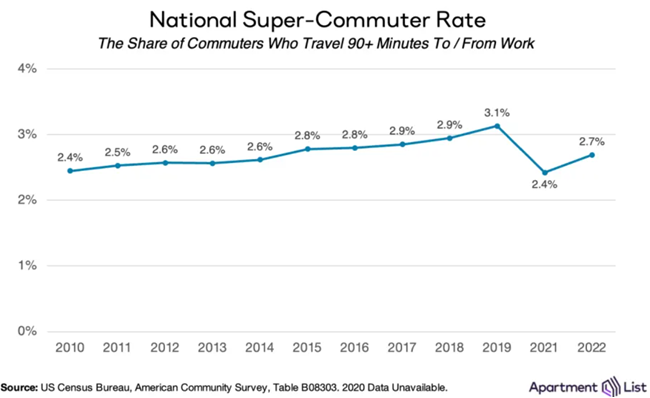
New data from the U.S. Census Bureau shows a growing number of Americans are spending at least 90 minutes each way traveling to and from work, a practice known as “super-commuting,” Apartment List says in a new report.

While the super-commuting trend is not new, the pandemic provided a “brief respite, eliminating commutes for many and reducing commute times for the rest as traffic abated. As the economy went remote, the number of super-commuters fell by over 1.5 million even as demand for suburban and exurban living remained strong,” the report’s economists say in the report.

A growing number of Americans are spending at least 90 minutes each way traveling to and from work, a practice known as “super-commuting"

The report says the city-to-suburb migration is more recently focused on homeownership and affordable cost-of-living options. That has encouraged families to head to the lower-density suburbs while keeping jobs in the central city.

The latest population estimates from the U.S. Census Bureau show suburbanization vividly, with high-growth counties forming visible rings around urban cores.

Wages Are Higher for Those Willing to Commute Long Distances

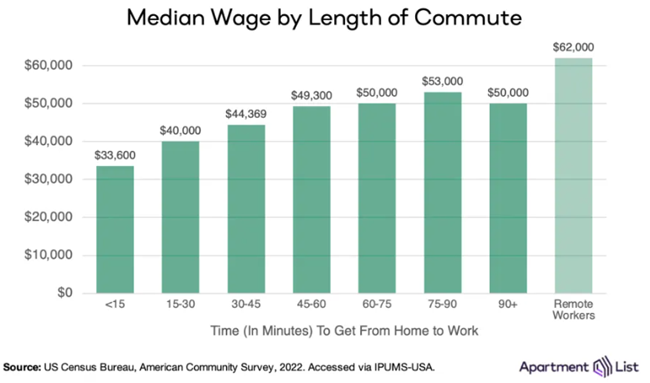
“The latest census data clearly show that workers are willing to trade lengthy commutes for higher incomes. In 2022, the median wage eclipses $50,000 for workers who spend at least one hour commuting, and is actually lowest for those who live within a quick 15-minute trip to work,” the Census Bureau report shows.

A growing number of Americans are spending at least 90 minutes each way traveling to and from work, a practice known as “super-commuting"

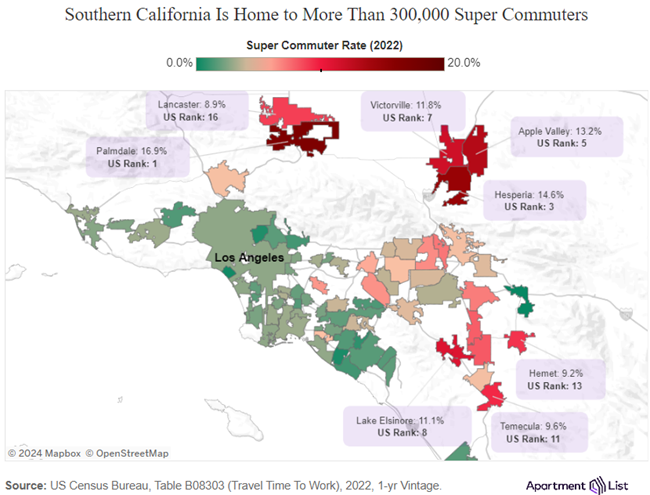
The nationwide super-commuting rate is 2.7 percent, but double-digit rates can be found along the peripheries of several large metros in California and Texas, as well as Seattle, New York, and Washington, D.C.

The Los Angeles region has more super-commuters than anywhere else. The nation’s highest super-commuter rate can be found in Palmdale, a 60-mile drive from Los Angeles, where 16.9 percent of all workers commute at least 90 minutes for work.

A growing number of Americans are spending at least 90 minutes each way traveling to and from work, a practice known as “super-commuting"

Super-Commuting and its Implications

Apartment List senior research associate Rob Warnock writes, “The relationship between where people live and where they work continues to evolve. A record number continue working from home; however, many employers appear to be shifting back to in-person or hybrid arrangements.

“This is putting more commuters on roadways and transitways daily – including more super-commuters – and resuming the pre-pandemic trend. Worsening commutes for drivers increase car-related expenses, impact physical health, and amplify the environmental consequences of suburban sprawl. Meanwhile, worsening commutes for transit riders harm quality-of-life in urban cities and disproportionately affect the car-free households that tend to be lower-income. Altogether, this trend may increase tension between workers and employers, as they negotiate working arrangements that affect their commutes.

“Housing is, of course, central to any attempts at cutting back on super-commuting. In cities and suburbs alike, dense construction and infill development (built at a rate that scales appropriately with job growth) can improve housing opportunities so that those who wish to live closer to work can afford to do so,” Warnock says.


Sign Up For Our Weekly Newsletter And Get Rental Property And Apartment News And Helpful, Useful Content Each Week.

* indicates required

NAA Announces 2024 Excellence Awards Winners

NAA announced the winners of the 2024 NAA Excellence Awards, a program that recognizes excellence and leadership in rental housing industry

The National Apartment Association (NAA) has announced the winners of the 2024 NAA Excellence Awards, an annual program that recognizes excellence and leadership across the rental housing industry. This year’s award recipients were formally recognized at a ceremony during Apartmentalize, NAA’s annual conference and exposition, held June 19 – 21 in Philadelphia.

“Congratulations to this year’s NAA Excellence Awards winners who have gone above and beyond to make tangible and lasting impacts to the rental housing industry,” said NAA President and CEO Bob Pinnegar. “Across our country, these individuals and organizations are leading the way and we are proud to highlight their accomplishments and commitment to excellence.”

NAA’s Excellence Awards celebrate apartment communities, industry professionals and affiliated apartment associations that make unique and lasting contributions to the industry each year. You can learn more about the awards program here.

A full list of the 2024 NAA Excellence Awards winners is included below.

Upper State Apartment Association
Affiliate of the Year (Mid-Size)
Pennsylvania Apartment Association
Affiliate of the Year (State/Metro)
The Cadence
Wesley Property Management
Affordable Community of the Year
Fern Crossing at Bayou Pierre
U.L. Coleman Properties
Major Rehab Community of the Year
Jasper
Westhome
New Construction Community of the Year
201 Canal
WinnResidential
Small Community of the Year
Keva Flats
Hankin Apartments
Large Community of the Year
American Landmark Apartments
Leading Organization in Diversity, Equity & Inclusion
Bozzuto
#NAAGives
Grace Hill
Supplier Company of the Year
Thompson Thrift
NAAEI Dedication to Education
Carol Christner
Pennsylvania Apartment Association
Chris Christenson Association Executive of the Year
Maryland Multi-Housing Association
Anthony V. Pusateri Apartment Career Promotion Award Comprehensive Program
Crystal Dukes
RealSource Management
DEI Champion
Kristine Levinskas
Trilogy Residential Management
Apartment Career & Education (ACE) Industry Educator of the Year
Tina M. White
McMahan’s Flooring
Supplier Sales Professional of the Year
Harmony Tripp
CMG Leasing
Emerging Leader of the Year
Kara Bonzheim
FSI Construction
National Supplier Council Achievement Award
John Whitaker
Elevated Asset Management
Independent Rental Owner of the Year


About NAA
The National Apartment Association (NAA) serves as the leading voice and preeminent resource through advocacy, education, and collaboration on behalf of the rental housing industry. As a federation of 141 state, local and global affiliates, NAA encompasses nearly 97,000 members representing more than 12 million apartment homes globally. NAA believes that rental housing is a valuable partner in every community that emphasizes integrity, accountability, collaboration, community responsibility, inclusivity, and innovation. To learn more, visit www.naahq.org. NAA thanks its Strategic Partners AppFolio, The Home Depot Pro, Lowe’s Pro Supply and Yardi.


Sign Up For Our Weekly Newsletter And Get Rental Property And Apartment News And Helpful, Useful Content Each Week.

* indicates required

Entrata Acquires Colleen AI to Usher in New Era of Autonomous Property Management

Entrata's acquisition of Colleen AI enables operators to automate workflows end-to-end through a new AI product suite for property management

Entrata’s acquisition of Colleen AI enables operators to automate workflows end-to-end through a new AI product suite, ELI+

Entrata®, a leading AI-enabled multifamily Operating System (OS), has announced its acquisition of Colleen AI, immediately furthering its ability to automate property operations. By incorporating Colleen AI into the Entrata OS, operators can take the next step towards autonomous property management, introducing a new era for the industry.

Entrata’s vision of the future has Autonomous Property Management™ at its core, making workflows increasingly automated and portfolios more efficient while simultaneously delivering an elevated resident experience. With the unprecedented adoption of Entrata Layered Intelligence™ (ELI™), the acquisition of Colleen AI further bolsters AI capabilities across the Entrata OS.

Entrata is debuting ELI+, a new comprehensive suite of AI products designed to pave the way for transformational change in the next generation of multifamily.

Why it matters

By utilizing an improved AI platform designed to significantly improve workflows, property managers can focus efforts on filling vacancies, providing better customer service and building community engagement instead of chasing payments and drowning in project deadlines. It’s a grand new vision for where AI can take the experience of renters and property managers.

Entrata will now offer the following four core suites of products, which make up the Entrata OS:

  • ELI+ – a suite of AI products that provides comprehensive AI capabilities, market-ready functionality, and a team of multifamily AI experts. (formerly Colleen AI)
  • PMS – a suite of property management products designed to help automate workflows, improving efficiency while delivering an elevated resident experience.
  • Homebody – a fully integrated resident financial services offering that consists of three core products including rent reporting, deposit alternatives and renters insurance.
  • Utilities – an easy-to-use operating system that helps simplify billing, increase NOI and cut expenses.

Transformative efficiency through end-to-end AI workflow automation

Through the acquisition of Colleen AI, Entrata is introducing ELI+™, an elevated suite of AI products to power end-to-end workflows. ELI+ is for operators looking to harness the power of AI to transform their business through automation for even more efficiency.

It’s designed to be modular and allows for swift enhancement utilizing modern AI and machine learning technology, giving operators the most up to date functionality. Operators will have immediate access to AI-powered collections and renewal modules, with additional modules, including leasing, in the coming months.

“The acquisition of Colleen AI significantly accelerates our vision of Autonomous Property Management while immediately providing our customers with comprehensive AI capabilities, market-ready functionality, and a team of multifamily AI experts,” said Adam Edmunds, CEO of Entrata. “Through this combination, operators can power end-to-end automated workflows and interactions. This, in turn, will allow teams to concentrate on meaningful resident connection and high impact tasks to positively impact the resident experience and, ultimately, NOI.”

Increased data quality for more contextual AI 

Entrata’s new AI products sit across the OS to provide the ultimate automation, workflow management, and orchestration. There are thousands of data variables within the Entrata OS, and ELI+ leverages all of them to automate and contextualize every interaction — a clear advantage over other, non-native AI solutions. These data sources in Entrata are comprehensive and native to the OS to allow for high quality inputs.

This technology consolidation enables Conversational Context Switching™, which contextualizes each interaction through data and workflows for each resident, made possible by the single data source. For example, if a conversation begins for an amenity reservation, AI can easily satisfy the original request and then seamlessly shift the conversation to other priority tasks, such as beginning an early renewal process.

In addition, by embracing an OS with a native AI layer, like ELI+, site teams don’t need to switch or become bogged down by disparate tech. Operating in one system that teams are familiar with allows for rapid re-prioritization of activities through workforce redeployment.

“One of the key challenges to effective AI is high-quality and current data,” said Itamar Roth, CEO and co-founder of Colleen AI. “By introducing Colleen AI as native technology to the Entrata OS, the efficacy will be unmatched in the multifamily industry, dramatically accelerating the possibilities for autonomy in many areas that don’t exist today. We are thrilled about the innovation potential this combination brings.”

As part of the transaction, shareholders of Colleen AI, including Wilshire Lane Capital, will become shareholders of Entrata, Inc.

More information on ELI+ can be found here.

Advisors 

Wilson Sonsini Goodrich & Rosati served as legal counsel to Entrata. J.P. Morgan Securities LLC served as financial advisor to Entrata. Goldfarb Gross Seligman served as legal counsel for Colleen AI.

About Entrata

Entrata is a leading operating system for multifamily communities worldwide. Setting the bar for innovation in property management software since 2003, Entrata offers solutions for every step of the leasing lifecycle and empowers owners, property managers, and renters to create stronger communities. Entrata currently serves over three million residents across more than 20,000 multifamily communities around the globe. Learn more at www.entrata.com.

 

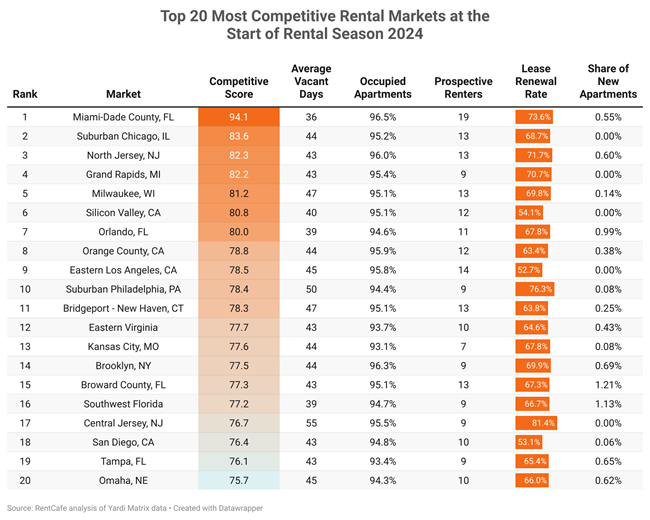
Where Are the Most Competitive Rental Markets?

As the summer moving and leasing season heats up, RentCafe took a look to find out where the most competitive rental markets are located

As the summer moving and leasing season heats up, RentCafe took a look to find out where the most competitive rental markets in the United States are located.

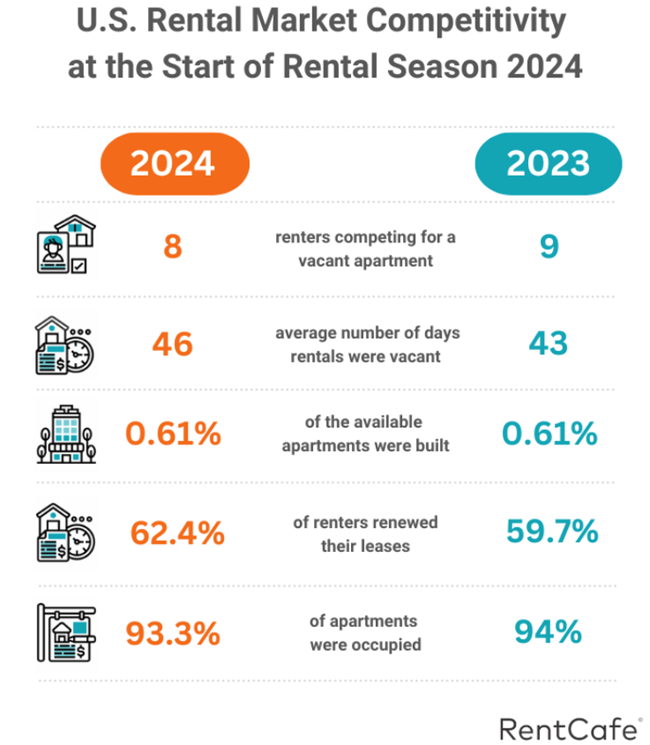
“Overall, the U.S. rental market is experiencing slightly less strain at the start of this moving season compared to one year prior, as it’s still feeling the effects of the influx of new apartments that have been introduced in recent years.

“Notably, the supply of apartments increased by 0.61% since January, which is in line with one year prior. Also, it’s worth noting that around 29% of the 137 markets analyzed are showing signs of softening, often with longer vacancy periods and more lease renewals,” the report says.

Taking a closer look at the 127 rental markets RentCafe analyzed, here are the most competitive, plus a few interesting newcomers:

  • Miami remains the most competitive rental market, with its RCI score of 94 driven by limited new apartments and a low vacancy rate of 3.5%. On average, each vacant apartment there attracts 19 eager renters.
  • Suburban Chicago is now the second-most competitive market, jumping from 10th place last year. With an RCI score of 83.6, 13 renters compete for each unit amid a 95.2% occupancy rate and no recent new builds.
  • North Jersey: Now the third-most competitive market with an RCI score of 82.3, a 96% occupancy rate, and a 71.7% lease renewal rate. Apartments are filled within 43 days, with 13 renters competing for each vacant unit.
  • Silicon Valley surged to sixth place, fueled by a resurgent tech sector. With a 95.1% occupancy rate and no new units, vacant apartments attract 12 renters each.
  • Manhattan is one of the markets where competition has intensified the most in the last year: Its RCI score has risen by 5.2 points to 73.3, driven by higher lease-renewal rates (65.7%) and virtually zero new apartments brought to the market.

As the summer moving and leasing season heats up, RentCafe took a look to find out where the most competitive rental markets are located

See the full report here.

Multifamily Challenges For Rest of 2024

Sign Up For Our Weekly Newsletter And Get Rental Property And Apartment News And Helpful, Useful Content Each Week.

* indicates required

Multifamily Challenges For Rest of 2024

Multifamily challenges and the direction of inflation and interest rates will be closely watched by the industry in the second half of 2024

The direction of inflation and interest rates will be closely watched by the multifamily industry along with other multifamily challenges in the second half of 2024, Yardi Matrix says in their summer report.

“Performance continues to benefit from the strong economy and robust demand, while facing headwinds that include a large number of deliveries in some markets and higher-for-longer interest rates,” the report says.

Yardi Matrix’s mid-year 2024 outlook looks at how these issues will affect the market.

Some highlights:

  • Multifamily performance continues to be strong, but it is not without challenges. Demand remains steady from consistent job growth and immigration, but some fundamental metrics including rent growth and occupancy have deteriorated since the market peak in 2022.
  • Plus, the capital markets will remain a headwind until rates recede.
  • “We expect growth to slow in the second half of the year. Employment and consumer activity are positive, but there are some worrying signs and there is stress on lower income households.”
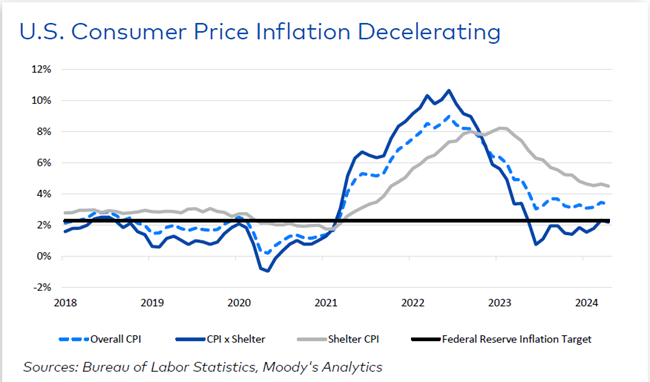
  • Inflation is likely to decelerate, but not fast enough to entice the Federal Reserve to cut interest rates meaningfully.
  • Higher-for-longer rates are a mixed blessing. Demand is boosted by weaker home sales, as would-be homebuyers can’t afford to buy and homeowners with low mortgage rates stay in place. But high mortgage rates put stress on sales and refinancings.
  • Rent growth is weak, and likely will remain so. Absorption so far this year continues to be healthy, at a pace of nearly 300,000 units nationally, but supply growth is putting pressure on rents in the Sun Belt.
  • Supply growth will be high in 2024 and 2025, but will wane after that.
  • Transaction activity remains weak, as rates are still high.
  • Debt continues to be a sticking point.

“We expect inflation to recede in the second half, in large part due to decelerating rents. Housing is a big contributor to the inflation numbers, and the methodology used to calculate the CPI means it lags rental-market changes,” the report says.

multifamily challenges for the rest of 2024 and how the direction of inflation and interest rates will be closely watched by the multifamily industry in the second half of 2024

“Our expectation is that economic growth will slow but remain positive in the second half of the year, while there is a deceleration in some of the factors such as job and income growth that created robust demand for multifamily,” the report says.

Read the full Yardi-Matrix Mid-Year report here.

About Yardi Matrix

Yardi Matrix researches and reports on multifamily, office and self-storage properties across the United States, serving the needs of a variety of industry professionals. Yardi Matrix Multifamily provides accurate data on 18+ million units, covering more than 90 percent of the U.S. population. Contact the company at (480) 663-1149.

May Multifamily Performance is Modest

Sign Up For Our Weekly Newsletter And Get Rental Property And Apartment News And Helpful, Useful Content Each Week.

* indicates required

5 Tips to Help Multifamily Property Owners Improve Fire Safety

Fire safety is important for property owners so here are tips to avoid the most common cause of multifamily property damage, fire damage.

As a multifamily property owner, nothing is more important than keeping your residents and property safe. This means fire safety and protecting your property from one of the most common causes of multifamily property damage, fire damage.

By Steve Lockwood

According to the National Fire Sprinkler Association, there are an average of 88,600 apartment fires in the United States per year and it is the third leading cause for insurance claims according to the National Multifamily Housing Council.

The threat of fire damage is real which means multifamily property owners need to take fire safety seriously. As an expert in multifamily fire safety maintenance and testing, I know that many multifamily property owners can limit their liability with very minor fixes to their fire safety plan. Here are a few tips to help improve fire safety at your apartment complex.

No. 1 – Conduct annual inspections

The biggest mistake multifamily property owners make is also the simplest to fix.

All multifamily property owners must do an annual fire safety inspection. Too many apartment owners take too long to do fire safety inspections. I see property owners six to seven months past due for inspections because they have not fixed the deficiencies they were noted for the year prior. An annual inspection is the simplest way to learn about lapses in your fire safety plan. Do these yearly or you will run the risk of insurance not covering you when a fire occurs.

No. 2 – Don’t paint your sprinkler heads

Apartment complex owners are going to paint the interior and exterior of their property at some point.

A paint job is how one of the most common fire safety mistakes occurs. Accidentally painting sprinkler heads is an incredibly common but dangerous mistake multifamily property owners make. Painting a sprinkler head inhibits the spray pattern of the head which hurts its ability to put out fires. A sprinkler head that is painted shut can not discharge. If you paint over one you have to replace the whole head. You can’t just clean it. Hire a painter who understands this part of the fire code and properly covers up sprinkler heads before doing a paint job.

No. 3 – Replace bad pipes and valves

 Sprinkler systems will wear over time. Bacteria from the water in your system will build over time and rust your system from the inside out.

The piping in your fire system is bad on the inside, but it looks perfectly fine on the outside, so you don’t even know there is an issue. Not addressing internally corroded pipes will increase the chances of having a pipe burst. A pipe bursting during a fire emergency will make your sprinkler system unusable. The best way to fix this issue is to hire someone to do an internal pipe and valve inspection once every five years or do one on any multifamily property you are looking to purchase.  This inspection will let you know the condition of your pipes and valves and replace any faulty pipes before they fail you in an emergency.

No. 4 – Inspect fire extinguishers

 Fire extinguishers are the first line of defense against any fire.

If the fire extinguisher does its job in time your more extensive fire system won’t need to activate. Unfortunately, fire extinguishers are also always the last thing to be replaced due to compliance issues. Inspect your fire extinguishers annually; they need a full tear-down inspection every six years. This is when a fire safety expert will break down your fire extinguisher, empty it of powder, clean all the parts, and replace any defective ones. You should get a hydrostatic test every 12 years. This is when your fire extinguisher is filled with water or oil and then pressurized to test the integrity of its shell. Extinguishers get sun damaged, rusted, or dented all the time and are never inspected. Inspecting your fire extinguishers ensures you can stop fires before they become a bigger deal.

No. 5 – Getting a fire safety inspection

 You are going to need to get a fire safety inspection at least once per year.

Every piece of fire safety equipment will be marked with the date it was last inspected. Look at that date and one year from that date is when you need to get another inspection. The best way to get a fire inspection is to Google for a fire safety inspector and pick one that has a lot of good reviews. You can also ask any friends or property owners you trust who does their inspections. The fire department does not give recommendations for fire inspection companies in order to avoid the appearance of favoritism.

It is important to note that multifamily property owners are not required to have a specific fire evacuation or communication plan to operate but it is recommend that create one with the help of an expert. Creating a plan does not need to be complicated. A easily available property map with labeled fire escape routes will go a long way in helping people remove themselves from danger. An Annual email to tenants to remind them of your fire safety plan would also be a helpful but not required step to keep people safe during a fire.

About the author:

Steve Lockwood is the Owner of Mountain State Fire Protection LLC in Mesa, Arizona.

3 Critical Electrical, Fire Safety, & HVAC Maintenance Checks

Sign Up For Our Newsletter And Get Apartment News And Helpful, Useful Content Each Week.

* indicates required

Rental Property Maintenance Checklist, Part One: Plumbing

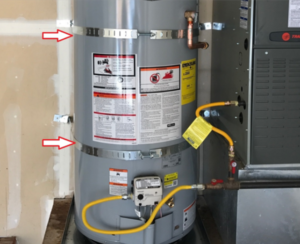
rental property maintenance plumbing and water heater secured with straps in earthquake prone areas of the country

3 Common Plumbing Emergencies In Rental Properties And What To Do

Rental Property Maintenance: 6 Items to Troubleshoot in Your Crawl Spaces

How to Waterproof Your Basement</

Part 2 – Rental Property Maintenance: Security, Pest Control, & Exteriors

Photo credit Liudmila Chernetska via istockphoto.com