

Behind every application is a leasing team trying to make the right call, quickly and with confidence while dealing with fraud tactics, verification and changing tenant applicant behavior.
This report looks at how fraud tactics, verification patterns, and applicant behavior shifted across multifamily communities in the third quarter, and what that means for the decisions your team makes going forward.
Snappt’s third quarter 2026 report finds that rental application fraud remains a significant operational risk, even as detected document alterations declined.
“Behind every application is a leasing team trying to make the right call, and in Q3, that call got harder. The fraud we saw was organized and built to look legitimate, and the strongest protection came from verifying beyond documents alone—even as many applicants still prefer to upload them. That’s the balance VerifyMyWay is built for, letting applicants verify in the way that works for them while giving your team the confidence to approve,” the report says.
Across 533,833 applicants and 583,880 submissions, the company reported a 3.27% average fraud rate, identifying 19,083 edited submissions. Applicant and submission volumes increased 34% from a year earlier, while edited submissions fell 8%.
Tenant Application Document Upload Is An Issue
The report says keeping the option to upload documents is critical to maintaining occupancy and getting good residents. When document upload is turned off, roughly half of qualified applicants may abandon the application. Some push through the friction, but many will apply to other communities where the process better fits their needs. A process that shuts out nearly half the applicant pool may limit fraud exposure, but it also reduces leads, tours, and signed leases.
A closer read shows fraud follows fraud tactics follow the path of least resistance, and applicants who intend to submit altered documents have learned which communities verify.
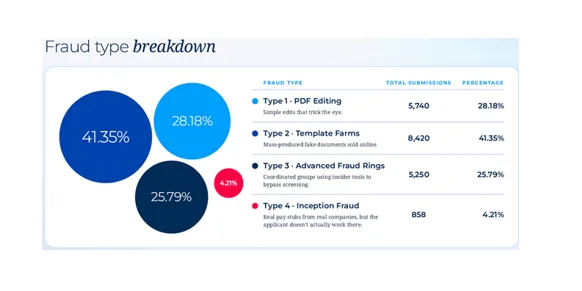
The report portrays fraud as increasingly organized. Template farms producing counterfeit documents accounted for approximately 41% of classified fraud, followed by basic PDF editing and advanced fraud rings. Paystubs represented 69% of edited documents, compared with 24% for bank statements, making employment income documentation a central screening vulnerability.
Among larger metropolitan markets, Atlanta recorded the highest percentage of rental applications that contained altered, manipulated, or falsified financial documents at 4.50%, followed by Houston at 4.38% and Las Vegas at 4.03%. Smaller markets also showed increases: Columbia, South Carolina, reached 4.16%; Port St. Lucie reached 4.08%; and Kansas City rose to 3.14%.
Verification methods produced sharply different results. Submissions relying exclusively on uploaded documents had a 4.67% edited rate, versus 0.07% for connected verification. However, document uploads remained the most common approach, representing 60.2% of submissions. Snappt argues that preserving applicant choice can help operators maintain leasing activity while strengthening screening.
Offer letters and rental histories provide additional opportunities to identify risk. Employer checks flagged 134 altered offer letters, while rental verification uncovered approximately $5.96 million in outstanding balances. The report also emphasizes that verified payment histories can support approval of otherwise qualified applicants whose credit scores are weaker.
For rental housing operators, the principal takeaway is to combine document authentication, direct source verification, employer confirmation, and rental history checks. Findings should be interpreted as results from Snappt’s customer base, rather than a nationwide prevalence estimate.