
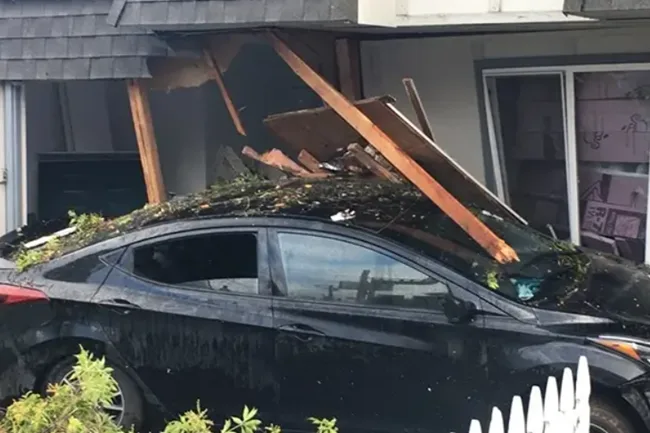
Cars and trucks end up going through apartment building walls more often than you think and it is a loss owners do not plan for and then there are floods.
By Aaron Kirk Douglas
Ask an apartment owner to list the risks they worry about and you will hear fire, water, mold and asbestos. Vehicles hitting buildings rarely makes the list. It should.
Matthew Steimle, general manager of Kennedy Restoration, and Tysen Bodewig, the company’s marketing director, were interviewed recently on Multifamily Marketwatch about losses that fall outside the standard checklist.
Auto impacts happen more than owners expect
When we asked how often a vehicle ends up inside an apartment building, Steimle’s answer was that it happens more often than you think. His team had responded to one the week before.
Three scenarios cover most of them.
The first is a parking event. A driver, often an older one, confuses the gas pedal for the brake. The car jumps a curb and ends up inside a leasing office or a ground-floor unit. Nobody is seriously hurt and the damage stays contained.
The second involves alcohol and speed, and it is a different category entirely. Steimle asked listeners to picture what a 3,500-pound truck traveling 40 mph does to the side of a building.
The third is collateral damage. Two vehicles collide at an intersection, one glances off and a building that had nothing to do with the crash absorbs the impact.
The first question is structural
The response sequence starts with people. Once everyone is accounted for, the question becomes whether the building is safe.
If a vehicle has gone through the exterior wall of a two-story building, Steimle said, the immediate question is what is holding up the second story. How wide is the opening. How violent was the impact.
Shoring comes before rebuilding. Only after the structure is stable does the crew work on the envelope, either to let a unit be occupied again or to secure a vacant one against intruders while a longer repair runs.
Kennedy keeps electricians, plumbers and structural engineers available on short notice. Engineers get involved for more than safety. On a three-story building or a tower, or anywhere a steel column is affected, an engineer looking over the crew’s shoulder protects everyone and satisfies the building department, which is often notified early and may require permits.
The 10 p.m. flood and the contents problem
A different problem shows up in water losses.
The apartment and the tenant’s belongings are usually owned by two different parties. Often they are insured by two different carriers. Sometimes the contents are not insured at all because the tenant carries no renters coverage.
That matters at 10 p.m. with 10 inches of water on the floor, because contents are frequently in the way of extraction. Steimle said the crew will not touch them without permission from on-site management. The billing gets sorted afterward. The authorization has to happen first.
The practical implication is a staffing question more than a restoration question. Site managers need to know in advance that they can authorize moving a couch or a table in the middle of the night. Waiting until morning is not a neutral choice. Bodewig noted that when a tenant is away and the unit sits wet, secondary damage begins immediately and mold starts within hours.

Specialty contents
Owners tend to think of contents as furniture. Restoration crews find otherwise.
Steimle described walking into a unit filled with signed presidential photographs. A Treasury Department certificate on the wall answered his question before he asked it. The man had been Secret Service.
Bodewig’s version involved a tenant with an Emmy award who wanted assurance he would get it back. Steimle once found an MTV Video Music Award on a shelf.
Art, antiques, pianos, grandfather clocks, weapons and tapestries all turn up. Kennedy handles some in-house and calls specialists for the rest, including contacts at the Portland Art Museum. Steimle put it as knowing when to hand off to specialized experts and when the work is within the crew’s wheelhouse.
What owners can do before the loss
Nothing in either conversation required a restoration contractor to act on. The useful steps all happen beforehand.
- Confirm your leases require renters’ insurance and that you enforce it. Uninsured contents slow every water loss and shift cost and liability toward the owner.
- Give site staff written authority to approve emergency work and contents handling without waiting on a regional manager.
- Establish a relationship with a restoration vendor before you need one, so the first call at 10 p.m. is not also the first conversation.
- Look at bollards, curbing and landscaping near leasing offices and ground-floor units that face parking. It is a small capital item measured against rebuilding a wall.
The pattern across both conversations is the same. The expensive part of these losses is rarely repair. It is the hours lost while somebody figures out who has authority to say yes.
About the author:

HFO Research (Aaron Kirk Douglas) from HFO Investment Real Estate’s Multifamily Marketwatch YouTube podcast, hosted by partner Greg Frick. Aaron Kirk Douglas is director of market intelligence for HFO Investment Real Estate In Portland.