

The most dangerous leasing signal word when reviewing your leasing performance is “fine.” It can show up when occupancy reads high, the lead count looks full, and the risk that should worry you is a quarter away, Apartment List writes in a new report.
“We’re still like 97, 98% occupied,” an operator told us on a recent call, before adding that the property usually runs at 99.5%. He was more than a point under his own baseline, and the headline number told him nothing about what it may have cost to preserve it. Occupancy can look stable while loss to lease is already doing the damage underneath.
The damage works on a delay. By the time occupancy slips, the demand that set it is months gone. The same blind spot can hide under a healthy lead count and a market lifting with the season.
When the pipeline softens, occupancy might hold a bit longer, and then you’ll pay the difference later in rent cuts to fill the unit.
4 Ways “Fine” Can Hide a Softening Leasing Pipeline
The four reasons “fine” is the most dangerous leasing signal word and can sound credible while the leasing pipeline thins beneath it:
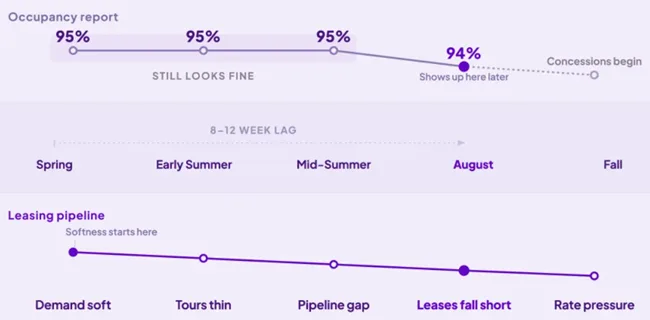
- Occupancy slips last. A soft pipeline can run 8 to 12 weeks before the number budges. By the time it drops, the cause is already old.
- Seasonal lift disguises softness. Peak season hands nearly every property a bump. That bump is not proof you’re doing something right.
- Your own baseline is the first read. A one-point drop below your historical norm matters even when the absolute number still looks high.
- Missed softness compounds. A quiet stretch you let pass resurfaces as concessions, weak renewal conversations, and lost pricing power you can’t buy back.
Why Direction Matters More Than the Occupancy Snapshot Alone
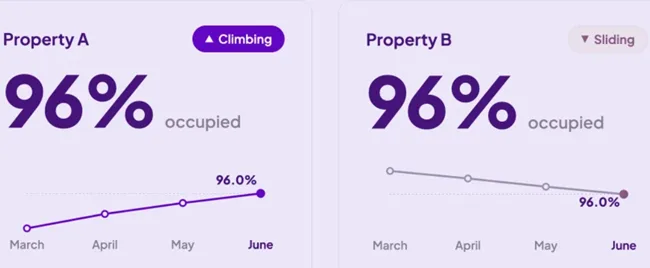
Picture two properties at 96% occupied. One climbed there and is still climbing. The other is on its way down. On a monthly report, they look identical, because a single occupancy reading never shows the trend. The number worth watching is your own direction over time. History is what gives the percentage its meaning.
Before you call 96, 97, or 98% occupancy “fine,” check whether the number is improving, holding, or quietly sliding against the demand you should be capturing now.
Occupancy Slips After the Leasing Pipeline Has Already Softened
Occupancy reports the truth late. By the time a signed lease changes the number, the demand behind it has already spent weeks moving from inquiry to tour to lease.
A unit you list today takes about 30 days to lease right now, the slowest any May has been since 2019. That is a national average, and your market could run faster or slower, though the funnel works the same everywhere. Before that lease, someone toured. Before that tour, they inquired.
You, or someone on your team, runs that sequence every day. The damage is in the lag stacked between each step, weeks at a time. When inquiries thin out, you won’t see it in tours for weeks, and those softer numbers take weeks more to show up as fewer signed leases. Only then does occupancy move.
How a Soft Spring Turns into a Weak Fall
These figures are idealized, built to show how the lag moves rather than to set an occupancy target. Your own numbers will likely be messier, and your strong and soft seasons may land on a different calendar than this one.
The operating risk remains. Soft demand impacts occupancy after the easiest weeks to correct it have already passed.
“Fine” Turns A Demand Problem Into A Timing Problem
None of this required teaching you the basics. You already know occupancy lags, a full lead count can hide softness, and seasonal lift reaches every property. The costly part is how easy it is to know all of that and still let the quarter keep moving.
That is what “fine” does and why it is the most dangerous leasing signal. It turns a demand problem into a timing problem. The team waits for more proof, the report stays clean for a few more weeks, and the first real decision shows up later than it should. By then, the cheapest moves are usually gone. Follow-up is already late, exposure is already thin, and pricing starts carrying the weight.
Apartment List gives operators more room to move before that happens. We put communities in front of move-ready renters already searching the market, keep more of that demand engaged with always-on leasing AI, and tie spend to signed leases instead of raw lead volume. That gives teams a better chance to remain competitive before “fine” becomes a concession conversation.
Read the full report here.