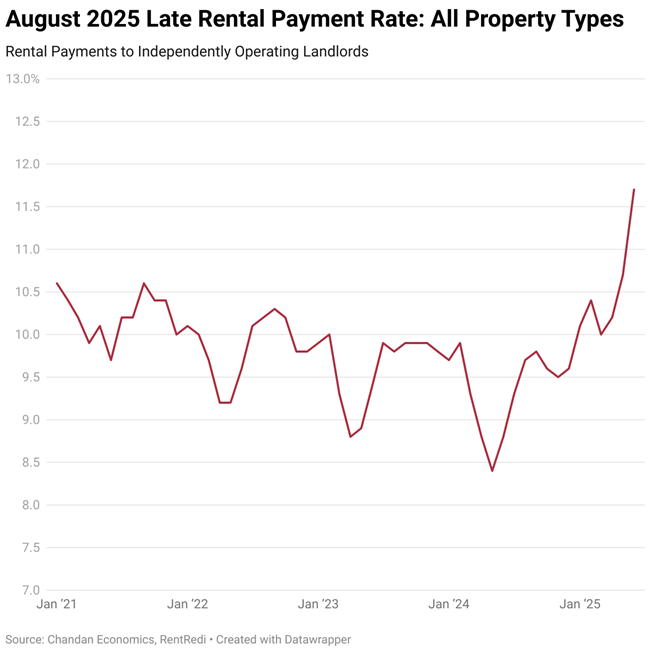
On-time rent payments by apartment renters have been on the decline since April 2023, illustrating the financial strains facing many renter households as late rent payments climb and U.S. economic growth slows, according to a new report from Chandan Economics powered by RentRedi data.
While August 2025 payments showed some improvement, on-time rent payments are down substantially from a year ago.
Highlights of the late-rent-payments report:
- On-time rent payments have declined steadily since April 2023, reflecting mounting financial stress on renters.
- Full rent collections remain steadier, but more renters are paying late—late payments in independently owned rentals rose from 8.8% in mid-2024 to 11.7% in June 2025.
- Seasonal patterns are shifting: Typically, late payments ease in spring tax-refund season, but not this year—suggesting deeper cash flow misalignment.
- Slower wage growth and rising debt burdens are pressuring renters, though stable employment has helped many eventually catch up.
- Looking ahead, household debt and interest payments pose the biggest risks to renters’ ability to stay current.
“The growing share of apartment renters playing catch-up on their monthly bills may speak to a broader undercurrent of distress,” the report says.
“The seasonality of late rent payments in recent years suggests that renters in mom-and-pop properties are sensitive to modest changes in monthly cashflow.
“Late-rent-payments have tended to drop off in the spring, lining up with when most households receive their tax refunds. However, a sustained recent surge in late rent payments this year without the normal springtime improvement may indicate a structural misalignment of household cash flows, with a growing share of tenants relying on mid-month income to pay off overdue rent,” the report says.
Compared to the early pandemic years, the income constraints felt by renters today are not as acute — nor are they as destabilizing to landlord incomes. Although wages have slowed, layoffs are not accelerating significantly, helping explain why many renters are eventually meeting their rent obligations even if it’s taking longer to get there.
“Looking ahead, rising household debt and interest payments pose the most obvious risk to renters’ ability to keep up,” the report says.